

Effects of bariatric surgery in Chinese with obesity and type 2 diabetes mellitus: A 3-year follow-up
Open accessThe DOI matches its Crossref record; 42 of the 42 references it cites were found in a registry or an index.
Abstract
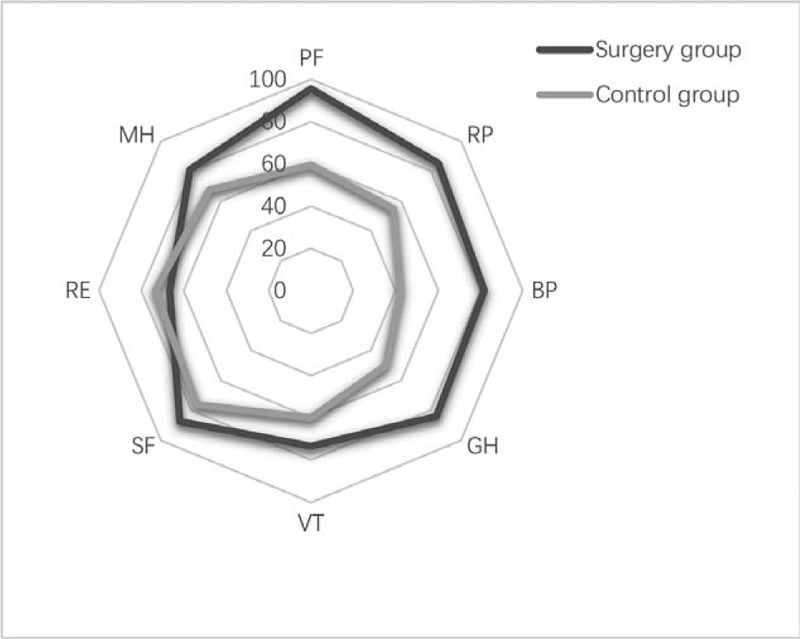
The incidence of obesity and type 2 diabetes mellitus is growing, and bariatric surgery was applied as a new therapy in the past few decades. However, bariatric surgery started rather late in China, and the number of surgeries and the follow-up data is limited. We assessed body weight, glucose, lipid levels, and blood pressure at baseline and 6-month, 1-year, 3-year in patients who underwent bariatric surgery. Vitamins and trace elements were investigated at 3-year after surgery. The quality of life was assessed at 3-year and compared with the control group. In total 20 patients were recruited in the study, and all the 20 patients underwent surgery and completed all follow-ups. Results showed that the body weight, body mass index, glycated hemoglobin (HbA1C), glucose, and insulin level were decreased, and islet function improved significantly in 6-month and 1-year (P < .001), and the changes were more obvious in the first 6 months. However, all the indexes rebound significantly at the 3-year (P < .05), but still better than baseline (P < .05). Weight regain was 50% after 3 years, and the mean weight regain rate was 31.45%. Besides, blood pressure and lipid levels decreased significantly compared with baseline (P < .001). At the 3-year follow-up, we found that 100% of the patients showed vitamin D deficiency, 50% calcium deficiency, 20% vitamin B12 deficiency, 20% iron deficiency, and 15% suffered from anemia. Compared with the control group, the quality of life was better in patients who underwent surgery, especially in the physical health (P < .05). The current study showed that the body weight, glucose and islet function improved significantly after bariatric surgery, and the indexes changed mainly in the first 6 months, but there seemed to be a rebound after 3 years. Furthermore, the surgery may improve the blood pressure, lipid profile, and the quality of life. However, some patients may suffer anemia, calcium deficiency, iron deficiency, vitamin D, and vitamin B12 deficiency after 3 years.
Overview
The claims and statistics of this paper haven’t been checked yet.
Free: it reads the open-access text and checks the first 5 claims that cite a source we can check. Create a free account to check every claim.
Integrity signals
Registry
Cites
Statistics
Figures
Verification
Claims the paper makes
The claims and statistics of this paper haven’t been checked yet.
Free: it reads the open-access text and checks the first 5 claims that cite a source we can check. Create a free account to check every claim.
Claims other papers make about this one
Each is checked against this paper’s own text: does it say what the citing paper says it does?
In the citing paper
“Bariatric surgery in obese persons and individuals with Type 2 Diabetes (T2D) may cause ID [27].”
From Iron Deficiency in Obesity and after Bariatric Surgery (2021) · cites this paper as [27]
Self-check
Percentages, sums and reported differences re-computed from the paper’s own numbers.
The self-check needs the paper’s full text.
Citations
Cites
Prevalence of Diabetes among Men and Women in China
Yang, W., Lu, J., Weng, J., Jia, W., Ji, L., Xiao, J., Shan, Z., Liu, J., Tian, H., Ji, Q., et al. (2010) · New England Journal of Medicine · doi:10.1056/nejmoa0908292 · Cited by 3,031 · cited 1×
“4 million adults in China with diabetes.([5]) The most recent national survey in 2010 reported that the incidence of diabetes has increased to 11.”
BackgroundBariatric Surgery versus Intensive Medical Therapy for Diabetes — 5-Year Outcomes
Schauer, P. R., Bhatt, D. L., Kirwan, J. P., Wolski, K., Aminian, A., Brethauer, S. A., Navaneethan, S. D., Singh, R. P., Pothier, C. E., Nissen, S. E., et al. (2017) · New England Journal of Medicine · doi:10.1056/nejmoa1600869 · Cited by 2,934 · cited 1×
“According to previous studies,([7,21,22]) the efficiency of bariatric surgery is better than lifestyle interventions and medications, which is consistent with the conclusions of this study.”
ResultPrevalence and Control of Diabetes in Chinese Adults
Xu, Y. (2013) · JAMA · doi:10.1001/jama.2013.168118 · Cited by 2,703 · cited 2×
“As a result, the incidence of obesity and type 2 diabetes mellitus (T2DM) has increased significantly, but the awareness rate, diagnosis rate, and adequate control rate are relatively low.([1]) In China, the prevalence of diabetes was 0.”
BackgroundEpidemic obesity and type 2 diabetes in Asia
Yoon, K.-H., Lee, J.-H., Kim, J.-W., Cho, J. H., Choi, Y.-H., Ko, S.-H., Zimmet, P., & Son, H.-Y. (2006) · The Lancet · doi:10.1016/s0140-6736(06)69703-1 · Cited by 1,580 · cited 1×
“It should be noted that Asians may have higher risk of cardiovascular diseases and metabolic disorders since the higher visceral fat content in the body,([14,15]) and previous studies have shown that surgery is also effective for patients with BMI 25 to 27.”
BackgroundBariatric Surgery Worldwide 2013
Angrisani, L., Santonicola, A., Iovino, P., Formisano, G., Buchwald, H., & Scopinaro, N. (2015) · Obesity Surgery · doi:10.1007/s11695-015-1657-z · Cited by 1,491
Peterli, R., Wölnerhanssen, B. K., Peters, T., Vetter, D., Kröll, D., Borbély, Y., Schultes, B., Beglinger, C., Drewe, J., Schiesser, M., et al. (2018) · JAMA · doi:10.1001/jama.2017.20897 · Cited by 1,267
IFSO Worldwide Survey 2016: Primary, Endoluminal, and Revisional Procedures
Angrisani, L., Santonicola, A., Iovino, P., Vitiello, A., Higa, K., Himpens, J., Buchwald, H., & Scopinaro, N. (2018) · Obesity Surgery · doi:10.1007/s11695-018-3450-2 · Cited by 1,032 · cited 1×
“In the past, RYGB was the most recorded operation,([25,26]) but RYGB removed most of the stomach and small intestines, which affected the absorption of vitamins and minerals.”
BackgroundSalminen, P., Helmiö, M., Ovaska, J., Juuti, A., Leivonen, M., Peromaa-Haavisto, P., Hurme, S., Soinio, M., Nuutila, P., & Victorzon, M. (2018) · JAMA · doi:10.1001/jama.2017.20313 · Cited by 946 · cited 1×
“Contrarily, due to SG is technically simpler and has fewer gastrointestinal anatomy alterations and perioperative complications, the number of SG is increasing greatly in the recent years.([28,29]) Previous studies had found that there were no statistically significant differences between SG and RYGB in weight loss, T…”
ResultWelbourn, R., Hollyman, M., Kinsman, R., Dixon, J., Liem, R., Ottosson, J., Ramos, A., Våge, V., Al-Sabah, S., Brown, W., et al. (2019) · Obesity Surgery · doi:10.1007/s11695-018-3593-1 · Cited by 824
Health benefits of gastric bypass surgery after 6 years
Adams, T. D., Davidson, L. E., Litwin, S. E., Kolotkin, R. L., LaMonte, M. J., Pendleton, R. C., Strong, M. B., Vinik, R., Wanner, N. A., Hopkins, P. N., et al. (2012) · JAMA · doi:10.1001/2012.jama.11164 · Cited by 674
Welbourn, R., Pournaras, D. J., Dixon, J., Higa, K., Kinsman, R., Ottosson, J., Ramos, A., van Wagensveld, B., Walton, P., Weiner, R., et al. (2018) · Obesity Surgery · doi:10.1007/s11695-017-2845-9 · Cited by 555
Prevalence of Diabetes and Its Risk Factors in China, 1994
Pan, X.-R., Yang, W.-Y., Li, G.-W., Liu, J., & National Diabetes Prevention and Control Cooperative Group (1997) · Diabetes Care · doi:10.2337/diacare.20.11.1664 · Cited by 491
for the InterASIA Collaborative Group, Gu, D., Reynolds, K., Duan, X., Xin, X., Chen, J., Wu, X., Mo, J., Whelton, P. K., & He, J. (2003) · Diabetologia · doi:10.1007/s00125-003-1167-8 · Cited by 404 · cited 1×
“5%).([4]) In 2007, the prevalence of diabetes was 9.”
BackgroundPrevalence of Diabetes among Men and Women in China
(2010) · New England Journal of Medicine · doi:10.1056/nejmc1004671 · Cited by 277
Self-citationComparison of Surgical and Medical Therapy for Type 2 Diabetes in Severely Obese Adolescents
Inge, T. H., Laffel, L. M., Jenkins, T. M., Marcus, M. D., Leibel, N. I., Brandt, M. L., Haymond, M., Urbina, E. M., Dolan, L. M., Zeitler, P. S., et al. (2018) · JAMA Pediatrics · doi:10.1001/jamapediatrics.2017.5763 · Cited by 189 · cited 1×
“According to previous studies,([7,21,22]) the efficiency of bariatric surgery is better than lifestyle interventions and medications, which is consistent with the conclusions of this study.”
ResultPanunzi, S., De Gaetano, A., Carnicelli, A., & Mingrone, G. (2015) · Annals of Surgery · doi:10.1097/sla.0000000000000863 · Cited by 185
Simonson, D. C., Halperin, F., Foster, K., Vernon, A., & Goldfine, A. B. (2018) · Diabetes Care · doi:10.2337/dc17-0487 · Cited by 136
for the Indian Bariatric Surgery Outcome Reporting (IBSOR) Group, Baig, S. J., Priya, P., Mahawar, K. K., & Shah, S. (2019) · Obesity Surgery · doi:10.1007/s11695-019-03734-6 · Cited by 127 · cited 1×
“Weight regain was determined based on: 25% increase in lost weight from the first year after operation or weight regain more than 10kg from the weight at 1 year after surgery.([19]) Nutritional assessment of the patients was conducted in 3 years after surgery.”
MethodIgnat, M., Vix, M., Imad, I., D'Urso, A., Perretta, S., Marescaux, J., & Mutter, D. (2017) · Journal of British Surgery · doi:10.1002/bjs.10400 · Cited by 122 · cited 1×
“Previous studies had found that there were no statistically significant differences between SG and RYGB in weight loss, T2DM remission and QoL improvement.([30,31]) In previous studies, the incidence of nutrient deficiencies was different due to different surgical methods, nutrient supplementations, personal complianc…”
ResultMajumder, S., Soriano, J. M., Cruz, A. L., & Dasanu, C. A. (2013) · Surgery for Obesity and Related Diseases · doi:10.1016/j.soard.2013.04.017 · Cited by 120 · cited 2×
“Furthermore, some patients have bacterial overgrowth in the small intestine that leads to vitamin deficiencies after RYGB.([37]) Previous studies showed that vitamin B12 and iron deficiency occurs much more often in RYGB after surgery, which is similarly to our results.”
ResultThereaux, J., Lesuffleur, T., Czernichow, S., Basdevant, A., Msika, S., Nocca, D., Millat, B., & Fagot-Campagna, A. (2019) · The Lancet Diabetes & Endocrinology · doi:10.1016/s2213-8587(19)30191-3 · Cited by 117 · cited 1×
“In this study, patients in the surgical group scored higher than control group, especially in terms of physical functioning, role physical, and general health, which is consistent with previous studies.([40,41]) The possible reasons are as follows: bariatric surgery could reduce body weight, waist circumference, and i…”
ResultAssociations of General and Central Adiposity With Incident Diabetes in Chinese Men and Women
Bragg, F., Tang, K., Guo, Y., Iona, A., Du, H., Holmes, M. V., Bian, Z., Kartsonaki, C., Chen, Y., Yang, L., et al. (2018) · Diabetes Care · doi:10.2337/dc17-1852 · Cited by 104 · cited 1×
“It should be noted that Asians may have higher risk of cardiovascular diseases and metabolic disorders since the higher visceral fat content in the body,([14,15]) and previous studies have shown that surgery is also effective for patients with BMI 25 to 27.”
BackgroundYan, Y., Sha, Y., Yao, G., Wang, S., Kong, F., Liu, H., Zhang, G., Zhang, H., Hu, C., & Zhang, X. (2016) · Medicine · doi:10.1097/md.0000000000003462 · Cited by 94
Mechanisms of long-term weight regain in patients undergoing sleeve gastrectomy
Alvarez, V., Carrasco, F., Cuevas, A., Valenzuela, B., Muñoz, G., Ghiardo, D., Burr, M., Lehmann, Y., Leiva, M. J., Berry, M., et al. (2016) · Nutrition · doi:10.1016/j.nut.2015.08.023 · Cited by 89 · cited 1×
“regained weight after surgery had poor diet quality, characterized by excessive intake of calories, snacks, sweets, fatty foods, and higher intake of high glycemic index carbohydrates.([24]) Therefore, physicians should provide more educations and supervisions, emphasizing the importance of lifestyle interventions suc…”
BackgroundLong-term nutritional impact of sleeve gastrectomy
Caron, M., Hould, F. S., Lescelleur, O., Marceau, S., Lebel, S., Julien, F., Simard, S., & Biertho, L. D. (2017) · Surgery for Obesity and Related Diseases · doi:10.1016/j.soard.2017.07.019 · Cited by 85
Jirapinyo, P., Abu Dayyeh, B. K., & Thompson, C. C. (2017) · BMJ Open Gastroenterology · doi:10.1136/bmjgast-2017-000153 · Cited by 74
Antoniewicz, A., Kalinowski, P., Kotulecka, K. J., Kocoń, P., Paluszkiewicz, R., Remiszewski, P., & Zieniewicz, K. (2019) · Obesity Surgery · doi:10.1007/s11695-019-03985-3 · Cited by 71 · cited 1×
“Previous studies showed that vitamin B12 and iron deficiency occurs much more often in RYGB after surgery, which is similarly to our results.([27,38]) Nutrient deficiencies were common in obesity or T2DM patients, so nutrition assessment and malnutrition treatment are necessary before operation.”
ResultSarwer, D. B., Wadden, T. A., Spitzer, J. C., Mitchell, J. E., Lancaster, K., Courcoulas, A., Gourash, W., Rosen, R. C., & Christian, N. J. (2018) · Obesity Surgery · doi:10.1007/s11695-017-3025-7 · Cited by 71 · cited 1×
“In this study, patients in the surgical group scored higher than control group, especially in terms of physical functioning, role physical, and general health, which is consistent with previous studies.([40,41]) The possible reasons are as follows: bariatric surgery could reduce body weight, waist circumference, and i…”
ResultGlobal obesity research trends during 1999 to 2017: A bibliometric analysis
Zhao, N., Tao, K., Wang, G., & Xia, Z. (2019) · Medicine · doi:10.1097/md.0000000000014132 · Cited by 68 · cited 1×
“Obesity has been a field of intense research in the last decades.([20]) Development of bariatric surgery in China is rather late and limited, especially in the northeast region.”
BackgroundSelf-citationImprovement in quality of life after bariatric surgery: sleeve versus bypass
Versteegden, D. P. A., himbeeck, M. J. J. V., & Nienhuijs, S. W. (2017) · Surgery for Obesity and Related Diseases · doi:10.1016/j.soard.2017.10.008 · Cited by 58 · cited 1×
“Various organizations recommended that vitamin D supplement doses of 3000IU/d to 50,000 IU 1 to 3 times per week are needed.([39]) Additionally, the efficiency of supplementation is different according to patients’ compliance.”
BackgroundBilleter, A. T., Probst, P., Fischer, L., Senft, J. D., Kenngott, H., Schulte, T., Clemens, G., Zech, U., Büchler, M. W., Nawroth, P. P., et al. (2015) · Obesity Surgery · doi:10.1007/s11695-015-1676-9 · Cited by 46
Bailly, L., Schiavo, L., Sebastianelli, L., Fabre, R., Pradier, C., & Iannelli, A. (2018) · Obesity Surgery · doi:10.1007/s11695-018-3143-x · Cited by 45
Hypocalcemia After Bariatric Surgery: Prevalence and Associated Risk Factors
Shah, M., Sharma, A. R., Wermers, R. A., Kennel, K. A., Kellogg, T. A., & Mundi, M. S. (2017) · Obesity Surgery · doi:10.1007/s11695-017-2705-7 · Cited by 44 · cited 1×
“In this study, all patients had vitamin D deficiency, which is much higher than previous studies,([35,36]) and the possible reasons are as follows: stomach and small intestines are the main area that absorbs vitamin D and calcium; lipid malabsorption leads to the lack of fat-soluble vitamins; northeastern people have…”
ResultLiang, H., Wei, G., Yanling, Y., Zhongqi, M., Yijun, M., Liu, H., & Yi, M. (2015) · Journal of Biomedical Research · doi:10.7555/jbr.29.20140109 · Cited by 27
Patients at risk for trace element deficiencies: Bariatric surgery
FREELAND-GRAVES, J. H., Lee, J., Mousa, T. Y., & Elizondo, J. J. (2014) · Journal of Trace Elements in Medicine and Biology · doi:10.1016/j.jtemb.2014.06.015 · Cited by 24
Li, L., Yu, H., Liang, J., Guo, Y., Peng, S., Luo, Y., & Wang, J. (2019) · Medicine · doi:10.1097/md.0000000000014735 · Cited by 23
Mihmanlı, M., Işıl, R. G., Işıl, C. T., Ömeroğlu, S., Sayın, P., Oba, S., Öztürk, F. Y., & Altuntaş, Y. (2017) · Obesity Surgery · doi:10.1007/s11695-017-2747-x · Cited by 22
Quality of life after bariatric surgery
Dixon, J. B., & Blazeby, J. M. (2014) · The Lancet Diabetes & Endocrinology · doi:10.1016/s2213-8587(14)70021-x · Cited by 21
Improved and more effective algorithms to screen for nutrient deficiencies after bariatric surgery
Bazuin, I., Pouwels, S., Houterman, S., Nienhuijs, S. W., Smulders, J. F., & Boer, A. (2016) · European Journal of Clinical Nutrition · doi:10.1038/ejcn.2016.254 · Cited by 16
Pak, J., Kwon, Y., Menzo, E. L., Park, S. S., Szomstein, S., & Rosenthal, R. J. (2014) · Surgery for Obesity and Related Diseases · doi:10.1016/j.soard.2014.12.008 · Cited by 12
Khiyani, N., Tülchinsky, M., Hava, S., Ho, T. A., & Dadparvar, S. (2019) · Medicine · doi:10.1097/md.0000000000017205 · Cited by 3
Research works printed but not linked: 1
- 29. Salminen P, Helmiö M, Ovaska J, et al. Effect of laparoscopic sleeve gastrectomy vs laparoscopic Roux-en-Y gastric bypass on weight loss at 5 years among patients with morbid obesity: the SLEEVEPASS Randomized Clinical Trial. JAMA 2018;319:241–54. · DOI · Paper page
Cited by
Iron Deficiency in Obesity and after Bariatric Surgery
Bjørklund, G., Peana, M., Pivina, L., Dosa, A., Aaseth, J., Semenova, Y., Chirumbolo, S., Medici, S., Dadar, M., & Costea, D.-O. (2021) · Biomolecules · doi:10.3390/biom11050613 · Cited by 99
Luca, M. D., Shikora, S. A., Eisenberg, D., Angrisani, L., Parmar, C. D., Alqahtani, A. R., Aminian, A., Aarts, E. O., Brown, W., COHEN, R. V., et al. (2024) · Obesity Surgery · doi:10.1007/s11695-024-07370-7 · Cited by 91
Luca, M. D., Shikora, S. A., Eisenberg, D., Angrisani, L., Parmar, C. D., Alqahtani, A. R., Aminian, A., Aarts, E. O., Brown, W. A., COHEN, R. V., et al. (2024) · Surgery for Obesity and Related Diseases · doi:10.1016/j.soard.2024.05.009 · Cited by 70
Factors of Obesity and Metabolically Healthy Obesity in Asia
Mathis, B. J., Tanaka, K., & Hiramatsu, Y. (2022) · Medicina · doi:10.3390/medicina58091271 · Cited by 39
Chinese Guidelines for Medical Nutrition Therapy for Patients with Diabetes (2022 Edition).
(2024) · PubMed Central · doi:10.6133/apjcn.202406_33(2).0001 · Cited by 15
Metadata
- Authors
- Zuo, D., Xiao, X., Yang, S., Gao, Y., Wang, G., & Ning, G.
- Affiliations
- Guizhou University (CN)
- First Hospital of Jilin University (CN)
- Shanghai Jiao Tong University (CN)
- Corresponding author
- Wang, Guixia
- Ning, Guang
- Venue
- Medicine
- Published
- 2020-08-21
- Volume
- 99
- Issue
- 34
- Pages
- e21673
- ISSN
- 0025-7974 (ISSN-L)
- 1536-5964
- PMC
- PMC7447381
- OpenAlex
- W3075981597
- Cited by
- 7
- References
- 42
- Citations by year
- 2024: 3 · 2023: 1 · 2022: 1 · 2021: 2
- FWCI
- 0.91
- Type
- journal article
- Language
- en
- Open access
- gold
- doi.org
- Licence
- Locations
- Medicine (publishedVersion, cc-by-nc)
- PubMed Central (publishedVersion, cc-by-nc)
- PubMed (publishedVersion)
- Funders
- Jilin Scientific and Technological Development Program (20160101126JC)
- Innovative Capability Project of Jilin Province Development and Reform Commission (2017C019)
- Topics
- Health Sciences › Medicine › Surgery › Bariatric Surgery and Outcomes
- Health Sciences › Medicine › Endocrinology, Diabetes and Metabolism › Diabetes, Cardiovascular Risks, and Lipoproteins
- Health Sciences › Medicine › Surgery › Minimally Invasive Surgical Techniques
- Keywords
- bariatric surgery, obesity, type 2 diabetes, weight regain, HbA1c, insulin, islet function, blood pressure, lipid profile, vitamin D deficiency, calcium deficiency, vitamin B12 deficiency, iron deficiency, anemia, quality of life, Chinese patients
- MeSH terms
- Adult, Diabetes Mellitus, Type 2, Female, Follow-Up Studies, Humans, Male, Middle Aged, Obesity, Morbid, Time Factors, Treatment Outcome, Asian People, Bariatric Surgery
About these checks
Registry, retraction, Cites and statistics results are computed, not judged, with one exception: a printed reference that no index lists is read once by a model before it counts as a citation error. Claims are extracted by a model and kept only when their quote appears verbatim in the text; each cited source is then checked, with a model’s help, for whether it says what the claim relies on. Those verdicts can be wrong — read the claim’s quote and the cited source before relying on one.
Statistics and arithmetic are recomputed, not judged.
Confidence bands are shown only for fields calibrated on our annotated test set. None is calibrated yet, so no band is shown.
What counts as a claim ›How we measure confidence ›How we check this ›
Are you an author, or do you see a problem with this page? Request a review
Data sources
Bibliographic data: Semantic Scholar, OpenAlex, Crossref.
Contains information from the Semantic Scholar Academic Graph Datasets, made available under the ODC Attribution License (ODC-BY 1.0).
Semantic Scholar’s data is described in: Kinney, R., et al. (2023). The Semantic Scholar Open Data Platform. arXiv:2301.10140.
