

The DOI matches its Crossref record; 1 of the 1 references it cites were found in a registry or an index.
A Peer-Led, Artificial Intelligence–Augmented Social Network Intervention to Prevent HIV Among Youth Experiencing Homelessness
Abstract
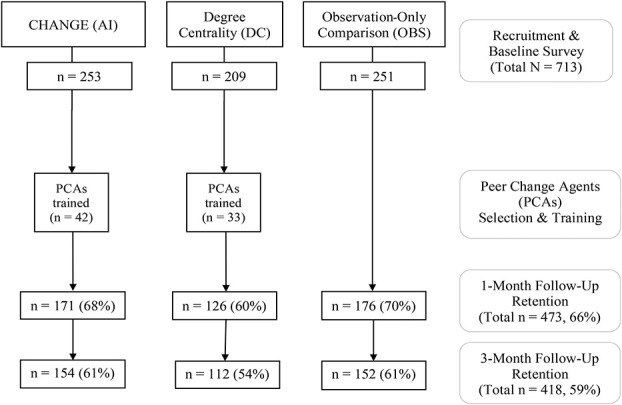
Background: Youth experiencing homelessness (YEH) are at elevated risk of HIV/AIDS and disproportionately identify as racial, ethnic, sexual, and gender minorities. We developed a new peer change agent (PCA) HIV prevention intervention with 3 arms: (1) an arm using an artificial intelligence (AI) planning algorithm to select PCAs; (2) a popularity arm, the standard PCA approach, operationalized as highest degree centrality (DC); and (3) an observation-only comparison group. Setting: A total of 713 YEH were recruited from 3 drop-in centers in Los Angeles, CA. Methods: Youth consented and completed a baseline survey that collected self-reported data on HIV knowledge, condom use, and social network information. A quasi-experimental pretest/posttest design was used; 472 youth (66.5% retention at 1 month postbaseline) and 415 youth (58.5% retention at 3 months postbaseline) completed follow-up. In each intervention arm (AI and DC), 20% of youth was selected as PCAs and attended a 4-hour initial training, followed by 7 weeks of half-hour follow-up sessions. Youth disseminated messages promoting HIV knowledge and condom use. Results: Using generalized estimating equation models, there was a significant reduction over time (P < 0.001) and a significant time by AI arm interaction (P < 0.001) for condomless anal sex act. There was a significant increase in HIV knowledge over time among PCAs in DC and AI arms. Conclusions: PCA models that promote HIV knowledge and condom use are efficacious for YEH. Youth are able to serve as a bridge between interventionists and their community. Interventionists should consider working with computer scientists to solve implementation problems.
Overview
The claims and statistics of this paper haven’t been checked yet.
Run the check — free, no account needed. It reads the open-access text and checks the sources it cites.
Integrity signals
Registry
Cites
Statistics
Figures
Verification
Claims the paper makes
The claims and statistics of this paper haven’t been checked yet.
Run the check — free, no account needed. It reads the open-access text and checks the sources it cites.
Claims other papers make about this one
Each is checked against this paper’s own text: does it say what the citing paper says it does?
The source backs part of the claim, not all of it — or backs it for a different population, condition or comparison.
In the citing paper
“The relevance of this finding to the present review is indirect (the sample was neither adolescent nor predominantly LGBTQ+) and the outcome was sexual behavior rather than mental health”
From Artificial intelligence and immersive technologies for LGBTQ+ youth: a narrative review (2026) · cites this paper as Rice et al. (2021)
Experimental — accuracy not yet measuredIn the citing paper
“Rice et al. (2021) demonstrated in a quasiexperimental study with 713 youth experiencing homelessness in Los Angeles (mean age 22.0 years), of whom 20-40% identified as sexual or gender minorities, that an AI planning algorithm for selecting peer change agents produced significantly greater reductions in condomless anal sex compared to standard popularity-based peer selection.”
From Artificial intelligence and immersive technologies for LGBTQ+ youth: a narrative review (2026) · cites this paper as Rice et al. (2021)
Self-check
Percentages, sums and reported differences re-computed from the paper’s own numbers.
The self-check needs the paper’s full text.
Citations
Cites
Implementing Machine Learning in Health Care — Addressing Ethical Challenges
Char, D. S., Shah, N. H., & Magnus, D. (2018) · New England Journal of Medicine · doi:10.1056/nejmp1714229 · Cited by 1,857
Research works printed but not linked: 24
- Morton, 2018, Prevalence and correlates of youth homelessness in the United States, J Adolesc Health, 62, 14, 10.1016/j.jadohealth.2017.10.006 · DOI
- Caccamo, 2017, Narrative review: sexually transmitted diseases and homeless youth-what do we know about sexually transmitted disease prevalence and risk?, Sex Transm Dis, 44, 466, 10.1097/OLQ.0000000000000633 · DOI
- McCann, 2019, Homelessness among youth who identify as LGBTQ+: a systematic review, J Clin Nurs, 28, 2061, 10.1111/jocn.14818 · DOI
- Kelly, 1997, Randomised, controlled, community-level HIV-prevention intervention for sexual-risk behaviour among homosexual men in US cities. Community HIV Prevention Research Collaborative, Lancet, 350, 1500, 10.1016/S0140-6736(97)07439-4 · DOI
- Latkin, 2003, HIV prevention among drug users: outcome of a network-oriented peer outreach intervention, Health Psychol, 22, 332, 10.1037/0278-6133.22.4.332 · DOI
- Schneider, 2021, A pragmatic randomized controlled trial to increase PrEP uptake for HIV prevention: 55-week results from PrEPChicago, J Acquir Immune Defic Syndr, 86, 31, 10.1097/QAI.0000000000002518 · DOI
- Green, 2013, Shared risk: who engages in substance use with American homeless youth?, Addiction, 108, 1618, 10.1111/add.12177 · DOI
- Rice, 2010, Internet use, social networking, and HIV/AIDS risk for homeless adolescents, J Adolesc Health, 47, 610, 10.1016/j.jadohealth.2010.04.016 · DOI
- Rice, 2012, Position-specific HIV risk in a large network of homeless youths, Am J Public Health, 102, 141, 10.2105/AJPH.2011.300295 · DOI
- Valente, 2013, Gender differences in sexual risk and sexually transmitted infections correlate with gender differences in social networks among San Francisco homeless youth, J Adolesc Health, 53, 486, 10.1016/j.jadohealth.2013.05.016 · DOI
- Arnold, 2009, Comparisons of prevention programs for homeless youth, Prev Sci, 10, 76, 10.1007/s11121-008-0119-4 · DOI
- Medley, 2009, Effectiveness of peer education interventions for HIV prevention in developing countries: a systematic review and meta-analysis, AIDS Educ Prev, 21, 181, 10.1521/aeap.2009.21.3.181 · DOI
- 2010, Results of the NIMH collaborative HIV/sexually transmitted disease prevention trial of a community popular opinion leader intervention, J Acquir Immune Defic Syndr, 54, 204, 10.1097/QAI.0b013e3181d61def · DOI
- Kelly, 2004, Popular opinion leaders and HIV prevention peer education: resolving discrepant findings, and implications for the development of effective community programmes, AIDS Care, 16, 139, 10.1080/09540120410001640986 · DOI
- Schneider, 2015, A new HIV prevention network approach: sociometric peer change agent selection, Soc Sci Med, 125, 192, 10.1016/j.socscimed.2013.12.034 · DOI
- Valente, 2007, Identifying opinion leaders to promote behavior change, Health Educ Behav, 34, 881, 10.1177/1090198106297855 · DOI · Paper page
- Rice, 2018, Piloting the use of artificial intelligence to enhance HIV prevention interventions for youth experiencing homelessness, J Soc Soc Work Res, 9, 551, 10.1086/701439 · DOI
- Ahn, 2016, Utility of machine-learning approaches to identify behavioral markers for substance use disorders: impulsivity dimensions as predictors of current cocaine dependence, Front Psychiatry, 7, 34, 10.3389/fpsyt.2016.00034 · DOI
- Verghese, 2018, What this computer needs Is a physician: humanism and artificial intelligence, JAMA, 319, 19, 10.1001/jama.2017.19198 · DOI · Paper page
- Milburn, 2009, Adolescents exiting homelessness over two years: the risk amplification and abatement model, J Res Adolesc, 19, 762, 10.1111/j.1532-7795.2009.00610.x · DOI
- Freeman, 1994, Interpersonal proximity in social and cognitive space, Soc Cognit, 12, 223, 10.1521/soco.1994.12.3.223 · DOI
- Milburn, 2012, Family intervention to reduce sexual risk behavior, substance use, and delinquency among newly homeless youth, J Adolesc Health, 50, 358, 10.1016/j.jadohealth.2011.08.009 · DOI
- Rotheram-Borus, 2003, Reductions in HIV risk among runaway youth, Prev Sci, 4, 173, 10.1023/A:1024697706033 · DOI
- Bender, 2018, Enhancing risk detection among homeless youth: a randomized clinical rrial of a promising pilot intervention, J Interpers Violence, 33, 2945, 10.1177/0886260516633208 · DOI
Cited by
Sorted by citations
Artificial intelligence and immersive technologies for LGBTQ+ youth: a narrative review
Shekarchi, R., Eleuteri, S., Saladino, V., Calaresi, D., Giordano, F., & Prunas, A. (2026) · Frontiers in Psychology · doi:10.3389/fpsyg.2026.2002054
Metadata
- Authors
- Rice, E., Wilder, B., Onasch-Vera, L., DiGuiseppi, G., Petering, R., Hill, C., Yadav, A., Lee, S.-J., & Tambe, M.
- Affiliations
- Suzanne Dworak-Peck School of Social Work and Center for Artificial Intelligence in Society, University of Southern California Los Angeles, CA;
- Center for Research on Computation and Society, John A. Paulson School of Engineering and Applied Sciences, Harvard University Cambridge, MA;
- Lens Co;
- College of Information Sciences and Technology, Pennsylvania State University College Station, TX; and
- Department of Psychiatry and Biobehavioral Sciences, Division of Population Behavioral Health, David Geffen School of Medicine, University of California, Los Angeles Los Angeles, CA.
- Venue
- JAIDS Journal of Acquired Immune Deficiency Syndromes
- Published
- 2021-12-15
- Volume
- 88
- Issue
- S1
- Pages
- S20-S26
- ISSN
- 1525-4135
- PMC
- PMC8579989
- Cited by
- 20
- References
- 1
- Language
- en
About these checks
Registry, retraction, Cites and statistics results are computed, not judged, with one exception: a printed reference that no index lists is read once by a model before it counts as a citation error. Claims are extracted by a model and kept only when their quote appears verbatim in the text; each cited source is then checked, with a model’s help, for whether it says what the claim relies on. Those verdicts can be wrong — read the claim’s quote and the cited source before relying on one.
Statistics and arithmetic are recomputed, not judged.
Confidence bands are shown only for fields calibrated on our annotated test set. None is calibrated yet, so no band is shown.
What counts as a claim ›How we measure confidence ›How we check this ›
Are you an author, or do you see a problem with this page? Request a review
