

Indications and Outcomes in Liver Transplantation in Patients With Primary Sclerosing Cholangitis in Norway
Open accessThe DOI matches its Crossref record; 33 of the 33 references it cites were found in a registry or an index.
Abstract
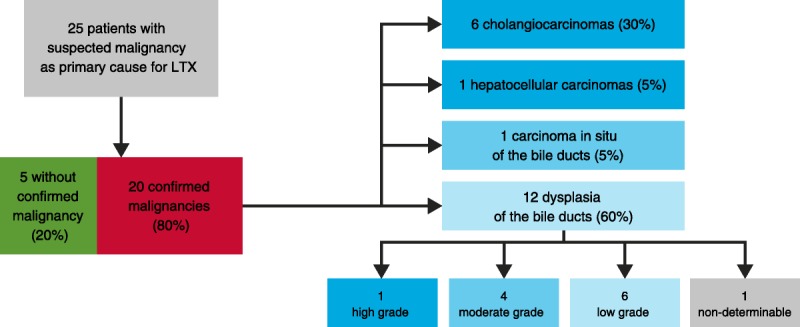
BACKGROUND: Primary sclerosing cholangitis (PSC) is 1 of the leading causes of liver transplantation (LTX) in Scandinavia, and an increasing number of PSC patients have been transplanted in Norway during the last 2 decades. This trend is partly attributable to the recently established practice in Norway of offering LTX to PSC patients with cholangiocellular dysplasia. Based on the controversy associated with this practice, we herein aimed to report the main features and outcomes of our LTX program in PSC. METHODS: The primary indication for LTX (quality of life/end-stage liver disease or suspected neoplasia) was retrospectively determined for 222 patients undergoing LTX for PSC or other autoimmune liver diseases (primary biliary cirrhosis/autoimmune hepatitis) with at least 5 years of follow-up. RESULTS: In PSC patients impaired quality of life (43.5%) and end-stage liver disease (38.4%) were the most frequent indications for LTX, whereas suspected neoplasia accounted for 18.1%. The proportion of PSC patients with manifest encephalopathy, variceal bleeding, or ascites declined over time. In patients with suspected neoplasia as the primary indication for LTX (n = 25), neoplasia was confirmed in the explanted liver in 20 patients (80%). Five-year survival rates for PSC patients transplanted between 2001 and 2009 were 91.9% for patients receiving LTX due to impaired quality of life or end-stage liver disease and 83.3% for suspected neoplasia. CONCLUSIONS: The PSC patients are increasingly listed for LTX at an earlier stage of their liver disease. In patients with suspected neoplasia before LTX, 5-year survival was acceptable, despite confirmation of neoplasia in 80% of the liver explants.
Overview
The claims and statistics of this paper haven’t been checked yet.
Free: it reads the open-access text and checks the first 5 claims that cite a source we can check. Create a free account to check every claim.
Integrity signals
Registry
Cites
Statistics
Figures
Verification
Claims the paper makes
The claims and statistics of this paper haven’t been checked yet.
Free: it reads the open-access text and checks the first 5 claims that cite a source we can check. Create a free account to check every claim.
Claims other papers make about this one
Each is checked against this paper’s own text: does it say what the citing paper says it does?
In the citing paper
“There is a wide variation in practice internationally with 17% of people with PSC transplanted for this indication in Norway 245 while less than 5% of people with PSC are listed for this indication in the UK. 1”
From EASL Clinical Practice Guidelines on sclerosing cholangitis (2022) · cites this paper as [245]
In the citing paper
“Due to the challenges of differentiating early-stage biliary neoplasia from benign bile duct strictures and inflammatory epithelial changes, histology in up to 20% of the liver explants in these individuals may show no signs of neoplasia in real-world settings.245”
From EASL Clinical Practice Guidelines on sclerosing cholangitis (2022) · cites this paper as [245]
Self-check
Percentages, sums and reported differences re-computed from the paper’s own numbers.
The self-check needs the paper’s full text.
Citations
Cites
Diagnosis and Management of Primary Sclerosing Cholangitis
Chapman, R., Fevery, J., Kalloo, A., Nagorney, D. M., Boberg, K. M., Shneider, B., & Gores, G. J. (2010) · Hepatology · doi:10.1002/hep.23294 · Cited by 1,224
Self-citationBoonstra, K., Weersma, R. K., van Erpecum, K. J., Rauws, E. A., Spanier, B. W. M., Poen, A. C., van Nieuwkerk, K. M., Drenth, J. P., Witteman, B. J., Tuynman, H. A., et al. (2013) · Hepatology · doi:10.1002/hep.26565 · Cited by 725 · cited 1×
“No medical therapy has so far proven to delay disease progression,(2) andmore than half of the patients will face an endpoint of liver transplantation (LTX) or death within 12 to 21 years after diagnosis.(3,4) The high lifetime cumulative risk of developing cholangiocarcinoma (10-15%) in PSC further complicates the ti…”
BackgroundHepatic and extrahepatic malignancies in primary sclerosing cholangitis
Bergquist, A., Ekbom, A., Olsson, R., Kornfeldt, D., Lööf, L., Danielsson, Å., Hultcrantz, R., Lindgren, S., Prytz, H., Sandberg-Gertzén, H., et al. (2002) · Journal of Hepatology · doi:10.1016/s0168-8278(01)00288-4 · Cited by 717 · cited 1×
“The high lifetime cumulative risk of developing cholangiocarcinoma (10-15%) in PSC further complicates the timing of LTX and accounts for death in almost half of the cases.(5) The etiology of PSC is unknown,(6) but like in primary biliary cirrhosis (PBC)”
BackgroundDarwish Murad, S., Kim, W. R., Harnois, D. M., Douglas, D. D., Burton, J., Kulik, L. M., Botha, J. F., Mezrich, J. D., Chapman, W. C., Schwartz, J. J., et al. (2012) · Gastroenterology · doi:10.1053/j.gastro.2012.04.008 · Cited by 597
Primary sclerosing cholangitis
Hirschfield, G. M., Karlsen, T. H., Lindor, K. D., & Adams, D. H. (2013) · The Lancet · doi:10.1016/s0140-6736(13)60096-3 · Cited by 592
Self-citationDe Vreede, I., Steers, J. L., Burch, P. A., Rosen, C. B., Gunderson, L. L., Haddock, M. G., Burgart, L., & Gores, G. J. (2000) · Liver Transplantation · doi:10.1053/lv.2000.6143 · Cited by 395 · cited 1×
“3% for patients with a primary indication of suspected neoplasia is good and exceeding results after LTX for manifest cholangiocarcinoma after neoadjuvant chemoirradiation and brachytherapy.(29) Manifest cholangiocarcinoma is generally associated with poor post-LTX survival and a contraindication for LTX,(30) also in…”
Brandsæter, B., Isoniemi, H., Broomé, U., Olausson, M., Bäckman, L., Hansen, B., Schrumpf, E., Oksanen, A., Ericzon, B.-G., Höckerstedt, K., et al. (2004) · Journal of Hepatology · doi:10.1016/j.jhep.2004.01.002 · Cited by 201
Self-citationBangarulingam, S. Y., Bjornsson, E., Enders, F., Barr Fritcher, E. G., Gores, G., Halling, K. C., & Lindor, K. D. (2010) · Hepatology · doi:10.1002/hep.23277 · Cited by 173
Diagnostic benefit of biliary brush cytology in cholangiocarcinoma in primary sclerosing cholangitis
Boberg, K. M., Jebsen, P., Clausen, O. P., Foss, A., Aabakken, L., & Schrumpf, E. (2006) · Journal of Hepatology · doi:10.1016/j.jhep.2006.05.010 · Cited by 159 · cited 1×
“The most commonly used method for early cholangiocarcinoma detection in PSC is assessment of brush cytology specimens, obtained at endoscopic retrograde cholangiography by brushing in a region of a suspicious stricture.(11) No prospectively validated screening algorithm for early cholangiocarcinoma detection in PSC ha…”
MethodSelf-citationWeismüller, T. J., Fikatas, P., Schmidt, J., Barreiros, A. P., Otto, G., Beckebaum, S., Paul, A., Scherer, M. N., Schmidt, H. H., Schlitt, H. J., et al. (2011) · Transplant International · doi:10.1111/j.1432-2277.2010.01161.x · Cited by 147 · cited 1×
“However, high MELD scores are also associated with increased perioperative and postoperative mortality, and a decline in survival after clinical implementation of the MELD criteria has been suggested by some authors.(21) We observed favorable survival rates for patients transplanted on the basis of impaired quality of…”
BackgroundKim, R. W., Poterucha, J. J., Wiesner, R. H., LaRusso, N. F., Lindor, K. D., Petz, J., Therneau, T. M., Malinchoc, M., & Dickson, R. E. (1999) · Hepatology · doi:10.1002/hep.510290607 · Cited by 138
Lewis, J. T., Talwalkar, J. A., Rosen, C. B., Smyrk, T. C., & Abraham, S. C. (2010) · American Journal of Surgical Pathology · doi:10.1097/pas.0b013e3181bc96f9 · Cited by 122 · cited 1×
“A strong relationship between bile duct dysplasia and the presence of cholangiocarcinoma has been suggested.(17) In this study, no relationship between disease stage and dysplasia was observed, showing that prognostic models for cirrhosis development in PSC have little relevance in forecasting malignancies.”
BackgroundUpdate on primary sclerosing cholangitis
Karlsen, T. H., & Boberg, K. M. (2013) · Journal of Hepatology · doi:10.1016/j.jhep.2013.03.015 · Cited by 122
Self-citationUpdate on primary sclerosing cholangitis
Karlsen, T. H., Schrumpf, E., & Boberg, K. M. (2010) · Digestive and Liver Disease · doi:10.1016/j.dld.2010.01.011 · Cited by 117
Self-citationNovel insights into autoimmune liver diseases provided by genome-wide association studies
Mells, G. F., Kaser, A., & Karlsen, T. H. (2013) · Journal of Autoimmunity · doi:10.1016/j.jaut.2013.07.004 · Cited by 116 · cited 1×
“Transplantation Di and autoimmune hepatitis (AIH), an autoimmune component likely contributes to disease development.(4,7) PSC is strongly associated with inflammatory bowel disease, predominantly in the form of ulcerative colitis affecting up to 70% to 80% of the PSC patients in Western countries.”
BackgroundSelf-citationRicci, P., Therneau, T. M., Malinchoc, M., Benson, J. T., Petz, J. L., Klintmalm, G. B., Crippin, J. S., Wiesner, R. H., Steers, J. L., Rakela, J., et al. (1997) · Hepatology · doi:10.1002/hep.510250330 · Cited by 105
Biliary dysplasia as a marker of cholangiocarcinoma in primary sclerosing cholangitis
Fleming, K. A., Boberg, K. M., Glaumann, H., Bergquist, A. M., Smith, D., & Clausen, O. P. F. (2001) · Journal of Hepatology · doi:10.1016/s0168-8278(00)00034-9 · Cited by 100
Self-citationFosby, B., Melum, E., Bjøro, K., Bennet, W., Rasmussen, A., Andersen, I. M., Castedal, M., Olausson, M., Wibeck, C., Gotlieb, M., et al. (2015) · Scandinavian Journal of Gastroenterology · doi:10.3109/00365521.2015.1036359 · Cited by 99 · cited 1×
“The Nordic countries have generally had a favorable organ donor situation with short waiting list; and in 2013, the median waiting time for first LTXwas 41 days excluding urgent call listings.(20) This is the reasonwhyMELD scores are currently not used to prioritize patients for LTX in Norway and likely an important f…”
BackgroundSelf-citationBoberg, K. M., Rocca, G., Egeland, T., Bergquist, A., Broomé, U., Caballeria, L., Chapman, R., Hultcrantz, R., Mitchell, S., Pares, A., et al. (2002) · Hepatology · doi:10.1053/jhep.2002.31872 · Cited by 92
Self-citationLiver Transplantation in Primary Sclerosing Cholangitis
Bjøro, K., Brandsæter, B., Foss, A., & Schrumpf, E. (2006) · Seminars in Liver Disease · doi:10.1055/s-2006-933565 · Cited by 91
Self-citationKarlsen, T. H., Vesterhus, M., & Boberg, K. M. (2014) · Alimentary Pharmacology & Therapeutics · doi:10.1111/apt.12581 · Cited by 86 · cited 3×
“The rate of PSC progression is highly variable, and outcome prediction at the individual level is virtually impossible.(2) In the Nordic countries, PSC is one of the leading indications for LTX, accounting for 15.”
BackgroundMethodSelf-citationSchramm, C., Bubenheim, M., Adam, R., Karam, V., Buckels, J., O'Grady, J. G., Jamieson, N., Pollard, S., Neuhaus, P., Manns, M. M., et al. (2010) · Liver Transplantation · doi:10.1002/lt.22018 · Cited by 84
Self-citationPrimary sclerosing cholangitis and malignancy
Boberg, K. M., & Lind, G. E. (2011) · Best Practice & Research Clinical Gastroenterology · doi:10.1016/j.bpg.2011.10.002 · Cited by 84
Self-citationThe safety of continuous hepatic inflow occlusion during major liver resection
Quan, D., & Wj, W. (1996) · Liver Transplantation and Surgery · doi:10.1002/lt.500020203 · Cited by 70
Goldberg, D., French, B., Thomasson, A., Reddy, R. K., & Halpern, S. D. (2011) · Liver Transplantation · doi:10.1002/lt.22396 · Cited by 66
Liver transplantation for primary sclerosing cholangitis
Bjøro, K., & Schrumpf, E. (2004) · Journal of Hepatology · doi:10.1016/j.jhep.2004.01.021 · Cited by 61
Self-citationBergquist, A. M., Glaumann, H., Stal, P. I., Wang, G., & Broomé, U. (2001) · Journal of Internal Medicine · doi:10.1046/j.1365-2796.2001.00775.x · Cited by 61
Risk of waitlist mortality in patients with primary sclerosing cholangitis and bacterial cholangitis
Goldberg, D. S., Camp, A., Martinez-Camacho, A., Forman, L., Fortune, B., & Reddy, R. K. (2013) · Liver Transplantation · doi:10.1002/lt.23587 · Cited by 58
Current Trends in Living Donor Liver Transplantation for Primary Sclerosing Cholangitis
Goldberg, D. S., French, B., Thomasson, A., Reddy, K. R., & Halpern, S. D. (2011) · Transplantation · doi:10.1097/tp.0b013e31821694b3 · Cited by 43
Liver transplantation in the MELD era--analysis of the OPTN/UNOS registry.
Taniguchi, M. (2012) · PubMed · Cited by 43
Biliary dysplasia in patients with primary sclerosing cholangitis: additional value of DNA ploidity
Halme, L., Arola, J., Numminen, K., Krogerus, L., Mäkisalo, H., & Färkkilä, M. (2012) · Liver International · doi:10.1111/j.1478-3231.2011.02672.x · Cited by 35
Is hepatic histology the true gold standard in diagnosing acute hepatic allograft rejection?
Wiesner, R. H. (1996) · Liver Transplantation and Surgery · doi:10.1002/lt.500020214 · Cited by 28
Levertransplantasjon i Norge gjennom 25 år
Scholz, T., Karlsen, T. H., Sanengen, T., Schrumpf, E., Foss, A. E., Line, P., Boberg, K. M., Jørgensen, P. F., Fosby, B., Bentdal, Ø., et al. (2009) · Tidsskrift for Den norske legeforening · doi:10.4045/tidsskr.09.1106 · Cited by 10 · cited 5×
“This restriction was made to (a) allow all patients at least 5 years of follow-up and (b) to avoid bias related to changes in operative technique (eg, in 2000, the piggyback technique and temporary portocaval shunting was introduced).(8)”
BackgroundMethodSelf-citation
Research works printed but not linked: 1
- 22. Wiesner RH, Porayko MK, Hay JE, et al. Liver transplantation for primary sclerosing cholangitis: impact of risk factors on outcome. Liver Transpl Surg. 1996; 2: 99– 108.
Cited by
Primary sclerosing cholangitis – a comprehensive review
Karlsen, T. H., Folseraas, T., Thorburn, D., & Vesterhus, M. (2017) · Journal of Hepatology · doi:10.1016/j.jhep.2017.07.022 · Cited by 868
Self-citationEASL Clinical Practice Guidelines on sclerosing cholangitis
Chazouilleres, O., Beuers, U., Bergquist, A., Karlsen, T. H., Levy, C., Samyn, M., Schramm, C., & Trauner, M. (2022) · Journal of Hepatology · doi:10.1016/j.jhep.2022.05.011 · Cited by 419
Self-citationChapman, M. H., Thorburn, D., Hirschfield, G. M., Webster, G. G. J., Rushbrook, S. M., Alexander, G., Collier, J., Dyson, J. K., Jones, D. E., Patanwala, I., et al. (2019) · Gut · doi:10.1136/gutjnl-2018-317993 · Cited by 284
Holmer, M., Melum, E., Isoniemi, H., Ericzon, B., Castedal, M., Nordin, A., Aagaard Schultz, N., Rasmussen, A., Line, P., Stål, P., et al. (2018) · Liver International · doi:10.1111/liv.13751 · Cited by 66
Self-citationCarbone, M., Penna, A. D., Mazzarelli, C., Martin, E. D., Villard, C., Bergquist, A. M., Line, P., Neuberger, J., Al-Shakhshir, S., Trivedi, P. J., et al. (2023) · Transplant International · doi:10.3389/ti.2023.11729 · Cited by 62
“In some centers, high-grade biliary dysplasia and early cholangiocarcinoma are also accepted as indications [2].”
BackgroundSelf-citation
Metadata
- Authors
- Andersen, I. M., Fosby, B., Boberg, K. M., Clausen, O. P. F., Jebsen, P., Melum, E., Line, P. D., Foss, A., Schrumpf, E., & Karlsen, T. H.
- Affiliations
- Oslo University Hospital (NO)
- Corresponding author
- Fosby, Bjarte
- Venue
- Transplantation Direct
- Published
- 2015-10
- Volume
- 1
- Issue
- 9
- Pages
- e39
- ISSN
- 2373-8731 (ISSN-L)
- PMC
- PMC4946487
- OpenAlex
- W2521381657
- Cited by
- 45
- References
- 33
- Citations by year
- 2026: 7 · 2025: 4 · 2024: 5 · 2023: 6 · 2022: 3 · 2021: 2 · 2020: 5 · 2019: 4 · 2018: 5 · 2017: 3
- FWCI
- 1.58
- Type
- journal article
- Language
- en
- Open access
- gold
- doi.org
- Licence
- cc-by-nc-nd
- Locations
- Transplantation Direct (publishedVersion, cc-by-nc-nd)
- PubMed Central (publishedVersion, cc-by-nc-nd)
- PubMed (publishedVersion)
- Topics
- Health Sciences › Medicine › Hepatology › Liver Diseases and Immunity
- Health Sciences › Medicine › Surgery › Organ Transplantation Techniques and Outcomes
- Health Sciences › Medicine › Hepatology › Liver Disease and Transplantation
- Keywords
- primary sclerosing cholangitis, liver transplantation, transplant indications, end-stage liver disease, quality of life, post-transplant survival, autoimmune liver disease, primary biliary cirrhosis, autoimmune hepatitis
About these checks
Registry, retraction, Cites and statistics results are computed, not judged, with one exception: a printed reference that no index lists is read once by a model before it counts as a citation error. Claims are extracted by a model and kept only when their quote appears verbatim in the text; each cited source is then checked, with a model’s help, for whether it says what the claim relies on. Those verdicts can be wrong — read the claim’s quote and the cited source before relying on one.
Statistics and arithmetic are recomputed, not judged.
Confidence bands are shown only for fields calibrated on our annotated test set. None is calibrated yet, so no band is shown.
What counts as a claim ›How we measure confidence ›How we check this ›
Are you an author, or do you see a problem with this page? Request a review
Data sources
Bibliographic data: Semantic Scholar, OpenAlex, Crossref.
Contains information from the Semantic Scholar Academic Graph Datasets, made available under the ODC Attribution License (ODC-BY 1.0).
Semantic Scholar’s data is described in: Kinney, R., et al. (2023). The Semantic Scholar Open Data Platform. arXiv:2301.10140.
