

Efficacy and safety of vortioxetine (Lu AA21004), 15 and 20 mg/day: a randomized, double-blind, placebo-controlled, duloxetine-referenced study in the acute treatment of adult patients with major depressive disorder
Open accessThe DOI matches its Crossref record, with a small difference in title or year; 33 of the 34 references it cites were found in a registry or an index.
Abstract
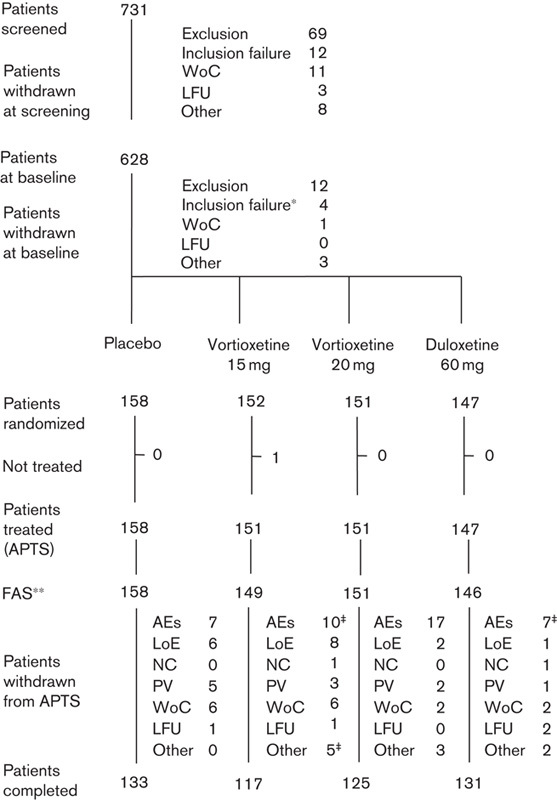
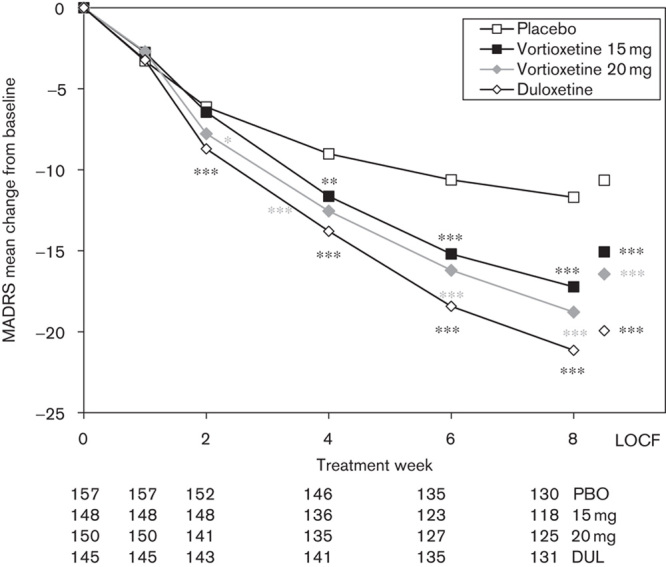
This study assessed the efficacy, tolerability and safety of vortioxetine versus placebo in adults with recurrent major depressive disorder. This double-blind, randomized, placebo-controlled study included 608 patients [Montgomery-Åsberg Depression Rating Scale (MADRS) total score ≥ 26 and Clinical Global Impression - Severity score ≥ 4]. Patients were randomly assigned (1 : 1 : 1 : 1) to vortioxetine 15 mg/day, vortioxetine 20 mg/day, duloxetine 60 mg/day or placebo. The primary efficacy endpoint was change from baseline in MADRS total score at week 8 (mixed model for repeated measurements). Key secondary endpoints were: MADRS responders; Clinical Global Impression - Improvement scale score; MADRS total score in patients with baseline Hamilton Anxiety Rating Scale ≥ 20; remission (MADRS ≤ 10); and Sheehan Disability Scale total score at week 8. On the primary efficacy endpoint, both vortioxetine doses were statistically significantly superior to placebo, with a mean difference to placebo (n = 158) of -5.5 (vortioxetine 15 mg, P < 0.0001, n = 149) and -7.1 MADRS points (vortioxetine 20 mg, P < 0.0001, n = 151). Duloxetine (n = 146) separated from placebo, thus validating the study. In all key secondary analyses, both vortioxetine doses were statistically significantly superior to placebo. Vortioxetine treatment was well tolerated; common adverse events (incidence ≥ 5%) were nausea, headache, diarrhea, dry mouth and dizziness. No clinically relevant changes were seen in clinical safety laboratory values, weight, ECG or vital signs parameters. Vortioxetine was efficacious and well tolerated in the treatment of patients with major depressive disorder.
Overview
The claims and statistics of this paper haven’t been checked yet.
Free: it reads the open-access text and checks the first 5 claims that cite a source we can check. Create a free account to check every claim.
Integrity signals
Registry
Cites
Statistics
Figures
Verification
Claims the paper makes
The claims and statistics of this paper haven’t been checked yet.
Free: it reads the open-access text and checks the first 5 claims that cite a source we can check. Create a free account to check every claim.
Claims other papers make about this one
Each is checked against this paper’s own text: does it say what the citing paper says it does?
The source backs part of the claim, not all of it — or backs it for a different population, condition or comparison.
In the citing paper
“Vortioxetine 20 mg has been shown to be significantly superior to placebo on multiple depression endpoints (MADRS total score, response rate, CGI-I, SDS, and MADRS in patients with high baseline HAM-A) after 8 weeks of treatment in two other studies, one conducted in the USA and the other conducted outside of the USA”
From A randomized, double-blind, duloxetine-referenced study comparing efficacy and tolerability of 2 fixed doses of vortioxetine in the acute treatment of adults with MDD (2015) · cites this paper as Boulenger et al. 2014
Experimental — accuracy not yet measuredThe cited source says what the claim attributes to it.
In the citing paper
“this dose did demonstrate statistically significant improvement over placebo in a previous study conducted outside of the USA”
From A randomized, double-blind, duloxetine-referenced study comparing efficacy and tolerability of 2 fixed doses of vortioxetine in the acute treatment of adults with MDD (2015) · cites this paper as Boulenger et al. 2014
The cited source says what the claim attributes to it.
In the citing paper
“Vortioxetine (1-[2-(2,4-dimethyl-phenylsulfanyl)-phenyl]-piperazine-hydrobromide, Lu AA21004) is a novel antidepressant that has demonstrated efficacy in doses up to 20 mg/d in short-term studies of 6–8 wk duration in adult patients with MDD (Alvarez et al., 2012; Henigsberg et al., 2012; Boulenger et al., 2014).”
From A randomized, double-blind, placebo-controlled study of vortioxetine on cognitive function in depressed adults (2014) · cites this paper as Boulenger et al., 2014
Self-check
Percentages, sums and reported differences re-computed from the paper’s own numbers.
The self-check needs the paper’s full text.
Citations
Cites
A new depression scale designed to be sensitive to change
Montgomery, S. A., & Åsberg, M. (1979) · British Journal of Psychiatry · doi:10.1192/bjp.134.4.382 · Cited by 13,962 · cited 1×
“The primary endpoint was the change from baseline in Montgomery–Åsberg Depression Rating Scale (MADRS) (Montgomery and Åsberg, 1979) total score as primary endpoint after 8 weeks of treatment.”
MethodThe assessment of anxiety states by rating
HAMILTON, M. (1959) · British Journal of Medical Psychology · doi:10.1111/j.2044-8341.1959.tb00467.x · Cited by 11,455
(1976) · Medical Entomology and Zoology · Cited by 8,899
Lecrubier, Y., Sheehan, D., Weiller, E., Amorim, P., Bonora, I., Sheehan, K. H., Janavs, J., & Dunbar, G. (1997) · European Psychiatry · doi:10.1016/s0924-9338(97)83296-8 · Cited by 3,513 · cited 2×
“All the raters underwent formal training in the MADRS and the Mini International Neuropsychiatric Interview, and the scoring conventions for the CGI, the Hamilton Anxiety Rating Scale (HAM-A) (Hamilton, 1959) and the Discontinuation-Emergent Signs and Symptoms checklist (DESS) (Rosenbaum et al., 1998) to maximize inte…”
MethodThe functioning and well-being of depressed patients. Results from the Medical Outcomes Study
Wells, K. B. (1989) · JAMA · doi:10.1001/jama.262.7.914 · Cited by 2,808
The Functioning and Well-being of Depressed Patients: Results From the Medical Outcomes Study
Wells, K. B. (1989) · JAMA · doi:10.1001/jama.1989.03430070062031 · Cited by 2,130
Antidepressant Drug Effects and Depression Severity: A Patient-Level Meta-analysis
Fournier, J. C., DeRubeis, R. J., Hollon, S. D., Dimidjian, S., Amsterdam, J. D., Shelton, R. C., & Fawcett, J. (2010) · JAMA · doi:10.1001/jama.2009.1943 · Cited by 2,009
(1993) · PubMed · Cited by 1,900
Sheehan, D. V., Harnett-Sheehan, K., & Raj, B. A. (1996) · International Clinical Psychopharmacology · doi:10.1097/00004850-199606003-00015 · Cited by 1,440
The Medical Dictionary for Regulatory Activities (MedDRA)
Brown, E. G., Wood, L., & Wood, S. (1999) · Drug Safety · doi:10.2165/00002018-199920020-00002 · Cited by 1,390
The Arizona Sexual Experience Scale (ASEX): Reliability and Validity
A. McGahuey, A. J. G. (2000) · Journal of Sex & Marital Therapy · doi:10.1080/009262300278623 · Cited by 1,155
Fava, M., Rush, A. J., Alpert, J. E., Balasubramani, G. K., Wisniewski, S. R., Carmin, C. N., Biggs, M. M., Zisook, S., Leuchter, A., Howland, R., et al. (2008) · American Journal of Psychiatry · doi:10.1176/appi.ajp.2007.06111868 · Cited by 927 · cited 1×
“Improving depressive symptoms in patients with higher baseline anxiety may be particularly clinically meaningful, as these patients may be slower to respond to treatment and have lower rates of response to antidepressants (Fava et al., 2008).”
BackgroundDeclaration of Helsinki Ethical Principles for Medical Research Involving Human Subjects
(2009) · JIBL · doi:10.1515/jibl.2009.12 · Cited by 768
Bang-Andersen, B., Ruhland, T., Jørgensen, M., Smith, G., Frederiksen, K., Jensen, K. G., Zhong, H., Nielsen, S. M., Hogg, S., Mørk, A., et al. (2011) · Journal of Medicinal Chemistry · doi:10.1021/jm101459g · Cited by 606 · cited 2×
“In-vitro studies indicate that vortioxetine is a 5-HT3, 5-HT7 and 5-HT1D receptor antagonist, 5-HT1B receptor partial agonist, 5-HT1A receptor agonist and an inhibitor of the 5-HT transporter (Bang-Andersen et al., 2011; Westrich et al., 2012).”
BackgroundSelective serotonin reuptake inhibitor discontinuation syndrome: a randomized clinical trial
Rosenbaum, J. F., Fava, M., Hoog, S. L., Ascroft, R. C., & Krebs, W. B. (1998) · Biological Psychiatry · doi:10.1016/s0006-3223(98)00126-7 · Cited by 574
Residual symptoms in depressed patients who respond acutely to fluoxetine
Nierenberg, A. A., Keefe, B. R., Leslie, V. C., Alpert, J. E., Pava, J. A., Worthington, J. J., Rosenbaum, J. F., & Fava, M. (1999) · The Journal of Clinical Psychiatry · doi:10.4088/jcp.v60n0403 · Cited by 470 · cited 1×
“Treatment of depression still remains a challenge, with one of the issues being the diversity of the individual patient symptom profiles, and often residual symptoms persist at the end of antidepressant treatment (Nierenberg et al., 1999).”
BackgroundKatona, C., Hansen, T., & Olsen, C. K. (2012) · International Clinical Psychopharmacology · doi:10.1097/yic.0b013e3283542457 · Cited by 445 · cited 2×
“10 mg in adults and the elderly (Alvarez et al., 2012; Henigsberg et al., 2012; Katona et al., 2012) and one failed study was supportive of these doses (Baldwin et al., 2012).”
BackgroundSelf-citationMørk, A., Pehrson, A., Brennum, L. T., Nielsen, S. M., Zhong, H., Lassen, A. B., Miller, S., Westrich, L., Boyle, N. J., Sánchez, C., et al. (2012) · The Journal of Pharmacology and Experimental Therapeutics · doi:10.1124/jpet.111.189068 · Cited by 271 · cited 3×
“In-vivo nonclinical studies have demonstrated that vortioxetine enhances levels of multiple neurotransmitters (5-HT, noradrenaline, dopamine, acetylcholine and histamine) in specific areas of the brain (Mørk et al., 2012).”
BackgroundAlvarez, E., Perez, V., Dragheim, M., Loft, H., & Artigas, F. (2012) · The International Journal of Neuropsychopharmacology · doi:10.1017/s1461145711001027 · Cited by 225 · cited 5×
“Previous studies evaluating vortioxetine in the treatment of MDD at 10 mg/day demonstrated statistically significant efficacy versus placebo (Alvarez et al., 2012; Henigsberg et al., 2012), with some indication of a dose–response effect, with numerically greater reductions at the higher dose levels.”
BackgroundMethodInfluentialSelf-citationBrożek, J. L., Guyatt, G. H., & Schünemann, H. J. (2006) · Health and Quality of Life Outcomes · doi:10.1186/1477-7525-4-69 · Cited by 174
Baldwin, D. S., Loft, H., & Dragheim, M. (2011) · European Neuropsychopharmacology · doi:10.1016/j.euroneuro.2011.11.008 · Cited by 164
Self-citationTrivedi, M. H., Rush, A. J., Wisniewski, S. R., Warden, D., McKinney, W., Downing, M., Berman, S. R., Farabaugh, A., Luther, J. F., Nierenberg, A. A., et al. (2006) · The Journal of Clinical Psychiatry · doi:10.4088/jcp.v67n0203 · Cited by 160
Henigsberg, N., Mahableshwarkar, A. R., Jacobsen, P., Chen, Y., & Thase, M. E. (2012) · The Journal of Clinical Psychiatry · doi:10.4088/jcp.11m07470 · Cited by 150 · cited 5×
“Efficacy and safety of vortioxetine (Lu AA21004), 15 and”
BackgroundMethodInfluentialMahableshwarkar, A. R., Jacobsen, P. L., & Chen, Y. (2013) · Current Medical Research and Opinion · doi:10.1185/03007995.2012.761600 · Cited by 135
Delgado, P. L., Brannan, S. K., Mallinckrodt, C. H., Tran, P. V., McNamara, R. K., Wang, F., Watkin, J. G., & Detke, M. J. (2005) · The Journal of Clinical Psychiatry · doi:10.4088/jcp.v66n0603 · Cited by 134
Jain, R., Mahableshwarkar, A. R., Jacobsen, P. L., Chen, Y., & Thase, M. E. (2013) · International Journal of Neuropsychopharmacology · doi:10.1017/s1461145712000727 · Cited by 132 · cited 4×
“a broader clinical profile are expected with vortioxetine doses higher than those used in previous clinical trials (Alvarez et al., 2012; Baldwin et al., 2012; Bidzan et al., 2012; Henigsberg et al., 2012; Jain et al., 2013; Mahableshwarkar et al., 2013).”
BackgroundResultInfluentialBoulenger, J.-P., Loft, H., & Florea, I. (2012) · Journal of Psychopharmacology · doi:10.1177/0269881112441866 · Cited by 127 · cited 13×
“The results of five randomized clinical trials of vortioxetine in the acute treatment of MDD have been published to date; they used doses ranging from 1 to 10 mg/day.”
BackgroundMethodInfluentialSelf-citationMontgomery, S. A., & Möller, H.-J. (2009) · International Clinical Psychopharmacology · doi:10.1097/yic.0b013e32832a8eb2 · Cited by 121
Clinical effectiveness: The importance of psychosocial functioning outcomes
Lam, R. W. M., Filteau, M., & Milev, R. V. (2011) · Journal of Affective Disorders · doi:10.1016/j.jad.2011.03.046 · Cited by 118
Melander, H., Salmonson, T., Abadie, E., & van Zwieten-Boot, B. (2008) · European Neuropsychopharmacology · doi:10.1016/j.euroneuro.2008.06.003 · Cited by 117
Sexual dysfunction associated with antidepressant drugs
Baldwin, D. S. (2004) · Expert Opinion on Drug Safety · doi:10.1517/14740338.3.5.457 · Cited by 84 · cited 3×
“Although sexual side effects are frequently reported during antidepressant treatment with SSRIs and SNRIs (Baldwin, 2004), their incidence with vortioxetine did not differ significantly from that observed with placebo in all the randomized clinical trials published so far, including one where vortioxetine was administ…”
BackgroundResultInfluentialBidzan, L., Mahableshwarkar, A. R., Jacobsen, P. L., Yan, M., & Sheehan, D. V. (2012) · European Neuropsychopharmacology · doi:10.1016/j.euroneuro.2012.07.012 · Cited by 74
Areberg, J., Luntang‐Jensen, M., Søgaard, B., & Nilausen, D. Ø. (2012) · Basic & Clinical Pharmacology & Toxicology · doi:10.1111/j.1742-7843.2011.00810.x · Cited by 68 · cited 4×
“This study differs from previous studies in using doses of vortioxetine corresponding to a 5-HT transporter occupancy of greater than 80% (Areberg et al., 2012b).”
BackgroundResultInfluential
Cited by
A brief history of the development of antidepressant drugs: From monoamines to glutamate.
Hillhouse, T. M., & Porter, J. H. (2015) · Experimental and Clinical Psychopharmacology · doi:10.1037/a0038550 · Cited by 605
Sanchez, C., Asin, K. E., & Artigas, F. (2015) · Pharmacology & Therapeutics · doi:10.1016/j.pharmthera.2014.07.001 · Cited by 547
McIntyre, R. S., Lophaven, S., & Olsen, C. K. (2014) · The International Journal of Neuropsychopharmacology · doi:10.1017/s1461145714000546 · Cited by 433
Self-citationBaldwin, D. S., Chrones, L., Florea, I., Nielsen, R., Nomikos, G. G., Palo, W., & Reines, E. (2016) · Journal of Psychopharmacology · doi:10.1177/0269881116628440 · Cited by 187
Restoring function in major depressive disorder: A systematic review
Sheehan, D. V., Nakagome, K., Asami, Y., Pappadopulos, E. A., & Boucher, M. (2017) · Journal of Affective Disorders · doi:10.1016/j.jad.2017.02.029 · Cited by 182
Metadata
- Authors
- Boulenger, J.-P., Loft, H., & Olsen, C. K.
- Affiliations
- Centre Hospitalier Universitaire de Montpellier (FR)
- Lundbeck (Denmark) (DK)
- Corresponding author
- Boulenger, Jean-Philippe
- Venue
- International Clinical Psychopharmacology
- Published
- 2014-05
- Volume
- 29
- Issue
- 3
- Pages
- 138-149
- ISSN
- 0268-1315 (ISSN-L)
- PMC
- PMC3979887
- OpenAlex
- W2001782289
- Cited by
- 176
- References
- 34
- Citations by year
- 2026: 4 · 2025: 14 · 2024: 10 · 2023: 11 · 2022: 11 · 2021: 10 · 2020: 7 · 2019: 15 · 2018: 14 · 2017: 17 · 2016: 16 · 2015: 29 · 2014: 16
- FWCI
- 15.42
- Type
- journal article
- Language
- en
- Open access
- hybrid
- doi.org
- Licence
- cc-by-nc-nd
- Locations
- International Clinical Psychopharmacology (publishedVersion, cc-by-nc-nd)
- Europe PMC (PubMed Central) (publishedVersion, cc-by-nc-nd)
- PubMed Central (publishedVersion, cc-by-nc-nd)
- PubMed (publishedVersion)
- Funders
- H. Lundbeck A/S
- Topics
- Health Sciences › Medicine › Pharmacology (medical) › Treatment of Major Depression
- Social Sciences › Psychology › Experimental and Cognitive Psychology › Anxiety, Depression, Psychometrics, Treatment, Cognitive Processes
- Health Sciences › Medicine › Psychiatry and Mental health › Bipolar Disorder and Treatment
- Keywords
- vortioxetine, major depressive disorder, duloxetine, antidepressant efficacy, drug safety, tolerability, dose comparison, recurrent depression, adverse events, remission, disability
- MeSH terms
- Duloxetine Hydrochloride, Vortioxetine, Adolescent, Adult, Aged, Major Depressive Disorder, Double-Blind Method, Female, Headache, Humans, Male, Middle Aged, Nausea, Piperazines, Psychiatric Status Rating Scales, Sulfides, Thiophenes, Treatment Outcome, Selective Serotonin Reuptake Inhibitors, Internationality, Young Adult
About these checks
Registry, retraction, Cites and statistics results are computed, not judged, with one exception: a printed reference that no index lists is read once by a model before it counts as a citation error. Claims are extracted by a model and kept only when their quote appears verbatim in the text; each cited source is then checked, with a model’s help, for whether it says what the claim relies on. Those verdicts can be wrong — read the claim’s quote and the cited source before relying on one.
Statistics and arithmetic are recomputed, not judged.
Confidence bands are shown only for fields calibrated on our annotated test set. None is calibrated yet, so no band is shown.
What counts as a claim ›How we measure confidence ›How we check this ›
Are you an author, or do you see a problem with this page? Request a review
Data sources
Bibliographic data: Semantic Scholar, OpenAlex, Crossref.
Contains information from the Semantic Scholar Academic Graph Datasets, made available under the ODC Attribution License (ODC-BY 1.0).
Semantic Scholar’s data is described in: Kinney, R., et al. (2023). The Semantic Scholar Open Data Platform. arXiv:2301.10140.
