

Tolcapone in obsessive-compulsive disorder: a randomized double-blind placebo-controlled crossover trial
Open accessThe DOI matches its Crossref record; 19 of the 19 references it cites were found in a registry or an index.
Abstract
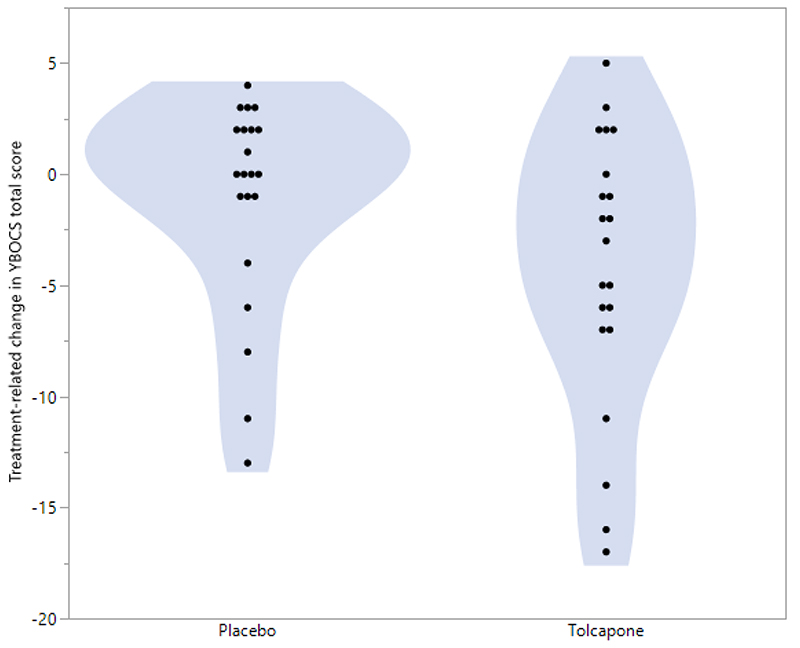
Despite the availability of evidence-based treatments for obsessive-compulsive disorder (OCD), not all patients experience sufficient benefit or are able to tolerate them. Tolcapone is a catechol-O-methyl-transferase (COMT) enzyme inhibitor that augments cortical dopaminergic transmission. Conduct a proof of concept study to examine whether a COMT inhibitor would reduce OCD symptoms to a greater extent than placebo. We conducted a randomized, placebo-controlled, double-blind crossover trial in adults with OCD ( N = 20). Participants were assessed at baseline, after 2 weeks of tolcapone, and again after 2 weeks of placebo on measures of OCD symptom severity and psychosocial functioning. There was a 1-week washout period between the 2-week treatment phases. Two weeks of tolcapone was associated with significant improvement in OCD versus two weeks of placebo ( t = 2.194, P = 0.0409). The mean percentage decreases in the total Yale–Brown obsessive-compulsive scale (YBOCS) scores for the entire sample over the corresponding 2-week period were 16.4% for tolcapone and 3.6% for placebo. These data indicate that brain penetrant COMT inhibitors merit further investigation as a candidate new treatment for OCD.
Overview
The claims and statistics of this paper haven’t been checked yet.
Free: it reads the open-access text and checks the first 5 claims that cite a source we can check. Create a free account to check every claim.
Integrity signals
Registry
Cites
Statistics
Figures
Verification
Claims the paper makes
The claims and statistics of this paper haven’t been checked yet.
Free: it reads the open-access text and checks the first 5 claims that cite a source we can check. Create a free account to check every claim.
Claims other papers make about this one
Each is checked against this paper’s own text: does it say what the citing paper says it does?
The cited source says what the claim attributes to it.
In the citing paper
“It was effective in a randomized, placebo-controlled crossover trial [42] and further evaluation as a candidate medication for OCD is needed.”
From Clinical Advances in Treatment Strategies for Obsessive-compulsive Disorder in Adults (2023) · cites this paper as [42]
Self-check
Percentages, sums and reported differences re-computed from the paper’s own numbers.
The self-check needs the paper’s full text.
Citations
Cites
Hamilton, M. (1960) · Journal of Neurology, Neurosurgery & Psychiatry · doi:10.1136/jnnp.23.1.56 · Cited by 32,817 · cited 5×
“Some college 25% (5) - College graduate 40% (8) - College + 30% (6) - YBOCS Total 21.4 (4.06) 18-29 HAM-A 6.55 (5.84) 0-16 HAM-D 6.50 (5.80) 0-20 Comorbidities (N): Major depressive episode (5), panic disorder (2), agoraphobia (2), social phobia (2), post-traumatic stress disorder (2), substance dependence/abuse (2),…”
MethodInfluential(1998) · The Journal of Clinical Psychiatry · Cited by 19,139
The assessment of anxiety states by rating
HAMILTON, M. (1959) · British Journal of Medical Psychology · doi:10.1111/j.2044-8341.1959.tb00467.x · Cited by 11,455 · cited 5×
“Some college 25% (5) - College graduate 40% (8) - College + 30% (6) - YBOCS Total 21.4 (4.06) 18-29 HAM-A 6.55 (5.84) 0-16 HAM-D 6.50 (5.80) 0-20 Comorbidities (N): Major depressive episode (5), panic disorder (2), agoraphobia (2), social phobia (2), post-traumatic stress disorder (2), substance dependence/abuse (2),…”
MethodInfluential(1998) · PubMed · Cited by 10,216
(1976) · Medical Entomology and Zoology · Cited by 8,899
The Yale-Brown Obsessive Compulsive Scale: I. Development, Use, and Reliability
Goodman, W. K. (1989) · Archives of General Psychiatry · doi:10.1001/archpsyc.1989.01810110048007 · Cited by 7,712 · cited 4×
“E urope PM C Funders A uthor M anuscripts E urope PM C Funders A uthor M anuscripts placebo after only two weeks of administration (Goodman et al., 1989).”
BackgroundMethodInfluentialInverted-U–Shaped Dopamine Actions on Human Working Memory and Cognitive Control
Cools, R., & D'Esposito, M. (2011) · Biological Psychiatry · doi:10.1016/j.biopsych.2011.03.028 · Cited by 1,673
The Neuropsychopharmacology of Fronto-Executive Function: Monoaminergic Modulation
Robbins, T. W., & Arnsten, A. F. T. (2009) · Annual Review of Neuroscience · doi:10.1146/annurev.neuro.051508.135535 · Cited by 957
Chamberlain, S. R., Blackwell, A. D., Fineberg, N. A., Robbins, T. W., & Sahakian, B. J. (2005) · Neuroscience & Biobehavioral Reviews · doi:10.1016/j.neubiorev.2004.11.006 · Cited by 830 · cited 1×
“Importantly, dysfunction of many of these cognitive domains has been implicated in OCD (Chamberlain et al., 2005; Fullana et al., 2020).”
BackgroundSelf-citationTunbridge, E. M. (2004) · Journal of Neuroscience · doi:10.1523/jneurosci.1124-04.2004 · Cited by 418
Cited by
Obsessive-compulsive disorder: Etiology, neuropathology, and cognitive dysfunction
Jalal, B., Chamberlain, S. R., & Sahakian, B. J. (2023) · Brain and Behavior · doi:10.1002/brb3.3000 · Cited by 111
Self-citationTreatment-resistant OCD: Pharmacotherapies in adults
van Roessel, P. J., Grassi, G., Aboujaoude, E. N., Menchón, J. M., Van Ameringen, M., & Rodríguez, C. I. (2023) · Comprehensive Psychiatry · doi:10.1016/j.comppsych.2022.152352 · Cited by 86
Cortical dopamine reduces the impact of motivational biases governing automated behaviour
Scholz, V., Hook, R. W., Kandroodi, M. R., Algermissen, J., Ioannidis, K., Christmas, D. M. B., Valle, S., Robbins, T. W., Grant, J. E., Chamberlain, S. R., et al. (2022) · Neuropsychopharmacology · doi:10.1038/s41386-022-01291-8 · Cited by 36
“The clinical potential of COMT inhibitors is suggested by recently reported improvements following two-week tolcapone treatment in OCD, relative to placebo; as well as by other contextual studies in healthy controls suggestive of cortically-relevant cognitive effects [32,33,73].”
InfluentialSelf-citationClinical Advances in Treatment Strategies for Obsessive-compulsive Disorder in Adults
Roh, D., Jang, K. W., & Kim, C.-H. (2023) · Clinical Psychopharmacology and Neuroscience · doi:10.9758/cpn.23.1075 · Cited by 20
“It was effective in a randomized, placebo-controlled crossover trial [42] and further evaluation as a candidate medication for OCD is needed.”
MethodMota, P. M. P. C., Picó‐Pérez, M., & Morgado, P. F. (2025) · Journal of Psychiatric Research · doi:10.1016/j.jpsychires.2025.12.007 · Cited by 18
Metadata
- Authors
- Grant, J. E., Hook, R., Valle, S., Chesivoir, E., & Chamberlain, S. R.
- Affiliations
- University of Chicago (US)
- University of Cambridge (GB)
- Corresponding author
- Grant, Jon E.
- Venue
- International Clinical Psychopharmacology
- Published
- 2021-07-20
- Volume
- 36
- Issue
- 5
- Pages
- 225-229
- ISSN
- 0268-1315 (ISSN-L)
- PMC
- PMC7611531
- OpenAlex
- W3186834239
- Cited by
- 24
- References
- 19
- Citations by year
- 2026: 5 · 2025: 6 · 2024: 6 · 2023: 3 · 2022: 4
- FWCI
- 2.22
- Type
- journal article
- Language
- en
- Open access
- green
- www.ncbi.nlm.nih.gov
- Licence
- cc-by
- Locations
- International Clinical Psychopharmacology (publishedVersion)
- PubMed (publishedVersion)
- PubMed Central (acceptedVersion, cc-by)
- ePrints Soton (University of Southampton) (acceptedVersion)
- Funders
- Wellcome Trust (110,049/Z/15/Z, 110,049/Z/15/A, 110049)
- Topics
- Social Sciences › Psychology › Clinical Psychology › Obsessive-Compulsive Spectrum Disorders
- Health Sciences › Medicine › Psychiatry and Mental health › Schizophrenia research and treatment
- Social Sciences › Psychology › Clinical Psychology › Psychoanalysis and Psychopathology Research
- Keywords
- tolcapone, obsessive-compulsive disorder, catechol-O-methyltransferase inhibitors, COMT inhibition, dopamine signaling, OCD severity, Yale-Brown Obsessive Compulsive Scale, psychosocial functioning, adjunctive pharmacotherapy
- MeSH terms
- Tolcapone, Adult, Double-Blind Method, Humans, Obsessive-Compulsive Disorder, Cross-Over Studies
About these checks
Registry, retraction, Cites and statistics results are computed, not judged, with one exception: a printed reference that no index lists is read once by a model before it counts as a citation error. Claims are extracted by a model and kept only when their quote appears verbatim in the text; each cited source is then checked, with a model’s help, for whether it says what the claim relies on. Those verdicts can be wrong — read the claim’s quote and the cited source before relying on one.
Statistics and arithmetic are recomputed, not judged.
Confidence bands are shown only for fields calibrated on our annotated test set. None is calibrated yet, so no band is shown.
What counts as a claim ›How we measure confidence ›How we check this ›
Are you an author, or do you see a problem with this page? Request a review
How to cite
Cite CoChat for the checks on this page, and the paper for its own findings.
- This page
- CoChat. (2026). Citation check: Tolcapone in obsessive-compulsive disorder: a randomized double-blind placebo-controlled crossover trial. https://app.cochat.ai/papers/10.1097/yic.0000000000000368
- The paper
- Grant, J. E., Hook, R., Valle, S., Chesivoir, E., & Chamberlain, S. R. (2021). Tolcapone in obsessive-compulsive disorder: a randomized double-blind placebo-controlled crossover trial. International Clinical Psychopharmacology. https://doi.org/10.1097/yic.0000000000000368
Data sources
Bibliographic data: Semantic Scholar, OpenAlex, Crossref.
Contains information from the Semantic Scholar Academic Graph Datasets, made available under the ODC Attribution License (ODC-BY 1.0).
Semantic Scholar’s data is described in: Kinney, R., et al. (2023). The Semantic Scholar Open Data Platform. arXiv:2301.10140.
