

The DOI matches its Crossref record; 159 of the 161 references it cites were found in a registry or an index.
Genome-wide scans for footprints of natural selection
Open accessAbstract
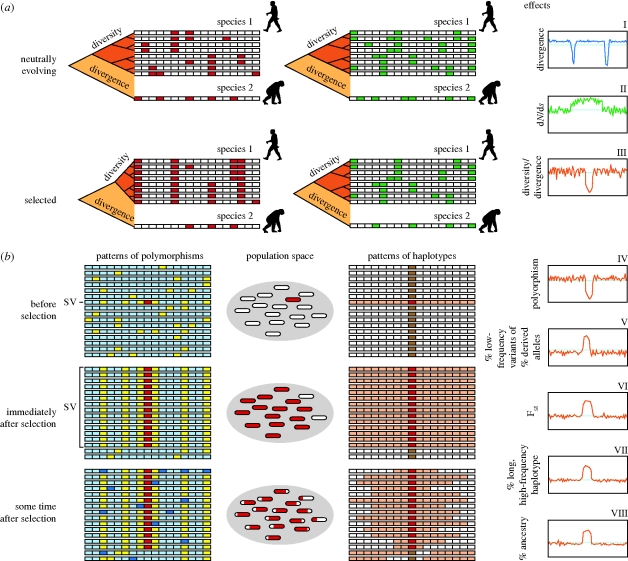
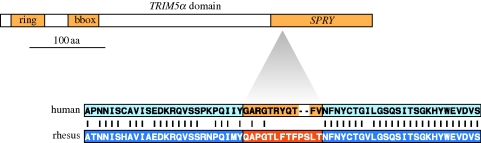
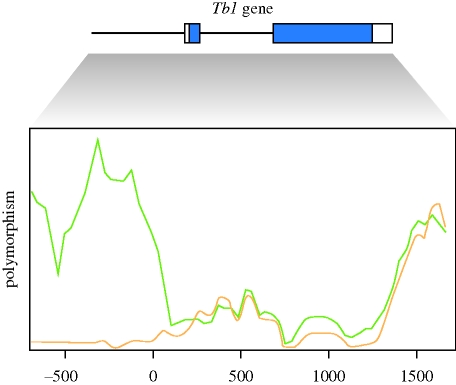
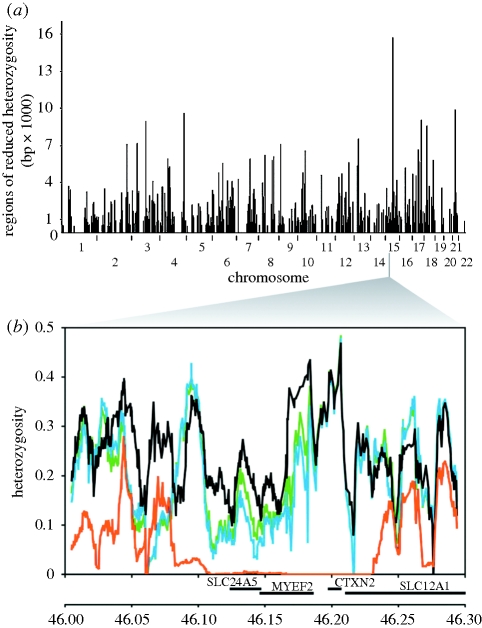
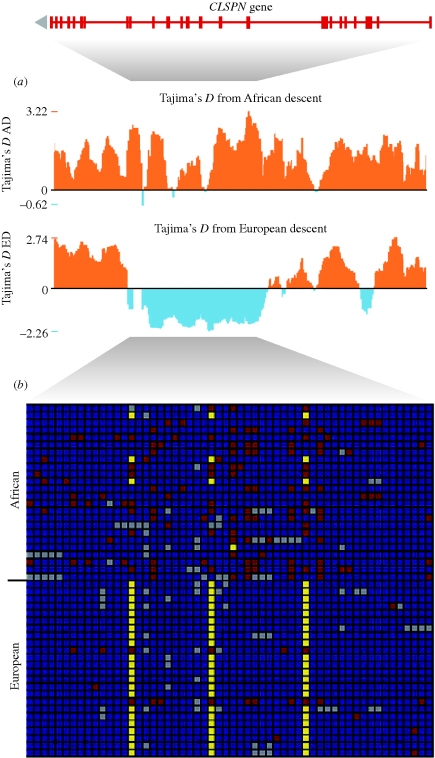
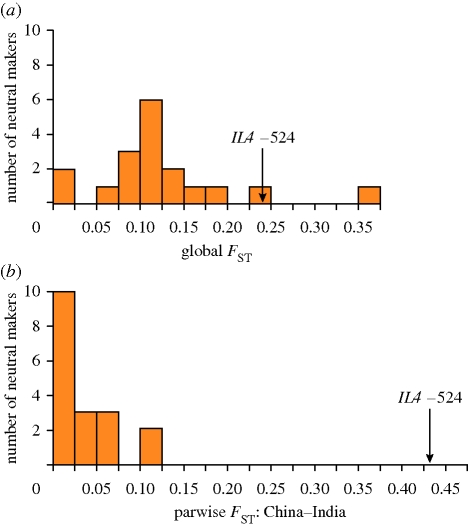
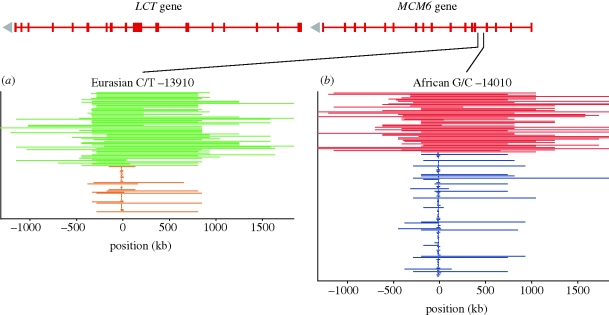
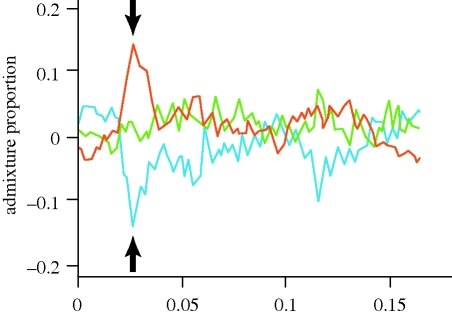
Detecting recent selected ‘genomic footprints’ applies directly to the discovery of disease genes and in the imputation of the formative events that molded modern population genetic structure. The imprints of historic selection/adaptation episodes left in human and animal genomes allow one to interpret modern and ancestral gene origins and modifications. Current approaches to reveal selected regions applied in genome-wide selection scans (GWSSs) fall into eight principal categories: (I) phylogenetic footprinting, (II) detecting increased rates of functional mutations, (III) evaluating divergence versus polymorphism, (IV) detecting extended segments of linkage disequilibrium, (V) evaluating local reduction in genetic variation, (VI) detecting changes in the shape of the frequency distribution (spectrum) of genetic variation, (VII) assessing differentiating between populations ( F ST ), and (VIII) detecting excess or decrease in admixture contribution from one population. Here, we review and compare these approaches using available human genome-wide datasets to provide independent verification (or not) of regions found by different methods and using different populations. The lessons learned from GWSSs will be applied to identify genome signatures of historic selective pressures on genes and gene regions in other species with emerging genome sequences. This would offer considerable potential for genome annotation in functional, developmental and evolutionary contexts.
Overview
The claims and statistics of this paper haven’t been checked yet.
Run the check — free, no account needed. It reads the open-access text and checks the sources it cites.
Integrity signals
Registry
Cites
Statistics
Figures
Verification
Claims the paper makes
The claims and statistics of this paper haven’t been checked yet.
Run the check — free, no account needed. It reads the open-access text and checks the sources it cites.
Claims other papers make about this one
Each is checked against this paper’s own text: does it say what the citing paper says it does?
The check wasn’t confident either way, so it gives no verdict — never disputed.
In the citing paper
“in agreement with Rsb being a powerful method to detect selection signature when the selected allele has reached fixation (Tang et al., 2007; Oleksyk et al., 2010; Bahbahani et al., 2018).”
From Identification of Candidate Signature Genes and Key Regulators Associated With Trypanotolerance in the Sheko Breed (2019) · cites this paper as Oleksyk et al., 2010
Experimental — accuracy not yet measured
Self-check
Percentages, sums and reported differences re-computed from the paper’s own numbers.
The self-check needs the paper’s full text.
Citations
Cites
Initial sequencing and analysis of the human genome
International Human Genome Sequencing Consortium, Whitehead Institute for Biomedical Research, C. F. G. R., Lander, E. S., Linton, L. M., Birren, B., Nusbaum, C., Zody, M. C., Baldwin, J., Devon, K., Dewar, K., et al. (2001) · Nature · doi:10.1038/35057062 · Cited by 24,216
Statistical method for testing the neutral mutation hypothesis by DNA polymorphism.
Tajima, F. (1989) · Genetics · doi:10.1093/genetics/123.3.585 · Cited by 14,056
THE GENETICAL STRUCTURE OF POPULATIONS
Wright, S. (1949) · Annals of Eugenics · doi:10.1111/j.1469-1809.1949.tb02451.x · Cited by 6,729
A haplotype map of the human genome
The International HapMap Consortium (2005) · Nature · doi:10.1038/nature04226 · Cited by 5,858
A second generation human haplotype map of over 3.1 million SNPs
The International HapMap Consortium (2007) · Nature · doi:10.1038/nature06258 · Cited by 4,438
Statistical tests of neutrality of mutations.
Fu, Y., & Li, W. (1993) · Genetics · doi:10.1093/genetics/133.3.693 · Cited by 4,067
The hitch-hiking effect of a favourable gene
Smith, J. M., & Haigh, J. (1974) · Genetical Research · doi:10.1017/s0016672300014634 · Cited by 3,415
Adaptive protein evolution at the Adh locus in Drosophila
McDonald, J. H., & Kreitman, M. (1991) · Nature · doi:10.1038/351652a0 · Cited by 3,313
A Map of Recent Positive Selection in the Human Genome
Voight, B. F., Kudaravalli, S., Wen, X., & Pritchard, J. K. (2006) · PLoS Biology · doi:10.1371/journal.pbio.0040072 · Cited by 2,925
The hitch-hiking effect of a favourable gene
Smith, J. M., & Haigh, J. (2007) · Genetics Research · doi:10.1017/s0016672308009579 · Cited by 2,675
Cited by
Sorted by citations
Genomics and the future of conservation genetics
Allendorf, F. W., Hohenlohe, P. A., & Luikart, G. (2010) · Nature Reviews Genetics · doi:10.1038/nrg2844 · Cited by 1,641
Lotterhos, K. E., & Whitlock, M. C. (2015) · Molecular Ecology · doi:10.1111/mec.13100 · Cited by 588
Genome-Wide Scan for Adaptive Divergence and Association with Population-Specific Covariates
Gautier, M. (2015) · Genetics · doi:10.1534/genetics.115.181453 · Cited by 532
Guiblet, W. M., Zhao, K., O’Brien, S. J., Massey, S. E., Roca, A. L., & Oleksyk, T. K. (2015) · GigaScience · doi:10.1186/2047-217x-4-1 · Cited by 374
Self-citationYang, J. H., Li, W., Lv, F., He, S., Tian, S., Peng, W., Sun, Y., Zhao, Y., Tu, X.-L., Zhang, M., et al. (2016) · Molecular Biology and Evolution · doi:10.1093/molbev/msw129 · Cited by 350
Metadata
- Authors
- Oleksyk, T. K., Smith, M. W., & O'Brien, S. J.
- Affiliations
- Biology Department, University of Puerto Rico at Mayaguez, Mayaguez 00681, Puerto Rico
- National Cancer Institute (US)
- Laboratory of Genomic Diversity, National Cancer Institute at Frederick, Frederick, MD 21702, USA
- ORCID
- Smith, Michael W.
- Venue
- Philosophical Transactions of the Royal Society B: Biological Sciences
- Publisher
- The Royal Society
- Published
- 2010-01-12
- Volume
- 365
- Issue
- 1537
- Pages
- 185-205
- ISSN
- 0962-8436 (ISSN-L)
- 1471-2970
- PMC
- PMC2842710
- OpenAlex
- W2143606043
- Cited by
- 340
- References
- 161
- Citations by year
- 2026: 11 · 2025: 18 · 2024: 12 · 2023: 18 · 2022: 19 · 2021: 27 · 2020: 17 · 2019: 18 · 2018: 31 · 2017: 28 · 2016: 20 · 2015: 28 · 2014: 27 · 2013: 21 · 2012: 18
- FWCI
- 1.41
- Type
- journal article
- Language
- en
- Open access
- hybrid
- doi.org
- Locations
- Philosophical Transactions of the Royal Society B Biological Sciences (publishedVersion, cc-by)
- PubMed Central (publishedVersion, cc-by)
- PubMed (publishedVersion)
- NSUWorks (Nova Southeastern University) (submittedVersion)
- Funders
- U.S. Department of Health and Human Services
- National Institutes of Health
- National Cancer Institute (N01CO12400)
- Topics
- Life Sciences › Biochemistry, Genetics and Molecular Biology › Genetics › Forensic and Genetic Research
- Life Sciences › Biochemistry, Genetics and Molecular Biology › Genetics › Genetic Associations and Epidemiology
- Life Sciences › Biochemistry, Genetics and Molecular Biology › Genetics › Genetic diversity and population structure
- Keywords
- natural selection, linkage disequilibrium, genetic variation, genetic differentiation, F(ST), admixture, disease-associated genes, phylogenetic footprinting, functional mutations, genome annotation, human genome, animal genomes
- MeSH terms
- Animals, Base Sequence, Humans, Phylogeny, Selection, Genetic, Genetic Variation, Genome, Human, Evolution, Molecular, Genome-Wide Association Study
About these checks
Registry, retraction, Cites and statistics results are computed, not judged, with one exception: a printed reference that no index lists is read once by a model before it counts as a citation error. Claims are extracted by a model and kept only when their quote appears verbatim in the text; each cited source is then checked, with a model’s help, for whether it says what the claim relies on. Those verdicts can be wrong — read the claim’s quote and the cited source before relying on one.
Statistics and arithmetic are recomputed, not judged.
Confidence bands are shown only for fields calibrated on our annotated test set. None is calibrated yet, so no band is shown.
What counts as a claim ›How we measure confidence ›How we check this ›
Are you an author, or do you see a problem with this page? Request a review
