

The DOI matches its Crossref record; 153 of the 155 references it cites were found in a registry or an index, and 2 are not checked yet.
The neural basis of metacognitive ability
Open accessAbstract
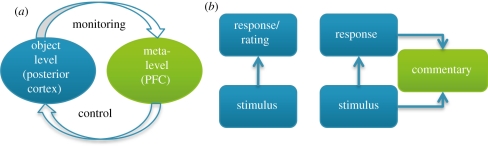
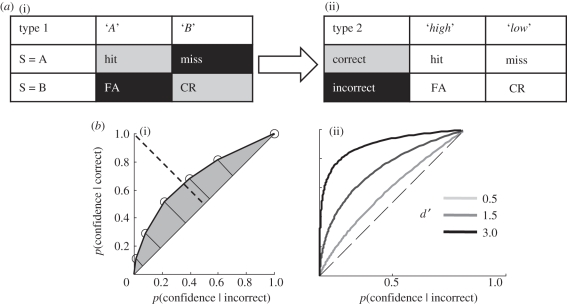
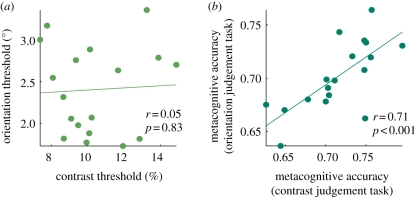
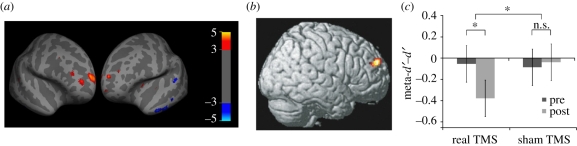
Ability in various cognitive domains is often assessed by measuring task performance, such as the accuracy of a perceptual categorization. A similar analysis can be applied to metacognitive reports about a task to quantify the degree to which an individual is aware of his or her success or failure. Here, we review the psychological and neural underpinnings of metacognitive accuracy, drawing on research in memory and decision-making. These data show that metacognitive accuracy is dissociable from task performance and varies across individuals. Convergent evidence indicates that the function of the rostral and dorsal aspect of the lateral prefrontal cortex (PFC) is important for the accuracy of retrospective judgements of performance. In contrast, prospective judgements of performance may depend upon medial PFC. We close with a discussion of how metacognitive processes relate to concepts of cognitive control, and propose a neural synthesis in which dorsolateral and anterior prefrontal cortical subregions interact with interoceptive cortices (cingulate and insula) to promote accurate judgements of performance.
Overview
The claims and statistics of this paper haven’t been checked yet.
Run the check — free, no account needed. It reads the open-access text and checks the sources it cites.
Integrity signals
Registry
Cites
Statistics
Figures
Verification
Claims the paper makes
The claims and statistics of this paper haven’t been checked yet.
Run the check — free, no account needed. It reads the open-access text and checks the sources it cites.
Claims other papers make about this one
Each is checked against this paper’s own text: does it say what the citing paper says it does?
The cited source says what the claim attributes to it.
In the citing paper
“Weil et al. (2013) showed that metacognitive efficiency increases during adolescence, consistent with the maturation of prefrontal regions thought to underpin metacognition (Fleming and Dolan, 2012).”
From How to measure metacognition (2014) · cites this paper as Fleming and Dolan, 2012
Self-check
Percentages, sums and reported differences re-computed from the paper’s own numbers.
The self-check needs the paper’s full text.
Citations
Cites
James, W. (1891) · Personality Culture Society · doi:10.1037/11059-000 · Cited by 25,876
Telling more than we can know: Verbal reports on mental processes.
Nisbett, R. E., & Wilson, T. D. (1977) · Psychological Review · doi:10.1037/0033-295x.84.3.231 · Cited by 11,317 · cited 1×
“inaccurate [2, 3].”
Metacognition and cognitive monitoring: A new area of cognitive–developmental inquiry
Flavell, J. H. (1979) · American Psychologist · doi:10.1037/0003-066x.34.10.906 · Cited by 11,282 · cited 1×
“By focussing on self-reports about memory performance—metacognitive reports—Flavell provided a systematic framework for the study of self-knowledge in healthy individuals [13].”
Background(1966) · Medical Entomology and Zoology · Cited by 10,293
Signal detection theory and psychophysics
Ingleby, D. (1967) · Journal of Sound and Vibration · doi:10.1016/0022-460x(67)90197-6 · Cited by 8,616
Kruger, J., & Dunning, D. (1999) · Journal of Personality and Social Psychology · doi:10.1037/0022-3514.77.6.1121 · Cited by 7,731 · cited 1×
“Despite being dissociable, it turns out that metacognitive accuracy generally scales with task performance [33, 77–80].”
Conflict monitoring and cognitive control
Botvinick, M. M., Braver, T. S., Barch, D. M., Carter, C. S., & Cohen, J. D. (2001) · Psychological Review · doi:10.1037/0033-295x.108.3.624 · Cited by 7,351
Detection Theory: A User's Guide
Macmillan, N. A., & Creelman, C. D. (1991) · Cited by 5,415
Dual-Processing Accounts of Reasoning, Judgment, and Social Cognition
Evans, J. S. B. T. (2008) · Annual Review of Psychology · doi:10.1146/annurev.psych.59.103006.093629 · Cited by 5,137 · cited 1×
“other low-level, based on non-verbal epistemic feelings of uncertainty [125, 126].”
BackgroundA theory of cortical responses.
Friston, K. (2005) · Philosophical Transactions of the Royal Society B: Biological Sciences · doi:10.1098/rstb.2005.1622 · Cited by 4,578 · cited 1×
“Indeed, several recent models of local and large-scale brain function rely on hierarchy as a principal organising factor [9, 10].”
Background
Research works printed but not linked: 3
- Shimamura A. P., 2008, Handbook of memory and metamemory: essays in honor of Thomas O. Nelson, 373
- Schwartz B., 2008, Handbook of memory and metamemory: essays in honor of Thomas O. Nelson, 355
- Lau H., 2010, Frontiers of consciousness: Chichele lectures
Cited by
Sorted by citations
Items 601–700 of 744
Blanco, R. M. M., & Flórez, L. P. (2019) · Americanae (AECID Library)
Errors in visual metacognition using cognitive illusions
Marín, J. O. (2019)
Brain regions and networks in meditation
Tang, Y., & Tang, R. (2020) · Elsevier eBooks · doi:10.1016/b978-0-12-818266-6.00007-1
Endogenicity and awareness in voluntary action
Parés-Pujolràs, E. (2019) · UCL Discovery (University College London)
Hoffmann, M. (2019) · Assembly of the Executive Mind · doi:10.1017/9781108589246.006
Default Mode Network (Mentalizing) and Limbic Network for Explicit Episodic Memory Syndromes
Hoffmann, M. W. (2020) · Springer eBooks · doi:10.1007/978-3-030-46324-3_8
Rys, W. (2020) · Arrow@dit (Dublin Institute of Technology)
أبوزید, ش. (2018) · دراسات في الارشاد النفسي والتربوي · doi:10.21608/dapt.2018.109268
Clarifying metacognition through computational modelling
Conway-Smith, B. (2019) · Carleton University's Institutional Repository (MacOdrum Library, Carleton University) · doi:10.22215/etd/2019-13888
Emergence of Metacognitive Knowledge via Audible Pupil Size
de Rooij, A., Wijers, I., & Marinussen, M. (2021) · European Conference on Cognitive Ergonomics · doi:10.1145/3452853.3452870 · Cited by 2
“processes thought to facilitate task performance [8].”
A Resource-Aware Component Model for Embedded Systems
Vulgarakis, A. (2009) · Diva portal (Dalarna University Library)
Connaître ses forces et ses faiblesses
Fleming, S. M. (2016) · Cerveau & Psycho · doi:10.3917/cerpsy.082.0054
Self-citationDo propranolol and amisulpride modulate confidence in risk-taking?
Habicht, J., Dubois, M., Michely, J., & Hauser, T. U. (2022) · Wellcome Open Research · doi:10.12688/wellcomeopenres.17423.1
Implications Neuroscience for Teaching PracticePreprint
Fadhilaturrahmi, F. (2020) · OSF Preprints (OSF Preprints) · doi:10.31219/osf.io/8k59h
Retrospective confidence judgments: Meta-analysis of fMRI studiesPreprint
Мартин-Луенго, Б., Zinchenko, O. O., Dolgoarshinnaia, A., & Leminen, A. (2020) · doi:10.31234/osf.io/8nz7d
Cunningham, S., Zhou, Z., Hughes, C., et al. (2017) · Springer eBooks · doi:10.1007/978-3-319-56782-2_1464-2
The Effect of Feedback and Reinforcement Learning on Time PerceptionPreprint
Bader, F., & Wiener, M. (2020) · doi:10.31234/osf.io/8ydfr
Fleming, S. M. (2019) · Faculty Opinions – Post-Publication Peer Review of the Biomedical Literature · doi:10.3410/f.734068306.793559296
Self-citationPatterson, J. P. (2018) · Springer eBooks · doi:10.1007/978-3-319-57111-9_897
Cunningham, S., Zhou, Z., Hughes, C., et al. (2018) · Springer eBooks · doi:10.1007/978-3-319-57111-9_1464
Unraveling of Brain Networks in Neurological Conditions
Hoffmann, M. W. (2019) · Cambridge University Press eBooks · doi:10.1017/9781108589246.008
The perceptual nature of illusory object recognitionPreprint
Alilović, J., Lampers, E., Slagter, H. A., & van Gaal, S. (2022) · bioRxiv (Cold Spring Harbor Laboratory) · doi:10.1101/2022.11.16.476617
“Participants discriminated which of the two object categories was presented and indicated how confident they were in this decision (high/low confidence) (15, 16).”
BackgroundTask learning is subserved by a domain-general brain networkPreprint
Yeon, J., Larson, A. S., Rahnev, D., & D’Esposito, M. (2022) · bioRxiv (Cold Spring Harbor Laboratory) · doi:10.1101/2022.12.07.519504
“The metacognition task required subjects to engage in evaluating their confidence level about the previously made perceptual decision (Fleming & Dolan, 2012; Rahnev, 2021; Yeon et al., 2020).”
MethodTHE NEURAL CORRELATES OF METACOGNITIVE AWARENESS
Lenzoni, S. (2022) · doi:10.17771/pucrio.acad.61730
Sense of Agency Enhances Visual Signal Detection and Metacognitive SensitivityPreprint
Tagami, U., & Imaizumi, S. (2023) · SSRN Electronic Journal · doi:10.2139/ssrn.4354282
On-off synecdoche: a just good enough model of subjective experiencePreprint
Martinez‐Saito, M. (2023) · PsyArXiv (OSF Preprints) · doi:10.31234/osf.io/2b4nc
Young, J. H. (2023) · Wiley eBooks · doi:10.1002/9781119767398.furread
Linking the evolution of two prefrontal brain regions to social and foraging challenges in primatesPreprint
Bouret, S., Paradis, E., Prat, S., Castro, L., Gilissen, E., & Garcia, C. (2023) · doi:10.7554/elife.87780.1
Lukić, J., Višnjić, S., Brkić–Jovanović, N., Andrejić-Višnjić, B., & Bosanac, M. (2022) · Педагошка стварност · doi:10.19090/ps.2022.1.80-96
Fluency trumps working memory capacity in the truth effect
Mak, C. W., & Chooi, W.-T. (2023) · Journal of Cognitive Psychology · doi:10.1080/20445911.2023.2260048
“This approach, as advocated by Ackerman and Gold-smith (2011) and Fleming and Dolan (2012) o ff ers a more ecologically valid perspective.”
Methodالوعي المعرفي بمتبقيات المبيدات في الفاكهة والخضراوات والاتجاه نحو التدابير الوقائية
الصيرفي, ر. س., العصار, د. ت. م. م., التطاوى, د. م. أ. ر., & العال, د. ص. ع. ا. ع. (2023) · International Journal on Humanities and Social Sciences · doi:10.33193/ijohss.50.2023.632
Sun, W., Ripp, I., Borrmann, A., Moll, M., & Fairhurst, M. T. (2023) · Research Square · doi:10.21203/rs.3.rs-3714585/v1
Metamemory: An update of critical findings
Schwartz, B. L., & Metcalfe, J. (2023) · Elsevier eBooks · doi:10.1016/b978-0-443-15754-7.00004-3 · Cited by 1
Metacognition in multialternative choices is based on more information than type-1 decisions.Preprint
Comay, N. A., Solovey, G., & Barttfeld, P. (2024) · doi:10.31234/osf.io/byjv6
Representation of Others' BeliefsPreprint
Qin, J., & Wu, H. (2024) · doi:10.31234/osf.io/4usbp
Keulers, E. H. H., Falbo, L., de Bruin, A. B. H., & Stiers, P. L. J. (2024) · Trends in Neuroscience and Education · doi:10.1016/j.tine.2024.100223
“In spite of the ongoing advancement of self-regulation, from early adolescence on the educational system appeals to self-regulating abilities, such as meta-cognitive monitoring and control of study (e.g., [4,5]).”
Exploring the frontal pole: Bridging theories and revealing associated neural computations
Rondot, L., Witkowski, P. P., & Boorman, E. D. (2024) · Elsevier eBooks · doi:10.1016/b978-0-12-820480-1.00105-4
Sun, W., Ripp, I., Borrmann, A., Moll, M., & Fairhurst, M. T. (2024) · Research Square · doi:10.21203/rs.3.rs-3714585/v2
Representation of others' beliefs
Qin, J., & Wu, H. (2024) · Elsevier eBooks · doi:10.1016/b978-0-12-820480-1.00159-5
How to accomplish brain fitness: The five brain rules
Hoffmann, M. W. (2024) · Elsevier eBooks · doi:10.1016/b978-0-443-29839-4.00002-0 · Cited by 1
The evolutionary origins and purpose of brain fitness
Hoffmann, M. W. (2024) · Elsevier eBooks · doi:10.1016/b978-0-443-29839-4.00003-2
Linking the evolution of two prefrontal brain regions to social and foraging challenges in primatesPreprint
Bouret, S., Paradis, E., Prat, S., Castro, L., Pérez, P., Gilissen, E., & Garcia, C. (2024) · eLife · doi:10.7554/elife.87780.3
Bouret, S., Paradis, E., Prat, S., et al. (2024) · eLife · doi:10.7554/elife.87780.3.sa1
Bouret, S., Paradis, E., Prat, S., Castro, L., Pérez, P., Gilissen, E., & Garcia, C. (2024) · eLife · doi:10.7554/elife.87780.3.sa0
Skill learning in the developing brain: Interactions of control and representation systems
Fandakova, Y., & Wenger, E. (2024) · The Psychology of learning and motivation/The psychology of learning and motivation · doi:10.1016/bs.plm.2024.07.002 · Cited by 2
Non-reflective consciousness and our moral duties to non-reflective animals
Aguilera, B. (2024) · Revista de Filosofia Aurora · doi:10.1590/2965-1557.036.e202430456
Integrating Sexology into Evidence-Based Psychotherapy Practice
Cavallo, F., Salvatore, G., & Lenzi, A. (2024) · Springer eBooks · doi:10.1007/978-3-031-71904-2_21
Refining the Allostatic Self-Efficacy Theory of Fatigue and Depression Using Causal Inference
Hess, A. J., von Werder, D., Harrison, O. K., Heinzle, J., & Stephan, K. E. (2024) · Entropy · doi:10.3390/e26121127
“Metacognition can be summarised as cognition about cognition 11 , comprising a variety of evaluation processes by which the brain monitors its own performance.”
Ferguson, T. D., Fyshe, A., & White, A. (2025) · Brain Research · doi:10.1016/j.brainres.2025.149471
“In turn, a greater degree of confidence has been shown to change attentional signals in the prefrontal cortex, enhancing performance monitoring signals from the frontal and parietal cortex when confidence is lower (due to a greater degree of uncertainty; Fleming & Dolan, 2012).”
Introspection and Decision-MakingPreprint
Bilotta, F. (2025) · SSRN Electronic Journal · doi:10.2139/ssrn.5105705
Nagamura, H., Onishi, H., Kobayasi, K. I., & Yuki, S. (2025) · Frontiers in Human Neuroscience · doi:10.3389/fnhum.2025.1490530
Performance judgment in mathematical and reading competence in adults
Seitz, M., Hawrot, A., & Lockl, K. (2025) · Metacognition and Learning · doi:10.1007/s11409-025-09416-2 · Cited by 1
“Nevertheless, given that metacognition and executive functions share certain functional areas in the brain (e.g., Roebers & Feurer, 2016) that show aging-related changes (e.g., Fleming & Dolan, 2012; Stuss, 2011), it seems likely that both will decline with age.”
Devaki, V., Ramganesh, E., & Amutha, S. (2025) · International Research Journal of Multidisciplinary Scope · doi:10.47857/irjms.2025.v06i02.03134
“The authors measured the psychological determinants of metacognitive accuracy, the neural basis of metacognitive accuracy and the relation between the metacognitive and cognitive control (41).”
WITHDRAWNPreprint
Shkursky, A. A. (2025) · doi:10.31234/osf.io/yzfth_v1
Convergent Approach to Modeling BiomorphicCognitive ArchitecturesPreprint
Urmanov, T. (2025) · OSF Preprints (OSF Preprints) · doi:10.31219/osf.io/28ubs_v1
Precautionary Principle and Post-Mortem Brain Resuscitation
Long, B., & Resnik, D. B. (2025) · Neuroethics · doi:10.1007/s12152-025-09605-5
“These areas are associated with complex cognitive functions such as self-awareness, confidence judgments, and error monitoring, capacities that align with the meta-rep-resentational requirements of higher-order theories [17].”
Xiao, L., Baetens, K., & Deroost, N. (2025) · Current Psychology · doi:10.1007/s12144-025-08161-8
“Metacognition, which involves the awareness of one’s own success or failure in cognitive processes (Fleming & Dolan, 2012; Fleming & Lau, 2014), may help clarify the relationship between SPS and perceptual processing.”
Metacognitive Governance: Civilizational Scaffolding under EntropyPreprint
Yuan, M. (2025) · SSRN Electronic Journal · doi:10.2139/ssrn.5344812
Salient Memory: Effects of Distributed Learning on Cortical Regions During Memory Retrieval
Li, C., & Yang, J. (2025) · Human Brain Mapping · doi:10.1002/hbm.70301 · Cited by 1
“Confidence is generally regarded as an index of metamemory ability, which is the knowledge we have about our memory (Fleming and Dolan 2012; Martín-Luengo et al. 2021).”
Improving decision capabilities through brain–computer interfaces
Poli, R., & Cinel, C. (2025) · Elsevier eBooks · doi:10.1016/b978-0-443-24824-5.00008-9
Nelson, B. K., Picon, E. L., Sayers, L., Farah, L. N., Saint, S. A., Chen, J., Sossi, V., Sekhon, M. S., Stoessl, A. J., Wellington, C. L., et al. (2025) · Journal of Clinical and Experimental Neuropsychology · doi:10.1080/13803395.2025.2555610
“We quantified metamemory using the alignment of trial-by -trial confidence ratings with accuracy during a recognition memory task based on signal detection theory, the “gold standard” for assessing metacognition (Fleming & Dolan, 2012; Fleming & Lau, 2014).”
Dovizio, M., Rossi, C., Pesce, M., Candeloro, G., Pica, V., Bruno, A., Laurenzi, V. D., Ballerini, P., Sommer, D., & Sacco, P. L. (2025) · The Arts in Psychotherapy · doi:10.1016/j.aip.2025.102367
Schmid, G. B. (2025) · Springer eBooks · doi:10.1007/978-3-662-70831-6_2
A Region of Interest Analysis Focusing on the Insular and Cingulate Cortices
Kouzalis, A., & Ershova, R. V. (2024) · Вестник Российского университета дружбы народов. Серия: Психология и педагогика · doi:10.22363/2313-1683-2024-21-1-328-339 · Cited by 2
“A metacognitive model has been proposed where the prefrontal cortex works together with interoceptive cortices such as the cingulate and the insula to encourage the accuracy of performance self-ratings (Fleming & Dolan, 2012).”
Multiple Routes to Metacognitive Judgments of Working Memory in the Macaque Prefrontal CortexPreprint
Ning, C., Fu, G., Zhang, Y., Meyniel, F., & Wang, L. (2025) · bioRxiv (Cold Spring Harbor Laboratory) · doi:10.1101/2025.07.15.664842
Prefrontal Cortex Responses to Conflicting Information
Bíró, P., & Collin, S. H. P. (2025) · Human Brain Mapping · doi:10.1002/hbm.70418 · Cited by 1
“Due to the high similarity and potential overlap between schema-congruent new details and existing memory traces, schema-congruent trials might possibly rely more heavily on source evaluation—a process that engages metacognitive monitoring (Vaccaro and Fleming 2018; Fleming and Dolan 2012).”
Metacognition and Metacognitive Therapy in Gambling Disorder
Erdem, E., Şafak, Y., & Mutlu, E. A. (2025) · Psikiyatride Guncel Yaklasimlar - Current Approaches in Psychiatry · doi:10.18863/pgy.1754996
Tisserand, A., Blanc, F., Mondino, M., Muller, C., Durand, H., Demuynck, C., de Sousa, P. L., Ravier, A., Sanna, L., Botzung, A., et al. (2024) · Figshare · doi:10.6084/m9.figshare.26708837
Correlation between Body Mass Index and Metacognitive Beliefs of Medical Undergraduates
Dash, S., Jena, S. K., & Rath, B. K. (2025) · CHRISMED Journal of Health and Research · doi:10.4103/cjhr.cjhr_26_25
Low confidence for perceptual completion of partially occluded objects
Baykan, C., Mamassian, P., & Schütz, A. C. (2026) · Journal of Vision · doi:10.1167/jov.26.1.4
Yue, L., Liu, Z., & Gao, X. (2026) · Advances in Psychological Science · doi:10.3724/sp.j.1042.2026.0487
Bates, C. M., & Martin, A. K. (2026) · Social Cognitive and Affective Neuroscience · doi:10.1093/scan/nsag070
“Neurocognitive models of metacognition implicate distributed frontoparietal systems, including medial prefrontal and posterior parietal regions that overlap with networks supporting self-referential processing and episodic memory (Fleming and Dolan 2012).”
Frontal Theta Oscillations in Perceptual Decision-Making Reflect Cognitive Control and Confidence
Parajuli, R., Flynn, E., & Dhamala, M. (2026) · Brain Sciences · doi:10.3390/brainsci16020123
“Therefore, the confidence interpretation remains hypothesis-level, supported by convergent evidence from prior studies linking prefrontal theta to metacognitive monitoring [33] and confidence reports [32], but requiring direct behavioral validation in future work.”
Personalized Image Enhancement for Visual Search Task
Mabuchi, Y., & Ozasa, Y. (2026) · IEEE Access · doi:10.1109/access.2026.3657428
Investigating the role of executive function in brain responses to infant crying among new parents
Hiraoka, D., Xie, Y., Powers, S. E., Patterson, G., Chin, J., Brady, N., YEH, T. P., & Kim, P. (2026) · Social Cognitive and Affective Neuroscience · doi:10.1093/scan/nsag002
Xie, Y., Liu, Y., & Hu, F. (2026) · Thinking Skills and Creativity · doi:10.1016/j.tsc.2026.102163
Effects of Cognitive Behavioral Therapy on Memory and Metamemory in Obsessive-Compulsive Disorders
Irak, M., & Duman, T. N. (2026) · Journal of Cognitive Psychotherapy · doi:10.1891/jcp-2025-0016
Self-Reflection Protects Behavior from Volatile Beliefs Linked to Paranoia
Suthaharan, P., Castiello, S., Ang, Y., & Corlett, P. (2026) · Computational Psychiatry · doi:10.5334/cpsy.150 · Cited by 1
Wang, S., Li, Z., Funahashi, S., Zhang, Z., Wu, J., & Yang, J. (2025) · International Conference on Health Big Data and Intelligent Healthcare (ICHIH) · doi:10.1145/3792746.3792750
“Although the present study adopted a binary confidence judgment, this design choice is consistent with a substantial body of metacognition research using dichotomous confidence ratings to quantify type-2 performance [27–29].”
Metacognitive Training in Confidence and Introspective Reaction Times JudgmentsPreprint
Aróstica, L. T., & Gabriel Reyes, M. (2026) · SSRN Electronic Journal · doi:10.2139/ssrn.6308420
Sasaoka, T., Maekawa, T., & Yamawaki, S. (2026) · Scientific Reports · doi:10.1038/s41598-026-41447-w
Creative Metacognition in Theory, Measurement, and Education
刘, 龙. (2026) · Advances in Psychology · doi:10.12677/ap.2026.163118
Men, H., & Schütz, A. C. (2026) · Vision Research · doi:10.1016/j.visres.2026.108794
“…the estimation of confidence because of two reasons: First, perceptual filling-in can occur as early as V1 and V2 (for a review see Komatsu, 2006), whereas confidence judgments and metacognition are associated with higher-level cortical regions (for reviews see Fleming & Dolan, 2012; Rahnev, 2021).”
Action modulates visual detection and metacognitive sensitivity
Tagami, U., & Imaizumi, S. (2026) · Acta Psychologica · doi:10.1016/j.actpsy.2026.106632 · Cited by 1
Cognitive predictors of metacognitive accuracy
Waller, C. S., Dodd, M. D., Walsh, M. J., Al-Momani, S. I., & Chiou, K. S. (2026) · Journal of Clinical and Experimental Neuropsychology · doi:10.1080/13803395.2026.2644926
“…investigations that have identified the same fundamental structures implicated in both executive function and metacognition (Chua et al., 2006; Fleming & Dolan, 2012; Grossner et al., 2019; Vaccaro & Fleming, 2018), an initial hypothesis was put forth that measures of executive function would…”
Distinct perceptual-metacognitive profiles of interoceptive and exteroceptive timing
Chen, S., & Zheng, M. (2026) · Consciousness and Cognition · doi:10.1016/j.concog.2026.104043
Bilgin, S. N., Giomo, D., Mustafali, U., & Kononowicz, T. W. (2026) · bioRxiv (Cold Spring Harbor Laboratory) · doi:10.64898/2026.03.24.714009
Exploration et vérification : études comportementales et neurophysiologiques du cortex préfrontal
Stoll, F. M. (2014) · theses.fr (ABES) · doi:10.70675/460ef294z3e03z40f6zafe4z4b1b927beada
Jacquot, A. (2017) · theses.fr (ABES) · doi:10.70675/478cde05z7ccdz4892zb377z64cc28317287
“A cet égard, les évaluations rétrospectives, peuvent impliquer des processus différents des jugements prospectifs (Fleming & Dolan, 2012).”
BackgroundThe Brain Valuation System and its role in decision-making
Lopez‐Persem, A. (2016) · theses.fr (ABES) · doi:10.70675/d4ee5e83z099dz4d34z89ddzf182df6a9cf2 · Cited by 1
On metacognition and the dynamics of selective attention
Recht, S. (2019) · theses.fr (ABES) · doi:10.70675/9091ccaez90a4z489fz8603z56a8a1538875
Le fractionnement de la métamémoire dans la maladie d'Alzheimer
Bertrand, J. (2017) · theses.fr (ABES) · doi:10.70675/d7c308d7z62dbz4e27zaa10zae95309a6df8
Martin-Gomez, F. J. (2023) · theses.fr (ABES) · doi:10.70675/8827e91ezc1e6z41b9zb5cezaad6817446ed
Metadata
- Authors
- Fleming, S. M., & Dolan, R. J.
- Affiliations
- New York University (US)
- Wellcome Centre for Human Neuroimaging (GB)
- Corresponding author
- Fleming, Stephen M.
- Venue
- Philosophical Transactions of the Royal Society B: Biological Sciences
- Publisher
- The Royal Society
- Published
- 2012-05-19
- Volume
- 367
- Issue
- 1594
- Pages
- 1338-1349
- ISSN
- 0962-8436 (ISSN-L)
- 1471-2970
- PMC
- PMC3318765
- OpenAlex
- W2155610381
- Semantic Scholar
- 6067b80d698ec3f84bd5329f7154f302e0cde788
- Cited by
- 747
- References
- 153
- Citations by year
- 2026: 71 · 2025: 69 · 2024: 65 · 2023: 52 · 2022: 49 · 2021: 64 · 2020: 66 · 2019: 57 · 2018: 49 · 2017: 55 · 2016: 46 · 2015: 30 · 2014: 39 · 2013: 22 · 2012: 9
- FWCI
- 2.53
- Type
- journal article
- Language
- en
- Open access
- hybrid
- doi.org
- Locations
- Philosophical Transactions of the Royal Society B Biological Sciences (publishedVersion, cc-by)
- Europe PMC (PubMed Central) (publishedVersion, cc-by)
- PubMed Central (publishedVersion, cc-by)
- PubMed (publishedVersion)
- UCL Discovery (University College London) (submittedVersion)
- Max Planck Digital Library (submittedVersion, other-oa)
- MPG.PuRe (Max Planck Society) (submittedVersion, other-oa)
- Funders
- Wellcome Trust (091593, 078865/Z/05/Z)
- Topics
- Life Sciences › Neuroscience › Cognitive Neuroscience › Neural and Behavioral Psychology Studies
- Life Sciences › Neuroscience › Cognitive Neuroscience › Memory Processes and Influences
- Social Sciences › Psychology › Experimental and Cognitive Psychology › Cognitive Functions and Memory
- Keywords
- metacognition, metacognitive accuracy, lateral prefrontal cortex, medial prefrontal cortex, dorsolateral prefrontal cortex, anterior cingulate cortex, insula, interoception, cognitive control, memory, decision-making, individual differences
- MeSH terms
- Animals, Cognition, Decision Making, Humans, Memory, Neural Pathways, Prefrontal Cortex
About these checks
Registry, retraction, Cites and statistics results are computed, not judged, with one exception: a printed reference that no index lists is read once by a model before it counts as a citation error. Claims are extracted by a model and kept only when their quote appears verbatim in the text; each cited source is then checked, with a model’s help, for whether it says what the claim relies on. Those verdicts can be wrong — read the claim’s quote and the cited source before relying on one.
Statistics and arithmetic are recomputed, not judged.
Confidence bands are shown only for fields calibrated on our annotated test set. None is calibrated yet, so no band is shown.
What counts as a claim ›How we measure confidence ›How we check this ›
Are you an author, or do you see a problem with this page? Request a review
