

The DOI matches its Crossref record; 133 of the 140 references it cites were found in a registry or an index, and 7 are not checked yet.
The macroevolutionary consequences of phenotypic integration: from development to deep time
Open accessAbstract
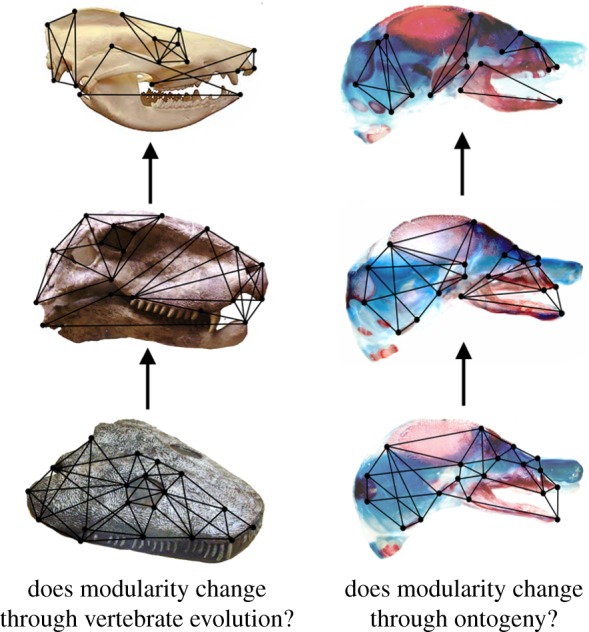
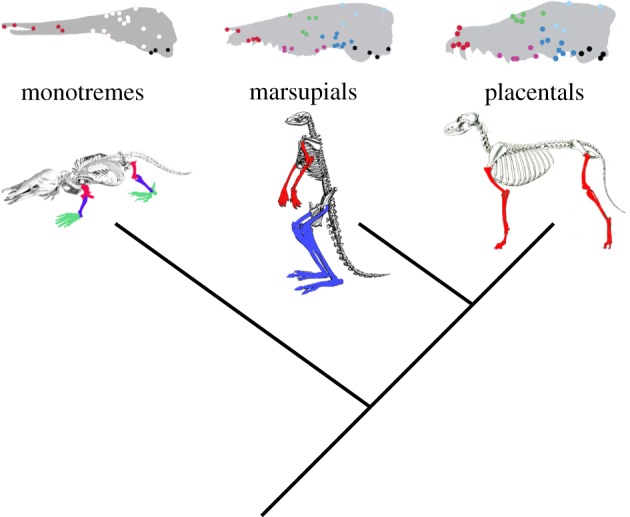
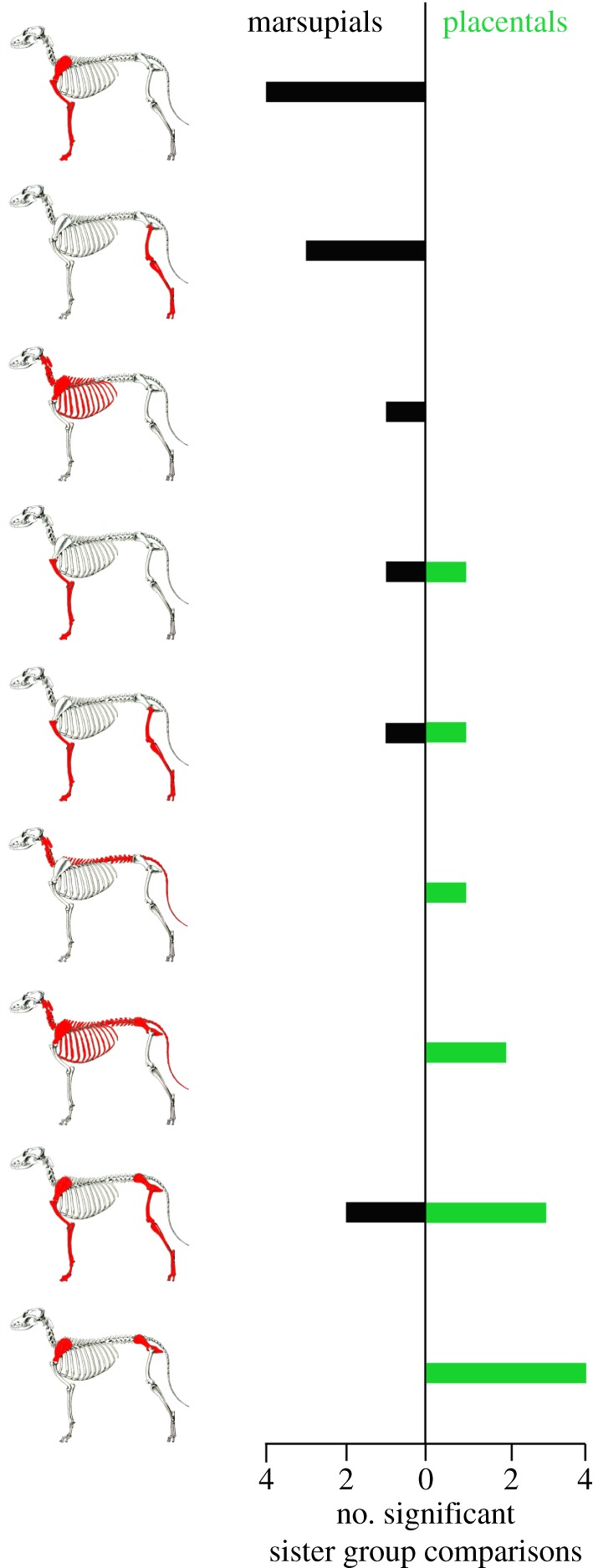
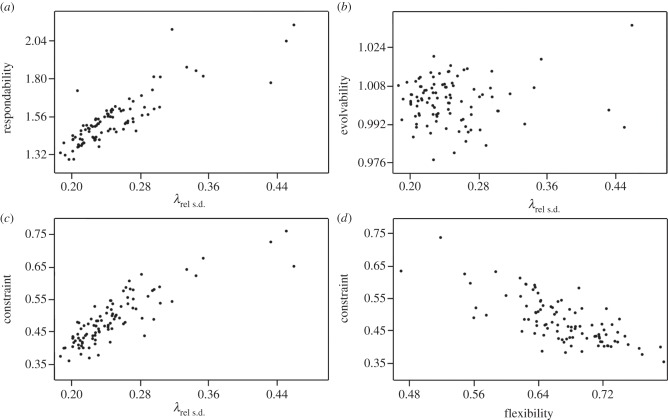
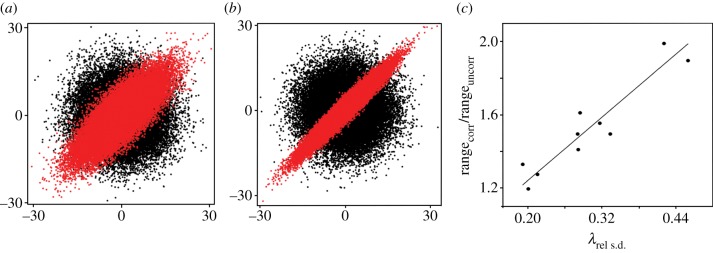
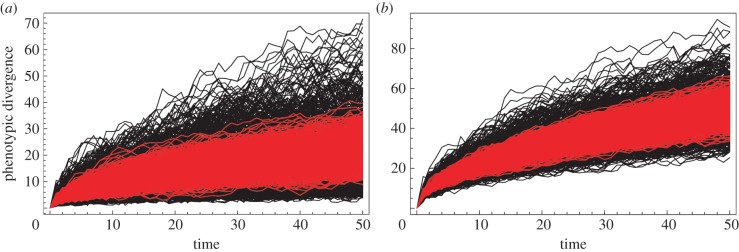
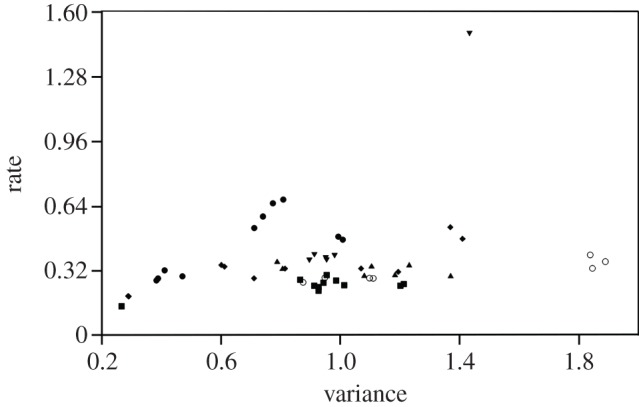
Phenotypic integration is a pervasive characteristic of organisms. Numerous analyses have demonstrated that patterns of phenotypic integration are conserved across large clades, but that significant variation also exists. For example, heterochronic shifts related to different mammalian reproductive strategies are reflected in postcranial skeletal integration and in coordination of bone ossification. Phenotypic integration and modularity have been hypothesized to shape morphological evolution, and we extended simulations to confirm that trait integration can influence both the trajectory and magnitude of response to selection. We further demonstrate that phenotypic integration can produce both more and less disparate organisms than would be expected under random walk models by repartitioning variance in preferred directions. This effect can also be expected to favour homoplasy and convergent evolution. New empirical analyses of the carnivoran cranium show that rates of evolution, in contrast, are not strongly influenced by phenotypic integration and show little relationship to morphological disparity, suggesting that phenotypic integration may shape the direction of evolutionary change, but not necessarily the speed of it. Nonetheless, phenotypic integration is problematic for morphological clocks and should be incorporated more widely into models that seek to accurately reconstruct both trait and organismal evolution.
Overview
The claims and statistics of this paper haven’t been checked yet.
Run the check — free, no account needed. It reads the open-access text and checks the sources it cites.
Integrity signals
Registry
Cites
Statistics
Figures
Verification
Claims the paper makes
The claims and statistics of this paper haven’t been checked yet.
Run the check — free, no account needed. It reads the open-access text and checks the sources it cites.
Claims other papers make about this one
Each is checked against this paper’s own text: does it say what the citing paper says it does?
The source backs part of the claim, not all of it — or backs it for a different population, condition or comparison.
In the citing paper
“Rather, the macroevolutionary consequences of integration are likely to be highly dependent on the direction and magnitude of selection on each module (13).”
From Developmental origins of mosaic evolution in the avian cranium (2018) · cites this paper as [13]
Experimental — accuracy not yet measuredThe source backs part of the claim, not all of it — or backs it for a different population, condition or comparison.
In the citing paper
“Taken together, these results support the fundamental prediction that macroevolutionary patterns are shaped by phenotypic modularity and integration, which are in turn determined by developmental processes (7, 11, 13, 16, 23).”
From Developmental origins of mosaic evolution in the avian cranium (2018) · cites this paper as [13]
Experimental — accuracy not yet measured
Self-check
Percentages, sums and reported differences re-computed from the paper’s own numbers.
The self-check needs the paper’s full text.
Citations
Cites
(1977) · Cited by 4,052
Løvtrup, S., & Gould, S. J. (1978) · Systematic Zoology · doi:10.2307/2412825 · Cited by 2,359
PERSPECTIVE: COMPLEX ADAPTATIONS AND THE EVOLUTION OF EVOLVABILITY
Wagner, G. P., & Altenberg, L. (1996) · Evolution · doi:10.1111/j.1558-5646.1996.tb02339.x · Cited by 2,118
The delayed rise of present-day mammals
Bininda-Emonds, O. R. P., Cardillo, M., Jones, K. E., MacPhee, R. D. E., Beck, R. M. D., Grenyer, R., Price, S. A., Vos, R. A., Gittleman, J. L., & Purvis, A. (2007) · Nature · doi:10.1038/nature05634 · Cited by 2,082
Martins, E. P., & Hansen, T. F. (1997) · The American Naturalist · doi:10.1086/286013 · Cited by 1,718
The Development of the Vertebrate Skull
(1938) · Nature · doi:10.1038/142004a0 · Cited by 1,425
Raff, R. A. (1996) · University of Chicago Press eBooks · doi:10.7208/chicago/9780226256573.001.0001 · Cited by 1,262
The shape of life: genes, development, and the evolution of animal form
(1996) · Choice Reviews Online · doi:10.5860/choice.34-1536 · Cited by 1,003
Perspective: Complex Adaptations and the Evolution of Evolvability
Wagner, G. P., & Altenberg, L. (1996) · Evolution · doi:10.2307/2410639 · Cited by 884
PHENOTYPIC, GENETIC, AND ENVIRONMENTAL MORPHOLOGICAL INTEGRATION IN THE CRANIUM
Cheverud, J. M. (1982) · Evolution · doi:10.1111/j.1558-5646.1982.tb05070.x · Cited by 859
Research works printed but not linked: 11
- Schlosser G, 2004, Modularity in development and evolution
- Atchley WR, 1993, The skull. 1 Development, 207
- Cheverud JM, 2004, Modularity in development and evolution, 132
- Goswami A, 2010, Quantitative methods in paleobiology, 213
- 10.1002/1096-8644(2000)43:31 <117::AID-AJPA5>3.3.CO;2-9 · DOI
- Klingenberg CP, 2008, MorphoJ
- Schlosser G, 2005, Modularity in development and evolution, 519
- Shubin N, 2004, Modularity in development and evolution, 429
- Zelditch ML, 2001, Beyond heterochrony: the evolution of development, 145
- Polly PD, 2012, Phylogenetics for mathematica, 2.1 edn
- Polly PD, 2004, On the simulation of the evolution of morphological shape: multivariate shape under selection and drift, Palaeontol. Electron., 7, 1
Cited by
Sorted by citations
mv morph : an r package for fitting multivariate evolutionary models to morphometric data
Clavel, J., Escarguel, G., & Merceron, G. (2015) · Methods in Ecology and Evolution · doi:10.1111/2041-210x.12420 · Cited by 524
Analyzing Fluctuating Asymmetry with Geometric Morphometrics: Concepts, Methods, and Applications
Klingenberg, C. P. (2015) · Symmetry · doi:10.3390/sym7020843 · Cited by 456
Integrated phenotypes: understanding trait covariation in plants and animals
Armbruster, W. S., Pélabon, C., Bolstad, G. H., & Hansen, T. F. (2014) · Philosophical Transactions of the Royal Society B Biological Sciences · doi:10.1098/rstb.2013.0245 · Cited by 311
Developmental origins of mosaic evolution in the avian cranium
Felice, R. N., & Goswami, A. (2018) · Proceedings of the National Academy of Sciences · doi:10.1073/pnas.1716437115 · Cited by 249
“Rather, the macroevolutionary consequences of integration are likely to be highly dependent on the direction and magnitude of selection on each module (13).”
BackgroundInfluentialSelf-citationAdams, D. C. (2016) · Methods in Ecology and Evolution · doi:10.1111/2041-210x.12511 · Cited by 257
Metadata
- Authors
- Goswami, A., Smaers, J. B., Soligo, C., & Polly, P. D.
- Affiliations
- University College London (GB)
- Indiana University Bloomington (US)
- Corresponding author
- Goswami, A.
- Venue
- Philosophical Transactions of the Royal Society B: Biological Sciences
- Publisher
- The Royal Society
- Published
- 2014-08-19
- Volume
- 369
- Issue
- 1649
- Pages
- 20130254
- ISSN
- 0962-8436 (ISSN-L)
- 1471-2970
- PMC
- PMC4084539
- OpenAlex
- W2158213278
- Cited by
- 359
- References
- 133
- Citations by year
- 2026: 20 · 2025: 30 · 2024: 27 · 2023: 39 · 2022: 30 · 2021: 40 · 2020: 30 · 2019: 42 · 2018: 34 · 2017: 19 · 2016: 26 · 2015: 17 · 2014: 5
- FWCI
- 31.00
- Type
- journal article
- Language
- en
- Open access
- hybrid
- doi.org
- Locations
- Philosophical Transactions of the Royal Society B Biological Sciences (publishedVersion, cc-by)
- Europe PMC (PubMed Central) (publishedVersion, cc-by)
- PubMed Central (publishedVersion, cc-by)
- PubMed (publishedVersion)
- UCL Discovery (University College London) (submittedVersion)
- Funders
- National Science Foundation (0308765, 0502186)
- American Museum of Natural History
- University of Chicago
- Field Museum
- Royal Society
- University of New South Wales
- National Museum of Natural History
- Natural Environment Research Council (NE/J012432/1, NE/H022937/1)
- Office of International Science and Engineering
- University of California Museum of Paleontology
- Topics
- Life Sciences › Agricultural and Biological Sciences › Ecology, Evolution, Behavior and Systematics › Morphological variations and asymmetry
- Physical Sciences › Earth and Planetary Sciences › Paleontology › Evolution and Paleontology Studies
- Life Sciences › Biochemistry, Genetics and Molecular Biology › Genetics › Evolution and Genetic Dynamics
- Keywords
- phenotypic integration, modularity, morphological evolution, heterochrony, postcranial skeleton, ossification, selection response, morphological disparity, homoplasy, convergent evolution, evolutionary rates, random walks
- MeSH terms
- Animals, Biological Evolution, Models, Biological, Phenotype, Phylogeny, Selection, Genetic, Time Factors, Vertebrates, Developmental Biology, Body Patterning, Biodiversity, Systems Biology
About these checks
Registry, retraction, Cites and statistics results are computed, not judged, with one exception: a printed reference that no index lists is read once by a model before it counts as a citation error. Claims are extracted by a model and kept only when their quote appears verbatim in the text; each cited source is then checked, with a model’s help, for whether it says what the claim relies on. Those verdicts can be wrong — read the claim’s quote and the cited source before relying on one.
Statistics and arithmetic are recomputed, not judged.
Confidence bands are shown only for fields calibrated on our annotated test set. None is calibrated yet, so no band is shown.
What counts as a claim ›How we measure confidence ›How we check this ›
Are you an author, or do you see a problem with this page? Request a review
