

The DOI matches its Crossref record; 153 of the 153 references it cites were found in a registry or an index.
The why, what, where, when and how of goal-directed choice: neuronal and computational principles
Open accessAbstract
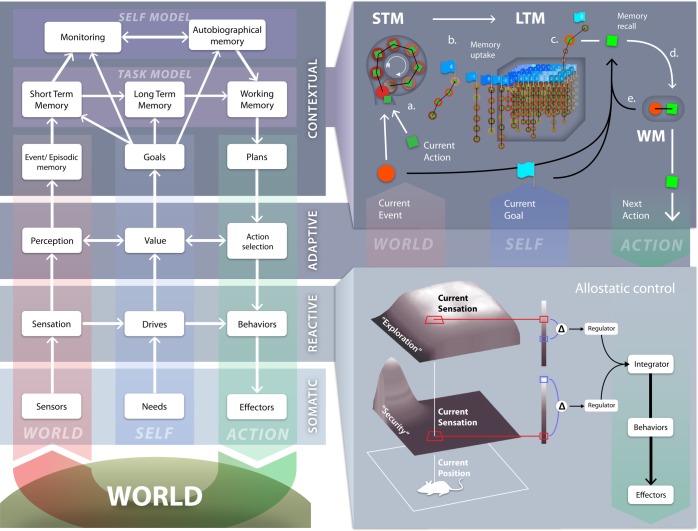
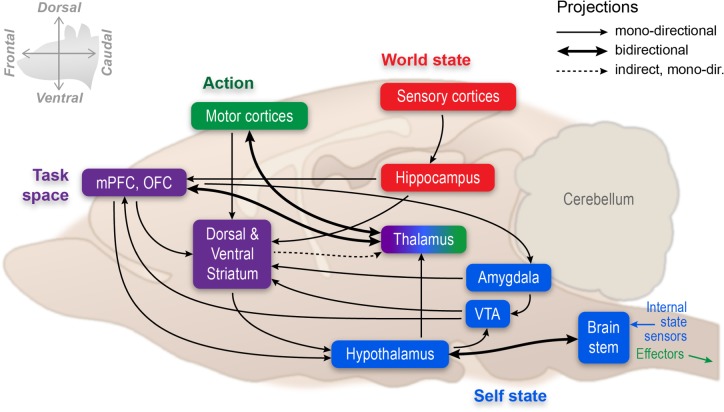
The central problems that goal-directed animals must solve are: 'What do I need and Why, Where and When can this be obtained, and How do I get it?' or the H4W problem. Here, we elucidate the principles underlying the neuronal solutions to H4W using a combination of neurobiological and neurorobotic approaches. First, we analyse H4W from a system-level perspective by mapping its objectives onto the Distributed Adaptive Control embodied cognitive architecture which sees the generation of adaptive action in the real world as the primary task of the brain rather than optimally solving abstract problems. We next map this functional decomposition to the architecture of the rodent brain to test its consistency. Following this approach, we propose that the mammalian brain solves the H4W problem on the basis of multiple kinds of outcome predictions, integrating central representations of needs and drives (e.g. hypothalamus), valence (e.g. amygdala), world, self and task state spaces (e.g. neocortex, hippocampus and prefrontal cortex, respectively) combined with multi-modal selection (e.g. basal ganglia). In our analysis, goal-directed behaviour results from a well-structured architecture in which goals are bootstrapped on the basis of predefined needs, valence and multiple learning, memory and planning mechanisms rather than being generated by a singular computation.
Overview
The claims and statistics of this paper haven’t been checked yet.
Run the check — free, no account needed. It reads the open-access text and checks the sources it cites.
Integrity signals
Registry
Cites
Statistics
Figures
Verification
Claims the paper makes
The claims and statistics of this paper haven’t been checked yet.
Run the check — free, no account needed. It reads the open-access text and checks the sources it cites.
Claims other papers make about this one
Each is checked against this paper’s own text: does it say what the citing paper says it does?
The cited source says what the claim attributes to it.
In the citing paper
“In most psychological theories, drives are usually linked to basic motivations and homoeostasis (e.g., interoceptive hunger or thirst), while goals are considered to have more elaborate (exteroceptive) sensory and cognitive aspects (e.g., dining in a restaurant), but their relations are often unclear from a mechanistic viewpoint (Pezzulo et al., 2014b, Verschure et al., 2014).”
From Active Inference, homeostatic regulation and adaptive behavioural control (2015) · cites this paper as Verschure et al., 2014
Self-check
Percentages, sums and reported differences re-computed from the paper’s own numbers.
The self-check needs the paper’s full text.
Citations
Cites
The free-energy principle: a unified brain theory?
Friston, K. (2010) · Nature Reviews Neuroscience · doi:10.1038/nrn2787 · Cited by 8,120 · cited 1×
“CSL is consistent with ‘predictive brain’ frameworks and ‘free energy minimization’ principles [29,30].”
MethodReal-Time Obstacle Avoidance for Manipulators and Mobile Robots
Khatib, O. (1986) · The International Journal of Robotics Research · doi:10.1177/027836498600500106 · Cited by 7,894 · cited 1×
“This idea has its roots in Gestalt psychology [20] and is a standard approach towards robot navigation [21] but generalizes towards optimal path planning in mobile robots [22] and social interaction in humanoid robots [23].”
BackgroundSearle, J. R. (1980) · Behavioral and Brain Sciences · doi:10.1017/s0140525x00005756 · Cited by 6,954 · cited 1×
“The AL allows the agent to overcome the predefined behavioural repertoire of the RL and to engage an a priori unpredictable world, solving the notorious symbol grounding that led to the demise of classical AI [3,28].”
BackgroundCognitive maps in rats and men
Tolman, E. C. (1948) · Psychological Review · doi:10.1037/h0061626 · Cited by 6,641 · cited 1×
“The first view holds that the hippocampus codes an agent’s position in space, as inspired by the Cognitive Map theory of Tolman [63] as well as the body of place-cell research initiated by O’Keefe & Dostrovsky [64].”
MethodThe hippocampus as a spatial map. Preliminary evidence from unit activity in the freely-moving rat
O'Keefe, J., & Dostrovsky, J. (1971) · Brain Research · doi:10.1016/0006-8993(71)90358-1 · Cited by 6,151
Episodic memory: from mind to brain
Tulving, E. (2002) · Annual Review of Psychology · doi:10.1146/annurev.psych.53.100901.135114 · Cited by 4,950 · cited 1×
“The second notion accounts for hippocampal function as a ‘recorder’ of experience—an organ for the formation of episodic memories that would be transferred, with the passage of time, to neocortical sites where also generalization (semanticization) of memory may take place [65].”
BackgroundPredictive reward signal of dopamine neurons
Schultz, W. (1998) · Journal of Neurophysiology · doi:10.1152/jn.1998.80.1.1 · Cited by 4,564 · cited 1×
“Building on previous models that framed the basal ganglia as an actor–critic architecture for (model-free) reinforcement learning [120,121], we recently argued that especially the ‘Critic’ (goal-predictive) function of the striatum is well supported by the data, whereas its implementation of the ‘Actor’ component is m…”
ResultAffective Neuroscience: The Foundations of Human and Animal Emotions
Panksepp, J. (1998) · doi:10.1093/oso/9780195096736.001.0001 · Cited by 4,428
(1991) · Choice Reviews Online · doi:10.5860/choice.28-5376 · Cited by 4,218
(1998) · Cited by 4,012
Research works printed but not linked: 8
- Verschure PFMJ, 2013, Formal minds and biological brains II: from the mirage of intelligence to a science and engineering of consciousness, IEEE Expert., 28, 33
- Panksepp J, 2012, The archaeology of mind: neuroevolutionary origins of human emotions (Norton series on interpersonal neurobiology)
- Sanchez-Fibla MS, 2010, IEEE/RSJ Int. Conf. 18–22 October 2010
- Miller S, 1928, Sur une forme particuliere des reflexes conditionnels, C.R. Seances Soc. Polonaise Biol., 49, 1155
- Ringwald M, 2007, ECMR 2007–3rd European Conf. on Mobile Robots
- Simerly R, 1995, The rat nervous system, 353
- Gray JA, 2000, The neuropsychology of anxiety: an enquiry into thé functions of thesepto-hippocampal system
- Verschure PFMJ, 2012, The distributed adaptive control architecture of the mind, brain, body nexus, Biol. Inspired Cogn. Archit., 1, 55
Cited by
Sorted by citations
Items 101–131 of 131
Puigbò, J.-Y., Moulin-Frier, C., Vouloutsi, V., Sánchez-Fibla, M., Herreros, I., & Verschure, P. F. M. J. (2015) · IEEE-RAS International Conference on Humanoid Robots (Humanoids) · doi:10.1109/humanoids.2015.7363580 · Cited by 2
“This structure nicely fits the biologically grounded Distributed Adaptive Control framework (DAC, [21], [23]).”
BackgroundPetracca, E. (2022) · Economics and Philosophy · doi:10.1017/s0266267122000189 · Cited by 2
“For instance, cognitive approaches to learning have long maintained that pursuing a goal requires a complex interplay of cognitive processes such as planning and imagination (Verschure et al. 2014).”
BackgroundEffenberg, A. O., & Schmitz, G. H. (2023) · Springer eBooks · doi:10.1007/978-3-662-53410-6_60 · Cited by 2
Grid cells: the missing link in understanding Parkinson’s disease?
Reinshagen, A. (2024) · Frontiers in Neuroscience · doi:10.3389/fnins.2024.1276714 · Cited by 3
“…versa, the striatum and the HF/EC are effectively linked (Finch et al., 1995; Totterdell and Meredith, 1997; Devan and White, 1999; Hartley et al., 2003; Johnson et al., 2007; Lex and Hauber, 2010; van der Meer et al., 2010; Ghiglieri et al., 2011; Verschure et al., 2014; Stoianov et al., 2018).”
BackgroundFeeling Artificial Intelligence. Cognitive Decision-Making Model Borrowed from Living Beings
Kargin, A., & Petrenko, T. (2024) · International Symposium on Networks, Computers and Communications (ISNCC) · doi:10.1109/isncc62547.2024.10759016 · Cited by 1
“Thus, the above two approaches aimed to construct Hybrid AI for robots occupy different niches of hierarchical cognitive architecture [11, 12], and their possible integration in future FAI can high level of the service given by robots.”
Modelling Agency Perception in a Multi-agent Context in Depression Using Active Inference
Pitliya, R. J., Marković, D., Folesani, F., Murri, M. B., Castiello, S., & Murphy, R. A. (2024) · Communications in computer and information science · doi:10.1007/978-3-031-77138-5_2 · Cited by 1
Prescott, T. J., & Jiménez-Rodríguez, A. (2025) · The Psychology of learning and motivation/The psychology of learning and motivation · doi:10.1016/bs.plm.2025.03.005 · Cited by 1
Li, M., Cheng, S., Fan, J., Shang, Z., & Wan, H. (2022) · Brain Research Bulletin · doi:10.1016/j.brainresbull.2022.03.007 · Cited by 2
Towards sample-efficient policy learning with DAC-ML
Freire, I. T., Amil, A. F., Vouloutsi, V., & Verschure, P. F. M. J. (2021) · Procedia Computer Science · doi:10.1016/j.procs.2021.06.035 · Cited by 1
“It is built based on the architectural principles of DAC of layered and hierarchical organization, that predicate that cognition is hierarchically distributed in different layers of control [10], [11], [12].”
BackgroundA Generalised Inverse Reinforcement Learning FrameworkPreprint
Jarboui, F., & Perchet, V. (2021) · arXiv (Cornell University) · doi:10.48550/arxiv.2105.11812 · Cited by 2
Goma, S. R. (2015) · Proceedings of SPIE, the International Society for Optical Engineering/Proceedings of SPIE · doi:10.1117/12.2086166
“In other words, in complex designs, the ‘why’ becomes very hard to define as opposed to ‘what-how’ and the ‘why’ is associated with ‘system-level’ view of a problem – in terms of cognition the ‘what-how’ would be problem solving whereas the ‘why’ would define the context in which the problem solving should occur, very…”
ResultKassem, M. S. (2017) · The Sydney eScholarship Repository (The University of Sydney)
Notice of Violation of IEEE Publication Principles: Influence of Emotions in Shaping Decisions
Ghosh, A., & Huang, S. (2019) · IEEE National Aerospace and Electronics Conference (NAECON) · doi:10.1109/naecon46414.2019.9058296
“Continuing along the process of decision-making, experienced emotion can contribute to reinforcement learning [52][53][54][49], increases the memory [55][56] of both positive and negative emotions.”
BackgroundTowards sample-efficient episodic control with DAC-MLPreprint
Freire, I. T., Amil, A. F., Vouloutsi, V., & Verschure, P. F. M. J. (2020) · arXiv (Cornell University) · doi:10.48550/arxiv.2012.13779
“It is built based on the architectural principles of DAC of layered and hierarchical organization, that predicate that cognition is hierarchically distributed in different layers of control [10], [11], [12].”
BackgroundBarros, K. O., de Almeida, D. M., & Bueno, K. D. O. (2021) · LA Referencia (Red Federada de Repositorios Institucionales de Publicaciones Científicas)
Gaze-Related Activity in Primate Frontal Cortex Predicts and Mitigates Spatial UncertaintyPreprint
Bharmauria, V., Schütz, A., Khoozani, P. A., Yan, X., Wang, H., Bremmer, F., & Crawford, J. D. (2021) · bioRxiv (Cold Spring Harbor Laboratory) · doi:10.1101/2021.06.20.449147
Computer Aided Search Tasks in a Naturally Occurring Environment
Harrington, K., Pinchin, J., & Sharples, S. (2021) · Lecture notes in computer science · doi:10.1007/978-3-030-77932-0_22
Tognoli, E., & Huang, S. (2021) · arXiv (Cornell University) · doi:10.48550/arxiv.2110.01503
Verschure, P. F. M. J. (2021) · Biosystems & biorobotics · doi:10.1007/978-3-030-70316-5_92
Perkes, I. E., Morris, R. W., Griffiths, K. R., Quail, S. L., Waters, F. A., O’Brien, M., Hazell, P., & Balleine, B. W. (2022) · medRxiv · doi:10.1101/2022.03.19.22272645
Borges, V. P. M. (2023) · ResearchEquals · doi:10.53962/m326-qk7j
Kennedy, E. A. (2023) · Digital Repository Service (Northeastern University) · doi:10.17760/d20481307
Schwarb, H. D., Dulas, M. R., Patel, N. N., Bouton, N. A., Cohen, N. J., & Duff, M. C. (2025) · Neuropsychologia · doi:10.1016/j.neuropsychologia.2025.109157
The effects of task-relevant suggestions on motivated cognitive control
Zahedi, A., & Sommer, W. (2025) · International review of neurobiology · doi:10.1016/bs.irn.2025.06.003
Cognitive Architectures: Definition, Examples, and Challenges
Verschure, P. F. M. J. (2024) · Springer eBooks · doi:10.1007/978-3-642-41610-1_206-1 · Cited by 2
The Brain’s Extended Navigation Network
Patai, E. Z., Brown, T. I., Ciocchi, S., Goard, M. J., Jadhav, S. P., Keshavarzi, S., Krupic, J., Laurens, J., Vervaeke, K., & Jeffery, K. J. (2026) · Springer eBooks · doi:10.1007/978-3-032-20563-6_12
Brain-inspired predictive control of robotic sensorimotor systems
Pio‐Lopez, L. (2017) · theses.fr (ABES) · doi:10.70675/cb356dbdz484cz4dd4zaad7z6622007ab33b
Puygrenier, L. (2019) · theses.fr (ABES) · doi:10.70675/c632ab07z5b2ez4f68zaa26z9533043f65ab
Feeling artificial intelligence. Attention engine model borrowed from living beings
Kargin, A., & Petrenko, T. (2024) · International Conference on Information Control Systems & Technologies (ICST) · doi:10.55056/ceur-ws.org/vol-3790/paper39.pdf
“In [10, 11], hypothetical neuronal architecture of the mammalian brain where cognitive processes divided over different layers is proposed.”
Metadata
- Authors
- Verschure, P. F. M. J., Pennartz, C. M. A., & Pezzulo, G.
- Affiliations
- Institució Catalana de Recerca i Estudis Avançats (ES)
- University of Amsterdam (NL)
- National Research Council (IT)
- Corresponding author
- Verschure, Paul F. M. J.
- Venue
- Philosophical Transactions of the Royal Society B Biological Sciences
- Publisher
- The Royal Society
- Published
- 2014-11-05
- Volume
- 369
- Issue
- 1655
- Pages
- 20130483
- ISSN
- 0962-8436 (ISSN-L)
- 1471-2970
- PMC
- PMC4186236
- OpenAlex
- W2143590399
- Semantic Scholar
- defe4585fd20817ba121287456fe83112d9582f7
- Cited by
- 131
- References
- 152
- Citations by year
- 2026: 1 · 2025: 6 · 2024: 11 · 2023: 11 · 2022: 9 · 2021: 16 · 2020: 11 · 2019: 13 · 2018: 11 · 2017: 10 · 2016: 15 · 2015: 16 · 2014: 1
- FWCI
- 1.35
- Type
- journal article
- Language
- en
- Open access
- hybrid
- doi.org
- Locations
- Philosophical Transactions of the Royal Society B Biological Sciences (publishedVersion, cc-by)
- PubMed Central (publishedVersion, cc-by)
- PubMed (publishedVersion)
- UvA-DARE (University of Amsterdam) (publishedVersion)
- UvA-DARE (University of Amsterdam) (submittedVersion)
- Repositori digital de la UPF (Universitat Pompeu Fabra) (submittedVersion, cc-by)
- Data Archiving and Networked Services (DANS) (submittedVersion)
- Topics
- Life Sciences › Neuroscience › Cognitive Neuroscience › Neural and Behavioral Psychology Studies
- Life Sciences › Neuroscience › Cognitive Neuroscience › Memory and Neural Mechanisms
- Physical Sciences › Computer Science › Artificial Intelligence › Psychiatry, Mental Health, Neuroscience
- Keywords
- goal-directed behavior, distributed adaptive control, embodied cognition, outcome prediction, valence, basal ganglia, hippocampus, prefrontal cortex, amygdala, hypothalamus, action planning, learning and memory, neurorobotics
- MeSH terms
- Animals, Artificial Intelligence, Behavior, Animal, Brain, Choice Behavior, Cognition, Goals, Rodentia
About these checks
Registry, retraction, Cites and statistics results are computed, not judged, with one exception: a printed reference that no index lists is read once by a model before it counts as a citation error. Claims are extracted by a model and kept only when their quote appears verbatim in the text; each cited source is then checked, with a model’s help, for whether it says what the claim relies on. Those verdicts can be wrong — read the claim’s quote and the cited source before relying on one.
Statistics and arithmetic are recomputed, not judged.
Confidence bands are shown only for fields calibrated on our annotated test set. None is calibrated yet, so no band is shown.
What counts as a claim ›How we measure confidence ›How we check this ›
Are you an author, or do you see a problem with this page? Request a review
