

The DOI matches its Crossref record; 153 of the 153 references it cites were found in a registry or an index.
The why, what, where, when and how of goal-directed choice: neuronal and computational principles
Open accessAbstract
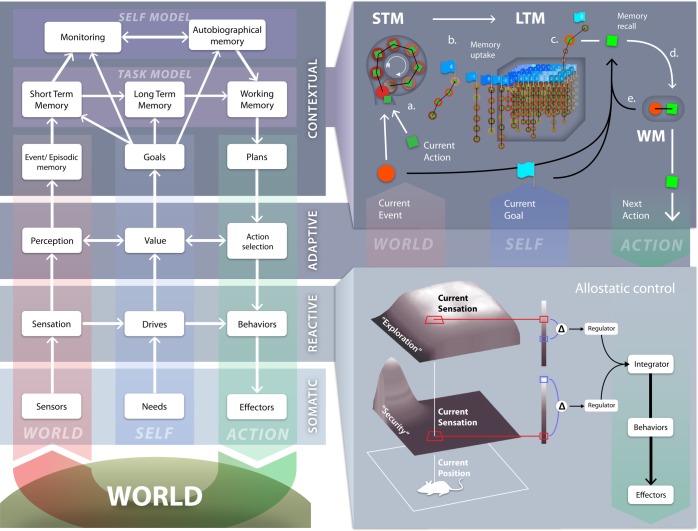
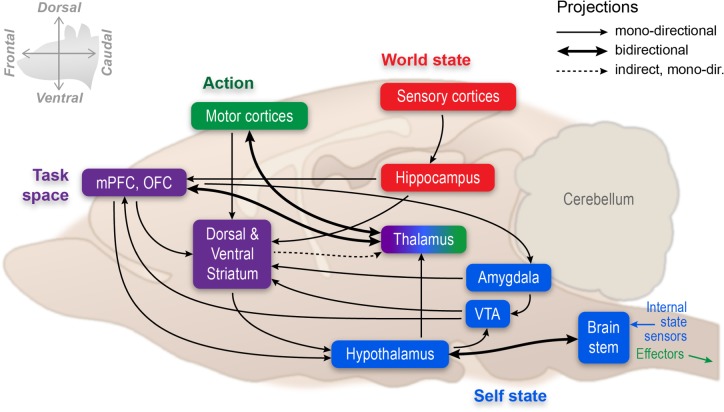
The central problems that goal-directed animals must solve are: 'What do I need and Why, Where and When can this be obtained, and How do I get it?' or the H4W problem. Here, we elucidate the principles underlying the neuronal solutions to H4W using a combination of neurobiological and neurorobotic approaches. First, we analyse H4W from a system-level perspective by mapping its objectives onto the Distributed Adaptive Control embodied cognitive architecture which sees the generation of adaptive action in the real world as the primary task of the brain rather than optimally solving abstract problems. We next map this functional decomposition to the architecture of the rodent brain to test its consistency. Following this approach, we propose that the mammalian brain solves the H4W problem on the basis of multiple kinds of outcome predictions, integrating central representations of needs and drives (e.g. hypothalamus), valence (e.g. amygdala), world, self and task state spaces (e.g. neocortex, hippocampus and prefrontal cortex, respectively) combined with multi-modal selection (e.g. basal ganglia). In our analysis, goal-directed behaviour results from a well-structured architecture in which goals are bootstrapped on the basis of predefined needs, valence and multiple learning, memory and planning mechanisms rather than being generated by a singular computation.
Overview
The claims and statistics of this paper haven’t been checked yet.
Run the check — free, no account needed. It reads the open-access text and checks the sources it cites.
Integrity signals
Registry
Cites
Statistics
Figures
Verification
Claims the paper makes
The claims and statistics of this paper haven’t been checked yet.
Run the check — free, no account needed. It reads the open-access text and checks the sources it cites.
Claims other papers make about this one
Each is checked against this paper’s own text: does it say what the citing paper says it does?
The cited source says what the claim attributes to it.
In the citing paper
“In most psychological theories, drives are usually linked to basic motivations and homoeostasis (e.g., interoceptive hunger or thirst), while goals are considered to have more elaborate (exteroceptive) sensory and cognitive aspects (e.g., dining in a restaurant), but their relations are often unclear from a mechanistic viewpoint (Pezzulo et al., 2014b, Verschure et al., 2014).”
From Active Inference, homeostatic regulation and adaptive behavioural control (2015) · cites this paper as Verschure et al., 2014
Self-check
Percentages, sums and reported differences re-computed from the paper’s own numbers.
The self-check needs the paper’s full text.
Citations
Cites
The free-energy principle: a unified brain theory?
Friston, K. (2010) · Nature Reviews Neuroscience · doi:10.1038/nrn2787 · Cited by 8,120 · cited 1×
“CSL is consistent with ‘predictive brain’ frameworks and ‘free energy minimization’ principles [29,30].”
MethodReal-Time Obstacle Avoidance for Manipulators and Mobile Robots
Khatib, O. (1986) · The International Journal of Robotics Research · doi:10.1177/027836498600500106 · Cited by 7,894 · cited 1×
“This idea has its roots in Gestalt psychology [20] and is a standard approach towards robot navigation [21] but generalizes towards optimal path planning in mobile robots [22] and social interaction in humanoid robots [23].”
BackgroundSearle, J. R. (1980) · Behavioral and Brain Sciences · doi:10.1017/s0140525x00005756 · Cited by 6,954 · cited 1×
“The AL allows the agent to overcome the predefined behavioural repertoire of the RL and to engage an a priori unpredictable world, solving the notorious symbol grounding that led to the demise of classical AI [3,28].”
BackgroundCognitive maps in rats and men
Tolman, E. C. (1948) · Psychological Review · doi:10.1037/h0061626 · Cited by 6,641 · cited 1×
“The first view holds that the hippocampus codes an agent’s position in space, as inspired by the Cognitive Map theory of Tolman [63] as well as the body of place-cell research initiated by O’Keefe & Dostrovsky [64].”
MethodThe hippocampus as a spatial map. Preliminary evidence from unit activity in the freely-moving rat
O'Keefe, J., & Dostrovsky, J. (1971) · Brain Research · doi:10.1016/0006-8993(71)90358-1 · Cited by 6,151
Episodic memory: from mind to brain
Tulving, E. (2002) · Annual Review of Psychology · doi:10.1146/annurev.psych.53.100901.135114 · Cited by 4,950 · cited 1×
“The second notion accounts for hippocampal function as a ‘recorder’ of experience—an organ for the formation of episodic memories that would be transferred, with the passage of time, to neocortical sites where also generalization (semanticization) of memory may take place [65].”
BackgroundPredictive reward signal of dopamine neurons
Schultz, W. (1998) · Journal of Neurophysiology · doi:10.1152/jn.1998.80.1.1 · Cited by 4,564 · cited 1×
“Building on previous models that framed the basal ganglia as an actor–critic architecture for (model-free) reinforcement learning [120,121], we recently argued that especially the ‘Critic’ (goal-predictive) function of the striatum is well supported by the data, whereas its implementation of the ‘Actor’ component is m…”
ResultAffective Neuroscience: The Foundations of Human and Animal Emotions
Panksepp, J. (1998) · doi:10.1093/oso/9780195096736.001.0001 · Cited by 4,428
(1991) · Choice Reviews Online · doi:10.5860/choice.28-5376 · Cited by 4,218
(1998) · Cited by 4,012
Principles of topological psychology.
Lewin, K. (1936) · McGraw-Hill eBooks · doi:10.1037/10019-000 · Cited by 3,938
The psychology of fear and stress
(1988) · Choice Reviews Online · doi:10.5860/choice.26-2399 · Cited by 3,133 · cited 1×
“These sensorimotor loops are organized in fundamental and opposing behaviour systems that support basic needs such as fight, flight [15], seek and play [16].”
BackgroundReactivation of hippocampal ensemble memories during sleep
Wilson, M. A., & McNaughton, B. L. (1994) · Science · doi:10.1126/science.8036517 · Cited by 3,118 · cited 1×
“In addition to storing information, the hippocampus is able to retrieve previously stored information and to self-generate internal sequences of cell activity that are subsequently used to map novel environments or situations [82–84].”
Conditioned Reflexes: An Investigation of the Physiological Activity of the Cerebral Cortex.
Pavlov, P. I. (1930) · Archives of Neurology And Psychiatry · doi:10.1001/archneurpsyc.1930.02220110256018 · Cited by 2,681
Daw, N. D., Niv, Y., & Dayan, P. (2005) · Nature Neuroscience · doi:10.1038/nn1560 · Cited by 2,533 · cited 1×
“Neuroscience and neuroeconomics have often benefited from a close linkage to computational methods but these often abstract from many details of situated action (e.g. model-based reinforcement learning theories [134,135] and several contributions to this special issue).”
BackgroundPurposive Behavior in Animals and Men
Rodhom, C., & Tolman, E. C. (1950) · The American Journal of Psychology · doi:10.2307/1418946 · Cited by 2,455 · cited 1×
“With the cognitive revolution, these notions were again incorporated in the terminology of mind and brain [1] but the mechanistic functioning and neuronal underpinnings of goal-directed behaviour remained largely unknown.”
BackgroundAlexander, G. E., Crutcher, M. D., & DeLong, M. R. (1990) · PubMed · Cited by 2,422
The role of the basal ganglia in habit formation
Yin, H. H., & Knowlton, B. J. (2006) · Nature Reviews Neuroscience · doi:10.1038/nrn1919 · Cited by 2,402 · cited 1×
“associations (and ensuing habits) can be acquired via the dorsal striatal system [80,81].”
Background“Materialism and Qualia: The Explanatory Gap
Levine, J. (1983) · Pacific Philosophical Quarterly · doi:10.1111/j.1468-0114.1983.tb00207.x · Cited by 2,150 · cited 1×
“As much as there is a ‘hard problem’ in the explanation of consciousness [4,5], we can argue that a similar explanatory gap exists in understanding goal-oriented behaviour, it also critically depends on inferences by the observer on the beliefs an organism entertains with respect to its goals and tasks.”
BackgroundFacing up to the problem of consciousness
Chalmers, D. J. (1996) · Toward a Science of Consciousness · doi:10.7551/mitpress/6860.003.0003 · Cited by 1,966
(1991) · Progress in Brain Research · doi:10.1016/s0079-6123(08)62678-3 · Cited by 1,961
Conditioned Reflexes: an Investigation of the Physiological Activity of the Cerebral Cortex
Denny-Brown, D. E. (1928) · Nature · doi:10.1038/121662a0 · Cited by 1,854
Neural correlates of decision variables in parietal cortex
Platt, M. L., & Glimcher, P. W. (1999) · Nature · doi:10.1038/22268 · Cited by 1,721 · cited 1×
“Even structures such as posterior parietal cortex and primary sensory cortex (A1, V1) are deeply affected by associative stimulus–reward and action–reward learning [56–62].”
BackgroundPattern Separation in the Dentate Gyrus and CA3 of the Hippocampus
Leutgeb, J. K., Leutgeb, S., Moser, M.-B., & Moser, E. I. (2007) · Science · doi:10.1126/science.1135801 · Cited by 1,601
Neurons in the orbitofrontal cortex encode economic value
Padoa-Schioppa, C., & Assad, J. A. (2006) · Nature · doi:10.1038/nature04676 · Cited by 1,598 · cited 1×
“Importantly, orbito-frontal and medial prefrontal-anterior cingulate neurons are sensitive to the motivational value of cues [100–104] and actions associated with goal pursuit [105,106].”
BackgroundThe effects of changes in the environment on the spatial firing of hippocampal complex-spike cells
Muller, R., & Kubie, J. (1987) · The Journal of Neuroscience · doi:10.1523/jneurosci.07-07-01951.1987 · Cited by 1,581 · cited 1×
“Moreover, the representation of the task seems to follow a multiplexing of input streams combining sensory, location and action information at both the input and memory stages of hippocampal processing wood [66,71–73].”
BackgroundPackard, M. G., & McGaugh, J. L. (1996) · Neurobiology of Learning and Memory · doi:10.1006/nlme.1996.0007 · Cited by 1,566 · cited 1×
“B 369 : 20130483 associations (and ensuing habits) can be acquired via the dorsal striatal system [80,81].”
BackgroundGoal-directed instrumental action: contingency and incentive learning and their cortical substrates
Balleine, B. W., & Dickinson, A. (1998) · Neuropharmacology · doi:10.1016/s0028-3908(98)00033-1 · Cited by 1,541 · cited 3×
“Furthermore, if the value/utility of a goal changes, for instance because of a change in motivational state, the organism should refrain from persistently conducting a fixed stimulus–response sequence or habit, but must adjust its response according to the change in value [7].”
BackgroundDissociation in prefrontal cortex of affective and attentional shifts
Dias, R., Robbins, T. W., & Roberts, A. C. (1996) · Nature · doi:10.1038/380069a0 · Cited by 1,527 · cited 1×
“Lesion studies have confirmed a causal involvement of prefrontal structures in representing goals and task rules, implying orbitofrontal cortex in reversal learning and medial prefrontal cortex in both extra-dimensional shifting [107,108] and learning action–outcome relationships [7,109].”
BackgroundConditioned reflexes: An investigation of the physiological activity of the cerebral cortex
Pavlov, I. P. (2010) · Annals of Neurosciences · doi:10.5214/ans.0972-7531.1017309 · Cited by 1,466 · cited 1×
“…by the RL, following the paradigm of classical conditioning where initially neutral or conditioned stimuli (CS) obtain the ability to trigger actions, or conditioned reponses (CR), by virtue of their contingent presentation with intrinsically motivational stimuli or unconditioned stimuli (US) [12].”
BackgroundAllostasis: A New Paradigm to Explain Arousal Pathology
Sterling, P., & Eyer, J. (1988) · Zenodo · doi:10.5281/zenodo.13537700 · Cited by 1,450
Medial Frontal Cortex Mediates Perceptual Attentional Set Shifting in the Rat
Birrell, J. M., & Brown, V. J. (2000) · The Journal of Neuroscience · doi:10.1523/jneurosci.20-11-04320.2000 · Cited by 1,421 · cited 1×
“Lesion studies have confirmed a causal involvement of prefrontal structures in representing goals and task rules, implying orbitofrontal cortex in reversal learning and medial prefrontal cortex in both extra-dimensional shifting [107,108] and learning action–outcome relationships [7,109].”
BackgroundMultiple dopamine functions at different time courses
Schultz, W. (2007) · Annual Review of Neuroscience · doi:10.1146/annurev.neuro.28.061604.135722 · Cited by 1,415 · cited 1×
“…such as comparison—at least in the domain of reward and appetitive learning—is the reward-prediction-error mechanism that may be implemented by mesodiencephalic dopaminergic neurons projecting to striatum and prefrontal cortex [125], while the habenula has been implied in aversive learning [126].”
BackgroundFacing Up to the Problem of Consciousness
Chalmers, D. J. (1998) · Routledge eBooks · doi:10.4324/9780203826430-11 · Cited by 1,334
Relative reward preference in primate orbitofrontal cortex
Tremblay, L., & Schultz, W. (1999) · Nature · doi:10.1038/19525 · Cited by 1,314 · cited 1×
“Importantly, orbitofrontal and medial prefrontal-anterior cingulate neurons are sensitive to the motivational value of cues [100–104] and actions associated with goal pursuit [105,106].”
BackgroundInternally Generated Cell Assembly Sequences in the Rat Hippocampus
Pastalkova, E., Itskov, V., Amarasingham, A., & Buzsáki, G. (2008) · Science · doi:10.1126/science.1159775 · Cited by 1,301
Hippocampal place-cell sequences depict future paths to remembered goals
Pfeiffer, B. E., & Foster, D. J. (2013) · Nature · doi:10.1038/nature12112 · Cited by 1,216 · cited 3×
“Thus, during ongoing goal-directed behaviour, as well as ‘off-line’, the hippocampus has multiple modes to (re-)generate and recall information from memory, which can be flexibly used to guide decision-making and/or support consolidation [90,91].”
BackgroundThe basal ganglia: a vertebrate solution to the selection problem?
Redgrave, P., Prescott, T. J., & Gurney, K. (1999) · Neuroscience · doi:10.1016/s0306-4522(98)00319-4 · Cited by 1,199
Models of Information Processing in the Basal Ganglia
(1994) · doi:10.7551/mitpress/4708.001.0001 · Cited by 1,190
Putting a spin on the dorsal-ventral divide of the striatum
Voorn, P., Vanderschuren, L. J. M. J., Groenewegen, H. J., Robbins, T. W., & Pennartz, C. M. A. (2004) · Trends in Neurosciences · doi:10.1016/j.tins.2004.06.006 · Cited by 1,188 · cited 1×
“…inputs), dorsomedial sector (mainly anterior cingulate and prelimbic inputs), a ventrolateral sector (the‘core’ ofnucleusaccumbens; mainlyamygdaloid, prelimbic and dorsal hippocampal input) and a ventromedial sector (‘shell’; mainly prelimbic, infralimbic and ventral hippocampal input [115]).”
BackgroundGläscher, J., Daw, N., Dayan, P., & O'Doherty, J. P. (2010) · Neuron · doi:10.1016/j.neuron.2010.04.016 · Cited by 1,166
The role of the dorsomedial striatum in instrumental conditioning
Yin, H. H., Ostlund, S. B., Knowlton, B. J., & Balleine, B. W. (2005) · European Journal of Neuroscience · doi:10.1111/j.1460-9568.2005.04218.x · Cited by 1,099 · cited 1×
“The dorsomedial striatum, for instance, has been implied in action-outcome learning [122], whereas the ventral striatal core functions in cue-outcome learning, in conjunction with its strong amygda-loid input [9,123].”
BackgroundSingle neurons in prefrontal cortex encode abstract rules
Wallis, J. D., Anderson, K. C., & Miller, E. K. (2001) · Nature · doi:10.1038/35082081 · Cited by 1,075 · cited 1×
“Neurophysiological studies in rodents and primates indicate that prefrontal neurons can encode task rules that need to be followed to obtain a goal [94], individual actions or chunks of actions leading up to a goal [95–97], and goals and goal sites themselves [98,99].”
BackgroundThe Hippocampus, Memory, and Place Cells
Eichenbaum, H., Dudchenko, P., Wood, E., Shapiro, M., & Tanila, H. (1999) · Neuron · doi:10.1016/s0896-6273(00)80773-4 · Cited by 1,064
Theta rhythms coordinate hippocampal-prefrontal interactions in a spatial memory task
Jones, M. W., & Wilson, M. A. (2005) · PLoS Biology · doi:10.1371/journal.pbio.0030402 · Cited by 1,036
Matching Behavior and the Representation of Value in the Parietal Cortex
Sugrue, L. P., Corrado, G. S., & Newsome, W. T. (2004) · Science · doi:10.1126/science.1094765 · Cited by 1,030 · cited 2×
“Even structures such as posterior parietal cortex and primary sensory cortex (A1, V1) are deeply affected by associative stimulus–reward and action–reward learning [56–62].”
BackgroundMethodNeural ensembles in CA3 transiently encode paths forward of the animal at a decision point
Johnson, A., & Redish, A. D. (2007) · The Journal of Neuroscience · doi:10.1523/jneurosci.3761-07.2007 · Cited by 1,003
Hippocampal replay in the awake state: a potential substrate for memory consolidation and retrieval
Carr, M. F., Jadhav, S. P., & Frank, L. M. (2011) · Nature Neuroscience · doi:10.1038/nn.2732 · Cited by 958 · cited 1×
“In addition to storing information, the hippocampus is able to retrieve previously stored information and to self-generate internal sequences of cell activity that are subsequently used to map novel environments or situations [82–84].”
The habenula: from stress evasion to value-based decision-making
Hikosaka, O. (2010) · Nature Reviews Neuroscience · doi:10.1038/nrn2866 · Cited by 955 · cited 1×
“…such as comparison—at least in the domain of reward and appetitive learning—is the reward-prediction-error mechanism that may be implemented by mesodiencephalic dopaminergic neurons projecting to striatum and prefrontal cortex [125], while the habenula has been implied in aversive learning [126].”
BackgroundAwake hippocampal sharp-wave ripples support spatial memory
Jadhav, S. P., Kemere, C., German, P. W., & Frank, L. M. (2012) · Science · doi:10.1126/science.1217230 · Cited by 924 · cited 2×
“…retrieval is thought to take place as ‘replay’ mainly occurring during hippocampal local-field potential (LFP) events called sharp-wave ripples [85–88], but also during bouts of LFP theta-band activity during running and other ongoing behaviour, resulting in ‘forward sweeps’ of hippocampal place…”
BackgroundIndependent Codes for Spatial and Episodic Memory in Hippocampal Neuronal Ensembles
Leutgeb, S., Leutgeb, J. K., Barnes, C. A., Moser, E. I., McNaughton, B. L., & Moser, M. (2005) · Science · doi:10.1126/science.1114037 · Cited by 918 · cited 1×
“neutral environmental cues such as odours, and cues that predict reward, as well as the time spent in a situation conducive to goal pursuit [66–70].”
BackgroundFunctional identification of an aggression locus in the mouse hypothalamus
Lin, D., Boyle, M. P., Dollar, P., Lee, H., Lein, E. S., Perona, P., & Anderson, D. J. (2011) · Nature · doi:10.1038/nature09736 · Cited by 914 · cited 1×
“For goal-directed behaviour, a first point to note is that drives and their associated behavioural expression, such as aggression, thirst, hunger, sex, sleep and safety, are determined in basic form at the level of the hypothalamus together with lower-order structures [50], analogous to the functioning of the RL in DA…”
BackgroundAlexander, G. E. (1998) · Cited by 891
Vinkhuyzen, R. E., Verschure, P. F. M. J., & Newell, A. (1994) · The American Journal of Psychology · doi:10.2307/1422886 · Cited by 831
Neural synchrony in cortical networks: history, concept and current status
Uhlhaas, P. (2009) · Frontiers in Integrative Neuroscience · doi:10.3389/neuro.07.017.2009 · Cited by 758
Kudrimoti, H. S., Barnes, C. A., & McNaughton, B. L. (1999) · The Journal of Neuroscience · doi:10.1523/jneurosci.19-10-04090.1999 · Cited by 753 · cited 1×
“Self-initiated retrieval is thought to take place as ‘replay’ mainly occurring during hippocampal local-field potential (LFP) events called sharp-wave ripples [85–88], but also during bouts of LFP theta-band activity during running and other ongoing behaviour, resulting in ‘forward sweeps’ of hippocampal place represe…”
BackgroundPreplay of future place cell sequences by hippocampal cellular assemblies
Dragoi, G., & Tonegawa, S. (2011) · Nature · doi:10.1038/nature09633 · Cited by 716
The global record of memory in hippocampal neuronal activity
Wood, E. R., Dudchenko, P. A., & Eichenbaum, H. (1999) · Nature · doi:10.1038/17605 · Cited by 707 · cited 2×
“neutral environmental cues such as odours, and cues that predict reward, as well as the time spent in a situation conducive to goal pursuit [66–70].”
BackgroundCentral mechanisms of osmosensation and systemic osmoregulation
Bourque, C. W. (2008) · Nature reviews. Neuroscience · doi:10.1038/nrn2400 · Cited by 703
Decision Making as a Window on Cognition
Shadlen, M. N., & Kiani, R. (2013) · Neuron · doi:10.1016/j.neuron.2013.10.047 · Cited by 691
Reward Timing in the Primary Visual Cortex
Shuler, M. G. H., & Bear, M. F. (2006) · Science · doi:10.1126/science.1123513 · Cited by 656 · cited 1×
“Even structures such as posterior parietal cortex and primary sensory cortex (A1, V1) are deeply affected by associative stimulus–reward and action–reward learning [56–62].”
BackgroundMotivation and cognitive control in the human prefrontal cortex
Kouneiher, F., Charron, S., & Koechlin, E. (2009) · Nature Neuroscience · doi:10.1038/nn.2321 · Cited by 590 · cited 1×
“…and events relevant for pursuing a goal in space and time (What, When and Where), the prefrontal cortex appears better equipped to represent a task space, i.e. the set of rules, constraints, goals and goal-predictive values of cues and actions available as options to pursue goals (How) (cf. [110]).”
BackgroundFast-Forward Playback of Recent Memory Sequences in Prefrontal Cortex During Sleep
Euston, D. R., Tatsuno, M., & McNaughton, B. L. (2007) · Science · doi:10.1126/science.1148979 · Cited by 586 · cited 1×
“How hippocampal events are precisely linked to prefrontal processing is less clear yet, but the medial prefrontal cortex does exhibit replay, and its activity coheres with hippocampal theta activity [132,133].”
BackgroundHippocampal “Time Cells”: Time versus Path Integration
Kraus, B. J., Robinson, R. J., White, J. A., Eichenbaum, H., & Hasselmo, M. E. (2013) · Neuron · doi:10.1016/j.neuron.2013.04.015 · Cited by 559 · cited 1×
“neutral environmental cues such as odours, and cues that predict reward, as well as the time spent in a situation conducive to goal pursuit [66–70].”
BackgroundSchoenbaum, G., Setlow, B., Saddoris, M. P., & Gallagher, M. (2003) · Neuron · doi:10.1016/s0896-6273(03)00474-4 · Cited by 484
Adaptive Critics and the Basal Ganglia
Barto, A. G. (1994) · The MIT Press eBooks · doi:10.7551/mitpress/4708.003.0018 · Cited by 476
The prefrontal cortex and the integration of sensory, limbic and autonomic information
Groenewegen, H. J., & Uylings, H. B. M. (2000) · Progress in brain research · doi:10.1016/s0079-6123(00)26003-2 · Cited by 454 · cited 1×
“Furthermore, the motor cortices are meant to include premotor, supplementary motor and frontal oculomotor areas (based on [40–42]).”
BackgroundNeurons in the frontal lobe encode the value of multiple decision variables
Kennerley, S. W., Dahmubed, A. F., Lara, A. H., & Wallis, J. D. (2009) · Journal of Cognitive Neuroscience · doi:10.1162/jocn.2009.21100 · Cited by 453 · cited 1×
“Importantly, orbito-frontal and medial prefrontal-anterior cingulate neurons are sensitive to the motivational value of cues [100–104] and actions associated with goal pursuit [105,106].”
BackgroundCentral control of thermogenesis in mammals
Morrison, S. F., Nakamura, K., & Madden, C. J. (2008) · Experimental Physiology · doi:10.1113/expphysiol.2007.041848 · Cited by 424 · cited 1×
“For instance, the preoptic area contains thermosensitive neurons that, at the same time, are involved in the generation and dissipation of body heat [43].”
BackgroundThe hypocretins: Setting the arousal threshold
Sutcliffe, J. G., & de Lecea, L. (2002) · Nature reviews. Neuroscience · doi:10.1038/nrn808 · Cited by 416 · cited 1×
“[45–49]).”
Hippocampus leads ventral striatum in replay of place-reward information
Lansink, C. S., Goltstein, P. M., Lankelma, J. V., McNaughton, B. L., & Pennartz, C. M. A. (2009) · PLoS Biology · doi:10.1371/journal.pbio.1000173 · Cited by 400
The Neurobiology of the Prefrontal Cortex: Anatomy, Evolution, and the Origin of Insight
Passingham, R. E., & Wise, S. P. (2012) · doi:10.1093/acprof:osobl/9780199552917.001.0001 · Cited by 379
Beyond the Cognitive Map: From Place Cells to Episodic Memory
Redish, A. D. (1999) · Cited by 369
The effect of lesions of the basolateral amygdala on instrumental conditioning
Balleine, B. W., Killcross, A. S., & Dickinson, A. (2003) · The Journal of Neuroscience · doi:10.1523/jneurosci.23-02-00666.2003 · Cited by 355
Orbitofrontal Cortex Supports Behavior and Learning Using Inferred But Not Cached Values
Jones, J. L., Esber, G. R., McDannald, M. A., Gruber, A. J., Hernández, A., Mirenzi, A., & Schoenbaum, G. M. (2012) · Science · doi:10.1126/science.1227489 · Cited by 344
Hypothalamic nutrient sensing in the control of energy homeostasis
Blouet, C., & Schwartz, G. J. (2009) · Behavioural Brain Research · doi:10.1016/j.bbr.2009.12.024 · Cited by 343 · cited 1×
“[45–49]).”
Ciano, P. D., & Everitt, B. J. (2004) · Journal of Neuroscience · doi:10.1523/jneurosci.1581-04.2004 · Cited by 333 · cited 1×
“The dorsomedial striatum, for instance, has been implied in action-outcome learning [122], whereas the ventral striatal core functions in cue-outcome learning, in conjunction with its strong amygdaloid input [9,123].”
BackgroundInhibitory Interactions Between Spiny Projection Neurons in the Rat Striatum
Tunstall, M. J., Oorschot, D. E., Kean, A., & Wickens, J. R. (2002) · Journal of Neurophysiology · doi:10.1152/jn.2002.88.3.1263 · Cited by 311 · cited 1×
“However, striatal principal cells are connected via GABAergic recurrent collaterals, providing a potential mechanism for competitive selection [117,118].”
BackgroundRedish, A. D. (1999) · The MIT Press eBooks · doi:10.7551/mitpress/1571.001.0001 · Cited by 310 · cited 1×
“This study also illustrates the relationship between taxon versus route navigation strategies [39] in a robotic system.”
BackgroundThe Neurobiology of the Prefrontal Cortex: Anatomy, Evolution, and the Origin of Insight
Passingham, R. E., & Wise, S. P. (2012) · Cited by 307
Stefan Schaal, A., Ijspeert, A. J., Billard, A., Vijayakumar, S., Hallam, J. C. T., & Meyer, J.-A. (2004) · University of Southern Denmark Research Portal (University of Southern Denmark) · Cited by 300
Covert expectation-of-reward in rat ventral striatum at decision points
van der Meer, M. A. A. (2009) · Frontiers in Integrative Neuroscience · doi:10.3389/neuro.07.001.2009 · Cited by 299
Plasticity of temporal information processing in the primary auditory cortex
Kilgard, M. P., & Merzenich, M. M. (1998) · Nature Neuroscience · doi:10.1038/3729 · Cited by 298 · cited 1×
“Even structures such as posterior parietal cortex and primary sensory cortex (A1, V1) are deeply affected by associative stimulus–reward and action–reward learning [56–62].”
BackgroundThe anatomy of choice: dopamine and decision-making.
Friston, K., Schwartenbeck, P., FitzGerald, T., Moutoussis, M., Behrens, T., & Dolan, R. J. (2014) · Philosophical Transactions of the Royal Society B: Biological Sciences · doi:10.1098/rstb.2013.0481 · Cited by 289 · cited 1×
“CSL is consistent with ‘predictive brain’ frameworks and ‘free energy minimization’ principles [29,30].”
MethodThe hippocampal-striatal axis in learning, prediction and goal-directed behavior
Pennartz, C. M. A., Ito, R., Verschure, P. F. M. J., Battaglia, F. P., & Robbins, T. W. (2011) · Trends in Neurosciences · doi:10.1016/j.tins.2011.08.001 · Cited by 287 · cited 5×
“Error signals incorporating model-based, highdimensional information (‘I got a banana instead of the apple I expected, but they are worth the same’) may involve cortical systems such as the anterior cingulate and orbitofrontal cortex, but also striatal regions [9,127,128] (see [31] for a more detailed computational an…”
BackgroundResultInfluentialCoding for spatial goals in the prelimbic/infralimbic area of the rat frontal cortex
Hok, V., Save, É., Lenck‐Santini, P., & Poucet, B. (2005) · Proceedings of the National Academy of Sciences · doi:10.1073/pnas.0407332102 · Cited by 269 · cited 1×
“Neurophysiological studies in rodents and primates indicate that prefrontal neurons can encode task rules that need to be followed to obtain a goal [94], individual actions or chunks of actions leading up to a goal [95–97], and goals and goal sites themselves [98,99].”
BackgroundMind versus metabolism in the control of food intake and energy balance
Berthoud, H. (2004) · Physiology & Behavior · doi:10.1016/j.physbeh.2004.04.034 · Cited by 259 · cited 2×
“Furthermore, the motor cortices are meant to include premotor, supplementary motor and frontal oculomotor areas (based on [40–42]).”
BackgroundConcepts and models of sleep regulation: an overview
Borbély, A. A., & Achermann, P. (1992) · Journal of Sleep Research · doi:10.1111/j.1365-2869.1992.tb00013.x · Cited by 250 · cited 1×
“[18,51]).”
Purposive Behavior in Animals and Man
Young, P. T., & Tolman, E. C. (1933) · The American Journal of Psychology · doi:10.2307/1414208 · Cited by 250 · cited 1×
“With the cognitive revolution, these notions were again incorporated in the terminology of mind and brain [1] but the mechanistic functioning and neuronal underpinnings of goal-directed behaviour remained largely unknown.”
BackgroundDavis, K. L., & Panksepp, J. (2011) · Neuroscience & Biobehavioral Reviews · doi:10.1016/j.neubiorev.2011.04.004 · Cited by 235
Ito, R., Robbins, T. W., Pennartz, C. M. A., & Everitt, B. J. (2008) · Journal of Neuroscience · doi:10.1523/jneurosci.1615-08.2008 · Cited by 230
Is a bird in the hand worth two in the future? The neuroeconomics of intertemporal decision-making
Kalenscher, T., & Pennartz, C. M. A. (2007) · Progress in Neurobiology · doi:10.1016/j.pneurobio.2007.11.004 · Cited by 227 · cited 1×
“model-based reinforcement learning theories [134,135] and several contributions to this special issue).”
BackgroundEnvironmentally mediated synergy between perception and behaviour in mobile robots
Verschure, P. F. M. J., Voegtlin, T., & Douglas, R. J. (2003) · Nature · doi:10.1038/nature02024 · Cited by 219 · cited 2×
“non-neuronal feedback resulting from both the high spatio-temporal correlation in sensory streams combined with experience-dependent biased sampling of the sensory space [13,24].”
BackgroundInternally generated sequences in learning and executing goal-directed behavior
Pezzulo, G., van der Meer, M. A. A., Lansink, C. S., & Pennartz, C. M. A. (2014) · Trends in Cognitive Sciences · doi:10.1016/j.tics.2014.06.011 · Cited by 217 · cited 1×
“Thus, during ongoing goal-directed behaviour, as well as ‘off-line’, the hippocampus has multiple modes to (re-)generate and recall information from memory, which can be flexibly used to guide decision-making and/or support consolidation [90,91].”
BackgroundSelf-citationThe Mechanics of Embodiment: A Dialog on Embodiment and Computational Modeling
Pezzulo, G., Barsalou, L. W., Cangelosi, A., Fischer, M. H., McRae, K., & Spivey, M. J. (2011) · Frontiers in Psychology · doi:10.3389/fpsyg.2011.00005 · Cited by 207 · cited 1×
“…neurophysiological and neurorobotic approach holds the promise to simultaneously tackle the problem of goal-directed choice at multiple levels [140–142]: (i) the func-tional-behavioural level, e.g. how goals are selected and realized in the real world based on their expected value and the cost of…”
BackgroundOn the challenges and mechanisms of embodied decisions
Cisek, P., & Pastor‐Bernier, A. (2014) · Philosophical Transactions of the Royal Society B Biological Sciences · doi:10.1098/rstb.2013.0479 · Cited by 203 · cited 1×
“In this integration, we take as our specific question whether goals should be seen as single scalar functions against which behaviour is optimized or whether they are multi-dimensional processes that emerge from the interaction across a number of perceptual, affective, cognitive and motor systems (see also [6]).”
BackgroundWoody, E. Z., & Szechtman, H. (2011) · Neuroscience & Biobehavioral Reviews · doi:10.1016/j.neubiorev.2010.08.003 · Cited by 195 · cited 1×
“[45–49]).”
The algorithmic anatomy of model-based evaluation
Daw, N. D., & Dayan, P. (2014) · Philosophical Transactions of the Royal Society B: Biological Sciences · doi:10.1098/rstb.2013.0478 · Cited by 195 · cited 2×
“Third, the strict distinction between retrospective model-free and prospective model-based decision-making is misleading in the sense that in both cases, the state space on which decision-making operates is defined based on models albeit of varying spatio-temporal complexity [31].”
BackgroundUbiquity and Specificity of Reinforcement Signals throughout the Human Brain
Vickery, T. J., Chun, M. M., & Lee, D. (2011) · Neuron · doi:10.1016/j.neuron.2011.08.011 · Cited by 191 · cited 1×
“Even structures such as posterior parietal cortex and primary sensory cortex (A1, V1) are deeply affected by associative stimulus–reward and action–reward learning [56–62].”
BackgroundLearning-induced changes of auditory receptive fields
Weinberger, N. M. (1993) · Current Opinion in Neurobiology · doi:10.1016/0959-4388(93)90058-7 · Cited by 166 · cited 1×
“Even structures such as posterior parietal cortex and primary sensory cortex (A1, V1) are deeply affected by associative stimulus–reward and action–reward learning [56–62].”
BackgroundPezzulo, G., Rigoli, F., & Chersi, F. (2013) · Frontiers in Psychology · doi:10.3389/fpsyg.2013.00092 · Cited by 163
Self-citationRondi‐Reig, L., Petit, G. H., Tobin, C., Tonegawa, S., Mariani, J., & Berthoz, A. (2006) · Journal of Neuroscience · doi:10.1523/jneurosci.3408-05.2006 · Cited by 151 · cited 1×
“The update on the second notion of the recording of experience is that the hippocampus has turned out not only to record (i.e. encode and store) spatial experiences, but also—and more generally—chains of associated events and sequences of motor actions [77–79].”
BackgroundAnatomical Substrates of Hypothalamic Integration
Simerly, R. B. (2004) · Elsevier eBooks · doi:10.1016/b978-012547638-6/50015-8 · Cited by 148
Activity in prefrontal cortex during dynamic selection of action sequences
Averbeck, B. B., Sohn, J.-W., & Lee, D. (2006) · Nature Neuroscience · doi:10.1038/nn1634 · Cited by 144
Single-Neuron Mechanisms Underlying Cost-Benefit Analysis in Frontal Cortex
Hosokawa, T., Kennerley, S. W., Sloan, J., & Wallis, J. D. (2013) · Journal of Neuroscience · doi:10.1523/jneurosci.2221-13.2013 · Cited by 141 · cited 1×
“Importantly, orbito-frontal and medial prefrontal-anterior cingulate neurons are sensitive to the motivational value of cues [100–104] and actions associated with goal pursuit [105,106].”
BackgroundThinking as the control of imagination: a conceptual framework for goal-directed systems
Pezzulo, G., & Castelfranchi, C. (2009) · Psychological Research Psychologische Forschung · doi:10.1007/s00426-009-0237-z · Cited by 141 · cited 1×
“However, through the state space learning systems of the AL and the task learning systems of the CL, these goals become incrementally more abstracted from their homeostatic origins (see also [137,138]).”
BackgroundStolzenberg, D. S., & Numan, M. (2010) · Neuroscience & Biobehavioral Reviews · doi:10.1016/j.neubiorev.2010.10.003 · Cited by 137
Distributed adaptive control: The self-organization of structured behavior
Verschure, P. F. M. J., Kröse, B., & Pfeifer, R. (1992) · Robotics and Autonomous Systems · doi:10.1016/0921-8890(92)90054-3 · Cited by 135 · cited 1×
“The reactive layer (RL) of DAC supports the basic functionality of the SL and generates control signals that drive and modulate the engagement of higher control layers and their epistemic functions [14] (figure 1, lower right panel).”
BackgroundTaverna, S., van Dongen, Y. C., Groenewegen, H. J., & Pennartz, C. M. A. (2004) · Journal of Neurophysiology · doi:10.1152/jn.00892.2003 · Cited by 130
Frontal units of the monkey coding the associative significance of visual and auditory stimuli
Watanabe, M. (1992) · Experimental Brain Research · doi:10.1007/bf00228241 · Cited by 128
Cabral, H., Vinck, M. A., Fouquet, C., Pennartz, C. M. A., Rondi‐Reig, L., & Battaglia, F. P. (2014) · Neuron · doi:10.1016/j.neuron.2013.11.010 · Cited by 119 · cited 1×
“encode and store) spatial experiences, but also—and more generally—chains of associated events and sequences of motor actions [77–79].”
BackgroundLearning in and from Brain-Based Devices
Edelman, G. M. (2007) · Science · doi:10.1126/science.1148677 · Cited by 111
A real-world rational agent: unifying old and new AI
Verschure, P. F. M. J., & Althaus, P. (2003) · Cognitive Science · doi:10.1207/s15516709cog2704_1 · Cited by 111
Distributed Adaptive Control: A theory of the Mind, Brain, Body Nexus
Verschure, P. F. M. J. (2012) · Biologically Inspired Cognitive Architectures · doi:10.1016/j.bica.2012.04.005 · Cited by 109
Impaired hippocampal rate coding after lesions of the lateral entorhinal cortex
Lu, L., Leutgeb, J. K., Tsao, A., Henriksen, E. J., Leutgeb, S., Barnes, C. A., Witter, M. P., Moser, M., & Moser, E. I. (2013) · Nature Neuroscience · doi:10.1038/nn.3462 · Cited by 108
The Road Not Taken: Neural Correlates of Decision Making in Orbitofrontal Cortex
Steiner, A. P., & Redish, A. D. (2012) · Frontiers in Neuroscience · doi:10.3389/fnins.2012.00131 · Cited by 104 · cited 1×
“During hippocampal forward sweeps, ventral striatal neurons code covert reward expectations, while orbitofrontal neurons code expected outcome at alternative sites that had not been selected for visiting [129,130].”
BackgroundRhodes, S. E. V., & Murray, E. A. (2013) · Journal of Neuroscience · doi:10.1523/jneurosci.4374-12.2013 · Cited by 99
Pezzulo, G., & Castelfranchi, C. (2007) · Cognitive Processing · doi:10.1007/s10339-007-0164-0 · Cited by 98 · cited 1×
“However, through the state space learning systems of the AL and the task learning systems of the CL, these goals become incrementally more abstracted from their homeostatic origins (see also [137,138]).”
BackgroundGoltstein, P. M., Coffey, E. B. J., Roelfsema, P. R., & Pennartz, C. M. A. (2013) · Journal of Neuroscience · doi:10.1523/jneurosci.1341-12.2013 · Cited by 93
Marcos, E., Pani, P., Brunamonti, E., Deco, G., Ferraina, S., & Verschure, P. F. M. J. (2013) · Neuron · doi:10.1016/j.neuron.2013.02.006 · Cited by 92 · cited 1×
“…during a countermanding task has shown that the inter trial variability of the neuronal response to the movement cue is directly proportional to the errors the animal has committed (i.e. task memory) and fully predicts performance, i.e. error rate and reaction time rather than firing rate [114].”
BackgroundModel‐based learning and the contribution of the orbitofrontal cortex to the model‐free world
McDannald, M. A., Takahashi, Y. K., Lopatina, N., Pietras, B. W., Jones, J. L., & Schoenbaum, G. M. (2012) · European Journal of Neuroscience · doi:10.1111/j.1460-9568.2011.07982.x · Cited by 88
Sex differences in the neural circuit that mediates female sexual receptivity
Flanagan-Cato, L. (2011) · Frontiers in neuroendocrinology (Print) · doi:10.1016/j.yfrne.2011.02.008 · Cited by 86 · cited 1×
“[45–49]).”
Mulder, A. B., Nordquist, R. E., Örgüt, O., & Pennartz, C. M. A. (2003) · Behavioural Brain Research · doi:10.1016/j.bbr.2003.09.016 · Cited by 84 · cited 1×
“Neurophysiological studies in rodents and primates indicate that prefrontal neurons can encode task rules that need to be followed to obtain a goal [94], individual actions or chunks of actions leading up to a goal [95–97], and goals and goal sites themselves [98,99].”
BackgroundThe orbitofrontal cortex, predicted value and choice
Balleine, B. W., Leung, B. K., & Ostlund, S. B. (2011) · Annals of the New York Academy of Sciences · doi:10.1111/j.1749-6632.2011.06270.x · Cited by 80
The Mechanism of Rate Remapping in the Dentate Gyrus
Rennó‐Costa, C., Lisman, J. E., & Verschure, P. F. M. J. (2010) · Neuron · doi:10.1016/j.neuron.2010.11.024 · Cited by 79 · cited 1×
“However, the inputs to the hippocampus from the grid cells of the medial entorhinal cortex can be interpreted as representing heading direction and thus action, a source of information that in turn strongly dominates memory dynamics [72].”
BackgroundCorbit, L. H., Leung, B. K., & Balleine, B. W. (2013) · The Journal of Neuroscience · doi:10.1523/jneurosci.3271-13.2013 · Cited by 75 · cited 1×
“…context, the amygdaloid complex should be included as part of a larger network for affectively driven goal-directed behaviour not only mediating value based Pavlovian response behaviours, but should also be goal-oriented instrumental behaviours which can be invigorated by Pavlovian cues [111,112].”
BackgroundLisman, J. E. (2007) · Progress in brain research · doi:10.1016/s0079-6123(07)63033-7 · Cited by 68
Memory reactivation and consolidation during sleep: from cellular mechanisms to human performance
Pennartz, C. M. A., Uylings, H. B. M., Barnes, C. A., & McNaughton, B. L. (2002) · Progress in brain research · doi:10.1016/s0079-6123(02)38076-2 · Cited by 59 · cited 2×
“These hippocampal replay events are likely to impact on the ventral striatum, where replay events have been shown to occur in succession to place-cell replay in the hippocampus [85,87].”
BackgroundMicrostimulation of Frontal Cortex Can Reorder a Remembered Spatial Sequence
Histed, M. H., & Miller, E. K. (2006) · PLoS Biology · doi:10.1371/journal.pbio.0040134 · Cited by 59 · cited 1×
“Neurophysiological studies in rodents and primates indicate that prefrontal neurons can encode task rules that need to be followed to obtain a goal [94], individual actions or chunks of actions leading up to a goal [95–97], and goals and goal sites themselves [98,99].”
BackgroundOrganization and physiology of thesubstantia nigra
Condé, H. (1992) · Experimental Brain Research · doi:10.1007/bf02259099 · Cited by 57
A Signature of Attractor Dynamics in the CA3 Region of the Hippocampus
Rennó‐Costa, C., Lisman, J. E., & Verschure, P. F. M. J. (2014) · PLoS Computational Biology · doi:10.1371/journal.pcbi.1003641 · Cited by 54
Place fields of rat hippocampal pyramidal cells and spatial learning in the watermaze
Hollup, S., Molden, S., Donnett, J. G., Moser, M., & Moser, E. I. (2001) · European Journal of Neuroscience · doi:10.1046/j.0953-816x.2001.01487.x · Cited by 49
Herreros, I., & Verschure, P. F. M. J. (2013) · Neural Networks · doi:10.1016/j.neunet.2013.01.026 · Cited by 49
Transient Neuronal Correlations Underlying Goal Selection and Maintenance in Prefrontal Cortex
Tsujimoto, S., Genovesio, A., & Wise, S. P. (2008) · Cerebral Cortex · doi:10.1093/cercor/bhn033 · Cited by 49 · cited 1×
“Neurophysiological studies in rodents and primates indicate that prefrontal neurons can encode task rules that need to be followed to obtain a goal [94], individual actions or chunks of actions leading up to a goal [95–97], and goals and goal sites themselves [98,99].”
BackgroundMathews, Z., Lechón, M., Calvo, J. M. B., Dhir, A., Duff, A., Badia, S. B. I., & Verschure, P. F. M. J. (2009) · IEEE/RSJ International Conference on Intelligent Robots and Systems (IROS) · doi:10.1109/iros.2009.5354264 · Cited by 47
Lansink, C. S., Jackson, J. C., Lankelma, J. V., Ito, R., Robbins, T. W., Everitt, B. J., & Pennartz, C. M. A. (2012) · Journal of Neuroscience · doi:10.1523/jneurosci.0593-12.2012 · Cited by 45
A Mechanistic Approach to Preventing Schizophrenia in At-Risk Individuals
Moghaddam, B. (2013) · Neuron · doi:10.1016/j.neuron.2013.03.024 · Cited by 38
Duff, A., Sánchez-Fibla, M., & Verschure, P. F. M. J. (2010) · Brain Research Bulletin · doi:10.1016/j.brainresbull.2010.11.008 · Cited by 37
Verschure, P. F. M. J., & Pfeifer, R. (1993) · The MIT Press eBooks · doi:10.7551/mitpress/3116.003.0030 · Cited by 36
ALLOSTATIC CONTROL FOR ROBOT BEHAVIOR REGULATION: A COMPARATIVE RODENT-ROBOT STUDY
Sánchez-Fibla, M., Bernardet, U., Wasserman, E., Pelc, T., Mintz, M., Jackson, J. C., Lansink, C. S., Pennartz, C. M. A., & Verschure, P. F. M. J. (2010) · Advances in Complex Systems · doi:10.1142/s0219525910002621 · Cited by 33 · cited 3×
“In addition, these functions address not only homeostatic regulation, but also allostasis, referring especially to responses to challenges that require system-wide, dynamic adaptation and predictive regulation in anticipation of upcoming homeostatic disturbances [17,18].”
Backgroundvan Wingerden, M., Vinck, M. A., Tijms, V., Ferreira, I. R. S., Jonker, A. J., & Pennartz, C. M. A. (2012) · Neuron · doi:10.1016/j.neuron.2012.09.039 · Cited by 31 · cited 2×
“Thus, especially the orbitofrontal cortex may not only provide model-based information on cue/object value before choices are made [102,103,131], but also engage in post-decisional evaluation and ‘looking back’ on previous decisions.”
BackgroundAllostatic control for robot behaviour regulation: An extension to path planning
Sánchez-Fibla, M., Bernardet, U., & Verschure, P. F. M. J. (2010) · IEEE/RSJ International Conference on Intelligent Robots and Systems (IROS) · doi:10.1109/iros.2010.5652866 · Cited by 29
Modulating Behaviors Using Allostatic Control
Vouloutsi, V., Lallée, S., & Verschure, P. F. M. J. (2013) · Lecture notes in computer science · doi:10.1007/978-3-642-39802-5_25 · Cited by 25 · cited 1×
“This idea has its roots in Gestalt psychology [20] and is a standard approach towards robot navigation [21] but generalizes towards optimal path planning in mobile robots [22] and social interaction in humanoid robots [23].”
BackgroundUnifying perceptual and behavioral learning with a correlative subspace learning rule
Duff, A., & Verschure, P. F. M. J. (2010) · Neurocomputing · doi:10.1016/j.neucom.2009.11.048 · Cited by 17 · cited 3×
“The CL of DAC models how state-action sequences that lead to reinforcement can be stored and increasingly support more complex goal-directed strategies [25,27].”
BackgroundSánchez-Fibla, M., Duff, A., & Verschure, P. F. M. J. (2011) · IEEE/RSJ International Conference on Intelligent Robots and Systems (IROS) · doi:10.1109/iros.2011.6094939 · Cited by 15
An integrated computational model of the two phase theory of classical conditioning
Inderbitzin, M., Herreros-Alonso, I., & Verschure, P. (2010) · IEEE International Joint Conference on Neural Network · doi:10.1109/ijcnn.2010.5596874 · Cited by 11 · cited 2×
“The CL of DAC models how state-action sequences that lead to reinforcement can be stored and increasingly support more complex goal-directed strategies [25,27].”
BackgroundMathews, Z., Verschure, P. F. M. J., & Badia, S. B. I. (2010) · Proceedings - IEEE International Conference on Robotics and Automation/Proceedings · doi:10.1109/robot.2010.5509935 · Cited by 10 · cited 1×
“This transition towards allocentric goal-oriented navigation leads to robust robot multi-modal (proximity sensors, chemosensing and vision) foraging including recovery from kidnapping and noise [35] and optimal maze navigation in the presence of distracters [36].”
BackgroundThe Hierarchical Accumulation of Knowledge in the Distributed Adaptive Control Architecture
Marcos, E., Ringwald, M., Duff, A., Sánchez-Fibla, M., & Verschure, P. F. M. J. (2013) · Springer eBooks · doi:10.1007/978-3-642-39875-9_10 · Cited by 9
TERANISHI, R. (1989) · The journal of the INCE of Japan · doi:10.11372/souonseigyo1977.13.243 · Cited by 6
Marcos, E., Duff, A., Sánchez-Fibla, M., & Verschure, P. F. M. J. (2010) · International Joint Conference on Neural Networks (IJCNN) · doi:10.1109/ijcnn.2010.5596919 · Cited by 5
(2012) · The MIT Press eBooks · doi:10.7551/mitpress/9529.003.0014 · Cited by 5 · cited 1×
“It is still largely unknown how such a drive for novel information or exploration (or reduction of uncertainty [52–55]) would be realized by the brain, although some higher-level control systems have been implicated (e.g. prefrontal cortex and hippocampus; see below).”
BackgroundThe Complementary Roles of Allostatic and Contextual Control Systems in Foraging Tasks
Marcos, E., Sánchez-Fibla, M., & Verschure, P. F. M. J. (2010) · Lecture notes in computer science · doi:10.1007/978-3-642-15193-4_35 · Cited by 4
Ringwald, M., & Verschure, P. F. M. J. (2007) · Zurich Open Repository and Archive (University of Zurich) · doi:10.5167/uzh-93221 · Cited by 3
Research works printed but not linked: 8
- Verschure PFMJ, 2013, Formal minds and biological brains II: from the mirage of intelligence to a science and engineering of consciousness, IEEE Expert., 28, 33
- Panksepp J, 2012, The archaeology of mind: neuroevolutionary origins of human emotions (Norton series on interpersonal neurobiology)
- Sanchez-Fibla MS, 2010, IEEE/RSJ Int. Conf. 18–22 October 2010
- Miller S, 1928, Sur une forme particuliere des reflexes conditionnels, C.R. Seances Soc. Polonaise Biol., 49, 1155
- Ringwald M, 2007, ECMR 2007–3rd European Conf. on Mobile Robots
- Simerly R, 1995, The rat nervous system, 353
- Gray JA, 2000, The neuropsychology of anxiety: an enquiry into thé functions of thesepto-hippocampal system
- Verschure PFMJ, 2012, The distributed adaptive control architecture of the mind, brain, body nexus, Biol. Inspired Cogn. Archit., 1, 55
Cited by
Sorted by citations
Friston, K., FitzGerald, T., Rigoli, F., Schwartenbeck, P., O⿿Doherty, J., & Pezzulo, G. (2016) · Neuroscience & Biobehavioral Reviews · doi:10.1016/j.neubiorev.2016.06.022 · Cited by 674
Active Inference, homeostatic regulation and adaptive behavioural control
Pezzulo, G., Rigoli, F., & Friston, K. (2015) · Progress in Neurobiology · doi:10.1016/j.pneurobio.2015.09.001 · Cited by 650
“Some of these architectures also include a (simplified) internal physiology that grounds higher-level goals (Verschure et al., 2014).”
InfluentialCaligiore, D., Pezzulo, G., Baldassarre, G., Bostan, A. C., Strick, P. L., Doya, K., Helmich, R. C. G., Dirkx, M. F., Houk, J. C., Jörntell, H., et al. (2016) · The Cerebellum · doi:10.1007/s12311-016-0763-3 · Cited by 445
Navigating the Affordance Landscape: Feedback Control as a Process Model of Behavior and Cognition
Pezzulo, G., & Cisek, P. (2016) · Trends in Cognitive Sciences · doi:10.1016/j.tics.2016.03.013 · Cited by 419
Hierarchical active inference: A theory of motivated control
Pezzulo, G., Rigoli, F., & Friston, K. J. (2018) · Trends in Cognitive Sciences · doi:10.1016/j.tics.2018.01.009 · Cited by 334
“Calling on early cybernetic models [16–18], the view that the brain uses control hierarchies has inspired many recent proposals [19–25]; for example, hierarchical temporal structures [26], hierarchical reinforcement learning [9], hierarchical mixture of experts [23], distributed adaptive control [8,27] and hierarchica…”
Self-citation
Metadata
- Authors
- Verschure, P. F. M. J., Pennartz, C. M. A., & Pezzulo, G.
- Affiliations
- Institució Catalana de Recerca i Estudis Avançats (ES)
- University of Amsterdam (NL)
- National Research Council (IT)
- Corresponding author
- Verschure, Paul F. M. J.
- Venue
- Philosophical Transactions of the Royal Society B Biological Sciences
- Publisher
- The Royal Society
- Published
- 2014-11-05
- Volume
- 369
- Issue
- 1655
- Pages
- 20130483
- ISSN
- 0962-8436 (ISSN-L)
- 1471-2970
- PMC
- PMC4186236
- OpenAlex
- W2143590399
- Semantic Scholar
- defe4585fd20817ba121287456fe83112d9582f7
- Cited by
- 131
- References
- 152
- Citations by year
- 2026: 1 · 2025: 6 · 2024: 11 · 2023: 11 · 2022: 9 · 2021: 16 · 2020: 11 · 2019: 13 · 2018: 11 · 2017: 10 · 2016: 15 · 2015: 16 · 2014: 1
- FWCI
- 1.35
- Type
- journal article
- Language
- en
- Open access
- hybrid
- doi.org
- Locations
- Philosophical Transactions of the Royal Society B Biological Sciences (publishedVersion, cc-by)
- PubMed Central (publishedVersion, cc-by)
- PubMed (publishedVersion)
- UvA-DARE (University of Amsterdam) (publishedVersion)
- UvA-DARE (University of Amsterdam) (submittedVersion)
- Repositori digital de la UPF (Universitat Pompeu Fabra) (submittedVersion, cc-by)
- Data Archiving and Networked Services (DANS) (submittedVersion)
- Topics
- Life Sciences › Neuroscience › Cognitive Neuroscience › Neural and Behavioral Psychology Studies
- Life Sciences › Neuroscience › Cognitive Neuroscience › Memory and Neural Mechanisms
- Physical Sciences › Computer Science › Artificial Intelligence › Psychiatry, Mental Health, Neuroscience
- Keywords
- goal-directed behavior, distributed adaptive control, embodied cognition, outcome prediction, valence, basal ganglia, hippocampus, prefrontal cortex, amygdala, hypothalamus, action planning, learning and memory, neurorobotics
- MeSH terms
- Animals, Artificial Intelligence, Behavior, Animal, Brain, Choice Behavior, Cognition, Goals, Rodentia
About these checks
Registry, retraction, Cites and statistics results are computed, not judged, with one exception: a printed reference that no index lists is read once by a model before it counts as a citation error. Claims are extracted by a model and kept only when their quote appears verbatim in the text; each cited source is then checked, with a model’s help, for whether it says what the claim relies on. Those verdicts can be wrong — read the claim’s quote and the cited source before relying on one.
Statistics and arithmetic are recomputed, not judged.
Confidence bands are shown only for fields calibrated on our annotated test set. None is calibrated yet, so no band is shown.
What counts as a claim ›How we measure confidence ›How we check this ›
Are you an author, or do you see a problem with this page? Request a review
