

The DOI matches its Crossref record; 1 of the 1 references it cites were found in a registry or an index.
The AdcACB/AdcAII system is Essential for Zinc Homeostasis and an Important Contributor of Enterococcus faecalis Virulence
Open accessPreprint — published as 10.1080/21505594.2022.2056965
Abstract
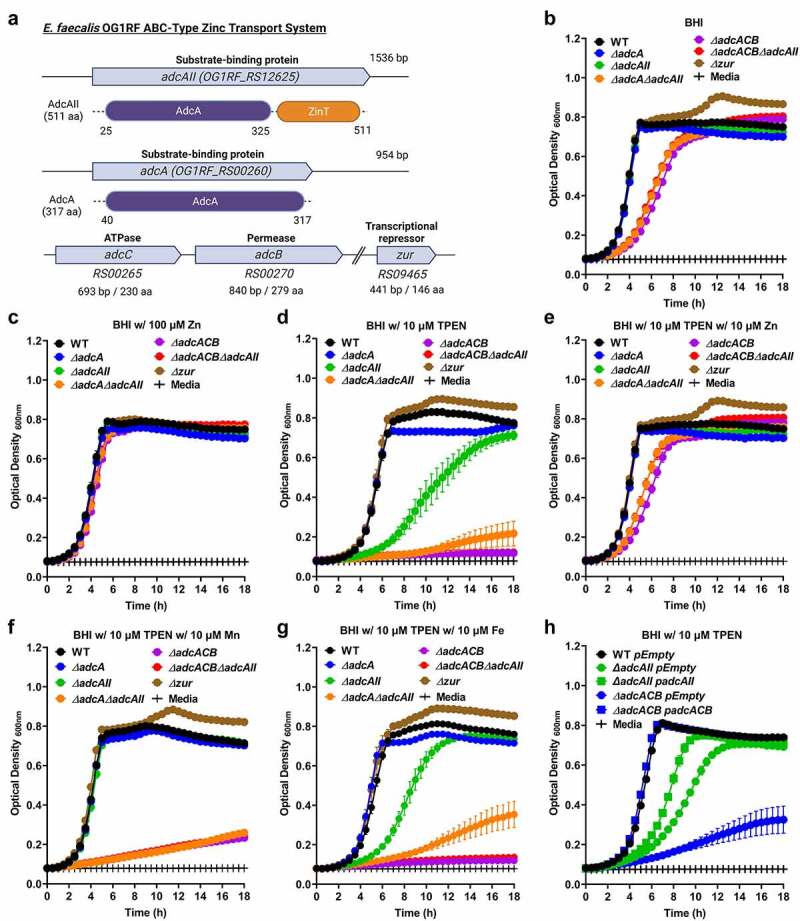
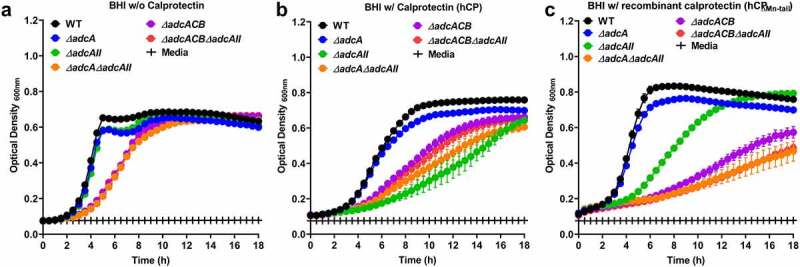
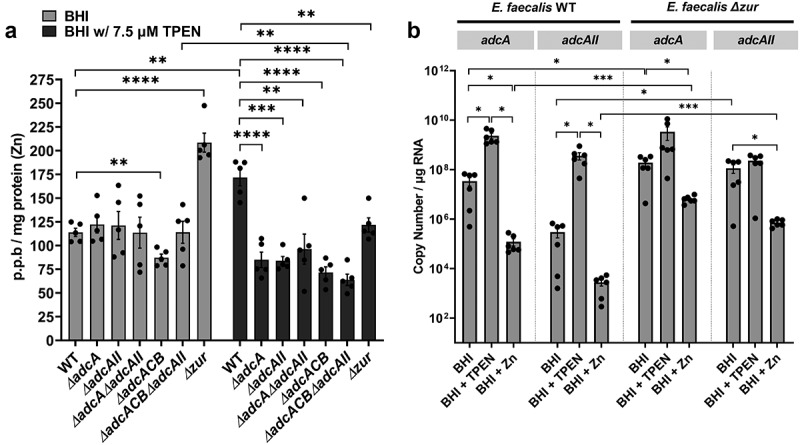
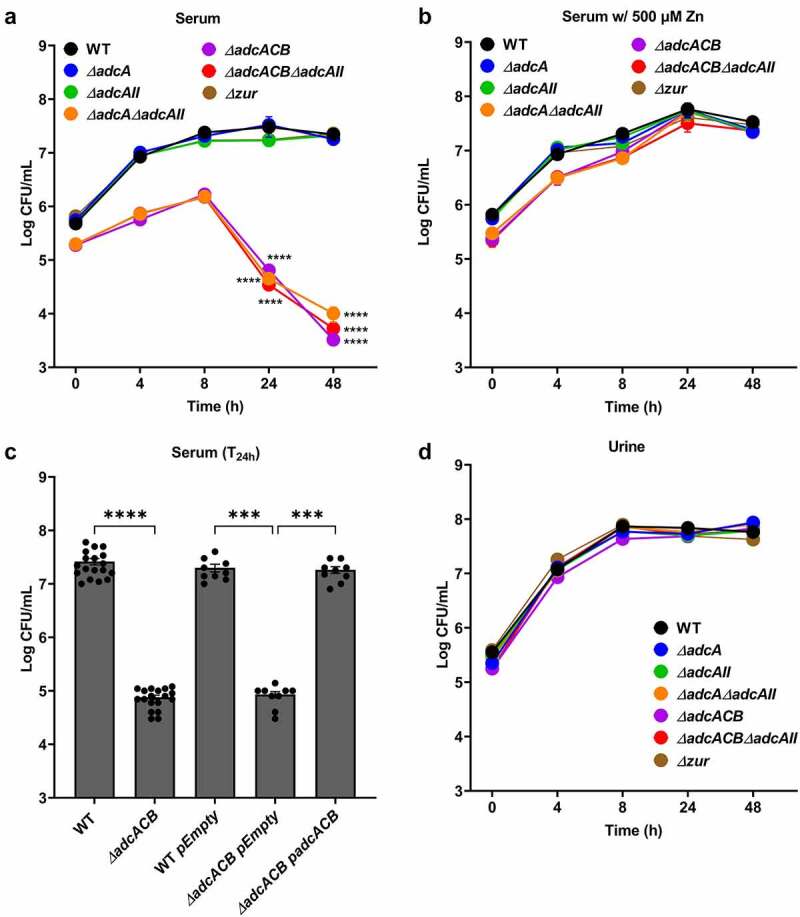
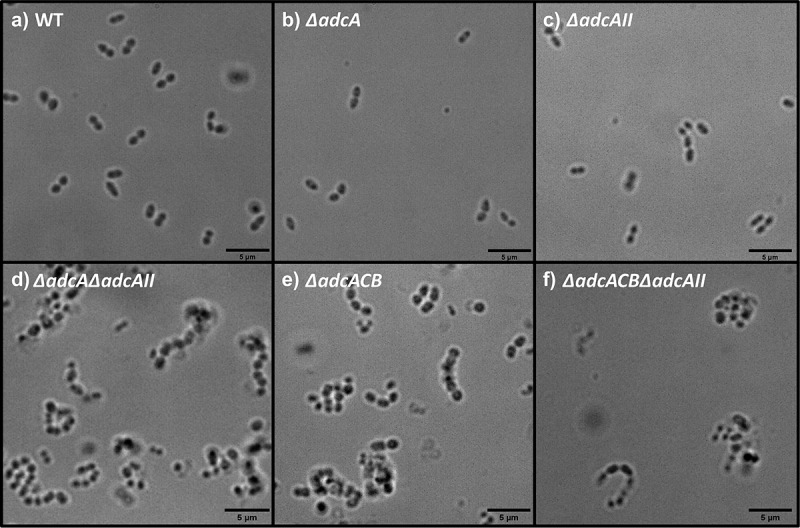
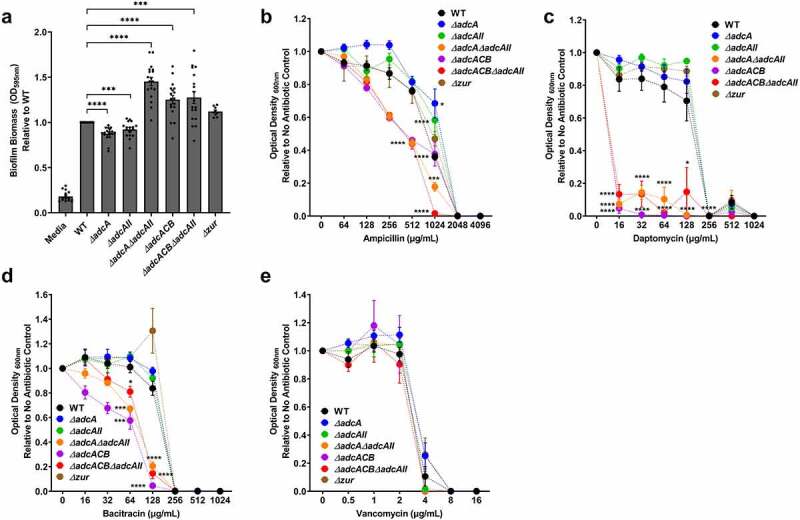
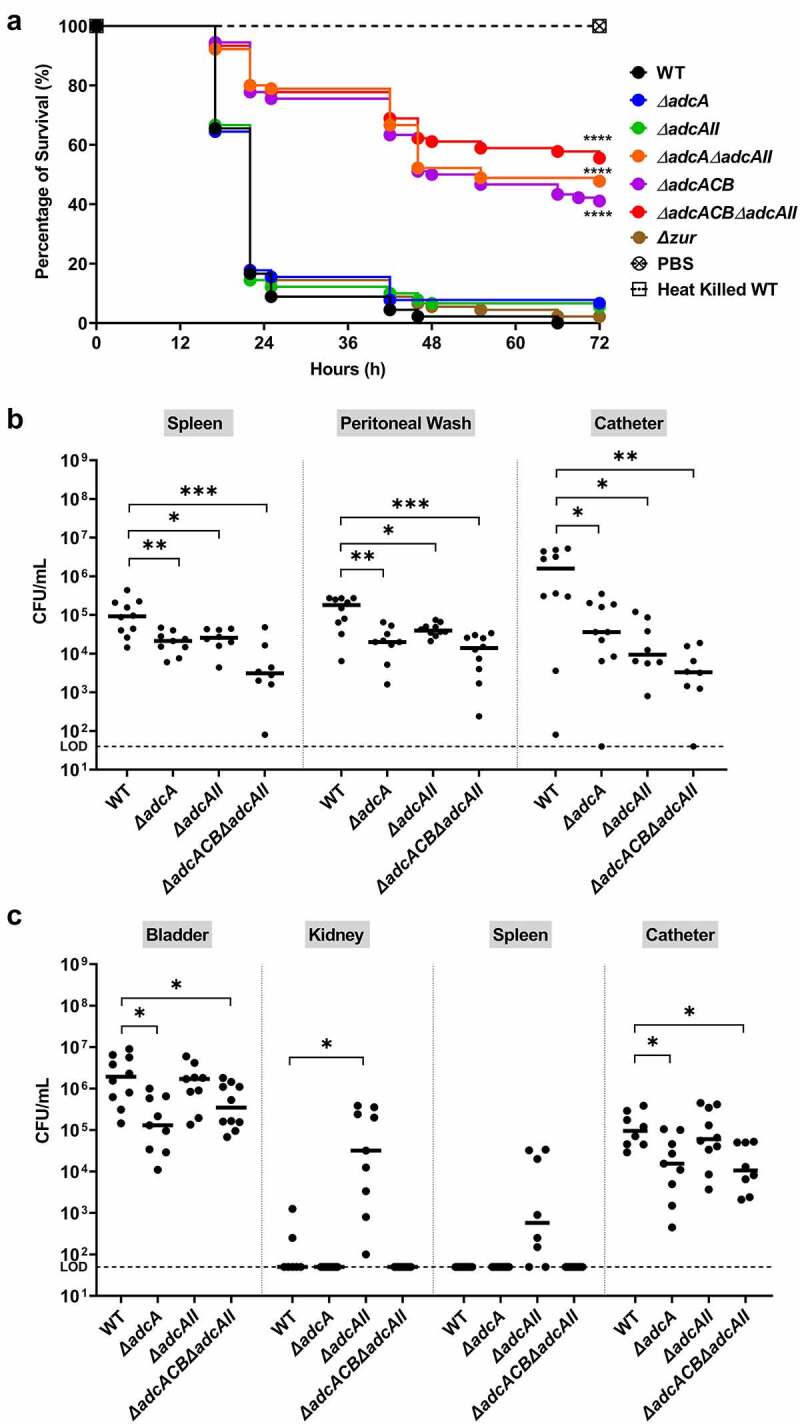
Bacterial pathogens require a variety of micronutrients for growth, including trace metals such as iron, manganese, and zinc (Zn). Despite their relative abundance in host environments, access to these metals is severely restricted during infection due to host-mediated defense mechanisms collectively known as nutritional immunity. Despite a growing appreciation of the importance of Zn in host-pathogen interactions, the mechanisms of Zn homeostasis and the significance of Zn to the pathophysiology of E. faecalis , a major pathogen of nosocomial and community-associated infections, have not been investigated. Here, we show that E. faecalis encoded an ABC-type transporter AdcACB and an orphan substrate-binding lipoprotein AdcAII that work cooperatively to maintain Zn homeostasis. Simultaneous inactivation of adcA and adcAII or the entire adcACB operon led to significant reduction in intracellular Zn under Zn-restricted conditions, heightened sensitivity to Zn-chelating agents including human calprotectin, aberrant cell morphology, and impaired fitness in serum ex vivo . Additionally, inactivation of adcACB and adcAII significantly reduced bacterial tolerance towards cell envelope-targeting antibiotics, which may be associated to altered fatty acid abundance and species. Lastly, we show that the AdcACB/AdcAII system contributes to E. faecalis virulence in an invertebrate ( Galleria mellonella ) infection model and in two catheter-associated mouse infection models that recapitulate many of the host conditions associated with enterococcal human infections. Collectively, this report reveals that high-affinity Zn import is essential for the pathogenesis of E. faecalis indicating that the surface-associated AdcA and AdcAII lipoproteins are potential therapeutic targets.
Overview
The claims and statistics of this paper haven’t been checked yet.
Run the check — free, no account needed. It reads the open-access text and checks the sources it cites.
Integrity signals
Registry
Cites
Statistics
Figures
Verification
Claims the paper makes
The claims and statistics of this paper haven’t been checked yet.
Run the check — free, no account needed. It reads the open-access text and checks the sources it cites.
Self-check
Percentages, sums and reported differences re-computed from the paper’s own numbers.
The self-check needs the paper’s full text.
Citations
Cites
Iron in infection and immunity
Cassat, J. E., & Skaar, E. P. (2013) · Cell Host & Microbe · doi:10.1016/j.chom.2013.04.010 · Cited by 1,214
Research works printed but not linked: 63
- 10.1021/pr050361j · DOI · Paper page
- 10.1038/nrmicro2836 · DOI · Paper page
- Gammoh NZ , Rink L . 2017. Zinc in Infection and Inflammation. Nutrients 9. · DOI
- 10.1021/pr0603699 · DOI · Paper page
- 10.1016/j.cbpa.2009.11.008 · DOI · Paper page
- 10.1111/mmi.13034 · DOI · Paper page
- 10.1146/annurev-genet-120215-035146 · DOI · Paper page
- 10.1146/annurev-biochem-062917-012312 · DOI
- 10.1073/pnas.1220341110 · DOI · Paper page
- 10.1111/1574-6976.12087 · DOI
- 2017, A Critical Role of Zinc Importer AdcABC in Group A Streptococcus-Host Interactions During Infection and Its Implications for Vaccine Development, EBioMedicine, 21, 131, 10.1016/j.ebiom.2017.05.030 · DOI
- 10.1111/mmi.13834 · DOI
- 2017, Pseudomonas aeruginosa zinc uptake in chelating environment is primarily mediated by the metallophore pseudopaline, Scientific reports, 7, 17132, 10.1038/s41598-017-16765-9 · DOI
- 10.1128/JB.185.20.5967-5975.2003 · DOI
- 10.1111/j.1365-2958.2011.07862.x · DOI · Paper page
- 10.1111/mmi.12504 · DOI
- 10.1074/jbc.R116.742023 · DOI · Paper page
- 10.1615/JEnvironPatholToxicolOncol.v25.i3.40 · DOI
- 10.1016/j.tibs.2019.06.010 · DOI · Paper page
- Crawford A , Wilson D . 2015. Essential metals at the host-pathogen interface: nutritional immunity and micronutrient assimilation by human fungal pathogens. FEMS Yeast Res 15. · DOI
- 10.1039/c4cc10174j · DOI
- 10.1128/msystems.00554-20 · DOI
- Grim KP , San Francisco B , Radin JN , Brazel EB , Kelliher JL , Párraga Solórzano PK , Kim PC , McDevitt CA , Kehl-Fie TE . 2017. The Metallophore Staphylopine Enables Staphylococcus aureus To Compete with the Host for Zinc and Overcome Nutritional Immunity. mBio 8. · DOI · Paper page
- 10.1039/c7mt00240h · DOI
- Makthal N , Do H , Wendel BM , Olsen RJ , Helmann JD , Musser JM , Kumaraswami M . 2020. Group A Streptococcus AdcR Regulon Participates in Bacterial Defense against Host-Mediated Zinc Sequestration and Contributes to Virulence. Infect Immun 88. · DOI
- Ong CY , Berking O , Walker MJ , McEwan AG . 2018. New Insights into the Role of Zinc Acquisition and Zinc Tolerance in Group A Streptococcal Infection. Infect Immun 86. · DOI · Paper page
- Burcham LR , Le Breton Y , Radin JN , Spencer BL , Deng L , Hiron A , Ransom MR , Mendonça JDC , Belew AT , El-Sayed NM , McIver KS , Kehl-Fie TE , Doran KS. 2020. Identification of Zinc-Dependent Mechanisms Used by Group B Streptococcus To Overcome Calprotectin-Mediated Stress. mBio 11. · DOI · Paper page
- 10.1101/2021.01.22.427828:2021.01.22.427828 · DOI
- 10.1128/microbiolspec.GPP3-0053-2018 · DOI
- 10.1038/s41579-018-0107-z · DOI
- 2011, Enterococcus: review of its physiology, pathogenesis, diseases and the challenges it poses for clinical microbiology, Frontiers in Biology, 6, 357, 10.1007/s11515-011-1167-x · DOI
- 10.1586/14787210.2014.956092 · DOI · Paper page
- 2019, Adaptation to Adversity: the Intermingling of Stress Tolerance and Pathogenesis in Enterococci, Microbiology and Molecular Biology Reviews, 83, e00008
- 10.1371/journal.pone.0026519 · DOI
- 10.1039/C5MT00043B · DOI
- 10.1016/j.plasmid.2006.08.003 · DOI
- 39. Kajfasz JK , Katrak C , Ganguly T , Vargas J , Wright L , Peters ZT , Spatafora GA , Abranches J , Lemos JA. 2020. Manganese Uptake, Mediated by SloABC and MntH, Is Essential for the Fitness of Streptococcus mutans. mSphere 5. · DOI
- 10.1007/s10571-016-0364-1 · DOI
- 10.1371/journal.ppat.1007102 · DOI
- 2013, Zinc and its importance for human health: An integrative review, Journal of research in medical sciences : the official journal of Isfahan University of Medical Sciences, 18, 144
- 2000, Zinc homeostasis in humans, J Nutr, 130, 1360s, 10.1093/jn/130.5.1360S · DOI
- 2018, Influence of an Acute Exercise Until Exhaustion on Serum and Urinary Concentrations of Molybdenum, Selenium, and Zinc in Athletes, Biological Trace Element Research, 186, 361, 10.1007/s12011-018-1327-9 · DOI · Paper page
- 1998, The role of copper, molybdenum, selenium, and zinc in nutrition and health, Clin Lab Med, 18, 673, 10.1016/S0272-2712(18)30143-4 · DOI
- 1995, Behaviour of zinc in physical exercise: a special reference to immunity and fatigue, Neurosci Biobehav Rev, 19, 439, 10.1016/0149-7634(95)00002-V · DOI
- Sandstead HH . 2015. Chapter 61 - Zinc, p 1369–1385. In Nordberg GF , Fowler BA , Nordberg M (ed), Handbook on the Toxicology of Metals (Fourth Edition) doi:https://doi.org/10.1016/B978-0-444-59453-2.00061-5. Academic Press, San Diego. · DOI
- Brewer W , Harrison J , Saito HE , Fozo EM . 2020. Induction of Daptomycin Tolerance in Enterococcus faecalis by Fatty Acid Combinations. Appl Environ Microbiol 86. · DOI
- 10.1371/journal.pone.0043958 · DOI
- Woodall BM , Harp JR , Brewer WT , Tague ED , Campagna SR , Fozo EM . 2021. Enterococcus faecalis Readily Adapts Membrane Phospholipid Composition to Environmental and Genetic Perturbation. Frontiers in Microbiology 12. · DOI
- 2019, An Acinetobacter baumannii, Zinc-Regulated Peptidase Maintains Cell Wall Integrity during Immune-Mediated Nutrient Sequestration, Cell Reports, 26, 2009, 10.1016/j.celrep.2019.01.089 · DOI · Paper page
- 10.1128/mBio.00281-13 · DOI · Paper page
- 10.1099/mic.0.000529 · DOI
- 10.1128/AEM.02044-14 · DOI
- 2017, Enterococcus faecalis Responds to Individual Exogenous Fatty Acids Independently of Their Degree of Saturation or Chain Length, Applied and environmental microbiology, 84, e01633
- 10.1128/AEM.00933-16 · DOI
- 10.1042/BST20170228 · DOI
- 10.1371/journal.pone.0081168 · DOI · Paper page
- 10.1128/mBio.00177-12 · DOI
- 2019, The BioCyc collection of microbial genomes and metabolic pathways, Brief Bioinform, 20, 1085, 10.1093/bib/bbx085 · DOI
- 10.1099/mic.0.060236-0 · DOI
- 10.1128/IAI.00026-12 · DOI
- 10.1126/scitranslmed.3009384 · DOI
- 2012, Fiji: an open-source platform for biological-image analysis, Nature Methods, 9, 676, 10.1038/nmeth.2019 · DOI · Paper page
- 10.1016/j.chroma.2008.10.006 · DOI
Metadata
- Authors
- Lam, L. N., Brunson, D. N., Molina, J. J., Flores-Mireles, A. L., & Lemos, J. A.
- Affiliations
- University of Florida Health (US)
- University of Notre Dame (US)
- Venue
- Virulence
- Publisher
- openRxiv
- Published
- 2021-12-01
- Volume
- 13
- Issue
- 1
- Pages
- 592-608
- ISSN
- 2150-5594 (ISSN-L)
- PMC
- PMC8966984
- OpenAlex
- W4220830726
- Cited by
- 23
- References
- 1
- Citations by year
- 2026: 5 · 2025: 7 · 2024: 4 · 2023: 4 · 2022: 3
- FWCI
- 2.71
- Type
- journal article
- Language
- en
- Open access
- gold
- doi.org
- Licence
- cc-by
- Locations
- Virulence (publishedVersion, cc-by)
- bioRxiv (Cold Spring Harbor Laboratory) (acceptedVersion, cc-by-nc-nd)
- PubMed Central (publishedVersion, cc-by)
- PubMed (publishedVersion)
- DOAJ (DOAJ: Directory of Open Access Journals) (submittedVersion, cc-by-sa)
- Funders
- University of Notre Dame
- National Institutes of Health
- National Institute of Allergy and Infectious Diseases (AI135158, R21AI135158)
- National Institute of Diabetes and Digestive and Kidney Diseases (R01DK128805)
- National Institute of Dental and Craniofacial Research (DE021990, T90DE021990)
- Topics
- Life Sciences › Biochemistry, Genetics and Molecular Biology › Genetics › Bacterial Genetics and Biotechnology
- Life Sciences › Immunology and Microbiology › Microbiology › Escherichia coli research studies
- Health Sciences › Nursing › Nutrition and Dietetics › Trace Elements in Health
- Keywords
- Enterococcus faecalis, zinc homeostasis, ABC transporters, nutritional immunity, bacterial virulence, catheter-related infection, Galleria mellonella infection model, antibiotic tolerance, calprotectin, zinc chelation, therapeutic target
- MeSH terms
- Animals, Bacterial Proteins, Homeostasis, Enterococcus faecalis, Virulence, Zinc, Mice
About these checks
Registry, retraction, Cites and statistics results are computed, not judged, with one exception: a printed reference that no index lists is read once by a model before it counts as a citation error. Claims are extracted by a model and kept only when their quote appears verbatim in the text; each cited source is then checked, with a model’s help, for whether it says what the claim relies on. Those verdicts can be wrong — read the claim’s quote and the cited source before relying on one.
Statistics and arithmetic are recomputed, not judged.
Confidence bands are shown only for fields calibrated on our annotated test set. None is calibrated yet, so no band is shown.
What counts as a claim ›How we measure confidence ›How we check this ›
Are you an author, or do you see a problem with this page? Request a review
