PreprintCited by 17Bacterial Genetics and BiotechnologyInfections and bacterial resistanceEnterobacteriaceae and Cronobacter Research

The DOI matches its Crossref record; 2 of the 2 references it cites were found in a registry or an index.

The regulatory protein ChuP connects heme and siderophore-mediated iron acquisition systems required for Chromobacterium violaceum virulence

Open access
de Lima, Vinicius M., Batista, Bianca B., Silva Neto, José F. da·2022·Frontiers in Cellular and Infection Microbiology

Preprint — published as 10.3389/fcimb.2022.873536 · Paper page

Abstract

Chromobacterium violaceum is an environmental Gram-negative beta-proteobacterium that causes systemic infections in humans. C. violaceum uses siderophore-based iron acquisition systems to overcome the host-imposed iron limitation, but its capacity to use other iron sources is unknown. In this work, we characterized ChuPRSTUV as a heme utilization system employed by C. violaceum to explore an important iron reservoir in mammalian hosts, free heme and hemoproteins. We demonstrate that the chuPRSTUV genes comprise a Fur-repressed operon that is expressed under iron limitation. The chu operon potentially encodes a small regulatory protein (ChuP), an outer membrane TonB-dependent receptor (ChuR), a heme degradation enzyme (ChuS), and an inner membrane ABC transporter (ChuTUV). Our nutrition growth experiments using C. violaceum chu deletion mutants revealed that, with the exception of chuS , all genes of the chu operon are required for heme and hemoglobin utilization in C. violaceum . The mutant strains without chuP displayed increased siderophore halos on CAS plate assays. Significantly, we demonstrate that ChuP connects heme and siderophore utilization by acting as a positive regulator of chuR and vbuA , which encode the TonB-dependent receptors for the uptake of heme (ChuR) and the siderophore viobactin (VbuA). Our data favor a model of ChuP as a heme-binding post-transcriptional regulator. Moreover, our virulence data in a mice model of acute infection demonstrate that C. violaceum uses both heme and siderophore for iron acquisition during infection, with a preference for siderophores over the Chu heme utilization system.

Overview

The claims and statistics of this paper haven’t been checked yet.

Run the check — free, no account needed. It reads the open-access text and checks the sources it cites.

A few free checks a day · papers already verified open instantly · results are public

Integrity signals

Registry

Crossref · 10.1101/2022.02.10.479982

Cites

2 of 2 references verified0 citation errors · 0 not checkable

Statistics

Figures

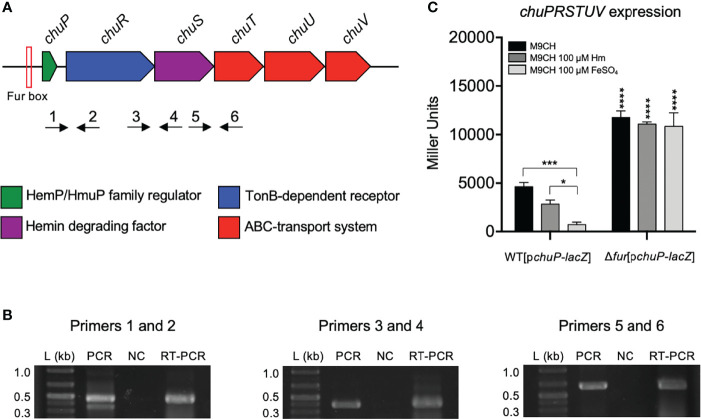
Figure 1 The chuPRSTUV genes compose an operon regulated by the iron levels and Fur. (A) Genomic organization of the chuPRSTUV genes in C. violaceum. A predicted Fur box is indicated. Numbered arrows indicate the primers used in RT-PCR (not scaled). (B) Confirmation of co-transcription of the chuPRSTUV genes. The RT-PCR reactions amplified fragments of 439 bp (Primers 1 and 2), 373 bp (Primers 3 and 4), and 662 bp (Primers 5 and 6). Conventional PCR was performed using genomic DNA (PCR) and RNA (NC) as controls. L, 1 Kb plus DNA Ladder (Thermo Scientific). (C) Promoter activity of the chu operon in response to iron and Fur. β-galactosidase assays were performed from the WT and Δfur strains harboring the chuP-lacZ fusion grown in M9CH medium and either untreated or treated with 100 μM Hm or 100 μM FeSO4. Data are from three biological replicates. ****p < 0.0001; ***p < 0.001; *p < 0.05; when not indicated, not significant. Two-way ANOVA followed by Dunnett’s multiple-comparison test.
Figure 1 The chuPRSTUV genes compose an operon regulated by the iron levels and Fur. (A) Genomic organization of the chuPRSTUV genes in C. violaceum. A predicted Fur box is indicated. Numbered arrows indicate the primers used in RT-PCR (not scaled). (B) Confirmation of co-transcription of the chuPRSTUV genes. The RT-PCR reactions amplified fragments of 439 bp (Primers 1 and 2), 373 bp (Primers 3 and 4), and 662 bp (Primers 5 and 6). Conventional PCR was performed using genomic DNA (PCR) and RNA (NC) as controls. L, 1 Kb plus DNA Ladder (Thermo Scientific). (C) Promoter activity of the chu operon in response to iron and Fur. β-galactosidase assays were performed from the WT and Δfur strains harboring the chuP-lacZ fusion grown in M9CH medium and either untreated or treated with 100 μM Hm or 100 μM FeSO4. Data are from three biological replicates. ****p < 0.0001; ***p < 0.001; *p < 0.05; when not indicated, not significant. Two-way ANOVA followed by Dunnett’s multiple-comparison test.CC BY · PubMed Central
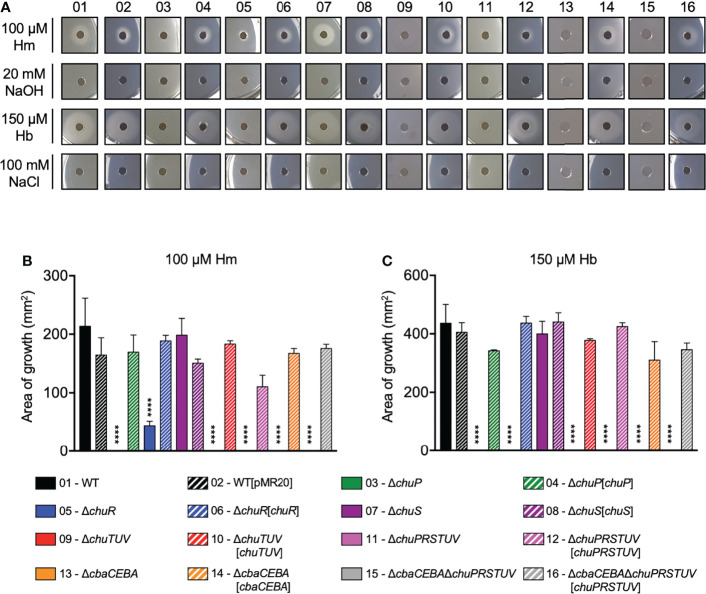
Figure 2 The chu operon encodes a heme uptake system (ChuRTUV) and a regulatory protein (ChuP) required for heme and hemoglobin utilization. (A) Nutrition assay for Hm and Hb under DP-imposed iron deficiency. The indicated strains were embedded into M9CH medium supplemented with 125 μM DP. Aliquots of 100 μM Hm and 150 μM Hb were provided as iron sources, while 20 mM NaOH and 100 mM NaCl were used as negative controls. Growth halos around the discs indicate compound utilization. Representative images are shown. (B, C) Quantification of Hm and Hb-stimulated growth. The area of the growth halos stimulated by Hm (B) and Hb (C) was measured using Image J software by subtracting the area of the discs. Data are from three biological replicates. Mutant and complemented strains were compared to WT and WT[pMR20], respectively. ****p < 0.0001; when not indicated, not significant. One-way ANOVA followed by Tukey’s multiple-comparison test.
Figure 2 The chu operon encodes a heme uptake system (ChuRTUV) and a regulatory protein (ChuP) required for heme and hemoglobin utilization. (A) Nutrition assay for Hm and Hb under DP-imposed iron deficiency. The indicated strains were embedded into M9CH medium supplemented with 125 μM DP. Aliquots of 100 μM Hm and 150 μM Hb were provided as iron sources, while 20 mM NaOH and 100 mM NaCl were used as negative controls. Growth halos around the discs indicate compound utilization. Representative images are shown. (B, C) Quantification of Hm and Hb-stimulated growth. The area of the growth halos stimulated by Hm (B) and Hb (C) was measured using Image J software by subtracting the area of the discs. Data are from three biological replicates. Mutant and complemented strains were compared to WT and WT[pMR20], respectively. ****p < 0.0001; when not indicated, not significant. One-way ANOVA followed by Tukey’s multiple-comparison test.CC BY · PubMed Central
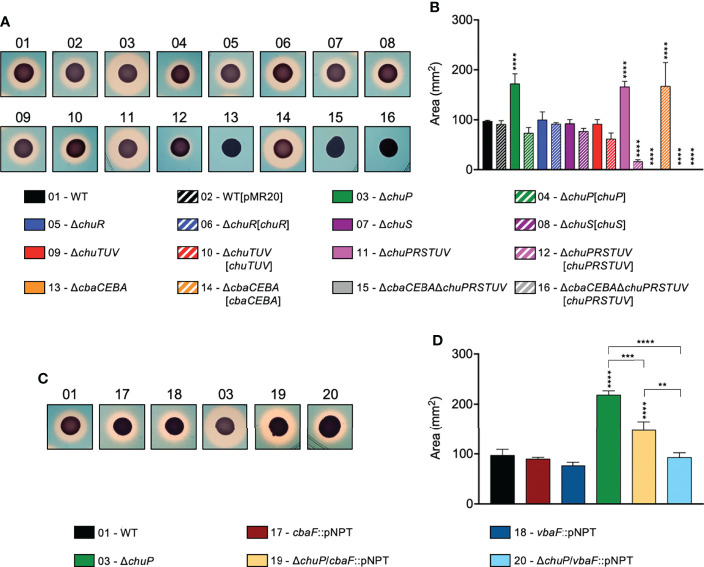
Figure 3 Deletion of chuP impacts the siderophore levels in C. violaceum. (A, B) Role of the chu operon on the siderophore levels in C. violaceum. Mutant strains without chuP showed increased siderophore halos. (C, D) The effect of ChuP occurs on the siderophore viobactin. For all indicated strains, the siderophore detection was performed by CAS assays on PSA-CAS plates. C. violaceum cultures were spotted onto the plate surface, and the orange halos indicating secreted siderophores were photographed (A, C) and measured (B, D), after incubation for 24 hours at 37°C, using Image J software. The area of the siderophore halos was calculated subtracting the area of bacterial growth. Data are from three biological replicates. Mutant and complemented strains (B) were compared to WT and WT[pMR20], respectively. Insertion mutants (D) were compared to the strains they derived from. **p < 0.01; ***p < 0.001; ****p < 0.0001; when not indicated, not significant. Vertical asterisks indicate comparisons with the WT strain. One-way ANOVA followed by Tukey’s multiple-comparison test.
Figure 3 Deletion of chuP impacts the siderophore levels in C. violaceum. (A, B) Role of the chu operon on the siderophore levels in C. violaceum. Mutant strains without chuP showed increased siderophore halos. (C, D) The effect of ChuP occurs on the siderophore viobactin. For all indicated strains, the siderophore detection was performed by CAS assays on PSA-CAS plates. C. violaceum cultures were spotted onto the plate surface, and the orange halos indicating secreted siderophores were photographed (A, C) and measured (B, D), after incubation for 24 hours at 37°C, using Image J software. The area of the siderophore halos was calculated subtracting the area of bacterial growth. Data are from three biological replicates. Mutant and complemented strains (B) were compared to WT and WT[pMR20], respectively. Insertion mutants (D) were compared to the strains they derived from. **p < 0.01; ***p < 0.001; ****p < 0.0001; when not indicated, not significant. Vertical asterisks indicate comparisons with the WT strain. One-way ANOVA followed by Tukey’s multiple-comparison test.CC BY · PubMed Central
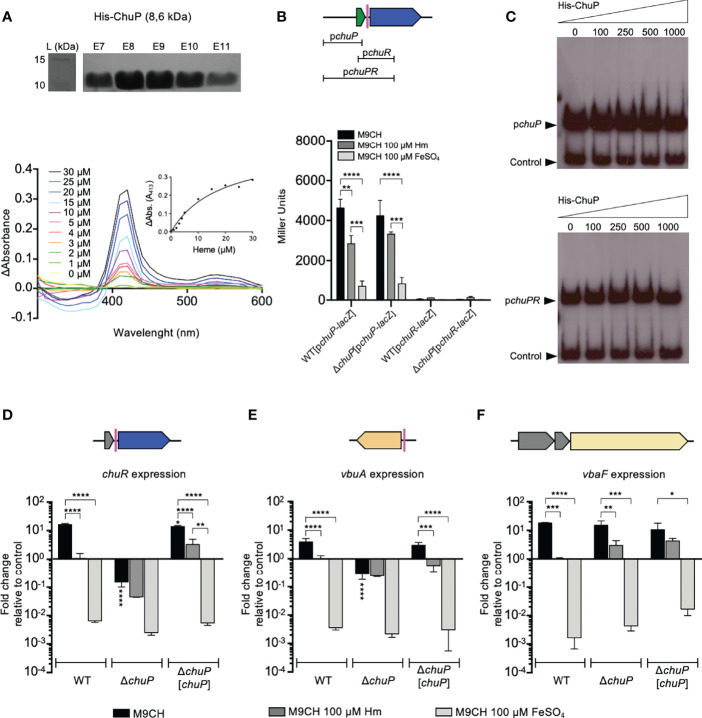
Figure 4 ChuP is a heme-binding regulatory protein that controls chuR and vbuA expression at a post-transcriptional level. (A) ChuP binds heme. The His-ChuP protein was purified (top) and incubated (10 μM protein) with the indicated concentrations of Hm (bottom). The absorption spectra were measured from 300 nm to 600 nm on a SpectraMax i3 MiniMax Imaging Cytometer. The changes at 413 nm were used to calculate the ChuP-Hm affinity (insert). Data are shown as differential absorption spectra: the difference of values obtained from the sample cuvette (His-ChuP and Hm) against the reference cuvette (Hm). Data are from a single experiment of three independent replicates. L, protein ladder; E7 to E11, eluted fractions of purified ChuP. (B) ChuP does not regulate the promoter of the chu operon. The scheme (top) indicates the regions used for β-galactosidase or EMSA assays. β-galactosidase assays were performed from the WT and ΔchuP strains harboring chuP-lacZ and chuR-lacZ fusions grown in M9CH in the indicated conditions of iron availability. Data are from three biological replicates. **p < 0.01; ***p < 0.001; ****p < 0.0001. When not shown, n.s. (not significant). Two-way ANOVA followed by Dunnett’s multiple-comparison test. (C) ChuP does not bind to DNA probes covering from chuP to chuR. The indicated concentrations of His-ChuP were used in EMSA assays with the chu indicated probes. In both cases, the promoter region of CV_2599 (control) was used as an in-reaction unspecific negative control. (D-F) chuR and vbuA but not vbaF have HPRE sequences and are regulated by ChuP. The predicted HPREs are indicated as colored bars in the gene maps. Expression was evaluated by RT-qPCR. cDNA was reverse transcribed from RNA obtained from the WT, ΔchuP, and ΔchuP[chuP] strains grown in M9CH, and either untreated or treated with 100 μM Hm or 100 μM FeSO4. Expression of chuR, vbuA, and vbaF is shown as the fold change relative to the control condition (WT in M9CH 100 μM Hm). Data are from three biological replicates. ****p < 0.0001; ***p < 0.001; **p < 0.01; *p < 0.05; when not indicated, not significant. Vertical asterisks indicate comparisons with the WT strain at the same condition. One-way ANOVA followed by Tukey’s multiple-comparison test.
Figure 4 ChuP is a heme-binding regulatory protein that controls chuR and vbuA expression at a post-transcriptional level. (A) ChuP binds heme. The His-ChuP protein was purified (top) and incubated (10 μM protein) with the indicated concentrations of Hm (bottom). The absorption spectra were measured from 300 nm to 600 nm on a SpectraMax i3 MiniMax Imaging Cytometer. The changes at 413 nm were used to calculate the ChuP-Hm affinity (insert). Data are shown as differential absorption spectra: the difference of values obtained from the sample cuvette (His-ChuP and Hm) against the reference cuvette (Hm). Data are from a single experiment of three independent replicates. L, protein ladder; E7 to E11, eluted fractions of purified ChuP. (B) ChuP does not regulate the promoter of the chu operon. The scheme (top) indicates the regions used for β-galactosidase or EMSA assays. β-galactosidase assays were performed from the WT and ΔchuP strains harboring chuP-lacZ and chuR-lacZ fusions grown in M9CH in the indicated conditions of iron availability. Data are from three biological replicates. **p < 0.01; ***p < 0.001; ****p < 0.0001. When not shown, n.s. (not significant). Two-way ANOVA followed by Dunnett’s multiple-comparison test. (C) ChuP does not bind to DNA probes covering from chuP to chuR. The indicated concentrations of His-ChuP were used in EMSA assays with the chu indicated probes. In both cases, the promoter region of CV_2599 (control) was used as an in-reaction unspecific negative control. (D-F) chuR and vbuA but not vbaF have HPRE sequences and are regulated by ChuP. The predicted HPREs are indicated as colored bars in the gene maps. Expression was evaluated by RT-qPCR. cDNA was reverse transcribed from RNA obtained from the WT, ΔchuP, and ΔchuP[chuP] strains grown in M9CH, and either untreated or treated with 100 μM Hm or 100 μM FeSO4. Expression of chuR, vbuA, and vbaF is shown as the fold change relative to the control condition (WT in M9CH 100 μM Hm). Data are from three biological replicates. ****p < 0.0001; ***p < 0.001; **p < 0.01; *p < 0.05; when not indicated, not significant. Vertical asterisks indicate comparisons with the WT strain at the same condition. One-way ANOVA followed by Tukey’s multiple-comparison test.CC BY · PubMed Central
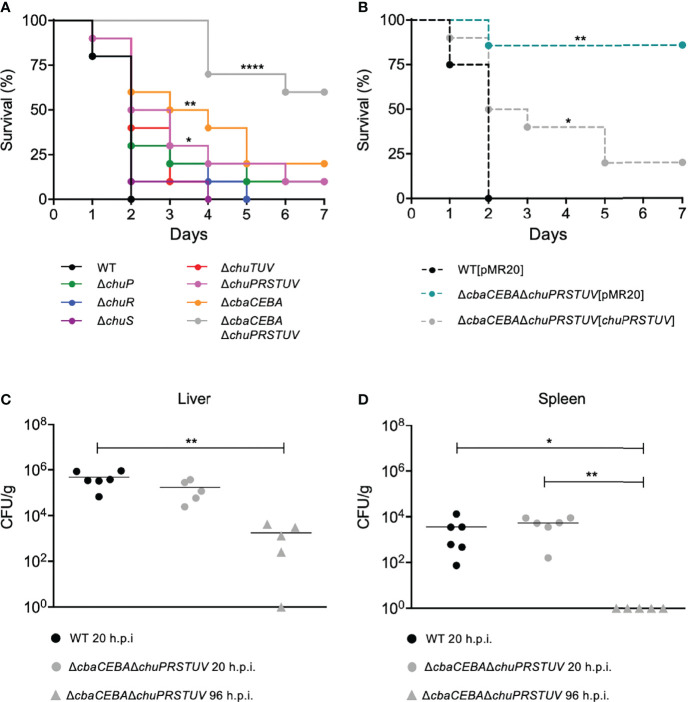
Figure 5 C violaceum requires siderophores and heme but prefers siderophores in a mice model of acute infection. (A, B) Survival curves of infected BALB/c mice. Animals (n = 8 for WT[pMR20]; n = 7 for ΔcbaCEBAΔchuPSRTUV[chuPRSTUV]; n = 10 for all other strains) were i.p. injected with 106 CFU of the indicated C. violaceum mutant (A) and complemented (B) strains. Animal survival was monitored daily for a week. *p < 0.05; **p < 0.01; ****p < 0.0001; when not shown, n.s. (not significant). Log-rank (Mantel-Cox) test. (C, D) Bacterial burden in organs. Animals were infected with 106 CFU of the indicated strains. After 20h or 96 h post-infection (h.p.i.), the liver (C) and the spleen (D) were collected, homogenized, serially diluted, and plated for CFU quantification. *p < 0.05; **p < 0.01; when not indicated, not significant. One-way ANOVA followed by Tukey’s (liver) or Dunnett’s (spleen) multiple-comparison tests.
Figure 5 C violaceum requires siderophores and heme but prefers siderophores in a mice model of acute infection. (A, B) Survival curves of infected BALB/c mice. Animals (n = 8 for WT[pMR20]; n = 7 for ΔcbaCEBAΔchuPSRTUV[chuPRSTUV]; n = 10 for all other strains) were i.p. injected with 106 CFU of the indicated C. violaceum mutant (A) and complemented (B) strains. Animal survival was monitored daily for a week. *p < 0.05; **p < 0.01; ****p < 0.0001; when not shown, n.s. (not significant). Log-rank (Mantel-Cox) test. (C, D) Bacterial burden in organs. Animals were infected with 106 CFU of the indicated strains. After 20h or 96 h post-infection (h.p.i.), the liver (C) and the spleen (D) were collected, homogenized, serially diluted, and plated for CFU quantification. *p < 0.05; **p < 0.01; when not indicated, not significant. One-way ANOVA followed by Tukey’s (liver) or Dunnett’s (spleen) multiple-comparison tests.CC BY · PubMed Central
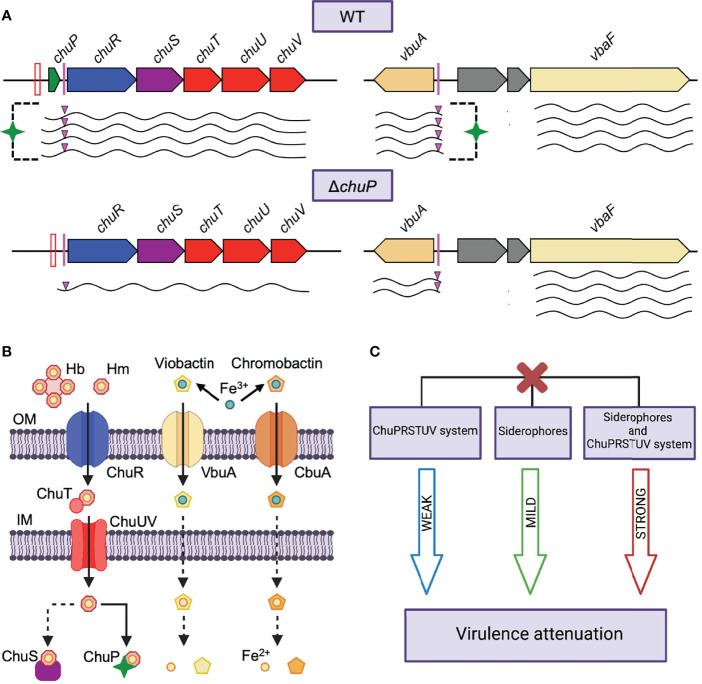
Figure 6 Model of how C. violaceum connects iron acquisition by heme and siderophore during infection. (A) Regulatory function of ChuP over chuR and vbuA. (B) Iron acquisition systems in C. violaceum for the uptake of heme (this work) and the siderophores viobactin and chromobactin (Batista et al., 2019). (C) Interplay between the uptake of heme and siderophore in the C. violaceum virulence. We propose that ChuP links heme and siderophore utilization by acting as a positive regulator of chuR and vbuA, which encode TBDRs for the uptake of heme (ChuR) and the siderophore viobactin (VbuA). In addition to Fur derepression, the expression of chuR and vbuA depends on ChuP under iron deficiency, possibly by a post-transcriptional mechanism involving HPRE (HmuP-responsive elements) sequences found in the 5’-UTR of the chuR and vbuA transcripts. In the absence of ChuP, the abundance of chuR and vbuA transcripts decreases, causing a reduction in heme and viobactin utilization. Different levels of virulence attenuation occurred when the ChuPRSTUV system (weak), the siderophores (mild), or both (strong) were deleted, indicating that C. violaceum prefers siderophores over heme during infection but relies on heme in the absence of siderophores. Red bars, Fur boxes; Pink bars and triangles, predicted HPRE sequences; Green stars, ChuP protein; Waved lines, mRNAs; Red X, mutant strains; OM, Outer membrane; IM, Inner membrane; Dashed lines, unknown mechanisms.
Figure 6 Model of how C. violaceum connects iron acquisition by heme and siderophore during infection. (A) Regulatory function of ChuP over chuR and vbuA. (B) Iron acquisition systems in C. violaceum for the uptake of heme (this work) and the siderophores viobactin and chromobactin (Batista et al., 2019). (C) Interplay between the uptake of heme and siderophore in the C. violaceum virulence. We propose that ChuP links heme and siderophore utilization by acting as a positive regulator of chuR and vbuA, which encode TBDRs for the uptake of heme (ChuR) and the siderophore viobactin (VbuA). In addition to Fur derepression, the expression of chuR and vbuA depends on ChuP under iron deficiency, possibly by a post-transcriptional mechanism involving HPRE (HmuP-responsive elements) sequences found in the 5’-UTR of the chuR and vbuA transcripts. In the absence of ChuP, the abundance of chuR and vbuA transcripts decreases, causing a reduction in heme and viobactin utilization. Different levels of virulence attenuation occurred when the ChuPRSTUV system (weak), the siderophores (mild), or both (strong) were deleted, indicating that C. violaceum prefers siderophores over heme during infection but relies on heme in the absence of siderophores. Red bars, Fur boxes; Pink bars and triangles, predicted HPRE sequences; Green stars, ChuP protein; Waved lines, mRNAs; Red X, mutant strains; OM, Outer membrane; IM, Inner membrane; Dashed lines, unknown mechanisms.CC BY · PubMed Central

Verification

Claims the paper makes

The claims and statistics of this paper haven’t been checked yet.

Run the check — free, no account needed. It reads the open-access text and checks the sources it cites.

A few free checks a day · papers already verified open instantly · results are public

Self-check

Percentages, sums and reported differences re-computed from the paper’s own numbers.

The self-check needs the paper’s full text.

Citations

Cites

Show all 2 references

Research works printed but not linked: 65

  1. 10.1016/j.fsi.2017.10.041 · DOI
  2. 10.1099/mic.0.037713-0 · DOI
  3. 10.1007/s10534-016-9919-3 · DOI
  4. 10.1007/s10534-019-00184-6 · DOI
  5. 10.1128/JB.00723-16 · DOI
  6. 10.1128/IAI.00577-19 · DOI
  7. 10.3389/fmicb.2017.02213 · DOI
  8. 10.1111/1462-2920.15033 · DOI
  9. 10.1128/JB.00458-21 · DOI · Paper page
  10. 10.1111/j.1365-2958.2004.04207.x · DOI
  11. 10.1016/j.cbpa.2011.01.005 · DOI · Paper page
  12. 10.1073/pnas.1832124100 · DOI
  13. 10.1074/jbc.M611121200 · DOI
  14. 10.1038/nrmicro.2017.15 · DOI · Paper page
  15. 10.1128/JB.00205-20 · DOI
  16. 10.1016/j.jmb.2016.03.018 · DOI · Paper page
  17. 10.1016/j.cbpa.2013.12.014 · DOI · Paper page
  18. 10.1128/mBio.00848-19 · DOI
  19. 10.1093/nar/gkp509 · DOI
  20. 10.1371/journal.pone.0047090 · DOI
  21. 10.1021/bi050422r · DOI
  22. 10.1128/JB.00071-12 · DOI
  23. 10.1111/j.1365-2958.2011.07562.x · DOI · Paper page
  24. 10.1128/mSystems.00933-20 · DOI
  25. 10.1091/mbc.3.8.913 · DOI
  26. 10.1016/S0022-2836(83)80284-8 · DOI
  27. 10.1038/nrmicro2836 · DOI · Paper page
  28. 10.1146/annurev-biochem-060815-014214 · DOI
  29. 10.1136/bcr-2015-210987 · DOI
  30. 10.1021/acs.chemrev.0c01005 · DOI · Paper page
  31. 10.4103/2229-516X.96814 · DOI
  32. 10.1073/pnas.1603209113 · DOI
  33. 10.1038/s41598-017-11907-5 · DOI
  34. 10.1006/meth.2001.1262 · DOI · Paper page
  35. 10.1016/j.immuni.2015.10.010 · DOI · Paper page
  36. 10.1128/mBio.00966-14 · DOI · Paper page
  37. 10.1111/j.1365-2958.2010.07248.x · DOI
  38. 10.1128/IAI.00098-16 · DOI · Paper page
  39. 10.1128/JB.01491-14 · DOI
  40. 10.1146/annurev.micro.112408.134247 · DOI · Paper page
  41. 10.1099/00221287-146-1-185 · DOI · Paper page
  42. 10.1111/1462-2920.14773 · DOI
  43. 10.1146/annurev-genet-120215-035146 · DOI · Paper page
  44. 10.1128/IAI.00602-13 · DOI · Paper page
  45. 10.1128/IAI.00017-17 · DOI
  46. 10.1128/JB.00737-06 · DOI · Paper page
  47. 10.1038/s41586-019-1453-3 · DOI · Paper page
  48. 10.1128/jb.178.7.1829-1841.1996 · DOI
  49. 10.3389/fcimb.2013.00055 · DOI · Paper page
  50. 10.1128/AEM.01620-20 · DOI
  51. 10.1007/s10534-018-0120-8 · DOI · Paper page
  52. 10.1128/AEM.00479-17 · DOI
  53. 10.3389/fcimb.2018.00047 · DOI
  54. 10.1128/microbiolspec.VMBF-0010-2015 · DOI · Paper page
  55. 10.1016/j.celrep.2017.06.081 · DOI
  56. 10.1038/nbt1183-784 · DOI
  57. 10.1371/journal.ppat.1000949 · DOI · Paper page
  58. 10.1126/science.1099930 · DOI · Paper page
  59. 10.1074/jbc.M114.633495 · DOI · Paper page
  60. 10.1002/j.1460-2075.1992.tb05535.x · DOI
  61. 10.1073/pnas.0504289102 · DOI · Paper page
  62. 10.1111/j.1365-2958.2012.08136.x · DOI
  63. 10.1016/j.jcma.2011.08.013 · DOI
  64. 10.1038/nature10510 · DOI
  65. 10.1074/jbc.RA120.015975 · DOI · Paper page

Metadata

Authors
de Lima, V. M., Batista, B. B., & Silva Neto, J. F. D.
Affiliations
Universidade de São Paulo (BR)
Venue
Frontiers in Cellular and Infection Microbiology
Publisher
openRxiv
Published
2022-02-10
Volume
12
Pages
873536-873536
ISSN
2235-2988 (ISSN-L)
OpenAlex
W4280565033
Cited by
17
References
2
Citations by year
2026: 4 · 2025: 1 · 2024: 7 · 2023: 5
FWCI
1.96
Type
journal article
Language
en
Open access
Licence
cc-by
Locations
  • Frontiers in Cellular and Infection Microbiology (publishedVersion, cc-by)
  • bioRxiv (Cold Spring Harbor Laboratory) (acceptedVersion)
  • PubMed Central (publishedVersion, cc-by)
  • PubMed (publishedVersion)
  • DOAJ (DOAJ: Directory of Open Access Journals) (submittedVersion, cc-by-sa)
Funders
  • Fundação de Amparo à Pesquisa do Estado de São Paulo (18/01388-6, 2020/, 20/00259-8)
  • Fundação de Apoio ao Ensino, Pesquisa e Assistência do Hospital das Clínicas da Faculdade de Medicina de Ribeirão Preto da Universidade de São Paulo
Topics
  • Life Sciences › Biochemistry, Genetics and Molecular Biology › Genetics › Bacterial Genetics and Biotechnology
  • Health Sciences › Medicine › Microbiology (medical) › Infections and bacterial resistance
  • Life Sciences › Immunology and Microbiology › Microbiology › Enterobacteriaceae and Cronobacter Research
Keywords
Chromobacterium violaceum, heme utilization, siderophore-mediated iron acquisition, TonB-dependent receptors, post-transcriptional regulation, heme degradation, ABC transporters, virulence, acute infection, hemoglobin utilization
MeSH terms
Animals, Chromobacterium, Heme, Iron, Mammals, Transcription Factors, Virulence, Siderophores, Mice

About these checks

Registry, retraction, Cites and statistics results are computed, not judged, with one exception: a printed reference that no index lists is read once by a model before it counts as a citation error. Claims are extracted by a model and kept only when their quote appears verbatim in the text; each cited source is then checked, with a model’s help, for whether it says what the claim relies on. Those verdicts can be wrong — read the claim’s quote and the cited source before relying on one.

Statistics and arithmetic are recomputed, not judged.

Confidence bands are shown only for fields calibrated on our annotated test set. None is calibrated yet, so no band is shown.

What counts as a claim ›How we measure confidence ›How we check this ›

Are you an author, or do you see a problem with this page? Request a review

How to cite

Cite CoChat for the checks on this page, and the paper for its own findings.

This page
CoChat. (2026). Citation check: The regulatory protein ChuP connects heme and siderophore-mediated iron acquisition systems required for Chromobacterium violaceum virulence. https://app.cochat.ai/papers/10.1101/2022.02.10.479982
The paper
de Lima, V. M., Batista, B. B., & Silva Neto, J. F. D. (2022). The regulatory protein ChuP connects heme and siderophore-mediated iron acquisition systems required for Chromobacterium violaceum virulence. Frontiers in Cellular and Infection Microbiology. https://doi.org/10.1101/2022.02.10.479982