

The DOI matches its Crossref record; 6 of the 6 references it cites were found in a registry or an index.
SARS-CoV-2 Omicron spike H655Y mutation is responsible for enhancement of the endosomal entry pathway and reduction of cell surface entry pathways
Abstract
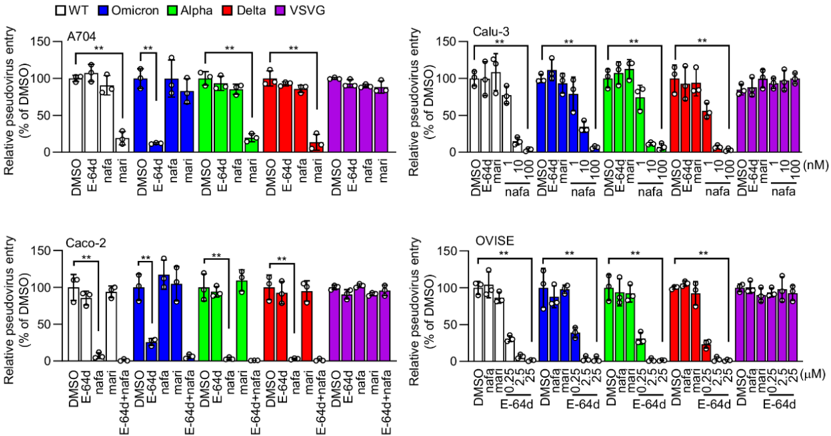
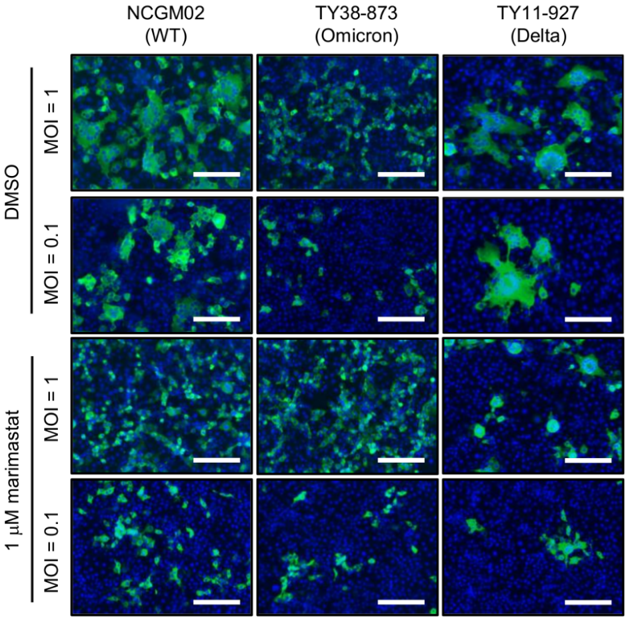
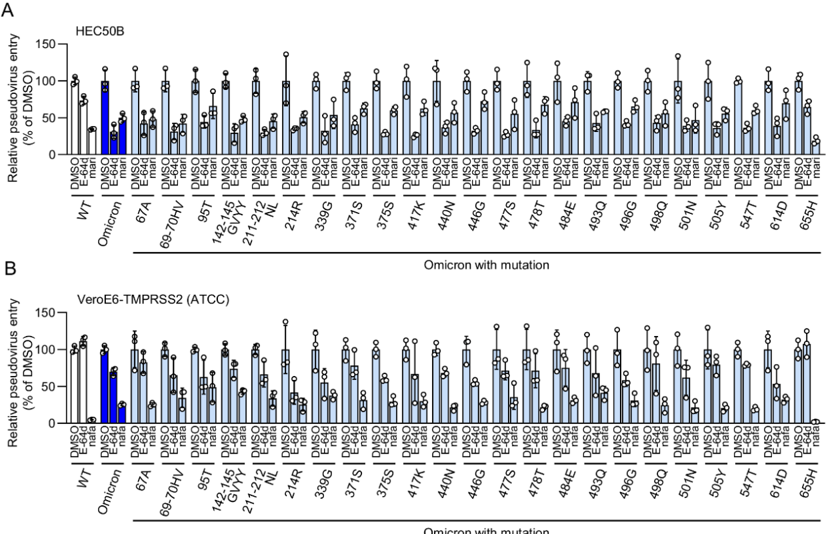
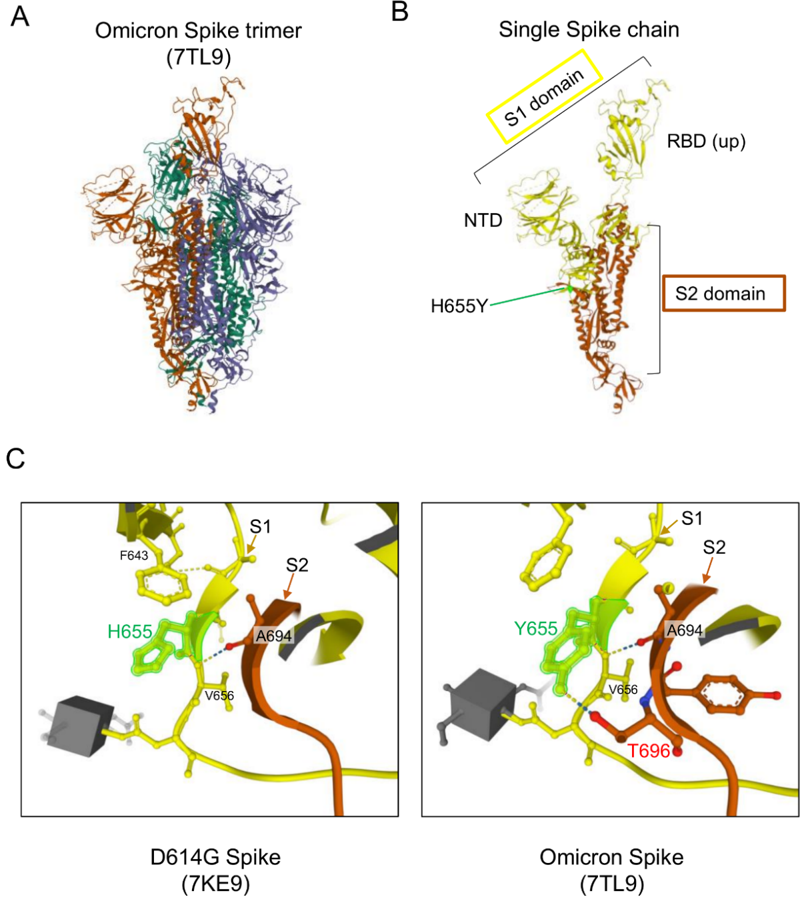
The SARS-CoV-2 Omicron variant reportedly displays decreased usage of the cell surface entry pathway mediated by the host transmembrane protease, serine 2 (TMPRSS2) and increased usage of the endosomal entry pathway mediated by cathepsin B/L. These differences result in different cell tropisms and low fusogenicity from other SARS-CoV-2 variants. Recent studies have revealed that host metalloproteases are also involved in cell surface entry and fusogenic activity of SARS-CoV-2, independent of TMPRSS2. However, the involvement of metalloproteinase-mediated cell entry and fusogenicity in Omicron infections has not been investigated. Here, we report that Omicron infection is less sensitive to the metalloproteinase inhibitor marimastat, like the TMPRSS2 inhibitor nafamostat, and is more sensitive to the cathepsin B/L inhibitor E-64d than infections with wild-type SARS-CoV-2 and other variants. The findings indicate that Omicron preferentially utilizes the endosomal pathway rather than cell surface pathways for entry. Moreover, the Omicron variant also displays poor syncytia formation mediated by metalloproteinases, even when the S cleavage status mediated by fusion-like proteases is unchanged. Intriguingly, the pseudovirus assay showed that a single mutation, H655Y, of the Omicron spike (S) is responsible for the preferential entry pathway usage without affecting the S cleavage status. These findings suggest that the Omicron variant has altered entry properties and fusogenicity, probably through the H655Y mutation in its S protein, leading to modulations of tissue and cell tropism, and reduced pathogenicity. Author summary: Recent studies have suggested that the SARS-CoV-2 Omicron variant displays altered cell tropism and fusogenicity, in addition to immune escape. However, comprehensive analyses of the usage of viral entry pathways in Omicron variant have not been performed. Here, we used protease inhibitors to block each viral entry pathway mediated by the three host proteases (cathepsin B/L, TMPRSS2, and metalloproteinases) in various cell types. The results clearly indicated that Omicron exhibits enhanced cathepsin B/L-dependent endosome entry and reduced metalloproteinase-dependent and TMPRSS2-dependent cell surface entry. Furthermore, the H655Y mutation of Omicron S determines the relative usage of the three entry pathways without affecting S cleavage by the host furin-like proteases. Comparative data among SARS-CoV-2 variants, including Omicron, may clarify the biological and pathological phenotypes of Omicron but increase the understanding of disease progression in infections with other SARS-CoV-2 variants.
Overview
The claims and statistics of this paper haven’t been checked yet.
Run the check — free, no account needed. It reads the open-access text and checks the sources it cites.
Integrity signals
Registry
Cites
Statistics
Figures
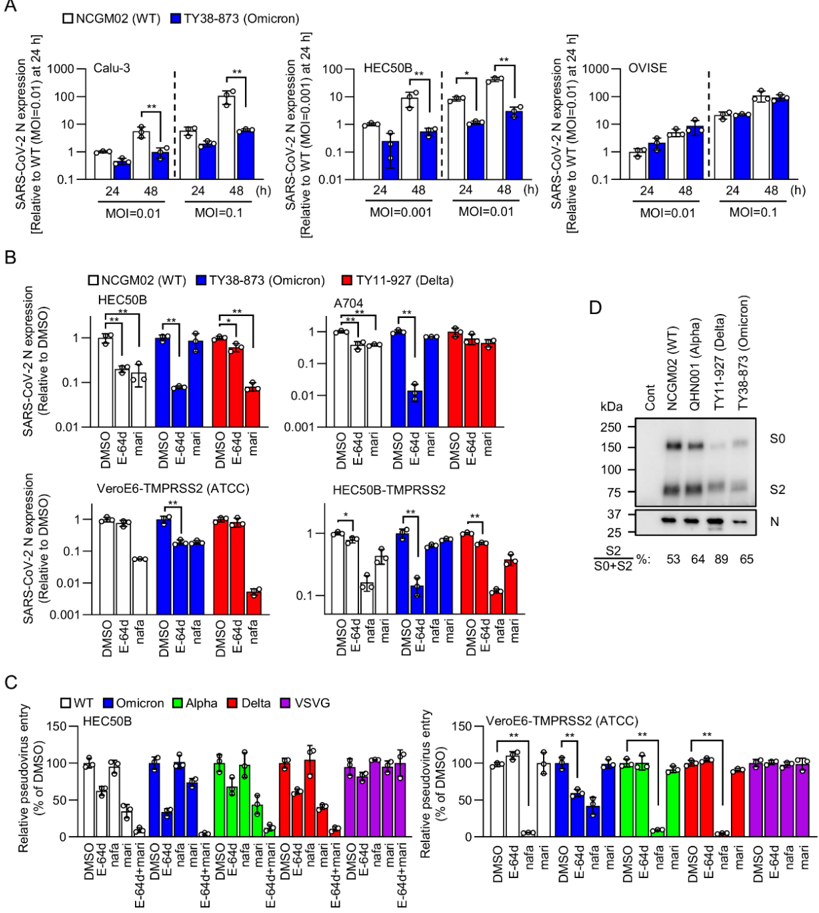
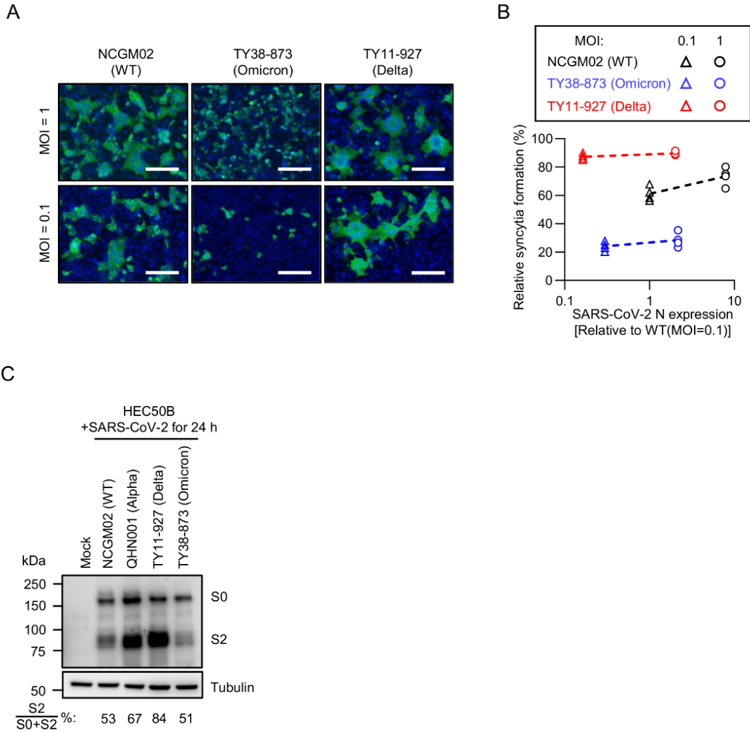
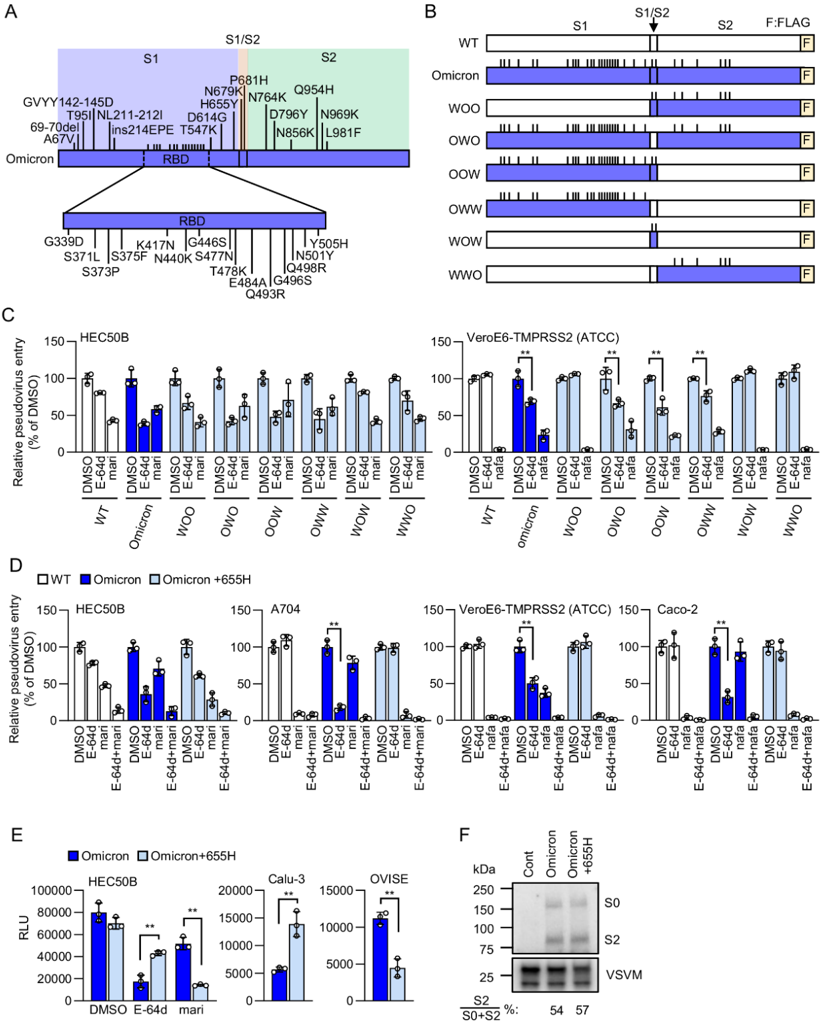
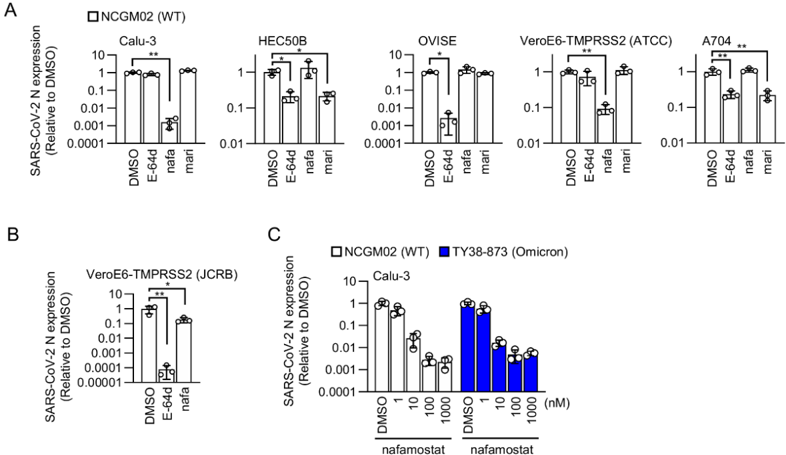
Verification
Claims the paper makes
The claims and statistics of this paper haven’t been checked yet.
Run the check — free, no account needed. It reads the open-access text and checks the sources it cites.
Claims other papers make about this one
Each is checked against this paper’s own text: does it say what the citing paper says it does?
In the citing paper
“and the H655Y mutation was shown to alter cell entry pathways, i.e. the mutation is responsible for the preferential usage of endosomal pathway over cell surface entry pathways41.”
From The roles of APOBEC-mediated RNA editing in SARS-CoV-2 mutations, replication and fitness (2022) · cites this paper as [41]
Self-check
Percentages, sums and reported differences re-computed from the paper’s own numbers.
The self-check needs the paper’s full text.
Citations
Cites
Cell entry mechanisms of SARS-CoV-2
Shang, J., Wan, Y., Luo, C., Ye, G., Geng, Q., Auerbach, A., & Li, F. (2020) · Proceedings of the National Academy of Sciences · doi:10.1073/pnas.2003138117 · Cited by 3,142
Hoffmann, M., Kleine-Weber, H., & Pöhlmann, S. (2020) · Molecular Cell · doi:10.1016/j.molcel.2020.04.022 · Cited by 1,852
Baum, A., Fulton, B. O., Wloga, E., Copin, R., Pascal, K. E., Russo, V., Giordano, S., Lanza, K., Negron, N., Ni, M., et al. (2020) · Science · doi:10.1126/science.abd0831 · Cited by 1,253
SARS-CoV-2 Omicron-B.1.1.529 leads to widespread escape from neutralizing antibody responses
Dejnirattisai, W., Huo, J., Zhou, D., Zahradník, J., Supasa, P., Liu, C., Duyvesteyn, H. M. E., Ginn, H. M., Mentzer, A. J., Tuekprakhon, A., et al. (2022) · Cell · doi:10.1016/j.cell.2021.12.046 · Cited by 930
Loss of furin cleavage site attenuates SARS-CoV-2 pathogenesis
Johnson, B. A., Xie, X., Bailey, A. L., Kalveram, B., Lokugamage, K. G., Muruato, A., Zou, J., Zhang, X., Juelich, T., Smith, J. K., et al. (2021) · Nature · doi:10.1038/s41586-021-03237-4 · Cited by 694
Zhao, H., Lu, L., Peng, Z., Chen, L.-L., Meng, X., Zhang, C., Ip, J. D., Chan, W.-M., Chu, A. W.-H., Chan, K.-H., et al. (2022) · Emerging Microbes & Infections · doi:10.1080/22221751.2021.2023329 · Cited by 413 · cited 4×
“Omicron variant displays poor syncytium formation mediated by metalloproteinases without affecting the S1/S2 cleavage of its S protein Reduced syncytia formation through the TMPRSS2 pathway has been reported in Omicron, suggesting a correlation with lower pathogenicity [2, 10, 12, 13].”
Influential
Research works printed but not linked: 36
- 10.1038/s41586-022-04441-6 · DOI
- 10.1038/s41586-022-04462-1 · DOI
- 10.1038/s41586-022-04442-5 · DOI
- 10.3390/ijms23041987 · DOI
- 10.1016/j.cell.2021.12.033 · DOI · Paper page
- 10.1056/NEJMc2119407 · DOI
- 10.1016/j.cell.2021.12.032 · DOI · Paper page
- 10.1038/s41586-021-04386-2 · DOI
- 10.1038/s41586-022-04479-6 · DOI
- 10.1038/s41586-022-04474-x · DOI · Paper page
- 10.21203/rs.3.rs-1191837/v1 · DOI · Paper page
- 10.1038/s41580-021-00418-x · DOI · Paper page
- 10.1126/science.abb2762 · DOI
- 10.1038/s41586-020-2180-5 · DOI · Paper page
- 10.1016/j.cell.2020.02.052 · DOI · Paper page
- 10.1038/s41392-021-00558-8 · DOI
- 10.1101/2021.12.14.472513 · DOI
- 10.1016/j.cell.2020.10.030 · DOI
- 10.1126/scitranslmed.abj7521 · DOI
- 10.1038/s41418-021-00782-3 · DOI
- 10.1016/j.ebiom.2020.103104 · DOI
- 10.1038/s41586-021-04266-9 · DOI
- 10.15252/embj.2021108944 · DOI
- 10.3390/v12060629 · DOI
- 10.1128/AAC.01043-16 · DOI
- 10.1093/cid/ciaa325 · DOI
- 10.1016/j.chom.2020.06.020 · DOI
- 10.1371/journal.ppat.1009373 · DOI
- 10.1101/2021.08.05.455290 · DOI
- 10.26508/lsa.202000786 · DOI · Paper page
- 10.1016/j.cell.2020.09.032 · DOI · Paper page
- 10.1038/s41586-020-2772-0 · DOI
- 10.1038/s41422-020-00430-4 · DOI
- 10.1101/2022.01.25.477784 · DOI
- 10.1073/pnas.2009799117 · DOI
- 10.4062/biomolther.2020.201 · DOI
Cited by
Sorted by citations
The roles of APOBEC-mediated RNA editing in SARS-CoV-2 mutations, replication and fitness
Kim, K., Calabrese, P., Wang, S., Qin, C., Rao, Y., Feng, P., & Chen, X. S. (2022) · Scientific Reports · doi:10.1038/s41598-022-19067-x · Cited by 115
Metadata
- Authors
- Yamamoto, M., Tomita, K., Hirayama, Y., Inoue, J.-I., Kawaguchi, Y., & Gohda, J.
- Publisher
- openRxiv
- Published
- 2022-03-21
- Cited by
- 36
- References
- 6
- Type
- Preprint
About these checks
Registry, retraction, Cites and statistics results are computed, not judged, with one exception: a printed reference that no index lists is read once by a model before it counts as a citation error. Claims are extracted by a model and kept only when their quote appears verbatim in the text; each cited source is then checked, with a model’s help, for whether it says what the claim relies on. Those verdicts can be wrong — read the claim’s quote and the cited source before relying on one.
Statistics and arithmetic are recomputed, not judged.
Confidence bands are shown only for fields calibrated on our annotated test set. None is calibrated yet, so no band is shown.
What counts as a claim ›How we measure confidence ›How we check this ›
Are you an author, or do you see a problem with this page? Request a review
