PreprintCited by 20Bacterial Genetics and BiotechnologyOral microbiology and periodontitis researchTrace Elements in Health

The DOI matches its Crossref record; 1 of the 1 references it cites were found in a registry or an index.

ZccE is a Novel P-type ATPase That Protects Streptococcus mutans Against Zinc Intoxication

Open access

Preprint — published as 10.1371/journal.ppat.1010477

Abstract

Zinc is a trace metal that is essential to all forms of life, but that becomes toxic at high concentrations. Because it has both antimicrobial and anti-inflammatory properties and low toxicity to mammalian cells, zinc has been used as a therapeutic agent for centuries to treat a variety of infectious and non-infectious conditions. While the usefulness of zinc-based therapies in caries prevention is controversial, zinc is incorporated into toothpaste and mouthwash formulations to prevent gingivitis and halitosis. Despite this widespread use of zinc in oral healthcare, the mechanisms that allow Streptococcus mutans , a keystone pathogen in dental caries and prevalent etiological agent of infective endocarditis, to overcome zinc toxicity are largely unknown. Here, we discovered that S. mutans is inherently more tolerant to high zinc stress than all other species of streptococci tested, including commensal streptococci associated with oral health. Using a transcriptome approach, we uncovered several potential strategies utilized by S. mutans to overcome zinc toxicity. Among them, we identified a previously uncharacterized P-type ATPase transporter and cognate transcriptional regulator, which we named ZccE and ZccR respectively, as responsible for the remarkable high zinc tolerance of S. mutans . In addition to zinc, we found that ZccE, which was found to be unique to S. mutans strains, mediates tolerance to at least three additional metal ions, namely cadmium, cobalt, and copper. Loss of the ability to maintain zinc homeostasis when exposed to high zinc stress severely disturbed Zinc:Manganese ratios, leading to heightened peroxide sensitivity that was alleviated by manganese supplementation. Finally, we showed that the ability of the Δ zccE strain to stably colonize the rat tooth surface after topical zinc treatment was significantly impaired, providing proof of concept that ZccE and ZccR are suitable targets for the development of antimicrobial therapies specifically tailored to kill S. mutans . Author summary: Dental caries is an overlooked infectious disease affecting more than 50% of the adult population. While several bacteria that reside in dental plaque have been associated with caries development and progression, Streptococcus mutans is deemed a keystone caries pathogen due to its capacity to modify the dental plaque environment in a way that is conducive with disease development. Zinc is an essential trace metal to life but very toxic when encountered at high concentrations, to the point that it has been used as an antimicrobial for centuries. Despite the widespread use of zinc in oral healthcare products, little is known about the mechanisms utilized by oral bacteria to overcome its toxic effects. In this study, we discovered that S. mutans can tolerate exposure to much higher levels of zinc than closely related streptococcal species, including species that antagonize S. mutans and are associated with oral health. In this study, we identified a new metal transporter, named ZccE, as directly responsible for the inherently high zinc tolerance of S. mutans . Because ZccE is not present in other bacteria, our findings provide a new target for the development of a zinc-based therapy specifically tailored to kill S. mutans .

Overview

The claims and statistics of this paper haven’t been checked yet.

Run the check — free, no account needed. It reads the open-access text and checks the sources it cites.

A few free checks a day · papers already verified open instantly · results are public

Integrity signals

Registry

Crossref · 10.1101/2022.03.29.486188

Cites

1 of 1 references verified0 citation errors · 0 not checkable

Statistics

Figures

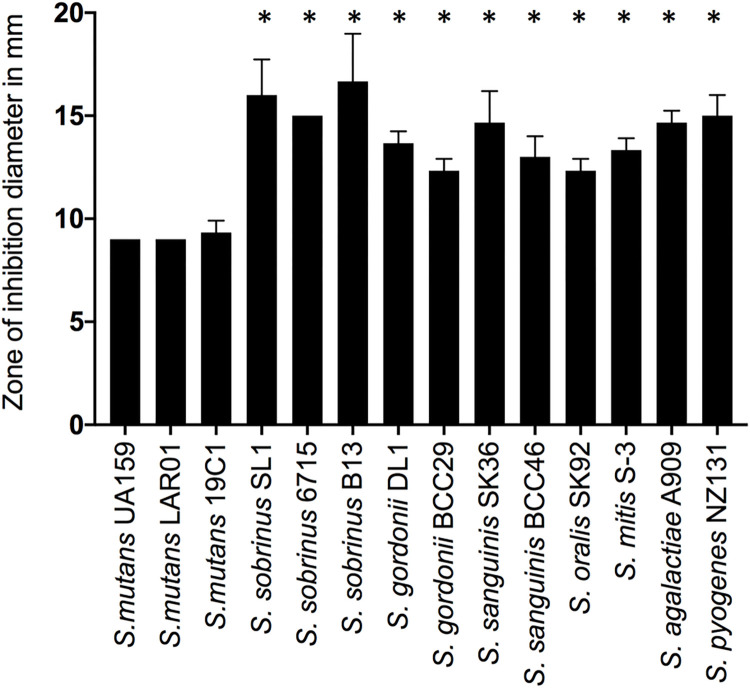
Fig 1 Disc diffusion assay indicating that S. mutans is inherently more tolerant to Zn than other streptococci. Cultures were grown to mid-exponential phase, spread onto BHI plates, and topped with filter paper discs saturated with 1 mM ZnSO4. Growth inhibition zones (in mm) around the discs were measured after 24 h incubation at 37°C in 5% CO2. Data represent means and standard deviations of results from 3 independent experiments. One-way ANOVA was used to compare the zones of growth inhibition of each strain to that of S. mutans UA159. A p value of <0.05 was considered significant (*).
Fig 1 Disc diffusion assay indicating that S. mutans is inherently more tolerant to Zn than other streptococci. Cultures were grown to mid-exponential phase, spread onto BHI plates, and topped with filter paper discs saturated with 1 mM ZnSO4. Growth inhibition zones (in mm) around the discs were measured after 24 h incubation at 37°C in 5% CO2. Data represent means and standard deviations of results from 3 independent experiments. One-way ANOVA was used to compare the zones of growth inhibition of each strain to that of S. mutans UA159. A p value of <0.05 was considered significant (*).CC BY · PubMed Central
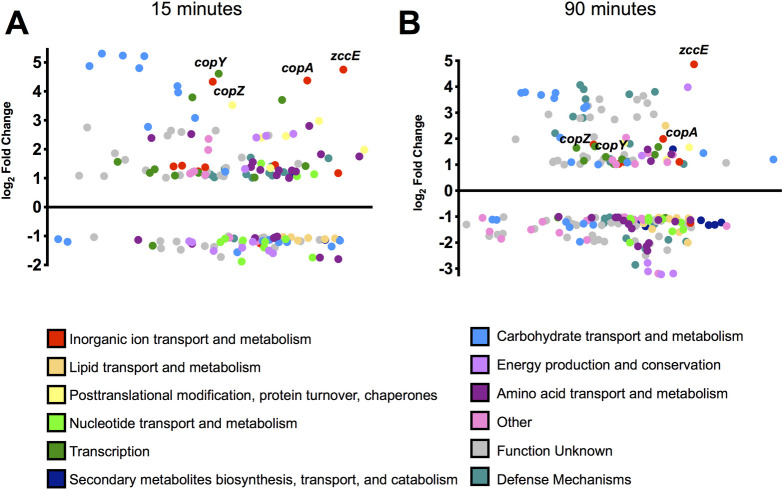
Fig 2 Summary of RNA-Seq analysis of S. mutans UA159 treated with 4 mM ZnSO4 for 15 (A) or 90 (B) minutes compared to untreated control. The y-axis indicates the log2 fold change in expression compared to the control, while the x-axis separates genes according to their average expression levels as compared to all other genes. The identities of selected genes of interest are indicated. The differentially expressed genes from both time points were grouped according to Clusters of Orthologous Groups (COG) functional categories [39].
Fig 2 Summary of RNA-Seq analysis of S. mutans UA159 treated with 4 mM ZnSO4 for 15 (A) or 90 (B) minutes compared to untreated control. The y-axis indicates the log2 fold change in expression compared to the control, while the x-axis separates genes according to their average expression levels as compared to all other genes. The identities of selected genes of interest are indicated. The differentially expressed genes from both time points were grouped according to Clusters of Orthologous Groups (COG) functional categories [39].CC BY · PubMed Central
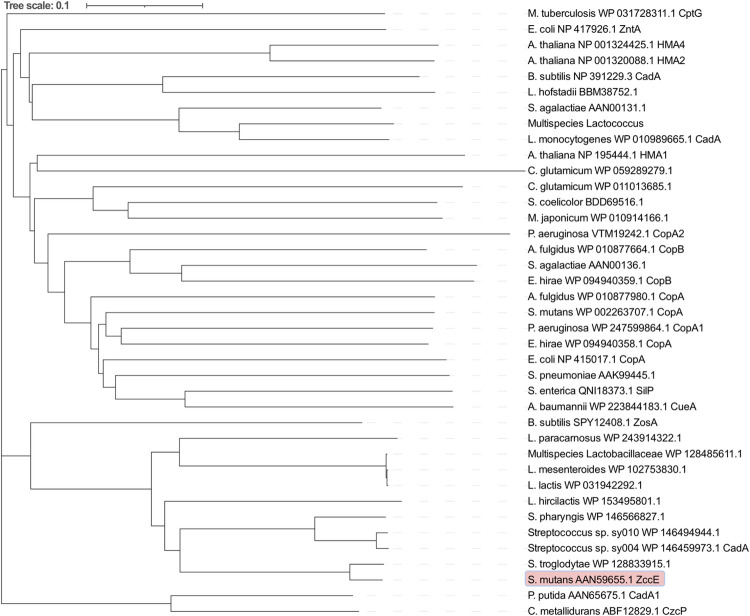
Fig 3 Phylogenetic tree of P-type ATPases including ZccE and 38 other P-type ATPases identified from the literature and from BLASTP searches for comparison. The tree distance is the calculated distance from the multiple sequence alignment in Clustal Omega. ZccE is highlighted in red.
Fig 3 Phylogenetic tree of P-type ATPases including ZccE and 38 other P-type ATPases identified from the literature and from BLASTP searches for comparison. The tree distance is the calculated distance from the multiple sequence alignment in Clustal Omega. ZccE is highlighted in red.CC BY · PubMed Central
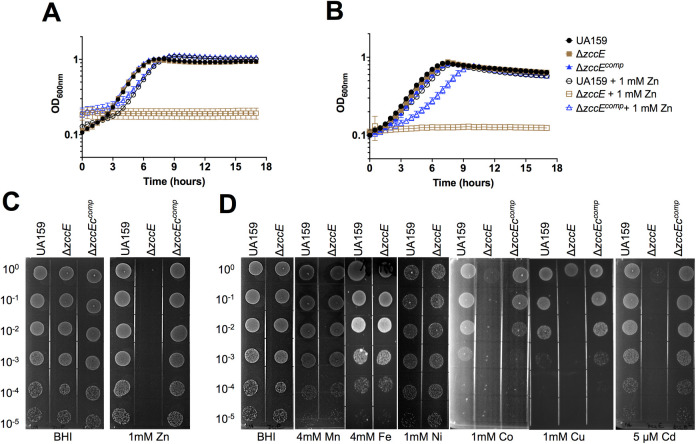
Fig 4 ZccE is a multi-metal exporter responsible for the high Zn tolerance of S. mutans. (A-B) Growth curves of S. mutans UA159, ΔzccE and ΔzccEcomp strains in FMC (A) or BHI (B) with or without 1 mM Zn supplementation. Data represent means from 3 independent experiments and the error bars represent standard deviations of the results. A nonlinear curve fit analysis and measuring the doubling time indicated that the growth defect of the ΔzccE strain was statistically significant when compared to either UA159 or ΔzccEcomp strains. (C) Plate titration (spot test) of S. mutans UA159, ΔzccE and ΔzccEcomp strains on BHI agar with or without 1 mM Zn supplementation. (D) Plate titration of S. mutans UA159 and ΔzccE strains on BHI agar supplemented with 4 mM Mn, 4 mM Fe, 1 mM Cu, 1 mM Ni or 5 μM Cd. (C-D) Images were taken after 24 h incubation at 37°C in 5% CO2 and are representative of at least 3 independent experiments.
Fig 4 ZccE is a multi-metal exporter responsible for the high Zn tolerance of S. mutans. (A-B) Growth curves of S. mutans UA159, ΔzccE and ΔzccEcomp strains in FMC (A) or BHI (B) with or without 1 mM Zn supplementation. Data represent means from 3 independent experiments and the error bars represent standard deviations of the results. A nonlinear curve fit analysis and measuring the doubling time indicated that the growth defect of the ΔzccE strain was statistically significant when compared to either UA159 or ΔzccEcomp strains. (C) Plate titration (spot test) of S. mutans UA159, ΔzccE and ΔzccEcomp strains on BHI agar with or without 1 mM Zn supplementation. (D) Plate titration of S. mutans UA159 and ΔzccE strains on BHI agar supplemented with 4 mM Mn, 4 mM Fe, 1 mM Cu, 1 mM Ni or 5 μM Cd. (C-D) Images were taken after 24 h incubation at 37°C in 5% CO2 and are representative of at least 3 independent experiments.CC BY · PubMed Central
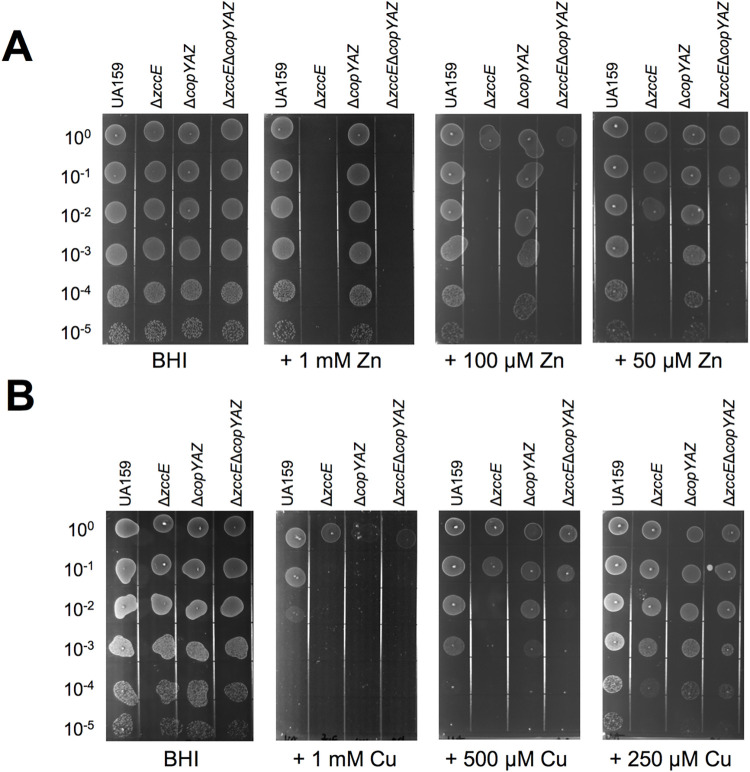
Fig 5 CopA plays a minor role in Zn tolerance while ZccE and CopA work interchangeably to protect against Cu intoxication in oxidizing environments. (A-B) Plate titration (spot test) of S. mutans UA159, ΔzccE, ΔcopYAZ, and ΔzccEΔcopYAZ strains on BHI agar with varying concentrations of Zn (A) or Cu (B). Images were taken after 24 h incubation at 37°C in 5% CO2 and are representative of at least 3 independent experiments.
Fig 5 CopA plays a minor role in Zn tolerance while ZccE and CopA work interchangeably to protect against Cu intoxication in oxidizing environments. (A-B) Plate titration (spot test) of S. mutans UA159, ΔzccE, ΔcopYAZ, and ΔzccEΔcopYAZ strains on BHI agar with varying concentrations of Zn (A) or Cu (B). Images were taken after 24 h incubation at 37°C in 5% CO2 and are representative of at least 3 independent experiments.CC BY · PubMed Central
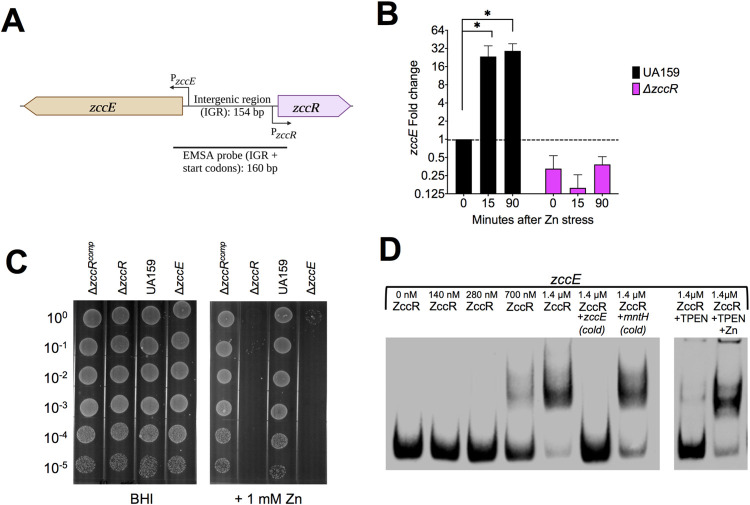
Fig 6 The MerR-type transcription factor ZccR is a positive regulator of zccE. (A) Genetic organization of zccE (smu2057c) and zccR (smu2058) in the S. mutans UA159 chromosome (Created with BioRender.com). (B) qRT-PCR analysis of zccE mRNA expression in the ΔzccR strain relative to the parent UA159 strain before and after exposure to 4 mM Zn. Data represent means and standard deviations of results from 3 independent experiments. One-way ANOVA was used to determine significance (*, p <0.001; ns, not significant). (C) Plate titration (spot test) of UA159, ΔzccE, ΔzccR and ΔzccRcomp strains on BHI with or without 1 mM Zn supplementation. Images were taken after 24 h incubation at 37°C in 5% CO2 and are representative of at least 3 independent experiments. (D) EMSA showing direct interaction of ZccR with the 160-bp zccE-zccR intergenic region (IGR). To determine ZccR binding specificity, addition of 100X (molar excess) of either non-biotin labeled (cold) zccE-zccR IGR or non-specific competitor DNA (mntH promoter region) was added to the reaction. To explore the role of Zn on ZccR binding activity, 3 mM TPEN (Zn specific chelator) was added to the reaction alone or in the presence of 2.5 mM ZnSO4.
Fig 6 The MerR-type transcription factor ZccR is a positive regulator of zccE. (A) Genetic organization of zccE (smu2057c) and zccR (smu2058) in the S. mutans UA159 chromosome (Created with BioRender.com). (B) qRT-PCR analysis of zccE mRNA expression in the ΔzccR strain relative to the parent UA159 strain before and after exposure to 4 mM Zn. Data represent means and standard deviations of results from 3 independent experiments. One-way ANOVA was used to determine significance (*, p <0.001; ns, not significant). (C) Plate titration (spot test) of UA159, ΔzccE, ΔzccR and ΔzccRcomp strains on BHI with or without 1 mM Zn supplementation. Images were taken after 24 h incubation at 37°C in 5% CO2 and are representative of at least 3 independent experiments. (D) EMSA showing direct interaction of ZccR with the 160-bp zccE-zccR intergenic region (IGR). To determine ZccR binding specificity, addition of 100X (molar excess) of either non-biotin labeled (cold) zccE-zccR IGR or non-specific competitor DNA (mntH promoter region) was added to the reaction. To explore the role of Zn on ZccR binding activity, 3 mM TPEN (Zn specific chelator) was added to the reaction alone or in the presence of 2.5 mM ZnSO4.CC BY · PubMed Central
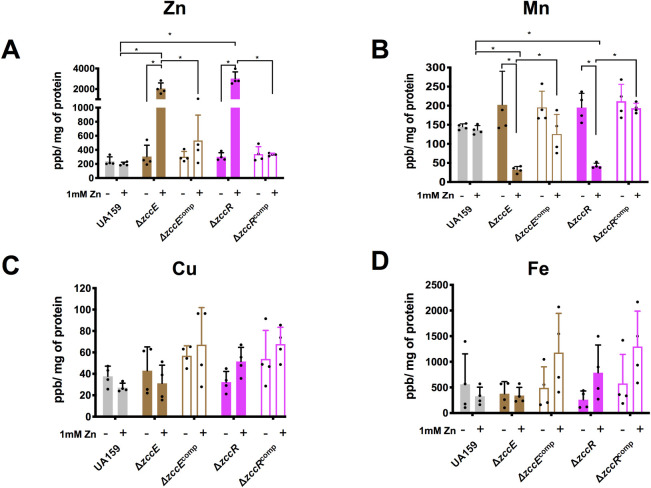
Fig 7 ICP-MS quantifications of intracellular Zn, Mn, Cu and Fe in UA159, ΔzccE, ΔzccR and respective complemented strains. Strains were grown in BHI to mid-exponential phase at which point the experimental groups were exposed to 1 mM Zn for 90 minutes. The graphs indicate intracellular parts per billion Zn (A), Mn (B), Cu (C), and Fe (D) normalized by milligram of total protein. Data represent average and standard deviation of values from four independent biological replicates. Two-way ANOVA was used to determine significance between metal content of either the same strain before and after Zn exposure or among different strains after Zn exposure. Error bars represent standard deviations of results from at least 3 independent experiments. A p value of <0.05 was considered significant (*), and only comparisons that were statistically significant are indicated in the figure.
Fig 7 ICP-MS quantifications of intracellular Zn, Mn, Cu and Fe in UA159, ΔzccE, ΔzccR and respective complemented strains. Strains were grown in BHI to mid-exponential phase at which point the experimental groups were exposed to 1 mM Zn for 90 minutes. The graphs indicate intracellular parts per billion Zn (A), Mn (B), Cu (C), and Fe (D) normalized by milligram of total protein. Data represent average and standard deviation of values from four independent biological replicates. Two-way ANOVA was used to determine significance between metal content of either the same strain before and after Zn exposure or among different strains after Zn exposure. Error bars represent standard deviations of results from at least 3 independent experiments. A p value of <0.05 was considered significant (*), and only comparisons that were statistically significant are indicated in the figure.CC BY · PubMed Central
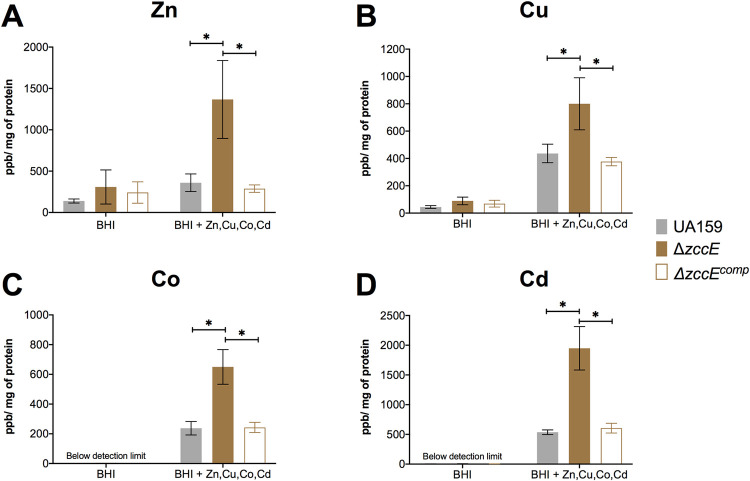
Fig 8 ICP-MS quantifications of intracellular Zn, Cu, Co, and Cd in UA159, ΔzccE, and complemented strains. Strains were grown in BHI to mid-exponential phase at which point the experimental groups were exposed to a mixture of sub-inhibitory concentrations of the 4 metals (0.5 mM Zn, 0.5 mM Cu, 0.5 mM Co and 2.5 μM Cd) for 90 minutes. The graphs indicate intracellular parts per billion of Zn (A), Cu (B), Co (C) and Cd (D) normalized by milligram of total protein. Two-way ANOVA was used to determine significant differences in intracellular metal content among strains after metal exposure. A p value of <0.05 was considered significant (*). Average and error bars represent standard deviations of results from at least 3 independent experiments.
Fig 8 ICP-MS quantifications of intracellular Zn, Cu, Co, and Cd in UA159, ΔzccE, and complemented strains. Strains were grown in BHI to mid-exponential phase at which point the experimental groups were exposed to a mixture of sub-inhibitory concentrations of the 4 metals (0.5 mM Zn, 0.5 mM Cu, 0.5 mM Co and 2.5 μM Cd) for 90 minutes. The graphs indicate intracellular parts per billion of Zn (A), Cu (B), Co (C) and Cd (D) normalized by milligram of total protein. Two-way ANOVA was used to determine significant differences in intracellular metal content among strains after metal exposure. A p value of <0.05 was considered significant (*). Average and error bars represent standard deviations of results from at least 3 independent experiments.CC BY · PubMed Central
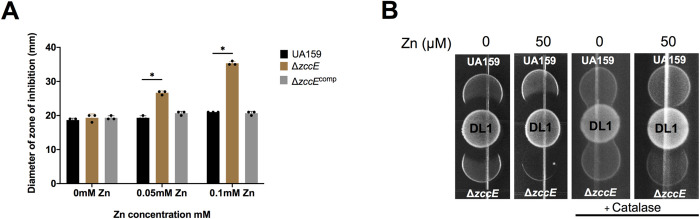
Fig 9 Disruption of Zn homeostasis increases H2O2 sensitivity in the zccE strain. (A) Growth inhibition zones for S. mutans UA159, ΔzccE, and ΔzccEComp strains grown on BHI agar with or without Zn supplementation and exposed to filter paper discs saturated with 0.25% H2O2. Two-way ANOVA was used to determine significance (*, p <0.05). (B) Growth inhibition zones of S. mutans UA159 and ΔzccE strains by peroxigenic S. gordonii DL-1 spotted on BHI agar with or without 50 μM Zn supplementation. The S. mutans-S. gordonii competition assay was repeated with catalase overlaid onto the S. gordonii spot to inactivate H2O2. Images are representative of results from three independent experiments.
Fig 9 Disruption of Zn homeostasis increases H2O2 sensitivity in the zccE strain. (A) Growth inhibition zones for S. mutans UA159, ΔzccE, and ΔzccEComp strains grown on BHI agar with or without Zn supplementation and exposed to filter paper discs saturated with 0.25% H2O2. Two-way ANOVA was used to determine significance (*, p <0.05). (B) Growth inhibition zones of S. mutans UA159 and ΔzccE strains by peroxigenic S. gordonii DL-1 spotted on BHI agar with or without 50 μM Zn supplementation. The S. mutans-S. gordonii competition assay was repeated with catalase overlaid onto the S. gordonii spot to inactivate H2O2. Images are representative of results from three independent experiments.CC BY · PubMed Central
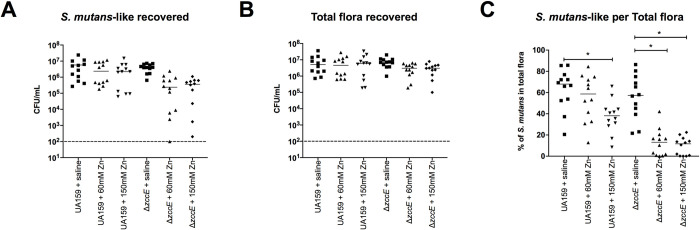
Fig 10 Colonization efficiency of S. mutans UA159 or ΔzccE on the teeth of rats after topical treatment with Zn. (A-B) Bacterial CFU recovered from rat jaws by plating on (A) MS agar for S. mutans and (B) blood agar for total flora. (C) Percentage of S. mutans-like colonies over total flora were calculated by dividing the values shown in (A) by those shown in (B). The dashed line indicates the limit of detection. One-way ANOVA was used to determine significance, and only statistically significant comparisons with p value <0.05 (*) are indicated in the figure.
Fig 10 Colonization efficiency of S. mutans UA159 or ΔzccE on the teeth of rats after topical treatment with Zn. (A-B) Bacterial CFU recovered from rat jaws by plating on (A) MS agar for S. mutans and (B) blood agar for total flora. (C) Percentage of S. mutans-like colonies over total flora were calculated by dividing the values shown in (A) by those shown in (B). The dashed line indicates the limit of detection. One-way ANOVA was used to determine significance, and only statistically significant comparisons with p value <0.05 (*) are indicated in the figure.CC BY · PubMed Central
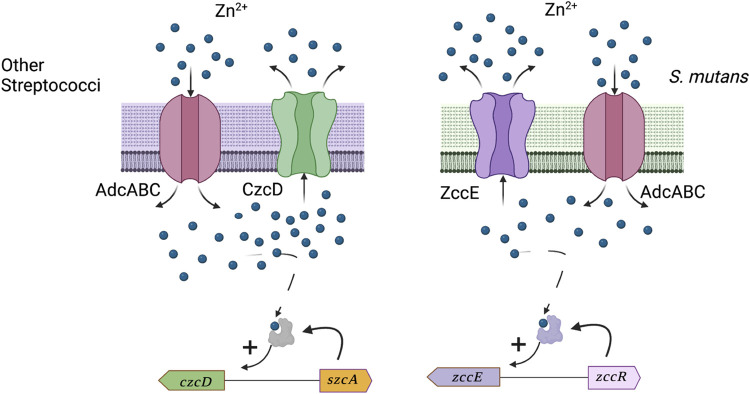
Fig 11 Model figure showing that ZccE (a P-type ATPase transporter) and CzcD (a CDF-type transporter) mediate high Zn tolerance in streptococci. Both czcD and zccE encode for Zn efflux systems and each system is positively regulated by cognate transcriptional regulators (SzcA for czcD and ZccR for zccE) that are activated under high Zn conditions. The CzcD/SzcA pair is found in most streptococci while ZccE/ZccR is unique to S. mutans and, based on Zn sensitivity assays and mutational analysis, is directly responsible for the exceptionally high Zn tolerance of S. mutans when compared to other streptococcal species. AdcABC is an ABC-type transporter conserved among streptococci and primarily responsible for Zn import. This figure was created with Biorender.
Fig 11 Model figure showing that ZccE (a P-type ATPase transporter) and CzcD (a CDF-type transporter) mediate high Zn tolerance in streptococci. Both czcD and zccE encode for Zn efflux systems and each system is positively regulated by cognate transcriptional regulators (SzcA for czcD and ZccR for zccE) that are activated under high Zn conditions. The CzcD/SzcA pair is found in most streptococci while ZccE/ZccR is unique to S. mutans and, based on Zn sensitivity assays and mutational analysis, is directly responsible for the exceptionally high Zn tolerance of S. mutans when compared to other streptococcal species. AdcABC is an ABC-type transporter conserved among streptococci and primarily responsible for Zn import. This figure was created with Biorender.CC BY · PubMed Central

Verification

Claims the paper makes

The claims and statistics of this paper haven’t been checked yet.

Run the check — free, no account needed. It reads the open-access text and checks the sources it cites.

A few free checks a day · papers already verified open instantly · results are public

Self-check

Percentages, sums and reported differences re-computed from the paper’s own numbers.

The self-check needs the paper’s full text.

Citations

Cites

Research works printed but not linked: 68

  1. 10.1038/nrmicro.2017.15 · DOI · Paper page
  2. 10.1146/annurev-genet-120215-035146 · DOI · Paper page
  3. 10.1016/j.coi.2019.04.002 · DOI
  4. 2021, The impact of metal availability on immune function during infection, Trends Endocrinol Metab, 32, 916, 10.1016/j.tem.2021.08.004 · DOI · Paper page
  5. 10.1146/annurev-biochem-062917-012312 · DOI
  6. 10.1074/jbc.R115.647099 · DOI · Paper page
  7. 10.1016/j.tibs.2019.06.010 · DOI · Paper page
  8. 10.1093/infdis/jiu053 · DOI · Paper page
  9. 10.1039/c7mt00240h · DOI
  10. 10.1023/A:1012984713391 · DOI
  11. 10.1016/j.mib.2005.02.007 · DOI
  12. 10.1111/j.1365-2958.1997.mmi518.x · DOI
  13. 10.1023/A:1023425321617 · DOI
  14. 10.1073/pnas.94.26.14326 · DOI · Paper page
  15. 10.1111/mmi.13654 · DOI · Paper page
  16. 10.1128/JB.00975-15 · DOI
  17. 10.1039/c0mt00050g · DOI
  18. 10.1111/j.1365-2958.2007.05849.x · DOI
  19. 10.1128/JB.181.22.6876-6881.1999 · DOI
  20. Ong CL , Walker MJ , McEwan AG . Zinc disrupts central carbon metabolism and capsule biosynthesis in Streptococcus pyogenes. Sci Rep. 2015;5:10799. · DOI · Paper page
  21. Sullivan MJ , Goh KGK , Ulett GC . Cellular Management of Zinc in Group B Streptococcus Supports Bacterial Resistance against Metal Intoxication and Promotes Disseminated Infection. mSphere. 2021;6(3). · DOI · Paper page
  22. 10.1016/S0140-6736(07)60031-2 · DOI · Paper page
  23. 2019, The Lancet Child Adolescent H. Oral health: oft overlooked, Lancet Child Adolesc Health, 3, 663, 10.1016/S2352-4642(19)30275-5 · DOI
  24. 10.1016/j.jacc.2015.03.518 · DOI
  25. 2020, Prevalence of Infective Endocarditis in Streptococcal Bloodstream Infections Is Dependent on Streptococcal Species, Circulation, 142, 720, 10.1161/CIRCULATIONAHA.120.046723 · DOI
  26. 10.1111/j.1875-595X.2011.00049.x · DOI
  27. Uwitonze AM , Ojeh N , Murererehe J , Atfi A , Razzaque MS . Zinc Adequacy Is Essential for the Maintenance of Optimal Oral Health. Nutrients. 2020;12(4). · DOI
  28. 10.1159/000079623 · DOI
  29. 1990, [The effect of zinc chloride mouthwashes on caries-inducing plaque streptococci. 3. The antibacterial effect of zinc chloride on the species Str. mutans, Str. sanguis and Str. salivarius in dental plaque], Zahn Mund Kieferheilkd Zentralbl, 78, 501
  30. 10.1111/j.1600-051X.1975.tb01724.x · DOI
  31. 1973, The inhibition of plaque in humans by two experimental oral rinses, J Periodontol, 44, 100, 10.1902/jop.1973.44.2.100 · DOI
  32. 10.1016/0003-9969(79)90041-4 · DOI
  33. 10.1046/j.0902-0055.2003.00109.x · DOI
  34. 10.1016/S0003-9969(01)00093-0 · DOI
  35. 10.1159/000261149 · DOI
  36. 10.1111/j.1574-6968.2005.00018.x · DOI
  37. 2021, Zinc import mediated by AdcABC is critical for colonization of the dental biofilm by Streptococcus mutans in an animal model, Mol Oral Microbiol, 36, 214, 10.1111/omi.12337 · DOI · Paper page
  38. 10.1093/nar/28.1.33 · DOI
  39. 10.1128/JB.02433-14 · DOI
  40. 10.1128/JB.00127-15 · DOI
  41. 10.1038/nchembio.1168 · DOI · Paper page
  42. 10.1074/jbc.M208490200 · DOI
  43. 10.1016/S0378-1119(96)00323-X · DOI
  44. 2001, Characterization of a copper-transport operon, copYAZ, from Streptococcus mutans. Microbiology, 147, 653
  45. 10.1111/j.1365-2958.2011.07758.x · DOI · Paper page
  46. 10.1111/j.1574-6976.1994.tb00112.x · DOI
  47. 10.1126/science.284.5415.805 · DOI
  48. Neubert MJ , Dahlmann EA , Ambrose A , Johnson MDL . Copper Chaperone CupA and Zinc Control CopY Regulation of the Pneumococcal cop Operon. mSphere. 2017;2(5). · DOI
  49. Kajfasz JK , Katrak C , Ganguly T , Vargas J , Wright L , Peters ZT , et al. Manganese Uptake, Mediated by SloABC and MntH, Is Essential for the Fitness of Streptococcus mutans. mSphere. 2020;5(1). · DOI
  50. Bosma EF , Rau MH , van Gijtenbeek LA , Siedler S . Regulation and distinct physiological roles of manganese in bacteria. FEMS Microbiol Rev. 2021;45(6). · DOI · Paper page
  51. Ortiz de Orue Lucana D , Wedderhoff I , Groves MR . ROS-Mediated Signalling in Bacteria: Zinc-Containing Cys-X-X-Cys Redox Centres and Iron-Based Oxidative Stress. J Signal Transduct. 2012;2012:605905. · DOI
  52. 10.1111/j.1600-0528.1988.tb00574.x · DOI
  53. 2018, Effect of phytate and zinc ions on fluoride toothpaste efficacy using an in situ caries model, J Dent, 73, 24, 10.1016/j.jdent.2018.03.013 · DOI
  54. 10.3390/biom4020419 · DOI
  55. 10.1111/omi.12286 · DOI
  56. 10.1021/bi00048a001 · DOI
  57. 10.1016/0968-0004(96)20016-7 · DOI
  58. 10.1021/bi0616394 · DOI
  59. 10.1371/journal.pone.0089427 · DOI
  60. 10.1371/journal.ppat.1002357 · DOI · Paper page
  61. 10.1128/JB.00612-15 · DOI
  62. 2003, A 100 kDa vanadate and lanzoprazole-sensitive ATPase from Streptococcus mutans membrane, Arch Oral Biol, 48, 815, 10.1016/S0003-9969(03)00177-8 · DOI
  63. 10.1128/IAI.11.4.649-655.1975 · DOI
  64. 10.1016/S0167-7012(01)00369-4 · DOI
  65. 10.1016/j.mimet.2015.09.023 · DOI
  66. 10.1128/AEM.02622-09 · DOI
  67. 10.1038/s41598-017-16367-5 · DOI
  68. 10.1128/JB.00155-06 · DOI

Metadata

Authors
Ganguly, T., Peterson, A., Burkholder, M., Kajfasz, J. K., Abranches, J., & Lemos, J. A.
Affiliations
University of Florida (US)
Venue
PLoS Pathogens
Publisher
openRxiv
Published
2022-03-29
Volume
18
Issue
8
Pages
e1010477-e1010477
ISSN
1553-7366 (ISSN-L)
OpenAlex
W4290667539
Cited by
20
References
1
Citations by year
2026: 6 · 2025: 3 · 2024: 4 · 2023: 6 · 2022: 1
FWCI
2.11
Type
journal article
Language
en
Open access
Licence
cc-by
Locations
  • PLoS Pathogens (publishedVersion, cc-by)
  • bioRxiv (Cold Spring Harbor Laboratory) (acceptedVersion, cc-by)
  • PubMed Central (publishedVersion, cc-by)
  • PubMed (publishedVersion)
  • DOAJ (DOAJ: Directory of Open Access Journals) (submittedVersion, cc-by-sa)
Funders
  • National Institutes of Health
  • National Institute of Dental and Craniofacial Research (DE019783, R01DE019783, DE021990, T90DE021990)
Topics
  • Life Sciences › Biochemistry, Genetics and Molecular Biology › Genetics › Bacterial Genetics and Biotechnology
  • Health Sciences › Dentistry › Periodontics › Oral microbiology and periodontitis research
  • Health Sciences › Nursing › Nutrition and Dietetics › Trace Elements in Health
Keywords
P-type ATPase, Streptococcus mutans, zinc toxicity, metal tolerance, zinc homeostasis, cadmium, cobalt, copper, manganese, hydrogen peroxide sensitivity, dental caries, oral colonization, antimicrobial drug targets, transcription factors
MeSH terms
P-type ATPases, Adenosine Triphosphatases, Animals, Anti-Infective Agents, Dental Caries, Mammals, Manganese, Streptococcus mutans, Zinc, Biofilms, Rats

About these checks

Registry, retraction, Cites and statistics results are computed, not judged, with one exception: a printed reference that no index lists is read once by a model before it counts as a citation error. Claims are extracted by a model and kept only when their quote appears verbatim in the text; each cited source is then checked, with a model’s help, for whether it says what the claim relies on. Those verdicts can be wrong — read the claim’s quote and the cited source before relying on one.

Statistics and arithmetic are recomputed, not judged.

Confidence bands are shown only for fields calibrated on our annotated test set. None is calibrated yet, so no band is shown.

What counts as a claim ›How we measure confidence ›How we check this ›

Are you an author, or do you see a problem with this page? Request a review