

Structure of phage λ Redβ 177 annealase shows how it anneals DNA strands during single-strand annealing homologous DNA recombination
Open accessPreprint — published as 10.1038/s41467-022-33090-6 · Paper page
The DOI matches its Crossref record; 79 of the 79 references it cites were found in a registry or an index.
Abstract
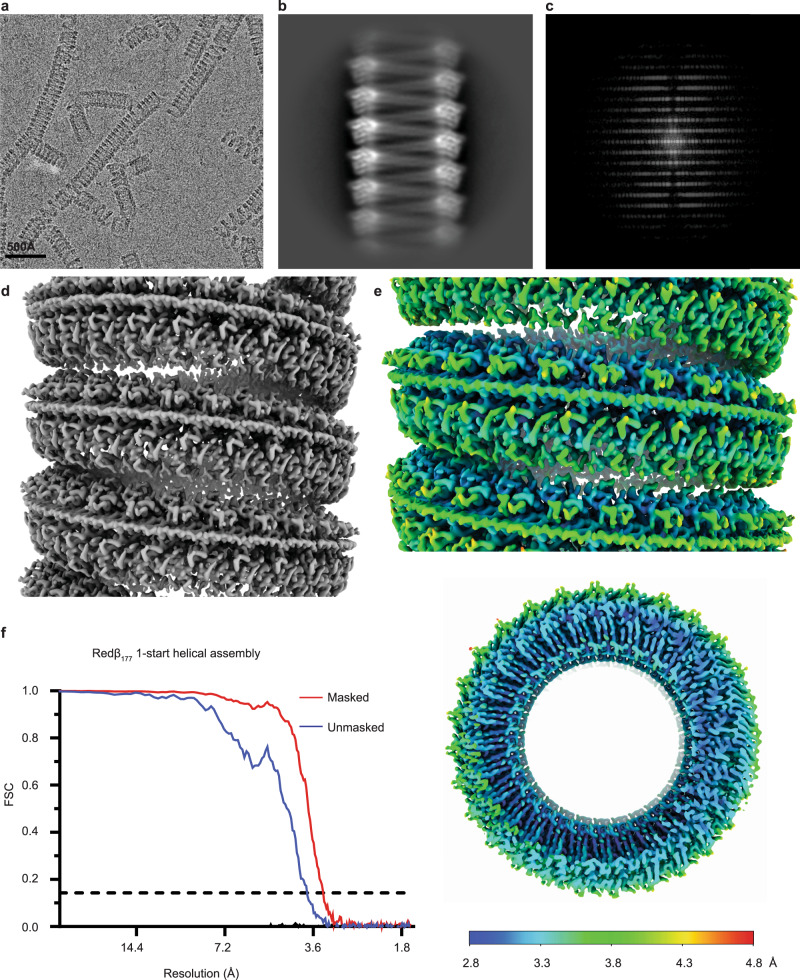
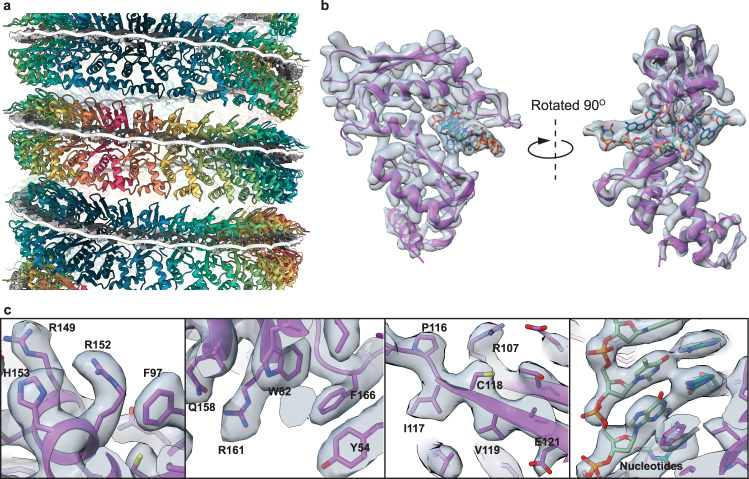
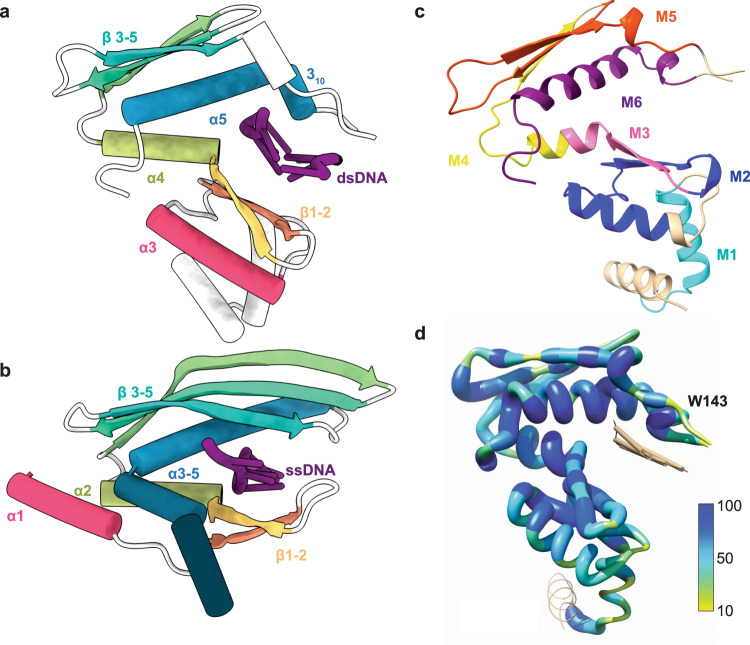
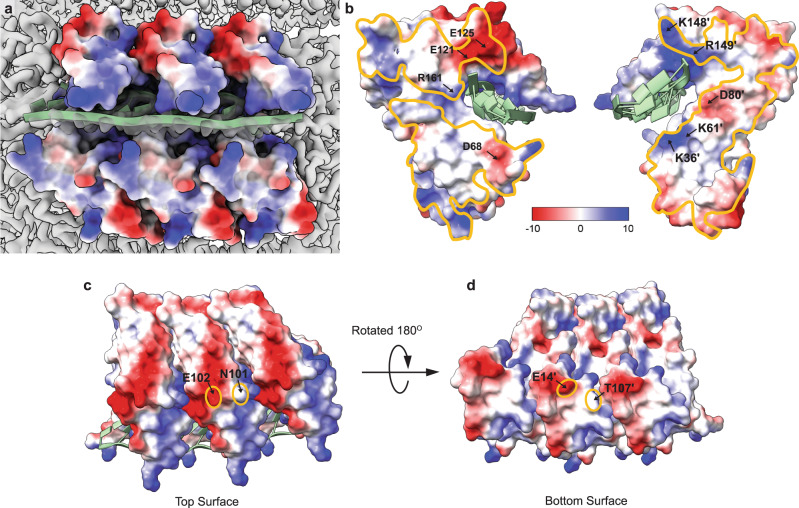
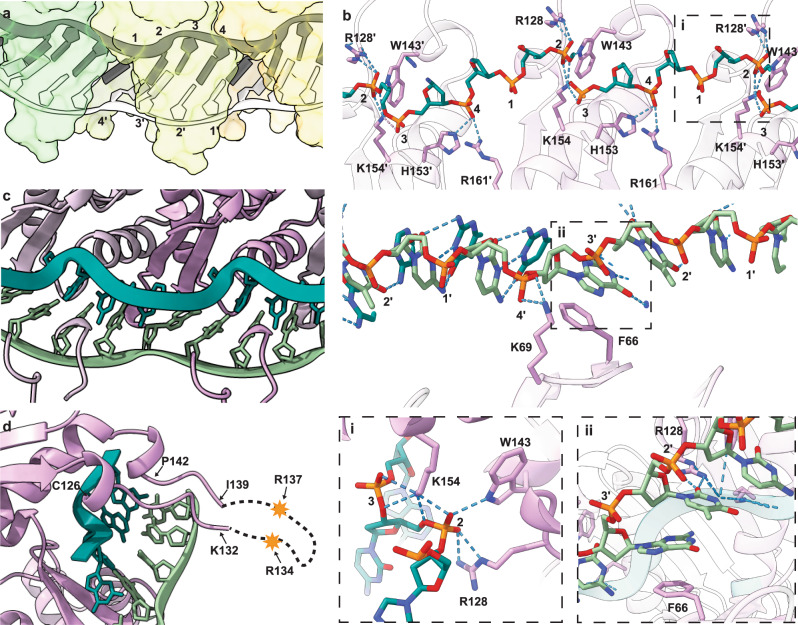
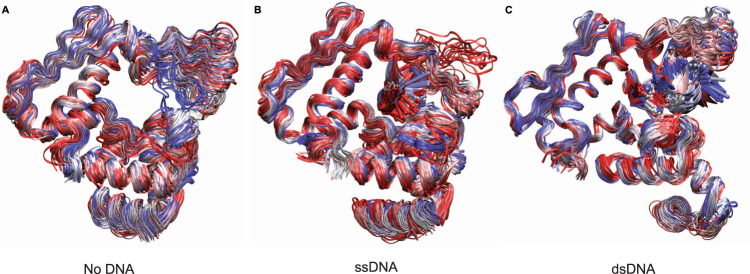
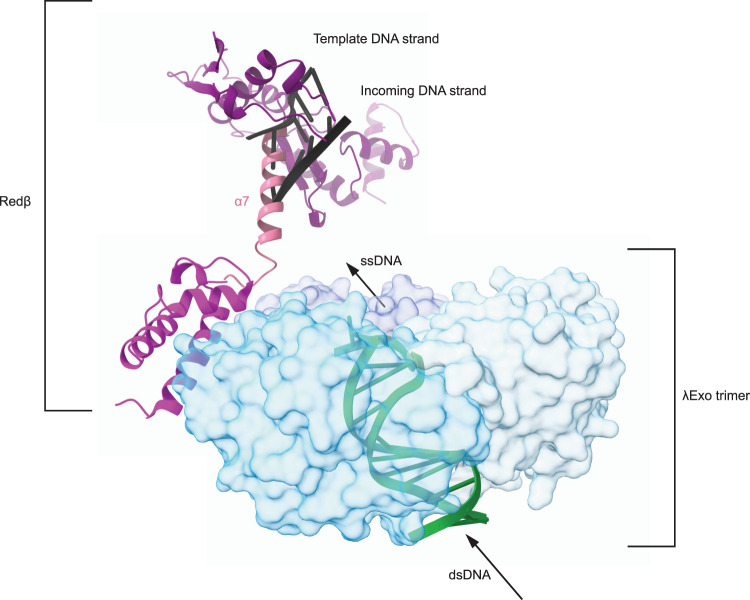
The bacteriophage λ red recombination system catalyzes the single-strand annealing homologous DNA recombination reaction, in which Redβ annealase protein plays a critical role. Using cryogenic electron microscopy, we were able to determine a structure of a C-terminally truncated Redβ with the residues 1-177 bound to two complementary 27mer oligonucleotides forming an annealing intermediate, to a final resolution of 3.3 Å. This structure validates and rationalizes decades of experimental observations on the biochemistry of Redβ. Definition of the interaction surfaces between subunits explains not only the DNA binding properties of Redβ, but also its propensity to oligomerize into long helical filaments, which are also formed by almost all annealases and are known to be functionally important. In addition, this annealing intermediate structure provides a detailed picture of the hydrogen bonding network that positions the DNA strands in a planar orientation to facilitate base pairing. Residues 133-138, which are missing from our structure, form a flexible loop. Molecular dynamics simulations were used to model the range of motion of the flexible loop, which suggested that it has a crucial role in keeping the DNA strands in the DNA-binding groove long enough to allow homology searching. The combination of structural and computational observations has allowed us to propose a detailed mechanism for the action of Redβ. More than half a century after its discovery, our work shines a light not only on the structure and mechanisms of Redβ, but also of other proteins within the annealase superfamilies. Significance Statement: Single-strand annealing homologous DNA recombination is a process that is conserved throughout evolution from bacteriophages to humans, highlighting its importance and indispensability. It is a process that repairs double-stranded DNA breaks and is particularly vital in dsDNA viruses. The Redβ protein from the bacteriophage lambda is the archetypal annealase protein, forming the basis of our knowledge about this class of proteins. Along with the exonuclease λExo, these two proteins not only form the model system for single-strand annealing homologous recombination, but are also used in thousands of laboratories worldwide for performing genetic manipulations. After its discovery in 1966, we report the first structure of the DNA-binding and oligomerization domain of Redβ, providing details about the mechanism of homologous DNA annealing.
Overview
The claims and statistics of this paper haven’t been checked yet.
Free: it reads the open-access text and checks the first 5 claims that cite a source we can check. Create a free account to check every claim.
Integrity signals
Registry
Cites
Statistics
Figures
Verification
Claims the paper makes
The claims and statistics of this paper haven’t been checked yet.
Free: it reads the open-access text and checks the first 5 claims that cite a source we can check. Create a free account to check every claim.
Self-check
Percentages, sums and reported differences re-computed from the paper’s own numbers.
The self-check needs the paper’s full text.
Citations
Cites
VMD: visual molecular dynamics
Humphrey, W., Dalke, A., & Schulten, K. (1996) · Journal of Molecular Graphics · doi:10.1016/0263-7855(96)00018-5 · Cited by 66,952
MAFFT Multiple Sequence Alignment Software Version 7: Improvements in Performance and Usability
Katoh, K., & Standley, D. M. (2013) · Molecular Biology and Evolution · doi:10.1093/molbev/mst010 · Cited by 46,209
Highly accurate protein structure prediction with AlphaFold
Jumper, J., Evans, R., Pritzel, A., Green, T., Figurnov, M., Ronneberger, O., Tunyasuvunakool, K., Bates, R., Žídek, A., Potapenko, A., et al. (2021) · Nature · doi:10.1038/s41586-021-03819-2 · Cited by 43,764
Comparison of simple potential functions for simulating liquid water
Jorgensen, W. L., Chandrasekhar, J., Madura, J. D., Impey, R. W., & Klein, M. L. (1983) · The Journal of Chemical Physics · doi:10.1063/1.445869 · Cited by 41,298
Particle mesh Ewald: An N ⋅log( N ) method for Ewald sums in large systems
Darden, T., York, D., & Pedersen, L. (1993) · The Journal of Chemical Physics · doi:10.1063/1.464397 · Cited by 30,546
Features and development of Coot
Emsley, P., Lohkamp, B., Scott, W. G., & Cowtan, K. (2010) · Acta Crystallographica Section D Biological Crystallography · doi:10.1107/s0907444910007493 · Cited by 29,915
cryoSPARC: algorithms for rapid unsupervised cryo-EM structure determination
Punjani, A., Rubinstein, J. L., Fleet, D. J., & Brubaker, M. A. (2017) · Nature Methods · doi:10.1038/nmeth.4169 · Cited by 11,626
Jalview Version 2—a multiple sequence alignment editor and analysis workbench
Waterhouse, A. M., Procter, J. B., Martin, D. M. A., Clamp, M., & Barton, G. J. (2009) · Bioinformatics · doi:10.1093/bioinformatics/btp033 · Cited by 11,399
CHARMM‐GUI: A web‐based graphical user interface for CHARMM
Jo, S., Kim, T., Iyer, V. G., & Im, W. (2008) · Journal of Computational Chemistry · doi:10.1002/jcc.20945 · Cited by 9,284
MolProbity: More and better reference data for improved all‐atom structure validation
Williams, C. J., Headd, J. J., Moriarty, N. W., Prisant, M. G., Videau, L. L., Deis, L. N., Verma, V., Keedy, D. A., Hintze, B. J., Chen, V. B., et al. (2018) · Protein Science · doi:10.1002/pro.3330 · Cited by 4,599
Research works printed but not linked: 7
- 1966, Regulation of lambda exonuclease. II. Joint regulation of exonuclease and a new lambda antigen, J Mol Biol, 18, 251
- 1971, Separation and characterization of exonuclease, betaprotein, and a complex of both, J. Biol. Chem, 246, 2510
- 10.1016/j.pbiomolbio.2019.03.005 · DOI
- 2013, Structural and Functional Characterization of the Red beta Recombinase from Bacteriophage lambda, Plos One, 8, 78869, 10.1371/journal.pone.0078869 · DOI
- 2019, Macromolecular structure determination using X-rays, neutrons and electrons: recent developments in Phenix, Acta Crystallogr D Biol Crystallogr, D75, 861
- 2009, LOOS: an extensible platform for the structural analysis of simulations, Annu Int Conf IEEE Eng Med Biol Soc, 2009, 2332
- 10.1101/2021.08.15.456425 · DOI · Paper page
Metadata
- Authors
- Newing, T., Brewster, J. L., Yu, H., Johnston, N. P., Fitschen, L. J., & Tolun, G.
- Affiliations
- University of Wollongong (AU)
- Corresponding author
- Tolun, Gökhan
- Venue
- Nature Communications
- Publisher
- openRxiv
- Published
- 2022-04-09
- Volume
- 13
- Issue
- 1
- Pages
- 5649-5649
- ISSN
- 2041-1723 (ISSN-L)
- PMC
- PMC9512822
- OpenAlex
- W4297239109
- Cited by
- 21
- References
- 79
- Citations by year
- 2026: 4 · 2025: 5 · 2024: 6 · 2023: 5 · 2022: 1
- FWCI
- 1.39
- Type
- journal article
- Language
- en
- Open access
- gold
- doi.org
- Licence
- cc-by
- Locations
- Nature Communications (publishedVersion, cc-by)
- bioRxiv (Cold Spring Harbor Laboratory) (acceptedVersion, cc-by-nc-nd)
- PubMed Central (publishedVersion, cc-by)
- PubMed (publishedVersion)
- Research Online (University of Wollongong) (submittedVersion)
- RePEc: Research Papers in Economics (submittedVersion)
- DOAJ (DOAJ: Directory of Open Access Journals) (submittedVersion, cc-by-sa)
- Funders
- National Health and Medical Research Council (1184012)
- Topics
- Life Sciences › Biochemistry, Genetics and Molecular Biology › Molecular Biology › DNA Repair Mechanisms
- Life Sciences › Biochemistry, Genetics and Molecular Biology › Structural Biology › Enzyme Structure and Function
- Life Sciences › Biochemistry, Genetics and Molecular Biology › Genetics › Bacterial Genetics and Biotechnology
- Keywords
- single-strand annealing, oligomerization, flexible loop, molecular mechanisms
- MeSH terms
- DNA, Single-Stranded, Oligonucleotides, Bacteriophage lambda, DNA, Complementary, Homologous Recombination
About these checks
Registry, retraction, Cites and statistics results are computed, not judged, with one exception: a printed reference that no index lists is read once by a model before it counts as a citation error. Claims are extracted by a model and kept only when their quote appears verbatim in the text; each cited source is then checked, with a model’s help, for whether it says what the claim relies on. Those verdicts can be wrong — read the claim’s quote and the cited source before relying on one.
Statistics and arithmetic are recomputed, not judged.
Confidence bands are shown only for fields calibrated on our annotated test set. None is calibrated yet, so no band is shown.
What counts as a claim ›How we measure confidence ›How we check this ›
Are you an author, or do you see a problem with this page? Request a review
How to cite
Cite CoChat for the checks on this page, and the paper for its own findings.
- This page
- CoChat. (2026). Citation check: Structure of phage λ Redβ 177 annealase shows how it anneals DNA strands during single-strand annealing homologous DNA recombination. https://app.cochat.ai/papers/10.1101/2022.04.09.487726
- The paper
- Newing, T., Brewster, J. L., Yu, H., Johnston, N. P., Fitschen, L. J., & Tolun, G. (2022). Structure of phage λ Redβ 177 annealase shows how it anneals DNA strands during single-strand annealing homologous DNA recombination. Nature Communications. https://doi.org/10.1101/2022.04.09.487726
Data sources
Bibliographic data: Semantic Scholar, OpenAlex, Crossref.
Contains information from the Semantic Scholar Academic Graph Datasets, made available under the ODC Attribution License (ODC-BY 1.0).
Semantic Scholar’s data is described in: Kinney, R., et al. (2023). The Semantic Scholar Open Data Platform. arXiv:2301.10140.
