

The DOI matches its Crossref record; 1 of the 1 references it cites were found in a registry or an index.
Divergence of trafficking and polarization mechanisms for PIN auxin transporters during land plant evolution
Open accessPreprint — published as 10.1016/j.xplc.2023.100669 · Paper page
Abstract
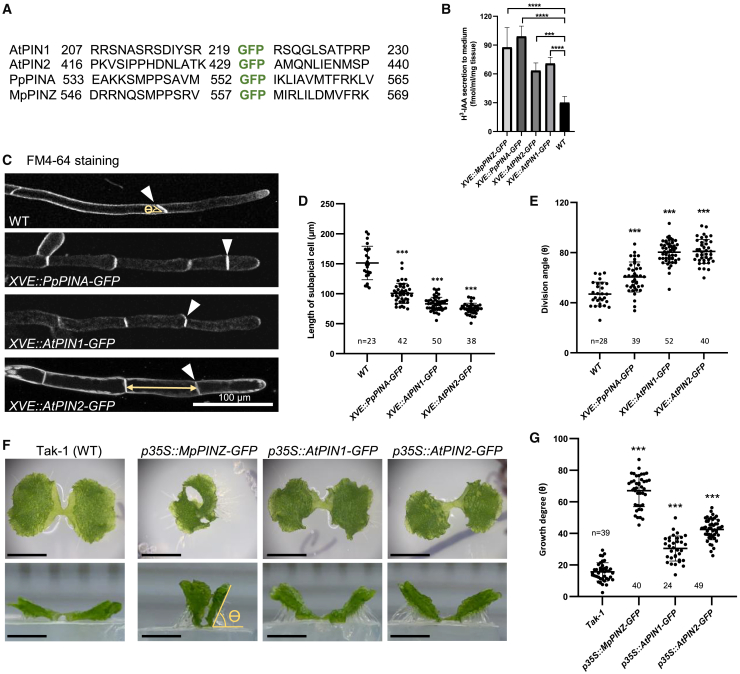
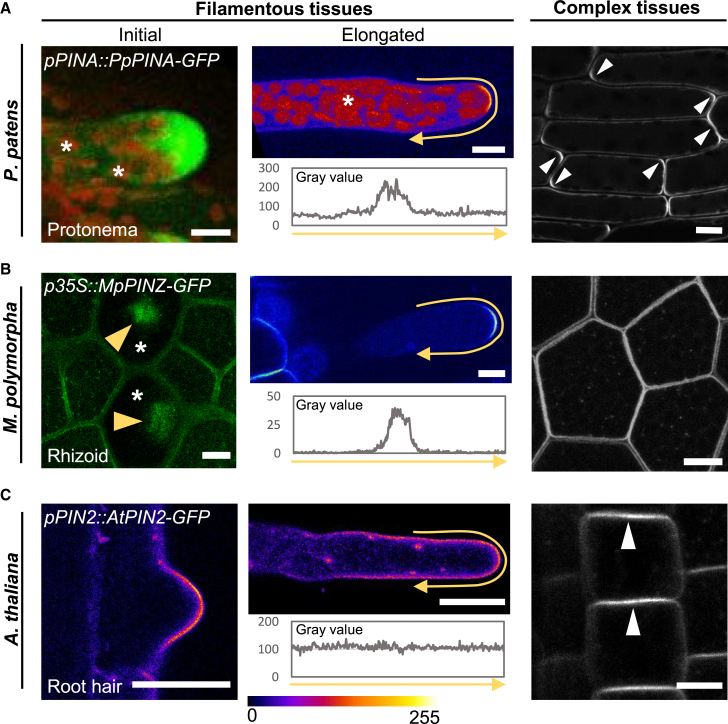
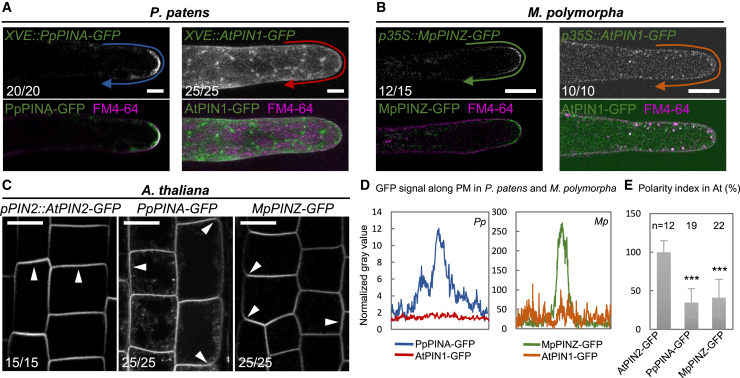
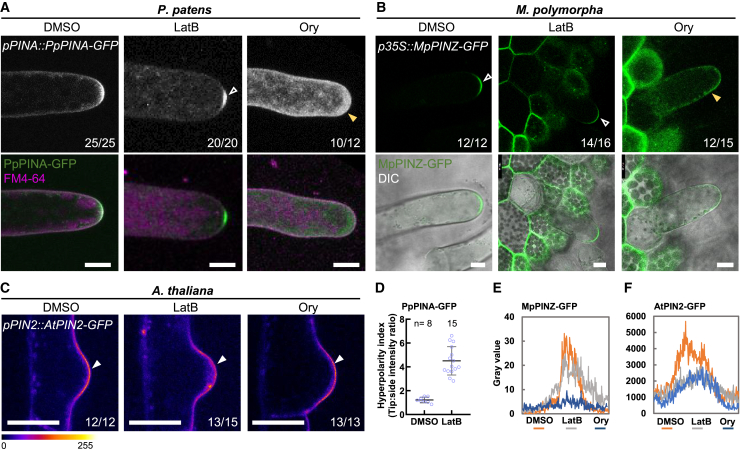
The phytohormone auxin and its directional transport through tissues play a fundamental role in development of higher plants. This polar auxin transport predominantly relies on PIN-FORMED (PIN) auxin exporters. Hence, PIN polarization is crucial for development, but its evolution during the rise of morphological complexity in land plants remains unclear. Here, we performed a cross-species investigation by observing the trafficking and localization of endogenous and xenologous PINs in two bryophytes, Physcomitrium patens and Marchantia polymorpha , and in the flowering plant Arabidopsis thaliana . We confirmed that the GFP fusion did not compromise the auxin export function of all examined PINs by using radioactive auxin export assay and by observing the phenotypic changes in transgenic bryophytes. Endogenous PINs polarize to filamentous apices, while xenologous Arabidopsis PINs distribute symmetrically on the membrane in both bryophytes. In Arabidopsis root epidermis, bryophytic PINs show no defined polarity. Pharmacological interference revealed a strong cytoskeleton dependence of bryophytic but not Arabidopsis PIN polarization. The divergence of PIN polarization and trafficking is also observed within the bryophyte clade and between tissues in individual species. These results collectively reveal a divergence of PIN trafficking and polarity mechanisms throughout land plant evolution and a co-evolution of PIN sequence-based and cell-based polarity mechanisms.
Overview
The claims and statistics of this paper haven’t been checked yet.
Run the check — free, no account needed. It reads the open-access text and checks the sources it cites.
Integrity signals
Registry
Cites
Statistics
Figures
Verification
Claims the paper makes
The claims and statistics of this paper haven’t been checked yet.
Run the check — free, no account needed. It reads the open-access text and checks the sources it cites.
Self-check
Percentages, sums and reported differences re-computed from the paper’s own numbers.
The self-check needs the paper’s full text.
Citations
Cites
Highly accurate protein structure prediction with AlphaFold
Jumper, J., Evans, R., Pritzel, A., Green, T., Figurnov, M., Ronneberger, O., Tunyasuvunakool, K., Bates, R., Žídek, A., Potapenko, A., et al. (2021) · Nature · doi:10.1038/s41586-021-03819-2 · Cited by 43,764
Research works printed but not linked: 62
- 10.1038/ncb1369 · DOI
- 10.1105/tpc.114.134874 · DOI
- 10.1006/dbio.2000.0115 · DOI
- 10.1016/j.tplants.2018.03.009 · DOI
- 10.1093/oxfordjournals.pcp.a078679 · DOI
- 10.1016/j.cub.2014.09.054 · DOI
- 10.1146/annurev-arplant-050718-100309 · DOI
- 10.1073/pnas.1424856112 · DOI
- 10.1007/s10265-012-0496-4 · DOI
- Floriach-Clark, J. , Tang, H. , and Willemsen, V. (2021). Mosses: Accessible Systems for Plant Development Studies. In Model Organisms in Plant Genetics, (IntechOpen. · DOI
- 10.1101/cshperspect.a039859 · DOI
- 10.1126/science.1100618 · DOI · Paper page
- 10.1038/35096571 · DOI
- 10.1038/s41477-018-0318-3 · DOI
- 10.3390/biom9060222 · DOI
- 10.1371/journal.pone.0138876 · DOI
- 10.1093/bioinformatics/8.3.275 · DOI
- 10.1093/jxb/erx267 · DOI
- 10.1093/pcp/pcx095 · DOI
- 10.1093/mp/ssn062 · DOI
- 10.1016/j.cub.2008.03.021 · DOI
- 10.1038/msb.2011.72 · DOI
- 10.1186/gb-2009-10-12-249 · DOI
- 10.1371/journal.pone.0077356 · DOI
- 10.1271/bbb.120700 · DOI
- 10.1093/molbev/msy096 · DOI · Paper page
- 10.7554/eLife.13325 · DOI
- 10.1038/nprot.2009.1 · DOI
- 10.1104/pp.17.00765 · DOI · Paper page
- 10.1016/j.cell.2007.07.033 · DOI · Paper page
- 10.1146/annurev.cellbio.23.090506.123214 · DOI · Paper page
- 10.1105/tpc.112.098509 · DOI
- 10.7554/eLife.52067 · DOI
- 10.1093/plphys/kiab134 · DOI
- 10.1093/dnares/7.1.9 · DOI
- 10.1093/pcp/pcp031 · DOI
- 10.1186/s12870-015-0685-0 · DOI
- 10.1242/dev.154617 · DOI
- 10.1002/pro.3943 · DOI
- 10.1105/tpc.19.00828 · DOI
- 10.1242/dev.168088 · DOI
- 2002, Preparing high-quality DNA from moss (Physcomitrella patens), Plant Molecular Biology Reporter, 20, 423, 10.1007/BF02772133 · DOI
- 10.1093/pcp/pcv192 · DOI
- 10.1038/s41477-019-0542-5 · DOI
- 10.1016/j.pbi.2015.10.001 · DOI
- 10.1104/pp.108.131607 · DOI
- 10.1111/nph.16276 · DOI
- 10.1111/nph.15039 · DOI
- 10.1038/s41586-022-04883-y · DOI
- 10.1016/j.cell.2009.03.001 · DOI
- 10.1016/j.tplants.2012.08.009 · DOI
- 10.1016/j.cub.2014.09.056 · DOI
- 10.1371/journal.pone.0005744 · DOI
- 10.1242/dev.02027 · DOI
- 10.1126/science.1121356 · DOI
- 10.1007/978-1-4939-3542-0_17 · DOI · Paper page
- 10.1038/s41586-022-05143-9 · DOI
- 10.1111/jipb.13225 · DOI
- 10.1073/pnas.0909460107 · DOI
- 10.1038/s41467-019-11471-8 · DOI
- 10.7554/eLife.02860 · DOI
- 10.3389/fpls.2019.00985 · DOI
Metadata
- Authors
- Tang, H., Lu, K.-J., Zhang, Y., Cheng, Y.-L., Tu, S.-L., & Friml, J.
- Affiliations
- Institute of Science and Technology Austria (AT)
- National Chung Hsing University (TW)
- Northwest A&F University (CN)
- Institute of Plant and Microbial Biology, Academia Sinica (TW)
- Venue
- Plant Communications
- Publisher
- openRxiv
- Published
- 2022-04-30
- Volume
- 5
- Issue
- 1
- Pages
- 100669-100669
- ISSN
- 2590-3462 (ISSN-L)
- PMC
- PMC10811345
- OpenAlex
- W4385431171
- Cited by
- 21
- References
- 1
- Citations by year
- 2026: 4 · 2025: 5 · 2024: 11 · 2023: 1
- FWCI
- 3.31
- Type
- journal article
- Language
- en
- Open access
- gold
- doi.org
- Licence
- cc-by-nc-nd
- Locations
- Plant Communications (publishedVersion, cc-by-nc-nd)
- bioRxiv (Cold Spring Harbor Laboratory) (acceptedVersion, cc-by-nc-nd)
- PubMed Central (publishedVersion, cc-by)
- PubMed (publishedVersion)
- Funders
- National Science and Technology Council
- Ministry of Science and Technology (110-2636-B-005-001)
- European Research Council (ETAP-742985)
- H2020 European Research Council
- Topics
- Life Sciences › Agricultural and Biological Sciences › Plant Science › Plant Molecular Biology Research
- Life Sciences › Agricultural and Biological Sciences › Plant Science › Plant nutrient uptake and metabolism
- Life Sciences › Agricultural and Biological Sciences › Plant Science › Plant Parasitism and Resistance
- Keywords
- PIN auxin transporters, polar auxin transport, land plant evolution, bryophytes, Physcomitrella patens, Marchantia polymorpha, Arabidopsis thaliana, cytoskeleton, GFP fusion protein, root epidermis, apical polarity, exogenous auxin
- MeSH terms
- Indoleacetic Acids, Arabidopsis, Plant Roots, Membrane Transport Proteins, Arabidopsis Proteins
About these checks
Registry, retraction, Cites and statistics results are computed, not judged, with one exception: a printed reference that no index lists is read once by a model before it counts as a citation error. Claims are extracted by a model and kept only when their quote appears verbatim in the text; each cited source is then checked, with a model’s help, for whether it says what the claim relies on. Those verdicts can be wrong — read the claim’s quote and the cited source before relying on one.
Statistics and arithmetic are recomputed, not judged.
Confidence bands are shown only for fields calibrated on our annotated test set. None is calibrated yet, so no band is shown.
What counts as a claim ›How we measure confidence ›How we check this ›
Are you an author, or do you see a problem with this page? Request a review
How to cite
Cite CoChat for the checks on this page, and the paper for its own findings.
- This page
- CoChat. (2026). Citation check: Divergence of trafficking and polarization mechanisms for PIN auxin transporters during land plant evolution. https://app.cochat.ai/papers/10.1101/2022.04.28.489888
- The paper
- Tang, H., Lu, K.-J., Zhang, Y., Cheng, Y.-L., Tu, S.-L., & Friml, J. (2022). Divergence of trafficking and polarization mechanisms for PIN auxin transporters during land plant evolution. Plant Communications. https://doi.org/10.1101/2022.04.28.489888
Data sources
Bibliographic data: Semantic Scholar, OpenAlex, Crossref.
Contains information from the Semantic Scholar Academic Graph Datasets, made available under the ODC Attribution License (ODC-BY 1.0).
Semantic Scholar’s data is described in: Kinney, R., et al. (2023). The Semantic Scholar Open Data Platform. arXiv:2301.10140.
