

Tup1 is Critical for Transcriptional Repression in Quiescence in S. cerevisiae
Open accessPreprint — published as 10.1371/journal.pgen.1010559
The DOI matches its Crossref record; 61 of the 61 references it cites were found in a registry or an index.
Abstract
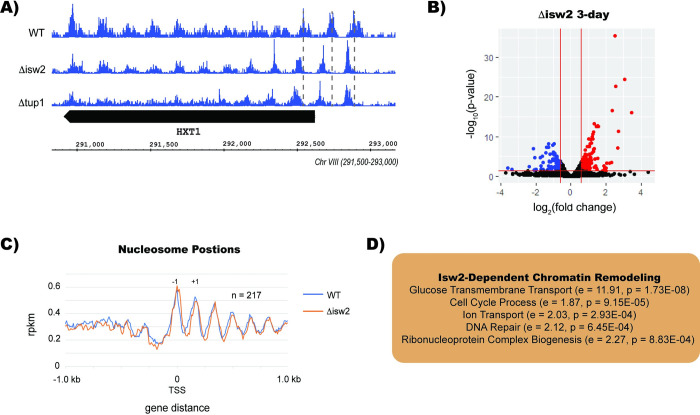
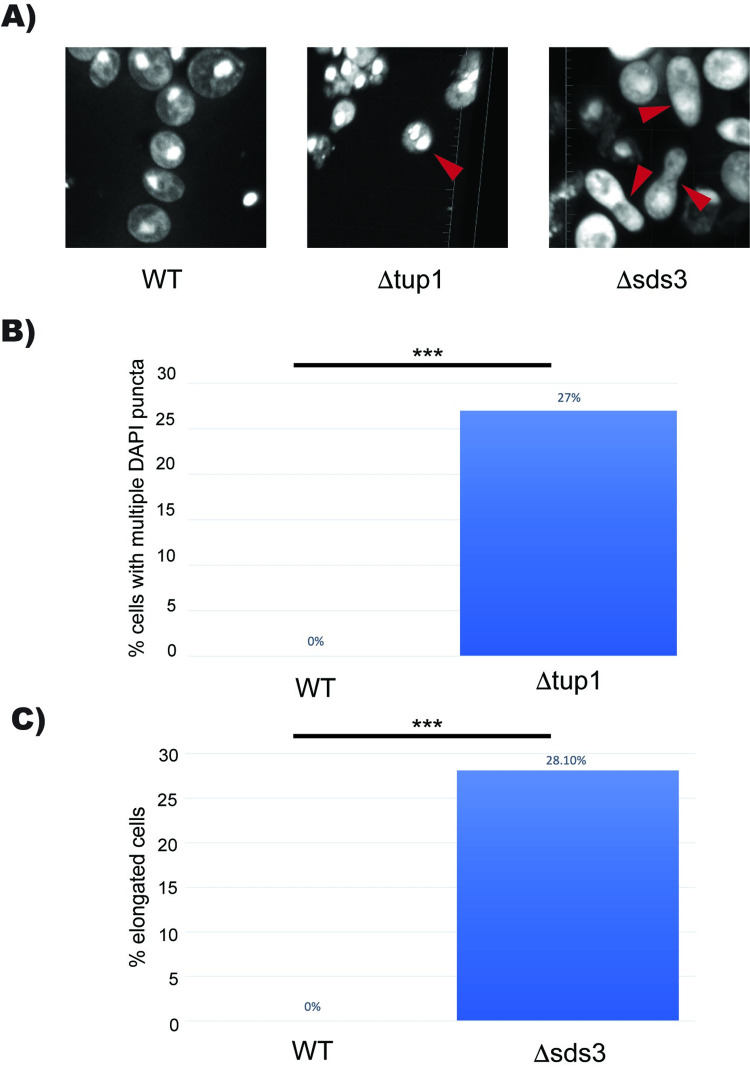
Upon glucose starvation, S. cerevisiae shows a dramatic alteration in transcription, resulting in wide-scale repression of most genes and activation of some others. This coincides with an arrest of cellular proliferation. A subset of such cells enters quiescence, a reversible non-dividing state. Here, we demonstrate that the conserved transcriptional corepressor Tup1 is critical for transcriptional repression after glucose depletion. We show that Tup1-Ssn6 binds new targets upon glucose depletion, where it remains as the cells enter the G0 phase of the cell cycle. In addition, we show that Tup1 represses a variety of glucose metabolism and transport genes. We explored how Tup1 mediated repression is accomplished and demonstrated that Tup1 coordinates with the Rpd3L complex to deacetylate H3K23. We found that Tup1 coordinates with Isw2 to affect nucleosome positions at glucose transporter HXT family genes during G0. Finally, microscopy revealed that a quarter of cells with a Tup1 deletion contain multiple DAPI puncta. Taken together, these findings demonstrate the role of Tup1 in transcriptional reprogramming in response to environmental cues leading to the quiescent state.
Overview
The claims and statistics of this paper haven’t been checked yet.
Free: it reads the open-access text and checks the first 5 claims that cite a source we can check. Create a free account to check every claim.
Integrity signals
Registry
Cites
Statistics
Figures
Verification
Claims the paper makes
The claims and statistics of this paper haven’t been checked yet.
Free: it reads the open-access text and checks the first 5 claims that cite a source we can check. Create a free account to check every claim.
Self-check
Percentages, sums and reported differences re-computed from the paper’s own numbers.
The self-check needs the paper’s full text.
Citations
Cites
Fast gapped-read alignment with Bowtie 2
Langmead, B., & Salzberg, S. L. (2012) · Nature Methods · doi:10.1038/nmeth.1923 · Cited by 56,400
Highly accurate protein structure prediction with AlphaFold
Jumper, J., Evans, R., Pritzel, A., Green, T., Figurnov, M., Ronneberger, O., Tunyasuvunakool, K., Bates, R., Žídek, A., Potapenko, A., et al. (2021) · Nature · doi:10.1038/s41586-021-03819-2 · Cited by 43,764
Model-based Analysis of ChIP-Seq (MACS)
Zhang, Y., Liu, T., Meyer, C. A., Eeckhoute, J., Johnson, D. S., Bernstein, B. E., Nusbaum, C., Myers, R. M., Brown, M., Li, W., et al. (2008) · Genome Biology · doi:10.1186/gb-2008-9-9-r137 · Cited by 18,386
deepTools2: a next generation web server for deep-sequencing data analysis
Ramírez, F., Ryan, D. P., Grüning, B., Bhardwaj, V., Kilpert, F., Richter, A. S., Heyne, S., Dündar, F., & Manke, T. (2016) · Nucleic Acids Research · doi:10.1093/nar/gkw257 · Cited by 8,096
Varadi, M., Anyango, S., Deshpande, M., Nair, S., Natassia, C., Yordanova, G., Yuan, D., Stroe, O., Wood, G., Laydon, A., et al. (2022) · Nucleic Acids Research · doi:10.1093/nar/gkab1061 · Cited by 7,850
Longtine, M. S., Mckenzie III, A., Demarini, D. J., Shah, N. G., Wach, A., Brachat, A., Philippsen, P., & Pringle, J. R. (1998) · Yeast · doi:10.1002/(sici)1097-0061(199807)14:10<953::aid-yea293>3.0.co;2-u · Cited by 5,345
Cui, P., Zhang, S., Ding, F., Ali, S., & Xiong, L. (2014) · Genome Biology · doi:10.1186/gb-2014-15-1-r1 · Cited by 2,294
Cai, L., Sutter, B. M., Li, B., & Tu, B. P. (2011) · Molecular Cell · doi:10.1016/j.molcel.2011.05.004 · Cited by 701
Repression by SSN6-TUP1 is directed by MIG1, a repressor/activator protein.
Treitel, M. A., & Carlson, M. (1995) · Proceedings of the National Academy of Sciences · doi:10.1073/pnas.92.8.3132 · Cited by 394
Integrated genome browser: visual analytics platform for genomics
Freese, N. H., Norris, D. C., & Loraine, A. E. (2016) · Bioinformatics · doi:10.1093/bioinformatics/btw069 · Cited by 371
Research works printed but not linked: 5
- 2018, Groucho related gene 5 (GRG5) is involved in embryonic and neural stem cell state decisions, Scientific Reports, 8, 1
- Eden, E. , Navon, R. , Steinfield, I. , Lipson, D. , Yakhini, Z. GOrilla: A Tool for Discovery and Visualization of Enriched GO Terms in Ranked Gene Lists. (2009). BMC Bioinformatics, 10(48). https://doi.org/10.1186/1471-2015-10-48 · DOI · Paper page
- 2004, “Sleeping Beauty”: Quiescence in Saccharomyces cerevisiae, Society, 68, 187
- 2017, Functional analysis of the global repressor Tup1 for maltose metabolism in Saccharomyces cerevisiae: Different roles of the functional domains, Microbial Cell Factories, 16, 1
- 1996, The Cyc8 (Ssn6)-Tup1 corepressor complex is composed of one Cyc8 and four Tup1 subunits, Molecular and Cellular Biology, 16, 67076714
Metadata
- Authors
- Bailey, T. B., Whitty, P. A., Selker, E. U., McKnight, J. N., & McKnight, L. E.
- Affiliations
- University of Oregon (US)
- Corresponding author
- McKnight, Laura E.
- Venue
- PLoS Genetics
- Publisher
- openRxiv
- Published
- 2022-08-10
- Volume
- 18
- Issue
- 12
- Pages
- e1010559-e1010559
- ISSN
- 1553-7390 (ISSN-L)
- PMC
- PMC9815585
- OpenAlex
- W4312059993
- Cited by
- 13
- References
- 61
- Citations by year
- 2025: 4 · 2024: 4 · 2023: 5
- FWCI
- 1.06
- Type
- journal article
- Language
- en
- Open access
- gold
- doi.org
- Licence
- cc-by
- Locations
- PLoS Genetics (publishedVersion, cc-by)
- bioRxiv (Cold Spring Harbor Laboratory) (acceptedVersion, cc-by-nc)
- PubMed Central (publishedVersion, cc-by)
- PubMed (publishedVersion)
- DOAJ (DOAJ: Directory of Open Access Journals) (submittedVersion)
- Funders
- University of Oregon
- National Institutes of Health
- National Institute of General Medical Sciences (R01GM129242, GM007759, GM127142, T32GM007759, GM129242, R35GM127142)
- Topics
- Life Sciences › Biochemistry, Genetics and Molecular Biology › Molecular Biology › Fungal and yeast genetics research
- Life Sciences › Biochemistry, Genetics and Molecular Biology › Molecular Biology › Genomics and Chromatin Dynamics
- Life Sciences › Biochemistry, Genetics and Molecular Biology › Genetics › Bacterial Genetics and Biotechnology
- Keywords
- Tup1, transcriptional repression, quiescent cells, glucose deprivation, Ssn6, ISW2, nucleosome positioning, G0 cell cycle arrest, Saccharomyces cerevisiae, transcriptional reprogramming
- MeSH terms
- DNA-Binding Proteins, Fungal Proteins, Glucose, Nuclear Proteins, Repressor Proteins, Saccharomyces cerevisiae, Transcription, Genetic, Gene Expression Regulation, Fungal, Saccharomyces cerevisiae Proteins
About these checks
Registry, retraction, Cites and statistics results are computed, not judged, with one exception: a printed reference that no index lists is read once by a model before it counts as a citation error. Claims are extracted by a model and kept only when their quote appears verbatim in the text; each cited source is then checked, with a model’s help, for whether it says what the claim relies on. Those verdicts can be wrong — read the claim’s quote and the cited source before relying on one.
Statistics and arithmetic are recomputed, not judged.
Confidence bands are shown only for fields calibrated on our annotated test set. None is calibrated yet, so no band is shown.
What counts as a claim ›How we measure confidence ›How we check this ›
Are you an author, or do you see a problem with this page? Request a review
How to cite
Cite CoChat for the checks on this page, and the paper for its own findings.
- This page
- CoChat. (2026). Citation check: Tup1 is Critical for Transcriptional Repression in Quiescence in S. cerevisiae. https://app.cochat.ai/papers/10.1101/2022.08.10.503497
- The paper
- Bailey, T. B., Whitty, P. A., Selker, E. U., McKnight, J. N., & McKnight, L. E. (2022). Tup1 is Critical for Transcriptional Repression in Quiescence in S. cerevisiae. PLoS Genetics. https://doi.org/10.1101/2022.08.10.503497
Data sources
Bibliographic data: Semantic Scholar, OpenAlex, Crossref.
Contains information from the Semantic Scholar Academic Graph Datasets, made available under the ODC Attribution License (ODC-BY 1.0).
Semantic Scholar’s data is described in: Kinney, R., et al. (2023). The Semantic Scholar Open Data Platform. arXiv:2301.10140.
