Student or educator? Sign up with your school email and get 6 months of Pro free.
PreprintCited by 15Enzyme Catalysis and ImmobilizationMicrobial Metabolic Engineering and BioproductionEvolution and Genetic Dynamics

The DOI matches its Crossref record; 1 of the 1 references it cites were found in a registry or an index.

Selecting better biocatalysts by complementing recoded bacteria

Open access
Rubini, Rudy, Jansen, Suzanne C., Beekhuis, Houdijn, Rozeboom, Henriëtte J., Mayer, Clemens·2022·Angewandte Chemie International Edition

Preprint — published as 10.1002/anie.202213942 · Paper page

Abstract

In vivo selections are powerful tools for the directed evolution of enzymes. However, the need to link enzymatic activity to cellular survival makes selections for enzymes that do not fulfill a metabolic function challenging. Here, we present an in vivo selection strategy that leverages recoded organisms addicted to non-canonical amino acids (ncAAs) to evolve biocatalysts that can provide these building blocks from synthetic precursors. We exemplify our platform by engineering carbamoylases that display catalytic efficiencies more than five orders of magnitude higher than those observed for the wild-type enzyme for ncAA-precursors. As growth rates of bacteria under selective conditions correlate with enzymatic activity, we were able to elicit improved variants from populations by performing serial passaging. By requiring minimal human intervention and no specialized equipment, we surmise that our strategy will become a versatile tool for the in vivo directed evolution of diverse biocatalysts.

Overview

The claims and statistics of this paper haven’t been checked yet.

Run the check — free, no account needed. It reads the open-access text and checks the sources it cites.

A few free checks a day · papers already verified open instantly · results are public

Integrity signals

Registry

Crossref · 10.1101/2022.08.16.504095

Cites

1 of 1 references verified0 citation errors · 0 not checkable

Statistics

Figures

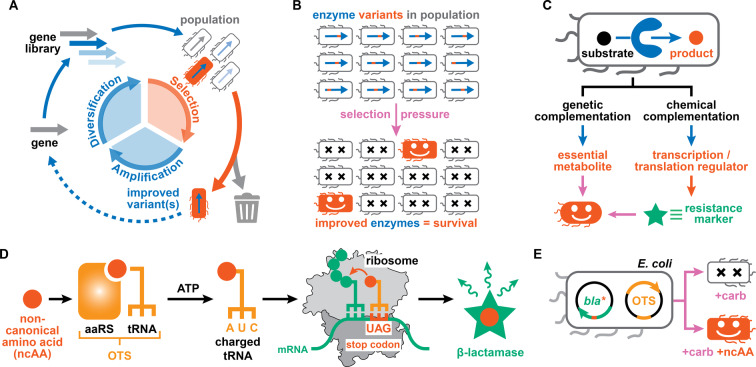
Figure 1 Selection strategies in the directed evolution of biocatalysts. A) The properties of biocatalysts are tailored in directed evolution via iterative cycles of gene diversification, selection, and amplification. B) In selections, enzyme variants in populations are assessed all at once with an applied selection pressure eliminating all undesired library members. C) Selections make use of genetic or chemical complementation strategies to link the activity of an enzyme of interest to the survival/growth of a producing organism. D–E) Orthogonal translation systems (OTSs) consist of aminoacyl tRNA synthetase (aaRS)/suppressor tRNA pairs that facilitate the site‐selective incorporation of non‐canonical amino acids into proteins of interest. When engineering OTSs for ncAAs, functional aaRS/tRNA pairs are identified by allowing E. coli to survive in presence of β‐lactam antibiotics (e.g. carbenicillin, carb). Panel D was adapted from Ref. [17].
Figure 1 Selection strategies in the directed evolution of biocatalysts. A) The properties of biocatalysts are tailored in directed evolution via iterative cycles of gene diversification, selection, and amplification. B) In selections, enzyme variants in populations are assessed all at once with an applied selection pressure eliminating all undesired library members. C) Selections make use of genetic or chemical complementation strategies to link the activity of an enzyme of interest to the survival/growth of a producing organism. D–E) Orthogonal translation systems (OTSs) consist of aminoacyl tRNA synthetase (aaRS)/suppressor tRNA pairs that facilitate the site‐selective incorporation of non‐canonical amino acids into proteins of interest. When engineering OTSs for ncAAs, functional aaRS/tRNA pairs are identified by allowing E. coli to survive in presence of β‐lactam antibiotics (e.g. carbenicillin, carb). Panel D was adapted from Ref. [17].CC BY · PubMed Central
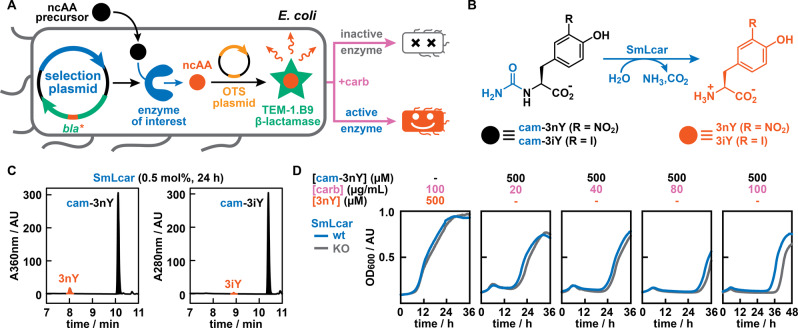
Figure 2 Design and validation of an in vivo enzyme engineering platform. A) Blueprint of a chemical complementation system based on recoded bacteria. A precursor is converted by an enzyme of interest to yield a ncAA, which is incorporated into a β‐lactamase. Active enzymes should allow E. coli to grow in presence of carbenicillin, while inactive ones perish under the selection pressure. B) Model transformations catalyzed by SmLcar that give rise to the ncAAs l ‐3‐nitro‐tyrosine (3nY) and l ‐3‐iodo‐tyrosine (3iY). C) HPLC chromatograms showing SmLcar is a weakly active catalyst for the conversion of carbamoylated ncAAs. D) Growth curves of E. coli in presence of varying concentrations of carbenicillin and 3nY or cam‐3nY. The weak activity of SmLcar for the ncAA precursor provides a small growth advantage in the complementation system, when compared to an inactive enzyme variant (SmLcar_KO).
Figure 2 Design and validation of an in vivo enzyme engineering platform. A) Blueprint of a chemical complementation system based on recoded bacteria. A precursor is converted by an enzyme of interest to yield a ncAA, which is incorporated into a β‐lactamase. Active enzymes should allow E. coli to grow in presence of carbenicillin, while inactive ones perish under the selection pressure. B) Model transformations catalyzed by SmLcar that give rise to the ncAAs l ‐3‐nitro‐tyrosine (3nY) and l ‐3‐iodo‐tyrosine (3iY). C) HPLC chromatograms showing SmLcar is a weakly active catalyst for the conversion of carbamoylated ncAAs. D) Growth curves of E. coli in presence of varying concentrations of carbenicillin and 3nY or cam‐3nY. The weak activity of SmLcar for the ncAA precursor provides a small growth advantage in the complementation system, when compared to an inactive enzyme variant (SmLcar_KO).CC BY · PubMed Central
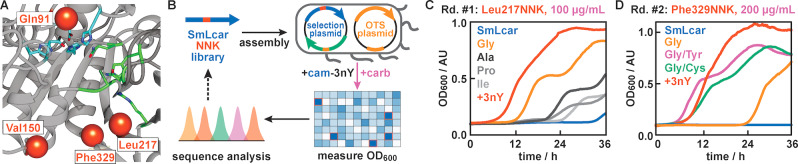
Figure 3 Directed evolution of SmLcar. A) Close‐up view of the active site of SmLcar. Red spheres indicate positions which were targeted by site‐directed mutagenesis in the evolution. Residues critical for binding of the two bivalent metal ions are highlighted in blue and amino acids that are either conserved or involved in substrate binding are shown in green. B) Workflow for the directed evolution of SmLcar in 96‐well plates. C) Growth curves of enzyme variants with substitutions at Leu217 that provided a growth advantage in the first round of evolution. D) Growth curves of improved SmLcar variants featuring an additional mutation at Phe329. Note that increased carbenicillin concentrations result in longer lag times for SmLcar_G and the wild‐type being unable to proliferate. Entries specified as +3nY refer to a positive control where cells producing SmLcar grow in presence of the ncAA (500 μM) instead of its synthetic precursor.
Figure 3 Directed evolution of SmLcar. A) Close‐up view of the active site of SmLcar. Red spheres indicate positions which were targeted by site‐directed mutagenesis in the evolution. Residues critical for binding of the two bivalent metal ions are highlighted in blue and amino acids that are either conserved or involved in substrate binding are shown in green. B) Workflow for the directed evolution of SmLcar in 96‐well plates. C) Growth curves of enzyme variants with substitutions at Leu217 that provided a growth advantage in the first round of evolution. D) Growth curves of improved SmLcar variants featuring an additional mutation at Phe329. Note that increased carbenicillin concentrations result in longer lag times for SmLcar_G and the wild‐type being unable to proliferate. Entries specified as +3nY refer to a positive control where cells producing SmLcar grow in presence of the ncAA (500 μM) instead of its synthetic precursor.CC BY · PubMed Central
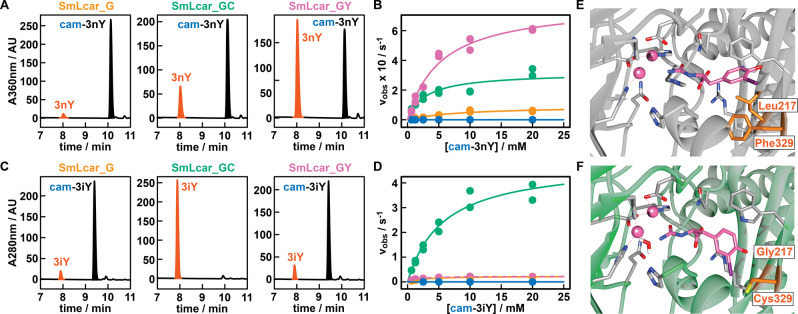
Figure 4 Characterization of improved SmLcar variants. A) HPLC chromatograms showing the activities of engineered SmLcar variants for cam‐3nY. B) Saturation kinetics for SmLcar (blue), SmLcar_G (orange) and SmLcar_GY (purple) for cam‐3nY. The corresponding kinetic parameters obtained from fitting data points to the Michaelis Menten equation are listed in Table 1. C) HPLC chromatograms showing the activities of engineered SmLcar variants for cam‐3iY. D) Saturation kinetics for SmLcar (blue), SmLcar_G (orange), SmLcar_GY (purple), and SmLcar_GC (green) for cam‐3iY. The corresponding kinetic parameters obtained from fitting data points to the Michaelis Menten equation are listed in Table 1. E–F) Close‐up view of the active sites of SmLcar (E, PDB: 8APZ) and SmLcar_GC (F, PDB: 8AQ0) with cam‐3iY docked into the obtained crystal structures.
Figure 4 Characterization of improved SmLcar variants. A) HPLC chromatograms showing the activities of engineered SmLcar variants for cam‐3nY. B) Saturation kinetics for SmLcar (blue), SmLcar_G (orange) and SmLcar_GY (purple) for cam‐3nY. The corresponding kinetic parameters obtained from fitting data points to the Michaelis Menten equation are listed in Table 1. C) HPLC chromatograms showing the activities of engineered SmLcar variants for cam‐3iY. D) Saturation kinetics for SmLcar (blue), SmLcar_G (orange), SmLcar_GY (purple), and SmLcar_GC (green) for cam‐3iY. The corresponding kinetic parameters obtained from fitting data points to the Michaelis Menten equation are listed in Table 1. E–F) Close‐up view of the active sites of SmLcar (E, PDB: 8APZ) and SmLcar_GC (F, PDB: 8AQ0) with cam‐3iY docked into the obtained crystal structures.CC BY · PubMed Central
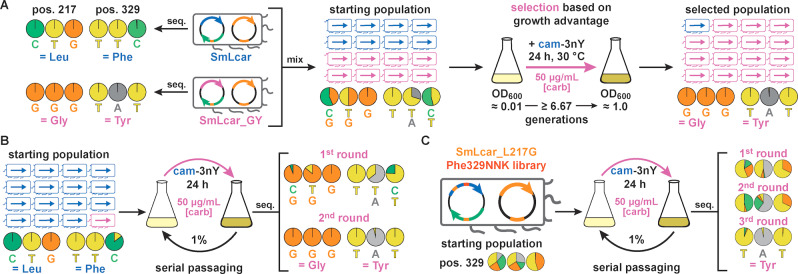
Figure 5 Selection of improved carbamoylases on the population level. A) Mock selection containing an equal mixture of SmLcar and SmLcar_GY. Overnight growth under selective conditions results in the improved carbamoylase becoming the dominant species. Base calls from Sanger sequencing of individual variants or populations are displayed as pie charts. B) Mock selections for a ≥10 : 1 mixture of SmLcar and SmLcar_GY. Cultures grown overnight are subjected to serial passaging under selective pressure. Two such growth‐dilution cycles are sufficient to yield a population that is dominated by SmLcar_GY. C) Application of the selection scheme by serial passaging to the second‐round SmLcar_G_Phe329NNK library. Starting from a diverse library, three growth‐dilution cycles elicit SmLcar_GY as the dominant variant as judged by Sanger sequencing.
Figure 5 Selection of improved carbamoylases on the population level. A) Mock selection containing an equal mixture of SmLcar and SmLcar_GY. Overnight growth under selective conditions results in the improved carbamoylase becoming the dominant species. Base calls from Sanger sequencing of individual variants or populations are displayed as pie charts. B) Mock selections for a ≥10 : 1 mixture of SmLcar and SmLcar_GY. Cultures grown overnight are subjected to serial passaging under selective pressure. Two such growth‐dilution cycles are sufficient to yield a population that is dominated by SmLcar_GY. C) Application of the selection scheme by serial passaging to the second‐round SmLcar_G_Phe329NNK library. Starting from a diverse library, three growth‐dilution cycles elicit SmLcar_GY as the dominant variant as judged by Sanger sequencing.CC BY · PubMed Central

Verification

Claims the paper makes

The claims and statistics of this paper haven’t been checked yet.

Run the check — free, no account needed. It reads the open-access text and checks the sources it cites.

A few free checks a day · papers already verified open instantly · results are public

Self-check

Percentages, sums and reported differences re-computed from the paper’s own numbers.

The self-check needs the paper’s full text.

Citations

Cites

Show all 1 references

Research works printed but not linked: 40

  1. 10.1038/350121a0 · DOI · Paper page
  2. 10.1021/ar000058i · DOI · Paper page
  3. 2021, Biocatalysis, Nat. Rev. Methods Primers, 1, 46, 10.1038/s43586-021-00044-z · DOI · Paper page
  4. 2021, Biocatalysis: Enzymatic Synthesis for Industrial Applications, Angew. Chem. Int, 60, 88, 10.1002/anie.202006648 · DOI · Paper page
  5. 10.1016/S1367-5931(99)80010-6 · DOI · Paper page
  6. 10.1038/nrg3927 · DOI · Paper page
  7. 2018, Directed Evolution of Protein Catalysts, Ann. Rev.Biochem, 87, 131, 10.1146/annurev-biochem-062917-012034 · DOI · Paper page
  8. 2018, Directed Evolution: Bringing New Chemistry to Life, Angew. Chem. Int, 57, 4143, 10.1002/anie.201708408 · DOI · Paper page
  9. 2021, The evolving art of creating genetic diversity: From directed evolution to synthetic biology, Biotech. Adv, 50, 107762, 10.1016/j.biotechadv.2021.107762 · DOI
  10. 2015, High Throughput Screening and Selection Methods for Directed Enzyme Evolution, Ind. Eng. Chem. Res, 54, 4011, 10.1021/ie503060a · DOI
  11. 2020, Advances in ultrahigh-throughput screening for directed enzyme evolution, Chem. Soc.Rev, 49, 233, 10.1039/C8CS00981C · DOI · Paper page
  12. 10.1016/j.cbpa.2005.02.002 · DOI
  13. 10.1042/BST20160076 · DOI
  14. 2001, Investigating and Engineering Enzymes by Genetic Selection, Angew. Chem. Int, 40, 3310, 10.1002/1521-3773(20010917)40:18<3310::AID-ANIE3310>3.0.CO;2-P · DOI
  15. 10.1038/nrg3351 · DOI · Paper page
  16. 10.1073/pnas.95.21.12141 · DOI
  17. 2020, Scalable continuous evolution for the generation of diverse enzyme variants encompassing promiscuous activities, Nat. Comm, 11, 5644, 10.1038/s41467-020-19539-6 · DOI
  18. 10.1002/cbic.200700754 · DOI
  19. Reetz, M. T. , Höbenreich, H. , Soni, P. & Fernández, L. A genetic selection system for evolving enantioselectivity of enzymes. Chem. Comm., 5502-5504 (2008). · DOI
  20. 10.1073/pnas.93.10.5043 · DOI
  21. 10.1073/pnas.95.10.5511 · DOI
  22. 10.1073/pnas.262420099 · DOI
  23. 10.1016/j.ymben.2012.04.004 · DOI
  24. 2017, Genetic biosensors for small-molecule products: Design and applications in high-throughput screening, Front. Chem. Sci. Eng, 11, 15, 10.1007/s11705-017-1629-z · DOI
  25. 10.1038/nature09929 · DOI · Paper page
  26. 2020, The developing toolkit of continuous directed evolution, Nat. Chem. Biol, 16, 610, 10.1038/s41589-020-0532-y · DOI
  27. 10.1126/science.1060077 · DOI · Paper page
  28. 10.1038/nature24031 · DOI
  29. 10.1021/acschembio.7b00974 · DOI · Paper page
  30. 2020, Addicting Escherichia coli to New-to-Nature Reactions, ACS Chem. Biol, 15, 3093, 10.1021/acschembio.0c00713 · DOI
  31. 2010, Carbamoylases: characteristics and applications in biotechnological processes, App. Microbiol. Biotech, 85, 441, 10.1007/s00253-009-2250-y · DOI
  32. 10.1038/nchembio.2002 · DOI
  33. 10.2174/187220808783330947 · DOI
  34. 10.1016/S0958-1669(01)00263-4 · DOI
  35. 2005, Molecular Cloning and Biochemical Characterization of L-N-Carbamoylase from Sinorhizobium meliloti CECT4114, Microb. Physiol, 9, 16, 10.1159/000088142 · DOI
  36. 2006, Thermodynamic and mutational studies of l-N-carbamoylase from Sinorhizobium meliloti CECT 4114 catalytic centre, Biochimie, 88, 837, 10.1016/j.biochi.2006.01.012 · DOI
  37. 10.1021/bi4000244 · DOI
  38. 10.1093/bioinformatics/btu426 · DOI
  39. 2019, Synthetic evolution, Nat. Biotech, 37, 730, 10.1038/s41587-019-0157-4 · DOI
  40. 2022, In vivo hypermutation and continuous evolution, Nat. Rev. Methods Primers, 2, 36, 10.1038/s43586-022-00119-5 · DOI

Metadata

Authors
Rubini, R., Jansen, S. C., Beekhuis, H., Rozeboom, H. J., & Mayer, C.
Affiliations
University of Groningen (NL)
Corresponding author
Mayer, Clemens
Venue
Angewandte Chemie International Edition
Publisher
openRxiv
Published
2022-08-16
Volume
62
Issue
2
Pages
e202213942-e202213942
ISSN
1433-7851 (ISSN-L)
OpenAlex
W4308365797
Cited by
15
References
1
Citations by year
2026: 6 · 2025: 1 · 2024: 3 · 2023: 4 · 2022: 1
FWCI
0.73
Type
journal article
Language
en
Open access
Licence
cc-by
Locations
  • Angewandte Chemie International Edition (publishedVersion, cc-by)
  • bioRxiv (Cold Spring Harbor Laboratory) (acceptedVersion, cc-by)
  • PubMed Central (publishedVersion, cc-by)
  • PubMed (publishedVersion)
  • University of Groningen research database (University of Groningen / Centre for Information Technology) (submittedVersion, cc-by)
Funders
Nederlandse Organisatie voor Wetenschappelijk Onderzoek (OCENW.M20, OCENW.M20.278, 722.017.007)
Topics
  • Life Sciences › Biochemistry, Genetics and Molecular Biology › Molecular Biology › Enzyme Catalysis and Immobilization
  • Life Sciences › Biochemistry, Genetics and Molecular Biology › Molecular Biology › Microbial Metabolic Engineering and Bioproduction
  • Life Sciences › Biochemistry, Genetics and Molecular Biology › Genetics › Evolution and Genetic Dynamics
Keywords
in vivo selection, directed evolution, unnatural amino acids, biocatalysts, serial passage, enzyme catalytic efficiency
MeSH terms
Amino Acids, Bacteria, Catalysis, Humans

About these checks

Registry, retraction, Cites and statistics results are computed, not judged, with one exception: a printed reference that no index lists is read once by a model before it counts as a citation error. Claims are extracted by a model and kept only when their quote appears verbatim in the text; each cited source is then checked, with a model’s help, for whether it says what the claim relies on. Those verdicts can be wrong — read the claim’s quote and the cited source before relying on one.

Statistics and arithmetic are recomputed, not judged.

Confidence bands are shown only for fields calibrated on our annotated test set. None is calibrated yet, so no band is shown.

What counts as a claim ›How we measure confidence ›How we check this ›

Are you an author, or do you see a problem with this page? Request a review

How to cite

Cite CoChat for the checks on this page, and the paper for its own findings.

This page
CoChat. (2026). Citation check: Selecting better biocatalysts by complementing recoded bacteria. https://app.cochat.ai/papers/10.1101/2022.08.16.504095
The paper
Rubini, R., Jansen, S. C., Beekhuis, H., Rozeboom, H. J., & Mayer, C. (2022). Selecting better biocatalysts by complementing recoded bacteria. Angewandte Chemie International Edition. https://doi.org/10.1101/2022.08.16.504095

Data sources

Bibliographic data: Semantic Scholar, OpenAlex, Crossref.

Contains information from the Semantic Scholar Academic Graph Datasets, made available under the ODC Attribution License (ODC-BY 1.0).

Semantic Scholar’s data is described in: Kinney, R., et al. (2023). The Semantic Scholar Open Data Platform. arXiv:2301.10140.