

The DOI matches its Crossref record; 1 of the 1 references it cites were found in a registry or an index.
Twenty-seven ZAD-ZNF genes of Drosophila melanogaster are orthologous to the embryo polarity determining mosquito gene cucoid
Open accessPreprint — published as 10.1371/journal.pone.0274716 · Paper page
Abstract
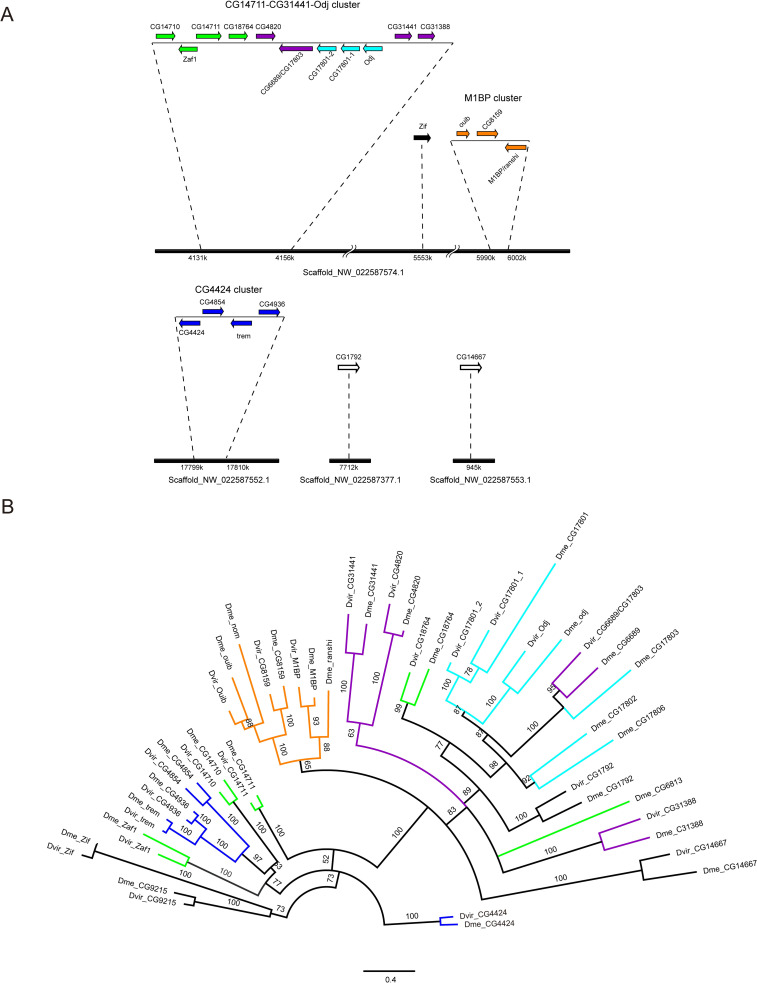
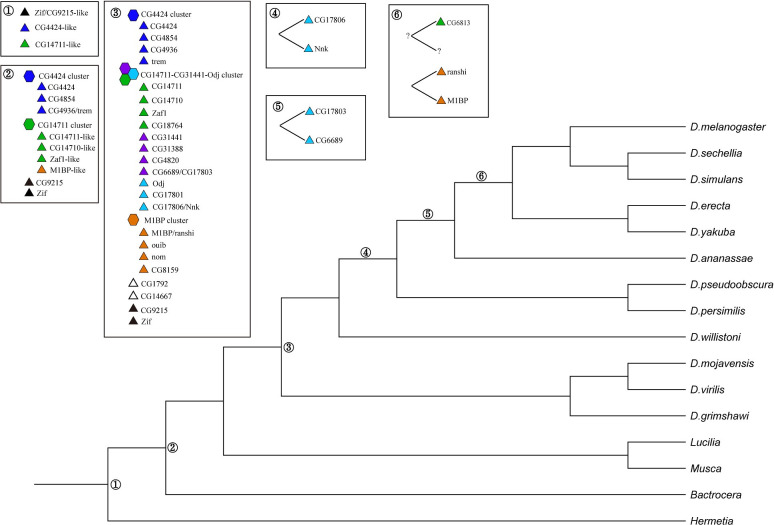
The C2H2 zinc finger gene cucoid establishes anterior-posterior (AP) polarity in the early embryo of culicine mosquitoes. This gene is unrelated to genes that establish embryo polarity in other fly species (Diptera), such as the homeobox gene bicoid , which serves this function in the traditional model organism Drosophila melanogaster . The cucoid gene is a conserved single copy gene across lower dipterans but nothing is known about its function in other species, and its evolution in higher dipterans, including Drosophila, is unresolved. We found that cucoid is a member of the ZAD-containing C2H2 zinc finger (ZAD-ZNF) gene family and is orthologous to 27 of the 91 members of this family in D. melanogaster , including M1BP, ranshi, ouib, nom, zaf1, odj, Nnk, trem, Zif , and eighteen uncharacterized genes. Available knowledge of the functions of cucoid orthologs in Drosophila melanogaster suggest that the progenitor of this lineage specific expansion may played a role in regulating chromatin. We also describe many aspects of the gene duplication history of cucoid in the brachyceran lineage of D. melanogaster , thereby providing a framework for predicting potential redundancies among these genes in D. melanogaster .
Overview
The claims and statistics of this paper haven’t been checked yet.
Run the check — free, no account needed. It reads the open-access text and checks the sources it cites.
Integrity signals
Registry
Cites
Statistics
Figures
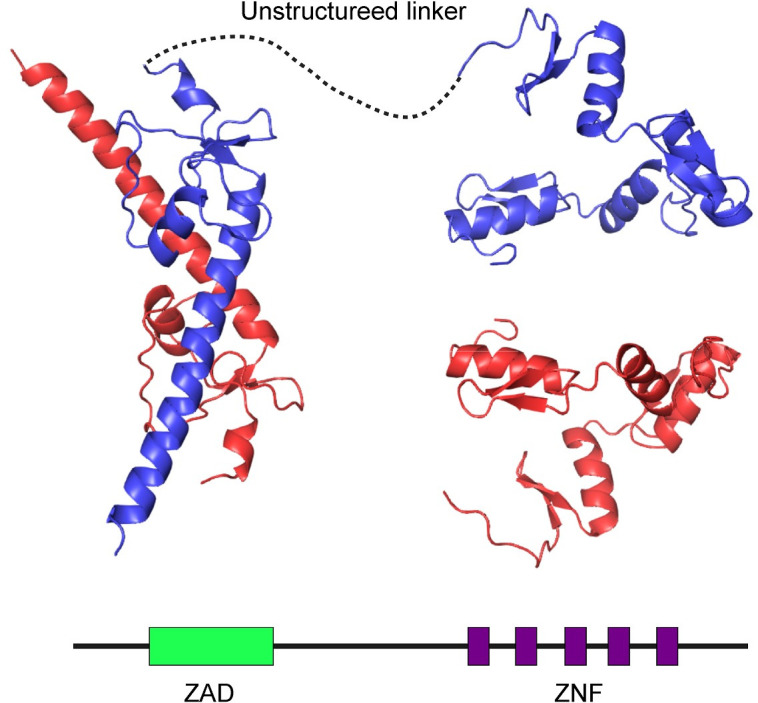
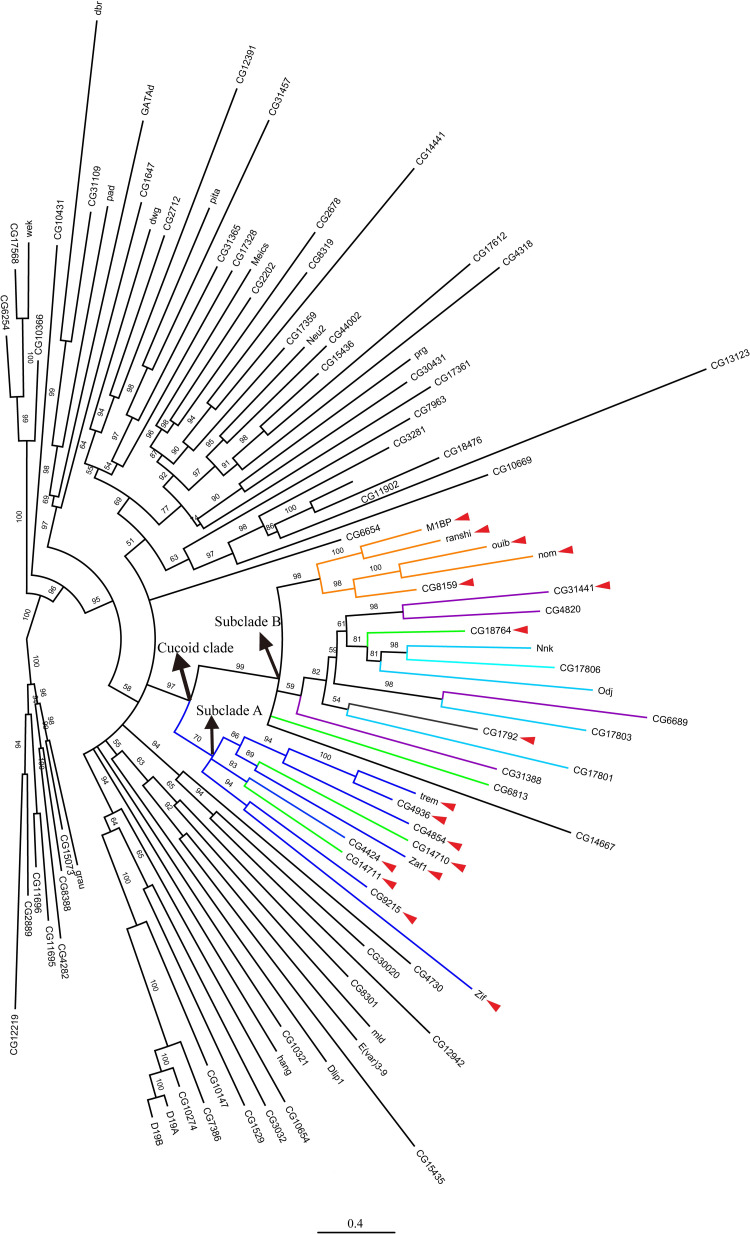
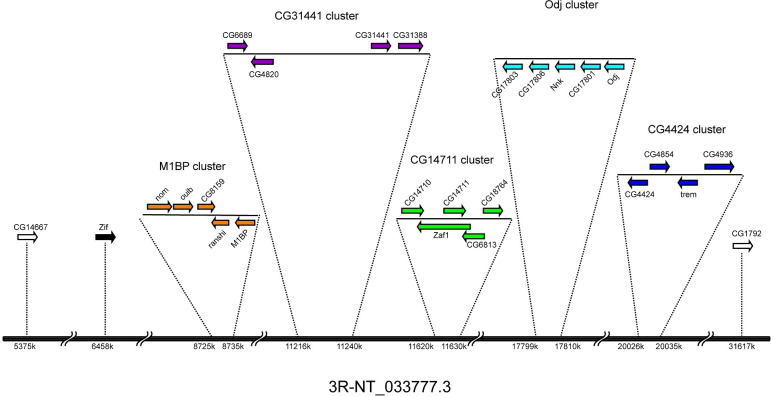
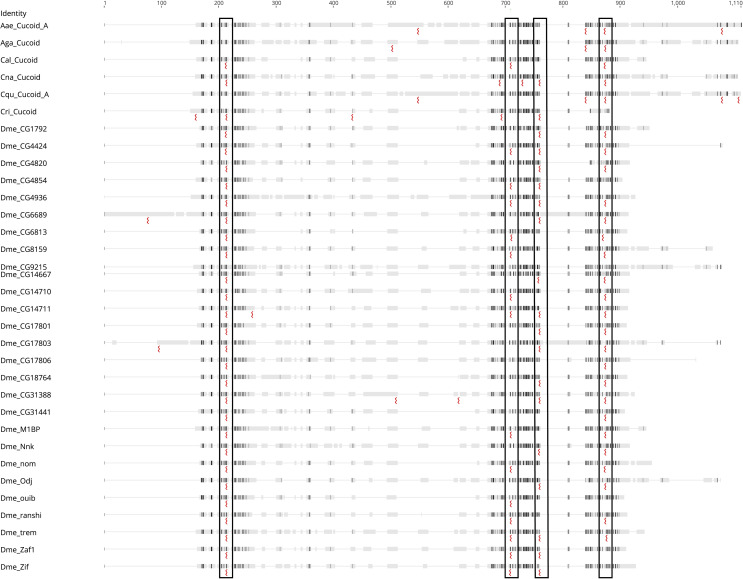
Verification
Claims the paper makes
The claims and statistics of this paper haven’t been checked yet.
Run the check — free, no account needed. It reads the open-access text and checks the sources it cites.
Self-check
Percentages, sums and reported differences re-computed from the paper’s own numbers.
The self-check needs the paper’s full text.
Citations
Cites
Highly accurate protein structure prediction with AlphaFold
Jumper, J., Evans, R., Pritzel, A., Green, T., Figurnov, M., Ronneberger, O., Tunyasuvunakool, K., Bates, R., Žídek, A., Potapenko, A., et al. (2021) · Nature · doi:10.1038/s41586-021-03819-2 · Cited by 43,764
Research works printed but not linked: 79
- Foe VE , Odell GM , Edgar BA . Mitosis and morphogenesis in the Drosophila embryo. In: Bate m , Martinez Arias A , editors. The development of Drosophila melanogaster. 1: Cold Spring Harbor Laboratory Press; 1993. p. 149–300.
- 10.1371/journal.pone.0084422 · DOI
- 10.1371/journal.pone.0084421 · DOI
- Lemke S , Kale G , Urbansky S. Comparing gastrulation in flies: Links between cell biology and the evolution of embryonic morphogenesis. Mechanisms of Development. 2020;164. · DOI
- 10.1038/s41576-018-0087-x · DOI
- 10.1016/bs.ctdb.2015.07.028 · DOI
- 10.1016/j.molcel.2021.02.020 · DOI · Paper page
- 2016, Maternal AP determinants in the Drosophila oocyte and embryo, Wiley Interdiscip Rev Dev Biol, 5, 562, 10.1002/wdev.235 · DOI
- 2022, Evolution and loss of beta-catenin and TCF-dependent axis specification in insects, Curr Opin Insect Sci, 50, 100877, 10.1016/j.cois.2022.100877 · DOI
- 10.1002/j.1460-2075.1988.tb03004.x · DOI
- 10.1016/j.cub.2010.01.026 · DOI
- 10.7554/eLife.13222 · DOI
- 10.1016/0092-8674(89)90062-7 · DOI
- 10.1038/379746a0 · DOI
- 10.1371/journal.pbio.0020271 · DOI
- 10.7554/elife.26258 · DOI
- 10.7554/eLife.28275.026 · DOI
- 2019, Embryo polarity in moth flies and mosquitoes relies on distinct old genes with localized transcript isoforms, eLife, 8, e46711, 10.7554/eLife.46711 · DOI
- 10.1126/science.aaa7105 · DOI
- 10.1016/j.cell.2012.03.018 · DOI
- 10.1073/pnas.0500373102 · DOI
- Hannon CE , Blythe SA , Wieschaus EF . Concentration dependent chromatin states induced by the bicoid morphogen gradient. Elife. 2017;6. · DOI
- 10.1073/pnas.96.7.3786 · DOI
- 10.1073/pnas.190095397 · DOI
- 10.1073/pnas.012292899 · DOI
- Liu Q , Onal P , Datta RR , Rogers JM , Schmidt-Ott U , Bulyk ML , et al. Ancient mechanisms for the evolution of the bicoid homeodomains function in fly development. Elife. 2018;7. · DOI
- 2021, Suboptimal Intermediates Underlie Evolution of the Bicoid Homeodomain, Mol Biol Evol, 38, 2179, 10.1093/molbev/msab051 · DOI
- 10.1101/gad.311985.118 · DOI · Paper page
- 10.1016/S0960-9822(03)00472-X · DOI
- 2013, The ZIC gene family encodes multi-functional proteins essential for patterning and morphogenesis, Cellular and molecular life sciences : CMLS, 70, 3791, 10.1007/s00018-013-1285-5 · DOI
- Soluri IV , Zumerling LM , Payan Parra OA , Clark EG , Blythe SA . Zygotic pioneer factor activity of Odd-paired/Zic is necessary for late function of the Drosophila segmentation network. Elife. 2020;9. · DOI
- Koromila T , Gao F , Iwasaki Y , He P , Pachter L , Gergen JP , et al. Odd-paired is a pioneer-like factor that coordinates with Zelda to control gene expression in embryos. Elife. 2020;9. · DOI
- 10.1371/journal.pgen.1007367 · DOI
- 10.1093/embo-reports/kvf243 · DOI
- 10.1093/molbev/msm121 · DOI
- 10.1016/j.str.2003.09.015 · DOI
- 10.1101/gr.174302 · DOI
- 10.1016/j.gene.2012.09.114 · DOI
- 2020, Innovation of heterochromatin functions drives rapid evolution of essential ZAD-ZNF genes in Drosophila, eLife, 9, e63368, 10.7554/eLife.63368 · DOI
- 10.1006/jmbi.1990.9999 · DOI · Paper page
- 10.1093/NAR/GKAA913 · DOI · Paper page
- 10.1093/nar/gkz991 · DOI
- 10.1093/bioinformatics/btv362 · DOI
- 10.1093/molbev/mst010 · DOI · Paper page
- 10.1093/nar/gkr408 · DOI
- 2017, ModelFinder: fast model selection for accurate phylogenetic estimates, Nature Methods, 14, 587, 10.1038/nmeth.4285 · DOI · Paper page
- 10.1093/molbev/msaa015 · DOI · Paper page
- 10.1093/molbev/msx281 · DOI · Paper page
- 10.1093/nar/gkw371 · DOI
- 2016, ZAD-Domain Is Essential for Nuclear Localization of Insulator Proteins in Drosophila melanogaster, Acta Naturae, 8, 97, 10.32607/20758251-2016-8-3-97-102 · DOI
- 10.7554/eLife.16096 · DOI
- 10.1101/gr.107334.110 · DOI
- 2020, Phylogenetic tree building in the genomic age, Nature Reviews Genetics, 21, 428, 10.1038/s41576-020-0233-0 · DOI · Paper page
- 10.1093/jhered/esp047 · DOI
- 10.1007/s12041-013-0212-8 · DOI
- 10.1016/S0968-0004(02)00013-0 · DOI
- 10.1073/pnas.0406882102 · DOI
- 2019, Classification of the human THAP protein family identifies an evolutionarily conserved coiled coil region, BMC Structural Biology, 19, 4, 10.1186/s12900-019-0102-2 · DOI
- 10.1073/pnas.1012675108 · DOI · Paper page
- Grimaldi D , Engel MS . Evolution of the Insects 1st ed: Cambridge University Press; 2005 2005.
- Generalovic TN , McCarthy SA , Warren IA , Wood JMD , Torrance J , Sims Y , et al. A high-quality, chromosome-level genome assembly of the Black Soldier Fly (Hermetia illucens L.). G3 (Bethesda). 2021;11(5). · DOI
- 10.7717/peerj.2951 · DOI
- 10.1038/nature07936 · DOI · Paper page
- 10.1038/nature08799 · DOI
- 10.1016/j.cell.2010.09.047 · DOI
- 10.1038/emboj.2013.111 · DOI
- 10.1038/s41467-021-24407-y · DOI
- 10.1016/j.ydbio.2009.12.035 · DOI
- 10.1080/21541264.2016.1210370 · DOI
- 10.1371/journal.pgen.1005712 · DOI
- 2020, Small Drosophila zinc finger C2H2 protein with an N-terminal zinc finger-associated domain demonstrates the architecture functions, Biochim Biophys Acta Gene Regul Mech, 1863, 194446, 10.1016/j.bbagrm.2019.194446 · DOI
- 10.1371/journal.pgen.1002005 · DOI
- 10.1016/j.devcel.2010.10.007 · DOI
- 2019, The regulation of cell size and branch complexity in the terminal cells of the Drosophila tracheal system, Developmental Biology, 451, 79, 10.1016/j.ydbio.2019.02.001 · DOI
- 2019, Removal of extra sequences with I-SceI in combination with CRISPR/Cas9 technique for precise gene editing in Drosophila, BioTechniques, 66, 198, 10.2144/btn-2018-0147 · DOI
- 10.1101/gr.181305.114 · DOI
- 10.1126/science.1196380 · DOI
- 2014, Whole-Genome Analysis of Muscle Founder Cells Implicates the Chromatin Regulator Sin3A in Muscle Identity, Cell Reports, 8, 858, 10.1016/j.celrep.2014.07.005 · DOI
- 10.1534/genetics.106.066761 · DOI
Metadata
- Authors
- Li, M., Kasan, K., Saha, Z., Yoon, Y., & Schmidt-Ott, U.
- Affiliations
- University of Chicago (US)
- University of California, Irvine (US)
- Venue
- PLoS ONE
- Publisher
- openRxiv
- Published
- 2022-09-05
- Volume
- 18
- Issue
- 1
- Pages
- e0274716-e0274716
- ISSN
- 1932-6203 (ISSN-L)
- PMC
- PMC9810180
- OpenAlex
- W4313461042
- Cited by
- 4
- References
- 1
- Citations by year
- 2025: 4
- FWCI
- 0.36
- Type
- journal article
- Language
- en
- Open access
- gold
- doi.org
- Licence
- cc-by
- Locations
- PLoS ONE (publishedVersion, cc-by)
- bioRxiv (Cold Spring Harbor Laboratory) (acceptedVersion, cc-by)
- PubMed Central (publishedVersion, cc-by)
- PubMed (publishedVersion)
- Knowledge@UChicago (University of Chicago) (submittedVersion, cc-by-nc-nd)
- DOAJ (DOAJ: Directory of Open Access Journals) (submittedVersion, cc-by-sa)
- University of Chicago (cc-by)
- Funders
- University of Chicago
- Peking University
- National Institutes of Health
- Directorate for Biological Sciences
- National Institute of General Medical Sciences (R01GM127366)
- Topics
- Life Sciences › Biochemistry, Genetics and Molecular Biology › Molecular Biology › Developmental Biology and Gene Regulation
- Life Sciences › Agricultural and Biological Sciences › Ecology, Evolution, Behavior and Systematics › Diptera species taxonomy and behavior
- Life Sciences › Biochemistry, Genetics and Molecular Biology › Genetics › Chromosomal and Genetic Variations
- Keywords
- embryonic polarity, anterior-posterior axis, Drosophila melanogaster, chromatin regulation, Bicoid, gene family evolution
- MeSH terms
- Animals, Drosophila, Drosophila melanogaster, Culicidae, Transcription Factors, Zinc Fingers, Drosophila Proteins
About these checks
Registry, retraction, Cites and statistics results are computed, not judged, with one exception: a printed reference that no index lists is read once by a model before it counts as a citation error. Claims are extracted by a model and kept only when their quote appears verbatim in the text; each cited source is then checked, with a model’s help, for whether it says what the claim relies on. Those verdicts can be wrong — read the claim’s quote and the cited source before relying on one.
Statistics and arithmetic are recomputed, not judged.
Confidence bands are shown only for fields calibrated on our annotated test set. None is calibrated yet, so no band is shown.
What counts as a claim ›How we measure confidence ›How we check this ›
Are you an author, or do you see a problem with this page? Request a review
