

Influence of metal cations on the viscoelastic properties of Escherichia coli biofilms
Open accessPreprint — published as 10.1021/acsomega.2c06438 · Paper page
The DOI matches its Crossref record; 47 of the 47 references it cites were found in a registry or an index.
Abstract
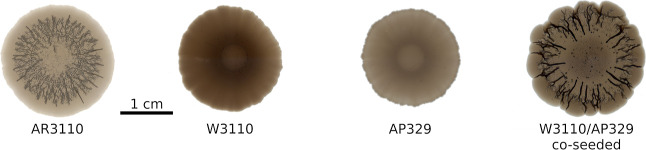
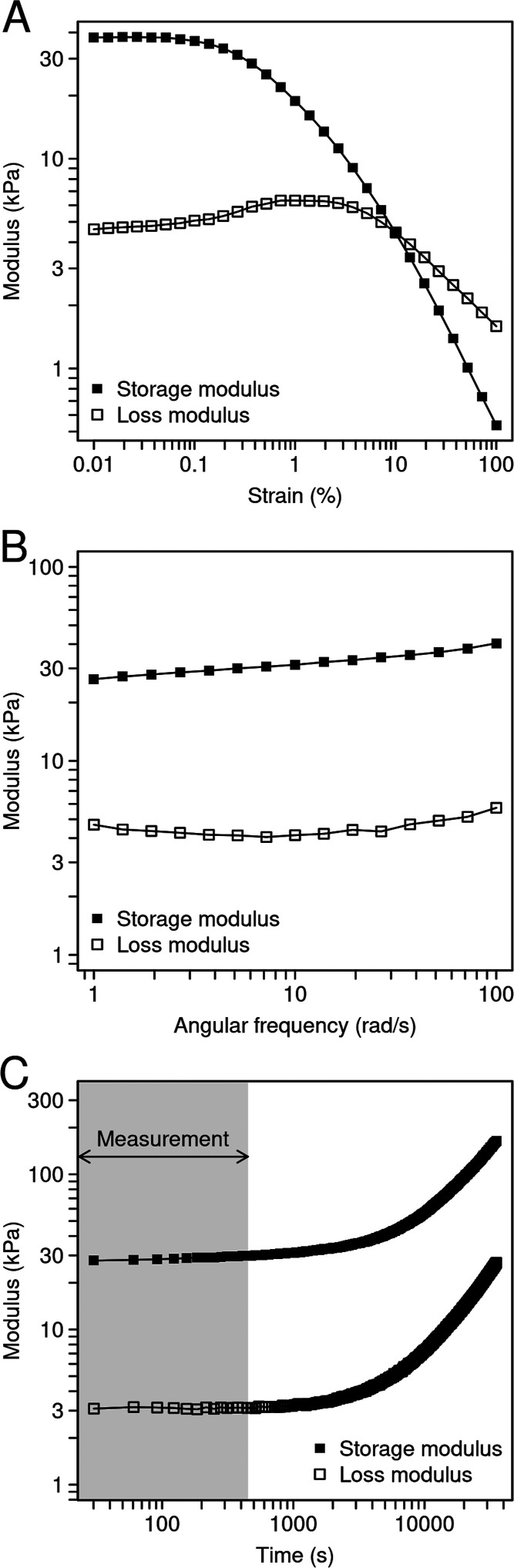
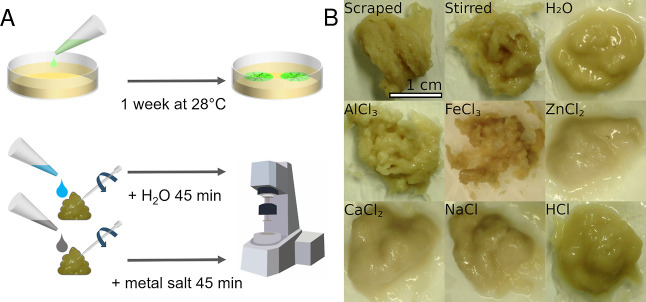
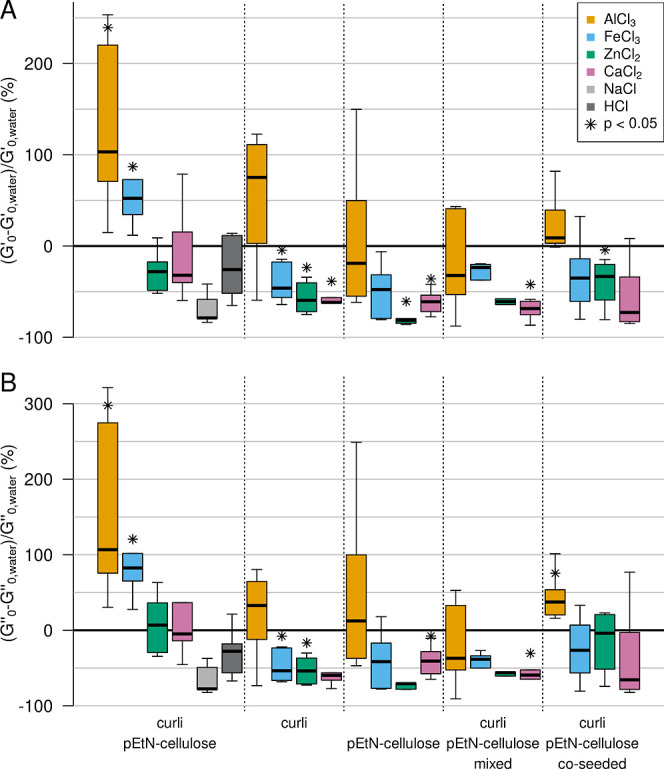
Biofilms frequently cause complications in various areas of human life, e.g. in medicine and in the food industry. More recently, biofilms are discussed as new types of living materials with tuneable mechanical properties. In particular, Escherichia coli produces a matrix composed of amyloid-forming curli and phosphoethanolamine-modified cellulose fibres in response to suboptimal environmental conditions. It is currently unknown how the interaction between these fibres contributes to the overall mechanical properties of the formed biofilms and if extrinsic control parameters can be utilized to manipulate these properties. Using shear rheology, we show that biofilms formed by the E. coli K-12 strain AR3110 stiffen by a factor of two when exposed to the trivalent metal cations Al(III) and Fe(III) while no such response is observed for the bivalent cations Zn(II) and Ca(II). Strains producing only one matrix component did not show any stiffening response to either cation or even a small softening. No stiffening response was further observed when strains producing only one type of fibre were co-cultured or simply mixed after biofilm growth. These results suggest that the E. coli biofilm matrix is a uniquely structured composite material when both matrix fibres are produced from the same bacterium. While the exact interaction mechanism between curli, phosphoethanolamine-modified cellulose and trivalent metal cations is currently not known, our results highlight the potential of using extrinsic parameters to understand and control the interplay between biofilm structure and mechanical properties. This will ultimately aid the development of better strategies for controlling biofilm growth. Table of Contents Graphic:
Overview
The claims and statistics of this paper haven’t been checked yet.
Free: it reads the open-access text and checks the first 5 claims that cite a source we can check. Create a free account to check every claim.
Integrity signals
Registry
Cites
Statistics
Figures
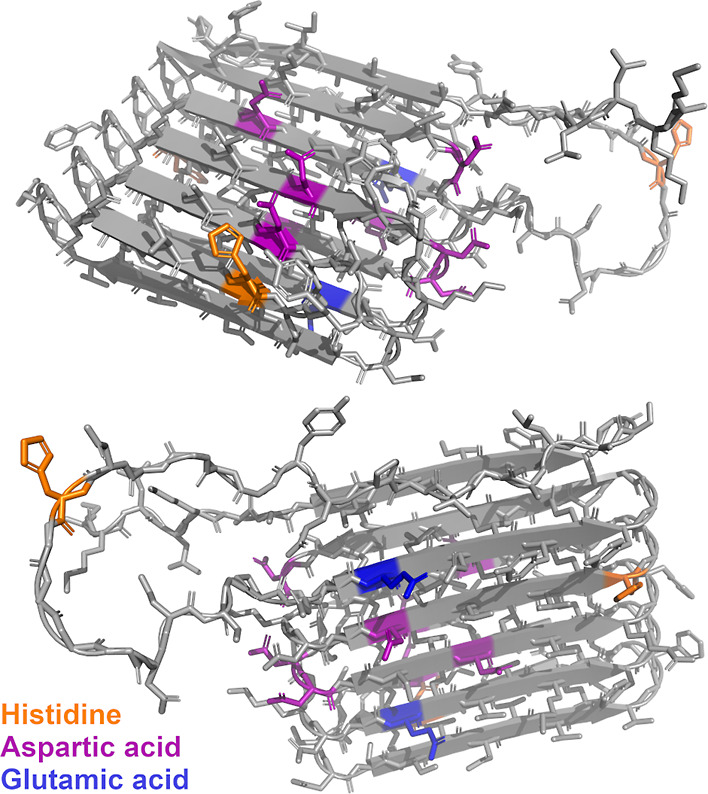
Verification
Claims the paper makes
The claims and statistics of this paper haven’t been checked yet.
Free: it reads the open-access text and checks the first 5 claims that cite a source we can check. Create a free account to check every claim.
Self-check
Percentages, sums and reported differences re-computed from the paper’s own numbers.
The self-check needs the paper’s full text.
Citations
Cites
Highly accurate protein structure prediction with AlphaFold
Jumper, J., Evans, R., Pritzel, A., Green, T., Figurnov, M., Ronneberger, O., Tunyasuvunakool, K., Bates, R., Žídek, A., Potapenko, A., et al. (2021) · Nature · doi:10.1038/s41586-021-03819-2 · Cited by 43,764
Varadi, M., Anyango, S., Deshpande, M., Nair, S., Natassia, C., Yordanova, G., Yuan, D., Stroe, O., Wood, G., Laydon, A., et al. (2022) · Nucleic Acids Research · doi:10.1093/nar/gkab1061 · Cited by 7,850
Biofilms: an emergent form of bacterial life
Flemming, H.-C., Wingender, J., Szewzyk, U., Steinberg, P., Rice, S. A., & Kjelleberg, S. (2016) · Nature Reviews Microbiology · doi:10.1038/nrmicro.2016.94 · Cited by 5,979
Barnhart, M. M., & Chapman, M. R. (2006) · Annual Review of Microbiology · doi:10.1146/annurev.micro.60.080805.142106 · Cited by 1,227
Structure and mechanical quality of the collagen–mineral nano-composite in bone
Fratzl, P., Gupta, H. S., Paschalis, E. P., & Roschger, P. (2004) · J. Mater. Chem. · doi:10.1039/b402005g · Cited by 1,222
One Juliet and four Romeos: VeA and its methyltransferases
Sarikaya-Bayram, Ã., Palmer, J. M., Keller, N., Braus, G. H., & Bayram, Ã. (2015) · Frontiers in Microbiology · doi:10.3389/fmicb.2015.00001 · Cited by 1,148
Heavy Metal Resistance of Biofilm and Planktonic Pseudomonas aeruginosa
Teitzel, G. M., & Parsek, M. R. (2003) · Applied and Environmental Microbiology · doi:10.1128/aem.69.4.2313-2320.2003 · Cited by 693
Pseudomonas biofilm matrix composition and niche biology
Mann, E. E., & Wozniak, D. J. (2012) · FEMS Microbiology Reviews · doi:10.1111/j.1574-6976.2011.00322.x · Cited by 606
Calcium Ion Coordination: A Comparison with That of Beryllium, Magnesium, and Zinc
Katz, A. K., Glusker, J. P., Beebe, S. A., & Bock, C. W. (1996) · Journal of the American Chemical Society · doi:10.1021/ja953943i · Cited by 544
Highly accurate genome sequences of Escherichia coli K‐12 strains MG1655 and W3110
Hayashi, K., Morooka, N., Yamamoto, Y., Fujita, K., Isono, K., Choi, S., Ohtsubo, E., Baba, T., Wanner, B. L., Mori, H., et al. (2006) · Molecular Systems Biology · doi:10.1038/msb4100049 · Cited by 502
Research works printed but not linked: 5
- 2015, Bacterial Extracellular Polysaccharides in Biofilm Formation and Function, Microbiol. Spectr, 3, 1
- 2015, Bio Fi Lm Matrix Proteins, Microbiol. Spectr, 3, 201
- 2021, Variation in the Ratio of Curli and Phosphoethanolamine Cellulose Associated with Biofilm Architecture and Properties, Biopolymers, 112, 1
- 2009, Removal of Cd(II), Cr(VI), Fe(III) and Ni(II) from Aqueous Solutions by an E. Coli Biofilm Supported on Kaolin, Chem. Eng. J, 149, 319
- 2009, Bioinorganic Chemistry of Copper and Zinc Ions Coordinated to Amyloid-β Peptide, Dalt. Trans, 7, 1080
Metadata
- Authors
- Sarlet, A., Ruffine, V., Blank, K. G., & Bidan, C. M.
- Affiliations
- Max Planck Society (DE)
- Max Planck Institute of Colloids and Interfaces (DE)
- Johannes Kepler University of Linz (AT)
- Corresponding author
- Blank, Kerstin G.
- Bidan, Cécile M.
- Venue
- ACS Omega
- Publisher
- openRxiv
- Published
- 2022-09-30
- Volume
- 8
- Issue
- 5
- Pages
- 4667-4676
- ISSN
- 2470-1343 (ISSN-L)
- PMC
- PMC9910073
- OpenAlex
- W4318218387
- Cited by
- 10
- References
- 47
- Citations by year
- 2026: 3 · 2025: 3 · 2024: 2 · 2023: 2
- FWCI
- 0.89
- Type
- journal article
- Language
- en
- Open access
- gold
- doi.org
- Licence
- cc-by
- Locations
- ACS Omega (publishedVersion, cc-by)
- bioRxiv (Cold Spring Harbor Laboratory) (acceptedVersion, cc-by)
- PubMed Central (publishedVersion, cc-by)
- PubMed (publishedVersion)
- MPG.PuRe (Max Planck Society) (submittedVersion, other-oa)
- Funders
- International Max Planck Research School for Environmental, Cellular and Molecular Microbiology
- Max-Planck-Gesellschaft
- International Max Planck Research School for Advanced Methods in Process and Systems Engineering
- Topics
- Life Sciences › Biochemistry, Genetics and Molecular Biology › Molecular Biology › Bacterial biofilms and quorum sensing
- Life Sciences › Agricultural and Biological Sciences › Food Science › Polysaccharides Composition and Applications
- Life Sciences › Immunology and Microbiology › Microbiology › Escherichia coli research studies
- Keywords
- Escherichia coli biofilm, viscoelasticity, metal cations, trivalent cations, aluminum, iron, biofilm matrix, curli fibers, shear rheology, biofilm mechanical properties
About these checks
Registry, retraction, Cites and statistics results are computed, not judged, with one exception: a printed reference that no index lists is read once by a model before it counts as a citation error. Claims are extracted by a model and kept only when their quote appears verbatim in the text; each cited source is then checked, with a model’s help, for whether it says what the claim relies on. Those verdicts can be wrong — read the claim’s quote and the cited source before relying on one.
Statistics and arithmetic are recomputed, not judged.
Confidence bands are shown only for fields calibrated on our annotated test set. None is calibrated yet, so no band is shown.
What counts as a claim ›How we measure confidence ›How we check this ›
Are you an author, or do you see a problem with this page? Request a review
How to cite
Cite CoChat for the checks on this page, and the paper for its own findings.
- This page
- CoChat. (2026). Citation check: Influence of metal cations on the viscoelastic properties of Escherichia coli biofilms. https://app.cochat.ai/papers/10.1101/2022.09.29.510089
- The paper
- Sarlet, A., Ruffine, V., Blank, K. G., & Bidan, C. M. (2022). Influence of metal cations on the viscoelastic properties of Escherichia coli biofilms. ACS Omega. https://doi.org/10.1101/2022.09.29.510089
Data sources
Bibliographic data: Semantic Scholar, OpenAlex, Crossref.
Contains information from the Semantic Scholar Academic Graph Datasets, made available under the ODC Attribution License (ODC-BY 1.0).
Semantic Scholar’s data is described in: Kinney, R., et al. (2023). The Semantic Scholar Open Data Platform. arXiv:2301.10140.
