

Interpretable Deep Learning for Improving Cancer Patient Survival Based on Personal Transcriptomes
Open accessPreprint — published as 10.1038/s41598-023-38429-7
The DOI matches its Crossref record; 26 of the 26 references it cites were found in a registry or an index.
Abstract
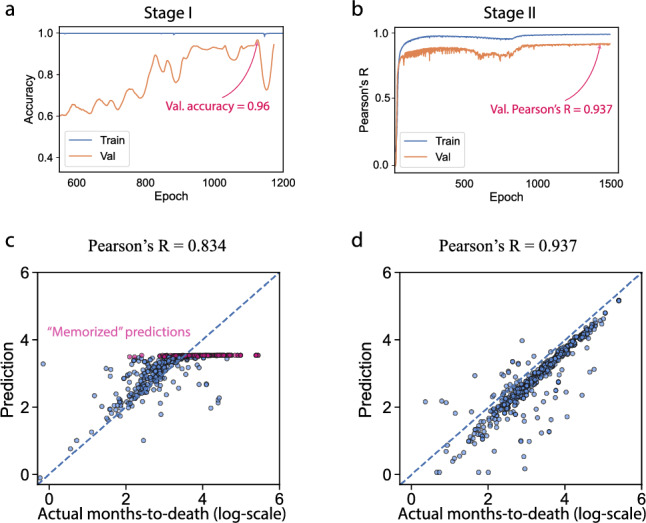
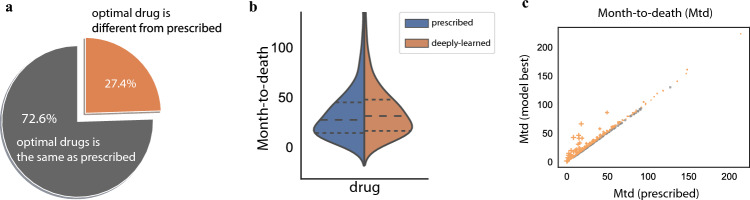
Precision medicine chooses the optimal drug for a patient by considering individual differences. With the tremendous amount of data accumulated for cancers, we develop an interpretable neural network to predict cancer patient survival based on drug prescriptions and personal transcriptomes (CancerIDP). The deep learning model achieves 96% classification accuracy in distinguishing short-lived from long-lived patients. The Pearson correlation between predicted and actual months-to-death values is as high as 0.937. About 27.4% of patients may survive longer with an alternative medicine chosen by our deep learning model. The median survival time of all patients can increase by 3.9 months. Our interpretable neural network model reveals the most discriminating pathways in the decision-making process, which will further facilitate mechanistic studies of drug development for cancers.
Overview
The claims and statistics of this paper haven’t been checked yet.
Free: it reads the open-access text and checks the first 5 claims that cite a source we can check. Create a free account to check every claim.
Integrity signals
Registry
Cites
Statistics
Figures
Verification
Claims the paper makes
The claims and statistics of this paper haven’t been checked yet.
Free: it reads the open-access text and checks the first 5 claims that cite a source we can check. Create a free account to check every claim.
Self-check
Percentages, sums and reported differences re-computed from the paper’s own numbers.
The self-check needs the paper’s full text.
Citations
Cites
Highly accurate protein structure prediction with AlphaFold
Jumper, J., Evans, R., Pritzel, A., Green, T., Figurnov, M., Ronneberger, O., Tunyasuvunakool, K., Bates, R., Žídek, A., Potapenko, A., et al. (2021) · Nature · doi:10.1038/s41586-021-03819-2 · Cited by 43,764
Gene Ontology: tool for the unification of biology
Ashburner, M., Ball, C. A., Blake, J. A., Botstein, D., Butler, H., Cherry, J. M., Davis, A. P., Dolinski, K., Dwight, S. S., Eppig, J. T., et al. (2000) · Nature Genetics · doi:10.1038/75556 · Cited by 43,206
Swin Transformer: Hierarchical Vision Transformer using Shifted Windows
Liu, Z., Lin, Y., Cao, Y., Hu, H., Wei, Y., Zhang, Z., Lin, S., & Guo, B. (2021) · 2021 IEEE/CVF International Conference on Computer Vision (ICCV) · doi:10.1109/iccv48922.2021.00986 · Cited by 35,534
Delving Deep into Rectifiers: Surpassing Human-Level Performance on ImageNet Classification
He, K., Zhang, X., Ren, S., & Sun, J. (2015) · 2015 IEEE International Conference on Computer Vision (ICCV) · doi:10.1109/iccv.2015.123 · Cited by 19,741
The Cancer Cell Line Encyclopedia enables predictive modelling of anticancer drug sensitivity
Barretina, J., Caponigro, G., Stransky, N., Venkatesan, K., Margolin, A. A., Kim, S., Wilson, C. J., Lehár, J., Kryukov, G. V., Sonkin, D., et al. (2012) · Nature · doi:10.1038/nature11003 · Cited by 7,950
A Comprehensive Survey on Transfer Learning
Zhuang, F., Qi, Z., Duan, K., Xi, D., Zhu, Y., Zhu, H., Xiong, H., & He, Q. (2021) · Proceedings of the IEEE · doi:10.1109/jproc.2020.3004555 · Cited by 6,678
A Landscape of Pharmacogenomic Interactions in Cancer
Iorio, F., Knijnenburg, T. A., Vis, D. J., Bignell, G. R., Menden, M. P., Schubert, M., Aben, N., Gonçalves, E., Barthorpe, S., Lightfoot, H., et al. (2016) · Cell · doi:10.1016/j.cell.2016.06.017 · Cited by 2,090
A survey on missing data in machine learning
Emmanuel, T., Maupong, T., Mpoeleng, D., Semong, T., Mphago, B., & Tabona, O. (2021) · Journal of Big Data · doi:10.1186/s40537-021-00516-9 · Cited by 1,067
Deep learning in cancer diagnosis, prognosis and treatment selection
Tran, K. A., Kondrashova, O., Bradley, A., Williams, E. D., Pearson, J. V., & Waddell, N. (2021) · Genome Medicine · doi:10.1186/s13073-021-00968-x · Cited by 932
Dcell: a scalable and fault-tolerant network structure for data centers
Guo, C., Wu, H., Tan, K., Shi, L., Zhang, Y., & Lu, S. (2008) · Proceedings of the ACM SIGCOMM 2008 conference on Data communication · doi:10.1145/1402958.1402968 · Cited by 563
FSCE: Few-Shot Object Detection via Contrastive Proposal Encoding
Sun, B., Li, B., Cai, S., Yuan, Y., & Zhang, C. (2021) · 2021 IEEE/CVF Conference on Computer Vision and Pattern Recognition (CVPR) · doi:10.1109/cvpr46437.2021.00727 · Cited by 555
Self-citationPredicting drug response and synergy using a deep learning model of human cancer cells
Kuenzi, B. M., Park, J., Fong, S. H., Sanchez, K. S., Lee, J., Kreisberg, J. F., Ma, J., & Ideker, T. (2020) · Cancer Cell · doi:10.1016/j.ccell.2020.09.014 · Cited by 544
Deep learning-based survival prediction for multiple cancer types using histopathology images
Wulczyn, E., Steiner, D. F., Xu, Z., Sadhwani, A., Wang, H., Flament-Auvigne, I., Mermel, C. H., Chen, P.-H. C., Liu, Y., & Stumpe, M. C. (2020) · PLOS ONE · doi:10.1371/journal.pone.0233678 · Cited by 266
Gerstung, M., Pellagatti, A., Malcovati, L., Giagounidis, A., Porta, M. G. D., Jädersten, M., Dolatshad, H., Verma, A., Cross, N. C. P., Vyas, P., et al. (2015) · Nature Communications · doi:10.1038/ncomms6901 · Cited by 238
Machine learning in the prediction of cancer therapy
Rafique, R., Islam, S. M. R., & Kazi, J. U. (2021) · Computational and Structural Biotechnology Journal · doi:10.1016/j.csbj.2021.07.003 · Cited by 174
Social environmental effects on gene regulation
Tung, J., & Gilad, Y. (2013) · Cellular and Molecular Life Sciences · doi:10.1007/s00018-013-1357-6 · Cited by 89
Hao, J., Kim, Y., Mallavarapu, T., Oh, J. H., & Kang, M. (2019) · BMC Medical Genomics · doi:10.1186/s12920-019-0624-2 · Cited by 82
A tree ensemble-based two-stage model for advanced-stage colorectal cancer survival prediction
Wang, Y., Wang, D., Ye, X., Wang, Y., Yin, Y., & Jin, Y. (2018) · Information Sciences · doi:10.1016/j.ins.2018.09.046 · Cited by 77
Environmental Effects on Gene Expression Phenotype Have Regional Biases in the Human Genome
Choi, J. K., & Kim, S. C. (2007) · Genetics · doi:10.1534/genetics.106.069047 · Cited by 63
Deep Learning-Based Survival Analysis for High-Dimensional Survival Data
Ha, I. D., Hao, L., Kim, J., & 권숙희 (2021) · Mathematics · doi:10.3390/math9111244 · Cited by 58
Effective Few-Shot Classification with Transfer Learning
Gupta, A., Thadani, K., & O’Hare, N. (2020) · International Conference on Computational Linguistics · doi:10.18653/v1/2020.coling-main.92 · Cited by 49
Cheng, C.-Y., Tseng, W., Chang, C., Chang, C.-H., & Gau, S. S. (2020) · Frontiers in Psychiatry · doi:10.3389/fpsyt.2020.00673 · Cited by 42
SurvNet: A Novel Deep Neural Network for Lung Cancer Survival Analysis With Missing Values
Wang, J., Chen, N., Guo, J., Xu, X., Liu, L., & Zhang, Y. (2021) · Frontiers in Oncology · doi:10.3389/fonc.2020.588990 · Cited by 39
Linking emotions to behaviors through deep transfer learning
Li, H., Baucom, B., & Georgiou, P. (2020) · PeerJ Computer Science · doi:10.7717/peerj-cs.246 · Cited by 34
GDISC: a web portal for integrative analysis of gene–drug interaction for survival in cancer
Spainhour, J. C. G., Lim, J., & Qiu, P. (2017) · Bioinformatics · doi:10.1093/bioinformatics/btw830 · Cited by 20
Tuning IR-cut Filter for Illumination-aware Spectral Reconstruction from RGB
Sun, B., Yan, J., Zhou, X., & Zheng, Y. (2021) · IEEE Computer Society Conference on Computer Vision and Pattern Recognition/Proceedings - IEEE Computer Society Conference on Computer Vision and Pattern Recognition/Proceedings · doi:10.1109/cvpr46437.2021.00015 · Cited by 15
Self-citation
Research works printed but not linked: 6
- Ren, S. , He, K. , Girshick, R. & Sun, J. Faster R-CNN: Towards Real-Time Object Detection with Region Proposal Networks. in Advances in Neural Information Processing Systems vol. 28 (Curran Associates, Inc., 2015).
- 10.1101/2020.08.06.20169698 · DOI
- 2021, Interpretable survival prediction for colorectal cancer using deep learning, npj Digit. Med, 4, 1
- 2015, The Cancer Genome Atlas (TCGA): an immeasurable source of knowledge, Contemp Oncol (Pozn), 19, A68
- Ioffe, S. & Szegedy, C. Batch Normalization: Accelerating Deep Network Training by Reducing Internal Covariate Shift. in Proceedings of the 32nd International Conference on Machine Learning 448–456 (PMLR, 2015).
- Rectified linear units improve restricted boltzmann machines | Proceedings of the 27th International Conference on International Conference on Machine Learning. https://dl.acm.org/doi/10.5555/3104322.3104425. · doi:10.5555/3104322.3104425
Metadata
- Authors
- Sun, B., & Chen, L.
- Affiliations
- University of Southern California (US)
- Corresponding author
- Chen, Liang
- ORCID
- Venue
- Scientific Reports
- Publisher
- openRxiv
- Published
- 2022-10-21
- Volume
- 13
- Issue
- 1
- Pages
- 11344-11344
- ISSN
- 2045-2322 (ISSN-L)
- PMC
- PMC10344908
- OpenAlex
- W4384130791
- Cited by
- 13
- References
- 26
- Citations by year
- 2026: 2 · 2025: 6 · 2024: 4 · 2023: 1
- FWCI
- 1.22
- Type
- journal article
- Language
- en
- Open access
- gold
- doi.org
- Licence
- cc-by
- Locations
- Scientific Reports (publishedVersion, cc-by)
- medRxiv (acceptedVersion)
- PubMed Central (publishedVersion, cc-by)
- PubMed (publishedVersion)
- DOAJ (DOAJ: Directory of Open Access Journals) (submittedVersion, cc-by-sa)
- Funders
- U.S. Department of Health and Human Services (R01NS104041, R01GM137428, R01NS15276)
- National Institutes of Health (R01NS15276)
- National Institute of General Medical Sciences (R01GM137428)
- National Institute of Neurological Disorders and Stroke (R01NS015076, R01NS104041, R01NS125276)
- Topics
- Physical Sciences › Computer Science › Artificial Intelligence › Machine Learning in Healthcare
- Life Sciences › Pharmacology, Toxicology and Pharmaceutics › Drug Discovery › Computational Drug Discovery Methods
- Life Sciences › Biochemistry, Genetics and Molecular Biology › Molecular Biology › Gene expression and cancer classification
- Keywords
- interpretable neural networks, precision medicine, drug prescribing, survival time, gene pathways
- MeSH terms
- Deep Learning, Humans, Neoplasms, Research, Neural Networks, Computer, Transcriptome
About these checks
Registry, retraction, Cites and statistics results are computed, not judged, with one exception: a printed reference that no index lists is read once by a model before it counts as a citation error. Claims are extracted by a model and kept only when their quote appears verbatim in the text; each cited source is then checked, with a model’s help, for whether it says what the claim relies on. Those verdicts can be wrong — read the claim’s quote and the cited source before relying on one.
Statistics and arithmetic are recomputed, not judged.
Confidence bands are shown only for fields calibrated on our annotated test set. None is calibrated yet, so no band is shown.
What counts as a claim ›How we measure confidence ›How we check this ›
Are you an author, or do you see a problem with this page? Request a review
Data sources
Bibliographic data: Semantic Scholar, OpenAlex, Crossref.
Contains information from the Semantic Scholar Academic Graph Datasets, made available under the ODC Attribution License (ODC-BY 1.0).
Semantic Scholar’s data is described in: Kinney, R., et al. (2023). The Semantic Scholar Open Data Platform. arXiv:2301.10140.
