

The DOI matches its Crossref record; 1 of the 1 references it cites were found in a registry or an index.
ASCARIS: Positional Feature Annotation and Protein Structure-Based Representation of Single Amino Acid Variations
Open accessPreprint — published as 10.1016/j.csbj.2023.09.017 · Paper page
Abstract
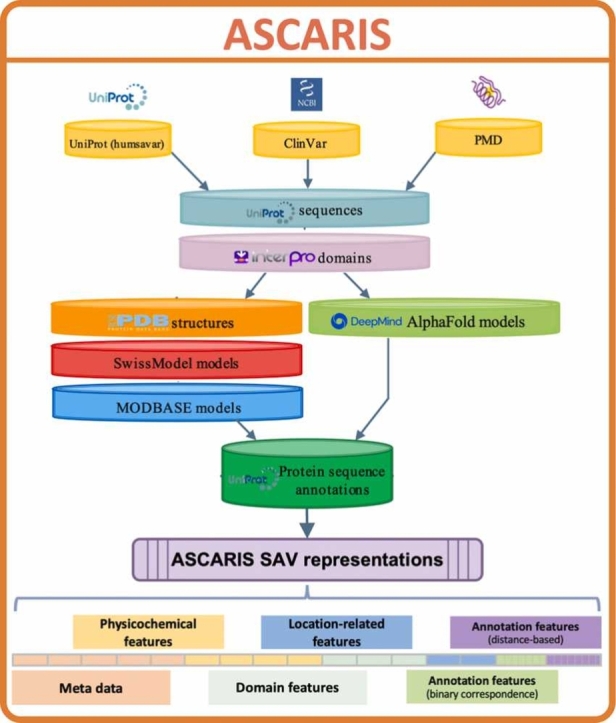
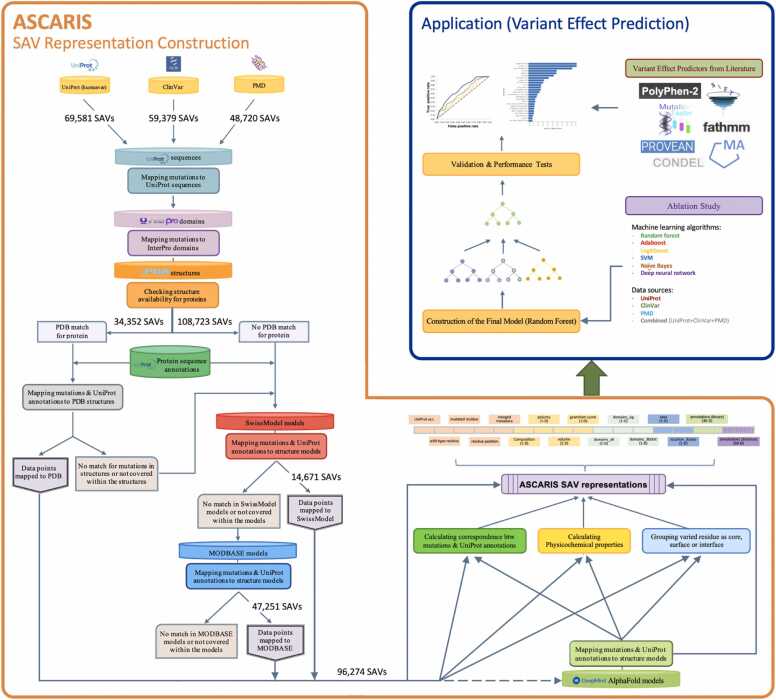
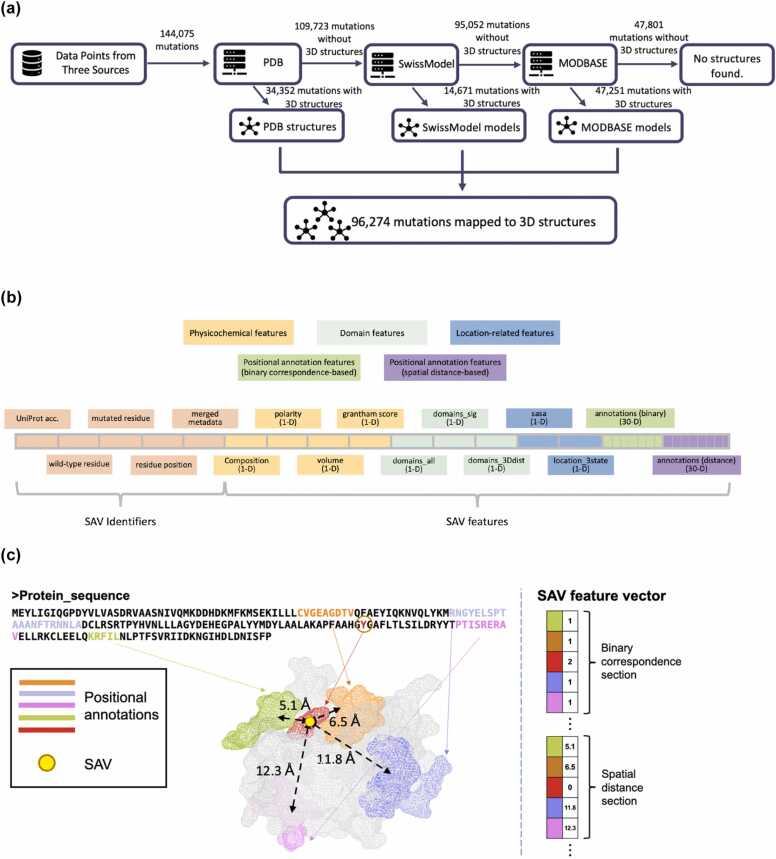
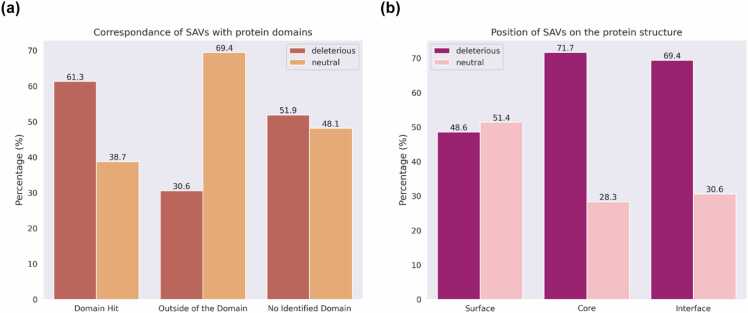
Motivation: Genomic variations may cause deleterious effects on protein functionality and perturb biological processes. Elucidating the effects of variations is critical for developing novel treatment strategies for diseases of genetic origin. Computational approaches have been aiding the work in this field by modeling and analyzing the mutational landscape. However, new approaches are required, especially for accurate and comprehensive representation and data-centric analysis of sequence variations. Results: In this study, we propose ASCARIS (Annotation and StruCture-bAsed RepresentatIon of Single amino acid variations - SAVs), a method for the featurization (i.e., quantitative representation) of SAVs, which could be used for a variety of purposes, such as predicting their functional effects or building multi-omics-based integrative models. In ASCARIS representations, we incorporated the correspondence between the location of the SAV on the sequence and 30 different types of positional feature annotations (e.g., active/lipidation/glycosylation sites; calcium/metal/DNA binding, inter/transmembrane regions, etc.) from UniProt, along with structural features such as protein domains, the location of variation (e.g., core/interface/surface), and the change in physico-chemical properties using models from PDB and AlphaFold-DB. We also mapped the mutated and annotated residues to the 3-D plane and calculated the spatial distances between them in order to account for the functional changes caused by variations in positions close to the functionally essential ones. Finally, we constructed a 74-dimensional feature set to represent each SAV in a dataset composed of ∼100,000 data points. We statistically analyzed the relationship between each of these features and the consequences of variations, and found that each of them carries information in this regard. To investigate potential applications of ASCARIS, we trained variant effect predictor models that utilize our SAV representations as input. We carried out both an ablation study and a comparison against the state-of-the-art methods over well-known benchmark datasets. We observed that our method displays a competing performance against widely-used predictors. Also, our predictions were complementary to these methods which is probably due to fact that ASCARIS has a rather unique focus in modeling variations. ASCARIS can be used either alone or in combination with other approaches, to universally represent SAVs from a functional perspective. Availability and implementation: The source code, datasets, results, and user instructions of ASCARIS are available at https://github.com/HUBioDataLab/ASCARIS .
Overview
The claims and statistics of this paper haven’t been checked yet.
Run the check — free, no account needed. It reads the open-access text and checks the sources it cites.
Integrity signals
Registry
Cites
Statistics
Figures
Verification
Claims the paper makes
The claims and statistics of this paper haven’t been checked yet.
Run the check — free, no account needed. It reads the open-access text and checks the sources it cites.
Self-check
Percentages, sums and reported differences re-computed from the paper’s own numbers.
The self-check needs the paper’s full text.
Citations
Cites
Highly accurate protein structure prediction with AlphaFold
Jumper, J., Evans, R., Pritzel, A., Green, T., Figurnov, M., Ronneberger, O., Tunyasuvunakool, K., Bates, R., Žídek, A., Potapenko, A., et al. (2021) · Nature · doi:10.1038/s41586-021-03819-2 · Cited by 43,764
Research works printed but not linked: 95
- 1971, An empirical hydrophobicity scale for α-amino-acids and some of its applications, International Journal of Biochemistry, 2, 537, 10.1016/0020-711X(71)90023-1 · DOI
- 2013, Predicting functional effect of human missense mutations using PolyPhen-2, Curr. Protoc. Hum. Genet, 76, 7
- 10.1038/nmeth0410-248 · DOI · Paper page
- 2014, PredictSNP: Robust and Accurate Consensus Classifier for Prediction of Disease-Related Mutations, PLoS Computational Biology, 10, e1003440, 10.1371/journal.pcbi.1003440 · DOI
- 10.1093/nar/28.1.235 · DOI · Paper page
- 10.1007/s10585-009-9253-z · DOI
- 2001, Machine Learning, 45, 261, 10.1023/A:1017934522171 · DOI
- 10.1093/nar/gkm238 · DOI
- 10.1093/bioinformatics/btn435 · DOI
- 10.1002/humu.21047 · DOI
- 10.1186/1471-2164-14-1 · DOI · Paper page
- 10.1093/nar/gki375 · DOI
- 2019, Integrating molecular networks with genetic variant interpretation for precision medicine, Wiley Interdiscip. Rev. Syst. Biol. Med, 11, e1443, 10.1002/wsbm.1443 · DOI
- 10.1158/0008-5472.CAN-09-1133 · DOI
- 10.1371/journal.pone.0236962 · DOI
- 10.1093/bioinformatics/btv195 · DOI
- 10.1093/bioinformatics/bth029 · DOI
- 10.1038/nature15393 · DOI · Paper page
- 10.1093/nar/gky1049 · DOI · Paper page
- Cox, M.A.A. and Cox, T.F. Multidimensional Scaling. Handbook of Data Visualization 2008:315–347. · DOI
- Cristianini, N. and Shawe-Taylor, J. An Introduction to Support Vector Machines and Other Kernel-based Learning Methods. 2000. · DOI · Paper page
- 10.1002/gepi.20642 · DOI
- 2015, Functional and Structural Consequences of Damaging Single Nucleotide Polymorphisms in Human Prostate Cancer Predisposition Gene RNASEL, Biomed Res Int, 2015, 271458
- 2019, 3D spatial organization and network-guided comparison of mutation profiles in Glioblastoma reveals similarities across patients, PLoS computational biology, 15, e1006789, 10.1371/journal.pcbi.1006789 · DOI
- 10.7717/peerj.5298 · DOI
- 10.1093/bioinformatics/btw114 · DOI
- 2021, Protein domain-based prediction of drug/compound–target interactions and experimental validation on LIM kinases, PLoS Computational Biology, 17, e1009171, 10.1371/journal.pcbi.1009171 · DOI
- 2021, CROssBAR: comprehensive resource of biomedical relations with knowledge graph representations, Nucleic Acids Research, 49, e96, 10.1093/nar/gkab543 · DOI
- Engin, H.B. , Hofree, M. and Carter, H. Identifying mutation specific cancer pathways using a structurally resolved protein interaction network. Pac. Symp. Biocomput. 2015:84–95. · DOI
- 10.1038/nature13835 · DOI · Paper page
- 10.1093/bioinformatics/btv291 · DOI
- 10.1006/jcss.1997.1504 · DOI · Paper page
- Friedman, J. , Hastie, T. and Tibshirani, R. Additive logistic regression: a statistical view of boosting (With discussion and a rejoinder by the authors). The Annals of Statistics 2000;28(2). · DOI · Paper page
- 1995, Learning binary relations using weighted majority voting, Machine Learning, 20, 245, 10.1007/BF00994017 · DOI
- 10.1016/0022-5193(73)90075-1 · DOI
- 10.1016/j.ajhg.2011.03.004 · DOI
- 10.1126/science.185.4154.862 · DOI
- 10.1002/humu.22768 · DOI · Paper page
- 10.1073/pnas.0403255101 · DOI
- 10.1038/10297 · DOI
- Hastie, T. , Friedman, J. and Tibshirani, R. The Elements of Statistical Learning. Springer Series in Statistics 2001. · DOI · Paper page
- 10.1186/s12859-015-0611-3 · DOI
- 10.1073/pnas.0903103106 · DOI · Paper page
- 10.1016/j.molp.2016.06.004 · DOI
- 10.1093/nar/gkm405 · DOI
- 10.1002/humu.20534 · DOI
- 10.1093/nar/27.1.355 · DOI
- 10.1038/nrg.2015.17 · DOI
- 10.1093/bioinformatics/btz595 · DOI
- 10.1093/nar/gkx1153 · DOI · Paper page
- 10.1172/JCI34772 · DOI · Paper page
- 10.1093/hmg/ddw091 · DOI
- 10.1002/humu.23738 · DOI
- 10.1038/nmeth.4540 · DOI
- 10.1093/nar/gky1100) · DOI · Paper page
- 2016, FreeSASA: An open source C library for solvent accessible surface area calculations, F1000Res, 5, 189, 10.12688/f1000research.7931.1 · DOI
- 10.1186/1471-2105-9-357 · DOI
- 10.1093/bioinformatics/btq028 · DOI
- 10.1093/bioinformatics/btn654 · DOI
- 10.1093/nar/gkg509 · DOI
- 10.1371/journal.pone.0066273 · DOI
- 2021, Computational evaluation of interactions between olfactory receptor OR2W1 and its ligands, Genomics Inform, 19, e9, 10.5808/gi.21026 · DOI
- 10.1002/pro.3774 · DOI
- 10.1093/nar/gkt1144 · DOI
- 10.1093/bioinformatics/btt691 · DOI · Paper page
- 10.1016/j.cell.2015.02.029 · DOI · Paper page
- 10.1093/bioinformatics/btw361 · DOI
- 10.1093/nar/gky1016 · DOI · Paper page
- 10.1186/gb-2007-8-11-r232 · DOI
- 10.1093/nar/gkr407 · DOI
- 10.1002/prot.25416 · DOI
- 10.1002/humu.22204 · DOI
- 10.1038/nrg3051 · DOI · Paper page
- 10.1093/bioinformatics/btw192 · DOI · Paper page
- 10.1038/nmeth.2890 · DOI · Paper page
- 10.1093/nar/gki387 · DOI · Paper page
- 10.1002/ppul.22567 · DOI
- 10.1002/humu.22225 · DOI
- 10.1101/gr.3804205 · DOI
- 10.1016/j.cell.2014.01.051 · DOI
- 10.1002/humu.22093 · DOI
- 10.1002/humu.20896 · DOI
- 10.1136/jmg.2005.033878 · DOI
- 10.1002/humu.21445 · DOI · Paper page
- 10.1093/protein/10.1.7 · DOI
- 10.1002/bies.201600062 · DOI
- 10.1038/s42256-022-00457-9 · DOI
- 10.1007/s10479-011-0841-3 · DOI
- 10.1093/nar/gky427 · DOI
- 10.1093/nar/gkr363 · DOI
- 1990, In vitro gamma-carboxylation of a 59-residue recombinant peptide including the propeptide and the gamma-carboxyglutamic acid domain of coagulation factor IX. Effect of mutations near the propeptide cleavage site, J. Biol. Chem, 265, 13124, 10.1016/S0021-9258(19)38275-4 · DOI
- 10.1007/s00726-012-1407-7 · DOI
- 10.1016/j.jmb.2005.08.020 · DOI
- 10.1016/j.jmb.2005.12.025 · DOI
- 2018, Unraveling the causes of adaptive benefits of synonymous mutations in TEM-1 beta-lactamase, Heredity (Edinb), 121, 406, 10.1038/s41437-018-0104-z · DOI
Metadata
- Authors
- Cankara, F., & Doğan, T.
- Affiliations
- Koç University (TR)
- Hacettepe University (TR)
- Corresponding author
- Doğan, Tunca
- Venue
- Computational and Structural Biotechnology Journal
- Publisher
- openRxiv
- Published
- 2022-11-04
- Volume
- 21
- Pages
- 4743-4758
- ISSN
- 2001-0370 (ISSN-L)
- PMC
- PMC10562615
- OpenAlex
- W4386813159
- Cited by
- 1
- References
- 1
- Citations by year
- 2026: 1
- FWCI
- 0.17
- Type
- journal article
- Language
- en
- Open access
- gold
- doi.org
- Licence
- cc-by-nc-nd
- Locations
- Computational and Structural Biotechnology Journal (publishedVersion, cc-by-nc-nd)
- bioRxiv (Cold Spring Harbor Laboratory) (acceptedVersion, cc-by)
- PubMed Central (publishedVersion, cc-by-nc-nd)
- PubMed (publishedVersion)
- Digital Collections portal (Koç University) (submittedVersion)
- DOAJ (DOAJ: Directory of Open Access Journals) (submittedVersion, cc-by-sa)
- Funders
- Koç Üniversitesi
- Topics
- Life Sciences › Biochemistry, Genetics and Molecular Biology › Genetics › Genomics and Rare Diseases
- Life Sciences › Biochemistry, Genetics and Molecular Biology › Molecular Biology › Protein Structure and Dynamics
- Life Sciences › Biochemistry, Genetics and Molecular Biology › Molecular Biology › Machine Learning in Bioinformatics
- Keywords
- variant effect prediction, protein structure, functional annotation, protein binding sites, physicochemical properties, multi-omics integration, Ascaris
About these checks
Registry, retraction, Cites and statistics results are computed, not judged, with one exception: a printed reference that no index lists is read once by a model before it counts as a citation error. Claims are extracted by a model and kept only when their quote appears verbatim in the text; each cited source is then checked, with a model’s help, for whether it says what the claim relies on. Those verdicts can be wrong — read the claim’s quote and the cited source before relying on one.
Statistics and arithmetic are recomputed, not judged.
Confidence bands are shown only for fields calibrated on our annotated test set. None is calibrated yet, so no band is shown.
What counts as a claim ›How we measure confidence ›How we check this ›
Are you an author, or do you see a problem with this page? Request a review
How to cite
Cite CoChat for the checks on this page, and the paper for its own findings.
- This page
- CoChat. (2026). Citation check: ASCARIS: Positional Feature Annotation and Protein Structure-Based Representation of Single Amino Acid Variations. https://app.cochat.ai/papers/10.1101/2022.11.03.514934
- The paper
- Cankara, F., & Doğan, T. (2022). ASCARIS: Positional Feature Annotation and Protein Structure-Based Representation of Single Amino Acid Variations. Computational and Structural Biotechnology Journal. https://doi.org/10.1101/2022.11.03.514934
