

The DOI matches its Crossref record; 43 of the 43 references it cites were found in a registry or an index.
InterPro in 2019: improving coverage, classification and access to protein sequence annotations
Open accessAbstract
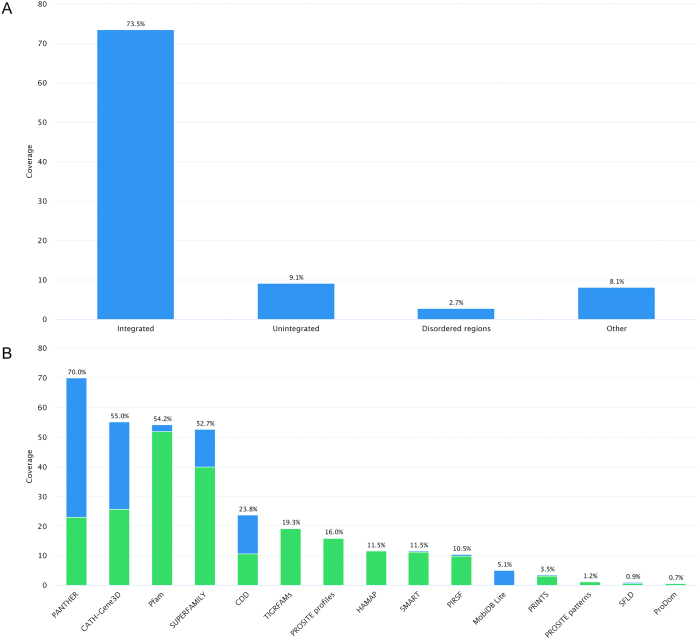
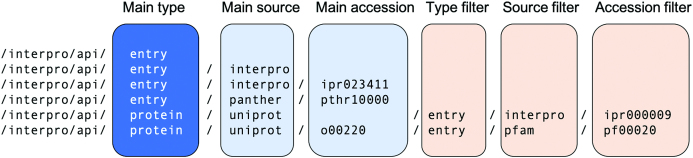
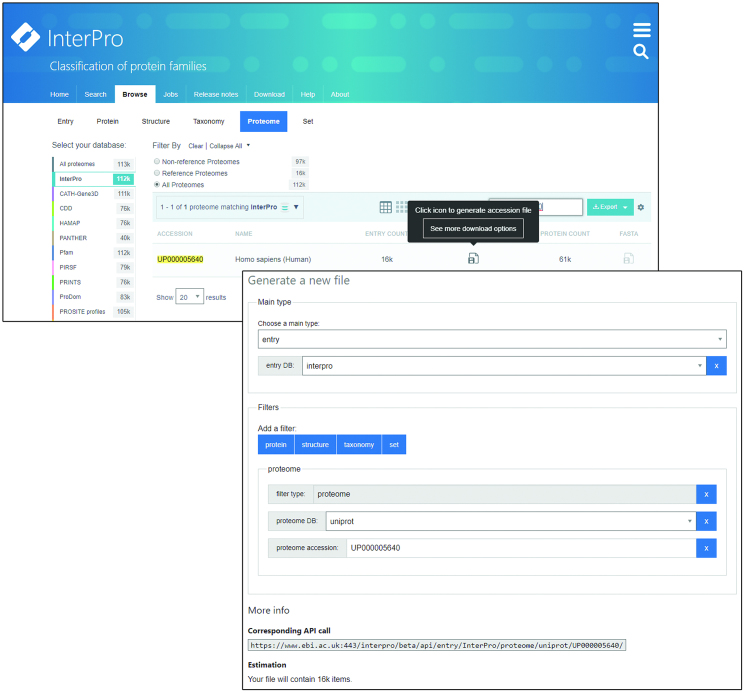
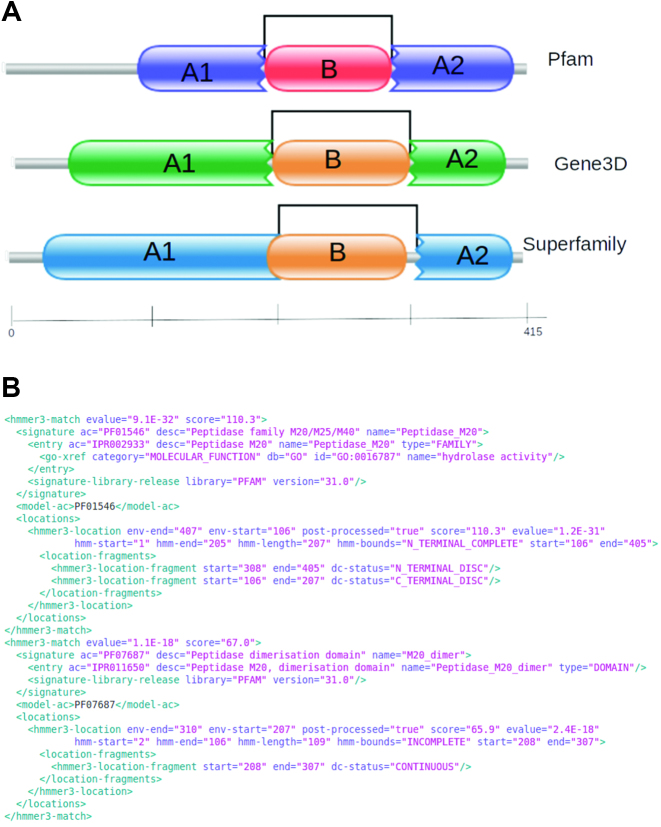
The InterPro database (http://www.ebi.ac.uk/interpro/) classifies protein sequences into families and predicts the presence of functionally important domains and sites. Here, we report recent developments with InterPro (version 70.0) and its associated software, including an 18% growth in the size of the database in terms on new InterPro entries, updates to content, the inclusion of an additional entry type, refined modelling of discontinuous domains, and the development of a new programmatic interface and website. These developments extend and enrich the information provided by InterPro, and provide greater flexibility in terms of data access. We also show that InterPro's sequence coverage has kept pace with the growth of UniProtKB, and discuss how our evaluation of residue coverage may help guide future curation activities.
Overview
The claims and statistics of this paper haven’t been checked yet.
Free: it reads the open-access text and checks the first 5 claims that cite a source we can check. Create a free account to check every claim.
Integrity signals
Registry
Cites
Statistics
Figures


Verification
Claims the paper makes
The claims and statistics of this paper haven’t been checked yet.
Free: it reads the open-access text and checks the first 5 claims that cite a source we can check. Create a free account to check every claim.
Claims other papers make about this one
Each is checked against this paper’s own text: does it say what the citing paper says it does?
The source backs part of the claim, not all of it — or backs it for a different population, condition or comparison.
In the citing paper
“InterPro14 assigned it into the MFS transporter superfamily.”
From Environmental conditions shape the nature of a minimal bacterial genome (2019) · cites this paper as [14]
Experimental — accuracy not yet measured
Self-check
Percentages, sums and reported differences re-computed from the paper’s own numbers.
The self-check needs the paper’s full text.
Citations
Cites
Gene Ontology: tool for the unification of biology
Ashburner, M., Ball, C. A., Blake, J. A., Botstein, D., Butler, H., Cherry, J. M., Davis, A. P., Dolinski, K., Dwight, S. S., Eppig, J. T., et al. (2000) · Nature Genetics · doi:10.1038/75556 · Cited by 43,206
Krogh, A., Larsson, B., von Heijne, G., & Sonnhammer, E. L. L. (2001) · Journal of Molecular Biology · doi:10.1006/jmbi.2000.4315 · Cited by 12,654
InterProScan 5: genome-scale protein function classification
Jones, P., Binns, D., Chang, H.-Y., Fraser, M., Li, W., McAnulla, C., McWilliam, H., Maslen, J., Mitchell, A., Nuka, G., et al. (2014) · Bioinformatics · doi:10.1093/bioinformatics/btu031 · Cited by 9,301
Self-citationUniProt: the Universal Protein knowledgebase
Apweiler, R. (2004) · Nucleic Acids Research · doi:10.1093/nar/gkh131 · Cited by 7,498
The Pfam protein families database: towards a more sustainable future
Finn, R. D., Coggill, P., Eberhardt, R. Y., Eddy, S. R., Mistry, J., Mitchell, A. L., Potter, S. C., Punta, M., Qureshi, M., Sangrador-Vegas, A., et al. (2016) · Nucleic Acids Research · doi:10.1093/nar/gkv1344 · Cited by 5,975
Self-citationUniProt: the universal protein knowledgebase
The UniProt Consortium (2017) · Nucleic Acids Research · doi:10.1093/nar/gkw1099 · Cited by 4,436
Predicting coiled coils from protein sequences.
Lupas, A., Van Dyke, M., & Stock, J. (1991) · Science · doi:10.1126/science.252.5009.1162 · Cited by 3,953
CDD/SPARCLE: functional classification of proteins via subfamily domain architectures
Marchler-Bauer, A., Bo, Y., Han, L., He, J., Lanczycki, C. J., Lu, S., Chitsaz, F., Derbyshire, M. K., Geer, R. C., Gonzales, N. R., et al. (2017) · Nucleic Acids Research · doi:10.1093/nar/gkw1129 · Cited by 2,713
Self-citationPotter, S. C., Luciani, A., Eddy, S. R., Park, Y., Lopez, R., & Finn, R. D. (2018) · Nucleic Acids Research · doi:10.1093/nar/gky448 · Cited by 2,607
Self-citationBlast2GO: A Comprehensive Suite for Functional Analysis in Plant Genomics
Conesa, A., & Götz, S. (2008) · International Journal of Plant Genomics · doi:10.1155/2008/619832 · Cited by 2,151
Cited by
Szklarczyk, D., Gable, A. L., Nastou, K. C., Lyon, D., Kirsch, R., Pyysalo, S., Doncheva, N. T., Legeay, M., Fang, T., Bork, P., et al. (2021) · Nucleic Acids Research · doi:10.1093/nar/gkaa1074 · Cited by 8,056
Self-citationPfam: The protein families database in 2021
Mistry, J., Chuguransky, S., Williams, L., Qureshi, M., Salazar, G. A., Sonnhammer, E. L. L., Tosatto, S. C. E., Paladin, L., Raj, S., Richardson, L. J., et al. (2021) · Nucleic Acids Research · doi:10.1093/nar/gkaa913 · Cited by 7,452
Self-citationUniProt: the universal protein knowledgebase in 2021
The UniProt Consortium, Bateman, A., Martin, M.-J., Orchard, S., Magrane, M., Agivetova, R., Ahmad, S., Alpi, E., Bowler-Barnett, E. H., Britto, R., et al. (2021) · Nucleic Acids Research · doi:10.1093/nar/gkaa1100 · Cited by 6,372
Self-citationThe EMBL-EBI search and sequence analysis tools APIs in 2019
Madeira, F., Park, Y. M., Lee, J., Buso, N., Gur, T., Madhusoodanan, N., Basutkar, P., Tivey, A. R. N., Potter, S. C., Finn, R. D., et al. (2019) · Nucleic Acids Research · doi:10.1093/nar/gkz268 · Cited by 4,167
Self-citationCDD/SPARCLE: the conserved domain database in 2020
Lu, S., Wang, J., Chitsaz, F., Derbyshire, M. K., Geer, R. C., Gonzales, N. R., Gwadz, M., Hurwitz, D. I., Marchler, G. H., Song, J. S., et al. (2020) · Nucleic Acids Research · doi:10.1093/nar/gkz991 · Cited by 3,028
Self-citation
Metadata
- Authors
- Mitchell, A. L., Attwood, T. K., Babbitt, P. C., Blum, M., Bork, P., Bridge, A., Brown, S. D., Chang, H.-Y., El-Gebali, S., Fraser, M. I., Gough, J., Haft, D. R., Huang, H., Letunic, I., Lopez, R., Luciani, A., Madeira, F., Marchler-Bauer, A., Mi, H., Natale, D. A., Necci, M., Nuka, G., Orengo, C., Pandurangan, A. P., Paysan-Lafosse, T., Pesseat, S., Potter, S. C., Qureshi, M. A., Rawlings, N. D., Redaschi, N., Richardson, L. J., Rivoire, C., Salazar, G. A., Sangrador-Vegas, A., Sigrist, C. J. A., Sillitoe, I., Sutton, G. G., Thanki, N., Thomas, P. D., Tosatto, S. C. E., Yong, S.-Y., & Finn, R. D.
- Affiliations
- European Bioinformatics Institute (GB)
- University of Manchester (GB)
- University of California, San Francisco (US)
- European Molecular Biology Laboratory, Structural and Computational Biology Unit, Meyerhofstr.1, 69117 Heidelberg, Germany
- SIB Swiss Institute of Bioinformatics (CH)
- MRC Laboratory of Molecular Biology (GB)
- J. Craig Venter Institute (US)
- University of Delaware (US)
- Biobyte Solutions GmbH, Bothestr 142, 69126 Heidelberg, Germany
- European Molecular Biology Laboratory, European Bioinformatics Institute (EMBL-EBI), Wellcome Trust Genome Campus, Hinxton, Cambridge CB10 1SD, UK
- National Center for Biotechnology Information, National Library of Medicine, NIH Bldg, 38A, 8600 Rockville Pike, Bethesda, MD 20894, USA
- University of Southern California (US)
- Georgetown University Medical Center (US)
- Fondazione Edmund Mach (IT)
- University College London (GB)
- National Institutes of Health (US)
- University of Padua (IT)
- Corresponding author
- Finn, Robert D
- ORCID
- Mitchell, Alex L
- Attwood, Teresa K
- Babbitt, Patricia C
- Blum, Matthias
- Bridge, Alan
- Chang, Hsin-Yu
- El-Gebali, Sara
- Gough, Julian
- Huang, Hongzhan
- Luciani, Aurélien
- Mi, Huaiyu
- Natale, Darren A
- Necci, Marco
- Orengo, Christine
- Pandurangan, Arun P
- Pesseat, Sebastien
- Potter, Simon C
- Qureshi, Matloob A
- Rawlings, Neil D
- Redaschi, Nicole
- Richardson, Lorna J
- Rivoire, Catherine
- Salazar, Gustavo A
- Sigrist, Christian J A
- Sillitoe, Ian
- Thanki, Narmada
- Thomas, Paul D
- Tosatto, Silvio C E
- Yong, Siew-Yit
- Finn, Robert D
- Venue
- Nucleic Acids Research
- Publisher
- Oxford University Press (OUP)
- Published
- 2018-11-06
- Volume
- 47
- Issue
- D1
- Pages
- D351-D360
- ISSN
- 0305-1048 (ISSN-L)
- 1362-4962
- PMC
- PMC6323941
- OpenAlex
- W2900359059
- Cited by
- 1,426
- References
- 43
- Citations by year
- 2026: 45 · 2025: 58 · 2024: 102 · 2023: 100 · 2022: 193 · 2021: 353 · 2020: 385 · 2019: 184 · 2018: 5
- FWCI
- 83.43
- Type
- journal article
- Language
- en
- Open access
- gold
- doi.org
- Licence
- Locations
- Nucleic Acids Research (publishedVersion, cc-by)
- Europe PMC (PubMed Central) (publishedVersion, cc-by)
- PubMed Central (publishedVersion, cc-by)
- PubMed (publishedVersion)
- Apollo (University of Cambridge) (submittedVersion, cc-by)
- UCL Discovery (University College London) (submittedVersion)
- Padua Research Archive (University of Padova) (submittedVersion, cc-by)
- Funders
- Wellcome Trust (108433/Z/15/Z)
- Biotechnology and Biological Sciences Research Council (BB/N00521X/1, BB/N019172/1, BB/L024136/1)
- National Science Foundation, Division of Biological Infrastructure (1458808)
- Topics
- Life Sciences › Biochemistry, Genetics and Molecular Biology › Molecular Biology › Genomics and Phylogenetic Studies
- Life Sciences › Biochemistry, Genetics and Molecular Biology › Molecular Biology › Machine Learning in Bioinformatics
- Life Sciences › Biochemistry, Genetics and Molecular Biology › Molecular Biology › Bioinformatics and Genomic Networks
- Keywords
- InterPro, protein sequence annotation, protein families, protein domains, sequencing depth, UniProtKB, database curation, functional sites
- MeSH terms
- Protein Domains, Animals, Multigene Family, Humans, Software, User-Computer Interface, Sequence Homology, Amino Acid, Internet, Databases, Genetic, Databases, Protein, Molecular Sequence Annotation, Gene Ontology
About these checks
Registry, retraction, Cites and statistics results are computed, not judged, with one exception: a printed reference that no index lists is read once by a model before it counts as a citation error. Claims are extracted by a model and kept only when their quote appears verbatim in the text; each cited source is then checked, with a model’s help, for whether it says what the claim relies on. Those verdicts can be wrong — read the claim’s quote and the cited source before relying on one.
Statistics and arithmetic are recomputed, not judged.
Confidence bands are shown only for fields calibrated on our annotated test set. None is calibrated yet, so no band is shown.
What counts as a claim ›How we measure confidence ›How we check this ›
Are you an author, or do you see a problem with this page? Request a review
How to cite
Cite CoChat for the checks on this page, and the paper for its own findings.
- This page
- CoChat. (2026). Citation check: InterPro in 2019: improving coverage, classification and access to protein sequence annotations. https://app.cochat.ai/papers/10.1093/nar/gky1100
- The paper
- Mitchell, A. L., Attwood, T. K., Babbitt, P. C., Blum, M., Bork, P., Bridge, A., Brown, S. D., Chang, H.-Y., El-Gebali, S., Fraser, M. I., Gough, J., Haft, D. R., Huang, H., Letunic, I., Lopez, R., Luciani, A., Madeira, F., Marchler-Bauer, A., Mi, H., . . . Finn, R. D. (2019). InterPro in 2019: improving coverage, classification and access to protein sequence annotations. Nucleic Acids Research. https://doi.org/10.1093/nar/gky1100
Data sources
Bibliographic data: Semantic Scholar, OpenAlex, Crossref.
Contains information from the Semantic Scholar Academic Graph Datasets, made available under the ODC Attribution License (ODC-BY 1.0).
Semantic Scholar’s data is described in: Kinney, R., et al. (2023). The Semantic Scholar Open Data Platform. arXiv:2301.10140.
