

Vibrio parahaemolyticus T6SS2 effector repertoires
Open accessPreprint — published as 10.1080/19490976.2023.2178795
The DOI matches its Crossref record; 52 of the 52 references it cites were found in a registry or an index.
Abstract
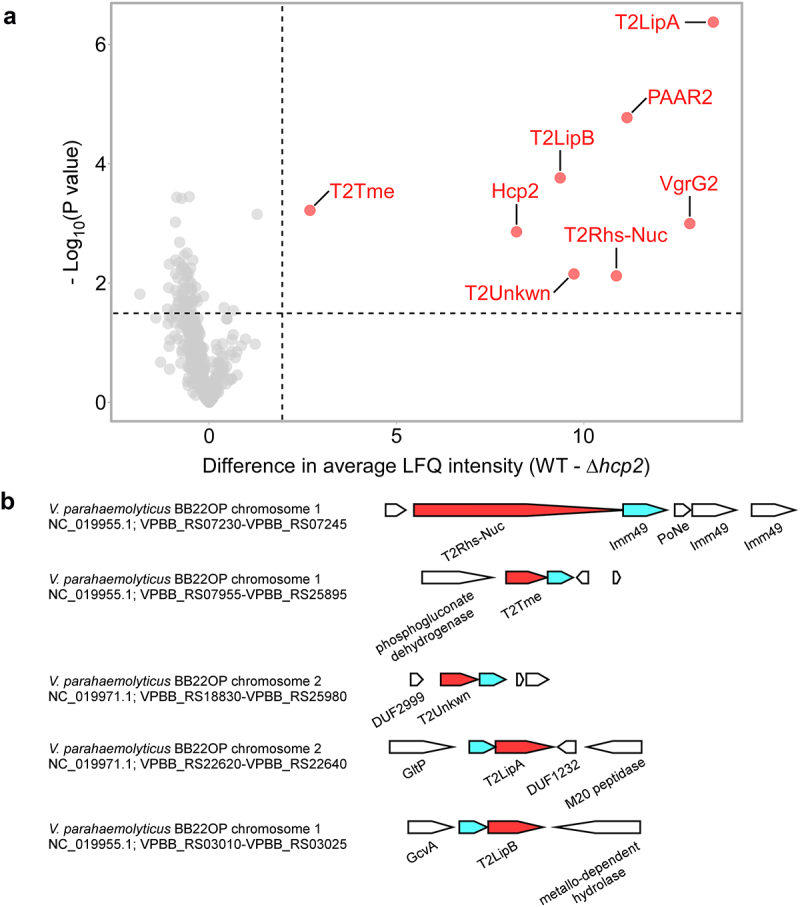
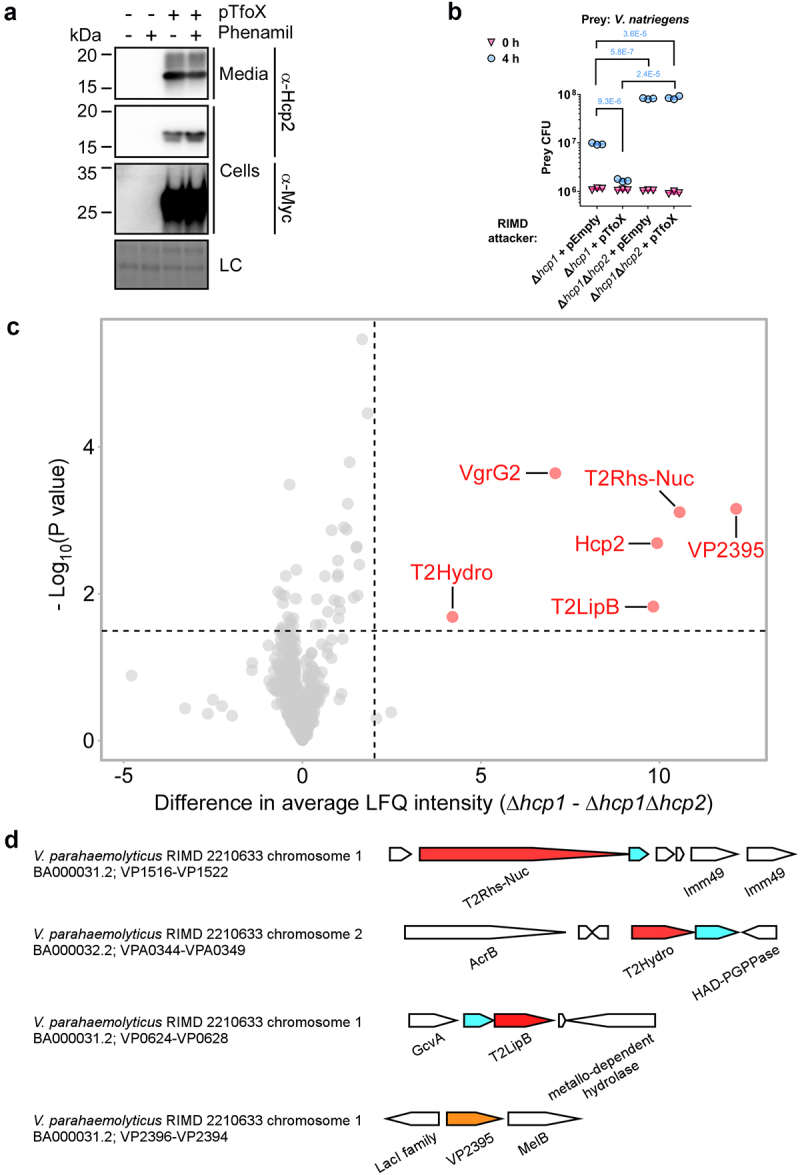
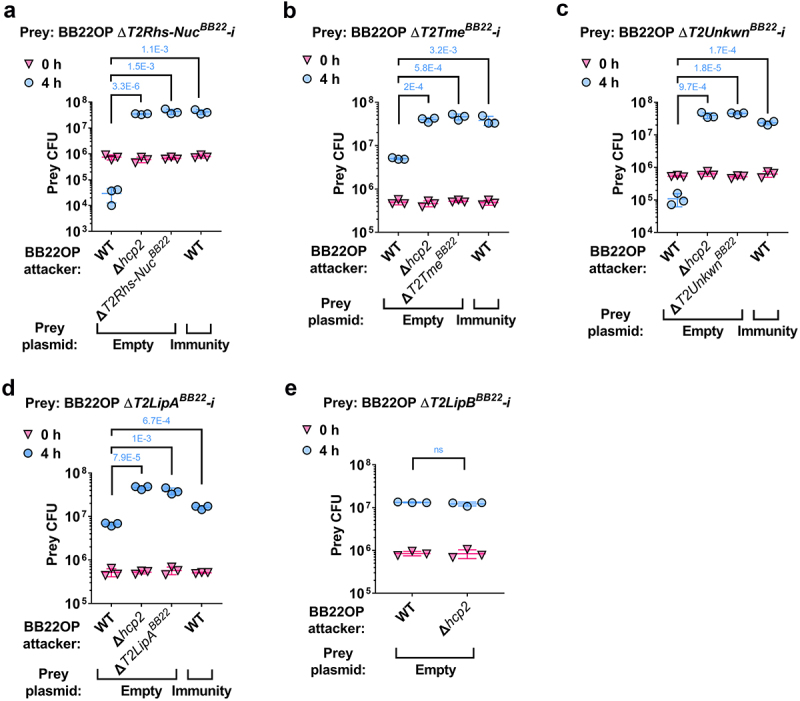
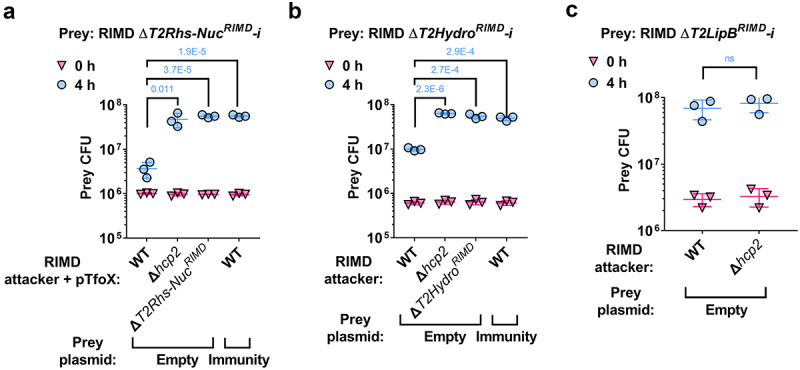
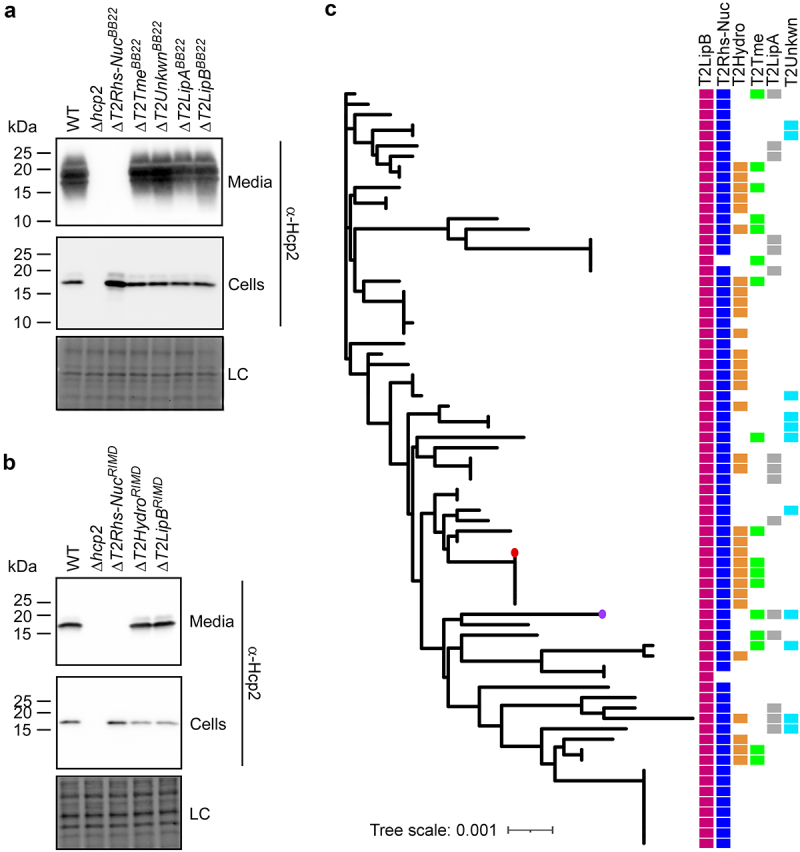
All strains of the marine bacterium Vibrio parahaemolyticus harbor a type VI secretion system (T6SS) named T6SS2, suggesting that this system plays an important role in the life cycle of this emerging pathogen. Although T6SS2 was recently shown to play a role in interbacterial competition, its effector repertoire remains unknown. Here, we employed proteomics to investigate the T6SS2 secretome of two V. parahaemolyticus strains, and we identified several antibacterial effectors encoded outside of the main T6SS2 gene cluster. We revealed two T6SS2-secreted proteins that are conserved in this species, indicating that they constitute the core secretome of T6SS2; other identified effectors are found only in subsets of strains, suggesting that they comprise an accessory effector arsenal of T6SS2. Remarkably, a conserved Rhs repeat-containing effector serves as a quality control checkpoint and is required for T6SS2 activity. Our results reveal the effector repertoire of a conserved T6SS, some of which have no known activity and have not been previously associated with T6SSs.
Overview
The claims and statistics of this paper haven’t been checked yet.
Free: it reads the open-access text and checks the first 5 claims that cite a source we can check. Create a free account to check every claim.
Integrity signals
Registry
Cites
Statistics
Figures
Verification
Claims the paper makes
The claims and statistics of this paper haven’t been checked yet.
Free: it reads the open-access text and checks the first 5 claims that cite a source we can check. Create a free account to check every claim.
Self-check
Percentages, sums and reported differences re-computed from the paper’s own numbers.
The self-check needs the paper’s full text.
Citations
Cites
The neighbor-joining method: a new method for reconstructing phylogenetic trees.
(1987) · Molecular Biology and Evolution · doi:10.1093/oxfordjournals.molbev.a040454 · Cited by 59,715
Highly accurate protein structure prediction with AlphaFold
Jumper, J., Evans, R., Pritzel, A., Green, T., Figurnov, M., Ronneberger, O., Tunyasuvunakool, K., Bates, R., Žídek, A., Potapenko, A., et al. (2021) · Nature · doi:10.1038/s41586-021-03819-2 · Cited by 43,764
BLAST+: architecture and applications
Camacho, C., Coulouris, G., Avagyan, V., Ma, N., Papadopoulos, J., Bealer, K., & Madden, T. L. (2009) · BMC Bioinformatics · doi:10.1186/1471-2105-10-421 · Cited by 22,074
MAFFT: a novel method for rapid multiple sequence alignment based on fast Fourier transform
Katoh, K. (2002) · Nucleic Acids Research · doi:10.1093/nar/gkf436 · Cited by 17,027
Prodigal: prokaryotic gene recognition and translation initiation site identification
Hyatt, D., Chen, G.-L., LoCascio, P. F., Land, M. L., Larimer, F. W., & Hauser, L. J. (2010) · BMC Bioinformatics · doi:10.1186/1471-2105-11-119 · Cited by 12,587
Enzymatic assembly of DNA molecules up to several hundred kilobases
Gibson, D. G., Young, L., Chuang, R.-Y., Venter, J. C., Hutchison, C. A., & Smith, H. O. (2009) · Nature Methods · doi:10.1038/nmeth.1318 · Cited by 9,996
The Perseus computational platform for comprehensive analysis of (prote)omics data
Tyanova, S., Temu, T., Sinitcyn, P., Carlson, A., Hein, M. Y., Geiger, T., Mann, M., & Cox, J. (2016) · Nature Methods · doi:10.1038/nmeth.3901 · Cited by 8,803
Varadi, M., Anyango, S., Deshpande, M., Nair, S., Natassia, C., Yordanova, G., Yuan, D., Stroe, O., Wood, G., Laydon, A., et al. (2022) · Nucleic Acids Research · doi:10.1093/nar/gkab1061 · Cited by 7,850
The PRIDE database resources in 2022: a hub for mass spectrometry-based proteomics evidences
Perez-Riverol, Y., Bai, J., Bandla, C., García-Seisdedos, D., Hewapathirana, S., Kamatchinathan, S., Kundu, D. J., Prakash, A., Frericks-Zipper, A., Eisenacher, M., et al. (2022) · Nucleic Acids Research · doi:10.1093/nar/gkab1038 · Cited by 6,125
Cox, J., Hein, M. Y., Luber, C. A., Paron, I., Nagaraj, N., & Mann, M. (2014) · Molecular & Cellular Proteomics · doi:10.1074/mcp.m113.031591 · Cited by 5,180
Research works printed but not linked: 6
- 2020, The Vibrios: Scavengers, Symbionts, and Pathogens from the Sea, Microb Ecol 2020 803, 80, 501
- 2022, The coral pathogen Vibrio coralliilyticus kills non-pathogenic holobiont competitors by triggering prophage induction, Nat Ecol Evol 2022 68, 6, 1132
- 2015, An intracellular replication niche for Vibrio cholerae in the amoeba Acanthamoeba castellanii, ISME J 2016 104, 10, 897
- 2017, Type VI secretion system MIX-effectors carry both antibacterial and anti-eukaryotic activities, EMBO Rep, 18, e201744226
- 2017, Acute hepatopancreatic necrosis disease-causing Vibrio parahaemolyticus strains maintain an antibacterial type VI secretion system with versatile effector repertoires, Appl Environ Microbiol, 83, e00737
- 2018, MAFFT online service: Multiple sequence alignment, interactive sequence choice and visualization, Brief Bioinform, 20, 1160
Metadata
- Authors
- Tchelet, D., Keppel, K., Bosis, E., & Salomon, D.
- Affiliations
- Tel Aviv University (IL)
- Braude College of Engineering Karmiel (IL)
- Corresponding author
- Salomon, Dor
- Venue
- Gut Microbes
- Publisher
- openRxiv
- Published
- 2022-11-17
- Volume
- 15
- Issue
- 1
- Pages
- 2178795-2178795
- ISSN
- 1949-0976 (ISSN-L)
- PMC
- PMC9980498
- OpenAlex
- W4321376757
- Cited by
- 24
- References
- 52
- Citations by year
- 2026: 7 · 2025: 8 · 2024: 5 · 2023: 4
- FWCI
- 4.45
- Type
- journal article
- Language
- en
- Open access
- gold
- doi.org
- Licence
- cc-by
- Locations
- Gut Microbes (publishedVersion, cc-by)
- bioRxiv (Cold Spring Harbor Laboratory) (acceptedVersion, cc-by-nd)
- PubMed Central (publishedVersion, cc-by)
- PubMed (publishedVersion)
- DOAJ (DOAJ: Directory of Open Access Journals) (submittedVersion, cc-by-sa)
- Funders
- Israel Science Foundation (1362/21, 920/17)
- Tel Aviv University
- Topics
- Life Sciences › Immunology and Microbiology › Microbiology › Vibrio bacteria research studies
- Life Sciences › Biochemistry, Genetics and Molecular Biology › Genetics › Bacterial Genetics and Biotechnology
- Life Sciences › Immunology and Microbiology › Microbiology › Escherichia coli research studies
- Keywords
- Vibrio parahaemolyticus, type VI secretion system, effector repertoire, secretome, bacterial competition, marine bacterial pathogens
- MeSH terms
- Gastrointestinal Microbiome, Type VI Secretion Systems, Anti-Bacterial Agents, Bacterial Proteins, Vibrio parahaemolyticus
About these checks
Registry, retraction, Cites and statistics results are computed, not judged, with one exception: a printed reference that no index lists is read once by a model before it counts as a citation error. Claims are extracted by a model and kept only when their quote appears verbatim in the text; each cited source is then checked, with a model’s help, for whether it says what the claim relies on. Those verdicts can be wrong — read the claim’s quote and the cited source before relying on one.
Statistics and arithmetic are recomputed, not judged.
Confidence bands are shown only for fields calibrated on our annotated test set. None is calibrated yet, so no band is shown.
What counts as a claim ›How we measure confidence ›How we check this ›
Are you an author, or do you see a problem with this page? Request a review
How to cite
Cite CoChat for the checks on this page, and the paper for its own findings.
- This page
- CoChat. (2026). Citation check: Vibrio parahaemolyticus T6SS2 effector repertoires. https://app.cochat.ai/papers/10.1101/2022.11.17.516722
- The paper
- Tchelet, D., Keppel, K., Bosis, E., & Salomon, D. (2022). Vibrio parahaemolyticus T6SS2 effector repertoires. Gut Microbes. https://doi.org/10.1101/2022.11.17.516722
Data sources
Bibliographic data: Semantic Scholar, OpenAlex, Crossref.
Contains information from the Semantic Scholar Academic Graph Datasets, made available under the ODC Attribution License (ODC-BY 1.0).
Semantic Scholar’s data is described in: Kinney, R., et al. (2023). The Semantic Scholar Open Data Platform. arXiv:2301.10140.
