

Calculation of Protein Folding Thermodynamics using Molecular Dynamics Simulations
Open accessPreprint — published as 10.1021/acs.jcim.3c01107
The DOI matches its Crossref record; 106 of the 106 references it cites were found in a registry or an index.
Abstract
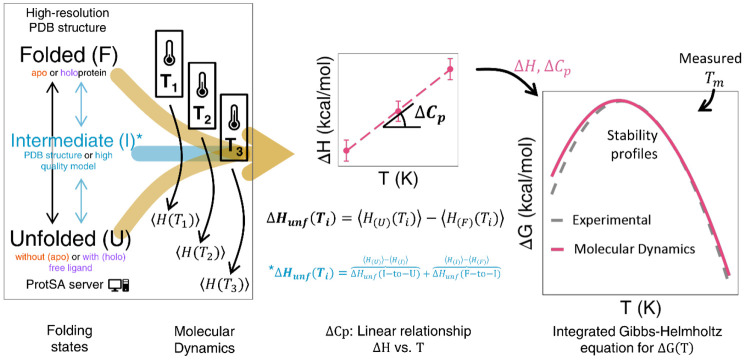
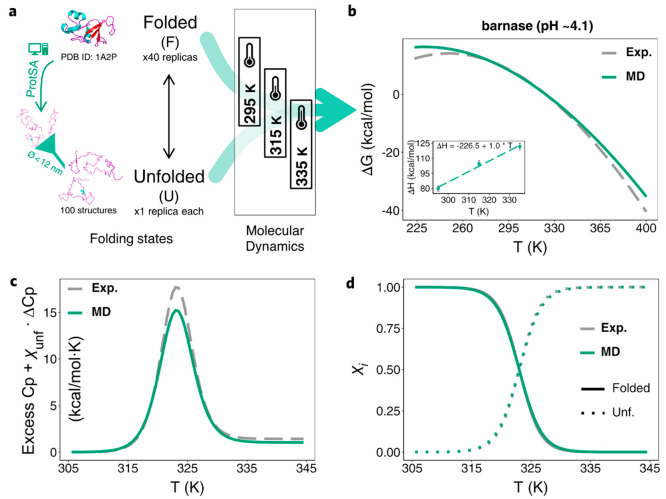
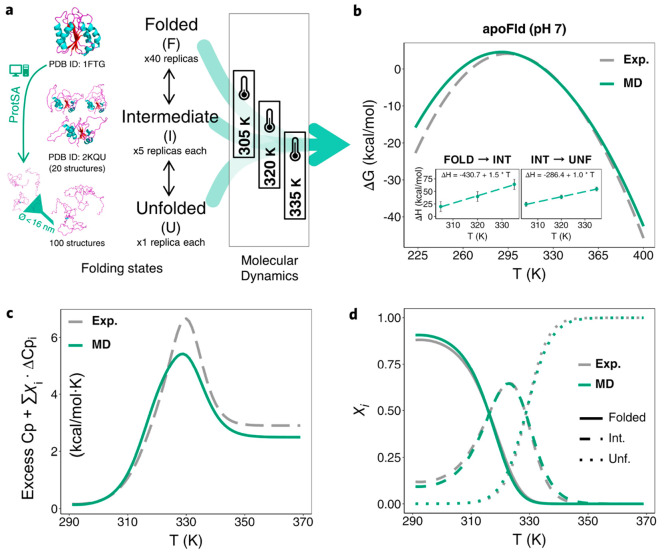
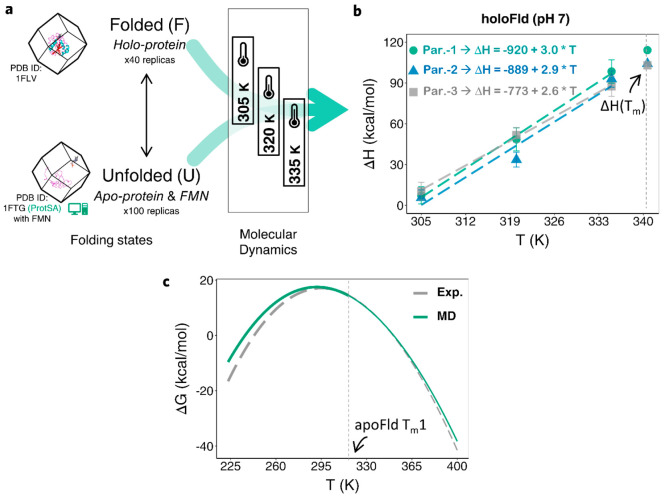
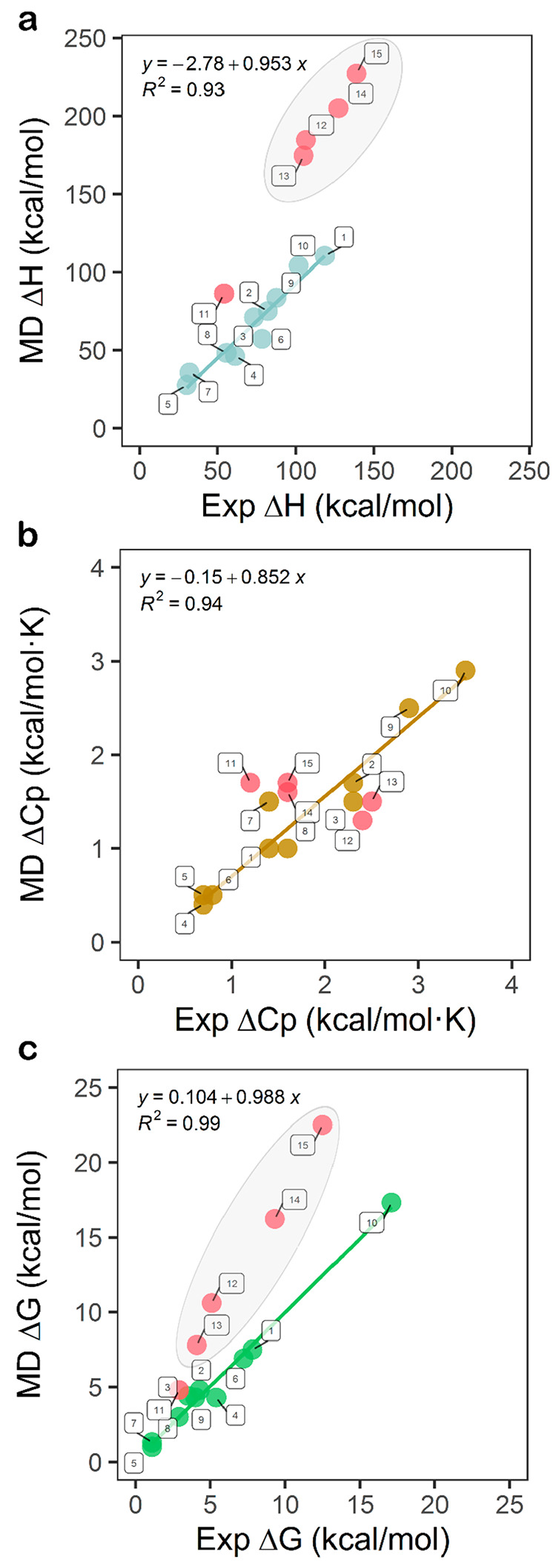
Despite impressive advances by AlphaFold2 in the field of computational biology, the protein folding problem remains an enigma to be solved. The continuous development of algorithms and methods to explore longer simulation timescales of biological systems, as well as the enhanced accuracy of potential functions (force fields and solvent models) have not yet led to significant progress in the calculation of the thermodynamics quantities associated to protein folding from first principles. Progress in this direction can help boost related fields such as protein engineering, drug design, or genetic interpretation, but the task seems not to have been addressed by the scientific community. Following an initial explorative study, we extend here the application of a Molecular Dynamics-based approach −with the most accurate force field/water model combination previously found (Charmm22-CMAP/Tip3p)− to computing the folding energetics of a set of two-state and three-state proteins that do or do not carry a bound cofactor. The proteins successfully computed are representative of the main protein structural classes, their sequences range from 84 to 169 residues, and their isoelectric points from 4.0 to 8.9. The devised approach enables accurate calculation of two essential magnitudes governing the stability of proteins −the changes in enthalpy and in heat capacity associated to protein unfolding−, which are used to obtain accurate values of the change in Gibbs free-energy, also known as the protein conformational stability. The method proves to be also suitable to obtain changes in stability due to changes in solution pH, or stability differences between a wild-type protein and a variant. The approach addresses the calculation by difference, a shortcut that avoids having to simulate the protein folding time, which is very often unfeasible computationally.
Overview
The claims and statistics of this paper haven’t been checked yet.
Free: it reads the open-access text and checks the first 5 claims that cite a source we can check. Create a free account to check every claim.
Integrity signals
Registry
Cites
Statistics
Figures
Verification
Claims the paper makes
The claims and statistics of this paper haven’t been checked yet.
Free: it reads the open-access text and checks the first 5 claims that cite a source we can check. Create a free account to check every claim.
Self-check
Percentages, sums and reported differences re-computed from the paper’s own numbers.
The self-check needs the paper’s full text.
Citations
Cites
UCSF Chimera—A visualization system for exploratory research and analysis
Pettersen, E. F., Goddard, T. D., Huang, C. C., Couch, G. S., Greenblatt, D. M., Meng, E. C., & Ferrin, T. E. (2004) · Journal of Computational Chemistry · doi:10.1002/jcc.20084 · Cited by 45,828
Highly accurate protein structure prediction with AlphaFold
Jumper, J., Evans, R., Pritzel, A., Green, T., Figurnov, M., Ronneberger, O., Tunyasuvunakool, K., Bates, R., Žídek, A., Potapenko, A., et al. (2021) · Nature · doi:10.1038/s41586-021-03819-2 · Cited by 43,764
Comparison of simple potential functions for simulating liquid water
Jorgensen, W. L., Chandrasekhar, J., Madura, J. D., Impey, R. W., & Klein, M. L. (1983) · The Journal of Chemical Physics · doi:10.1063/1.445869 · Cited by 41,298
Berman, H. M. (2000) · Nucleic Acids Research · doi:10.1093/nar/28.1.235 · Cited by 40,196
Development and testing of a general amber force field
Wang, J., Wolf, R. M., Caldwell, J. W., Kollman, P. A., & Case, D. A. (2004) · Journal of Computational Chemistry · doi:10.1002/jcc.20035 · Cited by 19,506
GROMACS: Fast, flexible, and free
Van Der Spoel, D., Lindahl, E., Hess, B., Groenhof, G., Mark, A. E., & Berendsen, H. J. C. (2005) · Journal of Computational Chemistry · doi:10.1002/jcc.20291 · Cited by 19,182
The missing term in effective pair potentials
Berendsen, H. J. C., Grigera, J. R., & Straatsma, T. P. (1987) · The Journal of Physical Chemistry · doi:10.1021/j100308a038 · Cited by 13,345
Bayly, C. I., Cieplak, P., Cornell, W., & Kollman, P. A. (1993) · The Journal of Physical Chemistry · doi:10.1021/j100142a004 · Cited by 8,081
Varadi, M., Anyango, S., Deshpande, M., Nair, S., Natassia, C., Yordanova, G., Yuan, D., Stroe, O., Wood, G., Laydon, A., et al. (2022) · Nucleic Acids Research · doi:10.1093/nar/gkab1061 · Cited by 7,850
UniProt: a worldwide hub of protein knowledge
The UniProt Consortium (2019) · Nucleic Acids Research · doi:10.1093/nar/gky1049 · Cited by 7,698
Research works printed but not linked: 3
- 2021, Molecular dynamics simulations for genetic interpretation in protein coding regions: where we are, where to go and when, Brief. Bioinform, 22, 3, 10.1093/bib/bbz146 · DOI
- 2020, The Expanding Computational Toolbox for Engineering Microbial Phenotypes at the Genome Scale, Microorganisms, 8, 1
- 2016, Protein stability: A crystallographer’s perspective, Acta Crystallographica Section:F Structural Biology Communications, 72, 72
Metadata
- Authors
- Galano-Frutos, J. J., Nerín-Fonz, F., & Sancho, J.
- Affiliations
- Universidad de Zaragoza (ES)
- Corresponding author
- Sancho, Javier
- Venue
- Journal of Chemical Information and Modeling
- Publisher
- openRxiv
- Published
- 2023-01-23
- Volume
- 63
- Issue
- 24
- Pages
- 7791-7806
- ISSN
- 1549-9596 (ISSN-L)
- PMC
- PMC10751793
- OpenAlex
- W4388639235
- Cited by
- 24
- References
- 106
- Citations by year
- 2026: 6 · 2025: 9 · 2024: 8 · 2023: 1
- FWCI
- 2.14
- Type
- journal article
- Language
- en
- Open access
- hybrid
- doi.org
- Licence
- cc-by
- Locations
- Journal of Chemical Information and Modeling (publishedVersion, cc-by)
- bioRxiv (Cold Spring Harbor Laboratory) (acceptedVersion, cc-by-nc-nd)
- PubMed Central (publishedVersion, cc-by)
- PubMed (publishedVersion)
- Zaguan (Universidad de Zaragoza) (submittedVersion, cc-by)
- Funders
- Ministerio de Ciencia e Innovación (PDC2021-121341-I00, PID2022‐141068NB‐I00, PID2019, PID2019-107293 GB-I00)
- Universidad de Zaragoza
- Gobierno de Aragón (E45_20R)
- Topics
- Life Sciences › Biochemistry, Genetics and Molecular Biology › Molecular Biology › Protein Structure and Dynamics
- Physical Sciences › Chemistry › Physical and Theoretical Chemistry › thermodynamics and calorimetric analyses
- Life Sciences › Biochemistry, Genetics and Molecular Biology › Molecular Biology › RNA and protein synthesis mechanisms
- Keywords
- protein folding thermodynamics, folding free energy, enthalpy change, heat capacity change, conformational stability, two-state proteins, ΔΔG, temperature-dependent folding, amino acid substitution effects
- MeSH terms
- Artificial Intelligence, Proteins, Thermodynamics, Protein Folding, Molecular Dynamics Simulation
About these checks
Registry, retraction, Cites and statistics results are computed, not judged, with one exception: a printed reference that no index lists is read once by a model before it counts as a citation error. Claims are extracted by a model and kept only when their quote appears verbatim in the text; each cited source is then checked, with a model’s help, for whether it says what the claim relies on. Those verdicts can be wrong — read the claim’s quote and the cited source before relying on one.
Statistics and arithmetic are recomputed, not judged.
Confidence bands are shown only for fields calibrated on our annotated test set. None is calibrated yet, so no band is shown.
What counts as a claim ›How we measure confidence ›How we check this ›
Are you an author, or do you see a problem with this page? Request a review
How to cite
Cite CoChat for the checks on this page, and the paper for its own findings.
- This page
- CoChat. (2026). Citation check: Calculation of Protein Folding Thermodynamics using Molecular Dynamics Simulations. https://app.cochat.ai/papers/10.1101/2023.01.21.525008
- The paper
- Galano-Frutos, J. J., Nerín-Fonz, F., & Sancho, J. (2023). Calculation of Protein Folding Thermodynamics using Molecular Dynamics Simulations. Journal of Chemical Information and Modeling. https://doi.org/10.1101/2023.01.21.525008
Data sources
Bibliographic data: Semantic Scholar, OpenAlex, Crossref.
Contains information from the Semantic Scholar Academic Graph Datasets, made available under the ODC Attribution License (ODC-BY 1.0).
Semantic Scholar’s data is described in: Kinney, R., et al. (2023). The Semantic Scholar Open Data Platform. arXiv:2301.10140.
