

The DOI matches its Crossref record; 1 of the 1 references it cites were found in a registry or an index.
TGF-β Ligand Cross-Subfamily Interactions in the Response of Caenorhabditis elegans to Bacterial Pathogens
Open accessPreprint — published as 10.1371/journal.pgen.1011324 · Paper page
Abstract
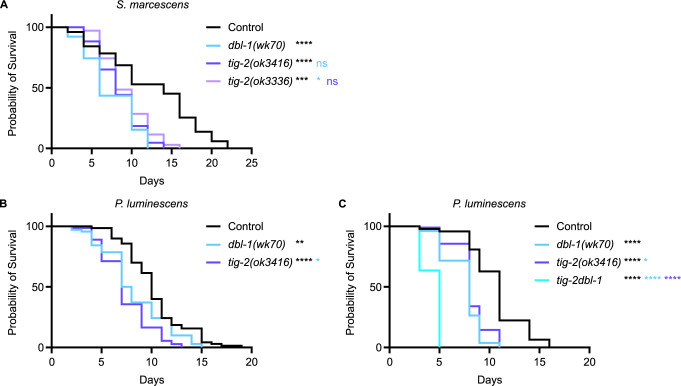
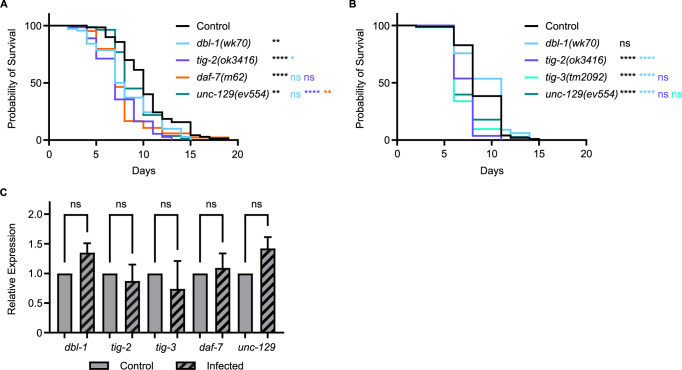
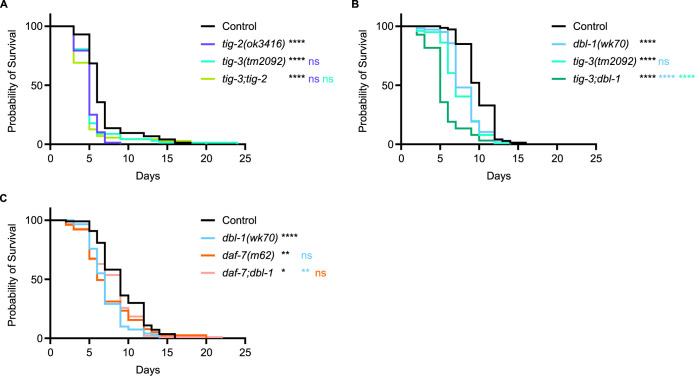
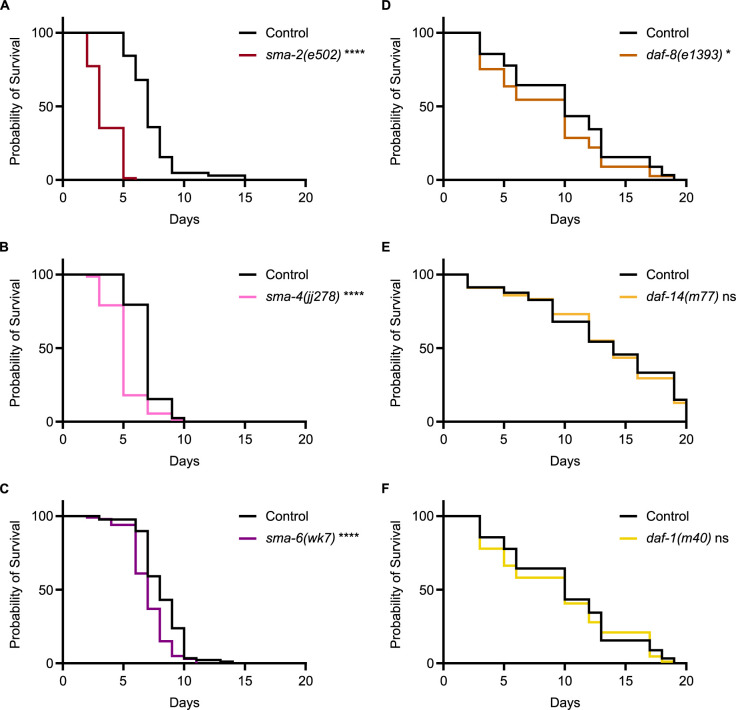
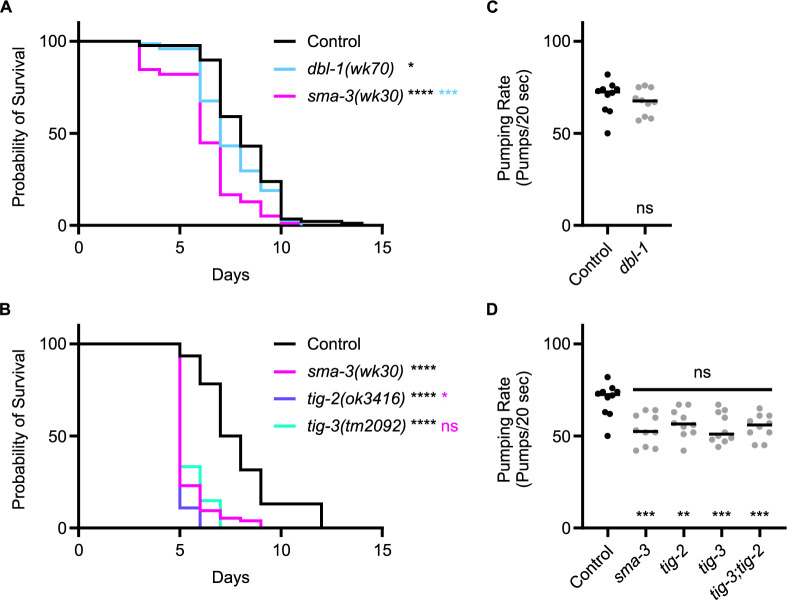
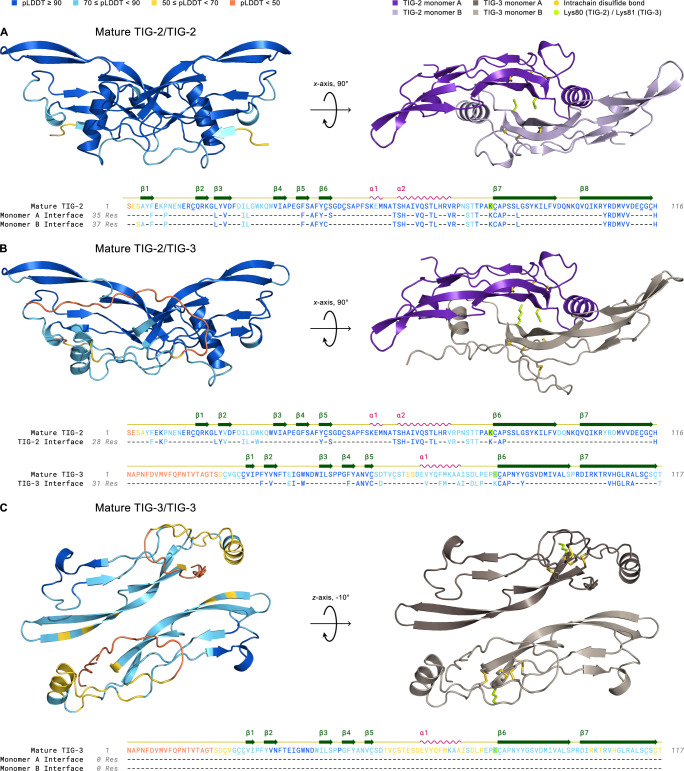
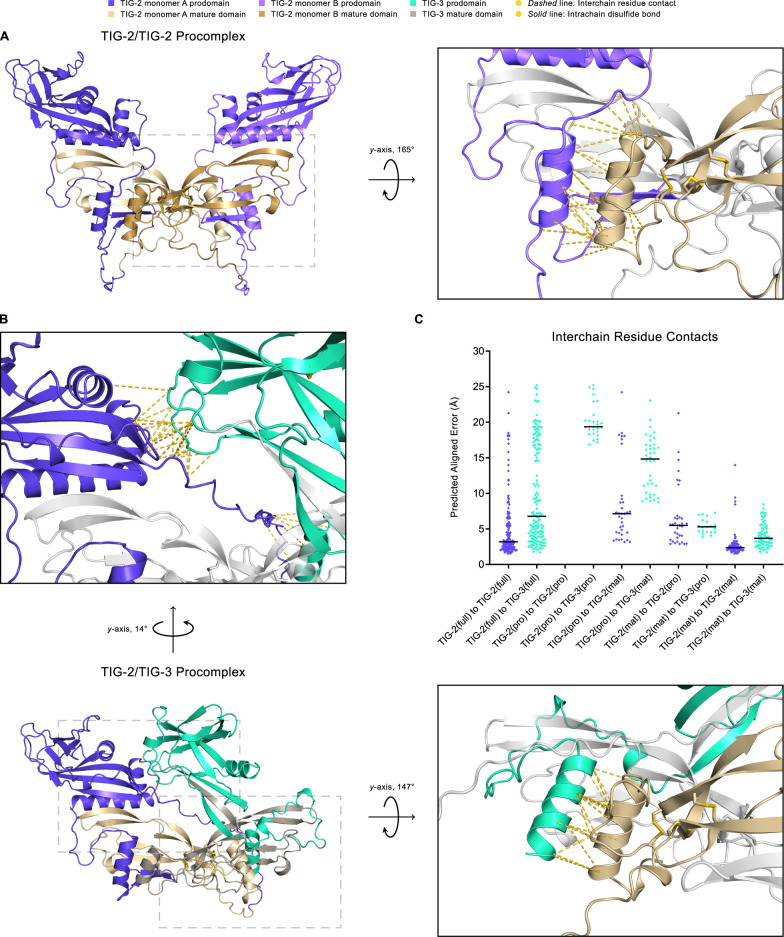
The Transforming Growth Factor beta (TGF-β) family consists of numerous secreted peptide growth factors that play significant roles in cell function, tissue patterning, and organismal homeostasis, including wound repair and immunity. Typically studied as homodimers, these ligands have the potential to diversify their functions through ligand interactions that are synergistic, cooperative, additive, and/or antagonistic. In the nematode Caenorhabditis elegans , there are only five TGF-β ligands, providing an opportunity to dissect ligand interactions in fewer combinations than in vertebrates. As in vertebrates, these ligands can be divided into bone morphogenetic protein (BMP) and TGF-β/Activin subfamilies that predominantly signal through discrete signaling pathways. The BMP subfamily ligand DBL-1 has been well studied for its role in the innate immune response in C. elegans . Here we show that all five TGF-β ligands play a role in the immune response. We also demonstrate that multiple TGF-β ligands act cooperatively as part of this response. We show that the two BMP-like ligands – DBL-1 and TIG-2 – function independently of each other in the immune response, while TIG-2/BMP and the TGF-β/Activin-like ligand TIG-3 function cooperatively. Structural modeling supports the potential for TIG-2 and TIG-3 to form heterodimers. Finally, we show that canonical DBL-1/BMP receptor and Smad signal transducers function in the response to bacterial pathogens, while components of the DAF-7 TGF-β/Activin signaling pathway do not play a role in survival. These results demonstrate a novel potential for BMP and TGF-β/Activin subfamily ligands to interact, and may provide a mechanism for distinguishing the developmental and homeostatic functions of these ligands from an acute response such as the innate immune response to bacterial pathogens.
Overview
The claims and statistics of this paper haven’t been checked yet.
Run the check — free, no account needed. It reads the open-access text and checks the sources it cites.
Integrity signals
Registry
Cites
Statistics
Figures
Verification
Claims the paper makes
The claims and statistics of this paper haven’t been checked yet.
Run the check — free, no account needed. It reads the open-access text and checks the sources it cites.
Self-check
Percentages, sums and reported differences re-computed from the paper’s own numbers.
The self-check needs the paper’s full text.
Citations
Cites
Highly accurate protein structure prediction with AlphaFold
Jumper, J., Evans, R., Pritzel, A., Green, T., Figurnov, M., Ronneberger, O., Tunyasuvunakool, K., Bates, R., Žídek, A., Potapenko, A., et al. (2021) · Nature · doi:10.1038/s41586-021-03819-2 · Cited by 43,764
Research works printed but not linked: 59
- 10.1016/S1359-6101(96)00042-1 · DOI
- 10.1074/jbc.M115.713487 · DOI · Paper page
- 10.1016/j.isci.2022.103791 · DOI
- 10.1056/NEJM200005043421807 · DOI
- 10.1101/2023.03.06.531324 · DOI
- 10.1038/ng1001-117 · DOI · Paper page
- 10.1016/S0092-8674(00)81696-7 · DOI
- 10.1038/365644a0 · DOI
- 10.1126/science.2315700 · DOI · Paper page
- 10.1016/0092-8674(90)90475-T · DOI · Paper page
- 10.1016/j.dci.2003.09.007 · DOI
- 10.1101/cshperspect.a022103 · DOI · Paper page
- 10.1126/science.284.5418.1313 · DOI
- 10.1186/1471-2148-9-28 · DOI
- 10.1073/pnas.0809527105 · DOI
- 10.1126/science.1073759 · DOI · Paper page
- 10.7554/eLife.48872 · DOI
- 10.1242/dev.126.2.251 · DOI
- 10.1016/j.cardiores.2004.10.036 · DOI
- 10.1146/annurev.immunol.24.021605.090737 · DOI
- 10.1038/ncb1870 · DOI
- 10.1038/nn.2256 · DOI
- 10.1016/S0960-9822(02)00928-4 · DOI · Paper page
- 10.1038/nrm3434 · DOI
- 10.1016/j.cell.2008.07.001 · DOI · Paper page
- 10.1146/annurev.biochem.67.1.753 · DOI
- 10.1101/gad.14.6.627 · DOI
- 10.1006/smim.1998.0136 · DOI
- 10.1016/j.coi.2003.11.005 · DOI
- 10.1038/s41592-022-01488-1 · DOI · Paper page
- 10.1093/emboj/21.5.1063 · DOI
- 10.1074/jbc.M115.671487 · DOI
- 10.1073/pnas.1501449112 · DOI
- 10.1002/dvdy.22232 · DOI
- 10.1016/S0168-9525(99)01916-2 · DOI
- 10.1073/pnas.1218020110 · DOI · Paper page
- 10.1016/j.bbadis.2009.06.004 · DOI · Paper page
- 10.1093/jnci/djt369 · DOI
- 10.7554/eLife.31756 · DOI · Paper page
- 10.15252/embj.2020106317 · DOI
- 10.1073/pnas.93.2.790 · DOI
- 10.1101/cshperspect.a022178 · DOI
- 10.1111/j.0105-2896.2004.0125.x · DOI
- 10.1016/j.cell.2005.02.009 · DOI · Paper page
- 10.1126/science.3474783 · DOI · Paper page
- 10.1242/dev.126.2.241 · DOI
- 10.1038/sj.embor.7401104 · DOI
- 10.1074/jbc.RA118.002968 · DOI
- 10.1371/journal.pone.0011167 · DOI
- 10.1074/jbc.M808763200 · DOI
- 10.1242/dev.129.21.4989 · DOI
- 10.7554/eLife.25301 · DOI
- 10.1534/genetics.119.302255 · DOI
- 10.1101/cshperspect.a011197 · DOI
- 10.1038/370341a0 · DOI · Paper page
- 10.1002/dvg.22847 · DOI
- 10.1006/dbio.2001.0443 · DOI
- 10.7150/ijbs.7.651 · DOI · Paper page
- 10.1371/journal.pone.0009457 · DOI
Metadata
- Authors
- Ciccarelli, E. J., Wing, Z., Bendelstein, M., Johal, R. K., Singh, G., Monas, A., & Savage-Dunn, C.
- Affiliations
- Queens College, CUNY (US)
- ORCID
- Savage-Dunn, Cathy
- Venue
- PLoS Genetics
- Publisher
- openRxiv
- Published
- 2023-05-08
- Volume
- 20
- Issue
- 6
- Pages
- e1011324-e1011324
- ISSN
- 1553-7390 (ISSN-L)
- PMC
- PMC11210861
- OpenAlex
- W4399666038
- Cited by
- 7
- References
- 1
- Citations by year
- 2025: 4 · 2024: 2 · 2023: 1
- FWCI
- 0.81
- Type
- journal article
- Language
- en
- Open access
- gold
- doi.org
- Licence
- cc-by
- Locations
- PLoS Genetics (publishedVersion, cc-by)
- bioRxiv (Cold Spring Harbor Laboratory) (acceptedVersion, cc-by-nc)
- PubMed Central (publishedVersion, cc-by)
- PubMed (publishedVersion)
- PubMed Central (submittedVersion, cc-by-nc)
- RePEc: Research Papers in Economics (submittedVersion)
- DOAJ (DOAJ: Directory of Open Access Journals) (submittedVersion, cc-by-sa)
- Funders
- National Institutes of Health (OD010440, P40OD010440)
- National Institute on Aging (R21AG075315)
- National Institute of General Medical Sciences (R15GM112147)
- Office of Research Infrastructure Programs, National Institutes of Health (P40OD010440)
- Topics
- Life Sciences › Biochemistry, Genetics and Molecular Biology › Molecular Biology › TGF-β signaling in diseases
- Life Sciences › Immunology and Microbiology › Immunology › Invertebrate Immune Response Mechanisms
- Life Sciences › Immunology and Microbiology › Immunology › Immune Response and Inflammation
- Keywords
- TGF-beta ligands, Caenorhabditis elegans, innate immunity, DBL-1, BMP signaling, TGF-beta/activin signaling, daf-7, Smad signaling
About these checks
Registry, retraction, Cites and statistics results are computed, not judged, with one exception: a printed reference that no index lists is read once by a model before it counts as a citation error. Claims are extracted by a model and kept only when their quote appears verbatim in the text; each cited source is then checked, with a model’s help, for whether it says what the claim relies on. Those verdicts can be wrong — read the claim’s quote and the cited source before relying on one.
Statistics and arithmetic are recomputed, not judged.
Confidence bands are shown only for fields calibrated on our annotated test set. None is calibrated yet, so no band is shown.
What counts as a claim ›How we measure confidence ›How we check this ›
Are you an author, or do you see a problem with this page? Request a review
Data sources
Bibliographic data: Semantic Scholar, OpenAlex, Crossref.
Contains information from the Semantic Scholar Academic Graph Datasets, made available under the ODC Attribution License (ODC-BY 1.0).
Semantic Scholar’s data is described in: Kinney, R., et al. (2023). The Semantic Scholar Open Data Platform. arXiv:2301.10140.
