

The DOI matches its Crossref record; 59 of the 59 references it cites were found in a registry or an index.
Online speech synthesis using a chronically implanted brain-computer interface in an individual with ALS
Open accessPreprint — published as 10.1038/s41598-024-60277-2
Abstract
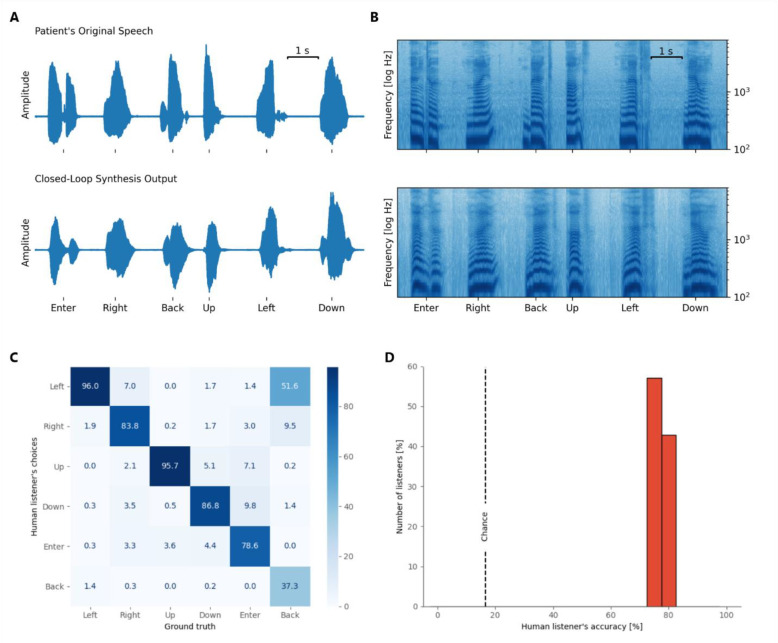
Recent studies have shown that speech can be reconstructed and synthesized using only brain activity recorded with intracranial electrodes, but until now this has only been done using retrospective analyses of recordings from able-bodied patients temporarily implanted with electrodes for epilepsy surgery. Here, we report online synthesis of intelligible words using a chronically implanted brain-computer interface (BCI) in a clinical trial participant (ClinicalTrials.gov, NCT03567213 ) with dysarthria due to amyotrophic lateral sclerosis (ALS). We demonstrate a reliable BCI that synthesizes commands freely chosen and spoken by the user from a vocabulary of 6 keywords originally designed to allow intuitive selection of items on a communication board. Our results show for the first time that a speech-impaired individual with ALS can use a chronically implanted BCI to reliably produce synthesized words that are intelligible to human listeners while preserving the participants voice profile.
Overview
The claims and statistics of this paper haven’t been checked yet.
Free: it reads the open-access text and checks the first 5 claims that cite a source we can check. Create a free account to check every claim.
Integrity signals
Registry
Cites
Statistics
Figures
Verification
Claims the paper makes
The claims and statistics of this paper haven’t been checked yet.
Free: it reads the open-access text and checks the first 5 claims that cite a source we can check. Create a free account to check every claim.
Claims other papers make about this one
Each is checked against this paper’s own text: does it say what the citing paper says it does?
The cited source says what the claim attributes to it.
In the citing paper
“Subsequent work has expanded this initial demonstration by directly decoding cortical activity into audible speech13,14 and allowing more generalizable and rapid text decoding14–16 in individuals with vocal-tract paralysis (Fig. 1).”
From The speech neuroprosthesis (2024) · cites this paper as [13]
The cited source says what the claim attributes to it.
In the citing paper
“Individuals with dysarthria may retain some intelligible vocalization over single, isolated words, allowing the acoustic regression approach to prove successful in synthesizing single words13 (Fig. 1; Angrick et al. 2023; and Supplementary Table 1).”
From The speech neuroprosthesis (2024) · cites this paper as Angrick et al. 2023
The cited source says what the claim attributes to it.
In the citing paper
“Individuals with dysarthria may retain some intelligible vocalization over single, isolated words, allowing the acoustic regression approach to prove successful in synthesizing single words13 (Fig. 1; Angrick et al. 2023; and Supplementary Table 1).”
From The speech neuroprosthesis (2024) · cites this paper as [13]
The cited source says what the claim attributes to it.
In the citing paper
“Given that most early studies in individuals with vocal-tract paralysis involve only single participants12–16,64,95,120, great care is needed when comparing results, as the broad spectrum of disease presentations is not sampled”
From The speech neuroprosthesis (2024) · cites this paper as [13]
Self-check
Percentages, sums and reported differences re-computed from the paper’s own numbers.
The self-check needs the paper’s full text.
Citations
Cites
(2014) · Cited by 33,419
An overview of gradient descent optimization algorithms
Ruder, S. (2016) · Vestnik komp iuternykh i informatsionnykh tekhnologii · doi:10.14489/vkit.2019.12.pp.010-017 · Cited by 7,086
Deep Inside Convolutional Networks: Visualising Image Classification Models and Saliency Maps
Simonyan, K., Vedaldi, A., & Zisserman, A. (2013) · arXiv · doi:10.48550/arxiv.1312.6034 · Cited by 5,370
An overview of gradient descent optimization algorithms
Ruder, S. (2016) · arXiv · doi:10.48550/arxiv.1609.04747 · Cited by 4,962
BCI2000: A General-Purpose Brain-Computer Interface (BCI) System
Schalk, G., McFarland, D. J., Hinterberger, T., Birbaumer, N., & Wolpaw, J. R. (2004) · IEEE Transactions on Biomedical Engineering · doi:10.1109/tbme.2004.827072 · Cited by 3,024
Methods for interpreting and understanding deep neural networks
Montavon, G., Samek, W., & Müller, K.-R. (2018) · Digital Signal Processing · doi:10.1016/j.dsp.2017.10.011 · Cited by 2,665
An Introduction to the Psychology of Hearing: Fourth Edition
Moore, B. (1997) · BRILL eBooks · doi:10.1163/9789004658820 · Cited by 2,646 · cited 1×
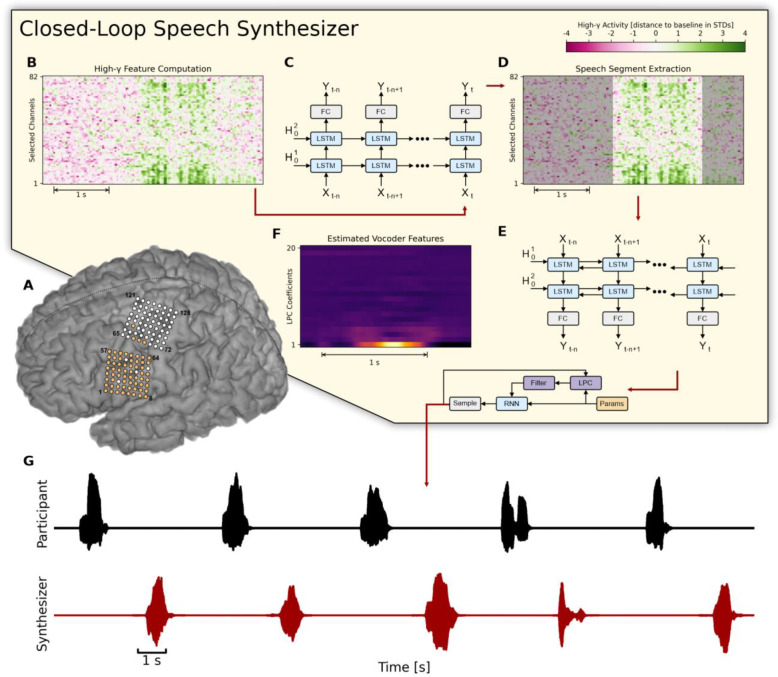
“Each buffered sequence was forwarded to a bidirectional decoding model that mapped high-gamma features onto 18 Bark-scale cepstral coefficients (Moore, 2012) and 2 pitch parameters, henceforth referred to as LPC coefficients (Taylor, 2009; Valin, 2019) (Figure 1.”
Responsive cortical stimulation for the treatment of medically intractable partial epilepsy
Morrell, M. J. (2011) · Neurology · doi:10.1212/wnl.0b013e3182302056 · Cited by 1,282 · cited 1×
“A potential advantage of ECoG for BCI is the stability of signal quality over long periods of time (Morrell, 2011).”
A Scale for the Measurement of the Psychological Magnitude Pitch
Stevens, S. S., Volkmann, J., & Newman, E. B. (1937) · The Journal of the Acoustical Society of America · doi:10.1121/1.1915893 · Cited by 1,107
Unmasking Clever Hans predictors and assessing what machines really learn
Lapuschkin, S., Wäldchen, S., Binder, A., Montavon, G., Samek, W., & Müller, K.-R. (2019) · Nature Communications · doi:10.1038/s41467-019-08987-4 · Cited by 1,047
Research works printed but not linked: 2
- Povey, D. , Ghoshal, A. , Boulianne, G. , Burget, L. , Glembek, O. , Goel, N. , … & Vesely, K. (2011). The Kaldi speech recognition toolkit. In IEEE 2011 workshop on automatic speech recognition and understanding (No. CONF). IEEE Signal Processing Society.
- Kraft, S. , & Zölzer, U . (2014, May). BeaqleJS: HTML5 and JavaScript based framework for the subjective evaluation of audio quality. In Linux Audio Conference, Karlsruhe, DE.
Cited by
Brain–computer interfaces: the innovative key to unlocking neurological conditions
Zhang, H., Jiao, L., Yang, S., Li, H., Jiang, X., Feng, J., Zou, S., Xu, Q., Gu, J., Wang, X., et al. (2024) · International Journal of Surgery · doi:10.1097/js9.0000000000002022 · Cited by 169
“…Amyotrophic Lateral Sclerosis (ALS) and visual impairments have demonstrated that integrating enhanced eye-tracking with SSVEP BCI and the Shuf fl e Speller interface can improve communication capabilities, although typing accuracy exhibits considerable variability among participants [146] .”
BackgroundSilva, A. B., Littlejohn, K. T., Liu, J. R., Moses, D. A., & Chang, E. F. (2024) · Nature Reviews Neuroscience · doi:10.1038/s41583-024-00819-9 · Cited by 103
“1; Angrick et al. 2023; and Supplementary Table 1).”
InfluentialAn instantaneous voice synthesis neuroprosthesisPreprint
Wairagkar, M., Card, N., Singer-Clark, T. S., et al. (2024) · bioRxiv · doi:10.1101/2024.08.14.607690 · Cited by 48
“Recently, intermittently intelligible speech was synthesized seconds after a user with ALS spoke overtly (and intelligibly) 17 from a six-word vocabulary.”
BackgroundResultNatraj, N., Seko, S., Abiri, R., Miao, R., Yan, H., Graham, Y., Tu-Chan, A., Chang, E. F., & Ganguly, K. (2025) · Cell · doi:10.1016/j.cell.2025.02.001 · Cited by 48
Meng, K., Goodarzy, F., Kim, E., Park, Y. J., Kim, J. S., Cook, M. J., Chung, C. K., & Grayden, D. B. (2023) · Journal of Neural Engineering · doi:10.1088/1741-2552/ace7f6 · Cited by 17
Metadata
- Authors
- Angrick, M., Luo, S., Rabbani, Q., Candrea, D. N., Shah, S., Milsap, G. W., Anderson, W. S., Gordon, C. R., Rosenblatt, K. R., Clawson, L., Maragakis, N., Tenore, F. V., Fifer, M. S., Hermansky, H., Ramsey, N. F., & Crone, N. E.
- Affiliations
- Johns Hopkins University (US)
- Johns Hopkins University Applied Physics Laboratory (US)
- University Medical Center Utrecht (NL)
- Corresponding author
- Angrick, Miguel
- Crone, Nathan E.
- ORCID
- Venue
- Scientific Reports
- Publisher
- openRxiv
- Published
- 2023-07-01
- Volume
- 14
- Issue
- 1
- Pages
- 9617-9617
- ISSN
- 2045-2322 (ISSN-L)
- PMC
- PMC10327279
- OpenAlex
- W4395666645
- Cited by
- 95
- References
- 53
- Citations by year
- 2026: 33 · 2025: 47 · 2024: 13 · 2023: 2
- FWCI
- 22.59
- Type
- journal article
- Language
- en
- Open access
- gold
- doi.org
- Licence
- cc-by
- Locations
- Scientific Reports (publishedVersion, cc-by)
- medRxiv (acceptedVersion, cc-by-nc-nd)
- PubMed Central (publishedVersion, cc-by)
- PubMed (publishedVersion)
- PubMed Central (submittedVersion, cc-by-nc-nd)
- DOAJ (DOAJ: Directory of Open Access Journals) (submittedVersion)
- Utrecht University Repository (Utrecht University) (submittedVersion, other-oa)
- OSF Preprints (OSF Preprints) (submittedVersion, cc-by)
- Funders
- National Institutes of Health
- National Institute of Neurological Disorders and Stroke (UH3NS114439, NS114439)
- Topics
- Life Sciences › Neuroscience › Cognitive Neuroscience › EEG and Brain-Computer Interfaces
- Physical Sciences › Computer Science › Artificial Intelligence › Speech Recognition and Synthesis
- Physical Sciences › Computer Science › Human-Computer Interaction › Gaze Tracking and Assistive Technology
- Keywords
- brain-computer interface, amyotrophic lateral sclerosis, electrocorticography, intracranial electrodes, recurrent neural networks, speech decoding, communication aids, motor cortex, premotor cortex, somatosensory cortex, intelligibility
About these checks
Registry, retraction, Cites and statistics results are computed, not judged, with one exception: a printed reference that no index lists is read once by a model before it counts as a citation error. Claims are extracted by a model and kept only when their quote appears verbatim in the text; each cited source is then checked, with a model’s help, for whether it says what the claim relies on. Those verdicts can be wrong — read the claim’s quote and the cited source before relying on one.
Statistics and arithmetic are recomputed, not judged.
Confidence bands are shown only for fields calibrated on our annotated test set. None is calibrated yet, so no band is shown.
What counts as a claim ›How we measure confidence ›How we check this ›
Are you an author, or do you see a problem with this page? Request a review
How to cite
Cite CoChat for the checks on this page, and the paper for its own findings.
- This page
- CoChat. (2026). Citation check: Online speech synthesis using a chronically implanted brain-computer interface in an individual with ALS. https://app.cochat.ai/papers/10.1101/2023.06.30.23291352
- The paper
- Angrick, M., Luo, S., Rabbani, Q., Candrea, D. N., Shah, S., Milsap, G. W., Anderson, W. S., Gordon, C. R., Rosenblatt, K. R., Clawson, L., Maragakis, N., Tenore, F. V., Fifer, M. S., Hermansky, H., Ramsey, N. F., & Crone, N. E. (2023). Online speech synthesis using a chronically implanted brain-computer interface in an individual with ALS. Scientific Reports. https://doi.org/10.1101/2023.06.30.23291352
Data sources
Bibliographic data: Semantic Scholar, OpenAlex, Crossref.
Contains information from the Semantic Scholar Academic Graph Datasets, made available under the ODC Attribution License (ODC-BY 1.0).
Semantic Scholar’s data is described in: Kinney, R., et al. (2023). The Semantic Scholar Open Data Platform. arXiv:2301.10140.
