

The DOI matches its Crossref record; 1 of the 1 references it cites were found in a registry or an index.
Knot or Not? Sequence-Based Identification of Knotted Proteins With Machine Learning
Open accessPreprint — published as 10.1002/pro.4998 · Paper page
Abstract
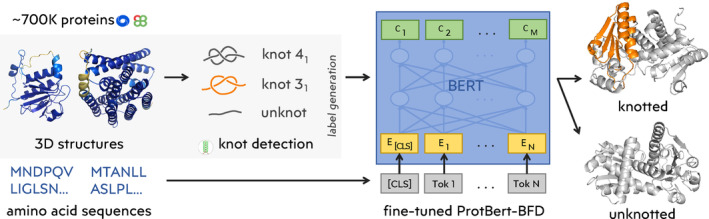
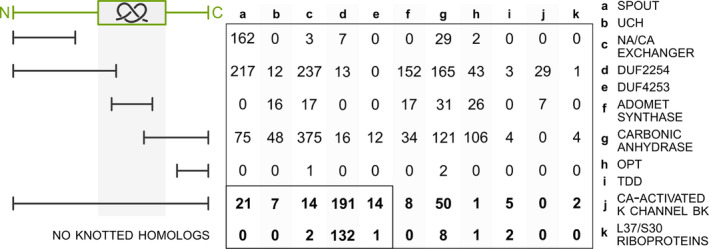
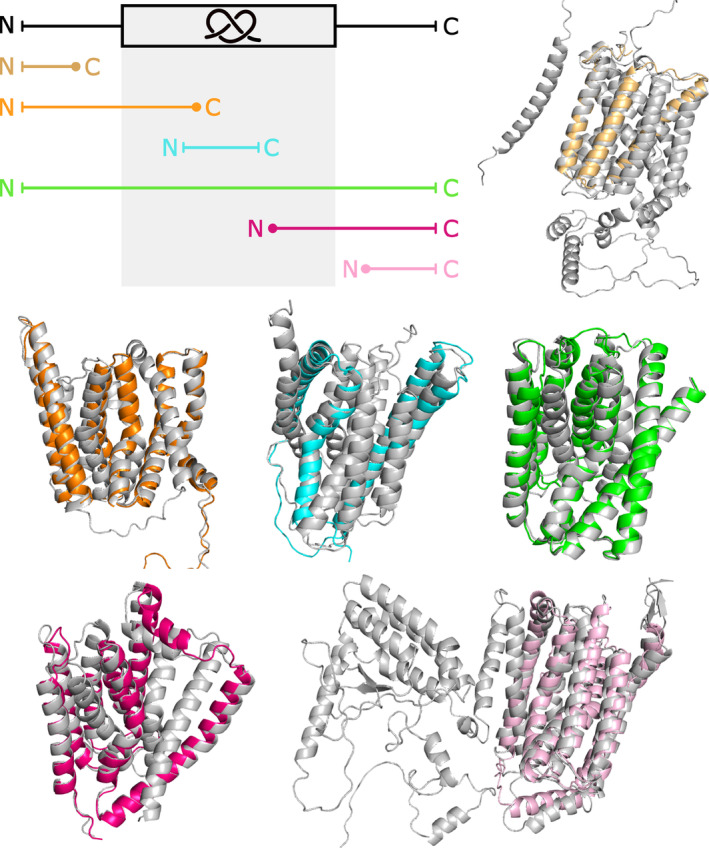
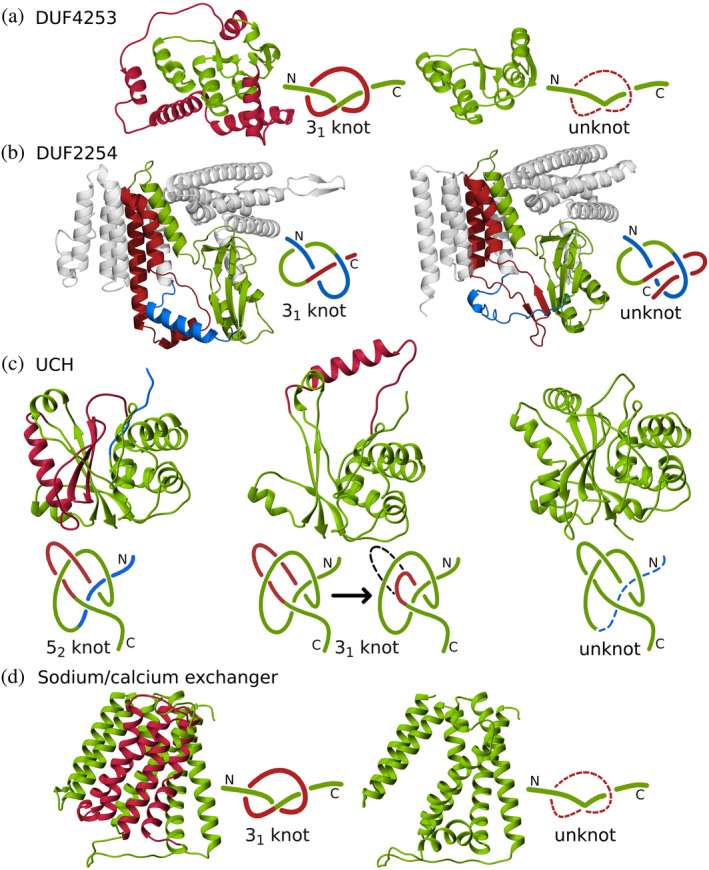
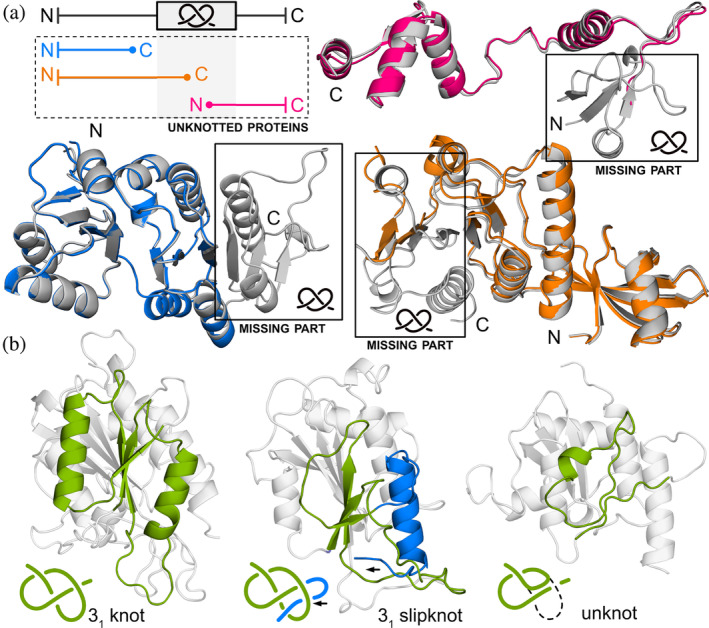
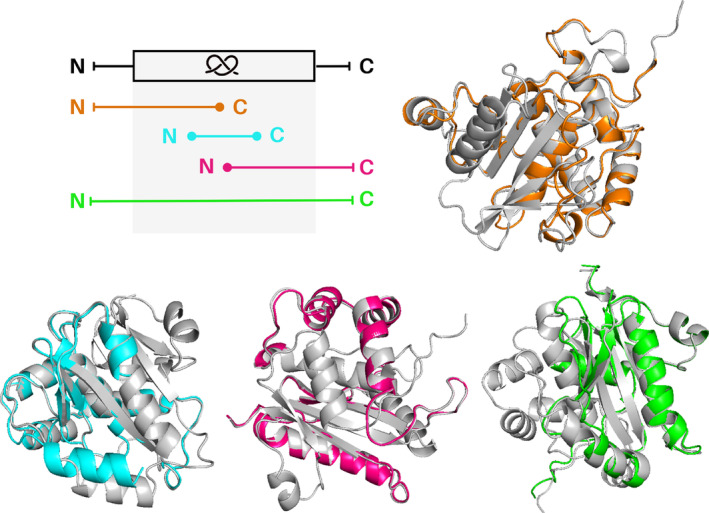
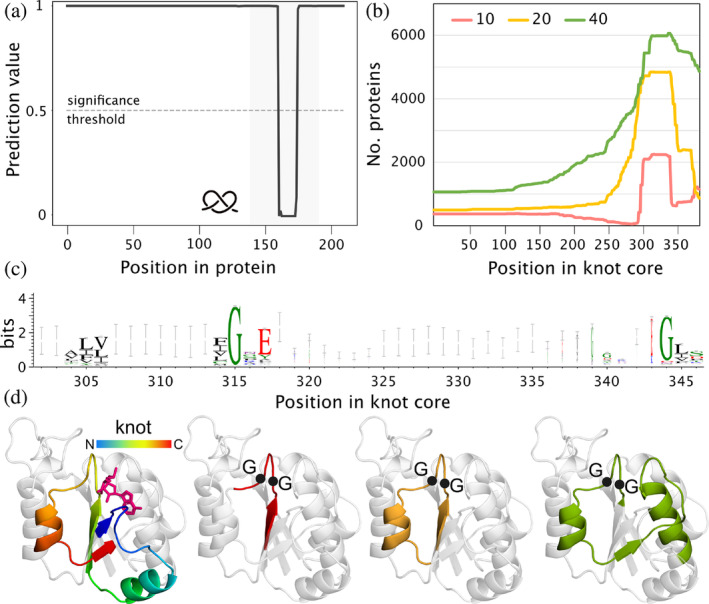
Knotted proteins, although scarce, are crucial structural components of certain protein families, and their roles remain a topic of intense research. Capitalizing on the vast collection of protein structure predictions offered by AlphaFold, this study computationally examines the entire UniProt database to create a robust dataset of knotted and unknotted proteins. Utilizing this dataset, we develop a machine learning model capable of accurately predicting the presence of knots in protein structures solely from their amino acid sequences, with our best-performing model demonstrating a 98.5% overall accuracy. Unveiling the sequence factors that contribute to knot formation, we discover that proteins predicted to be unknotted from known knotted families are typically non-functional fragments missing a significant portion of the knot core. The study further explores the significance of the substrate binding site in knot formation, particularly within the SPOUT protein family. Our findings spotlight the potential of machine learning in enhancing our understanding of protein topology and propose further investigation into the role of knotted structures across other protein families. TOC Graphic:
Overview
The claims and statistics of this paper haven’t been checked yet.
Run the check — free, no account needed. It reads the open-access text and checks the sources it cites.
Integrity signals
Registry
Cites
Statistics
Figures
Verification
Claims the paper makes
The claims and statistics of this paper haven’t been checked yet.
Run the check — free, no account needed. It reads the open-access text and checks the sources it cites.
Self-check
Percentages, sums and reported differences re-computed from the paper’s own numbers.
The self-check needs the paper’s full text.
Citations
Cites
Highly accurate protein structure prediction with AlphaFold
Jumper, J., Evans, R., Pritzel, A., Green, T., Figurnov, M., Ronneberger, O., Tunyasuvunakool, K., Bates, R., Žídek, A., Potapenko, A., et al. (2021) · Nature · doi:10.1038/s41586-021-03819-2 · Cited by 43,764
Research works printed but not linked: 39
- 10.1021/ja961147m · DOI
- 10.1038/nsb0494-213 · DOI
- 2019, KnotProt 2.0: a database of proteins with knots and other entangled structures, Nucleic acids research, 47, D367, 10.1093/nar/gky1140 · DOI
- 2022, AlphaKnot: server to analyze entanglement in structures predicted by AlphaFold methods, Nucleic Acids Research, 50, W44, 10.1093/nar/gkac388 · DOI
- 10.1073/pnas.1205918109 · DOI
- 2017, How to fold intricately: using theory and experiments to unravel the properties of knotted proteins, Current Opinion in Structural Biology, 42, 6, 10.1016/j.sbi.2016.10.002 · DOI
- 10.1186/1471-2105-8-73 · DOI
- 2016, Methyl transfer by substrate signaling from a knotted protein fold, Nature Structural & Molecular Biology, 23, 941, 10.1038/nsmb.3282 · DOI
- Zayats V , J. A. J. B. D.-H. S. S. J., Perlinska AP Slipknotted and unknotted monovalent cation-proton antiporters evolved from a common ancestor. PLoS computational biology 2021, 8. · DOI
- 2010, Knotted vs. unknotted proteins: evidence of knot-promoting loops, PLoS computational biology, 6, e1000864, 10.1371/journal.pcbi.1000864 · DOI
- 10.1016/j.jmb.2007.02.035 · DOI
- 10.1073/pnas.0811147106 · DOI
- 10.1073/pnas.1007602107 · DOI
- Bustamante, A. ; Sotelo-Campos, J. ; Guerra, D. ; Floor, M. ; Wilson, C. ; Bustamante, C. ; Baez, M. The energy cost of polypeptide knot formation and its folding consequences. Nature Communications 2017, 8. · DOI
- 2009, Stabilizing effect of knots on proteins, Proceedings of the National Academy of Sciences of the United States of America, 105, 19714
- 10.1093/NAR/GKAB1061 · DOI · Paper page
- 2022, The integration of AlphaFoldpredicted and crystal structures of human trans-3-hydroxy-l-proline dehydratase reveals a regulatory catalytic mechanism, Computational and Structural Biotechnology Journal, 20, 3874, 10.1016/j.csbj.2022.07.027 · DOI
- da Silva, F. B. ; Lewandowska, I. ; Kluza, A. ; Niewieczerzal, S. ; Augustyniak, R. ; Sulkowska, J. I. First crystal structure of double knotted protein TrmD-Tm1570 – inside from degradation perspective. bioRxiv 2023, · DOI
- Brems, M. A. ; Runkel, R. ; Yeates, T. O. ; Virnau, P. AlphaFold predicts the most complex protein knot and composite protein knots. Protein Science 2022, 31. · DOI
- Perlinska, A. P. ; Niemyska, W. H. ; Gren, B. A. ; Bukowicki, M. ; Nowakowski, S. ; Rubach, P. ; Sulkowska, J. I. scpAlphaFold/scp predicts novel human proteins with knots. Protein Science 2023, 32. · DOI
- 10.1111/j.1742-4658.2009.06990.x · DOI
- 2006, Intricate knots in proteins: Function and evolution, PLoS computational biology, 2, e122, 10.1371/journal.pcbi.0020122 · DOI
- Strassler, S. E. ; Bowles, I. E. ; Dey, D. ; Jackman, J. E. ; Conn, G. L. Tied up in knots: Untangling substrate recognition by the SPOUT methyltransferases. Journal of Biological Chemistry 2022, 298. · DOI
- 2020, Topoly: Python package to analyze topology of polymers, Briefings in Bioinformatics, 22, bbaa196
- Freyd, P. ; Yetter, D. ; Hoste, J. ; Lickorish, W. ; Millett, K. ; Ocneanu, A. A new polynomial invariant of knots and links. Bull. Amer. Math. Soc. 1985, 12. · DOI
- 2019, Proteins’ knotty problems, Journal of Molecular Biology, 431, 244, 10.1016/j.jmb.2018.10.012 · DOI
- Sikora, M. ; Flapan, E. ; Wong, H. ; Rubach, P. ; Garstka, W. ; Niewieczerzal, S. ; Rawdon, E. J. ; Sulkowska, J. I. Proteins containing 6-crossing knot types and their folding pathways. bioRxiv 2023, 2023–06. · DOI
- 2022, ProtTrans: Toward Understanding the Language of Life Through Self-Supervised Learning, IEEE Transactions on Pattern Analysis and Machine Intelligence, 44, 7112, 10.1109/TPAMI.2021.3095381 · DOI · Paper page
- 10.1038/nrg2776 · DOI · Paper page
- 2021, Slipknotted and unknotted monovalent cation-proton antiporters evolved from a common ancestor, PLoS Computational Biology, 17, e1009502, 10.1371/journal.pcbi.1009502 · DOI
- Shi, D. ; Allewell, N. M. ; Tuchman, M. From genome to structure and back again: A family portrait of the transcarbamylases. International Journal of Molecular Sciences 2015, 16. · DOI
- 2020, Restriction of S-adenosylmethionine conformational freedom by knotted protein binding sites, PLoS computational biology, 16, e1007904, 10.1371/journal.pcbi.1007904 · DOI
- Lundberg, S. M. ; Lee, S.-I. A unified approach to interpreting model predictions. Advances in neural information processing systems 2017, 30.
- 2022, InterPro in 2022, Nucleic Acids Research, 51, D418
- 10.1093/nar/gky1140 · DOI
- 2014, KnotProt: a database of proteins with knots and slipknots, Nucleic Acids Research, 43, D306
- 10.1093/bioinformatics/bts565 · DOI · Paper page
- Paszke, A. et al. Advances in Neural Information Processing Systems 32 ; Curran Associates, Inc., 2019; pp 8024–8035.
- Cik, I. ; Rasamoelina, A. D. ; Mach, M. ; Sincak, P. Explaining Deep Neural Network using Layer-wise Relevance Propagation and Integrated Gradients. 2021. · DOI
Metadata
- Authors
- Šrámková, D., Sikora, M., Uchal, D., Klimentová, E., Perlinska, A. P., Nguyen, M. L., Korpacz, M., Malinowska, R., Rubach, P., Šimeček, P., & Sulkowska, J. I.
- Affiliations
- Masaryk University (CZ)
- University of Warsaw (PL)
- Central European Institute of Technology – Masaryk University (CZ)
- Corresponding author
- Šimeček, Petr
- Sulkowska, Joanna I.
- ORCID
- Venue
- Protein Science
- Publisher
- openRxiv
- Published
- 2023-09-07
- Volume
- 33
- Issue
- 7
- Pages
- e4998-e4998
- ISSN
- 0961-8368 (ISSN-L)
- PMC
- PMC11184937
- OpenAlex
- W4399776685
- Cited by
- 13
- References
- 1
- Citations by year
- 2026: 3 · 2025: 5 · 2024: 5
- FWCI
- 1.77
- Type
- journal article
- Language
- en
- Open access
- hybrid
- doi.org
- Licence
- cc-by
- Locations
- Protein Science (publishedVersion, cc-by)
- bioRxiv (Cold Spring Harbor Laboratory) (acceptedVersion, cc-by-nd)
- PubMed Central (publishedVersion, cc-by)
- PubMed (publishedVersion)
- ReIn UW (University of Warsaw) (submittedVersion, cc-by-nc-nd)
- Funders
- Grantová Agentura České Republiky (GF23-04260L)
- Narodowe Centrum Nauki (#2021/43/I/NZ1/03341, UMO-2018/31/B/NZ1/04016)
- Masarykova Univerzita (LM2018140, 90254, CZ LM2018140)
- Topics
- Life Sciences › Biochemistry, Genetics and Molecular Biology › Molecular Biology › Protein Structure and Dynamics
- Life Sciences › Biochemistry, Genetics and Molecular Biology › Molecular Biology › Machine Learning in Bioinformatics
- Physical Sciences › Mathematics › Geometry and Topology › Geometric and Algebraic Topology
- Keywords
- knotted proteins, sequence-based prediction, protein topology, AlphaFold, UniProt
- MeSH terms
- Machine Learning, Amino Acid Sequence, Models, Molecular, Protein Conformation, Proteins, Databases, Protein
About these checks
Registry, retraction, Cites and statistics results are computed, not judged, with one exception: a printed reference that no index lists is read once by a model before it counts as a citation error. Claims are extracted by a model and kept only when their quote appears verbatim in the text; each cited source is then checked, with a model’s help, for whether it says what the claim relies on. Those verdicts can be wrong — read the claim’s quote and the cited source before relying on one.
Statistics and arithmetic are recomputed, not judged.
Confidence bands are shown only for fields calibrated on our annotated test set. None is calibrated yet, so no band is shown.
What counts as a claim ›How we measure confidence ›How we check this ›
Are you an author, or do you see a problem with this page? Request a review
