

The DOI matches its Crossref record; 1 of the 1 references it cites were found in a registry or an index.
TolRad: A model for predicting radiation tolerance using Pfam annotations identifies novel radiosensitive bacterial species from reference genomes and MAGs
Open accessPreprint — published as 10.1128/spectrum.03838-23
Abstract
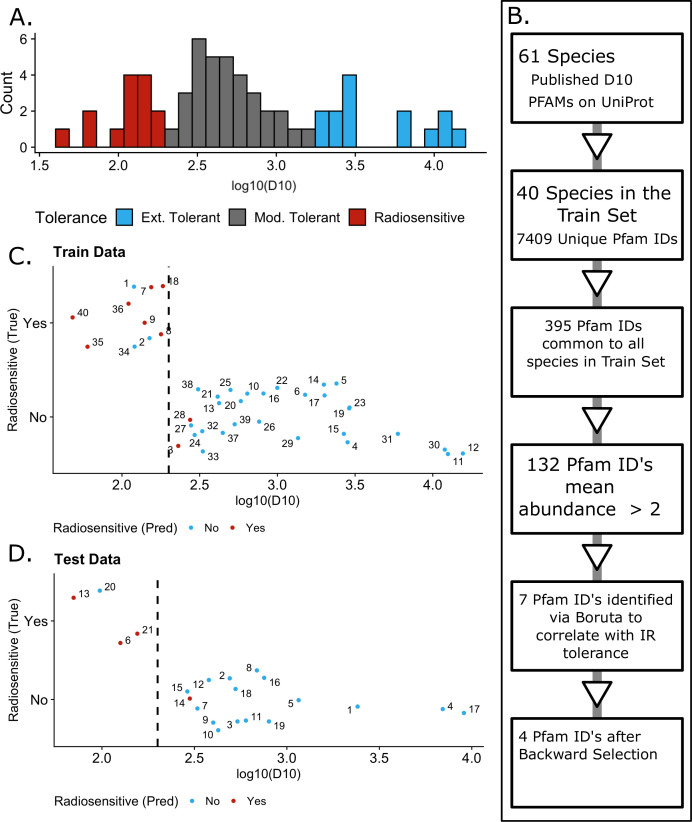
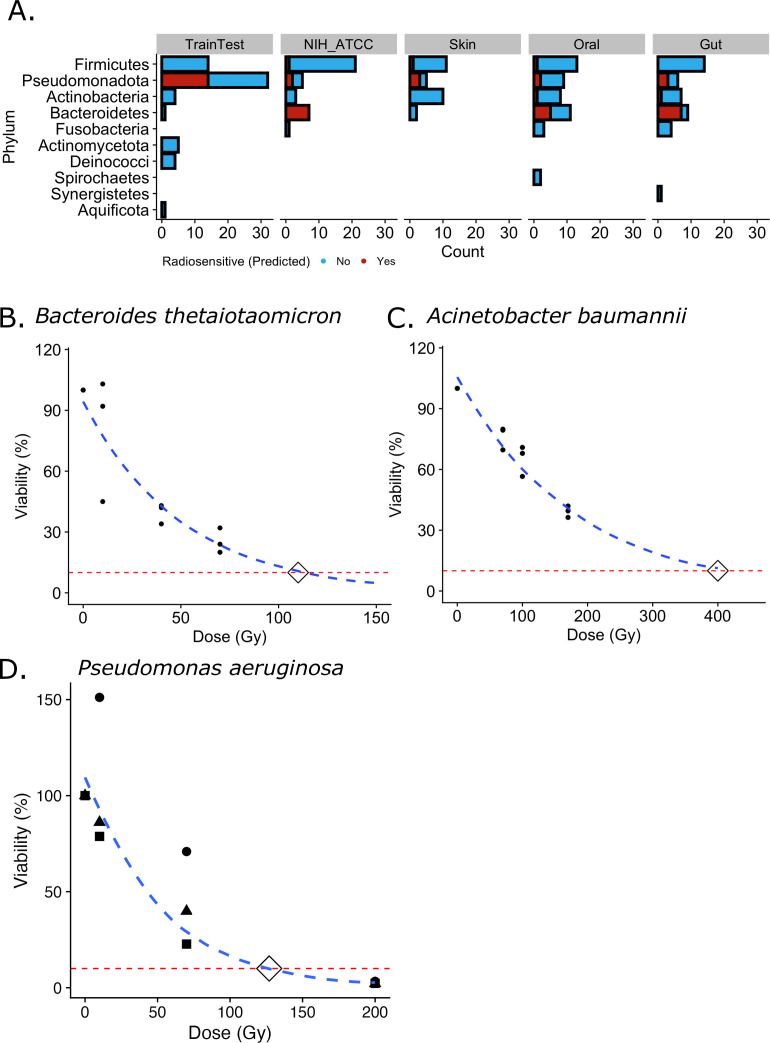
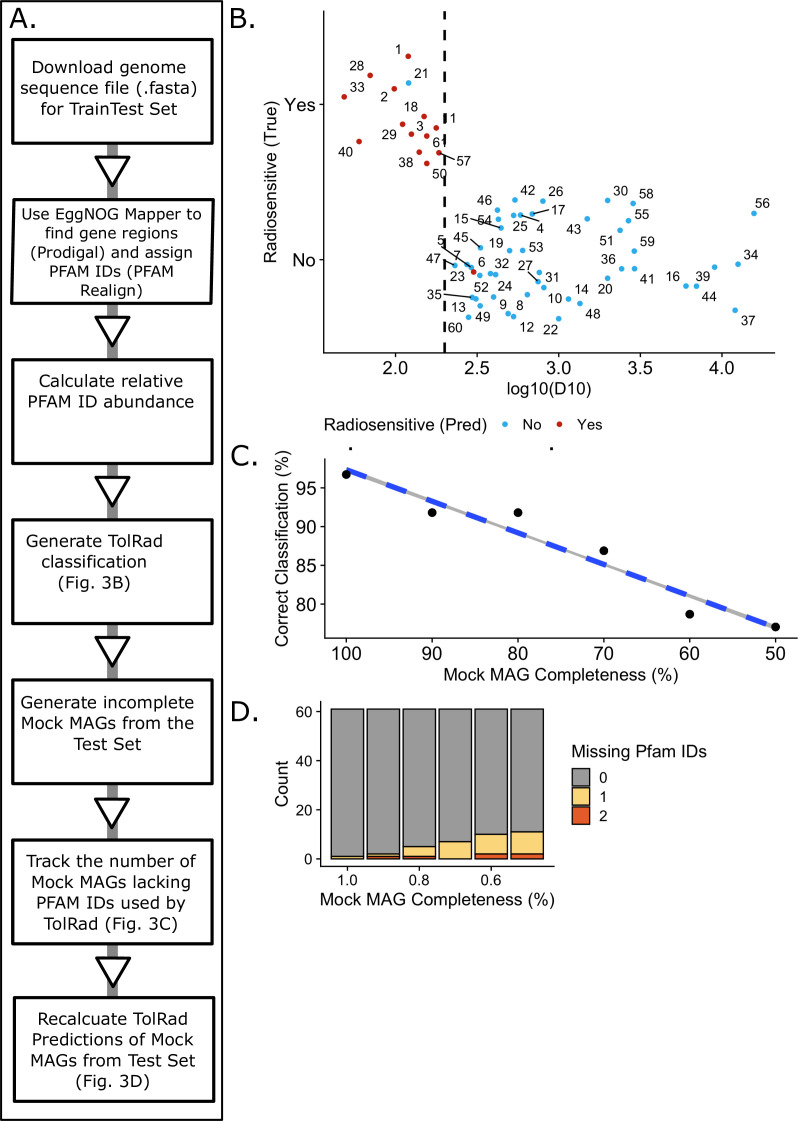
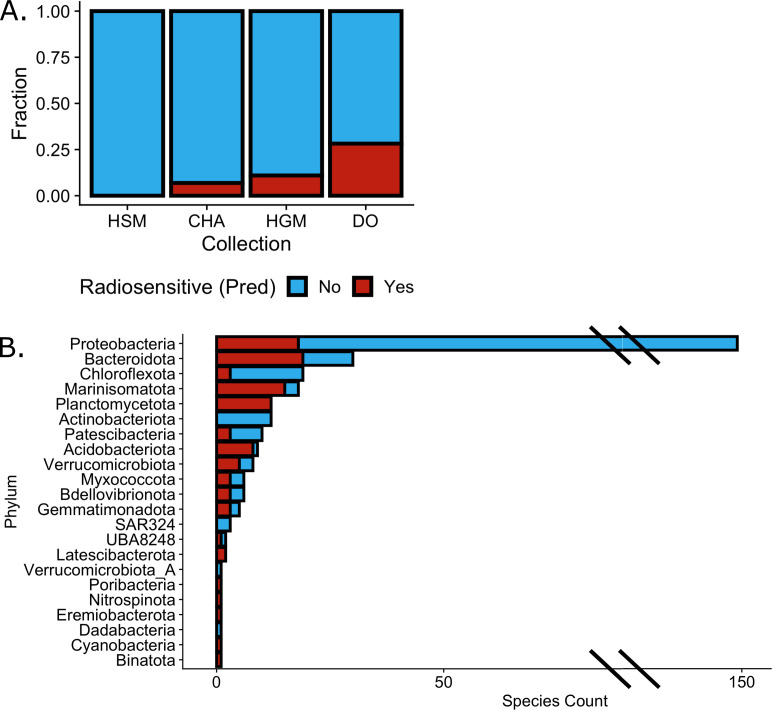
The trait of ionizing radiation (IR) tolerance is variable between bacterial species, with radiosensitive bacteria succumbing to acute doses around 100Gy and extremophiles able to survive doses exceeding 10,000Gy. While survival screens have identified multiple highly radioresistant bacteria, such systemic searches have not been conducted for radiosensitive bacteria. The taxonomy-level diversity of IR of intolerance across bacteria is poorly understood, as are genetic elements that influence IR sensitivity. Using the protein domain frequencies from 61 bacterial species with experimentally determined IR D10 values (the dose at which only 10% of the population survives) we trained TolRad, a random forest binary classifier, to distinguish between radiosensitive bacteria (D10 < 200Gy) and radiation tolerant bacteria (D10 > 200Gy). On the hidden species, TolRad had an accuracy of 0.900. We applied TolRad to 152 UniProt-hosted bacterial proteomes, including 37 strains from the ATCC Human Microbiome Collection, and classified 34 species as radiosensitive. Whereas IR intolerance (D10 < 200Gy) in the training dataset had been confined to the phylum Proteobacterium , this initial TolRad screen identified radiosensitive bacteria in 2 additional phyla. We experimentally validated the predicted radiosensitivity of a key species of the human microbiome from the Bacteroidota phyla. To demonstrate that TolRad can be applied to Metagenome-Assembled Genome (MAGs), we tested the accuracy of TolRad on Egg-NOG assembled proteomes (0.965) and partial proteomes. Finally, three collections of MAGs were screened using TolRad, identifying further phylum with radiosensitive species and suggesting that environmental conditions influence the abundance of radiosensitive bacteria. Importance: Bacterial species have vast genetic diversity, allowing for life in extreme environments and the conduction of complex chemistry. The ability to harness the full potential of bacterial diversity is hampered by the lack of high-throughput experimental or bioinformatic methods for characterizing bacterial traits. Here, we present a computational model that uses de novo generated genome annotations to classify a bacterium as tolerant of ionizing radiation (IR) or as radiosensitive. This model allows for rapid screening of bacterial communities for low-tolerance species that are of interest for both mechanistic studies into bacterial sensitivity to IR and biomarkers of IR exposure.
Overview
The claims and statistics of this paper haven’t been checked yet.
Run the check — free, no account needed. It reads the open-access text and checks the sources it cites.
Integrity signals
Registry
Cites
Statistics
Figures
Verification
Claims the paper makes
The claims and statistics of this paper haven’t been checked yet.
Run the check — free, no account needed. It reads the open-access text and checks the sources it cites.
Self-check
Percentages, sums and reported differences re-computed from the paper’s own numbers.
The self-check needs the paper’s full text.
Citations
Cites
Highly accurate protein structure prediction with AlphaFold
Jumper, J., Evans, R., Pritzel, A., Green, T., Figurnov, M., Ronneberger, O., Tunyasuvunakool, K., Bates, R., Žídek, A., Potapenko, A., et al. (2021) · Nature · doi:10.1038/s41586-021-03819-2 · Cited by 43,764
Research works printed but not linked: 51
- 10.1007/s10142-015-0433-4 · DOI
- 10.1146/annurev.genet.38.072902.091216 · DOI
- 10.3389/fmicb.2021.613791 · DOI
- 2006. Global Ocean Sampling Expedition Microbial MetagenomeMetagenomics: Sequences from the Environment [Internet]. National Center for Biotechnology Information (US). https://www.ncbi.nlm.nih.gov/books/NBK6855/. Retrieved 1 September 2022.
- 10.1016/j.anaerobe.2015.01.004 · DOI
- Nesme J , Achouak W , Agathos SN , Bailey M , Baldrian P , Brunel D , Frostegård Å , Heulin T , Jansson JK , Jurkevitch E , Kruus KL , Kowalchuk GA , Lagares A , Lappin-Scott HM , Lemanceau P , Le Paslier D , Mandic-Mulec I , Murrell JC , Myrold DD , Nalin R , Nannipieri P , Neufeld JD , O’Gara F , Parnell JJ , Pühler A , Pylro V , Ramos JL , Roesch LFW , Schloter M , Schleper C , Sczyrba A , Sessitsch A , Sjöling S , Sørensen J , Sørensen SJ , Tebbe CC , Topp E , Tsiamis G , van Elsas JD , van Keulen G , Widmer F , Wagner M , Zhang T , Zhang X , Zhao L , Zhu Y-G , Vogel TM , Simonet P . 2016. Back to the Future of Soil Metagenomics. Front Microbiol 7. · DOI
- 2022, Metabolic modeling of the International Space Station microbiome reveals key microbial interactions, Microbiome, 10, 102, 10.1186/s40168-022-01279-y · DOI
- 10.1126/science.aac9323 · DOI · Paper page
- 10.1186/1471-2105-11-119 · DOI
- 10.1093/NAR/GKAA913 · DOI · Paper page
- 10.7717/peerj.11396 · DOI
- 2019, Trait-based analysis of the human skin microbiome, Microbiome, 7, 101, 10.1186/s40168-019-0698-2 · DOI
- 10.1371/JOURNAL.PPAT.1010716 · DOI
- 2020, PARGT: a software tool for predicting antimicrobial resistance in bacteria, Sci Rep, 10, 11033, 10.1038/s41598-020-67949-9 · DOI
- 10.1128/mBio.01344-20 · DOI
- 10.1016/j.copbio.2008.07.012 · DOI
- 2012, Ionizing radiation biomarkers for potential use in epidemiological studies, Mutat Res Mutat Res, 751, 258, 10.1016/j.mrrev.2012.05.003 · DOI
- 2017, Space-type radiation induces multimodal responses in the mouse gut microbiome and metabolome, Microbiome, 5, 105, 10.1186/s40168-017-0325-z · DOI
- Binte Atique F , Ahmed KT , Asaduzzaman SM , Hasan KN . 2013. Effects of Gamma Irradiation on Bacterial Microflora Associated with Human Amniotic Membrane. BioMed Res Int 2013. · DOI
- 2021, The Effects of Ionizing Radiation on Gut Microbiota, a Systematic Review, Nutrients, 13, 3025, 10.3390/nu13093025 · DOI
- 2011, Direct Effects of Ionizing Radiation on Macromolecules, J Polym Sci Part B Polym Phys, 49, 827, 10.1002/polb.22250 · DOI
- 10.1073/pnas.1713608114 · DOI
- 10.1126/science.1103185 · DOI
- 10.1038/nrmicro2073 · DOI
- 10.1016/j.femsre.2004.12.007 · DOI
- 10.5731/pdajpst.2014.00955 · DOI
- 1998, Food preservation using ionizing radiation, Rev Environ Contam Toxicol, 154, 1
- 1981, Response of bacteria in wastewater sludge to moisture loss by evaporation and effect of moisture content on bacterial inactivation by ionizing radiation, Appl Environ Microbiol, 41, 1123, 10.1128/aem.41.5.1123-1127.1981 · DOI
- 2015, Diversity of ionizing radiation-resistant bacteria obtained from the Taklimakan Desert, J Basic Microbiol, 55, 135, 10.1002/jobm.201300390 · DOI
- 2011, Oxidative stress resistance in Deinococcus radiodurans, Microbiol Mol Biol Rev MMBR, 75, 133, 10.1128/MMBR.00015-10 · DOI · Paper page
- 10.1101/2021.06.03.446934 · DOI
- 10.1038/s42003-021-01672-7 · DOI
- 2016, From Genomes to Phenotypes: Traitar, the Microbial Trait Analyzer, mSystems, 1, e00101
- 10.18637/jss.v036.i11 · DOI · Paper page
- 10.18637/jss.v028.i05 · DOI · Paper page
- The 2017 NIH-wide microbiome workshop writing team, 2019, 2017 NIH-wide workshop report on “The Human Microbiome: Emerging Themes at the Horizon of the 21st Century.”, Microbiome, 7, 32, 10.1186/s40168-019-0627-4 · DOI
- 10.1038/nrmicro.2017.157 · DOI · Paper page
- 10.1038/nature13786 · DOI · Paper page
- 10.1038/ismej.2010.30 · DOI · Paper page
- 10.1038/s41587-018-0009-7 · DOI
- 2015, Effect of radiation processing in elimination of Klebsiella pneumoniae from food, Radiat Phys Chem, 115, 107, 10.1016/j.radphyschem.2015.06.016 · DOI
- 2003, Bacteroides thetaiotaomicron: a dynamic, niche-adapted human symbiont, BioEssays News Rev Mol Cell Dev Biol, 25, 926, 10.1002/bies.10350 · DOI
- 2021, The Reliability of Metagenome-Assembled Genomes (MAGs) in Representing Natural Populations: Insights from Comparing MAGs against Isolate Genomes Derived from the Same Fecal Sample, Appl Environ Microbiol, 87, e02593
- 2021, Recovery of strain-resolved genomes from human microbiome through an integration framework of single-cell genomics and metagenomics, Microbiome, 9, 202, 10.1186/s40168-021-01152-4 · DOI
- 2020, Microbial Metabolic Redundancy Is a Key Mechanism in a Sulfur-Rich Glacial Ecosystem, mSystems, 5, e00504
- 1993, Survival of subsurface microorganisms exposed to UV radiation and hydrogen peroxide, Appl Environ Microbiol, 59, 3545, 10.1128/aem.59.11.3545-3550.1993 · DOI
- 2016, Extremely high UV-C radiation resistant microorganisms from desert environments with different manganese concentrations, J Photochem Photobiol B, 163, 327, 10.1016/j.jphotobiol.2016.08.017 · DOI
- 2023, Exposure of Shewanella oneidensis MR-1 to Sublethal Doses of Ionizing Radiation Triggers Short-Term SOS Activation and Longer-Term Prophage Activation, Appl Environ Microbiol, 89, e01716
- 10.1128/JB.188.3.1199-1204.2006 · DOI
- 2015, Isolation of Radiation-Resistant Bacteria from Mars Analog Antarctic Dry Valleys by Preselection, and the Correlation between Radiation and Desiccation Resistance, Astrobiology, 15, 1076, 10.1089/ast.2014.1278 · DOI
- 2015, Radiation-resistant Macrococcus caseolyticus (A) isolated from radiation-processed semidried prawns, Can J Microbiol, 61, 89, 10.1139/cjm-2014-0636 · DOI
Metadata
- Authors
- Sweet, P., Burroughs, M., Jang, S., & Contreras, L.
- Affiliations
- The University of Texas at Austin (US)
- Corresponding author
- Contreras, Lydia
- Venue
- Microbiology Spectrum
- Publisher
- openRxiv
- Published
- 2023-11-02
- Volume
- 12
- Issue
- 10
- Pages
- e0383823-e0383823
- ISSN
- 2165-0497 (ISSN-L)
- PMC
- PMC11466087
- OpenAlex
- W4402272237
- Cited by
- 4
- References
- 1
- Citations by year
- 2026: 2 · 2024: 2
- FWCI
- 0.54
- Type
- journal article
- Language
- en
- Open access
- gold
- doi.org
- Licence
- cc-by
- Locations
- Microbiology Spectrum (publishedVersion, cc-by)
- bioRxiv (Cold Spring Harbor Laboratory) (acceptedVersion, cc-by-nc-nd)
- PubMed Central (publishedVersion, cc-by)
- PubMed (publishedVersion)
- DOAJ (DOAJ: Directory of Open Access Journals) (submittedVersion, cc-by-sa)
- Funders
- U.S. Department of Defense
- Office of the Director of National Intelligence (W911NF22S0002)
- Defense Threat Reduction Agency (HDTRA1-17-1-0025, HDTRA1)
- U.S. Air Force (FA9550)
- Intelligence Advanced Research Projects Activity
- Air Force Office of Scientific Research (FA9550-, FA9550-20-1, FA9550-20-1-0131, FA9550-20)
- Topics
- Life Sciences › Biochemistry, Genetics and Molecular Biology › Molecular Biology › Genomics and Phylogenetic Studies
- Life Sciences › Biochemistry, Genetics and Molecular Biology › Genetics › Bacterial Genetics and Biotechnology
- Health Sciences › Medicine › Radiology, Nuclear Medicine and Imaging › Effects of Radiation Exposure
- Keywords
- metagenome-assembled genomes, human microbiome, Bacteroidetes, extremophiles, radiation biomarkers, random forest classification
- MeSH terms
- Bacteria, Bacterial Proteins, Humans, Radiation Tolerance, Radiation, Ionizing, Genome, Bacterial, Proteome, Metagenome, Molecular Sequence Annotation, Microbiota
About these checks
Registry, retraction, Cites and statistics results are computed, not judged, with one exception: a printed reference that no index lists is read once by a model before it counts as a citation error. Claims are extracted by a model and kept only when their quote appears verbatim in the text; each cited source is then checked, with a model’s help, for whether it says what the claim relies on. Those verdicts can be wrong — read the claim’s quote and the cited source before relying on one.
Statistics and arithmetic are recomputed, not judged.
Confidence bands are shown only for fields calibrated on our annotated test set. None is calibrated yet, so no band is shown.
What counts as a claim ›How we measure confidence ›How we check this ›
Are you an author, or do you see a problem with this page? Request a review
