

ProkBERT Family: Genomic Language Models for Microbiome Applications
Open accessPreprint — published as 10.3389/fmicb.2023.1331233 · Paper page
The DOI matches its Crossref record; 1 of the 1 references it cites were found in a registry or an index.
Abstract
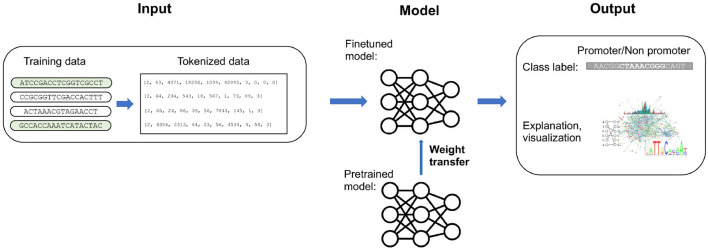
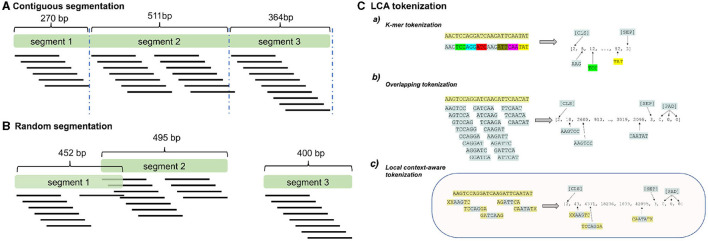
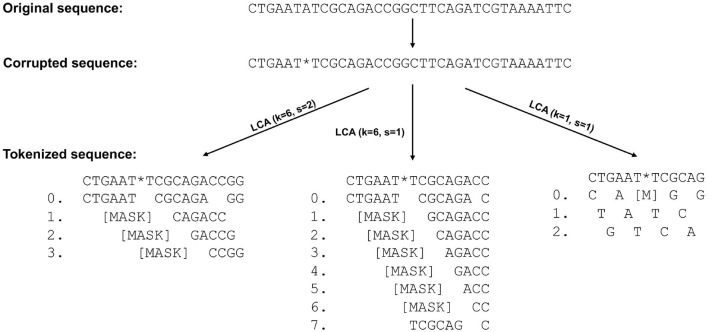
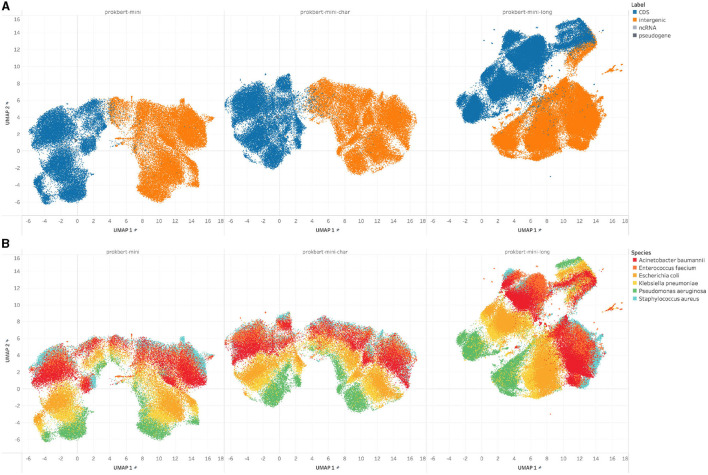
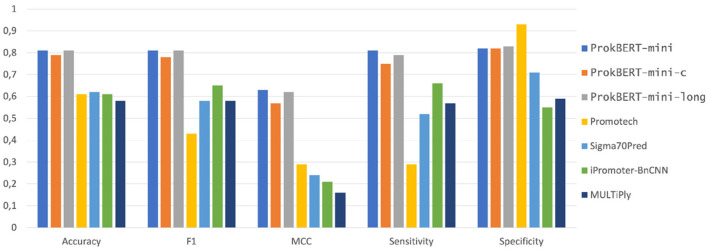
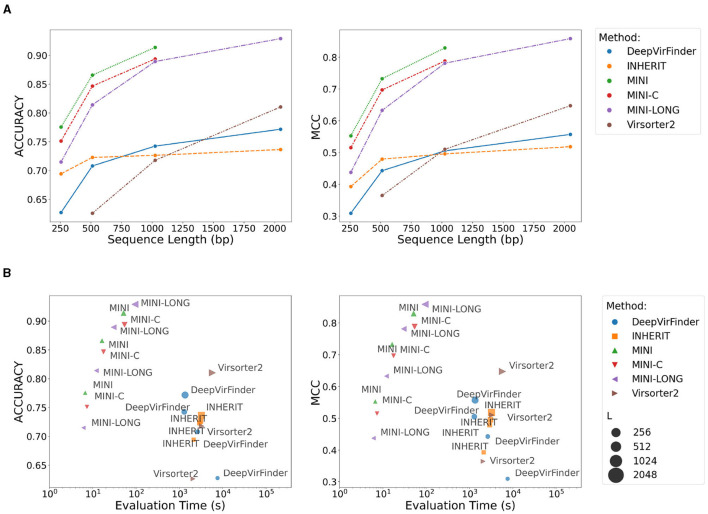
Machine learning offers transformative capabilities in microbiology and microbiome analysis, deciphering intricate microbial interactions, predicting functionalities, and unveiling novel patterns in vast datasets. This enriches our comprehension of microbial ecosystems and their influence on health and disease. However, the integration of machine learning in these fields contends with issues like the scarcity of labeled datasets, the immense volume and complexity of microbial data, and the subtle interactions within microbial communities. Addressing these challenges, we introduce the ProkBERT model family. Built on transfer learning and self-supervised methodologies, ProkBERT models capitalize on the abundant available data, demonstrating adaptability across diverse scenarios. The models’ learned representations align with established biological understanding, shedding light on phylogenetic relationships. With the novel Local Context-Aware (LCA) tokenization, the ProkBERT family overcomes the context size limitations of traditional transformer models without sacrificing performance or the information rich local context. In bioinformatics tasks like promoter prediction and phage identification, ProkBERT models excel. For promoter predictions, the best performing model achieved an MCC of 0.74 for E. coli and 0.62 in mixed-species contexts. In phage identification, they all consistently outperformed tools like VirSorter2 and DeepVirFinder, registering an MCC of 0.85. Compact yet powerful, the ProkBERT models are efficient, generalizable, and swift. They cater to both supervised and unsupervised tasks, providing an accessible tool for the community. The models are available on GitHub and HuggingFace.
Overview
The claims and statistics of this paper haven’t been checked yet.
Free: it reads the open-access text and checks the first 5 claims that cite a source we can check. Create a free account to check every claim.
Integrity signals
Registry
Cites
Statistics
Figures
Verification
Claims the paper makes
The claims and statistics of this paper haven’t been checked yet.
Free: it reads the open-access text and checks the first 5 claims that cite a source we can check. Create a free account to check every claim.
Self-check
Percentages, sums and reported differences re-computed from the paper’s own numbers.
The self-check needs the paper’s full text.
Citations
Cites
Highly accurate protein structure prediction with AlphaFold
Jumper, J., Evans, R., Pritzel, A., Green, T., Figurnov, M., Ronneberger, O., Tunyasuvunakool, K., Bates, R., Žídek, A., Potapenko, A., et al. (2021) · Nature · doi:10.1038/s41586-021-03819-2 · Cited by 43,764
Research works printed but not linked: 81
- 10.1038/nbt.3300 · DOI · Paper page
- 10.1093/bioinformatics/btaa609 · DOI
- 10.1186/1471-2164-9-1 · DOI · Paper page
- 2022, The human virome: viral metagenomics, relations with human diseases, and therapeutic applications, Viruses, 14, 278, 10.3390/v14020278 · DOI
- 10.1093/bioinformatics/btac509 · DOI
- 2020, Language models are few-shot learners, arXiv preprint
- Brown, T. B. , Mann, B. , Ryder, N. , Subbiah, M. , Kaplan, J. , Dhariwal, P. , et al. (2020b). Language Models are Few-Shot Learners. Advances in neural information processing systems 33
- 2023, IMG/VR v4: an expanded database of uncultivated virus genomes 782 within a framework of extensive functional, taxonomic, and ecological metadata, Nucleic 783 Acids Research 51. D733-D743, 784, 785
- 10.1101/2021.06.03.446934 · DOI
- Cassiano, M. H. A. and Silva-Rocha, R. (2020). Benchmarking bacterial promoter prediction tools: Potentialities and limitations. Msystems 5 · DOI
- 10.1186/s13059-020-02238-2 · DOI · Paper page
- Cho, K. , Van Merriënboer, B. , Gulcehre, C. , Bahdanau, D. , Bougares, F. , Schwenk, H. , et al. (2014). Learning phrase representations using RNN encoder-decoder for statistical machine translation. In Proceedings of the 2014 Conference on Empirical Methods in Natural Language Processing (EMNLP). 1724–1734 · DOI · Paper page
- 10.1038/31159 · DOI · Paper page
- Dalla-Torre, H. , Gonzalez, L. , Mendoza-Revilla, J. , Carranza, N. L. , Grzywaczewski, A. H. , Oteri, F. , et al. (2023). The nucleotide transformer: Building and evaluating robust foundation models for human genomics. bioRxiv, 2023–01 · DOI · Paper page
- 10.1016/j.jtbi.2011.07.017 · DOI
- 10.1016/S0966-842X(00)01703-0 · DOI · Paper page
- 10.1093/nar/27.23.4636 · DOI · Paper page
- Devlin, J. , Chang, M.-W. , Lee, K. , and Toutanova, K. (2019). BERT: Pre-training of Deep Bidirectional Transformers for Language Understanding. In Proceedings of the 2019 Conference of the North American Chapter of the Association for Computational Linguistics: Human Language Technologies, Volume 1 (Long and Short Papers). 4171–4186
- 10.1016/j.ijmm.2007.03.012 · DOI · Paper page
- Durbin, R. , Eddy, S. , Krogh, A. , and Mitchison, G. (1998). Biological sequence analysis: probabilistic models of proteins and nucleic acids (Cambridge university press) · DOI · Paper page
- 10.1097/MPG.0000000000002140 · DOI · Paper page
- 10.1093/bioinformatics/bts565 · DOI · Paper page
- 10.1186/s40168-021-01010-3 · DOI · Paper page
- 2022, A survey on vision transformer, IEEE transactions on pattern analysis and machine intelligence, 45, 87
- 2018, The human gut virome in hypertension, Frontiers in microbiology, 9, 3150, 10.3389/fmicb.2018.03150 · DOI
- He, K. , Fan, H. , Wu, Y. , Xie, S. , and Girshick, R. (2020). Momentum contrast for unsupervised visual representation learning. Proceedings of the IEEE/CVF Conference on Computer Vision and Pattern Recognition, 9726–9735 · DOI · Paper page
- 2018, 70ProPred: a predictor for discovering sigma70 promoters based on combining multiple features, BMC systems biology, 12, 99
- 2022, Deep learning of a bacterial and archaeal universal language of life enables transfer learning and illuminates microbial dark matter, Nature communications, 13, 2606, 10.1038/s41467-022-30070-8 · DOI · Paper page
- 2023, Soil viral diversity, ecology and climate change, Nature Reviews Microbiology, 21, 296, 10.1038/s41579-022-00811-z · DOI · Paper page
- 2021, DNABERT: pre-trained Bidirectional Encoder Representations from Transformers model for DNA-language in genome, Bioinformatics, 37, 2112, 10.1093/bioinformatics/btab083 · DOI · Paper page
- 10.1101/gr.227819.117 · DOI · Paper page
- 10.1186/s40168-020-00806-z · DOI · Paper page
- 2001, A review of Bayesian networks and structure learning, Mathematica Applicanda, 29, 9
- 10.1038/nature14539 · DOI · Paper page
- 10.1093/bioinformatics/btl158 · DOI · Paper page
- 10.1093/nar/gkaa1105 · DOI · Paper page
- 2020, Dynamics of the stool virome in very early-onset inflammatory bowel disease, Journal of Crohn’s and Colitis, 14, 1600, 10.1093/ecco-jcc/jjaa094 · DOI · Paper page
- 10.1016/j.aiopen.2022.10.001 · DOI · Paper page
- 10.1093/bioinformatics/btx579 · DOI · Paper page
- 10.1056/NEJM199808203390806 · DOI · Paper page
- 10.1093/nar/26.4.1107 · DOI · Paper page
- 2019, MG-RAST version 4 – lessons learned from a decade of low-budget ultra-high-throughput metagenome analysis, Briefings in bioinformatics, 20, 1151, 10.1093/bib/bbx105 · DOI
- 10.1093/bib/bbw068 · DOI · Paper page
- 10.1053/j.gastro.2018.04.018 · DOI · Paper page
- 10.1093/nar/gkv1189 · DOI · Paper page
- 10.1128/MMBR.00078-15 · DOI · Paper page
- 2009, A survey of transfer learning, Journal of Machine Learning Research, 22, 1
- 2004, Salmonella, Journal of Clinical Microbiology, 42, 872
- 2019, Language Models are Unsupervised Multitask Learners, OpenAI Blog, 1, 9
- 2021, Scaling language models: Methods, analysis & insights from training gopher, arXiv preprint
- 2019, Exploring the Limits of Transfer Learning with a Unified Text-to-Text Transformer, arXiv preprint
- 10.48550/arXiv.1910.10683 · DOI · Paper page
- 10.1007/s00438-018-1487-5 · DOI
- 2020, Identifying viruses from metagenomic data using deep learning, Quantitative Biology, 8, 64, 10.1007/s40484-019-0187-4 · DOI · Paper page
- 10.1016/0377-0427(87)90125-7 · DOI · Paper page
- 10.1093/nar/gky1077 · DOI · Paper page
- 2022, Current progress and open challenges for applying deep learning across the biosciences, Nature Communications, 13, 1728, 10.1038/s41467-022-29268-7 · DOI · Paper page
- 2023, Evaluation of computational phage detection tools for metagenomic datasets, Frontiers in Microbiology, 14, 1078760, 10.3389/fmicb.2023.1078760 · DOI
- 10.1093/bioinformatics/btu153 · DOI · Paper page
- 10.1093/bioinformatics/btw629 · DOI · Paper page
- Shoeybi, M. , Patwary, M. , Puri, R. , LeGresley, P. , Casper, J. , and Catanzaro, B. (2019). Megatron-LM: Training Multi-Billion Parameter Language Models Using Model Parallelism. CoRR abs/1909.08053 · arXiv
- Snell, J. , Swersky, K. , and Zemel, R. (2017). Prototypical networks for few-shot learning. In Advances in Neural Information Processing Systems. 4077–4087
- 2021, Balrog: A universal protein model for prokaryotic gene prediction, PLoS computational biology, 17, e1008727, 10.1371/journal.pcbi.1008727 · DOI
- 2021, PPD: a manually curated database for experimentally verified prokaryotic promoters, Journal of Molecular Biology, 433, 166860, 10.1016/j.jmb.2021.166860 · DOI · Paper page
- 10.1093/nar/gkw569 · DOI · Paper page
- 10.1126/science.1212986 · DOI · Paper page
- 10.1371/journal.pone.0171410 · DOI · Paper page
- Vaswani, A. , Shazeer, N. , Parmar, N. , Uszkoreit, J. , Jones, L. , Gomez, A. N. , et al. (2017). Attention is all you need. Advances in neural information processing systems 30
- 2011, Listeria monocytogenes: survival and adaptation in the gastrointestinal tract, Frontiers in cellular and infection microbiology, 1, 3
- 10.1007/s00705-022-05516-5 · DOI · Paper page
- 2018, Image-based promoter prediction: a promoter prediction method based on evolutionarily generated patterns, Scientific reports, 8, 17695, 10.1038/s41598-018-36308-0 · DOI
- Wu, L.-Y. , Pappas, N. , Wijesekara, Y. , Piedade, G. J. , Brussaard, C. P. , and Dutilh, B. E. (2023). Benchmarking Bioinformatic Virus Identification Tools Using Real-World Metagenomic Data across Biomes. bioRxiv, 2023–04 · DOI
- 2023, Interrogating the viral dark matter of the rumen ecosystem with a global virome database, Nature Communications, 14, 5254, 10.1038/s41467-023-41075-2 · DOI
- 2023, Rhizosphere phage communities drive soil suppressiveness to bacterial wilt disease, Microbiome, 11, 1
- 10.1093/bioinformatics/17.9.847 · DOI · Paper page
- 10.1093/bioinformatics/btz016 · DOI
- 2023, Applications of transformer-based language models in bioinformatics: a survey, Bioinformatics Advances, 3, vbad001, 10.1093/bioadv/vbad001 · DOI · Paper page
- Zhang, X. , Wang, R. , Xie, X. , Hu, Y. , Wang, J. , Sun, Q. , et al. (2022). Mining bacterial NGS data vastly expands the complete genomes of temperate phages. NAR Genomics and Bioinformatics 4, qac057 · DOI
- 10.1073/pnas.1706359114 · DOI · Paper page
- 2023, DNABERT-2: Efficient foundation model and benchmark for multi-species genome, arXiv preprint
- 2022, Metagenomic analyses of multiple gut datasets revealed the association of phage signatures in colorectal cancer, Frontiers in cellular and infection microbiology, 12, 918010, 10.3389/fcimb.2022.918010 · DOI
Metadata
- Authors
- Ligeti, B., Szepesi-Nagy, I., Bodnár, B., Ligeti-Nagy, N., & Juhász, J.
- Affiliations
- Pázmány Péter Catholic University (HU)
- ELTE Research Centre for Linguistics (HU)
- Semmelweis University (HU)
- Corresponding author
- Ligeti, Balázs
- Venue
- Frontiers in Microbiology
- Publisher
- openRxiv
- Published
- 2023-11-13
- Volume
- 14
- Pages
- 1331233-1331233
- ISSN
- 1664-302X (ISSN-L)
- PMC
- PMC10810988
- OpenAlex
- W4390790220
- Cited by
- 30
- References
- 1
- Citations by year
- 2026: 13 · 2025: 14 · 2024: 3
- FWCI
- 4.07
- Type
- journal article
- Language
- en
- Open access
- gold
- doi.org
- Licence
- cc-by
- Locations
- Frontiers in Microbiology (publishedVersion, cc-by)
- bioRxiv (Cold Spring Harbor Laboratory) (acceptedVersion, cc-by-nc)
- PubMed Central (publishedVersion, cc-by)
- PubMed (publishedVersion)
- DOAJ (DOAJ: Directory of Open Access Journals) (submittedVersion, cc-by-sa)
- Funders
- European High Performance Computing Joint Undertaking
- U.S. Department of Veterans Affairs (HIR 10-001)
- Hungarian Scientific Research Fund
- Nemzeti Kutatási Fejlesztési és Innovációs Hivatal
- Topics
- Life Sciences › Biochemistry, Genetics and Molecular Biology › Molecular Biology › Genomics and Phylogenetic Studies
- Life Sciences › Biochemistry, Genetics and Molecular Biology › Molecular Biology › Machine Learning in Bioinformatics
- Life Sciences › Immunology and Microbiology › Virology › Bacteriophages and microbial interactions
- Keywords
- genomic language models, phage identification, self-supervised learning, transfer learning, microbial genomics, microbiome analysis, protein function prediction
About these checks
Registry, retraction, Cites and statistics results are computed, not judged, with one exception: a printed reference that no index lists is read once by a model before it counts as a citation error. Claims are extracted by a model and kept only when their quote appears verbatim in the text; each cited source is then checked, with a model’s help, for whether it says what the claim relies on. Those verdicts can be wrong — read the claim’s quote and the cited source before relying on one.
Statistics and arithmetic are recomputed, not judged.
Confidence bands are shown only for fields calibrated on our annotated test set. None is calibrated yet, so no band is shown.
What counts as a claim ›How we measure confidence ›How we check this ›
Are you an author, or do you see a problem with this page? Request a review
Data sources
Bibliographic data: Semantic Scholar, OpenAlex, Crossref.
Contains information from the Semantic Scholar Academic Graph Datasets, made available under the ODC Attribution License (ODC-BY 1.0).
Semantic Scholar’s data is described in: Kinney, R., et al. (2023). The Semantic Scholar Open Data Platform. arXiv:2301.10140.
