

An accurate and rapidly calibrating speech neuroprosthesis
Open accessPreprint — published as 10.1056/nejmoa2314132 · Paper page
The DOI matches its Crossref record; 65 of the 65 references it cites were found in a registry or an index.
Abstract
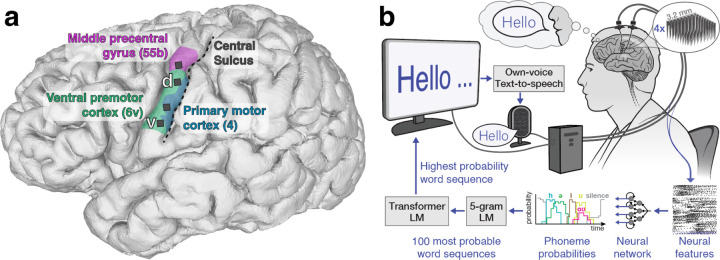
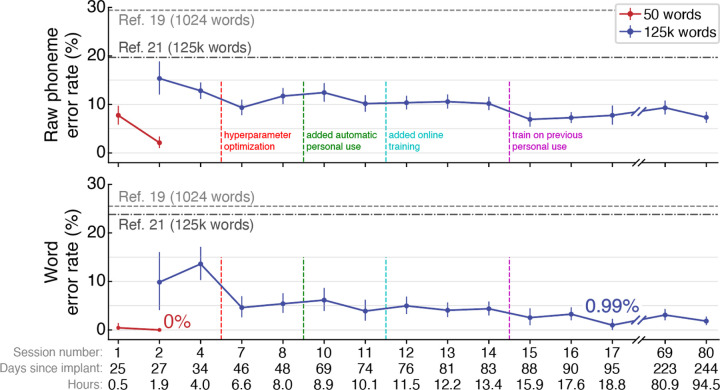
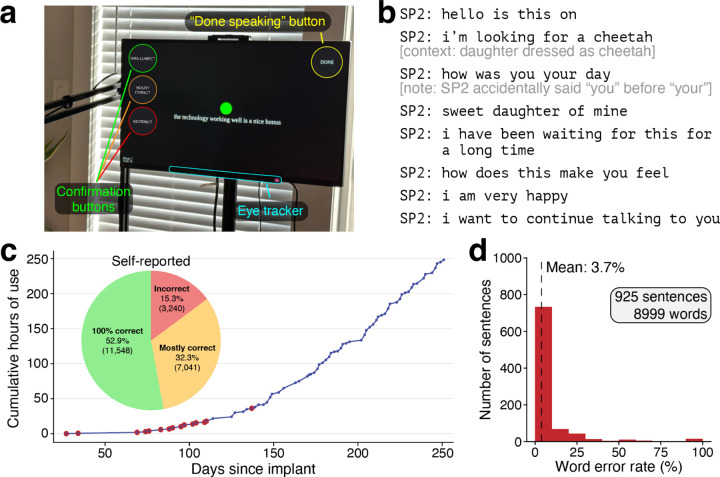
Brain-computer interfaces can enable rapid, intuitive communication for people with paralysis by transforming the cortical activity associated with attempted speech into text on a computer screen. Despite recent advances, communication with brain-computer interfaces has been restricted by extensive training data requirements and inaccurate word output. A man in his 40’s with ALS with tetraparesis and severe dysarthria (ALSFRS-R = 23) was enrolled into the BrainGate2 clinical trial. He underwent surgical implantation of four microelectrode arrays into his left precentral gyrus, which recorded neural activity from 256 intracortical electrodes. We report a speech neuroprosthesis that decoded his neural activity as he attempted to speak in both prompted and unstructured conversational settings. Decoded words were displayed on a screen, then vocalized using text-to-speech software designed to sound like his pre-ALS voice. On the first day of system use, following 30 minutes of attempted speech training data, the neuroprosthesis achieved 99.6% accuracy with a 50-word vocabulary. On the second day, the size of the possible output vocabulary increased to 125,000 words, and, after 1.4 additional hours of training data, the neuroprosthesis achieved 90.2% accuracy. With further training data, the neuroprosthesis sustained 97.5% accuracy beyond eight months after surgical implantation. The participant has used the neuroprosthesis to communicate in self-paced conversations for over 248 hours. In an individual with ALS and severe dysarthria, an intracortical speech neuroprosthesis reached a level of performance suitable to restore naturalistic communication after a brief training period.
Overview
The claims and statistics of this paper haven’t been checked yet.
Free: it reads the open-access text and checks the first 5 claims that cite a source we can check. Create a free account to check every claim.
Integrity signals
Registry
Cites
Statistics
Figures
Verification
Claims the paper makes
The claims and statistics of this paper haven’t been checked yet.
Free: it reads the open-access text and checks the first 5 claims that cite a source we can check. Create a free account to check every claim.
Claims other papers make about this one
Each is checked against this paper’s own text: does it say what the citing paper says it does?
The source backs part of the claim, not all of it — or backs it for a different population, condition or comparison.
In the citing paper
“Subsequent work has expanded this initial demonstration by directly decoding cortical activity into audible speech13,14 and allowing more generalizable and rapid text decoding14–16 in individuals with vocal-tract paralysis (Fig. 1).”
From The speech neuroprosthesis (2024) · cites this paper as [16]
Experimental — accuracy not yet measuredThe source backs part of the claim, not all of it — or backs it for a different population, condition or comparison.
In the citing paper
“Current speech-decoding applications from brain activity are primarily aimed at restoring communication to individuals with both limb and vocal-tract paralysis14–16.”
From The speech neuroprosthesis (2024) · cites this paper as [16]
Experimental — accuracy not yet measuredThe source backs part of the claim, not all of it — or backs it for a different population, condition or comparison.
In the citing paper
“Recent studies have also achieved high-performance speech-decoding results15,16 by measuring relevant single-unit and multi-unit neuronal activity from multiple small (4 × 4 mm2 (ref. 83)) cortical regions on the anterior precentral gyrus15,16,52,98.”
From The speech neuroprosthesis (2024) · cites this paper as [16]
Experimental — accuracy not yet measuredThe source backs part of the claim, not all of it — or backs it for a different population, condition or comparison.
In the citing paper
“Recent works have achieved large-vocabulary decoding while maintaining decoding speeds closer to natural speech, by using CTC loss.”
From The speech neuroprosthesis (2024) · cites this paper as Card et al. 2023
Experimental — accuracy not yet measuredThe source backs part of the claim, not all of it — or backs it for a different population, condition or comparison.
In the citing paper
“A second approach, specific to text decoding, involves leveraging large language models to automatically recalibrate MEA-based text neuroprostheses.”
From The speech neuroprosthesis (2024) · cites this paper as [16]
Experimental — accuracy not yet measured
6 more claims about this paper
Create a free account to see every claim other papers make about this one.
Self-check
Percentages, sums and reported differences re-computed from the paper’s own numbers.
The self-check needs the paper’s full text.
Citations
Cites
NWChem: A comprehensive and scalable open-source solution for large scale molecular simulations
Valiev, M., Bylaska, E. J., Govind, N., Kowalski, K., Straatsma, T. P., Van Dam, H. J. J., Wang, D., Nieplocha, J., Apra, E., Windus, T. L., et al. (2010) · Computer Physics Communications · doi:10.1016/j.cpc.2010.04.018 · Cited by 5,779
A multi-modal parcellation of human cerebral cortex
Glasser, M. F., Coalson, T. S., Robinson, E. C., Hacker, C. D., Harwell, J., Yacoub, E., Ugurbil, K., Andersson, J., Beckmann, C. F., Jenkinson, M., et al. (2016) · Nature · doi:10.1038/nature18933 · Cited by 5,111 · cited 2×
“…four 64-electrode Utah arrays chronically implanted in the precentral gyrus, targeted to brain areas that contributed most to speech decoding from recent studies 16,18,20 using the Human Connectome Project’s multi-modal MRI-derived cortical parcellation precisely mapped to SP2’s brain 21 (Fig.”
BackgroundMethodSelf-citationUnbiased average age-appropriate atlases for pediatric studies
Fonov, V., Evans, A. C., Botteron, K., Almli, C. R., McKinstry, R. C., & Collins, D. L. (2011) · NeuroImage · doi:10.1016/j.neuroimage.2010.07.033 · Cited by 2,290
SWITCHBOARD: telephone speech corpus for research and development
Godfrey, J. J., Holliman, E. C., & McDaniel, J. (1992) · [Proceedings] ICASSP-92: 1992 IEEE International Conference on Acoustics, Speech, and Signal Processing · doi:10.1109/icassp.1992.225858 · Cited by 2,134 · cited 4×
“We used neural activity collected during the speech tasks to train a recurrent neural network (RNN, Section S2) to predict the probability of each English phoneme being spoken.”
MethodInfluentialUnbiased nonlinear average age-appropriate brain templates from birth to adulthood
Fonov, V., Evans, A., McKinstry, R., Almli, C., & Collins, D. (2009) · NeuroImage · doi:10.1016/s1053-8119(09)70884-5 · Cited by 2,102
Salimi-Khorshidi, G., Douaud, G., Beckmann, C. F., Glasser, M. F., Griffanti, L., & Smith, S. M. (2014) · NeuroImage · doi:10.1016/j.neuroimage.2013.11.046 · Cited by 1,770
Self-citationHigh-performance brain-to-text communication via handwriting
Willett, F. R., Avansino, D. T., Hochberg, L. R., Henderson, J. M., & Shenoy, K. V. (2021) · Nature · doi:10.1038/s41586-021-03506-2 · Cited by 1,024
Self-citationSpeech synthesis from neural decoding of spoken sentences
Anumanchipalli, G. K., Chartier, J., & Chang, E. F. (2019) · Nature · doi:10.1038/s41586-019-1119-1 · Cited by 883
A brain-computer interface that evokes tactile sensations improves robotic arm control
Flesher, S. N., Downey, J. E., Weiss, J. M., Hughes, C. L., Herrera, A. J., Tyler-Kabara, E. C., Boninger, M. L., Collinger, J. L., & Gaunt, R. A. (2021) · Science · doi:10.1126/science.abd0380 · Cited by 617
Harms, M. P., Somerville, L. H., Ances, B. M., Andersson, J., Barch, D. M., Bastiani, M., Bookheimer, S. Y., Brown, T. B., Buckner, R. L., Burgess, G. C., et al. (2018) · NeuroImage · doi:10.1016/j.neuroimage.2018.09.060 · Cited by 584
Self-citation
Research works printed but not linked: 10
- 2023, Interim Safety Profile From the Feasibility Study of the BrainGate Neural Interface System, Neurology, 100, e1177
- 2002, Timing of speech deterioration in people with amyotrophic lateral sclerosis, J Med Speech-Lang Pathol, 10, 231
- Glasser MF, Coalson TS, Robinson EC, A multi-modal parcellation of human cerebral cortex. Nature 2016; 536(7615): 171– 8. 27437579 PMC4990127 · DOI · Paper page
- 10.1056/nejmoa2027540 · DOI · Paper page
- Metzger SL, Liu JR, Moses DA, Generalizable spelling using a speech neuroprosthesis in an individual with severe limb and vocal paralysis. Nat Commun 2022; 13(1): 6510. 36347863 PMC9643551 · DOI · Paper page
- Metzger SL, Littlejohn KT, Silva AB, A high-performance neuroprosthesis for speech decoding and avatar control. Nature 2023; 620(7976): 1037– 46. 37612505 PMC10826467 · DOI · Paper page
- Silva AB, Liu JR, Zhao L, Levy DF, Scott TL, Chang EF. A Neurosurgical Functional Dissection of the Middle Precentral Gyrus during Speech Production. J Neurosci 2022; 42(45): 8416– 26. 36351829 PMC9665919 · DOI · Paper page
- Ali YH, Bodkin K, Rigotti-Thompson M, BRAND: A platform for closed-loop experiments with deep network models [Internet]. 2023 [ cited 2023 Dec 11];2023.08.08.552473. Available from: 10.1101/2023.08.08.552473v1 PMC11021878 38579696 · doi:10.1101/2023.08.08.552473v1
- Godfrey JJ, Holliman EC, McDaniel J. SWITCHBOARD: telephone speech corpus for research and development [Internet]. In: [Proceedings] ICASSP-92: 1992 IEEE International Conference on Acoustics, Speech, and Signal Processing. 1992 [ cited 2023 Dec 11]. p. 517– 20 vol. 1. Available from: https://ieeexplore.ieee.org/document/225858 · DOI · Paper page
- Sussillo D, Stavisky SD, Kao JC, Ryu SI, Shenoy KV. Making brain–machine interfaces robust to future neural variability. Nat Commun 2016; 7(1): 13749. 27958268 PMC5159828 · DOI · Paper page
Cited by
Recent applications of EEG-based brain-computer-interface in the medical field
Liu, X., Wang, W.-L., Liu, M., Chen, M., Pereira, T., Doda, D. Y., Ke, Y., Wang, S., Dong, W., Tong, X., et al. (2025) · Military Medical Research · doi:10.1186/s40779-025-00598-z · Cited by 171
“Card et al. [172] recently reported a study involving a 45-year-old patient with ALS.”
Silva, A. B., Littlejohn, K. T., Liu, J. R., Moses, D. A., & Chang, E. F. (2024) · Nature Reviews Neuroscience · doi:10.1038/s41583-024-00819-9 · Cited by 103
“In this approach, MEA activity is decoded into subword units and converted into sentences using language models; this language model output is used as a ‘pseudo-label’ to update the RNN decoding model 9,16,105 .”
InfluentialA streaming brain-to-voice neuroprosthesis to restore naturalistic communication
Littlejohn, K. T., Cho, C. J., Liu, J. R., Silva, A. B., Yu, B., Anderson, V. R., Kurtz-Miott, C. M., Brosler, S., Kashyap, A., Hallinan, I. P., et al. (2025) · Nature Neuroscience · doi:10.1038/s41593-025-01905-6 · Cited by 133
“The neural data generated from these attempts were used to train the decoding model 21,22,24–27 , which may prove challenging to adapt to someone who has difficulty with or has lost this ability.”
InfluentialInner speech in motor cortex and implications for speech neuroprostheses
Kunz, E. M., Abramovich Krasa, B., Kamdar, F., Avansino, D. T., Hahn, N., Yoon, S., Singh, A., Nason-Tomaszewski, S. R., Card, N. S., Jude, J. J., et al. (2025) · Cell · doi:10.1016/j.cell.2025.06.015 · Cited by 55
“All LLM-gener-ated code was verified by researchers.”
InfluentialSelf-citationAn instantaneous voice synthesis neuroprosthesisPreprint
Wairagkar, M., Card, N., Singer-Clark, T. S., et al. (2024) · bioRxiv · doi:10.1101/2024.08.14.607690 · Cited by 48
“We also demonstrated that this brain-to-voice speech neuroprosthesis could be paired with our previously-reported high accuracy brain-to-text decoder 1 , which essentially acted as closed-captioning ( Video 3 ).”
BackgroundMethodInfluentialSelf-citationTowards decoding individual words from non-invasive brain recordings
d’Ascoli, S., Bel, C., Rapin, J., Banville, H. J., Benchetrit, Y., Pallier, C., & King, J.-R. (2025) · Nature Communications · doi:10.1038/s41467-025-65499-0 · Cited by 77
“The fi rst is a standard ridge regression model, implemented via SKLearn ’ s RidgeCV 61 , using a logarithmic search for the regularization parameter alpha varying from 10 − 2 to 10 8 .”
Brain-to-Text Decoding: A Non-invasive Approach via Typing
Lévy, J., Zhang, M.-F., Pinet, S., et al. (2025) · arXiv.org · doi:10.48550/arxiv.2502.17480 · Cited by 43
“…words (Metzger et al., 2022), and gestures (Willett et al., 2021), the recent development of AI models has improved the precision and rapidity of brain-to-text decoding to a point of enabling natural language production at rates close to normal speech (Metzger et al., 2023; Wairagkar et al., 2024).”
Brain–computer interface control with artificial intelligence copilots
Lee, J. Y., Lee, S., Mishra, A., Xu, Y., McMahan, B., Gaisford, B., Kobashigawa, C., Qu, M., Xie, C., & Kao, J. C. (2025) · Nature Machine Intelligence · doi:10.1038/s42256-025-01090-y · Cited by 65
“Recent studies have demonstrated high-performance intracortical BCI communication by decoding speech 60–62 .”
LibriBrain: Over 50 Hours of Within-Subject MEG to Improve Speech Decoding Methods at Scale
Özdogan, M., Landau, G., Elvers, G., et al. (2025) · Neural Information Processing Systems · doi:10.48550/arxiv.2506.02098 · Cited by 24
“This task builds upon the extensive tradition of phoneme-based automatic speech recognition (ASR) (Garofolo et al., 1993), and continues to play a central role in contemporary invasive brain-to-text pipelines (Wilson et al., 2020; Metzger et al., 2023; Willett et al., 2023; Card et al., 2024).”
Brain–Computer Interface—A Brain-in-the-Loop Communication System
Gao, X., Wang, Y., Chen, X., Liu, B., & Gao, S. (2025) · Proceedings of the IEEE · doi:10.1109/jproc.2025.3600389 · Cited by 32
“…with human speech can be directly interpreted and converted into corresponding speech or text messages [6], [349], [350], [351], [352], [353], [354]; and spontaneous brain signals associated with the human brainprint can even be used as a feature signal in identity recognition [300], [302].”
Bhadra, K., Giraud, A., & Marchesotti, S. (2025) · Communications Biology · doi:10.1038/s42003-025-07464-7 · Cited by 33
Wearable intelligent throat enables natural speech in stroke patients with dysarthria
Tang, C., Gao, S., Li, C., Yi, W., Jin, Y., Zhai, X., Lei, S., Meng, H., Zhang, Z., Xu, M., et al. (2026) · Nature Communications · doi:10.1038/s41467-025-68228-9 · Cited by 24
Shain, C., & Fedorenko, E. (2025) · bioRxiv · doi:10.1101/2025.03.29.646067 · Cited by 21
Real-time decoding of full-spectrum Chinese using brain-computer interface
Qian, Y., Liu, C., Yu, P., Ran, X., Li, S., Yang, Q., Liu, Y., Xia, L., Wang, Y., Qi, J., et al. (2025) · Science Advances · doi:10.1126/sciadv.adz9968 · Cited by 31
The 2025 PNPL Competition: Speech Detection and Phoneme Classification in the LibriBrain DatasetPreprint
Landau, G., Özdogan, M., Elvers, G., Mantegna, F., Somaiya, P., Jayalath, D., Kurth, L., Kwon, T., Shillingford, B., Farquhar, G., et al. (2025) · arXiv (Cornell University) · doi:10.48550/arxiv.2506.10165 · Cited by 23
“An invasive B2T competition was run in 2024 [36] which helped to bridge the jump from a large-vocabulary WER of 23.8% [35] to less than 5% [8].”
InfluentialFew-shot Algorithms for Consistent Neural Decoding (FALCON) BenchmarkPreprint
Karpowicz, B. M., Ye, J., Fan, C., et al. (2024) · bioRxiv (Cold Spring Harbor Laboratory) · doi:10.1101/2024.09.15.613126 · Cited by 1
“This task is therefore not amenable to traditional linear decoders and will require more sophisticated approaches, most canonically RNN decoders with a Connectionist Temporal Classification loss [5, 10, 11, 29].”
Self-citationUnlocking Non-Invasive Brain-to-TextPreprint
Jayalath, D., Landau, G., & Jones, Ō. P. (2025) · arXiv (Cornell University) · doi:10.48550/arxiv.2505.13446 · Cited by 19
“…of whether the patient will be with the same face [3] and body to go out with the young man [1] she saw over the counter at the pharmacy said [4] that we can get our medication this way [2] is the most effective without causing or worsening and also that in other cases where it can be done…”
InfluentialMindLLM: A Subject-Agnostic and Versatile Model for fMRI-to-Text DecodingPreprint
Qiu, W., Huang, Z., Hu, H., Feng, A., Yan, Y., & Ying, R. (2025) · arXiv (Cornell University) · doi:10.48550/arxiv.2502.15786 · Cited by 20
“For example, for individuals with speech impairments, this technology could restore communication capabilities, enabling them to express their thoughts effortlessly (Card et al., 2024).”
Long-term independent use of an intracortical brain–computer interface for speech and cursor control
Card, N. S., Singer-Clark, T., Peracha, H., Iacobacci, C., Hou, X., Wairagkar, M., Fogg, Z., Offenberg, E. C., Hochberg, L. R., Stavisky, S. D., et al. (2026) · Nature Medicine · doi:10.1038/s41591-026-04414-6 · Cited by 39
“This linear offset (as opposed to a nonlinear transformation as was used for the RNN 5,7 ) was empirically found to perform better for this architecture.”
InfluentialSelf-citationTransfer learning via distributed brain recordings enables reliable speech decoding
Singh, A., Thomas, T. M., Li, J., Hickok, G. S., Pitkow, X., & Tandon, N. (2025) · Nature Communications · doi:10.1038/s41467-025-63825-0 · Cited by 23
“Thus far, these data have been recorded from intact sensorimotor cortex in anarthric individuals with damaged efferent pathways or end effectors 5 – 7 .”
InfluentialSpeech motor cortex enables BCI cursor control and clickPreprint
Singer-Clark, T. S., Hou, X., Card, N., et al. (2024) · bioRxiv · doi:10.1101/2024.11.12.623096 · Cited by 16
“22 In the current study, we added the ability to neurally control T15’s personal computer’s (Mac) mouse cursor (Fig.”
Self-citationMental privacy: navigating risks, rights and regulation
Szoszkiewicz, Ł., & Yuste, R. (2025) · EMBO Reports · doi:10.1038/s44319-025-00505-6 · Cited by 43
“In 2024, researchers, using implanted sensors, successfully decoded attempted speech in individuals with amyotrophic lateral sclerosis (ALS), reaching accuracy levels as high as 97.5% (Card et al, 2024).”
InfluentialBrain and Cognitive Science Inspired Deep Learning: A Comprehensive Survey
Zhang, Z., Ding, X., Liang, X., Zhou, Y., Qin, B., & Liu, T. (2025) · IEEE Transactions on Knowledge and Data Engineering · doi:10.1109/tkde.2025.3527551 · Cited by 28
“Studies have successfully demonstrated the ability to synthesize audible speech from cortical activity by leveraging kinematic and sound representations encoded in the human brain [125], [126], [127], [128].”
An emerging view of neural geometry in motor cortex supports high-performance decoding
Perkins, S. M., Amematsro, E. A., Cunningham, J. P., Wang, Q., & Churchland, M. M. (2025) · eLife · doi:10.1101/2023.04.05.535396 · Cited by 16
Wireless Silent Speech Interface Using Multichannel Textile EMG Sensors Integrated Into Headphones
Tang, C., Mallah, J., Kazieczko, D., Yi, W., Kandukuri, T. R., Occhipinti, E., Mishra, B., Mehta, S., & Occhipinti, L. G. (2025) · IEEE Transactions on Instrumentation and Measurement · doi:10.1109/tim.2025.3583386 · Cited by 7
“…been proposed to realize SSIs, including brain-computer interfaces (BCIs) that leverage electroencephalography (EEG) or electrocorticography (ECoG) [4], [5], [6], wearable sensors such as electromyography (EMG) [7], [8] and strain sensors [9], [10], and mobile device-based solutions that utilize…”
Brain–computer interfaces patient preferences: a systematic review
Brannigan, J., Liyanage, K., Horsfall, H. L., Bashford, L., Muirhead, W. R., & Fry, A. (2024) · Journal of Neural Engineering · doi:10.1088/1741-2552/ad94a6 · Cited by 20
“Despite these challenges, a recent pre-print manuscript reports the rapid calibration of a high performance implantable speech neuroprosthesis [40].”
Brain-to-text decoding with context-aware neural representations and large language models
Li, J., Le, T., Fan, C., Chen, M., & Shlizerman, E. (2025) · Journal of Neural Engineering · doi:10.1088/1741-2552/adfab1 · Cited by 15
“…approach typically involves (1) neural signal to phonemes: using a temporal deep network to decode a binned multi-channel neural time series into probability of phonemes being spoken at each time step, and (2) phonemes to text: employing a language model (LM) to infer the most probable…”
Self-citationSpeech motor cortex enables BCI cursor control and click
Singer-Clark, T., Hou, X., Card, N. S., Wairagkar, M., Iacobacci, C., Peracha, H., Hochberg, L. R., Stavisky, S. D., & Brandman, D. M. (2025) · Journal of Neural Engineering · doi:10.1088/1741-2552/add0e5 · Cited by 26
“A previous study demonstrated that decoding this participant’s neural signals from these arrays enabled a highly accurate speech BCI [22].”
InfluentialSelf-citationJiang, Y., Li, K., Liang, Y. X., Chen, D., Tan, M., & Li, Y. (2024) · IEEE Transactions on Neural Systems and Rehabilitation Engineering · doi:10.1109/tnsre.2024.3520984 · Cited by 17
“For diseases such as ALS, for which there is still no cure, some researchers are directing their efforts toward enhancing the quality of life of these patients through systems without extremity engagement [6], [7].”
Noninvasive decoding of typed sentences from human brain activity
Levy, J., Zhang, M., Pinet, S., Rapin, J., Banville, H. J., d’Ascoli, S., & King, J.-R. (2026) · Nature Neuroscience · doi:10.1038/s41593-026-02303-2 · Cited by 55
“Originally limited to decoding small sets of linguistic features 2,5–8 , words 1 and gestures 9 , the recent development of artificial intelligence (AI) models has improved the precision and rapidity of brain-to-text decoding to the point of enabling natural language production at rates close to…”
NeuGPT: Unified multi-modal Neural GPTPreprint
Yang, Y., Duan, Y., Jo, H., Zhang, Q., Xu, R., Jones, Ō. P., Hu, X., Lin, C., & Xiong, H. (2024) · arXiv (Cornell University) · doi:10.48550/arxiv.2410.20916 · Cited by 15
“Similarly, Willett et al. (2023) and Card et al. (2024) contributed to the direct translation of neural activity into text, adapting a prior handwriting model (Willett et al., 2021).”
BackgroundA mosaic of whole-body representations in human motor cortexPreprint
Deo, D. R., Okorokova, E. V., Pritchard, A. L., Hahn, N. V., Card, N. S., Nason, S. R., Jude, J. J., Hosman, T., Choi, E. Y., Qiu, D., et al. (2024) · bioRxiv (Cold Spring Harbor Laboratory) · doi:10.1101/2024.09.14.613041 · Cited by 13
“2), and in our prior work, offered much higher speech decoding performance relative to the superior-ventral region 40,41 (even for unvoiced phonemes 41 ).”
BackgroundSelf-citationA flexible intracortical brain-computer interface for typing using finger movementsPreprint
Shah, N. P., Willsey, M. S., Hahn, N. V., Kamdar, F. B., Avansino, D. T., Fan, C., Hochberg, L. R., Willett, F. R., & Henderson, J. M. (2024) · bioRxiv (Cold Spring Harbor Laboratory) · doi:10.1101/2024.04.22.590630 · Cited by 16
“…have made significant strides, enabling control over 2D cursors (Bacher et al. 2015; Jarosiewicz et al. 2015; Gilja et al. 2015; Pandarinath et al. 2017), facilitating handwriting (Willett et al. 2021), and even supporting speech (Willett et al. 2023; Metzger et al. 2023; Card et al. 2023).”
BackgroundSelf-citationMEG-XL: Data-Efficient Brain-to-Text via Long-Context Pre-TrainingPreprint
Jayalath, D., & Jones, Ō. P. (2026) · arXiv (Cornell University) · doi:10.48550/arxiv.2602.02494 · Cited by 8
“Notwithstanding these predictions, prior brain-to-text de-coders typically operate on brief samples of brain data in the range of milliseconds to seconds (Moses et al., 2021; D´efossez et al., 2022; Tang et al., 2023; Willett et al., 2023; Card et al., 2024).”
SPINT: Spatial Permutation-Invariant Neural Transformer for Consistent Intracortical Motor Decoding
Le, T., Fang, H., Li, J., et al. (2025) · Neural Information Processing Systems · doi:10.48550/arxiv.2507.08402 · Cited by 8
“Despite the remarkable capabilities, iBCI systems suffer from performance degradation over extended periods of time, largely attributed to the nonstationarities of the recorded populations [6].”
Time-Masked Transformers with Lightweight Test-Time Adaptation for Neural Speech Decoding
Feghhi, E., Kaasyap, S., Hadidi, N., et al. (2025) · Neural Information Processing Systems · doi:10.48550/arxiv.2507.02800 · Cited by 8
“The majority of speech neuroprostheses have employed some combination of CNNs and RNNs (2; 29; 20; 32; 33; 22; 3; 7; 27; 19), although a few studies have used Transformers (31; 9; 8).”
DIVER-1: Scaling Intracranial EEG Foundation Models for Transferable RepresentationsPreprint
Han, D. D., Gwon, Y., Lee, A., Lee, T., Lee, S. J., Choi, J., Lee, S., Bang, J., Lee, S., Park, D. K., et al. (2025) · arXiv (Cornell University) · doi:10.48550/arxiv.2512.19097 · Cited by 9
“These properties make iEEG valuable for cognitive decoding, brain–computer interfaces [5, 6], and precision neuromedicine [7, 8].”
Evaluating EEG-to-text models through noise-based performance analysis
Jo, H., Yang, Y., Han, J., Duan, Y., Xiong, H., & Lee, W. H. (2025) · Scientific Reports · doi:10.1038/s41598-025-29587-x · Cited by 56
“Invasive techniques such as electrocorticography (ECoG) 1 and microelectrode arrays (MEAs) 2,3 have achieved remarkable precision in neural signal interpretation and high decoding accuracies.”
Towards precise synthetic neural codes: high-dimensional stimulation with flexible electrodes
Kim, R., Liu, Y., Zhang, J., Xie, C., & Luan, L. (2025) · npj Flexible Electronics · doi:10.1038/s41528-025-00447-y · Cited by 8
“These advancements have driven signi fi cant strides in “ read-out ” capacities, paving the way for large-scale BMIsto control roboticarms 19 , movecursors 20 ,and decodespeech 21 at scales not available previously.”
Decoding Finger Velocity from Cortical Spike Trains with Recurrent Spiking Neural Networks
Liu, T., Gygax, J., Rossbroich, J., Chua, Y., Zhang, S., & Zenke, F. (2024) · IEEE Biomedical Circuits and Systems Conference (BioCAS) · doi:10.1109/biocas61083.2024.10798222 · Cited by 10
“Significant progress has been made in invasive BMI technology, allowing volitional control of robotic arms [2], [3] and text generation for communication [4]–[7].”
Cross-brain transfer of high-performance intracortical speech and handwriting BCIsPreprint
Levin, A. D., Avansino, D. T., Kamdar, F. B., Card, N. S., Wairagkar, M., Jacques, B. G., Jude, J. J., Iacobacci, C., Lacayo, B. E., Bechefsky, P. H., et al. (2026) · bioRxiv (Cold Spring Harbor Laboratory) · doi:10.64898/2026.01.12.699110 · Cited by 7
“Although some studies have reported good decoding accuracies with only a small number of training sentences from a single user 5,6 , successful cross-brain transfer would enable more consistently short training data collection times across all users.”
Self-citationSensing technologies for silent speech interfaces
Tang, C., Qi, L., Gao, S., Zhang, Z., Yi, W., Xu, M., Occhipinti, E., Pan, Y., & Occhipinti, L. G. (2026) · Nature Sensors · doi:10.1038/s44460-025-00010-2 · Cited by 9
“However, this advantage comes at the cost of invasiveness and a need for custom-designed solutions or intervention procedures due to patient diversity in their anatomical structure, pathological conditions, biological responses and functional goals, alongside ethical constraints 10,11 .”
Implantable Neural Speech Decoders: Recent Advances, Future Challenges
Jhilal, S., Marchesotti, S., Thirion, B., Soudrie, B., Giraud, A., & Mandonnet, E. (2025) · Neurorehabilitation and neural repair · doi:10.1177/15459683251369468 · Cited by 9
“Building upon these 2 groups’ work, Card et al 21 achieved a word error rate of only 2.5% (out of a 125 000 words vocabulary) with a decoding speed of 32 words/minute, representing a significant leap in accuracy compared to previous studies.”
InfluentialJude, J. J., Levi-Aharoni, H., Acosta, A. J., Allcroft, S. B., Nicolas, C., Lacayo, B. E., Card, N. S., Wairagkar, M., Brandman, D. M., Stavisky, S. D., et al. (2025) · medRxiv · doi:10.1101/2025.04.01.25324990 · Cited by 7
“Additional future work will focus on developing independent participant use through online training of the RNN decoder 13,34 , whereby sentences confirmed to be decoded correctly would be trained upon.”
InfluentialSelf-citationEffective Phoneme Decoding With Hyperbolic Neural Networks for High-Performance Speech BCIs
Tan, X., Lian, Q., Zhu, J., Zhang, J., Wang, Y., & Qi, Y. (2024) · IEEE Transactions on Neural Systems and Rehabilitation Engineering · doi:10.1109/tnsre.2024.3457313 · Cited by 10
“Recent studies developed high-performance English speech BCIs through decoding phonemes [8], [9], [10], [11].”
BackgroundMethodInfluentialEthical and Safety Challenges of Implantable Brain-Computer Interface
Satam, I. A., & Szabolcsi, R. (2025) · Interdisciplinary Description of Complex Systems · doi:10.7906/indecs.23.2.1 · Cited by 6
“The patient, who suffered from tetraplegia and severe dysarthria, received an implanted BCI consisting of four microelectrode arrays placed in the left ventral precentral gyrus [23].”
Neural Embeddings Rank: Aligning 3D latent dynamics with movements
Chen, C., Yang, Z., & Wang, X. (2024) · Neural Information Processing Systems · doi:10.52202/079017-4492 · Cited by 6
“Nevertheless, uncovering the latent dynamics underlying these complex movements, which has yet to be achieved[7], could greatly advance BMI applications [3, 6].”
Accurate Decoding of Natural Sentences from Non-Invasive Brain RecordingsPreprint
Mingfang, Levy, J., Rommel, C., Rapin, J., Bel, C., Bonnaire, J., Nieto, D., Bourdillon, P., Pinet, S., d’Ascoli, S., et al. (2026) · arXiv (Cornell University) · doi:10.48550/arxiv.2608.18114 · Cited by 5
“…with electrodes over the motor cortex have recently been able to produce language via attempted speech (Moses et al., 2021; Willett et al., 2023; Card et al., 2024; Wairagkar et al., 2024), handwriting (Willett et al., 2021), and typing (Pandarinath et al., 2017; Jude et al., 2026), with…”
A mosaic of whole-body representations on the human precentral gyrus
Deo, D. R., Okorokova, E. V., Pritchard, A. L., Hahn, N. V., Card, N. S., Nason, S. R., Jude, J. J., Hosman, T., Choi, E. Y., Qiu, D., et al. (2026) · Nature · doi:10.1038/s41586-026-10653-x · Cited by 26
“One array was placed targeting area 55b, two arrays targeting area 6v and one array targeting area 4; see Card et al. for more details 61 .”
Self-citationA cross-species neural foundation model for end-to-end speech decoding
Zhang, Y., He, L., Fan, C., Liu, T., Yu, H., Le, T., Li, J., Linderman, S. W., Duncker, L., Willett, F. R., et al. (2026) · International Conference on Learning Representations · doi:10.48550/arxiv.2511.21740 · Cited by 10
“The Brain-to-Text Benchmark ’24 and ’25 datasets (Willett et al., 2023; Card et al., 2024) are used for attempted speech decoding.”
InfluentialSelf-citationJude, J. J., Haro, S., Levi-Aharoni, H., Hashimoto, H., Acosta, A. J., Card, N. S., Wairagkar, M., Brandman, D. M., Stavisky, S. D., Williams, Z. M., et al. (2025) · bioRxiv (Cold Spring Harbor Laboratory) · doi:10.1101/2025.08.12.668516 · Cited by 3
“Similarly to recent work 15,16 , we used a 5-gram language model performing Viterbi (beam) search to infer the most likely sentence spoken given the complete sequence of RNN phoneme probabilities at all timesteps and the statistics of the English language (see Methods for further decoding pipeline…”
InfluentialSelf-citationError encoding in human speech motor cortexPreprint
Hou, X., Iacobacci, C., Card, N. S., Wairagkar, M., Singer-Clark, T., Kunz, E. M., Fan, C., Kamdar, F. B., Hahn, N. V., Hochberg, L. R., et al. (2025) · bioRxiv (Cold Spring Harbor Laboratory) · doi:10.1101/2025.06.07.658426 · Cited by 8
“This error decoder operated in parallel with a speech brain-to-text decoder that decoded the neural correlates of phoneme articulation 27,28 ; thus, this combined system represents a hybrid “motor+cognitive” neuroprosthesis.”
InfluentialSelf-citationSoldier Enhancement through Brain–Computer Interfaces: The Risks of Changing the Human Condition
Gielas, A. M. (2025) · RUSI Journal · doi:10.1080/03071847.2025.2449894 · Cited by 5
Hierarchical Decoding of Perceived Speech From Non-Invasive Brain Recordings
Wang, B., Xu, X., Xiao, B., Linze, Z., Wu, X., Cheng, H., & Chen, J. (2026) · IEEE Transactions on Neural Systems and Rehabilitation Engineering · doi:10.1109/tnsre.2026.3688564 · Cited by 7
LibriBrain100: One Hundred Hours of Broad and Deep MEG Data for Neural Speech Decoding at ScalePreprint
Mantegna, F., Jayalath, D., Elvers, G., Kim, T., Ballyk, B., Fung, A., Cho, S., Kwon, T., Kurth, L., Özdogan, M., et al. (2026) · arXiv (Cornell University) · doi:10.48550/arxiv.2608.25204 · Cited by 6
“The early landmark result in Moses et al. (2021), with a simple 50-word vocabulary, paved the way for significant advances in following years (Willett et al., 2023; Card et al., 2024).”
Shain, C., & Fedorenko, E. G. (2026) · Nature Communications · doi:10.1038/s41467-026-75745-8 · Cited by 24
Mapping the neuronal building blocks of human language with language models
Cai, J., Kfir, Y., Jamali, M., Huang, H., Kim, Y. J., Cash, S. S., & Williams, Z. M. (2026) · Nature · doi:10.1038/s41586-026-10691-5 · Cited by 11
Encoding of speech modes and loudness in ventral precentral gyrus
Srinivasan, A., Wairagkar, M., Iacobacci, C., Hou, X., Card, N. S., Jacques, B. G., Pritchard, A. L., Bechefsky, P. H., Hochberg, L. R., Yong, N. A., et al. (2026) · Nature Communications · doi:10.1038/s41467-026-71284-4 · Cited by 9
“As speech neuroprostheses have been rapidly improving, characterizing neural ensemble encoding of speech mode and loudness at cellular resolution is becoming increasingly important so as to be able to achieve more precise control of speech output 7,19 – 24 .”
InfluentialSelf-citationA Silent Speech Decoding System from EEG and EMG with Heterogenous Electrode Configurations
Inoue, M., Sato, M., Tomeoka, K., et al. (2025) · Interspeech · doi:10.48550/arxiv.2506.13835 · Cited by 4
“While invasive brain activity measurements have achieved remarkable decoding accuracy [1, 2, 3, 4, 5], their widespread adoption is hindered by the requirement for cranial surgery.”
A Novel Multimodal Method for Decoding Speech Perception from Brain Activities
Zhang, A., Wang, B., Xi-hong, W., & Chen, J. (2025) · IEEE International Conference on Acoustics Speech and Signal Processing · doi:10.1109/icassp49660.2025.10889637 · Cited by 4
“Invasive BCI speech decoding has made significant progress recently [5]–[7], demonstrating the feasibility of speech neuroprosthesis.”
The ‘Brussels 4’: essential requirements for implantable brain–computer interface user autonomy
Oxley, T. J., Deo, D. R., Cernera, S., Sawyer, A., Putrino, D. F., Ramsey, N. F., & Fry, A. (2025) · Journal of Neural Engineering · doi:10.1088/1741-2552/ada0e6 · Cited by 7
Self-citationLarge-scale fMRI dataset for the design of motor-based Brain-Computer Interfaces
Bom, M. S., Brak, A. M. A., Raemaekers, M. A. H., Ramsey, N. F., Vansteensel, M. J., & Branco, M. P. (2025) · Scientific Data · doi:10.1038/s41597-025-05134-1 · Cited by 5
Simultaneous speech and gesture decoding for multimodal communication in paralysis
Brosler, S., Liu, J. R., Silva, A. B., Hallinan, I. P., Kurtz-Miott, C. M., Wilker, J. D., Tu-Chan, A., Ganguly, K., & Chang, E. F. (2026) · Nature Neuroscience · doi:10.1038/s41593-026-02446-2 · Cited by 6
A Common Measure of Communication for Speech Brain-Computer InterfacesPreprint
Jayalath, D., Ballyk, B., & Jones, Ō. P. (2026) · arXiv (Cornell University) · doi:10.48550/arxiv.2609.02887 · Cited by 5
“The later 125k-word invasive systems (Willett et al., 2023; Card et al., 2024) occupy the upper-right of the plot, combining near-complete coverage with high decoding fidelity.”
Transforming healthcare through in-body bioelectronic systems
Ceto, S., Elshove, S. A., Wu, M., Ramadi, K. B., Tondera, C., Minev, I. R., Srinivasan, S. S., Lee, K., Gora, M. J., Rogers, J. A., et al. (2026) · Nature Communications · doi:10.1038/s41467-026-71188-3 · Cited by 5
“These principles naturally extend to brain – computer interfaces (BCIs) with representative applications in communication 96,183 , external devices control 110,184,185 , and sensory feedback 106,186 , where decoding improvements will play a pivotal role clinically but only when paired with…”
Azarraga, R. B., Jackson, M. C., Fraix, M. P., & Agrawal, D. K. (2025) · Journal of Biotechnology and Biomedicine · doi:10.26502/jbb.2642-91280207 · Cited by 3
“Brain computer interfaces were found to be heavily used compared to other forms of communication when available [47].”
InfluentialLehner, K. R., Luo, S., Greene, B., Angrick, M., Candrea, D. N., Husari, K. S., Barth, K. J., Dister, J., Anushiravani, R., Miller, J. S., et al. (2026) · Neurosurgical FOCUS · doi:10.3171/2025.11.focus25908 · Cited by 5
A Personalized and Adaptable User Interface for a Speech and Cursor Brain-Computer Interface
Peracha, H., Iacobacci, C., Singer-Clark, T., Hochberg, L. R., Stavisky, S. D., Brandman, D. M., & Card, N. S. (2026) · CHI Conference on Human Factors in Computing Systems · doi:10.1145/3772318.3790750 · Cited by 5
“Although EEG-based BCIs remain promising as widely accessible AAC devices, they lack the signal-to-noise ratio required for the highest speed and accuracy in communication and computer use.”
Self-citationGobert, F., Mérida, I., Maby, E., Séguin, P., Jung, J., Morlet, D., André‐Obadia, N., Dailler, F., Berthomier, C., Otman, A., et al. (2025) · Communications Medicine · doi:10.1038/s43856-025-01196-9 · Cited by 7
“Nonetheless, this does not preclude the use of advanced BCIs, especially given the promising complementary fi ndings supporting their role in sustaining communication in patients with tetra-plegic and anarthric ALS 31 so as to maintain their quality of life 84 .”
Motor Cortex Coverage Predicts Signal Strength of a Stentrode Endovascular Brain-Computer InterfacePreprint
Schone, H. R., Yoo, P. E., Fry, A., Chetty, N., Sawyer, A., Herbers, C., Liu, F., Moon, C., Hill, K. J., Majidi, S., et al. (2025) · medRxiv · doi:10.1101/2025.09.19.25335875 · Cited by 5
Shared latent representations of speech production for cross-patient speech decoding
Spalding, Z., Duraivel, S., Rahimpour, S., et al. (2025) · bioRxiv · doi:10.1101/2025.08.21.671516 · Cited by 3
“…spatial and temporal resolution recordings directly from cortical populations, enabling more accurate decoding of speech-related neural activity 7–10 , but introduce challenges related to surgical implantation, limited and variable electrode coverage, and patient-64 specific sampling of neural…”
Silva, A. B., Liu, J. R., Anderson, V. R., Kurtz-Miott, C. M., Hallinan, I. P., Littlejohn, K. T., Brosler, S., Tu-Chan, A., Ganguly, K., Moses, D. A., et al. (2025) · Journal of Neural Engineering · doi:10.1088/1741-2552/adf50e · Cited by 7
“However, in future systems, the model making predictions (i.e. a classifier or a continuous decoder [4, 6, 33]), may not require 3–3.5 s of neural features after detected onset, which means a verification model could add significant latency.”
InfluentialA Pre-trained Framework for Multilingual Brain Decoding Using Non-invasive RecordingsPreprint
Guo, Y. P., Dong, Y., Ng, M. K.-P., & Wang, S. (2025) · arXiv (Cornell University) · doi:10.48550/arxiv.2506.03214 · Cited by 3
“BCIs with speech decoding show great promise both in restoring communication for patients with aphasia [1–3] and in advancing understanding of the neural mechanisms underlying human language [4–6].”
Higgins, N., Blakely, B. D., Everingham, R., Gilbert, F., Griffin, S., Harris, A. R., Herring, S. E., Ho, C. W.-L., Hoy, K. E., Kiel-Chisholm, S., et al. (2026) · BMC Medical Ethics · doi:10.1186/s12910-026-01475-7 · Cited by 4
“Investigational BCI systems have been shown to restore movement and enable limited pixelated vision in blind individuals [5], as well as provide new means of communication and interacting with the world [6–9].”
Large-scale single-neuron recording in the human cortex using an ultra-flexible electrode array
Wu, S. P., Yan, Z., Kong, C., Jiang, X., Dong, Q., Qian, Y., Chen, G., Chen, B., Ren, C., Lu, J., et al. (2026) · Nature Communications · doi:10.1038/s41467-026-71443-7 · Cited by 9
Huang, J., Narasimha, S. M., Patel, A. N., Sristi, R. D., Mishne, G., & Gilja, V. (2026) · bioRxiv (Cold Spring Harbor Laboratory) · doi:10.64898/2026.04.02.715749 · Cited by 2
“Most prior work has focused on improving end-to-end accuracy metrics such as word error rate [11,12,35–39 , Our results show that neural decoder predictive distribution (Sec.”
InfluentialSmart Ward Control Based on a Wearable Multimodal Brain–Computer Interface Mouse
Zhu, J., Li, K., Chen, S., Huang, H., Zhang, Y., Hu, L., & Li, Y. (2026) · IEEE Transactions on Neural Systems and Rehabilitation Engineering · doi:10.1109/tnsre.2026.3653138 · Cited by 2
“Many researchers have now directed their e ff orts towards developing e ff ective HCI methods for people with mobility issues in upper and lower extremities to realize independent operation of external devices without extremity engagement [6], [7], [8], [9].”
Li, Y., Feng, Y., Liu, X., Yuan, R., Chen, S., Wang, J., Pan, C., Li, G., & Tang, Z. (2026) · Neural Regeneration Research · doi:10.4103/nrr.nrr-d-25-00595 · Cited by 4
“Motor imagery (MI) has been adopted as a BCI paradigm after ALS patients progress to the point where they are unable to perform true motor executive activities (Pfurtscheller et al., 1997; Card et al., 2024).”
Jackson, M. C., Azarraga, R. B., Fraix, M. P., & Agrawal, D. K. (2025) · Archives of Internal Medicine Research · doi:10.26502/aimr.0230 · Cited by 2
“Overall, BCIs have been observed to be utilized significantly more than other communication methods when accessible to patients [5].”
From Minutes to Days: Scaling Intracranial Speech Decoding with Supervised Pretraining
Evanson, L., Zhang, M.-F., Banville, H. J., et al. (2025) · arXiv.org · doi:10.48550/arxiv.2512.15830 · Cited by 2
“The second is based on supervised architectures applied to task-only data (Willett et al., 2023; Metzger et al., 2023; Herff et al., 2015; Card et al., 2024; Wang et al., 2023b; Chen et al., 2024; d’Ascoli et al., 2024; Antonello et al., 2023), and is thus necessarily limited by the amount of brain…”
Mixture Models for Domain-Adaptive Brain DecodingPreprint
Dempster, A., & Laschowski, B. (2025) · bioRxiv (Cold Spring Harbor Laboratory) · doi:10.1101/2025.10.05.680511 · Cited by 2
“This occurs because brain activity is highly subject-specific, making it challenging for a single model to generalize across different subjects [4]– [7].”
SONIC: A Benchmarking Paradigm for Brain-Computer InterfacesPreprint
Perkins, S. M., Trumpis, M., Reitman, M. E., Jarosiewicz, B., Patel, A. N., Weiss, A., Scott, J. W., Nishimura, K. A., Angle, M. R., Qiao, S., et al. (2025) · bioRxiv (Cold Spring Harbor Laboratory) · doi:10.1101/2025.09.30.679683 · Cited by 4
“This higher-resolution signal enabled decoding with much shorter delays, on the order of hundreds of milliseconds, facilitating naturally paced communication with a large vocabulary (> 100,000 words) [17, 21].”
Signal properties and stability of a chronically implanted endovascular brain computer interfacePreprint
Chetty, N., Kacker, K., Feldman, A. K., Yoo, P. E., Bennett, J. D., Fry, A., Tal, I., Hardy, N. F., Ebrahimi, S., Echavarria, C., et al. (2025) · medRxiv · doi:10.1101/2025.09.19.25335897 · Cited by 4
“Nonetheless, MEAs give access to rich movement-related information and have enabled several notable human iBCI milestones, including computer control, robotic arm control, and speech decoding 8–11 .”
Wu, X., Hu, K., Fu, Z., & Zhang, D. (2025) · Imaging Neuroscience · doi:10.1162/imag.a.146 · Cited by 2
“Speech BCI decoding targets can be broadly categorized into two approaches: decoding text ( Card et al., 2024; Duraivel et al., 2023; Luo et al., 2023; Makin et al., 2020; Metzger et al., 2022, 2023; Moses et al., 2021; Proix et al., 2022; Sun et al., 2020; Willett et al., 2021, 2023; Wilson et…”
Word-Level Error Analysis in Decoding Systems: From Speech Recognition to Brain-Computer Interfaces
Huang, J., Patel, A. N., Narasimha, S. M., et al. (2025) · Interspeech · doi:10.21437/interspeech.2025-2550 · Cited by 2
“Our experiments, conducted on publicly released BTT outputs [2] and pre-trained ASR models [16], reveal a significant performance disparity: frequent words are decoded with considerably higher accuracy than infrequent and rare ones.”
InfluentialKovacs, J., Krusienski, D. J., Maninder, M., & Wriggers, W. R. (2025) · Neuroscience Informatics · doi:10.1016/j.neuri.2025.100232 · Cited by 3
“In contrast, long-term ECoG and MEAs have been implanted in targeted speech-related areas solely for the purposes of speech research, specifically for the development of speech neuroprothetics [17,18].”
Speech Envelope Reconstruction From Stereo EEG in a Speech Production Task
Ivucic, D., Bayer, T., Ivucic, G., Riès, S., Shih, J. J., Krusienski, D. J., & Schultz, T. (2025) · Annual International Conference of the IEEE Engineering in Medicine and Biology Society (EMBC) · doi:10.1109/embc58623.2025.11253269 · Cited by 3
“We hypothesize that the predictive power of stronger non-linear models, as are used in the current Speech-BCI literature [5][4][6], might prevail when more complex speech and language features are used as prediction targets, which must be further explored in future analysis.”
InfluentialLightweight Vision Language Model-Guided Gesture Recognition Based on Electromyography
Dere, M. D., Cheong, S., Jo, J.-H., Ku, G., & Lee, B. (2025) · IEEE Sensors Journal · doi:10.1109/jsen.2025.3565766 · Cited by 2
“Recent advancements have proposed the use of EEG for intelligent control of daily activities [8], [9], efficient speech prostheses [10], and representation decoding [11], [12].”
Silva, A. B., Liu, J. R., Anderson, V. R., et al. (2025) · medRxiv · doi:10.1101/2025.04.24.25326368 · Cited by 2
“Additionally, we tested our speech decoding with a restricted vocabulary of words; though a similar framework may scale to larger vocabulary approaches [3,4,6].”
InfluentialSelf-paced silent speech brain-computer interface for device control
Luo, S., Angrick, M., Coogan, C. G., Candrea, D. N., Wyse‐Sookoo, K., Schippers, A., Ganji, R., Milsap, G., Anderson, W. S., Gordon, C. R., et al. (2026) · Communications Biology · doi:10.1101/2025.04.09.25325542 · Cited by 2
“In ‘brain-to-text’ style BCIs 35– 37 , the output is usually displayed to both the user and their conversation partner 9,12 .”
Huang, Z., Wang, Y., Li, J., Ma, X., Zhang, Z., Sun, X., Zhang, J., Huang, D., Yang, B., Liu, J., et al. (2025) · IEEE International Conference on Micro Electro Mechanical Systems (MEMS) · doi:10.1109/mems61431.2025.10917939 · Cited by 1
“In recent years, UEA has successively broken through the analysis of advanced cognitive functions such as brain-controlled writing [3] and language decoding [4].”
The Semantic Bottleneck: Leveraging Semantic Representations for Non-Invasive Speech DecodingPreprint
Landau, G., Jayalath, D., & Jones, Ō. P. (2026) · arXiv (Cornell University) · doi:10.48550/arxiv.2609.10296 · Cited by 2
“Recent progress in invasive Brain2Text systems has demonstrated the feasibility of translating neural activity into language [Anumanchipalli et al., 2019, Moses et al., 2021, Willett et al., 2023, Card et al., 2024].”
DA2Mel: A Dual-Dynamic Adaptive Network for EEG-to-Mel Spectrogram Reconstruction
Fan, C., Lv, H., Zhang, S., Zhou, J., Li, X., Sun, C., & Lv, Z. (2026) · ACM Transactions on Autonomous and Adaptive Systems · doi:10.1145/3845811
“Previous studies have successfully demonstrated the feasibility of high-fidelity decoding and real-time synthesis across a spectrum of linguistic units, ranging from isolated words to complex continuous speech [3, 7, 7, 10, 31, 33, 44, 47].”
Self-citationMantegna, F., Elvers, G., Jayalath, D., Landau, G., Kim, T., Özdogan, M., Kurth, L., Kwon, T., Cho, S., Ballyk, B., et al. (2026) · arXiv (Cornell University) · doi:10.48550/arxiv.2609.03231 · Cited by 2
“Building on high-performance but invasive speech neuroprosthesis systems (Willett et al., 2023; Card et al., 2024), the Brain-to-Text Benchmark ’24 and its successor competition target the decoding of full transcripts from intracortical recordings (Willett et al., 2024).”
InfluentialCross-Subject Generalization in Decoding Perceived Speech from Non-Invasive Brain RecordingsPreprint
Zhang, A., Wang, B., Wu, X., Cheng, H., & Chen, J. (2026) · arXiv (Cornell University) · doi:10.48550/arxiv.2608.22420 · Cited by 2
“…because of the overlap between the neural mechanisms underlying speech perception and speech production [9]–[12], related research holds potential to advance the development of speech neu-roprostheses [2], [3], [13], which can restore communication for patients who have lost the ability to speak.”
Advancing data protections for implantable brain-computer interfaces
Sandbrink, J. D., & Young, M. J. (2026) · Communications Medicine · doi:10.1038/s43856-026-01797-y · Cited by 2
Diffusion Latent Representations for Neural DecodingPreprint
Wong, B., & Laschowski, B. (2026) · bioRxiv (Cold Spring Harbor Laboratory) · doi:10.64898/2026.07.08.737343
“Previous research has explored a variety of intermediate representations for image decoding [4]–[6], speech decoding [7]–[10], and other neural decoding tasks [11]–[15].”
InfluentialHashimoto, H., Jude, J. J., Levi-Aharoni, H., Williams, Z. M., Simeral, J. D., Hochberg, L. R., & Rubin, D. B. (2026) · bioRxiv (Cold Spring Harbor Laboratory) · doi:10.64898/2026.07.02.736059 · Cited by 1
“Subsequent analyses of across-session changes used these refined, clipped z-FR datasets (Figure 5, 6, 7).”
InfluentialSelf-citationChen, Q., Huang, N., Tong, C., Liu, P., Que, S., Xue, H., Xiao, X., & Song, E. (2026) · npj Biosensing · doi:10.1038/s44328-026-00109-7 · Cited by 4
A roadmap to navigate the future of neural engineering
Grill, W. M., Chestek, C. A., Wang, Y., Aberra, A. S., Destexhe, A., Chan, R. H. M., Lu, B., Hanein, Y., Robinson, J. T., Whitmire, C., et al. (2026) · Journal of Neural Engineering · doi:10.1088/1741-2552/ae78c2 · Cited by 3
“Within only the past year, we have seen direct speech decoding of the entire English language at close to conversational speeds [12].”
Metadata
- Authors
- Card, N. S., Wairagkar, M., Iacobacci, C., Hou, X., Singer-Clark, T., Willett, F. R., Kunz, E. M., Fan, C., Vahdati Nia, M., Deo, D. R., Srinivasan, A., Choi, E. Y., Glasser, M. F., Hochberg, L. R., Henderson, J. M., Shahlaie, K., Brandman, D. M., & Stavisky, S. D.
- Affiliations
- Howard Hughes Medical Institute (US)
- ORCID
- Venue
- New England Journal of Medicine
- Publisher
- openRxiv
- Published
- 2023-12-26
- Volume
- 391
- Issue
- 7
- Pages
- 609-618
- ISSN
- 0028-4793 (ISSN-L)
- PMC
- PMC11030484
- OpenAlex
- W4401560881
- Semantic Scholar
- 54934763d368ce6497b5ed690a5a9cc8ca88b2e3
- Cited by
- 244
- References
- 39
- Citations by year
- 2026: 105 · 2025: 109 · 2024: 29 · 2023: 1
- FWCI
- 59.04
- Type
- journal article
- Language
- en
- Open access
- green
- doi.org
- Licence
- cc-by-nc-nd
- Locations
- New England Journal of Medicine (publishedVersion)
- medRxiv (acceptedVersion, cc-by-nc-nd)
- PubMed (publishedVersion)
- PubMed Central (acceptedVersion)
- eScholarship (California Digital Library) (submittedVersion)
- PubMed Central (submittedVersion, cc-by)
- Digital Commons@Becker (Washington University School of Medicine) (submittedVersion)
- Funders
- U.S. Department of Defense
- Howard Hughes Medical Institute
- U.S. Department of Veterans Affairs (I01 RX002295, A2295R)
- Burroughs Wellcome Fund
- Simons Foundation (872146SPI)
- A.P. Giannini Foundation
- Massachusetts General Hospital
- Giannini Foundation of Agricultural Economics
- Searle Scholars Program
- National Institutes of Health (5u01dc017844-06)
- Rehabilitation Research and Development Service
- University of California, Davis
- Wu Tsai Neurosciences Institute, Stanford University
- National Institute of Mental Health (R01MH060974)
- NIH Office of the Director
- National Institute on Deafness and Other Communication Disorders (U01DC17844, U01DC019430, DP2DC021055, U01- DC017844)
- Congressionally Directed Medical Research Programs (AL220043)
- Topics
- Life Sciences › Neuroscience › Cognitive Neuroscience › EEG and Brain-Computer Interfaces
- Life Sciences › Neuroscience › Cellular and Molecular Neuroscience › Neuroscience and Neural Engineering
- Physical Sciences › Computer Science › Human-Computer Interaction › Gaze Tracking and Assistive Technology
- Keywords
- brain-computer interface, amyotrophic lateral sclerosis, tetraparesis, intracortical microelectrode arrays, text-to-speech, conversational communication
About these checks
Registry, retraction, Cites and statistics results are computed, not judged, with one exception: a printed reference that no index lists is read once by a model before it counts as a citation error. Claims are extracted by a model and kept only when their quote appears verbatim in the text; each cited source is then checked, with a model’s help, for whether it says what the claim relies on. Those verdicts can be wrong — read the claim’s quote and the cited source before relying on one.
Statistics and arithmetic are recomputed, not judged.
Confidence bands are shown only for fields calibrated on our annotated test set. None is calibrated yet, so no band is shown.
What counts as a claim ›How we measure confidence ›How we check this ›
Are you an author, or do you see a problem with this page? Request a review
Data sources
Bibliographic data: Semantic Scholar, OpenAlex, Crossref.
Contains information from the Semantic Scholar Academic Graph Datasets, made available under the ODC Attribution License (ODC-BY 1.0).
Semantic Scholar’s data is described in: Kinney, R., et al. (2023). The Semantic Scholar Open Data Platform. arXiv:2301.10140.
