

An accurate and rapidly calibrating speech neuroprosthesis
Open accessPreprint — published as 10.1056/nejmoa2314132 · Paper page
The DOI matches its Crossref record; 65 of the 65 references it cites were found in a registry or an index.
Abstract
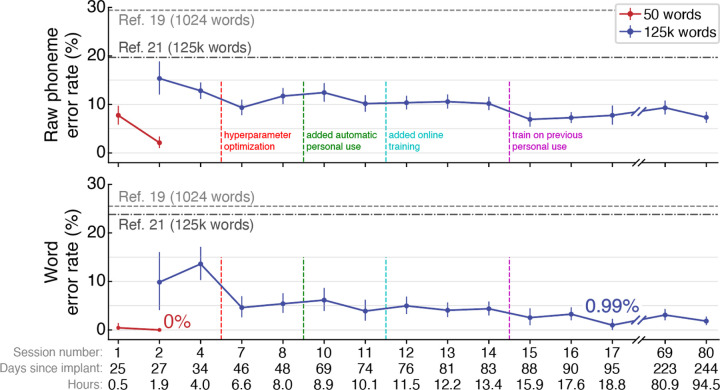
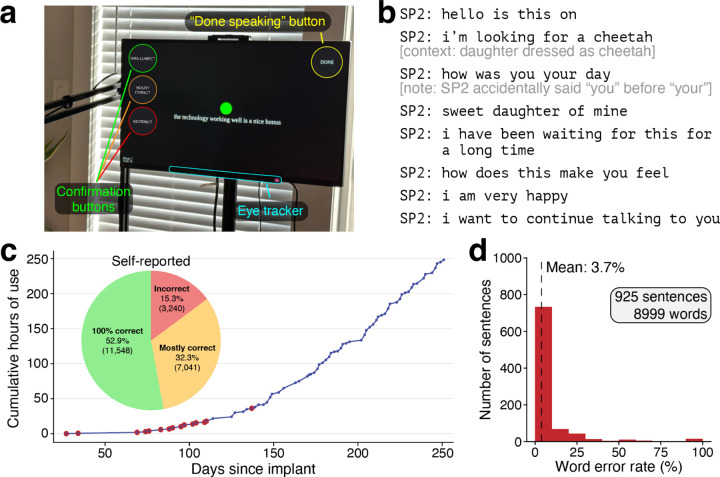
Brain-computer interfaces can enable rapid, intuitive communication for people with paralysis by transforming the cortical activity associated with attempted speech into text on a computer screen. Despite recent advances, communication with brain-computer interfaces has been restricted by extensive training data requirements and inaccurate word output. A man in his 40’s with ALS with tetraparesis and severe dysarthria (ALSFRS-R = 23) was enrolled into the BrainGate2 clinical trial. He underwent surgical implantation of four microelectrode arrays into his left precentral gyrus, which recorded neural activity from 256 intracortical electrodes. We report a speech neuroprosthesis that decoded his neural activity as he attempted to speak in both prompted and unstructured conversational settings. Decoded words were displayed on a screen, then vocalized using text-to-speech software designed to sound like his pre-ALS voice. On the first day of system use, following 30 minutes of attempted speech training data, the neuroprosthesis achieved 99.6% accuracy with a 50-word vocabulary. On the second day, the size of the possible output vocabulary increased to 125,000 words, and, after 1.4 additional hours of training data, the neuroprosthesis achieved 90.2% accuracy. With further training data, the neuroprosthesis sustained 97.5% accuracy beyond eight months after surgical implantation. The participant has used the neuroprosthesis to communicate in self-paced conversations for over 248 hours. In an individual with ALS and severe dysarthria, an intracortical speech neuroprosthesis reached a level of performance suitable to restore naturalistic communication after a brief training period.
Overview
The claims and statistics of this paper haven’t been checked yet.
Free: it reads the open-access text and checks the first 5 claims that cite a source we can check. Create a free account to check every claim.
Integrity signals
Registry
Cites
Statistics
Figures
Verification
Claims the paper makes
The claims and statistics of this paper haven’t been checked yet.
Free: it reads the open-access text and checks the first 5 claims that cite a source we can check. Create a free account to check every claim.
Claims other papers make about this one
Each is checked against this paper’s own text: does it say what the citing paper says it does?
The source backs part of the claim, not all of it — or backs it for a different population, condition or comparison.
In the citing paper
“Subsequent work has expanded this initial demonstration by directly decoding cortical activity into audible speech13,14 and allowing more generalizable and rapid text decoding14–16 in individuals with vocal-tract paralysis (Fig. 1).”
From The speech neuroprosthesis (2024) · cites this paper as [16]
Experimental — accuracy not yet measuredThe source backs part of the claim, not all of it — or backs it for a different population, condition or comparison.
In the citing paper
“Current speech-decoding applications from brain activity are primarily aimed at restoring communication to individuals with both limb and vocal-tract paralysis14–16.”
From The speech neuroprosthesis (2024) · cites this paper as [16]
Experimental — accuracy not yet measuredThe source backs part of the claim, not all of it — or backs it for a different population, condition or comparison.
In the citing paper
“Recent studies have also achieved high-performance speech-decoding results15,16 by measuring relevant single-unit and multi-unit neuronal activity from multiple small (4 × 4 mm2 (ref. 83)) cortical regions on the anterior precentral gyrus15,16,52,98.”
From The speech neuroprosthesis (2024) · cites this paper as [16]
Experimental — accuracy not yet measuredThe source backs part of the claim, not all of it — or backs it for a different population, condition or comparison.
In the citing paper
“Recent works have achieved large-vocabulary decoding while maintaining decoding speeds closer to natural speech, by using CTC loss.”
From The speech neuroprosthesis (2024) · cites this paper as Card et al. 2023
Experimental — accuracy not yet measuredThe source backs part of the claim, not all of it — or backs it for a different population, condition or comparison.
In the citing paper
“A second approach, specific to text decoding, involves leveraging large language models to automatically recalibrate MEA-based text neuroprostheses.”
From The speech neuroprosthesis (2024) · cites this paper as [16]
Experimental — accuracy not yet measured
6 more claims about this paper
Create a free account to see every claim other papers make about this one.
Self-check
Percentages, sums and reported differences re-computed from the paper’s own numbers.
The self-check needs the paper’s full text.
Citations
Cites
NWChem: A comprehensive and scalable open-source solution for large scale molecular simulations
Valiev, M., Bylaska, E. J., Govind, N., Kowalski, K., Straatsma, T. P., Van Dam, H. J. J., Wang, D., Nieplocha, J., Apra, E., Windus, T. L., et al. (2010) · Computer Physics Communications · doi:10.1016/j.cpc.2010.04.018 · Cited by 5,779
A multi-modal parcellation of human cerebral cortex
Glasser, M. F., Coalson, T. S., Robinson, E. C., Hacker, C. D., Harwell, J., Yacoub, E., Ugurbil, K., Andersson, J., Beckmann, C. F., Jenkinson, M., et al. (2016) · Nature · doi:10.1038/nature18933 · Cited by 5,111 · cited 2×
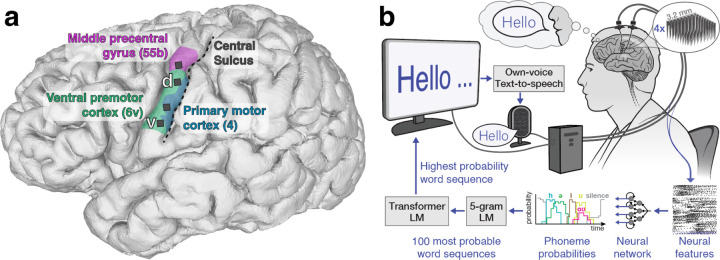
“…four 64-electrode Utah arrays chronically implanted in the precentral gyrus, targeted to brain areas that contributed most to speech decoding from recent studies 16,18,20 using the Human Connectome Project’s multi-modal MRI-derived cortical parcellation precisely mapped to SP2’s brain 21 (Fig.”
BackgroundMethodSelf-citationUnbiased average age-appropriate atlases for pediatric studies
Fonov, V., Evans, A. C., Botteron, K., Almli, C. R., McKinstry, R. C., & Collins, D. L. (2011) · NeuroImage · doi:10.1016/j.neuroimage.2010.07.033 · Cited by 2,290
SWITCHBOARD: telephone speech corpus for research and development
Godfrey, J. J., Holliman, E. C., & McDaniel, J. (1992) · [Proceedings] ICASSP-92: 1992 IEEE International Conference on Acoustics, Speech, and Signal Processing · doi:10.1109/icassp.1992.225858 · Cited by 2,134 · cited 4×
“We used neural activity collected during the speech tasks to train a recurrent neural network (RNN, Section S2) to predict the probability of each English phoneme being spoken.”
MethodInfluentialUnbiased nonlinear average age-appropriate brain templates from birth to adulthood
Fonov, V., Evans, A., McKinstry, R., Almli, C., & Collins, D. (2009) · NeuroImage · doi:10.1016/s1053-8119(09)70884-5 · Cited by 2,102
Salimi-Khorshidi, G., Douaud, G., Beckmann, C. F., Glasser, M. F., Griffanti, L., & Smith, S. M. (2014) · NeuroImage · doi:10.1016/j.neuroimage.2013.11.046 · Cited by 1,770
Self-citationHigh-performance brain-to-text communication via handwriting
Willett, F. R., Avansino, D. T., Hochberg, L. R., Henderson, J. M., & Shenoy, K. V. (2021) · Nature · doi:10.1038/s41586-021-03506-2 · Cited by 1,024
Self-citationSpeech synthesis from neural decoding of spoken sentences
Anumanchipalli, G. K., Chartier, J., & Chang, E. F. (2019) · Nature · doi:10.1038/s41586-019-1119-1 · Cited by 883
A brain-computer interface that evokes tactile sensations improves robotic arm control
Flesher, S. N., Downey, J. E., Weiss, J. M., Hughes, C. L., Herrera, A. J., Tyler-Kabara, E. C., Boninger, M. L., Collinger, J. L., & Gaunt, R. A. (2021) · Science · doi:10.1126/science.abd0380 · Cited by 617
Harms, M. P., Somerville, L. H., Ances, B. M., Andersson, J., Barch, D. M., Bastiani, M., Bookheimer, S. Y., Brown, T. B., Buckner, R. L., Burgess, G. C., et al. (2018) · NeuroImage · doi:10.1016/j.neuroimage.2018.09.060 · Cited by 584
Self-citation
Research works printed but not linked: 10
- 2023, Interim Safety Profile From the Feasibility Study of the BrainGate Neural Interface System, Neurology, 100, e1177
- 2002, Timing of speech deterioration in people with amyotrophic lateral sclerosis, J Med Speech-Lang Pathol, 10, 231
- Glasser MF, Coalson TS, Robinson EC, A multi-modal parcellation of human cerebral cortex. Nature 2016; 536(7615): 171– 8. 27437579 PMC4990127 · DOI · Paper page
- 10.1056/nejmoa2027540 · DOI · Paper page
- Metzger SL, Liu JR, Moses DA, Generalizable spelling using a speech neuroprosthesis in an individual with severe limb and vocal paralysis. Nat Commun 2022; 13(1): 6510. 36347863 PMC9643551 · DOI · Paper page
- Metzger SL, Littlejohn KT, Silva AB, A high-performance neuroprosthesis for speech decoding and avatar control. Nature 2023; 620(7976): 1037– 46. 37612505 PMC10826467 · DOI · Paper page
- Silva AB, Liu JR, Zhao L, Levy DF, Scott TL, Chang EF. A Neurosurgical Functional Dissection of the Middle Precentral Gyrus during Speech Production. J Neurosci 2022; 42(45): 8416– 26. 36351829 PMC9665919 · DOI · Paper page
- Ali YH, Bodkin K, Rigotti-Thompson M, BRAND: A platform for closed-loop experiments with deep network models [Internet]. 2023 [ cited 2023 Dec 11];2023.08.08.552473. Available from: 10.1101/2023.08.08.552473v1 PMC11021878 38579696 · doi:10.1101/2023.08.08.552473v1
- Godfrey JJ, Holliman EC, McDaniel J. SWITCHBOARD: telephone speech corpus for research and development [Internet]. In: [Proceedings] ICASSP-92: 1992 IEEE International Conference on Acoustics, Speech, and Signal Processing. 1992 [ cited 2023 Dec 11]. p. 517– 20 vol. 1. Available from: https://ieeexplore.ieee.org/document/225858 · DOI · Paper page
- Sussillo D, Stavisky SD, Kao JC, Ryu SI, Shenoy KV. Making brain–machine interfaces robust to future neural variability. Nat Commun 2016; 7(1): 13749. 27958268 PMC5159828 · DOI · Paper page
Cited by
Items 101–186 of 186
Meyer, L. M., & Zamani, M. (2026) · Journal of Neural Engineering · doi:10.1088/1741-2552/ae6dfd · Cited by 1
“Scaling the system to a 125 000-word vocabulary required just 1.4 additional hours of training [95], in sharp contrast to earlier models (see table 4).”
InfluentialEnd-to-End Intracortical Speech Decoding from Neural Activity
Khanday, O. M., Gonzalez-Lopez, J. A., Ouellet, M., Galdón, A., & Granados, G. O. (2026) · The Speaker and Language Recognition Workshop (Odyssey) · doi:10.21437/odyssey.2026-24 · Cited by 1
“A series of landmark studies in recent years has helped define the current state of the art in intracortical speech neuro-prostheses [25, 26, 27].”
InfluentialFrom Clever Hans to Scientific Discovery: Interpreting EEG Foundational Transformers with LRPPreprint
zu Bexten, J. M., Scherf, N., Franczyk, B., & Hofmann, S. (2026) · arXiv (Cornell University) · doi:10.48550/arxiv.2605.11885 · Cited by 2
“If these models achieve their promised generalization capabilities, their potential impact could be substantial (e.g., ALS speech prostheses [4]).”
Temporal structure of the language hierarchy within small cortical patchesPreprint
Gadonneix, J., Zhang, M., Rapin, J., Evanson, L., Bourdillon, P., & King, J.-R. (2026) · arXiv (Cornell University) · doi:10.48550/arxiv.2604.03021 · Cited by 2
“Detailed metadata regarding both datasets can be accessed through these repositories or in the original reports characterizing these neural populations (Willett et al., 2023; Card et al., 2024).”
InfluentialCIPHER: Conformer-based Inference of Phonemes from High-density EEG
Madishetty, V. (2026) · arXiv.org · doi:10.48550/arxiv.2604.02362 · Cited by 1
“While intracortical recordings have achieved remarkable decoding performance—including real-time sentence-level speech synthesis [1–3]—the clinical invasiveness of implanted electrode arrays severely limits their scalability.”
Towards unified brain-to-text decoding across speech production and perceptionPreprint
Yuan, Z., Yang, Y., Zhang, G., Cheng, B., Wu, Z., Xu, Y., Liu, X., Chen, L., Mao, Y. Q., & Li, M. (2026) · arXiv (Cornell University) · doi:10.48550/arxiv.2603.12628 · Cited by 1
Decoding the decoder: Contextual sequence-to-sequence modeling for intracortical speech decoding
Olak, M., Boccato, T., & Ferrante, M. (2026) · arXiv.org · doi:10.48550/arxiv.2603.20246 · Cited by 1
“Recent advances have clarified how articulatory and linguistic information is represented across speech-related cortex [2, 3, 4] and have culminated in initial demonstrations of real-time speech neuroprostheses for communication restoration [5, 6, 7].”
Words, Articulations, and Utterance Plans
Gasparri, L. (2026) · Philosophy and Phenomenological Research · doi:10.1111/phpr.70096
Compositional decoding of neural activity enhances generalization in handwriting BCIsPreprint
Narasimha, S. M., Huang, J., Sristi, R. D., Gilja, V., & Mishne, G. (2026) · bioRxiv (Cold Spring Harbor Laboratory) · doi:10.64898/2026.02.09.704932 · Cited by 1
“Recent brain-to-text BCIs for attempted speech have leveraged compositionality by decoding phoneme sequences to reconstruct words, achieving record communication rates [2]–[4].”
Relational personhood: the missing link for evaluating clinical impact of brain–computer interfaces
van Balen, B., Ramsey, N. F., & Vansteensel, M. J. (2025) · Brain Communications · doi:10.1093/braincomms/fcaf470 · Cited by 1
MEGState: Phoneme Decoding from Magnetoencephalography Signals
Suzuki, S., Hsu, C.-C.-D., Tsao, Y., et al. (2025) · arXiv.org · doi:10.48550/arxiv.2512.17978 · Cited by 1
“Recent advances in invasive brain–computer interfaces [Nagashima et al., 2025, Suzuki et al., 2025] have enabled continuous speech reconstruction from intracranial recordings, achieving word error rates below 5% for vocabularies exceeding 100,000 words [Card et al., 2024].”
Learning discrete neural latent spaces for high-performance speech decoding
Jia, Y., Lian, Q., Wang, L., Wang, Y., & Qi, Y. (2025) · Journal of Neural Engineering · doi:10.1088/1741-2552/ae2ccd · Cited by 1
“Previous studies have shown that RNN architectures are well-suited for NS decoding tasks [6, 7, 16, 31], while our results in section 3.2 show that LSTM is more robust compared to RNN and GRU.”
InfluentialTicha, M. B. B., Ran, X., Saldanha, G., Godais, G. L., Roussel, P., Aubert, M., Fontanell, A., Costecalde, T., Struber, L., Karakas, S., et al. (2025) · arXiv (Cornell University) · doi:10.48550/arxiv.2512.04618
“These proof-of-concepts of functional speech BCIs rely either on subdural ECoG recordings [16], [17], [18], [19], [20], [21], or, more recently, on intracortical recordings with Utah arrays [22], [23], [24].”
Temmar, H., Wang, Y., Gill, N., et al. (2025) · Neural Information Processing Systems · doi:10.52202/085713-4642 · Cited by 1
“Additionally, BMIs have helped restore speech in people living with ALS using recurrent-neural network decoders [18–20].”
Don’t put words in my mouth: speech perception can falsely activate a brain-computer interface
Schippers, A., Vansteensel, M. J., Freudenburg, Z. V., Luo, S., Crone, N. E., & Ramsey, N. F. (2025) · Journal of NeuroEngineering and Rehabilitation · doi:10.1186/s12984-025-01689-7 · Cited by 8
“A recent article reported overall high reliability of a speech BCI decoder, also in conversational settings, but of all trials in which speech was detected, in a small percentage the participant was not attempting to speak [22].”
Speech mode classification from electrocorticography: transfer between electrodes and participants
de Borman, A., Wittevrongel, B., Dyck, B. V., Rooy, K. V., Carrette, E., Meurs, A., Roost, D. V., & Hulle, M. M. V. (2025) · Journal of Neural Engineering · doi:10.1088/1741-2552/adf2de · Cited by 2
“Impressive results have also been demonstrated with minimal training requirements (Card et al 2024) and instantaneous voice-synthesis (Wairagkar et al 2025).”
Towards Unified Neural Decoding with Brain Functional Network ModelingPreprint
Wu, D., Bu, L., Jia, Y., Cao, L., Li, S., Chen, S., Zhou, Y., Fan, S., Ren, W., Wu, D., et al. (2025) · bioRxiv (Cold Spring Harbor Laboratory) · doi:10.1101/2025.06.02.657011 · Cited by 1
“The most significant contribution was identified in precentral gyrus and postcentral gyrus which have been extensively researched in speech decoding 7,9,29 .”
Recreating Neural Activity During Speech Production with Language and Speech Model Embeddings
Khanday, O. M., Esteban, P., Lone, Z., et al. (2025) · Interspeech · doi:10.48550/arxiv.2505.14074 · Cited by 1
“The potential applications of these devices are numerous [14], including the promise to restore communication to individuals with conditions such as amyotrophic lateral sclerosis (ALS) [15, 4, 11, 6, 16] or other severe speech disorders caused by brain damage (e.g. brain-stem stroke) [2, 3].”
Impact of Temporal Precision on Speech Synthesis Accuracy From Electrocorticographic Brain Signals
Rabbani, Q., Fifer, M. S., Crone, N. E., & Moro-Velázquez, L. (2025) · IEEE International Conference on Acoustics Speech and Signal Processing · doi:10.1109/icassp49660.2025.10888813 · Cited by 2
“However, for individuals with severe speech impairments, only "silent speech" (speech without audible vocal output) is feasible [4], [5], [9], [12].”
Bird’s Eye View of Artificial Intelligence in Neuroscience
Zhou, M. H., Lin, E., Ye, A. Q., Mukherjee, P., & Yuh, E. L. (2025) · AI in neuroscience. · doi:10.1089/ains.2024.0001 · Cited by 2
“55 CNNs are used in other studies in this cluster, to facilitate translation of EEG signals, for example, for emotion recognition, prognostication in coma patients subjected to auditory stimuli after cardiac arrest, and EEG denoising.”
Non-invasive brain-machine interface control with artificial intelligence copilotsPreprint
Lee, J. Y., Lee, S., Mishra, A., Xu, Y., McMahan, B., Gaisford, B., Kobashigawa, C., Qu, M., Xie, C., & Kao, J. C. (2024) · bioRxiv (Cold Spring Harbor Laboratory) · doi:10.1101/2024.10.09.615886 · Cited by 2
“Recent studies have demonstrated high-performance intracortical BCI communication by decoding speech 48–50 .”
NeuroLens: Learning Latent Embeddings of Neural Semantics from Chronic RecordingsPreprint
Lyu, H., Chen, B., Tan, T., Whiteway, M. R., Melin, M. D., Xia, J., He, L., Stadie, B. C., Churchland, A. K., Paninski, L., et al. (2026) · arXiv (Cornell University) · doi:10.48550/arxiv.2610.02864
“For T15, we analyze 9,498 trials across 45 sessions over 20 months, using all 256 electrodes in the precentral gyrus (Card et al., 2024).”
InfluentialNadrchal, D., Swain, M., Schmid, F., Widmer, G., & Primus, P. (2026) · arXiv · doi:10.48550/arxiv.2610.03017
“Furthermore, while recent advances in speech neuropros-theses (e.g., Card et al. [8]) have achieved a remarkable 2.5% WER for ALS patients using neural implants, such methods are expensive and highly invasive, rendering them impractical for our user’s immediate real-world needs.”
InfluentialFrom Neurons to Conversation: Speech Brain-Computer InterfacesPreprint
Khajehnejad, M., Habibollahi, F., Boccato, T., Sousa, M., Olak, M., Sheiban, F. J., & Ferrante, M. (2026) · arXiv (Cornell University) · doi:10.48550/arxiv.2609.36736
“In particular, large-vocabulary accuracy with only brief daily calibration [2] suggests that the bottleneck is shifting from signal availability toward longitudinal stability.”
InfluentialJev Matches 7B Language Models for Speech-Neuroprosthesis Rescoring
Cinà, G. (2026) · doi:10.48550/arxiv.2609.33538
“A recurrent network trained with connectionist temporal classification [5] emits phoneme probabilities, a lexicon-and n -gram-constrained decoder turns them into a ranked list of candidate sentences, and a language model rescores that list before the winner is spoken [1, 2].”
InfluentialA stereoencephalography study of internal speech
Naumov, A. V., Soghoyan, G. A., Makarova, A. V., Syrov, N., Skripnikov, A. A., Kustov, Y. V., Sufianov, A. A., & Lebedev, M. A. (2026) · Cognitive Neurodynamics · doi:10.1007/s11571-026-10554-9
“Our data further emphasize the involvement of dorsal motor regions during imagined speech, confirming previ - ous studies that have reported significant activation in these areas during covert articulation tasks (e.g., Willett et al. 2021; Card et al. 2024 ).”
Assistive algorithms influence neural representations in motor brain-computer interfaces
Rajeswaran, P., Payeur, A., Lajoie, G., & Orsborn, A. L. (2026) · Nature Communications · doi:10.1038/s41467-026-76109-y · Cited by 12
“Given measurement instabilities overa BCI ’ s lifetime, adaptive decoding is unavoidable and widely used in recent high-performance human BCIs (e.g., 44,67 – 69 ).”
Xie, P., & Alanwar, A. (2026) · arXiv (Cornell University) · doi:10.48550/arxiv.2609.07474 · Cited by 1
“Intracortical speech neuroprostheses decode attempted speech with language-model priors at 62 words per minute on a 125,000-word vocabulary [263], keep 97.5% accuracy over 8.4 months [32], and decode inner speech, protected by a passphrase [127].”
InfluentialBidirectional Wireless Communication for Weakly Coupled Implantable Brain-Computer InterfacesPreprint
Sen, S., Chatterjee, B., Barik, G., & Roy, A. (2026) · arXiv (Cornell University) · doi:10.48550/arxiv.2609.05786
Preserving Motor Features by Alternative Re‐Referencing to Remove Heart Artifact on the Stentrode
Feldman, A. K., Kacker, K., Yun, R., Chetty, N., Bennett, J., Yoo, P. E., Nogueira, R. G., Collinger, J. L., Opie, N. L., Oxley, T. J., et al. (2026) · Advanced Science · doi:10.1002/advs.76647
“These devices, with capabilities ranging from controlling a robotic arm [ 1–4 ] to real-time speech production [ 5–9 ], are rapidly evolving, with recent years witnessing significant advancements in the creation and commercialization of novel BCIs [ 10–12 ].”
Decoding silent reading from non-invasive EEGPreprint
Marquardt, I., Alchanat, A., & Jain, P. (2026) · arXiv (Cornell University) · doi:10.48550/arxiv.2608.20186 · Cited by 1
“Moses et al. (2021) reported that a language model reduced their median word error rate by 35 percentage points; Metzger et al. (2023) and Card et al. (2024) both rely on n-gram language models and large-language-model rescoring to convert noisy phoneme posteriors into accurate text; Kunz et al.…”
Bhairanatti, S. (2026) · Natural Resources for Human Health · doi:10.53365/nrfhh.481
“Card then addressed calibration, reaching 99.6 percent on the first day of use after thirty minutes of calibration and sustaining 97.5 percent over 8.4 months [43].”
InfluentialOptimal Size of Electrocorticography Grids for Classification of Hand Movements
Offenberg, E. C., Keller, D., Mehrkanoon, S., Berezutskaya, J., Vansteensel, M. J., & Branco, M. P. (2026) · Neuroinformatics · doi:10.1007/s12021-026-09807-z
Semenkov, I., Kleeva, D. F., Dakhtin, I., Maksudova, Z., & Ossadtchi, A. E. (2026) · arXiv (Cornell University) · doi:10.48550/arxiv.2608.01481
“And because speech production and perception share circuitry [16–19], the applications are concrete — speech neuroprostheses [5, 20], imagined-speech interfaces [21], and passive language mapping during surgery [22–24].”
van Balen, B., van Grunsven, J., IJsselsteijn, W. A., Ramsey, N. F., & Vansteensel, M. J. (2026) · Neuroethics · doi:10.1007/s12152-026-09660-6 · Cited by 1
“[23], p. 19, [14].”
EasyBCI Agent: Towards Universal Neural Data Preprocessing for Brain-Computer InterfacesPreprint
Zhu, Y., Zhao, R., Zhou, Z., Cai, J., Yao, Z., Zhang, C., Li, P., Zhang, X., Zheng, Q., Wu, J., et al. (2026) · arXiv (Cornell University) · doi:10.48550/arxiv.2607.29007
Vera, L. Z., & López, J. A. G. (2026) · arXiv (Cornell University) · doi:10.48550/arxiv.2607.26751 · Cited by 1
“…support coarse perception decoding [7, 8], electrocorticography (ECoG) enables phrase-and sentence-level decoding and synthesis [9, 10, 11, 12, 13], and intracortical microelectrode arrays offer the highest spatiotemporal resolution, driving the most accurate recent speech decoders [1, 14, 15].”
InfluentialDo EEG Foundation Models Transfer to Speech? A Benchmark on Overt and Imagined Speech DecodingPreprint
Khanday, O. M., Ticha, M. B. B., Belfrouh, S., Ouellet, M., & Gonzalez-Lopez, J. A. (2026) · arXiv (Cornell University) · doi:10.48550/arxiv.2607.27268 · Cited by 3
“The most remarkable advances in speech decoding have been achieved with invasive techniques — intracortical arrays [1, 2, 3, 4, 5] and electrocorticography (ECoG) [6, 7, 8, 9, 10, 11] — yet attention is increasingly turning toward less invasive approaches such as stereo-EEG (sEEG) [12, 13, 14, 15,…”
AI-integrated closed-loop brain-machine interfaces using soft bioelectronics
Kim, S., Kim, D., & Son, D. (2026) · Biomedical Engineering Letters · doi:10.1007/s13534-026-00606-8
Frequency-dependent effects of motor thalamus deep brain stimulation on speech and swallowing
Tang, L. W., Grigsby, E. M., Damiani, A., Ho, J. C., Montanaro, I. M., Nouduri, S., Ensel, S., Trant, S., Constantine, T., Adams, G. M., et al. (2026) · Nature Communications · doi:10.1038/s41467-026-75588-3 · Cited by 2
“In this regard, several research teams have developed real-time brain-computer interfaces that detect intended speech from cortical neural signals and output it onacomputerscreen 77 – 82 , buildingoff fromdecadesof braindecoding technologies for upper-and lower-limbs 76 .”
Shared latent representations of speech production for cross-patient speech decoding
Spalding, Z., Duraivel, S., Rahimpour, S., Wang, C., Barth, K. J., Schmitz, C., Lad, S. P., Friedman, A. H., Southwell, D. G., Viventi, J., et al. (2026) · Nature Communications · doi:10.1038/s41467-026-75455-1 · Cited by 7
“neural activity 7 – 10 , but introduce challenges related to surgical implantation, limited and variable electrode coverage, and patient-speci fi c sampling of neural populations.”
InfluentialXiao, B., Xu, X., Li, S., Yan, Y., Wu, X., Cheng, H., & Chen, J. (2026) · arXiv (Cornell University) · doi:10.48550/arxiv.2607.12071
“While speech decoders trained on invasive neural signals [4, 29, 48] leverage high-SNR neural signals [12, 26] to yield robust results, their widespread usability is constrained by significant surgical risks.”
Brain2voice 2.0: High-performance voice synthesis brain-computer interfacePreprint
Wairagkar, M., Srinivasan, A., Card, N. S., Singer-Clark, T., Hou, X., Iacobacci, C., Miller, L. M., Hochberg, L. R., Brandman, D. M., & Stavisky, S. D. (2026) · bioRxiv (Cold Spring Harbor Laboratory) · doi:10.64898/2026.06.30.735633 · Cited by 2
“The predicted phonemes have a low causal raw phoneme error rate of 7% (without a language model), comparable to recent brain-to-text models [2, 4].”
InfluentialSelf-citationPhysiological Noise Augmentation Improves Non-Invasive Brain-to-SpeechPreprint
Ballyk, B., Kwon, T., Özdogan, M., & Jones, Ō. P. (2026) · arXiv (Cornell University) · doi:10.48550/arxiv.2607.05165
“Although recent intracranial brain-computer interfaces (BCIs) have achieved increasingly accurate decoding of intended speech from cortical activity [30, 42, 5], these invasive systems carry risks of neurosurgical complications and long-term electrode instability [23].”
Heo, J.-H., Wisniewska, A. J., Lee, S., & Lee, S.-W. (2026) · arXiv (Cornell University) · doi:10.48550/arxiv.2607.19394
“Recent advances have shown potential for robust speech decoding and imagined speech-based communication systems [10], [11], [12], [13], [14], [15].”
Bekhelifi, O., & Mebtouche, N. E.-D. (2026) · arXiv.org · doi:10.48550/arxiv.2607.00794
“With rapid progress in the Brain-Computer Interface (BCI) field, invasive systems that implant electrodes into brain tissue can restore communications for amyotrophic lateral sclerosis (ALS) patients [1], [2].”
Estimation of neuronal tuning for word meaning from passively recorded naturalistic speechPreprint
Ismail, T., Chavez, A. G., Yan, X., Zhu, H., Franch, M. C., Belanger, J. L., Chamarthi, S., Kabotyanski, K. E., Katlowitz, K. A., Chericoni, A., et al. (2026) · bioRxiv (Cold Spring Harbor Laboratory) · doi:10.64898/2026.06.23.733980
“…models derived from everyday speech are increasingly relevant for clinical technologies, including speech prosthetics and adaptive deep brain stimulation, which require robust neural– linguistic mappings outside the laboratory (Card et al., 2024; Herron et al., 2017; Pina-Fuentes et al., 2020).”
Exploring Synergies in Brain-Machine Interfaces: Compression vs. Performance
Cubillos, L. H., Kelberman, M. M., Mender, M. J., Hite, A., Temmar, H., Willsey, M. S., Kumar, N. G., Kung, T. A., Patil, P. G., Chestek, C. A., et al. (2026) · Restorative Neurology and Neuroscience · doi:10.1177/09226028261457824
“…of controlling external devices by directly decoding brain signals into behavioral commands, and have been successfully applied in various settings, including controlling robotic arms (Hochberg et al., 2012; Flesher et al., 2021) and decoding live speech (Willett et al., 2021; Card et al., 2024).”
Sensory Restoration via Brain-Computer Interfaces: A Scoping ReviewPreprint
Tran, X.-T. (2026) · arXiv (Cornell University) · doi:10.48550/arxiv.2606.15091
“Primary [6] 2024 NEJM Intracortical speech (ALS) Eff.”
Swanson, E., Dohle, E., Bashford, L., Horsfall, H. L., Jovanovic, L., Muirhead, W. R., & Brannigan, J. (2026) · Journal of Neural Engineering · doi:10.1088/1741-2552/ae7694 · Cited by 2
“Most of these studies used either endovascular or planar ECoG arrays to record neural activity [7, 18, 39, 40, 43, 45–48, 50, 52–58], and only three used alternative devices [28, 49, 51].”
InfluentialA 1000-hour EEG-EMG-audio dataset of Japanese speech production
Sato, M., Horiguchi, I., Inoue, M., et al. (2026) · arXiv.org · doi:10.48550/arxiv.2606.01264
RAG-based EEG-to-Text Translation Using Deep Learning and LLMs
Collautti, E., Mao, X.-P., Tonin, L., et al. (2026) · arXiv.org · doi:10.48550/arxiv.2605.17503
“Recent advances in invasive neural recording technologies, such as electrocorticogra-phy (ECoG) and intracortical implants, have demonstrated promising results in decoding speech and linguistic information directly from brain activity [1], [2].”
A multi-region flexible neural interface for behavioral state decoding in freely moving mice
Tian, Y., Li, G., Su, H., Jiang, L., Luo, Y., Yang, Y., Huang, L., Li, J., Jin, S., Chen, P., et al. (2026) · Microsystems & Nanoengineering · doi:10.1038/s41378-026-01258-5 · Cited by 1
“Nevertheless, most current approaches remain con fi ned to a “ single-subject-single-model ” paradigm, where a model is effective only for a speci fi c individual within a speci fi c timeframe, severely limiting its versatility and translational potential 11,13 .”
MoDAl: Self-Supervised Neural Modality Discovery via Decorrelation for Speech Neuroprosthesis
Chen, Y., & Chin, P. S. (2026) · INTERNATIONAL CONFERENCE ON MULTIMODAL INTERACTION · doi:10.1145/3776574.3832754
Fast Label-Free Cross-Session Calibration for intra-cortical Speech Decoding
Roy, D., & Tabassum, F. (2026) · IEEE International Conference on Quantum Photonics, Artificial Intelligence & Networking (QPAIN) · doi:10.1109/qpain69676.2026.11546072
“We evaluated on the T12 intracortical speech public release, using the competitionData partition which provides aligned neural features and sentence transcripts across multiple recording days [2], [10].”
Neural Reconstruction in Disorders of Consciousness: Prospects and Emerging Challenges
Kolisnyk, M., Rankaduwa, S., Gupta, G., Kazazian, K., Debicki, D., & Owen, A. M. (2026) · The Neuroscientist · doi:10.1177/10738584261434939
“In speech reconstruction, neural activity may be translated into linguistic units such as phonemes or characters (Moses et al 2021; Willett et al 2021; Card et al 2024).”
InfluentialiPhoneme: Brain-to-Text Communication for ALS Using ConformerXL DecodingPreprint
Cha, Y., Chun, D., & Park, S. (2026) · arXiv (Cornell University) · doi:10.48550/arxiv.2604.16441
“Our system achieves approximately 3% absolute improvement over Card et al. [5] (89%), the prior state-of-the-art on the same T15 dataset.”
InfluentialA Modular Methodology for on-Device Audio Transcription from Live Media
SOUZA, T. D. J., Oliveira, S. B., Kimura, P. A. A., et al. (2026) · 2026 IEEE 2nd International Conference on Consumer Technology (ICCT-Pacific) · doi:10.1109/icct-pacific69083.2026.11518899
“It quantifies the number of errors (insertions, deletions, and substitutions) made by a system relative to a ground-truth transcription, with a lower WER indicating higher accuracy [9].”
EEG Foundation Model Improves Online Directional Motor Imagery Brain-computer Interface ControlPreprint
Karrenbach, M., Wang, H., Johnson, Z., Ding, Y., & He, B. (2026) · bioRxiv (Cold Spring Harbor Laboratory) · doi:10.64898/2026.03.24.714020
“Invasive BCI systems have created frameworks which enabled robust robotic manipulation [3], [4] or communicative speech [5], [6].”
ALIGN: Adversarial Learning for Generalizable Speech NeuroprosthesisPreprint
Zhang, Z., Li, S., Sabatini, B. L., Aoi, M., & Mishne, G. (2026) · arXiv (Cornell University) · doi:10.48550/arxiv.2603.18299 · Cited by 1
“As in Willett et al. [2023], Feghhi et al. [2025], Card et al. [2024], we use (2) Here, P enc ( b ) denotes the probability of the phoneme sequence under the phoneme classifier (CTC), and P ngram ( b ) is the probability assigned by the n -gram language model to the same phoneme sequence.”
LightBeam: An Accurate and Memory-Efficient CTC Decoder for Speech Neuroprostheses
Feghhi, E., Hu, J., Hadidi, N., et al. (2026) · arXiv.org · doi:10.48550/arxiv.2603.14002
“Speech neuroprostheses offer a promising path toward restoring communication for patients with these disorders, bypassing the vocal tract by decoding speech directly from neural activity [2, 3, 4, 5].”
InfluentialHe, D.-Y., Siok, W., & Wang, N.-Z. (2026) · doi:10.48550/arxiv.2603.12279
“Intracortical MEAs enabled high-rate and high-fidelity speech neuroprosthesis demonstrations [1, 10, 46], while chronic ECoG systems demonstrated stronger home-use feasibility in selected users with ALS [12, 13].”
InfluentialCross-subject decoding of human neural data for speech brain computer interfaces
Boccato, T., Olak, M., & Ferrante, M. (2026) · Journal of Neural Engineering · doi:10.1088/1741-2552/ae8576
“Log absolute determinant.”
InfluentialThe evolution of speech communication devices for anarthria: a review
Jones, C. T., & Hill, E. R. (2026) · Journal of Neurology · doi:10.1007/s00415-026-13734-z
“However, a 2024 study has analyzed neuroprosthetic usage in free, unprompted communication [39].”
InfluentialMEBM-Phoneme: Multi-scale Enhanced BrainMagic for End-to-End MEG Phoneme Classification
Liang, J.-H., Zhang, Z.-F., Li, S., et al. (2026) · arXiv.org · doi:10.48550/arxiv.2603.02254
“Recent advances in invasive neuroprosthetic technologies achieve remarkable accuracy by directly mapping neural activity to phoneme categories and then decoding text through language models [1, 2, 3].”
Closed-loop error damping in human BCI using pre-error motor cortex activityPreprint
Gontier, C., Hockeimer, W., Kunigk, N. G., Canario, E., Endsley, L. J., Downey, J. E., Weiss, J. M., Dekleva, B. M., & Collinger, J. L. (2026) · bioRxiv (Cold Spring Harbor Laboratory) · doi:10.64898/2026.02.25.707999
“In recent years, brain-computer interfaces (BCIs) have shown promise in restoring motor or communication ability that has been lost or impaired due to injury or disease [1–4].”
Word classification across speech modes from low-density electrocorticography signals
de Borman, A., Dyck, B. V., Rooy, K. V., Carrette, E., Meurs, A., Roost, D. V., & Hulle, M. M. V. (2026) · Journal of Neural Engineering · doi:10.1088/1741-2552/ae3a1b · Cited by 1
“Attempted speech can now be decoded with a very high accuracy (Moses et al 2021, Metzger et al 2023, Willett et al 2023, Card et al 2024, Littlejohn et al 2025, Wairagkar et al 2025).”
Grajski, K. A. (2025) · bioRxiv (Cold Spring Harbor Laboratory) · doi:10.1101/2025.08.21.671572
“Specifically, we hypothesize that ECoG correlation-based features (HG-C) are robust with respect to signal amplitude drift (regardless of root cause in biological or electrical or mechanical factors) and focal and distributed electrode disconnection.”
Anyanwu, B., & Anukam, V. O. (2025) · Journal of Arts and Sociological Research · doi:10.70382/ajasr.v10i6.065
“…most anticipated AI-driven technological breakthroughs include advancements in communication-assistive devices, such as brain – computer interfaces ( Card et al., 2024), personalized automatic speech recognition (Green et al., 2021), voice cloning ( Anand & Reji, 2024), and eye-tracking…”
Optimizing Tonal Speech Decoding from Electrocorticography with a Multi-Band Ensemble Network
Yu, P., Mu, Y., Wang, Z., Zhang, D., Lu, J., & Li, Y. (2025) · International IEEE/EMBS Conference on Neural Engineering · doi:10.1109/ner61569.2025.11588943
Characterization of Data-driven ECoG Filters for Speech and Hand Motor Decoding in an ALS Patient
Wallner, J., Angrick, M., Candrea, D. N., Luo, S., Crone, N. E., & Krusienski, D. J. (2025) · International IEEE/EMBS Conference on Neural Engineering · doi:10.1109/ner61569.2025.11589003
Pretraining with Masked Autoencoding Improves Speech Decoding from ECoG
Samar, A. R., & Makin, J. G. (2025) · International IEEE/EMBS Conference on Neural Engineering · doi:10.1109/ner61569.2025.11588938
Jain, N., Amate, G. A., Alapati, P. R., et al. (2025) · 2025 International Conference on Responsible, Generative and Explainable AI (ResGenXAI) · doi:10.1109/resgenxai64788.2025.11343996 · Cited by 1
“While federated learning (FL) for keyword spotting or general ASR has recently been studied, these works primarily disregard accent diversity which severely constrains their practical utility in the design of inclusive voice interfaces [6], [7].”
Doda, D. Y., He, R., Pang, M., Sun, Y., Li, C., Anwar, F., Yasi, A., Jiang, R., Wang, W., Ming, D., et al. (2025) · Journal of intelligent medicine. · doi:10.1002/jim4.70012 · Cited by 2
“15,16 However, despite these advances, translating laboratory prototypes into reliable user ‐ friendly consumer devices remains hindered by challenges in long ‐ term signal stability, hardware mini-aturization, regulatory approval, and ethical oversight.”
Gerrity, C. G., Treuting, R. L., Peters, R. A., & Womelsdorf, T. (2025) · bioRxiv (Cold Spring Harbor Laboratory) · doi:10.1101/2025.08.20.671126 · Cited by 1
“Importance analysis was performed by zeroing out a channel or groups of channels [4], [10], [73] and comparing the accuracy with all channels to accuracy of channels removed.”
Voice of the Future: Neurointerfaces for Amyotrophic Lateral Sclerosis Communication
Mughal, A. S., & Talha, M. (2025) · Indian Journal of Neurotrauma · doi:10.1055/s-0045-1810103
SACM: SEEG-Audio Contrastive Matching for Chinese Speech Decoding
Wang, H.-B., Jia, Z., Shen, Y.-Z., et al. (2025) · arXiv.org · doi:10.48550/arxiv.2505.19652
“More recently, Card et al. [13] reported an accuracy of 97.5% in speech decoding, more than eight months after a patient’s implantation surgery.”
InfluentialBekhelifi, O., Berrached, N.-E., Brezini, S. E., & Mebtouche, N. E.-D. (2025) · International Conference on Pattern Analysis and Intelligent Systems (PAIS) · doi:10.1109/pais66004.2025.11126056
“Brain-Computer Interfaces (BCIs) are paving the way for providing a mean to restore the interaction ability with the surrounding environment for patients suffering from neurodegenerative diseases [1].”
Comparing a BCI communication system in a patient with Multiple System Atrophy, with an animal model
Premchand, B., Toe, K. K., Wang, C., Wan, K. R., Selvaratnam, T., Toh, V. E., Ng, W. H., Libedinsky, C., Chen, W., Lim, R., et al. (2025) · Brain Research Bulletin · doi:10.1016/j.brainresbull.2025.111289
“…active channels were used as inputs for BCI decoding. p The number of active channels remained fairly consistent over the time scale of a year, in both P03 as well as our NHP. Nonetheless, we noted that there were consistently a lower number of active channels in P03 when compared to our NHP. e”
Using economic value signals from primate prefrontal cortex in neuro-engineering applications
Rouse, T. C., Lupkin, S. M., & McGinty, V. B. (2025) · Journal of Neural Engineering · doi:10.1088/1741-2552/ae0bf6
“Despite these advances, very few studies have explored the use of abstract cognitive signals related to subjective mental contents [5].”
Exploring Synergies in Brain-Machine Interfaces: Compression vs. Performance
Cubillos, L. H., Kelberman, M. M., Mender, M. J., et al. (2025) · bioRxiv · doi:10.1101/2025.02.03.636273
“…of controlling external devices by directly decoding brain signals into behavioral commands, and have been successfully applied in various settings, including controlling robotic arms (Hochberg et al., 2012; Flesher et al., 2021) and decoding live speech (Willett et al., 2021; Card et al., 2024).”
Reducing power requirements for high-accuracy decoding in iBCIs
Karpowicz, B. M., Bhaduri, B., Nason, S. R., Jacques, B. G., Ali, Y. H., Flint, R. D., Bechefsky, P. H., Hochberg, L. R., Yong, N. A., Slutzky, M. W., et al. (2024) · Journal of Neural Engineering · doi:10.1088/1741-2552/ad88a4 · Cited by 1
“We asked participant T16 to perform a cued speech task in which she vocalized a word presented to her on a screen [53], similar to previous speech-related tasks [17, 19].”
Self-citationBrain Function, Learning, and Role of Feedback in Complete Paralysis
Silvoni, S., Occhigrossi, C., Giorgi, M. D., Lulé, D. E., & Birbaumer, N. (2024) · Sensors · doi:10.3390/s24196366
“For instance, in the work by Card and colleagues (2024), the patient retained eye and neck movements at the time of the enrolment [13].”
BackgroundPirondini, E., Grigsby, E. M., Tang, L. W., Damiani, A., Ho, J., Montanaro, I. M., Nouduri, S., Trant, S., Constantine, T., Adams, G. M., et al. (2024) · Research Square · doi:10.21203/rs.3.rs-5085807/v1 · Cited by 1
“In this regard, several research teams have developed real-time brain-computer interfaces that detect intended speech from cortical neural signals and output it on a computer screen 75–80 , building on decades of brain decoding technologies for upper-and lower-limbs 74 .”
BackgroundToward Designing a Reduced Phone Set Using Text Decoding Accuracy Estimates in Speech BCI
Komeiji, S., Shinoda, K., & Tanaka, T. (2025) · International Joint Conference on Biomedical Engineering Systems and Technologies · doi:10.5220/0013265800003911
“…or speech from brain activity associated with language processing (Martin et al., 2016; Moses et al., 2018; Akbari et al., 2019; Sun et al., 2020; Makin et al., 2020; Angrick et al., 2021; Proix et al., 2022; Komeiji et al., 2022; Wil-lett et al., 2023; Komeiji et al., 2024; Card et al., 2024).”
CRRL: Learning Channel-invariant Neural Representations for High-performance Cross-day Decoding
Tan, X., Luo, B.-L., Qi, Y., et al. (2025) · Neural Information Processing Systems · doi:10.52202/085713-2889
“Brain-computer interfaces (BCIs) have paved a new way for motor and speech rehabilitation (Card et al., 2024; Metzger et al., 2023; Qi et al., 2019).”
Metadata
- Authors
- Card, N. S., Wairagkar, M., Iacobacci, C., Hou, X., Singer-Clark, T., Willett, F. R., Kunz, E. M., Fan, C., Vahdati Nia, M., Deo, D. R., Srinivasan, A., Choi, E. Y., Glasser, M. F., Hochberg, L. R., Henderson, J. M., Shahlaie, K., Brandman, D. M., & Stavisky, S. D.
- Affiliations
- Howard Hughes Medical Institute (US)
- ORCID
- Venue
- New England Journal of Medicine
- Publisher
- openRxiv
- Published
- 2023-12-26
- Volume
- 391
- Issue
- 7
- Pages
- 609-618
- ISSN
- 0028-4793 (ISSN-L)
- PMC
- PMC11030484
- OpenAlex
- W4401560881
- Semantic Scholar
- 54934763d368ce6497b5ed690a5a9cc8ca88b2e3
- Cited by
- 244
- References
- 39
- Citations by year
- 2026: 105 · 2025: 109 · 2024: 29 · 2023: 1
- FWCI
- 59.04
- Type
- journal article
- Language
- en
- Open access
- green
- doi.org
- Licence
- cc-by-nc-nd
- Locations
- New England Journal of Medicine (publishedVersion)
- medRxiv (acceptedVersion, cc-by-nc-nd)
- PubMed (publishedVersion)
- PubMed Central (acceptedVersion)
- eScholarship (California Digital Library) (submittedVersion)
- PubMed Central (submittedVersion, cc-by)
- Digital Commons@Becker (Washington University School of Medicine) (submittedVersion)
- Funders
- U.S. Department of Defense
- Howard Hughes Medical Institute
- U.S. Department of Veterans Affairs (I01 RX002295, A2295R)
- Burroughs Wellcome Fund
- Simons Foundation (872146SPI)
- A.P. Giannini Foundation
- Massachusetts General Hospital
- Giannini Foundation of Agricultural Economics
- Searle Scholars Program
- National Institutes of Health (5u01dc017844-06)
- Rehabilitation Research and Development Service
- University of California, Davis
- Wu Tsai Neurosciences Institute, Stanford University
- National Institute of Mental Health (R01MH060974)
- NIH Office of the Director
- National Institute on Deafness and Other Communication Disorders (U01DC17844, U01DC019430, DP2DC021055, U01- DC017844)
- Congressionally Directed Medical Research Programs (AL220043)
- Topics
- Life Sciences › Neuroscience › Cognitive Neuroscience › EEG and Brain-Computer Interfaces
- Life Sciences › Neuroscience › Cellular and Molecular Neuroscience › Neuroscience and Neural Engineering
- Physical Sciences › Computer Science › Human-Computer Interaction › Gaze Tracking and Assistive Technology
- Keywords
- brain-computer interface, amyotrophic lateral sclerosis, tetraparesis, intracortical microelectrode arrays, text-to-speech, conversational communication
About these checks
Registry, retraction, Cites and statistics results are computed, not judged, with one exception: a printed reference that no index lists is read once by a model before it counts as a citation error. Claims are extracted by a model and kept only when their quote appears verbatim in the text; each cited source is then checked, with a model’s help, for whether it says what the claim relies on. Those verdicts can be wrong — read the claim’s quote and the cited source before relying on one.
Statistics and arithmetic are recomputed, not judged.
Confidence bands are shown only for fields calibrated on our annotated test set. None is calibrated yet, so no band is shown.
What counts as a claim ›How we measure confidence ›How we check this ›
Are you an author, or do you see a problem with this page? Request a review
Data sources
Bibliographic data: Semantic Scholar, OpenAlex, Crossref.
Contains information from the Semantic Scholar Academic Graph Datasets, made available under the ODC Attribution License (ODC-BY 1.0).
Semantic Scholar’s data is described in: Kinney, R., et al. (2023). The Semantic Scholar Open Data Platform. arXiv:2301.10140.
