

Efficient Generation of Protein Pockets with PocketGen
Open accessPreprint — published as 10.1038/s42256-024-00920-9 · Paper page
The DOI matches its Crossref record; 1 of the 1 references it cites were found in a registry or an index.
Abstract
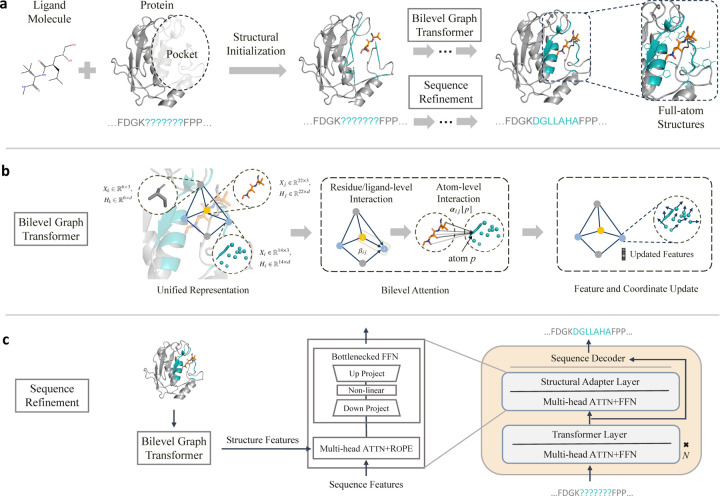
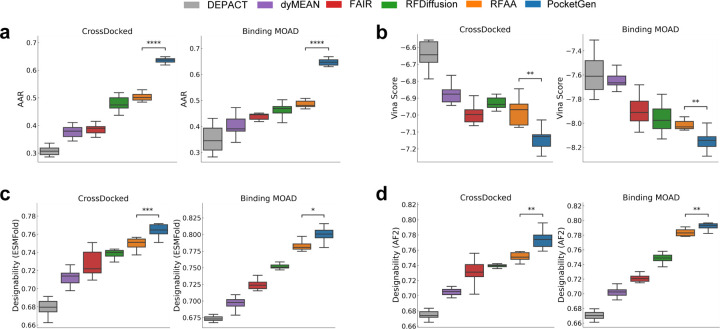
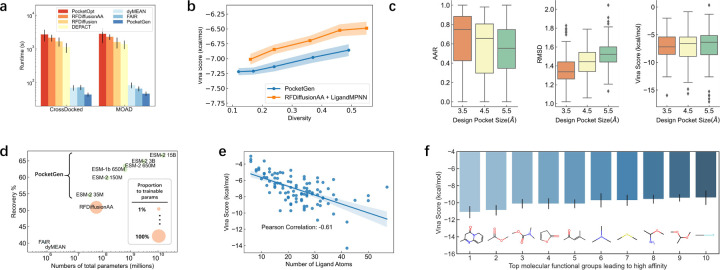
Designing protein-binding proteins is critical for drug discovery. However, the AI-based design of such proteins is challenging due to the complexity of ligand-protein interactions, the flexibility of ligand molecules and amino acid side chains, and sequence-structure dependencies. We introduce PocketGen, a deep generative model that simultaneously produces both the residue sequence and atomic structure of the protein regions where ligand interactions occur. PocketGen ensures consistency between sequence and structure by using a graph transformer for structural encoding and a sequence refinement module based on a protein language model. The bilevel graph transformer captures interactions at multiple scales, including atom, residue, and ligand levels. To enhance sequence refinement, PocketGen integrates a structural adapter into the protein language model, ensuring that structure-based predictions align with sequence-based predictions. PocketGen can generate high-fidelity protein pockets with superior binding affinity and structural validity. It operates ten times faster than physics-based methods and achieves a 95% success rate, defined as the percentage of generated pockets with higher binding affinity than reference pockets. Additionally, it attains an amino acid recovery rate exceeding 64%.
Overview
The claims and statistics of this paper haven’t been checked yet.
Free: it reads the open-access text and checks the first 5 claims that cite a source we can check. Create a free account to check every claim.
Integrity signals
Registry
Cites
Statistics
Figures
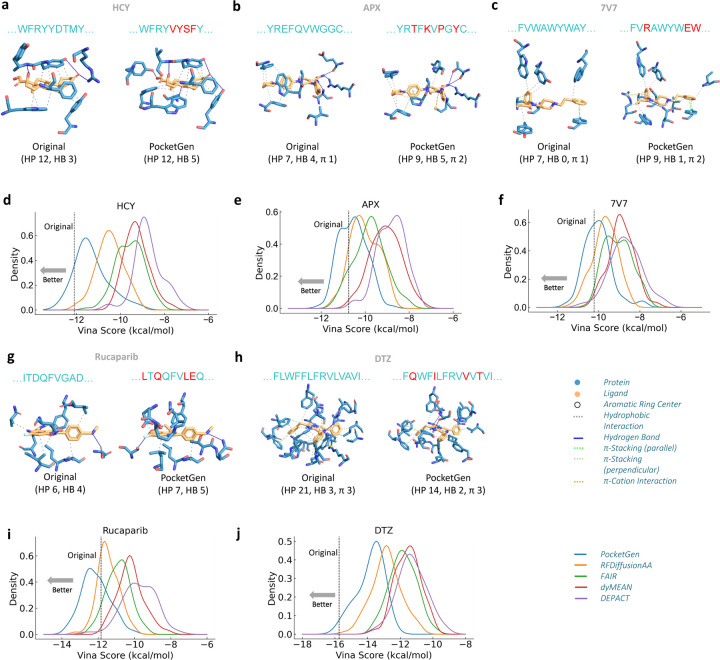
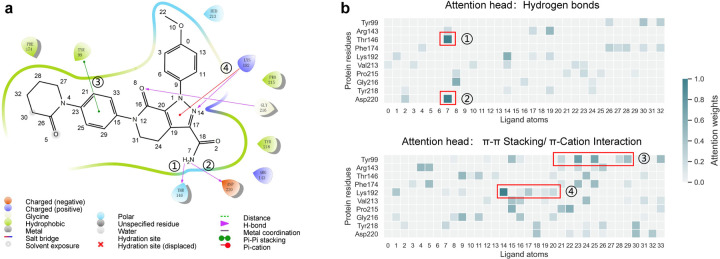
 and the generated protein binder by PocketGen (right panel). b, The originally designed protein binder for DTZ [8](left panel) and the generated protein binder by PocketGen (right panel). Note that PocketGen generates the whole protein instead of the pocket region in a&b. The generated protein binder has high scTM scores (0.900 and 0.976). c, The predicted affinity (log K) by GIGN [100] of the generated pockets by PocketGen with respect to RMSD. We randomly select two protein-ligand complexes from PDBBind (PDB id 2c3i and 3jya). d, The Vina score/binding affinity (log K) of the generated pockets by PocketGen and the original pockets from PDBBind. The black region/dots indicate the generated pockets have higher affinities than the original pockets while the red region/dots indicate lower affinities. f, The generated interactions by PocketGen with respect to a pair of activity cliff ligand molecules, i.e., C19 and C52 [77]. As marked with red rectangles, PocketGen adaptively generates different interactions for different molecular fragments (hydrogen bonds+hydrophobic interactions and halogen bonds respectively). ‘HP’ indicates hydrophobic interactions, ‘HB’ signifies hydrogen bonds, ‘π ‘ denotes the π-stacking/cation interactions, and ‘Halo’ indicates the Halogen bonds. e, Detailed validity check with PoseBusters on CrossDocked and Binding MOAD.](https://figures.cochat.ai/paper-figures/4e8cc4a7bcb44c7e8cddb5ceaaa80d58/efficient-generation-of-protein-pockets-with-pocketgen-figure-1.jpg)
Verification
Claims the paper makes
The claims and statistics of this paper haven’t been checked yet.
Free: it reads the open-access text and checks the first 5 claims that cite a source we can check. Create a free account to check every claim.
Self-check
Percentages, sums and reported differences re-computed from the paper’s own numbers.
The self-check needs the paper’s full text.
Citations
Cites
Highly accurate protein structure prediction with AlphaFold
Jumper, J., Evans, R., Pritzel, A., Green, T., Figurnov, M., Ronneberger, O., Tunyasuvunakool, K., Bates, R., Žídek, A., Potapenko, A., et al. (2021) · Nature · doi:10.1038/s41586-021-03819-2 · Cited by 43,764
Research works printed but not linked: 97
- 10.1038/nature12443 · DOI · Paper page
- 2023, A general model to predict small molecule substrates of enzymes based on machine and deep learning, Nature Communications, 14, 2787, 10.1038/s41467-023-38347-2 · DOI · Paper page
- Lee, G. R. et al. Small-molecule binding and sensing with a designed protein family. bioRxiv 2023–11 (2023). · DOI · Paper page
- Qiao, Z. , Nie, W. , Vahdat, A. , Miller III, T. F. & Anandkumar, A. State-specific protein–ligand complex structure prediction with a multiscale deep generative model. Nature Machine Intelligence 1–14 (2024). · DOI · Paper page
- 10.1126/science.1152692 · DOI · Paper page
- 10.1038/nature06879 · DOI · Paper page
- 10.1038/s41586-018-0509-0 · DOI · Paper page
- 10.1038/s41586-023-05696-3 · DOI · Paper page
- 10.1038/s41587-022-01364-5 · DOI
- 10.7554/eLife.28909 · DOI · Paper page
- 10.1126/science.aax8780 · DOI · Paper page
- 10.1038/s41586-021-03425-2 · DOI · Paper page
- 10.1126/science.abb8330 · DOI · Paper page
- 10.1073/pnas.2005412117 · DOI · Paper page
- 2017, Sampling and energy evaluation challenges in ligand binding protein design, Protein Science, 26, 2426, 10.1002/pro.3317 · DOI · Paper page
- Krishna, R. et al. Generalized biomolecular modeling and design with rosettafold all-atom. Science eadl2528 (2024). · DOI · Paper page
- 2022, Depact and pacmatch: A workflow of designing de novo protein pockets to bind small molecules, Journal of Chemical Information and Modeling, 62, 971, 10.1021/acs.jcim.1c01398 · DOI
- 2023, Pocketoptimizer 2.0: A modular framework for computer-aided ligand-binding design, Protein Science, 32, e4516, 10.1002/pro.4516 · DOI
- 10.1371/journal.pone.0052505 · DOI · Paper page
- Stiel, A. C. , Nellen, M. & Höcker, B. Pocketoptimizer and the design of ligand binding sites. Computational Design of Ligand Binding Proteins 63–75 (2016). · DOI
- 10.1126/science.adl5364 · DOI
- 2019, Apixaban: a clinical pharmacokinetic and pharmacodynamic review, Clinical pharmacokinetics, 58, 1265, 10.1007/s40262-019-00775-z · DOI · Paper page
- Stark, H. , Jing, B. , Barzilay, R. & Jaakkola, T. Harmonic prior self-conditioned flow matching for multi-ligand docking and binding site design. In NeurIPS 2023 Generative AI and Biology (GenBio) Workshop (2023).
- Zhang, Z. , Lu, Z. , Hao, Z. , Zitnik, M. & Liu, Q. Full-atom protein pocket design via iterative refinement. In Thirty-seventh Conference on Neural Information Processing Systems (2023).
- Kong, X. , Huang, W. & Liu, Y. End-to-end full-atom antibody design. ICML (2023).
- 2023, De novo design of protein structure and function with rfdiffusion, Nature, 620, 1089, 10.1038/s41586-023-06415-8 · DOI · Paper page
- 10.48550/ARXIV.2006.11239 · DOI · Paper page
- 10.1126/science.abj8754 · doi:10.1126/science.abj8754 · Paper page
- 10.1126/science.add2187 · DOI · Paper page
- Dauparas, J. et al. Atomic context-conditioned protein sequence design using ligandmpnn. Biorxiv 2023–12 (2023). · DOI
- Jin, W. , Wohlwend, J. , Barzilay, R. & Jaakkola, T. Iterative refinement graph neural network for antibody sequencestructure co-design. ICLR (2022).
- Jin, W. , Barzilay, R. & Jaakkola, T. Antibody-antigen docking and design via hierarchical structure refinement. In ICML, 10217–10227 (PMLR, 2022).
- Luo, S. et al. Antigen-specific antibody design and optimization with diffusion-based generative models. NeurIPS (2022). · DOI · Paper page
- Kong, X. , Huang, W. & Liu, Y. Conditional antibody design as 3d equivariant graph translation. ICLR (2023).
- Shi, C. , Wang, C. , Lu, J. , Zhong, B. & Tang, J. Protein sequence and structure co-design with equivariant translation. ICLR (2023).
- 2021, De novo protein design by deep network hallucination, Nature, 600, 547, 10.1038/s41586-021-04184-w · doi:10.1038/s41586-021-04184-w · Paper page
- 10.1073/pnas.1914677117 · DOI · Paper page
- 2022, Design of protein-binding proteins from the target structure alone, Nature, 605, 551, 10.1038/s41586-022-04654-9 · DOI · Paper page
- Rives, A. et al. Biological structure and function emerge from scaling unsupervised learning to 250 million protein sequences. PNAS (2019). · DOI · Paper page
- Lin, Z. et al. Language models of protein sequences at the scale of evolution enable accurate structure prediction. bioRxiv (2022).
- 10.1021/acs.jcim.0c00411 · DOI · Paper page
- 2005, Binding moad (mother of all databases), Proteins: Structure, Function, and Bioinformatics, 60, 333, 10.1002/prot.20512 · DOI · Paper page
- 10.1093/nar/28.1.304 · DOI · Paper page
- 10.1021/ci600342e · DOI · Paper page
- 10.1002/jcc.21334 · DOI · Paper page
- 2023, Uni-gbsa: An open-source and web-based automatic workflow to perform mm/gb (pb) sa calculations for virtual screening, Briefings in Bioinformatics, 24, bbad218, 10.1093/bib/bbad218 · DOI
- 10.1021/jm0306430 · DOI · Paper page
- 10.1126/science.ade2574 · doi:10.1126/science.ade2574 · Paper page
- Trippe, B. L. et al. Diffusion probabilistic modeling of protein backbones in 3d for the motif-scaffolding problem. In The Eleventh International Conference on Learning Representations (2023).
- Lin, Y. & AlQuraishi, M. Generating novel, designable, and diverse protein structures by equivariantly diffusing oriented residue clouds. ICML (2023).
- 2004, Scoring function for automated assessment of protein structure template quality, Proteins: Structure, Function, and Bioinformatics, 57, 702, 10.1002/prot.20264 · DOI · Paper page
- 2024, Improved motif-scaffolding with se (3) flow matching, arXiv preprint
- Yim, J. et al. Se (3) diffusion model with application to protein backbone generation. In International Conference on Machine Learning, 40001–40039 (PMLR, 2023).
- 1993, An introduction to the bootstrap, Monographs on statistics and applied probability, 57, 1
- Yoo, Y. J. , Feng, Y. Kim, Y.-H. & Yagonia, C. F. J. Fundamentals of enzyme engineering (2017). · DOI
- 1997, Protein engineering: Principles and practice, American Scientist, 85, 571
- 2019, Stereochemistry of polypeptoid chain configurations, Biopolymers, 110, e23266, 10.1002/bip.23266 · DOI
- Peng, X. et al. Pocket2mol: Efficient molecular sampling based on 3d protein pockets. ICML (2022).
- 2023, An equivariant generative framework for molecular graph-structure co-design, Chemical Science, 14, 8380, 10.1039/D3SC02538A · DOI
- 2020, Scaling laws for neural language models, arXiv preprint
- Alberts, B. Molecular biology of the cell (Garland science, 2017). · DOI · Paper page
- 10.1038/nature03197 · DOI · Paper page
- 2017, An algorithm to identify functional groups in organic molecules, Journal of cheminformatics, 9, 1
- 2024, Posebusters: Ai-based docking methods fail to generate physically valid poses or generalise to novel sequences, Chemical Science, 15, 3130, 10.1039/D3SC04185A · DOI · Paper page
- Satorras, V. G. , Hoogeboom, E. , Fuchs, F. B. , Posner, I. & Welling, M. E (n) equivariant normalizing flows. NeurIPS (2021).
- Jing, B. , Eismann, S. , Suriana, P. , Townshend, R. J. & Dror, R. Learning from protein structure with geometric vector perceptrons. ICLR (2021).
- 2022, Equivariant graph mechanics networks with constraints, arXiv preprint
- 2023, Structural insight to elucidate the binding specificity of the anti-cortisol fab fragment with glucocorticoids, Journal of Structural Biology, 215, 107966, 10.1016/j.jsb.2023.107966 · DOI
- 10.1021/jm070245n · DOI · Paper page
- 10.1016/j.amjcard.2017.07.092 · DOI
- 2014, The fentanyl story, The Journal of Pain, 15, 1215, 10.1016/j.jpain.2014.08.010 · DOI · Paper page
- 10.1093/nar/gkv315 · DOI · Paper page
- Yang, J. Li, F.-Z. & Arnold, F. H. Opportunities and challenges for machine learning-assisted enzyme engineering. ACS Central Science (2024). · DOI · Paper page
- Zhou, Y. , Pan, Q. , Pires, D. E. , Rodrigues, C. H. & Ascher, D. B. Ddmut: predicting effects of mutations on protein stability using deep learning. Nucleic Acids Research gkad472 (2023). · DOI · Paper page
- 2008, Discovery of aryl aminoquinazoline pyridones as potent, selective, and orally efficacious inhibitors of receptor tyrosine kinase c-kit, Journal of medicinal chemistry, 51, 3065, 10.1021/jm800188g · DOI
- Zhang, O. et al. Resgen is a pocket-aware 3d molecular generation model based on parallel multiscale modelling. Nature Machine Intelligence 1–11 (2023). · DOI
- Zhang, Z. & Liu, Q. Learning subpocket prototypes for generalizable structure-based drug design. ICML (2023).
- 10.1021/ci300523r · DOI
- 2023, Generalist equivariant transformer towards 3d molecular interaction learning, arXiv preprint
- Vaswani, A. et al. Attention is all you need. Advances in neural information processing systems 30 (2017).
- 2016, Layer normalization, arXiv preprint
- Igashov, I. et al. Equivariant 3d-conditional diffusion model for molecular linker design. Nature Machine Intelligence 1–11 (2024). · DOI · Paper page
- 2022, E (3)-equivariant graph neural networks for data-efficient and accurate interatomic potentials, Nature communications, 13, 2453, 10.1038/s41467-022-29939-5 · DOI · Paper page
- Houlsby, N. et al. Parameter-efficient transfer learning for nlp. In International Conference on Machine Learning, 2790–2799 (PMLR, 2019).
- Zheng, Z. et al. Structure-informed language models are protein designers. bioRxiv 2023–02 (2023). · DOI · Paper page
- 2021, Roformer: Enhanced transformer with rotary position embedding, arXiv preprint
- Huber, P. J. Robust estimation of a location parameter. Breakthroughs in statistics: Methodology and distribution 492–518 (1992). · DOI · Paper page
- 2021, A 3d generative model for structure-based drug design, NeurIPS, 34, 6229
- 10.1038/nbt.3988 · DOI · Paper page
- 2022, Structure-based drug design with equivariant diffusion models, arXiv preprint
- 10.1107/S0907444998009378 · DOI · Paper page
- 2014, Adam: A method for stochastic optimization, arXiv preprint
- 10.1110/ps.062353106 · DOI · Paper page
- 2017, The rosetta all-atom energy function for macromolecular modeling and design, Journal of chemical theory and computation, 13, 3031, 10.1021/acs.jctc.7b00125 · DOI · Paper page
- 2023, Geometric interaction graph neural network for predicting protein–ligand binding affinities from 3d structures (gign), The journal of physical chemistry letters, 14, 2020, 10.1021/acs.jpclett.2c03906 · DOI · Paper page
- 2015, ff14sb: improving the accuracy of protein side chain and backbone parameters from ff99sb, Journal of chemical theory and computation, 11, 3696, 10.1021/acs.jctc.5b00255 · DOI · Paper page
- 10.1016/j.str.2011.03.019 · DOI · Paper page
Metadata
- Authors
- Zhang, Z., Shen, W. X., Liu, Q., & Zitnik, M.
- Affiliations
- University of Science and Technology of China (CN)
- Harvard University (US)
- Corresponding author
- Liu, Qi
- Venue
- Nature Machine Intelligence
- Publisher
- openRxiv
- Published
- 2024-02-28
- Volume
- 6
- Issue
- 11
- Pages
- 1382-1395
- ISSN
- 2522-5839 (ISSN-L)
- PMC
- PMC10925136
- OpenAlex
- W4404391482
- Cited by
- 32
- References
- 1
- Citations by year
- 2026: 18 · 2025: 13 · 2024: 1
- FWCI
- 6.78
- Type
- journal article
- Language
- en
- Open access
- hybrid
- doi.org
- Licence
- Locations
- Nature Machine Intelligence (publishedVersion, cc-by)
- bioRxiv (Cold Spring Harbor Laboratory) (acceptedVersion, cc-by-nc-nd)
- PubMed (publishedVersion)
- PubMed Central (submittedVersion, cc-by-nc-nd)
- Funders
- National Science Foundation (2339524, CAREER)
- Pfizer
- AstraZeneca
- Sanofi
- Harvard University
- National Natural Science Foundation of China (62337001)
- University of Science and Technology of China (2021YFF0901003)
- National Institutes of Health (-0001)
- Harvard Data Science Initiative, Harvard University
- National Key Research and Development Program of China (2021YFF0901003)
- Fundamental Research Funds for the Central Universities
- Eunice Kennedy Shriver National Institute of Child Health and Human Development (R01HD108794)
- Topics
- Life Sciences › Pharmacology, Toxicology and Pharmaceutics › Drug Discovery › Computational Drug Discovery Methods
- Life Sciences › Biochemistry, Genetics and Molecular Biology › Molecular Biology › Protein Structure and Dynamics
- Life Sciences › Biochemistry, Genetics and Molecular Biology › Molecular Biology › Machine Learning in Bioinformatics
- Keywords
- deep generative models, graph transformer, protein language models, protein-ligand interactions, binding affinity, protein structure generation
About these checks
Registry, retraction, Cites and statistics results are computed, not judged, with one exception: a printed reference that no index lists is read once by a model before it counts as a citation error. Claims are extracted by a model and kept only when their quote appears verbatim in the text; each cited source is then checked, with a model’s help, for whether it says what the claim relies on. Those verdicts can be wrong — read the claim’s quote and the cited source before relying on one.
Statistics and arithmetic are recomputed, not judged.
Confidence bands are shown only for fields calibrated on our annotated test set. None is calibrated yet, so no band is shown.
What counts as a claim ›How we measure confidence ›How we check this ›
Are you an author, or do you see a problem with this page? Request a review
Data sources
Bibliographic data: Semantic Scholar, OpenAlex, Crossref.
Contains information from the Semantic Scholar Academic Graph Datasets, made available under the ODC Attribution License (ODC-BY 1.0).
Semantic Scholar’s data is described in: Kinney, R., et al. (2023). The Semantic Scholar Open Data Platform. arXiv:2301.10140.
