

Human FASTK preferentially binds single-stranded and G-rich RNA
Open accessPreprint — published as 10.1111/febs.70155
The DOI matches its Crossref record; 64 of the 64 references it cites were found in a registry or an index.
Abstract
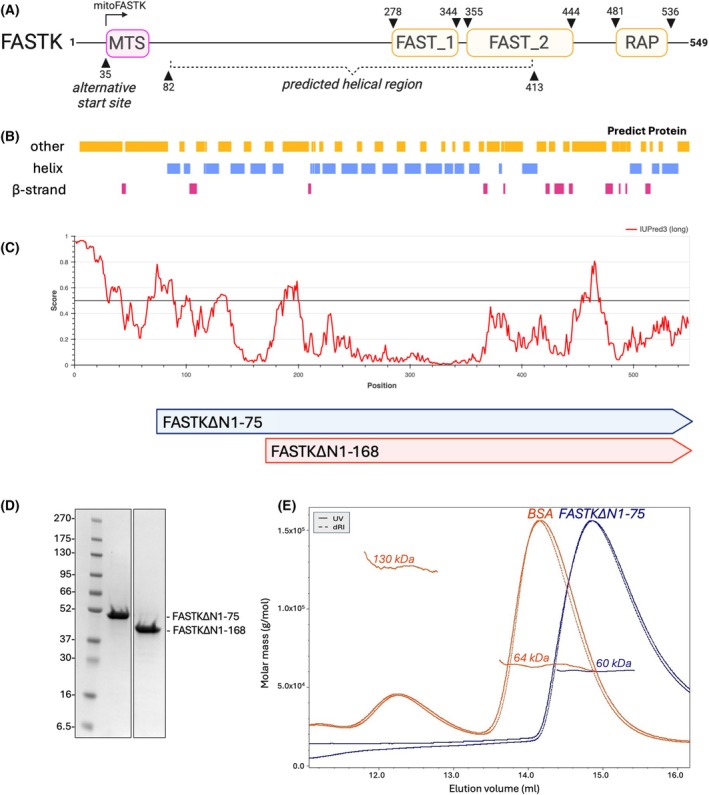
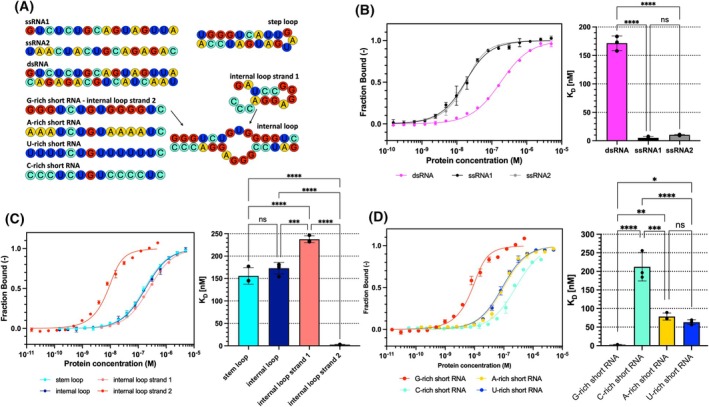
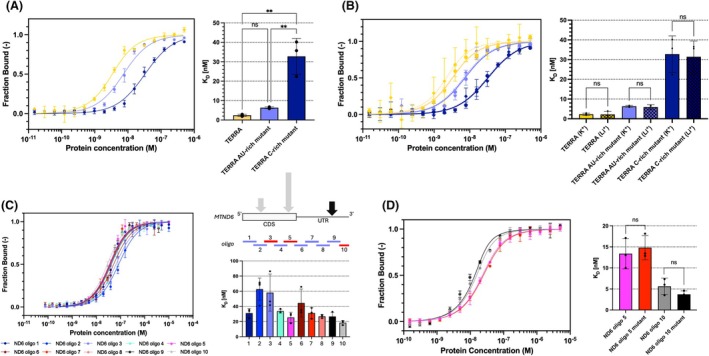
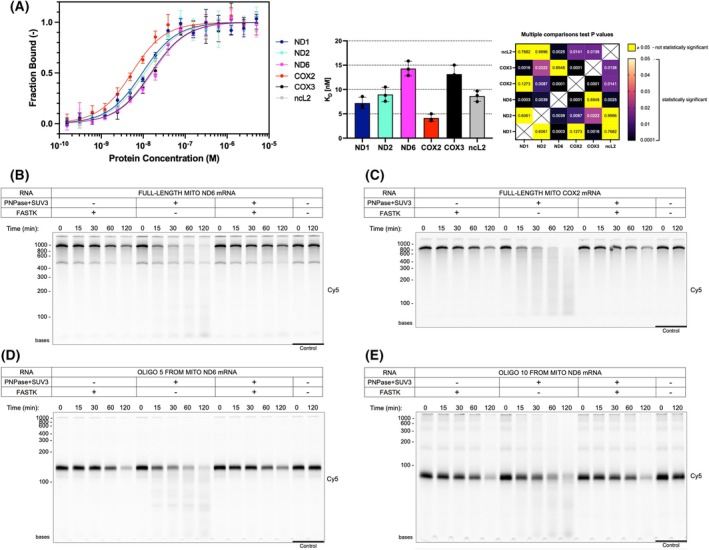
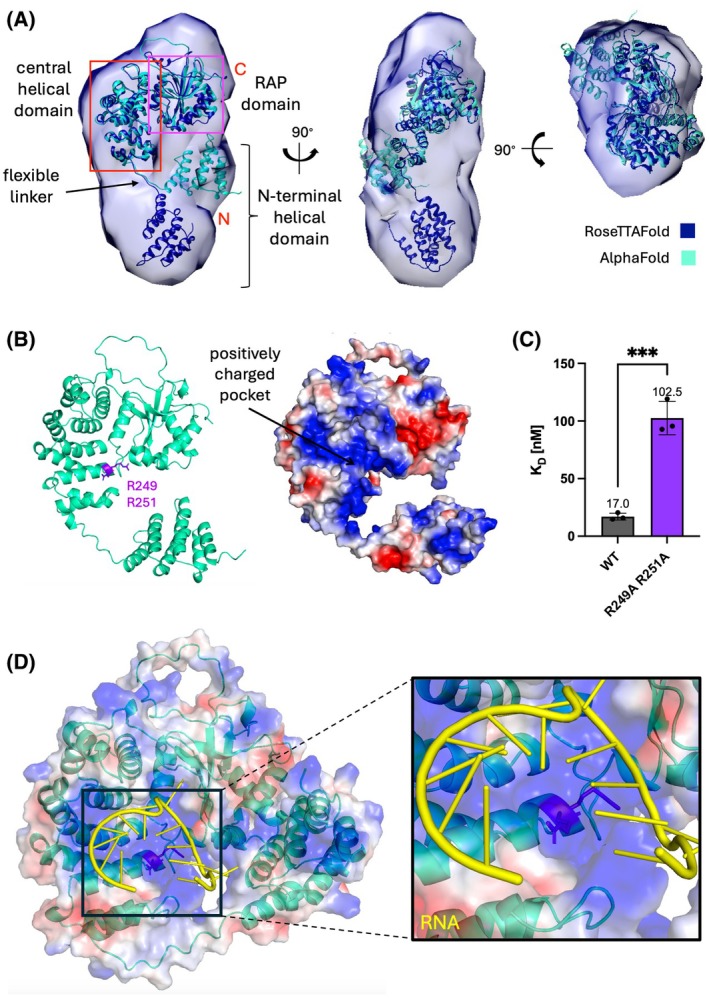
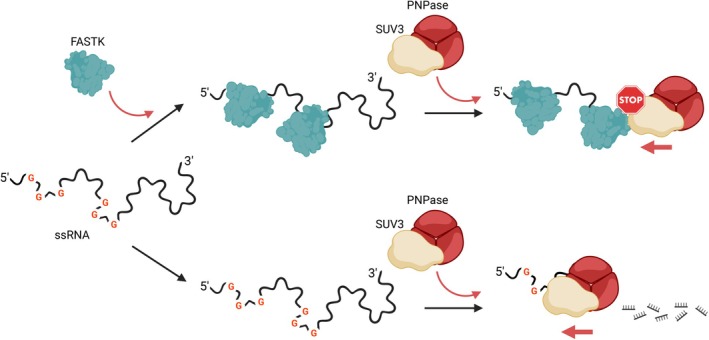
Fas-activated serine/threonine kinase (FASTK) is the founding member of the FASTKD protein family, which was shown to regulate the fate of mRNA molecules on multiple levels. The mitochondrial variant of FASTK co-localizes with mitochondrial RNA granules and regulates degradation of mitochondrial mRNAs, whereas the cytoplasmic and nuclear forms of FAST are involved in regulation of alternative splicing, cytoplasmic RNA granule formation and mRNA translation. Despite these multiple roles of FASTK in mRNA biology, the exact rules of RNA recognition by this protein remained undetermined. Here, we demonstrate direct RNA binding by purified human FASTK and show its preference for single-stranded G-rich sites and RNA G-quadruplexes. Addition of FASTK alone was sufficient to achieve protection of mitochondrial mRNAs from degradation by the degradosome. Structural characterization by SAXS showed that FASTK in solution is a monomer with an extended conformation. Point mutagenesis studies supported the structural predictions of an exposed RNA-binding interface in the central helical region, preceded by a smaller, flexibly attached, helical N-terminal domain. We provide the first such extensive in vitro characterization of the RNA binding properties for a representative of the FASTKD protein family, and suggest how these intrinsic properties may underly FASTK function in mRNA metabolism.
Overview
The claims and statistics of this paper haven’t been checked yet.
Free: it reads the open-access text and checks the first 5 claims that cite a source we can check. Create a free account to check every claim.
Integrity signals
Registry
Cites
Statistics
Figures
Verification
Claims the paper makes
The claims and statistics of this paper haven’t been checked yet.
Free: it reads the open-access text and checks the first 5 claims that cite a source we can check. Create a free account to check every claim.
Self-check
Percentages, sums and reported differences re-computed from the paper’s own numbers.
The self-check needs the paper’s full text.
Citations
Cites
Highly accurate protein structure prediction with AlphaFold
Jumper, J., Evans, R., Pritzel, A., Green, T., Figurnov, M., Ronneberger, O., Tunyasuvunakool, K., Bates, R., Žídek, A., Potapenko, A., et al. (2021) · Nature · doi:10.1038/s41586-021-03819-2 · Cited by 43,764
Accurate structure prediction of biomolecular interactions with AlphaFold 3
Abramson, J., Adler, J., Dunger, J., Evans, R., Green, T., Pritzel, A., Ronneberger, O., Willmore, L., Ballard, A. J., Bambrick, J., et al. (2024) · Nature · doi:10.1038/s41586-024-07487-w · Cited by 15,861
Tuerk, C., & Gold, L. (1990) · Science · doi:10.1126/science.2200121 · Cited by 10,405
Accurate prediction of protein structures and interactions using a 3-track network
Baek, M., DiMaio, F., Anishchenko, I., Dauparas, J., Ovchinnikov, S., Lee, G. R., Wang, J., Cong, Q., Kinch, L. N., Schaeffer, R. D., et al. (2021) · doi:10.1101/2021.06.14.448402 · Cited by 5,549
Bailey, T. L., Johnson, J., Grant, C. E., & Noble, W. S. (2015) · Nucleic Acids Research · doi:10.1093/nar/gkv416 · Cited by 5,269
Prediction of Protein Secondary Structure at Better than 70% Accuracy
Rost, B., & Sander, C. (1993) · Journal of Molecular Biology · doi:10.1006/jmbi.1993.1413 · Cited by 2,910
tRNA punctuation model of RNA processing in human mitochondria
Ojala, D., Montoya, J., & Attardi, G. (1981) · Nature · doi:10.1038/290470a0 · Cited by 2,523
Paysan-Lafosse, T., Blum, M., Chuguransky, S., Grego, T., Pinto, B. L., Salazar, G. A., Bileschi, M. L., Bork, P., Bridge, A., Colwell, L., et al. (2023) · Nucleic Acids Research · doi:10.1093/nar/gkac993 · Cited by 2,399
Insights into RNA Biology from an Atlas of Mammalian mRNA-Binding Proteins
Castello, A., Fischer, B., Eichelbaum, K., Horos, R., Beckmann, B. M., Strein, C., Davey, N. E., Humphreys, D. T., Preiss, T., Steinmetz, L. M., et al. (2012) · Cell · doi:10.1016/j.cell.2012.04.031 · Cited by 2,132
Prevalence of quadruplexes in the human genome
Huppert, J. L., & Balasubramanian, S. (2005) · Nucleic Acids Research · doi:10.1093/nar/gki609 · Cited by 1,741
Research works printed but not linked: 2
- 10.1101/2023.10.09.561572 · doi:10.1101/2023.10.09.561572
- 1994, Fitting a mixture model by expectation maximization to discover motifs in biopolymers, Proc Int Conf Intell Syst Mol Biol, 2, 28
Metadata
- Authors
- Dawidziak, D. M., Dzadz, D. A., Kuska, M. I., Kanavalli, M., Klimecka, M. M., Merski, M., Bandyra, K. J., & Górna, M. W.
- Affiliations
- University of Warsaw (PL)
- Corresponding author
- Górna, Maria W.
- ORCID
- Venue
- FEBS Journal
- Publisher
- openRxiv
- Published
- 2024-07-17
- Volume
- 293
- Issue
- 3
- Pages
- 729-748
- ISSN
- 1742-464X (ISSN-L)
- PMC
- PMC12871924
- OpenAlex
- W4411918402
- Cited by
- 3
- References
- 64
- Citations by year
- 2026: 2 · 2025: 1
- FWCI
- 0.90
- Type
- journal article
- Language
- en
- Open access
- hybrid
- doi.org
- Licence
- cc-by
- Locations
- FEBS Journal (publishedVersion, cc-by)
- bioRxiv (Cold Spring Harbor Laboratory) (acceptedVersion, cc-by)
- Europe PMC (PubMed Central) (publishedVersion, cc-by)
- PubMed (publishedVersion)
- Funders
- Fundacja na rzecz Nauki Polskiej (POIR.04.04.00‐00‐31DF/17, POIR.04.04)
- Narodowe Centrum Nauki (2014/15/D/NZ1/00968, 2020/37/N/NZ1/02348, 2020/37/K/NZ1/02312)
- Narodowym Centrum Nauki (#2014/15/D/NZ1/00968)
- Norway Grants (2014‐2021 2020/37/K/NZ1/02312)
- European Regional Development Fund (6817/IA/SP/2018, 2018-04-10, POIR.04.04.00-00-31DF/17)
- Topics
- Life Sciences › Biochemistry, Genetics and Molecular Biology › Molecular Biology › RNA Research and Splicing
- Life Sciences › Biochemistry, Genetics and Molecular Biology › Molecular Biology › DNA and Nucleic Acid Chemistry
- Life Sciences › Biochemistry, Genetics and Molecular Biology › Molecular Biology › RNA and protein synthesis mechanisms
- Keywords
- RNA binding, G-rich oligonucleotides, RNA G-quadruplex, single-stranded RNA, degradosome, protein conformation, mRNA metabolism, alternative splicing, RNA granules
- MeSH terms
- RNA, Mitochondrial, Humans, Mitochondria, Protein Binding, RNA, RNA, Messenger, RNA-Binding Proteins, Protein Serine-Threonine Kinases, RNA Stability, Poly(A)-Binding Proteins, Scattering, Small Angle, G-Quadruplexes
About these checks
Registry, retraction, Cites and statistics results are computed, not judged, with one exception: a printed reference that no index lists is read once by a model before it counts as a citation error. Claims are extracted by a model and kept only when their quote appears verbatim in the text; each cited source is then checked, with a model’s help, for whether it says what the claim relies on. Those verdicts can be wrong — read the claim’s quote and the cited source before relying on one.
Statistics and arithmetic are recomputed, not judged.
Confidence bands are shown only for fields calibrated on our annotated test set. None is calibrated yet, so no band is shown.
What counts as a claim ›How we measure confidence ›How we check this ›
Are you an author, or do you see a problem with this page? Request a review
How to cite
Cite CoChat for the checks on this page, and the paper for its own findings.
- This page
- CoChat. (2026). Citation check: Human FASTK preferentially binds single-stranded and G-rich RNA. https://app.cochat.ai/papers/10.1101/2024.07.16.603671
- The paper
- Dawidziak, D. M., Dzadz, D. A., Kuska, M. I., Kanavalli, M., Klimecka, M. M., Merski, M., Bandyra, K. J., & Górna, M. W. (2024). Human FASTK preferentially binds single-stranded and G-rich RNA. FEBS Journal. https://doi.org/10.1101/2024.07.16.603671
Data sources
Bibliographic data: Semantic Scholar, OpenAlex, Crossref.
Contains information from the Semantic Scholar Academic Graph Datasets, made available under the ODC Attribution License (ODC-BY 1.0).
Semantic Scholar’s data is described in: Kinney, R., et al. (2023). The Semantic Scholar Open Data Platform. arXiv:2301.10140.
