

The DOI matches its Crossref record; 1 of the 1 references it cites were found in a registry or an index.
Promiscuous and multivalent interactions between Eps15 and partner protein Dab2 generate a complex interaction network
Open accessPreprint — published as 10.1038/s41467-025-63090-1 · Paper page
Abstract
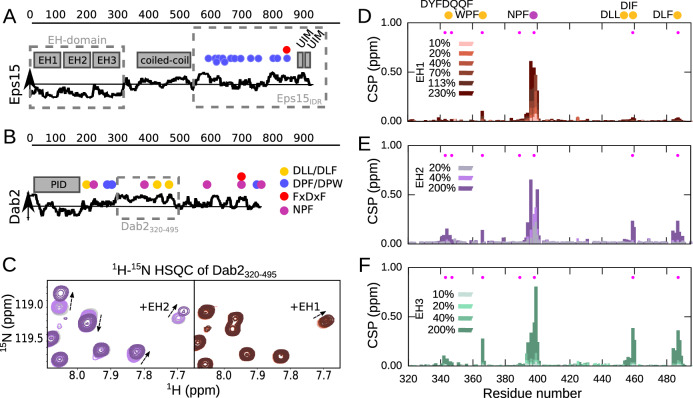
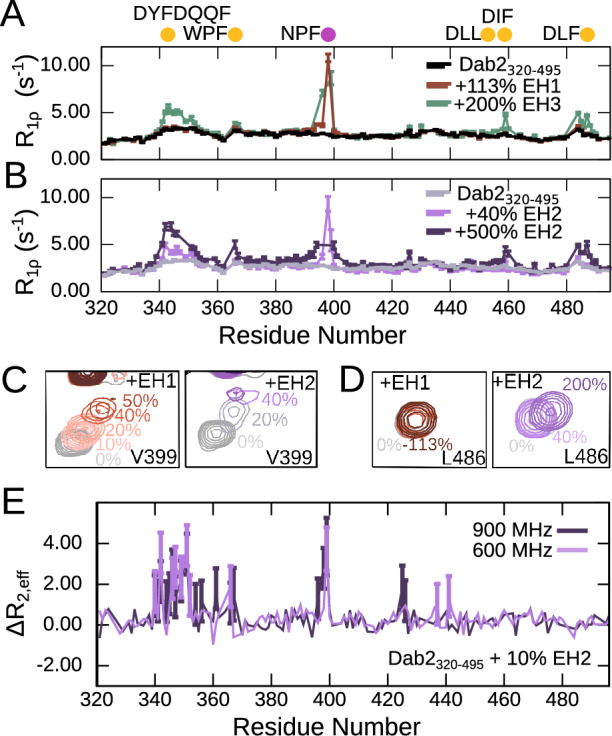
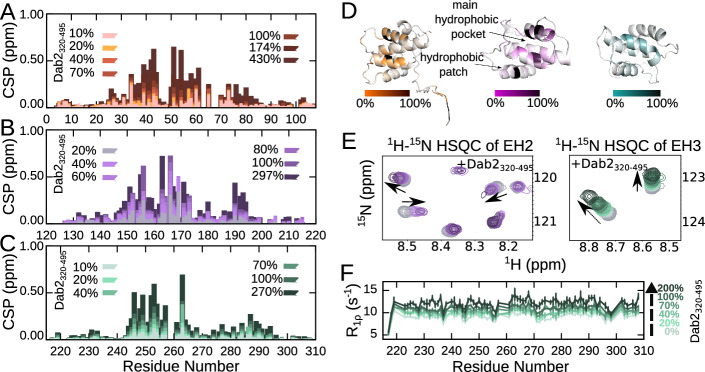
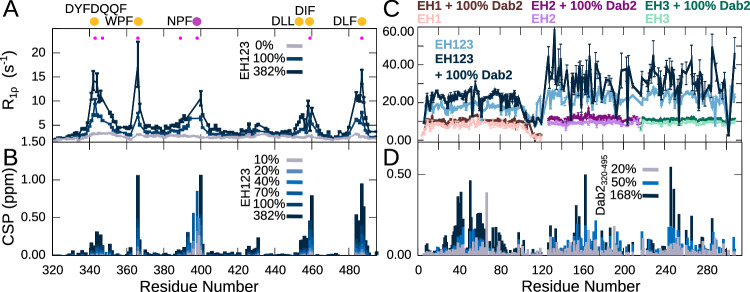
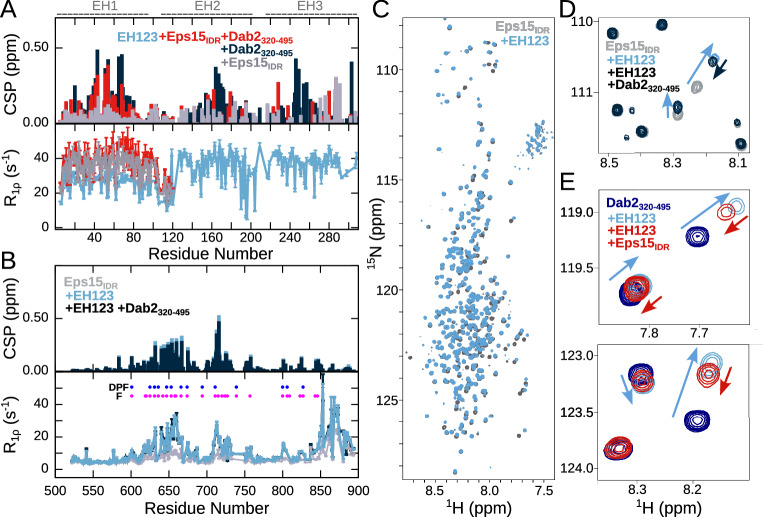
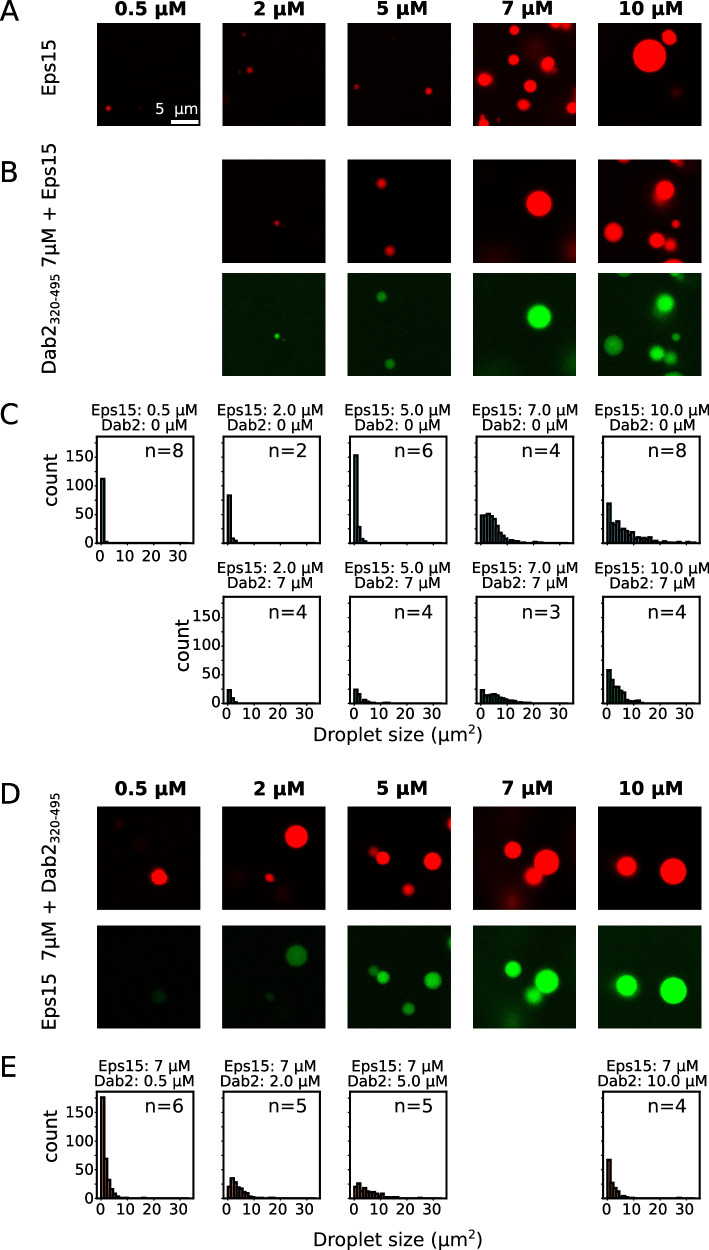
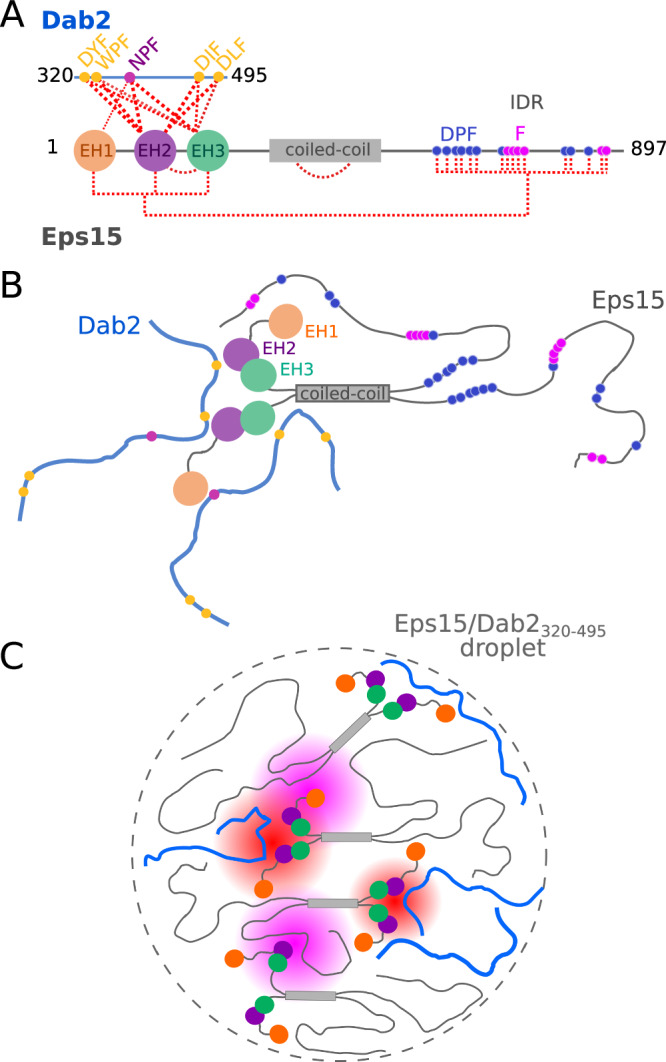
Clathrin-mediated endocytosis depends on complex protein interactions. Eps15 plays a key role through interactions of its three EH domains with Asn-Pro-Phe (NPF) motifs in intrinsically disordered regions (IDRs) of other endocytic proteins. Using nuclear magnetic resonance spectroscopy, we investigate the interaction between Eps15’s EH domains and a highly disordered Dab2 fragment (Dab2₃₂₀₋₄₉₅). We find that the EH domains exhibit binding promiscuity, recognizing not only the NPF motif of Dab2 but also other phenylalanine containing motifs. This promiscuity enables interactions with Eps15’s own IDR (Eps15 IDR ), which lacks NPF motifs, suggesting an self-inhibitory state that promotes liquid-liquid phase separation. Despite competing for the same EH domain binding sites, Eps15 IDR and Dab2₃₂₀₋₄₉₅ can bind EH123 simultaneously, forming a highly dynamic interaction network that facilitates the recruitment of Dab2₃₂₀₋₄₉₅ into Eps15 condensates. Our findings provide molecular insights into the competitive interactions shaping the early stages of clathrin-mediated endocytosis.
Overview
The claims and statistics of this paper haven’t been checked yet.
Run the check — free, no account needed. It reads the open-access text and checks the sources it cites.
Integrity signals
Registry
Cites
Statistics
Figures
Verification
Claims the paper makes
The claims and statistics of this paper haven’t been checked yet.
Run the check — free, no account needed. It reads the open-access text and checks the sources it cites.
Self-check
Percentages, sums and reported differences re-computed from the paper’s own numbers.
The self-check needs the paper’s full text.
Citations
Cites
Highly accurate protein structure prediction with AlphaFold
Jumper, J., Evans, R., Pritzel, A., Green, T., Figurnov, M., Ronneberger, O., Tunyasuvunakool, K., Bates, R., Žídek, A., Potapenko, A., et al. (2021) · Nature · doi:10.1038/s41586-021-03819-2 · Cited by 43,764
Research works printed but not linked: 61
- 10.1038/nrm.2017.132 · DOI · Paper page
- 10.1016/j.tcb.2006.08.001 · DOI
- 10.1016/S0969-2126(02)00784-0 · DOI
- 10.1021/cr400585q · DOI · Paper page
- 10.1371/journal.pbio.0040262 · DOI
- 10.1038/sj.emboj.7600445 · DOI · Paper page
- 10.1038/s41467-024-50212-4 · DOI
- 10.1016/j.jmb.2010.09.044 · DOI
- 10.1021/acs.biochem.5b00065 · DOI
- 10.1126/science.1188462 · DOI · Paper page
- 10.1016/S0014-5793(01)03241-0 · DOI
- 10.1074/jbc.272.24.15413 · DOI
- 10.1074/jbc.272.52.33430 · DOI
- 10.1186/1478-811X-7-24 · DOI
- 10.1038/emboj.2009.248 · DOI
- 10.1038/s41556-021-00646-5 · DOI
- 10.1101/gad.11.17.2239 · DOI · Paper page
- 10.1038/sj.emboj.7601980 · DOI
- 10.1091/mbc.E11-12-1007 · DOI
- 10.1002/bies.201670907 · DOI
- Smith, S. M. , Baker, M. , Halebian, M. & Smith, C. J . Weak Molecular Interactions in Clathrin-Mediated Endocytosis. Frontiers in Molecular Biosciences 4, (2017). · DOI
- 10.1016/S0962-8924(01)02082-7 · DOI · Paper page
- 10.1002/cpbi.99 · DOI · Paper page
- 10.1093/bioinformatics/bts172 · DOI
- 10.1021/ja909973n · DOI
- 10.1007/s12104-008-9083-y · DOI
- 10.1023/A:1008394326526 · DOI
- 10.1023/A:1008382305918 · DOI
- 10.1110/ps.062465306 · DOI
- 10.1021/bi990922i · DOI
- 10.1038/80924 · DOI
- 10.1021/bi9927383 · DOI
- 10.1021/ja809687r · DOI
- 10.1074/jbc.M203004200 · DOI
- 10.1016/S0968-0004(01)01835-7 · DOI · Paper page
- 10.1021/jacs.6b02424 · DOI
- 10.1016/j.sbi.2017.12.007 · DOI
- 10.1038/s41598-022-09259-w · DOI · Paper page
- 10.1093/emboj/17.22.6541 · DOI
- 10.1002/pro.258 · DOI
- 10.1186/1471-2091-8-29 · DOI
- 10.1038/nature06173 · DOI · Paper page
- 10.1038/s41467-024-48004-x · DOI
- 10.1093/pnasnexus/pgae342 · DOI
- 10.1126/science.aaw8653 · DOI · Paper page
- 10.1371/journal.pbio.1000604 · DOI · Paper page
- 10.1385/1-59259-890-0:571 · DOI
- 10.1007/BF00197809 · DOI · Paper page
- 10.1002/anie.201100370 · DOI
- 10.1007/s10858-016-0060-y · DOI · Paper page
- 10.1007/s10858-013-9715-0 · DOI
- 10.1023/B:JNMR.0000042954.99056.ad · DOI · Paper page
- 10.1023/A:1022836027055 · DOI · Paper page
- 10.1007/s10858-012-9626-5 · DOI
- 10.1021/jp074793o · DOI
- 10.1007/s10858-007-9166-6 · DOI · Paper page
- 10.1038/S41592-022-01488-1 · DOI · Paper page
- 10.1126/sciadv.aaz7095 · DOI
- 10.1007/978-1-61779-151-2_1 · DOI
- 10.1038/nmeth.2019 · DOI · Paper page
- 10.1073/pnas.1419528112 · DOI
Metadata
- Authors
- Papagiannoula, A., Vedel, I. M., Motzny, K., Tengo, M., Saiti, A., & Milles, S.
- Affiliations
- Leibniz-Forschungsinstitut für Molekulare Pharmakologie (DE)
- Centre National de la Recherche Scientifique (FR)
- Corresponding author
- Milles, Sigrid
- Venue
- Nature Communications
- Publisher
- openRxiv
- Published
- 2024-10-01
- Volume
- 16
- Issue
- 1
- Pages
- 7783-7783
- ISSN
- 2041-1723 (ISSN-L)
- PMC
- PMC12370899
- OpenAlex
- W4413405547
- Cited by
- 8
- References
- 1
- Citations by year
- 2026: 4 · 2025: 4
- FWCI
- 4.00
- Type
- journal article
- Language
- en
- Open access
- gold
- doi.org
- Licence
- Locations
- Nature Communications (publishedVersion, cc-by)
- bioRxiv (Cold Spring Harbor Laboratory) (acceptedVersion, cc-by-nc-nd)
- Europe PMC (PubMed Central) (publishedVersion, cc-by)
- PubMed Central (publishedVersion, cc-by)
- PubMed (publishedVersion)
- Refubium (Universitätsbibliothek der Freien Universität Berlin) (submittedVersion, cc-by)
- DOAJ (DOAJ: Directory of Open Access Journals) (submittedVersion, cc-by-sa)
- Universitätsbibliothek der FU Berlin Hochschulschriftenstelle u. Dokumentenserver (cc-by)
- Funders
- European Commission (802209, HORIZON2020, ERC StG 802209)
- Leibniz-Gemeinschaft
- Topics
- Life Sciences › Biochemistry, Genetics and Molecular Biology › Cell Biology › Cellular transport and secretion
- Life Sciences › Biochemistry, Genetics and Molecular Biology › Molecular Biology › Protein Structure and Dynamics
- Life Sciences › Biochemistry, Genetics and Molecular Biology › Molecular Biology › Receptor Mechanisms and Signaling
- Keywords
- Eps15, Dab2, clathrin-mediated endocytosis, EH domain, intrinsically disordered regions, binding promiscuity, protein-protein interaction, liquid-liquid phase separation, protein condensates, competitive binding
- MeSH terms
- Protein Domains, Biomolecular Condensates, Endocytosis, Humans, Phenylalanine, Nuclear Magnetic Resonance, Biomolecular, Amino Acid Motifs, Clathrin-Coated Vesicles, Adaptor Proteins, Signal Transducing, Apoptosis Regulatory Proteins, Hydrophobic and Hydrophilic Interactions, Protein Interaction Maps, Intrinsically Disordered Proteins
About these checks
Registry, retraction, Cites and statistics results are computed, not judged, with one exception: a printed reference that no index lists is read once by a model before it counts as a citation error. Claims are extracted by a model and kept only when their quote appears verbatim in the text; each cited source is then checked, with a model’s help, for whether it says what the claim relies on. Those verdicts can be wrong — read the claim’s quote and the cited source before relying on one.
Statistics and arithmetic are recomputed, not judged.
Confidence bands are shown only for fields calibrated on our annotated test set. None is calibrated yet, so no band is shown.
What counts as a claim ›How we measure confidence ›How we check this ›
Are you an author, or do you see a problem with this page? Request a review
Data sources
Bibliographic data: Semantic Scholar, OpenAlex, Crossref.
Contains information from the Semantic Scholar Academic Graph Datasets, made available under the ODC Attribution License (ODC-BY 1.0).
Semantic Scholar’s data is described in: Kinney, R., et al. (2023). The Semantic Scholar Open Data Platform. arXiv:2301.10140.
