

The DOI matches its Crossref record; 1 of the 1 references it cites were found in a registry or an index.
TransHLA: A Hybrid Transformer Model for HLA-Presented Epitope Detection
Open accessPreprint — published as 10.1093/gigascience/giaf008 · Paper page
Abstract
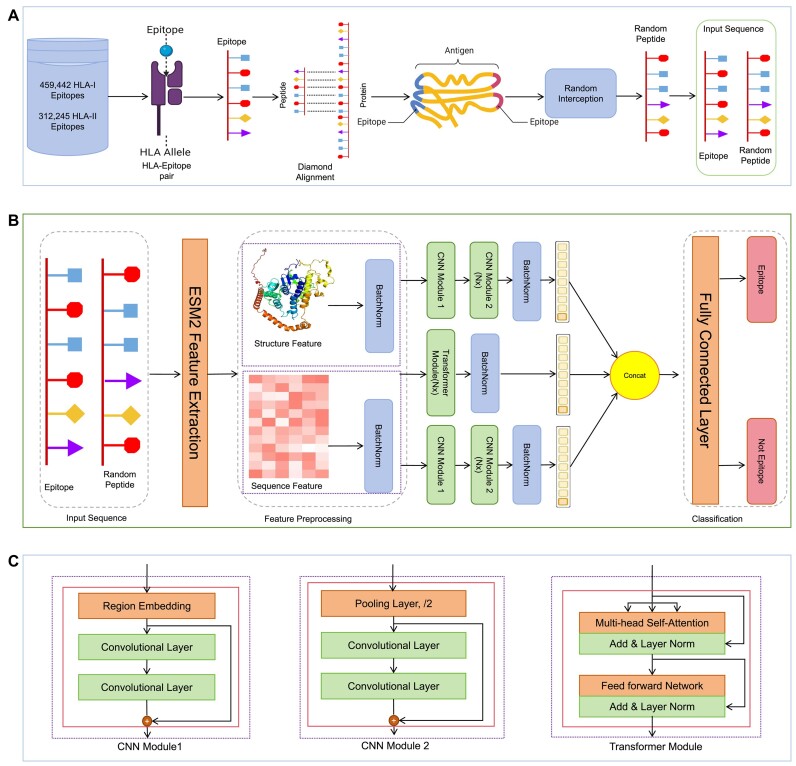
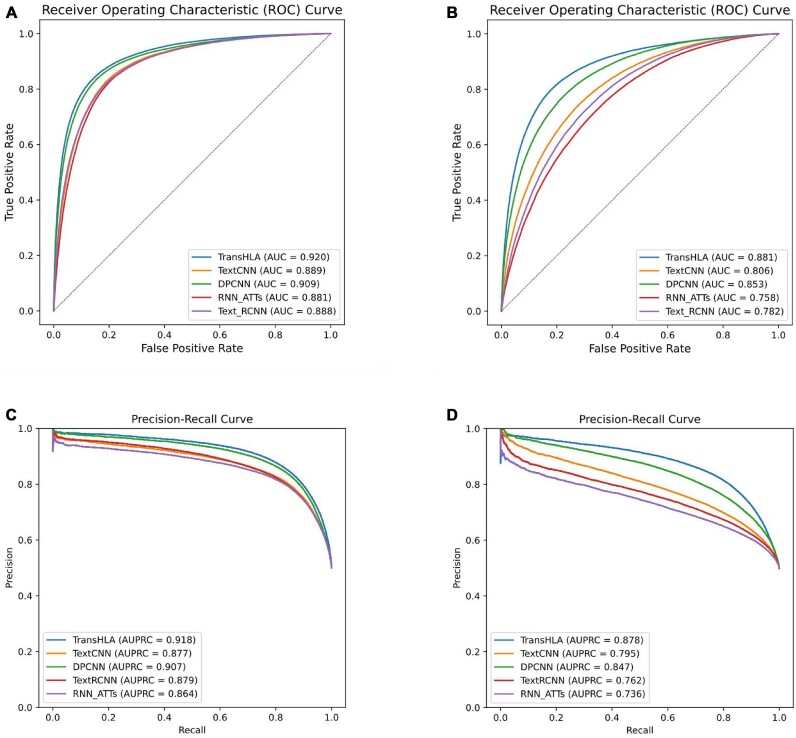
Background: Precise prediction of epitope presentation on human leukocyte antigen (HLA) molecules is crucial for advancing vaccine development and immunotherapy. Conventional HLA-peptide binding affinity prediction tools often focus on specific alleles and lack a universal approach for comprehensive HLA site analysis. This limitation hinders efficient filtering of invalid peptide segments. Results: We introduce TransHLA, a pioneering tool designed for epitope prediction across all HLA alleles, integrating Transformer and Residue CNN architectures. TransHLA utilizes the ESM2 large language model for sequence and structure embeddings, achieving high predictive accuracy. For HLA class I, it reaches an accuracy of 84.72% and an AUC of 91.95% on IEDB test data. For HLA class II, it achieves 79.94% accuracy and an AUC of 88.14%. Our case studies using datasets like CEDAR and VDJdb demonstrate that TransHLA surpasses existing models in specificity and sensitivity for identifying immunogenic epitopes and neoepitopes. Conclusions: TransHLA significantly enhances vaccine design and immunotherapy by efficiently identifying broadly reactive peptides. Our resources, including data and code, are publicly accessible at https://github.com/SkywalkerLuke/TransHLA Key Points: We developed TransHLA, a deep learning tool for predicting epitopes across all HLA alleles using Transformer and Residue CNN architectures. The model uses ESM2 embeddings to improve predictive accuracy and efficiency. TransHLA shows superior specificity and sensitivity in identifying immunogenic epitopes and neoepitopes compared to existing models. Our approach offers potential advancements in vaccine design and immunotherapy through enhanced peptide analysis.
Overview
The claims and statistics of this paper haven’t been checked yet.
Run the check — free, no account needed. It reads the open-access text and checks the sources it cites.
Integrity signals
Registry
Cites
Statistics
Figures
Verification
Claims the paper makes
The claims and statistics of this paper haven’t been checked yet.
Run the check — free, no account needed. It reads the open-access text and checks the sources it cites.
Self-check
Percentages, sums and reported differences re-computed from the paper’s own numbers.
The self-check needs the paper’s full text.
Citations
Cites
Highly accurate protein structure prediction with AlphaFold
Jumper, J., Evans, R., Pritzel, A., Green, T., Figurnov, M., Ronneberger, O., Tunyasuvunakool, K., Bates, R., Žídek, A., Potapenko, A., et al. (2021) · Nature · doi:10.1038/s41586-021-03819-2 · Cited by 43,764
Research works printed but not linked: 54
- Chaffey N , Alberts, B. , Johnson, A. , Lewis, J. , Raff, M. , Roberts, K. and Walter, P. Molecular biology of the cell. 4th edn. Oxford University Press; 2003. · DOI
- Murphy K , Weaver C. Janeway’s immunobiology. Garland science; 2016. · DOI
- Abbas A , Lichtman A , Pillai S. Cellular and molecular immunology E-book. Elsevier Health Sciences; 2014.
- 10.1158/2326-6066.CIR-19-0464 · DOI
- 10.1016/j.cels.2020.06.010 · DOI · Paper page
- 2021, DeepSeq-PanII: an interpretable recurrent neural network model with attention mechanism for peptide-HLA class II binding prediction, IEEE/ACM Transactions on Computational Biology and Bioinformatics, 19, 2188
- 10.1042/BST20210410 · DOI
- 10.1093/bib/bbaa415 · DOI
- 10.1093/nar/gkaa379 · DOI · Paper page
- 10.1038/s42256-022-00459-7 · DOI
- Tadros DM , Racle J , Gfeller D. Predicting MHC-I ligands across alleles and species: How far can we go? bioRxiv 2024;p. 2024- 05. · DOI
- 10.1016/j.immuni.2023.03.009 · DOI
- Vaswani A , Shazeer N , Parmar N , Uszkoreit J , Jones L , Gomez AN , et al. Attention is all you need. Advances in neural information processing systems 2017;30.
- He K , Zhang X , Ren S , Sun J. Deep residual learning for image recognition. In: Proceedings of the IEEE conference on computer vision and pattern recognition; 2016. p. 770-778. · DOI · Paper page
- 10.1126/science.ade2574 · DOI · Paper page
- Kim Y. Convolutional neural networks for sentence classification. arXiv preprint arXiv:14085882 2014;. · DOI · Paper page
- Lai S , Xu L , Liu K , Zhao J. Recurrent convolutional neural networks for text classification. In: Proceedings of the AAAI conference on artificial intelligence, vol. 29; 2015.. · DOI
- Johnson R , Zhang T. Deep pyramid convolutional neural networks for text categorization. In: Proceedings of the 55th Annual Meeting of the Association for Computational Linguistics (Volume 1: Long Papers); 2017. p. 562-570. · DOI
- Zhou P , Shi W , Tian J , Qi Z , Li B , Hao H , et al. Attention-based bidirectional long short-term memory networks for relation classification. In: Proceedings of the 54th annual meeting of the association for computational linguistics (volume 2: Short papers); 2016. p. 207-212. · DOI
- 10.1093/nar/gky1006 · DOI
- 10.1093/nar/gkac902 · DOI
- 10.1093/nar/gkx760 · DOI
- Nolan S , Vignali M , Klinger M , Dines JN , Kaplan IM , Svejnoha E , et al. A large-scale database of T-cell receptor beta (TCRβ) sequences and binding associations from natural and synthetic exposure to SARS-CoV-2. Research square 2020;. · DOI
- 10.3389/fimmu.2022.855976 · DOI
- 10.3389/fimmu.2021.644637 · DOI
- 10.1038/nmeth.3176 · DOI · Paper page
- 10.1093/nar/gkl842 · DOI
- 10.1093/bioinformatics/bts565 · DOI · Paper page
- 2024, xTrimoPGLM: unified 100B-scale pre-trained transformer for deciphering the language of protein, arXiv preprint
- Elnaggar A , Heinzinger M , Dallago C , Rehawi G , Yu W , Jones L , et al. ProtTrans: Towards Cracking the Language of Lifes Code Through Self-Supervised Deep Learning and High Performance Computing. IEEE Transactions on Pattern Analysis and Machine Intelligence 2021;p. 1-1. · DOI
- 2020, Language Models are Few-Shot Learners, Advances in Neural Information Processing Systems, 33, 1877
- 10.1093/bib/bbad135 · DOI
- Xu Z , Zhong H , He B , Wang X , Lu T. PTransIPs: Identification of Phosphorylation Sites Enhanced by Protein PLM Embeddings. IEEE Journal of Biomedical and Health Informatics 2024;. · DOI
- 10.1038/s41592-022-01488-1 · DOI · Paper page
- 2018, Bert: Pre-training of deep bidirectional transformers for language understanding, arXiv preprint
- 10.1038/s41587-019-0289-6 · DOI
- Nagler A , Kalaora S , Barbolin C , Gangaev A , Ketelaars SL , Alon M , et al. Identification of presented SARS-CoV-2 HLA class I and HLA class II peptides using HLA peptidomics. Cell Reports 2021;35(13). · DOI
- 10.3389/fimmu.2024.1293706 · DOI
- 10.1016/0098-3004(93)90090-R · DOI
- 10.1038/311123a0 · DOI
- 10.1021/acs.jcim.0c01397 · DOI
- Klatt MG , Mack KN , Bai Y , Aretz ZE , Nathan LI , Mun SS , et al. Solving an MHC allele-specific bias in the reported immunopeptidome. JCI insight 2020;5(19). · DOI
- 10.1093/bioinformatics/btp163 · DOI · Paper page
- 10.1002/prot.340190207 · DOI
- Chen T , Guestrin C. Xgboost: A scalable tree boosting system. In: Proceedings of the 22nd acm sigkdd international conference on knowledge discovery and data mining; 2016. p. 785-794. · DOI · Paper page
- 10.1038/s41586-022-04417-6 · DOI
- 10.6026/97320630081220 · DOI
- Baker E. Hydrogen bonding in biological macromolecules 2012;. · DOI
- 10.1021/la503865b · DOI
- 10.1039/c1sm05849e · DOI
- 10.1039/c3sm50807b · DOI
- 10.1016/j.bbapap.2013.02.011 · DOI
- Tianchi L , Xueying W , Wan N , Huo M , Shuaicheng L. Supporting data for “TransHLA: A Hybrid Transformer Model for HLA-Presented Epitope Detection”. GigaDB 2024; https://urldefense.com/v3/__https://doi.org/10.5524/102633__;!!KjDnqvtInNPT!i0agEmhs5f2c-6xn78vf1UHeQDc7MIvRJjXtTKhowEM818-6OF2FSrgCa2kiVF4O5NMkHRJhDcvGVR-Dmyvs$. · DOI
- Tianchi L , Xueying W , Wan N , Huo M , Shuaicheng L , TransHLA: A Hybrid Transformer Model for HLA-Presented Epitope Detection; 2024. https://urldefense.com/v3/__https://registry.dome-ml.org/review/peuywb6nkx__;!!KjDnqvtInNPT!i0agEmhs5f2c-6xn78vf1UHeQDc7MIvRJjXtTKhowEM818-6OF2FSrgCa2kiVF4O5NMkHRJhDcvGVW88ZMPB$. [DOME-ML Annotations].
Metadata
- Authors
- Lu, T., Wang, X., Nie, W., Huo, M., & Li, S.
- Affiliations
- City University of Hong Kong (HK)
- Department of Computer Science, City University of Hong Kong, Kowloon, Hong Kong
- Venue
- GigaScience
- Publisher
- openRxiv
- Published
- 2025-01-24
- Volume
- 14
- ISSN
- 2047-217X (ISSN-L)
- PMC
- PMC11878767
- OpenAlex
- W4408141849
- Cited by
- 9
- References
- 1
- Citations by year
- 2026: 5 · 2025: 4
- FWCI
- 2.67
- Type
- journal article
- Language
- en
- Open access
- gold
- doi.org
- Licence
- Locations
- GigaScience (publishedVersion, cc-by)
- bioRxiv (Cold Spring Harbor Laboratory) (acceptedVersion, cc-by)
- Europe PMC (PubMed Central) (publishedVersion, cc-by)
- PubMed Central (publishedVersion, cc-by)
- PubMed (publishedVersion)
- CityU Scholars (submittedVersion, cc-by)
- Topics
- Life Sciences › Biochemistry, Genetics and Molecular Biology › Molecular Biology › vaccines and immunoinformatics approaches
- Life Sciences › Biochemistry, Genetics and Molecular Biology › Molecular Biology › Machine Learning in Bioinformatics
- Life Sciences › Immunology and Microbiology › Immunology › Immunotherapy and Immune Responses
- Keywords
- HLA class I, HLA class II, ESM-2 embeddings, immunogenic epitopes, neoantigens, vaccine design, immunotherapy, IEDB, cedar
- MeSH terms
- Alleles, Epitopes, HLA Antigens, Humans, Software, Antigen Presentation, Epitope Mapping, Computational Biology
About these checks
Registry, retraction, Cites and statistics results are computed, not judged, with one exception: a printed reference that no index lists is read once by a model before it counts as a citation error. Claims are extracted by a model and kept only when their quote appears verbatim in the text; each cited source is then checked, with a model’s help, for whether it says what the claim relies on. Those verdicts can be wrong — read the claim’s quote and the cited source before relying on one.
Statistics and arithmetic are recomputed, not judged.
Confidence bands are shown only for fields calibrated on our annotated test set. None is calibrated yet, so no band is shown.
What counts as a claim ›How we measure confidence ›How we check this ›
Are you an author, or do you see a problem with this page? Request a review
How to cite
Cite CoChat for the checks on this page, and the paper for its own findings.
- This page
- CoChat. (2026). Citation check: TransHLA: A Hybrid Transformer Model for HLA-Presented Epitope Detection. https://app.cochat.ai/papers/10.1101/2025.01.20.634002
- The paper
- Lu, T., Wang, X., Nie, W., Huo, M., & Li, S. (2025). TransHLA: A Hybrid Transformer Model for HLA-Presented Epitope Detection. GigaScience. https://doi.org/10.1101/2025.01.20.634002
