The DOI matches its Crossref record; 1 of the 1 references it cites were found in a registry or an index.
Mrx6 binds the Lon protease Pim1 N-terminal domain to confer selective substrate specificity and regulate mtDNA copy number
Open accessPreprint — published as 10.1093/nar/gkaf1390
Abstract
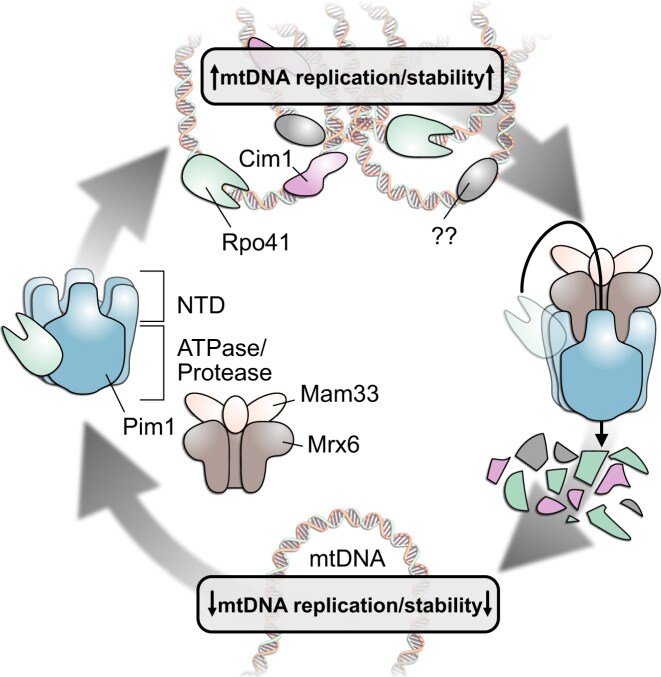
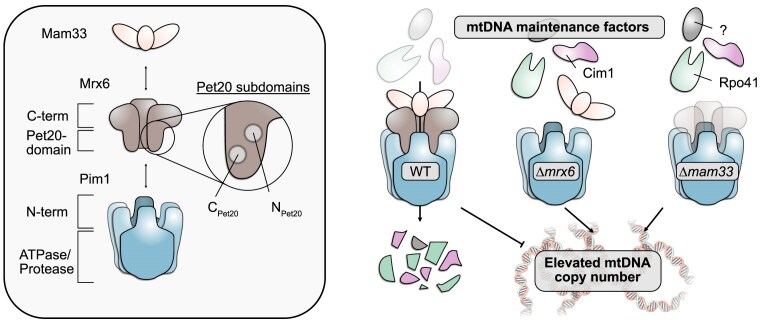
Mitochondrial DNA (mtDNA) copy number regulation remains incompletely understood, despite its importance in cellular function. In Saccharomyces cerevisiae , Mrx6 belongs to the Pet20-domain-containing protein family, consisting of Mrx6, Pet20, and Sue1. Notably, absence of Mrx6 leads to increased mtDNA copy number. Here, we identify the C-terminus of Mrx6 as essential for its stability and interaction with the mitochondrial matrix protein Mam33. Deletion of Mam33 mimics the effect of Mrx6 loss, resulting in elevated mtDNA copy number. Bioinformatics, mutational analyses, and immunoprecipitation studies reveal that a subcomplex of Mam33 and Mrx6 trimers interacts with the substrate recognition domain of the conserved mitochondrial Lon protease Pim1 through a bipartite motif in the Pet20 domain of Mrx6. Loss of Mrx6, its paralog Pet20, Mam33, or mutations disrupting the interaction between Mrx6 and Pim1 stabilize key proteins required for mtDNA maintenance, the RNA polymerase Rpo41 and the HMG-box-containing protein Cim1. We propose that Mrx6, alongside Pet20 and Mam33, regulates mtDNA copy number by modulating substrate degradation through Pim1. Additionally, Mrx6 loss alters Cim1’s function, preventing the detrimental effect on mtDNA maintenance observed upon Cim1 overexpression. The presence of three Pet20-domain proteins in yeast implies broader roles of Lon protease substrate recognition beyond mtDNA regulation.
Overview
The claims and statistics of this paper haven’t been checked yet.
Run the check — free, no account needed. It reads the open-access text and checks the sources it cites.
Integrity signals
Registry
Cites
Statistics
Figures
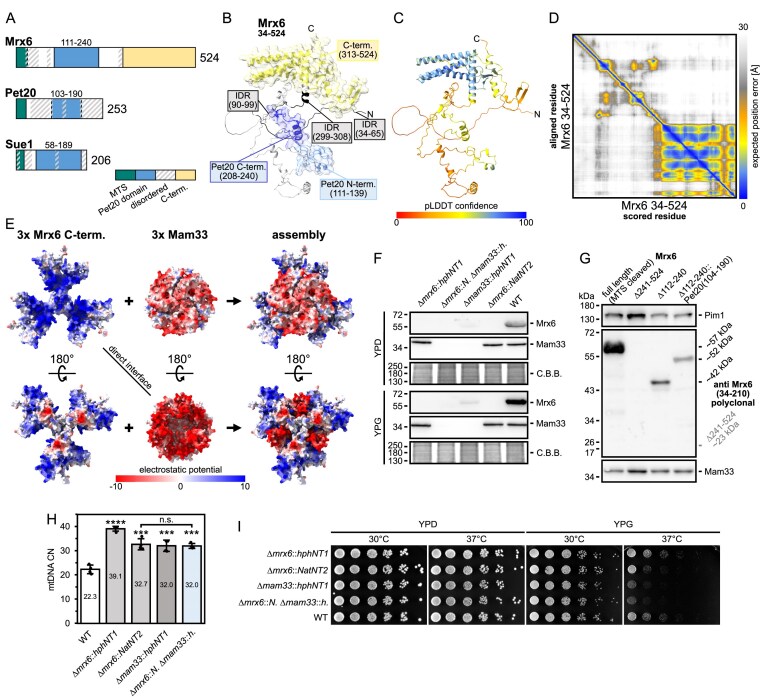
![Figure 2. Interdependency of Mrx6 and Mam33 governs mtDNA CN. (A) Schematic of protein domains of Mrx6, Pet20 and Sue1. Disordered regions (flDPnn propensity [69]) are highlighted diagonal lines. (B–D) Highest ranked (by predicted Template Modeling score, pTM) AlphaFold monomer prediction of Mrx6 (residues 34–524) lacking the mitochondrial targeting sequence (MTS) (mean pLDDT confidence ∼59.74). The ribbon model shows the NPet20- and CPet20-subdomains in blue and the C-terminal region in yellow. Intrinsically disordered regions (IDR) are colored in black (B). Error estimates are either shown as ribbon structure colored according to the residue specific pLDDT confidence (C) or as a heat map plot of the expected position error for every pair of residues (D). (E) AlphaFold multimer prediction of 3x Mam33 (residues 47-266) and 3x Mrx6 C-terminus (residues 271–524). Best ranked model with improved ipTM + pTM confidence of ∼0.7674. Surfaces are colored according to the coulombic electrostatic potential in the range of −10 to 10. (F and G) Immunoblots of indicated strains grown in YPD or YPG (G only YPD) at 30^\circC with Mrx6 and Mam33 (Pim1 additional loading control in G, for more controls of F see 4D) antibodies. C.B.B. stained protein bands remaining in the gel after transfer served as a loading control; n = 1. (H) qPCR on mtDNA encoded COX1 and nuclear reference TAF10 of indicated strains grown in YPD at 30^\circC; n = 4, each mutant 2 biological replicates from two independent deletion strains, data represent mean \pm SD. (I) Drop dilution growth analysis at 30 or 37^\circC of indicated strains pre-grown in YPD at 30^\circC. Images were taken after 48 h growth on YPD or YPG.](/paper-figures/85a7f74d7b4a47d28667501e1485d7e7/mrx6-binds-the-lon-protease-pim1-n-terminal-domain-to-confer-selective-substrate-figure-2.jpg)
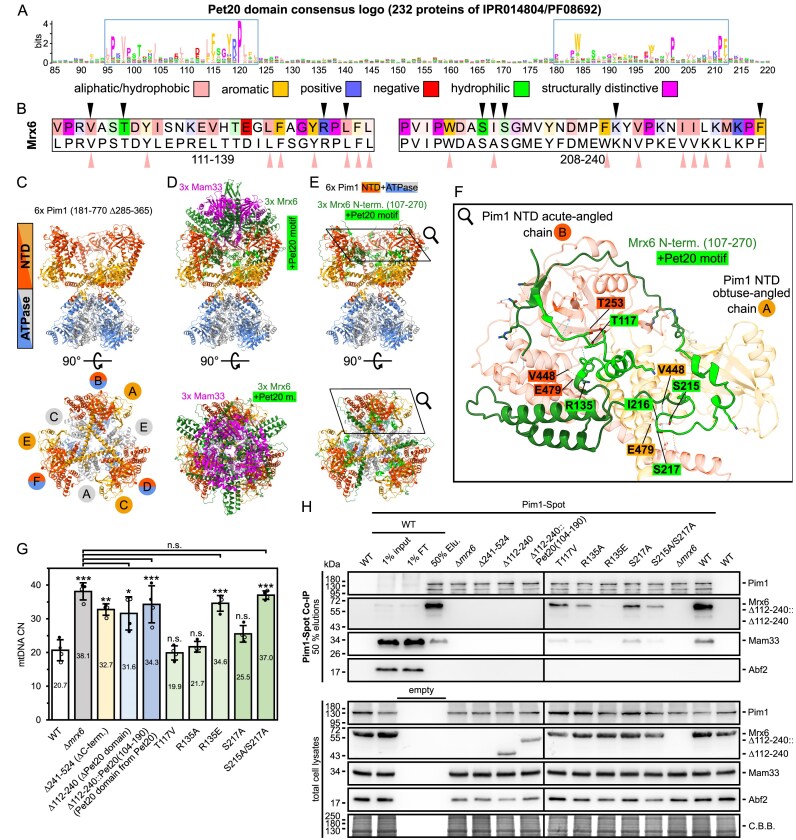
![Figure 3. Two subdomains in the bipartite Pet20 domain are important for interaction between Mrx6 and Pim1. (A) Pet20 domain consensus logo generated based on the sequences of 232 proteins of the Pet20 protein family (InterPro: IPR014804; Pfam: PF08692). Stretches of conserved NPet20- and CPet20-subdomains are highlighted by a blue rectangle. Residues are colored based on their physicochemical properties. (B) NPet20- (left) and CPet20-subdomain (right) of Mrx6 (color intensity corresponds to level of conservation) and the IPR014804/PF08692 consensus (bottom). Residues putatively involved in hydrogen bond formation (S6C+S8E) or hydrophobic interactions (S8F) to the Pim1 NTD according to AlphaFold predictions are indicated with black and salmon triangles, respectively. (C–F) AlphaFold 3 multimer prediction of 6x Pim1 NTD + ATPase (181–770 with deleted disordered region 285–365), 3x Mrx6 (107–524), and 3x Mam33 (47–266) best ranked model (ipTM + pTM confidence of ∼0.46). (C) Ribbon model of hexameric Pim1 (181–770 \Delta285–365) with separately colored NTD (181–528, gray) and ATPase domains (529–770, blue). Acute-(orange-red NTD, blue ATPase) or obtuse-angled (orange NTD, gray ATPase) protomers alternate. (D) Ribbon model of predicted structure consisting of 6x Pim1 NTD + ATPase, 3x Mrx6 (dark green with lime Pet20 subdomains), and 3x Mam33 (purple). (E) As in D, but Mam33 and Mrx6 C-terminus (271–524) are hidden. (F) Detail of (E) showing only one obtuse-angled (low opacity orange, chain A) and the adjacent acute-angled (low opacity orange-red, chain B) Pim1 NTD together with the Mrx6 N-terminus (107–270). Residues highlighted are putatively involved in hydrogen bonding. (G) qPCR on mtDNA encoded COX1 and nuclear reference TAF10 of indicated strains grown in YPD at 30^\circC. n = 4, indicated Mrx6 mutant strains expressing either WT Pim1 (filled circles) or Pim1–Spot (empty circles) were analyzed in two biological replicates each, data represent mean \pm SD. (H) Top panel: Immunoprecipitation pf Pim1–Spot from from native cell lysates of indicated strains grown in YPG at 30^\circC. Immunoblots were probed with Pim1, Mrx6, Mam33, and Abf2 (control). 50% of eluted fractions and 1% input and flow-through (FT) of the WT Pim1–Spot controls were loaded [for all 1% input and flow-through (FT) controls see S9A]. Bottom panel: Immunoblots of denatured total lysates of identical strains cultivated in YPG at 30^\circC are shown (enhanced detection compared to S9A). C.B.B.: colloidal Coomassie stained high molecular weight proteins that retained in the gel after transfer.](/paper-figures/d921dbcbf0364c74a4e2637dfd3174d0/mrx6-binds-the-lon-protease-pim1-n-terminal-domain-to-confer-selective-substrate-figure-3.jpg)
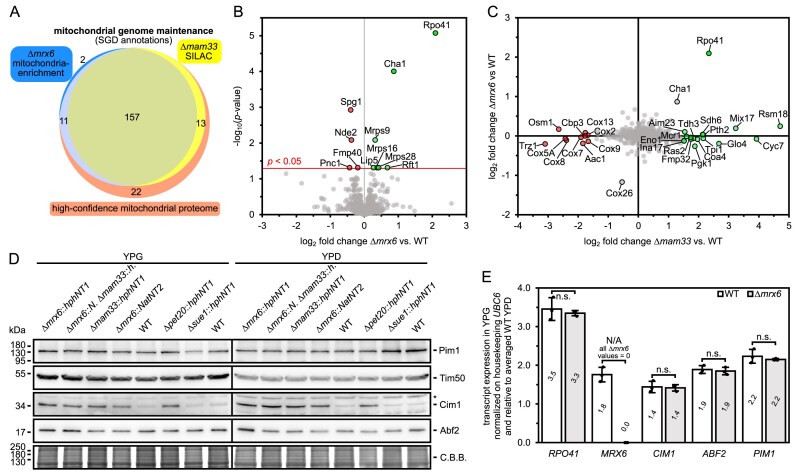
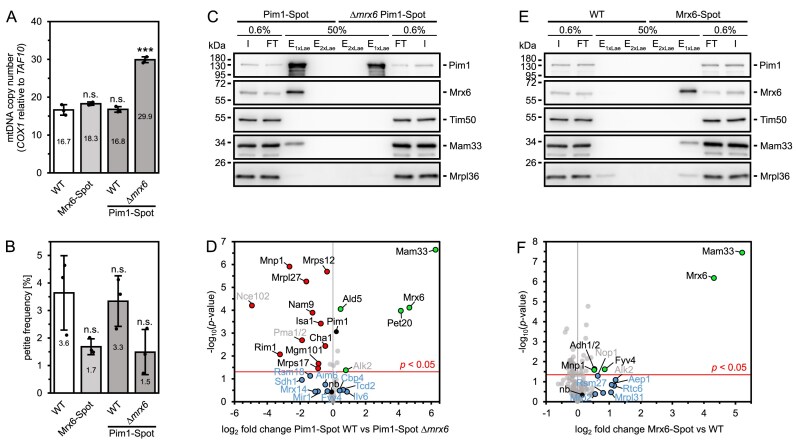
![Figure 4. Absence of Mrx6 leads to a post-transcriptional increase of Rpo41 and Cim1. (A) Comparison of proteins annotated for mitochondrial genome maintenance (http://www.yeastgenome.org, state February 2024) detected in the proteome of mitochondrial enriched fractions from \Delta mrx6 and WT cells (this study), a SILAC dataset from \Delta mam33 and WT cells filtered for mitochondrial proteins [18] and a high-confidence mitochondrial proteome [73]. (B) Volcano plot of differentially expressed proteins identified by LC-MS/MS analysis in mitochondrial enriched fractions of WT and \Delta mrx6 cells cultivated in YPG at 30^\circC. Normalization based on LFQ. n = 2 strain replicates, two technical replicates each. (C) Comparison of proteome alterations present in the \Delta mrx6 versus WT LFQ LC-MS/MS derived data as well as a \Delta mam33 versus WT SILAC dataset filtered for mitochondrial proteins [18]. Fold-changes of at least 2.8 in at least one of the two experiments are highlighted in green or red. (D) Immunoblots of Pim1, Tim50 (loading control), Cim1, and Abf2 from lysates of indicated cells grown in YPG or YPD at 30^\circC. *highlights unspecific cross-reaction of the Cim1 antibody. C.B.B.: colloidal Coomassie stained high molecular weight proteins that retained in the gel after transfer; n = 1. (E) RT-qPCR transcript comparison of indicated genes between WT and \Delta mrx6 with RNA extracted from cells cultivated in YPD or YPG medium at 30^\circC. Normalization to housekeeping gene UBC6 and relative to the averaged WT abundance in YPD (see S10A+B for only YPD and YPG). n = 3 biological replicates, data represent mean \pm SD.](/paper-figures/51346e31108a4e06aa42a832ecd57d6a/mrx6-binds-the-lon-protease-pim1-n-terminal-domain-to-confer-selective-substrate-figure-4.jpg)

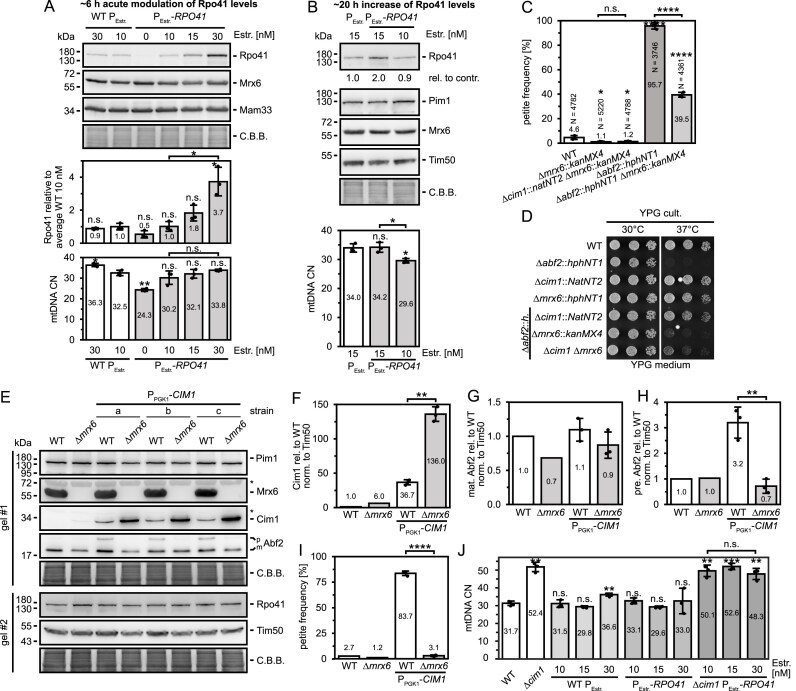
![Figure 6. Absence of Mrx6 suppresses Cim1 function. (A and B) Immunoblots of Rpo41 (with quantifications), Mrx6, and Mam33 (loading control) of lysates from PEstr.-RPO41 cells grown in YPG at 30^\circC for ∼6 h (A) or for ∼20 h (B) with indicated estradiol concentrations starting from 10 nM estradiol (WT-like Rpo41 levels). Cells with WT RPO41 promoter lacking LexA binding sites but expressing the LexA-(estradiol-LBD)-B42 activator served as control (WT PEstr.). C.B.B.: colloidal Coomassie stained high molecular weight proteins that retained in the gel after transfer. Rpo41 signals were quantified relative to the averaged signal of WT PEstr. cells cultivated with 10 nM (A) or 15 nM (B) estradiol. mtDNA CN was determined by qPCR on mtDNA encoded COX1 and nuclear reference TAF10. n = 3, data represent mean \pm SD. (see Supplementary Fig. S11G for quantifications of Mrx6 and Mam33 signals in A) (C) Petite frequency of indicated strains grown in YPD at 30^\circC. Experiment was performed as published and data for WT and \Delta abf2 are identical to [15]. n = 3 biological replicates, data represent mean \pm SD. (D) Drop dilution growth analysis at 30^\circC or 37^\circC of indicated strains pre-grown in YPG at 30^\circC. Images were taken after 48 h growth on YPG (for YPD see S11H). Only dilution steps 2–4 are shown. (E–J) Immunoblots (and quantifications) of Mrx6, Cim1 (F), Abf2 including premature (p) and mature (m) forms (G and H) and Tim50 (loading control) of lysates from indicated cells grown in YPD at 30^\circC. For PPGK1-CIM1 overexpression in either WT or \Delta mrx6 backgrounds n = 3 independent strains a, b, and c were analyzed. *highlights unspecific cross-reaction of Cim1 and Mrx6 antibodies. C.B.B.: colloidal Coomassie stained high molecular weight proteins that retained in the gel after transfer. (I) Petite frequency of indicated strains grown in YPD at 30^\circC. n = 3 (strains a, b, and c) datapoints of PPGK1-CIM1 samples represent two averaged biological replicates each, WT and \Delta mrx6; n = 1, data represent mean \pm SD. (J) mtDNA copy number in the indicated strains grown without (WT and \Delta cim1 ) or with 10, 15, or 30 nM estradiol for 20 h in YPG at 30 ^\circC, determined by qPCR using mitochondrial COX1 and nuclear TAF10 as reference genes. n = 3, data represent mean \pm SD.](/paper-figures/982761428db647fb975cb82f97ac1b28/mrx6-binds-the-lon-protease-pim1-n-terminal-domain-to-confer-selective-substrate-figure-6.jpg)

Verification
Claims the paper makes
The claims and statistics of this paper haven’t been checked yet.
Run the check — free, no account needed. It reads the open-access text and checks the sources it cites.
Self-check
Percentages, sums and reported differences re-computed from the paper’s own numbers.
The self-check needs the paper’s full text.
Citations
Cites
Highly accurate protein structure prediction with AlphaFold
Jumper, J., Evans, R., Pritzel, A., Green, T., Figurnov, M., Ronneberger, O., Tunyasuvunakool, K., Bates, R., Žídek, A., Potapenko, A., et al. (2021) · Nature · doi:10.1038/s41586-021-03819-2 · Cited by 43,764
Research works printed but not linked: 85
- 10.1038/s41586-024-07487-w · DOI · Paper page
- 10.1002/j.1460-2075.1984.tb02099.x · DOI
- 10.1111/j.2517-6161.1995.tb02031.x · DOI · Paper page
- 10.1016/j.celrep.2024.114018 · DOI
- 10.1038/srep19211 · DOI
- 10.1006/bbrc.2001.4473 · DOI
- 10.1016/j.mito.2020.06.004 · DOI
- 10.1126/science.1106391 · DOI
- 10.1128/MCB.18.10.5712 · DOI
- 10.1002/1873-3468.14199 · DOI
- 10.1074/mcp.m113.031591 · DOI · Paper page
- 10.1038/nbt.1511 · DOI · Paper page
- 10.1093/emboj/18.19.5226 · DOI
- 10.1016/j.bbagrm.2012.02.003 · DOI
- 10.1093/nar/gku868 · DOI
- 10.1073/pnas.88.17.7864 · DOI
- 10.3791/1431-V · DOI
- 10.1016/0378-1119(95)00805-5 · DOI
- 10.1371/journal.pcbi.1002195 · DOI · Paper page
- 10.1093/nar/gkh340 · DOI · Paper page
- 10.1101/gad.248583.114 · DOI
- 10.1016/j.ajhg.2017.08.015 · DOI
- 10.1002/1873-3468.14021 · DOI
- 10.1002/pro.3235 · DOI · Paper page
- 10.1091/mbc.E19-08-0470 · DOI
- 10.1073/pnas.83.10.3391 · DOI
- 10.1038/s41586-023-06426-5 · DOI
- 10.7554/eLife.18853 · DOI
- 10.1074/jbc.RA119.008476 · DOI
- 10.1038/s41467-020-20314-w · DOI · Paper page
- 10.1002/yea.1142 · DOI
- 10.1515/BC.2005.149 · DOI
- 10.1016/j.cell.2013.06.034 · DOI
- 10.1073/pnas.140063197 · DOI
- 10.1038/s41598-024-60030-9 · DOI
- 10.1111/j.1365-2958.2011.07646.x · DOI
- 10.1126/sciadv.abj7835 · DOI
- 10.1016/j.molcel.2012.10.023 · DOI
- 10.1093/nar/gkac240 · DOI
- 10.1111/tpj.14342 · DOI
- 10.1016/0092-8674(87)90013-4 · DOI
- 10.1074/jbc.C400384200 · DOI
- 10.1073/pnas.1008924107 · DOI
- 10.1083/jcb.145.2.291 · DOI
- 10.1002/PRO.4792 · DOI
- 10.1016/j.cell.2005.04.011 · DOI · Paper page
- 10.1038/s41586-023-06739-5 · DOI · Paper page
- 10.1016/j.str.2022.06.006 · DOI · Paper page
- 10.1093/emboj/cdg090 · DOI
- 10.1016/j.celrep.2017.06.014 · DOI
- 10.1074/jbc.272.39.24363 · DOI
- 10.1073/pnas.1501737112 · DOI
- 10.1093/nar/gku616 · DOI
- 10.1093/genetics/119.3.527 · DOI
- 10.1038/emboj.2008.79 · DOI
- 10.1016/j.jsb.2011.05.005 · DOI
- 10.1074/jbc.M116.740282 · DOI
- 10.1021/ac026117i · DOI
- 10.1093/nar/gkv007 · DOI · Paper page
- 10.1091/mbc.E15-04-0222 · DOI
- 10.18632/oncotarget.24082 · DOI
- 10.1016/S0006-291X(03)01548-1 · DOI
- 10.1016/j.mito.2015.06.004 · DOI
- 10.1007/s00709-004-0040-z · DOI
- 10.1007/s007090200005 · DOI
- 10.1038/nmeth.2019 · DOI · Paper page
- 10.1093/nar/gkad849 · DOI
- 10.1038/s41594-023-01091-8 · DOI
- 10.1007/978-1-0716-2079-3_11 · DOI
- 10.1038/90837 · DOI
- 10.1007/978-1-4615-0073-5_9 · DOI
- 10.1074/jbc.M117.797480 · DOI
- 10.1126/science.8146662 · DOI
- 10.1093/emboj/cdg623 · DOI
- 10.1074/mcp.M114.044016 · DOI
- 10.1038/nmeth.3901 · DOI · Paper page
- 10.1016/S0021-9258(17)42340-4 · DOI
- 10.1038/s41467-018-06714-z · DOI
- 10.1016/j.cell.2009.07.045 · DOI
- 10.1002/j.1460-2075.1994.tb06843.x · DOI
- 10.1093/bioinformatics/btp033 · DOI
- 10.1074/jbc.M403742200 · DOI
- 10.1186/1471-2105-15-7 · DOI
- 10.1038/nmeth.1322 · DOI · Paper page
- 10.1016/j.jbc.2022.101694 · DOI
Metadata
- Authors
- Schrott, S., Gerle, C., Bibinger, S., Bertgen, L., Marino, G., Schwenkert, S., Rathberger, R., Herrmann, J. M., & Osman, C.
- Affiliations
- Ludwig-Maximilians-Universität München (DE)
- University of Kaiserslautern (DE)
- Corresponding author
- Osman, Christof
- ORCID
- Venue
- Nucleic Acids Research
- Publisher
- openRxiv
- Published
- 2025-02-16
- Volume
- 54
- Issue
- 2
- ISSN
- 0305-1048 (ISSN-L)
- PMC
- PMC12802967
- OpenAlex
- W7124153078
- Cited by
- 3
- References
- 1
- Citations by year
- 2026: 3
- FWCI
- 6.20
- Type
- journal article
- Language
- en
- Open access
- gold
- doi.org
- Licence
- Locations
- Nucleic Acids Research (publishedVersion, cc-by-nc)
- bioRxiv (Cold Spring Harbor Laboratory) (acceptedVersion, cc-by-nc-nd)
- PubMed (publishedVersion)
- PubMed Central (publishedVersion, cc-by-nc)
- Funders
- Deutsche Forschungsgemeinschaft (HE2803/9-2)
- H2020 European Research Council (ERCStG-714739 IlluMitoDNA)
- Topics
- Life Sciences › Biochemistry, Genetics and Molecular Biology › Molecular Biology › Mitochondrial Function and Pathology
- Life Sciences › Biochemistry, Genetics and Molecular Biology › Molecular Biology › Heat shock proteins research
- Life Sciences › Biochemistry, Genetics and Molecular Biology › Molecular Biology › Fungal and yeast genetics research
- Keywords
- Lon protease, PIM-1, mitochondrial DNA maintenance, substrate specificity, protein stability, Saccharomyces cerevisiae
- MeSH terms
- Protein Domains, DNA, Mitochondrial, Mitochondria, Mutation, Protein Binding, Saccharomyces cerevisiae, Substrate Specificity, Mitochondrial Proteins, Saccharomyces cerevisiae Proteins, Protease La, Proto-Oncogene Proteins c-pim-1, DNA Copy Number Variations
About these checks
Registry, retraction, Cites and statistics results are computed, not judged, with one exception: a printed reference that no index lists is read once by a model before it counts as a citation error. Claims are extracted by a model and kept only when their quote appears verbatim in the text; each cited source is then checked, with a model’s help, for whether it says what the claim relies on. Those verdicts can be wrong — read the claim’s quote and the cited source before relying on one.
Statistics and arithmetic are recomputed, not judged.
Confidence bands are shown only for fields calibrated on our annotated test set. None is calibrated yet, so no band is shown.
What counts as a claim ›How we measure confidence ›How we check this ›
Are you an author, or do you see a problem with this page? Request a review
How to cite
Cite CoChat for the checks on this page, and the paper for its own findings.
- This page
- CoChat. (2026). Citation check: Mrx6 binds the Lon protease Pim1 N-terminal domain to confer selective substrate specificity and regulate mtDNA copy number. https://app.cochat.ai/papers/10.1101/2025.02.14.638270
- The paper
- Schrott, S., Gerle, C., Bibinger, S., Bertgen, L., Marino, G., Schwenkert, S., Rathberger, R., Herrmann, J. M., & Osman, C. (2025). Mrx6 binds the Lon protease Pim1 N-terminal domain to confer selective substrate specificity and regulate mtDNA copy number. Nucleic Acids Research. https://doi.org/10.1101/2025.02.14.638270