

Transcriptional regulation of disease-relevant microglial activation programs
Open accessThe DOI matches its Crossref record; 155 of the 157 references it cites were found in a registry or an index; none of the 84 sources its claims cite is checked for support yet.
Abstract
Summary: Microglia, the brain’s innate immune cells, can adopt a wide variety of activation states relevant to health and disease. Dysregulation of microglial activation occurs in numerous brain disorders, and driving or inhibiting specific states could be therapeutic. To discover regulators of microglia activation states, we conducted CRISPR interference screens in iPSC-derived microglia for inhibitors and activators of six microglial states. We characterized 31 regulators at the single-cell transcriptomic and cell-surface proteome level in two distinct iPSC-derived microglia models, uncovering new protein markers of relevant states. We functionally characterized several multi- state regulators. ZNF532 and PRDM1 knockdown drive disease-associated, lipid-rich signatures and enhance phagocytosis while showing opposing effects on antigen-presentation signatures. DNMT1 knockdown results in widespread loss of methylation, activating negative regulators of interferon signaling. These findings provide a framework to direct microglial activation to selectively enrich microglial activation states, define their functional outputs, and inform future therapies. Highlights: CRISPRi screening reveals novel regulators of six microglia activation states Multi-modal single-cell screens highlight new markers of microglial states Different iPSC-microglia models show different landscapes of activation states at baseline Loss of DNMT1 leads to widespread DNA demethylation, promoting some states but limiting the interferon-response state Loss of PRDM1 or ZNF532 drives the microglial disease-associated state
Overview
CoChat Summary
TL;DR
CRISPR interference screens in iPSC-derived microglia identify transcriptional regulators of six microglial activation states, with 31 regulators profiled by single-cell RNA and surface-protein readouts. Follow-up knockdowns show STAT2 loss inhibits interferon and lysosomal programs, PRDM1 loss drives disease-associated/lipid-rich signatures and phagocytosis, and DNMT1 loss causes widespread hypomethylation that activates interferon-signaling inhibitors.
Key findings
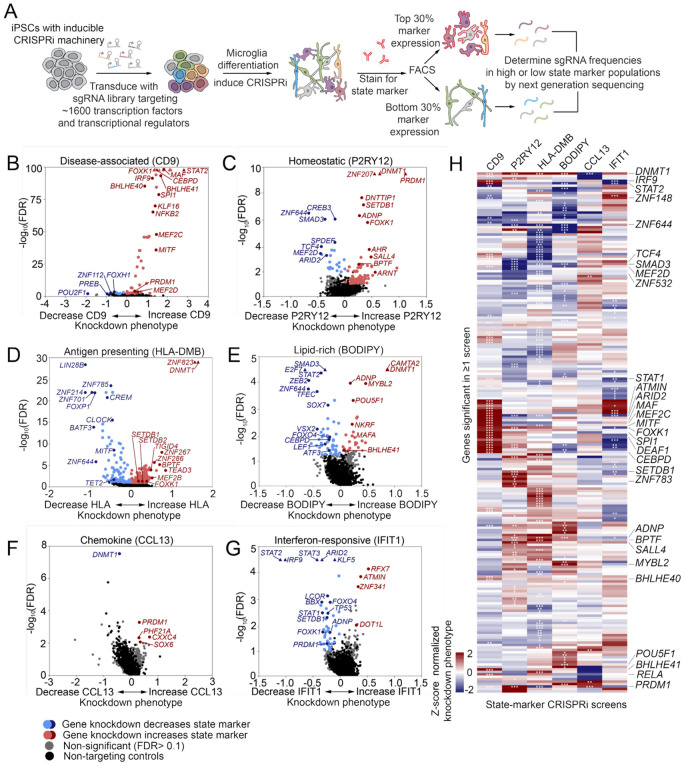
- Six FACS-based CRISPRi screens in iTF-MG microglia nominated regulators of homeostatic (P2RY12), disease-associated (CD9), antigen-presenting (HLA-DMB), lipid-rich (BODIPY), chemokine (CCL13), and interferon-responsive (IFIT1) states. Hit counts included CD9: 50 increased/8 decreased; P2RY12: 80 increased/20 decreased; HLA-DMB: 197 increased/88 decreased; BODIPY: 46 decreased/23 increased; CCL13: 4 hits; IFIT1: 44 decreased/4 increased. Across screens, 65% of significant regulators impacted one state and 34% impacted two or more; DNMT1 and PRDM1 impacted 5 of 6 states.
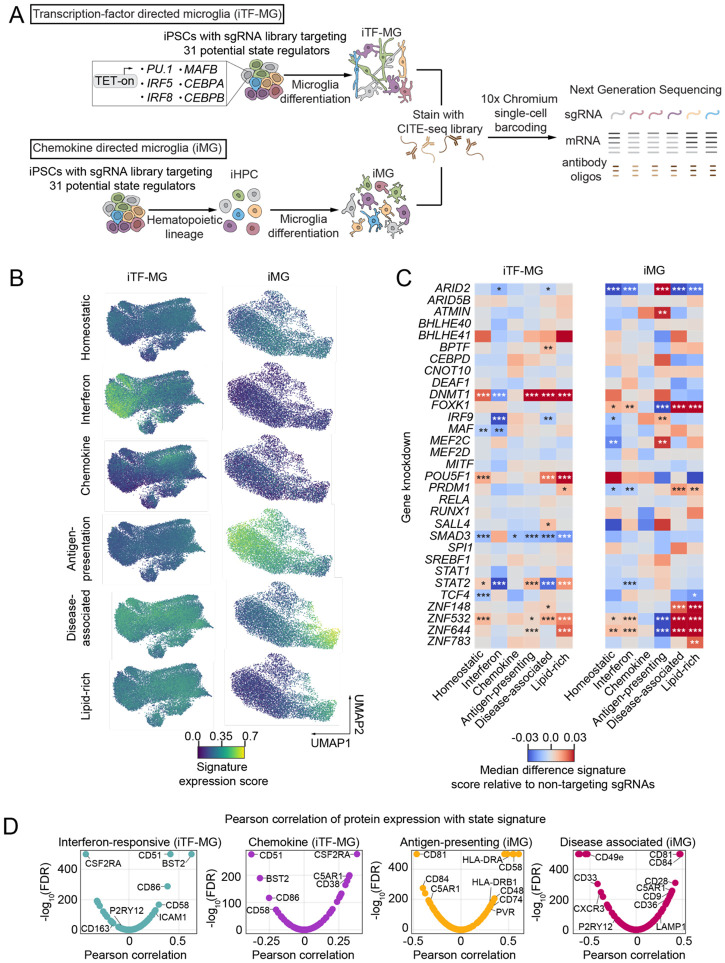
- CROP-seq plus CITE-seq of 31 selected regulators in two iPSC-microglia models (iTF-MG and iMG) showed distinct baseline activation landscapes and model-specific perturbation profiles; some marker-screen hits did not significantly alter full transcriptomic state signatures. Surface-protein analysis correlated 166 proteins with activation states, including positive correlation of interferon-response proteins with the interferon state and negative correlation with the chemokine state.
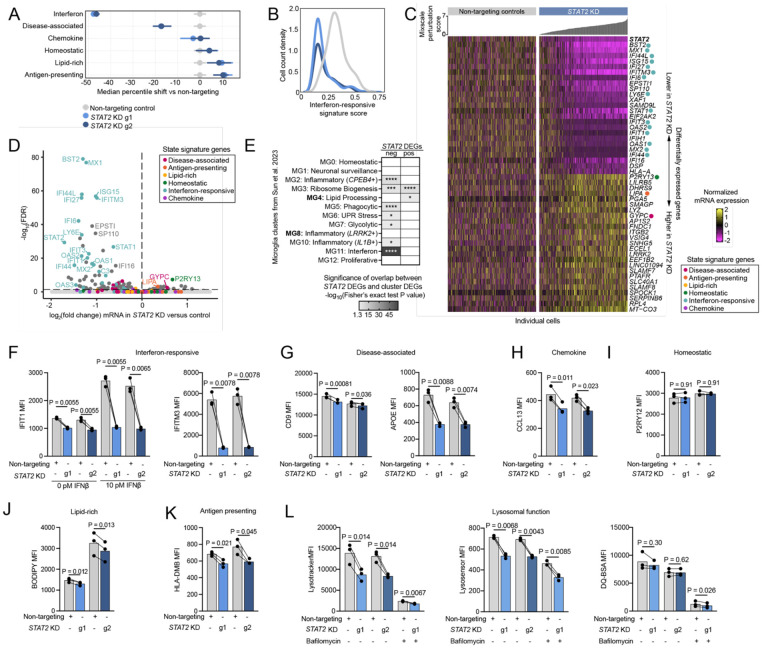
- STAT2 knockdown decreased interferon-responsive markers IFIT1 and IFITM3 at baseline and after IFNβ stimulation, reduced lysosomal pH indicators (lysotracker and lysosensor) without changing DQ-BSA cleavage, and lowered APOE, CCL13, HLA-DMB, and BODIPY staining; P2RY12 and CD9 were not perturbed.
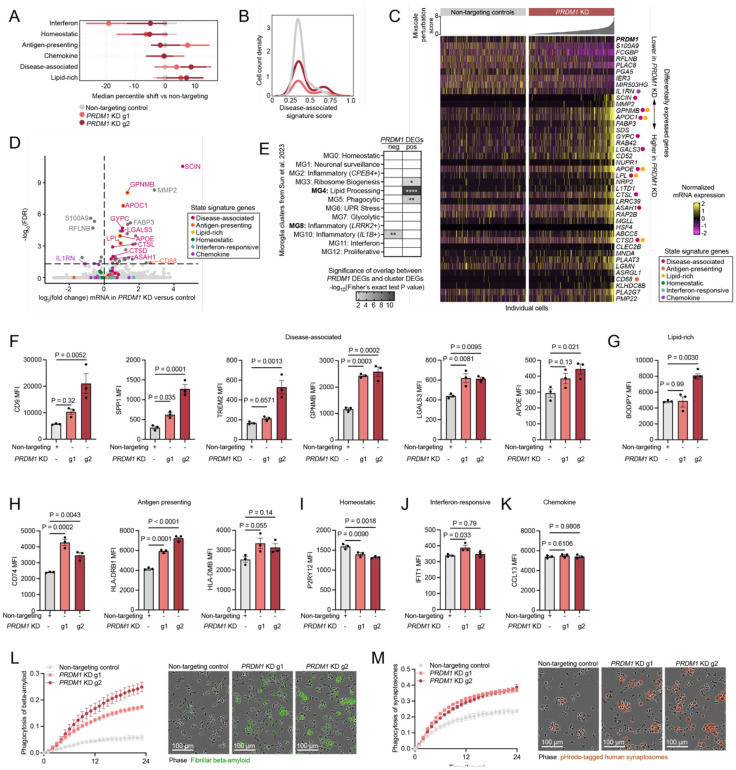
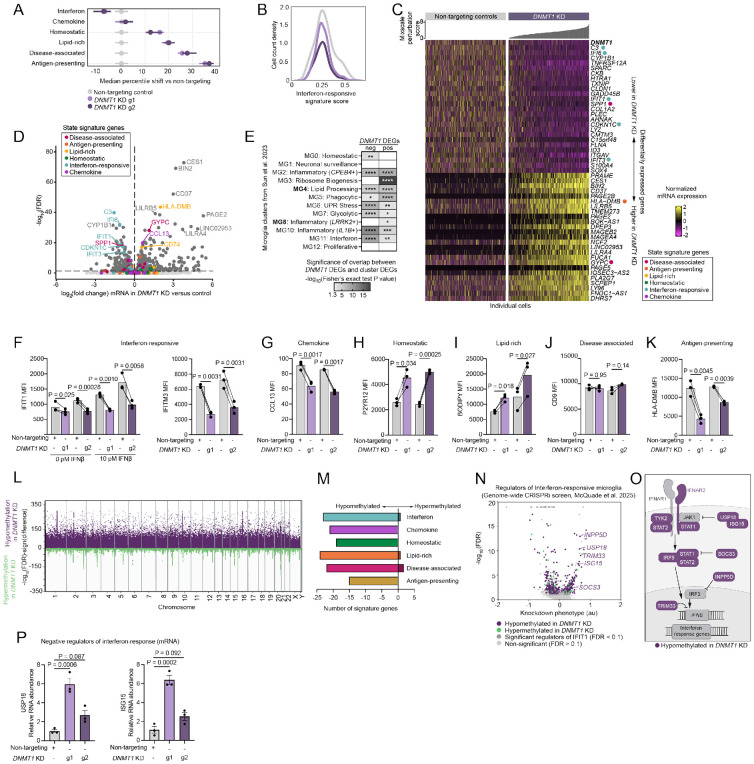
- PRDM1 knockdown increased disease-associated and lipid-processing signatures, with bimodal DAM scores and up-regulated genes overlapping human AD microglial clusters; PRDM1 KD microglia took up more beta-amyloid and synaptosomes without impaired DQ-BSA cleavage. DNMT1 knockdown caused widespread promoter hypomethylation, decreased the interferon-responsive state, increased homeostatic and lipid-rich markers, and increased mRNA of interferon inhibitors USP18 and ISG15.
Methods
- Six FACS-based CRISPRi screens were performed in iPSC-derived microglia using an sgRNA library targeting ~1600 transcription factors and transcriptional regulators, with five sgRNAs per gene and 250 non-targeting controls; cells were sorted into top 30% and bottom 30% for each state marker.
- Secondary single-cell screens used CROP-seq and CITE-seq for 31 regulators selected from primary hits, with two sgRNAs per gene plus five non-targeting sgRNAs, in two differentiation protocols: transcription-factor-driven iTF-MG and chemokine-driven iMG. Analyses included UCell state-signature scoring, Mixscale perturbation scores and weighted differential expression, and protein-signature correlations.
- Follow-up used individual CRISPRi knockdown lines for STAT2, PRDM1, and DNMT1, with flow cytometry, phagocytosis assays using pHrodo-tagged synaptosomes and Alexafluor488-tagged beta-amyloid, lysosomal function assays, and whole-genome enzymatic methylation sequencing for DNMT1.
Limitations
- The paper states that iPSC-derived microglia in monoculture do not model the brain’s complex signaling environment; further work is needed to test whether the identified regulators override environmental signals in vivo.
- The paper states that high-resolution single-cell analyses could not be performed on the full ~1600-gene sgRNA library because of cost, so the tiered approach limits scope to 31 regulators and three detailed knockdowns.
- The text makes evident additional constraints: primary screens relied on a single protein marker or dye per state; the iMG protocol showed sgRNA bottlenecking (over 50% dropout with the full library, and ~50% of sgRNAs assigned to fewer than 100 cells in the targeted library); and CRISPRi produces partial, tunable knockdown rather than binary loss of function.
Model-written summary. Check it against the paper before relying on it.
Integrity signals
Registry
Cites
Statistics
Figures
Verification
Claims the paper makes
0 Valid · 0 Not valid · 48 Not checked · 137 Own results and interpretations
A result the paper reports from its own data — it cites no other source for it, so there is none to check. The quote shows it is in the paper.
In the paper
“However, the full transcriptomic data highlights interferon-responsive genes as the main category of differentially expressed genes (DEGs) following STAT2 knockdown (KD) (Figure 3A-D, Table S4).”
§ Transcriptional regulation of disease-relevant microglial activation programs > Results > Loss of STAT2 inhibits the interferon-response state
plainstates a cause- Asserted: passes — The authors put it forward as true.
- Checkable: passes — It can be checked against evidence.
- Load-bearing: passes — The paper’s conclusions depend on it.
- Based: passes — The paper gives a reason why it holds.
In the paper
“The down-regulated DEGs in DNMT1 KD had significant overlap with multiple human patient-derived microglial states as defined by Sun et al. 202354. The strongest enrichment was for clusters MG10 and MG11 which represent inflammatory and interferon-responsive states (Figure 5E, Table S5).”
§ Transcriptional regulation of disease-relevant microglial activation programs > Results > Loss of DNMT1 is generally permissive to activation excluding the interferon-responsive state
What the sources say
- Not checked yetcites [54] Sun N. Human microglial state dynamics in Alzheimer’s disease progression. Cell 186, 4386– 4403.e29 (2023). 37774678 PMC10644954
boostedstates an association- Asserted: passes — The authors put it forward as true.
- Checkable: passes — It can be checked against evidence.
- Load-bearing: passes — The paper’s conclusions depend on it.
- Based: passes — The paper gives a reason why it holds.
A result the paper reports from its own data — it cites no other source for it, so there is none to check. The quote shows it is in the paper.
In the paper
“In this study, we identified novel regulators for six microglial activation states through CRISPRi-based functional genomic screens.”
§ Transcriptional regulation of disease-relevant microglial activation programs > Discussion
plainstates a cause- Asserted: passes — The authors put it forward as true.
- Checkable: passes — It can be checked against evidence.
- Load-bearing: passes — The paper’s conclusions depend on it.
- Based: passes — The paper gives a reason why it holds.
A result the paper reports from its own data — it cites no other source for it, so there is none to check. The quote shows it is in the paper.
In the paper
“Knockdown of DNMT1 enriched expression of all states except chemokine and interferon-responsive (Figure 5A).”
§ Transcriptional regulation of disease-relevant microglial activation programs > Results > Loss of DNMT1 is generally permissive to activation excluding the interferon-responsive state
plainstates a cause- Asserted: passes — The authors put it forward as true.
- Checkable: passes — It can be checked against evidence.
- Load-bearing: passes — The paper’s conclusions depend on it.
- Based: passes — The paper gives a reason why it holds.
A result the paper reports from its own data — it cites no other source for it, so there is none to check. The quote shows it is in the paper.
In the paper
“We found hypo-methylation at promoters of three negative regulators of interferon signaling (USP18, ISG15, SOCS3) (Figure 5N, O).”
§ Transcriptional regulation of disease-relevant microglial activation programs > Results > Hypo-methylation in DNMT1 KD enables expression of interferon-response inhibitors
plain- Asserted: passes — The authors put it forward as true.
- Checkable: passes — It can be checked against evidence.
- Load-bearing: passes — The paper’s conclusions depend on it.
- Based: passes — The paper gives a reason why it holds.
97 more claims
Create a free account to see all 185 claims and to verify the 81 references still open.
- It may state two separate claims as one. 42
- Probably not a substantial claim. 52
- The quote only partly states this claim. 1
Self-check
Percentages, sums and reported differences re-computed from the paper’s own numbers.
Each contradiction between two passages listed here was confirmed by an independent check.
Rated minor: it would not touch a result — a value no result rests on, a p-value that stays on the same side of the significance level, or a conflict that is clerical, resolved elsewhere in the paper, or outside its own findings.
In the paper
§ Transcriptional regulation of disease-relevant microglial activation programs > Discussion
“our data shows that PRDM1 DEGs only overlap with clusters MG3, MG4, MG5, and MG11.”
§ Transcriptional regulation of disease-relevant microglial activation programs > Results > Loss of PRDM1 promotes the disease-associated microglia signature
“However, these genes are significantly overlapping with MG10 from Sun et al. 2023, an early inflammatory state high for IL-1β (Figure 4E, Table S5).”
Rated minor: it would not touch a result — a value no result rests on, a p-value that stays on the same side of the significance level, or a conflict that is clerical, resolved elsewhere in the paper, or outside its own findings.
In the paper
“In total, 31 genes with 2 sgRNAs each were pooled alongside 5 non-targeting sgRNAs which did not influence phenotypes in any of the original FACS-based screens resulting in a final library size of 65 elements.”
§ Transcriptional regulation of disease-relevant microglial activation programs > Methods > Single-cell CRISPRi screening (CROP-seq and CITE-seq)
Reported 65 · recomputed 67
Rated minor: it would not touch a result — a value no result rests on, a p-value that stays on the same side of the significance level, or a conflict that is clerical, resolved elsewhere in the paper, or outside its own findings.
In the paper
§ Transcriptional regulation of disease-relevant microglial activation programs > Results > Loss of PRDM1 promotes the disease-associated microglia signature
“the up-regulated genes overlap with MG3, MG4, and MG5 from Sun et al. 202354 which represent their ribosome biogenesis, phagocytic, and lipid-processing states (Figure 4E, Table S5).”
§ Transcriptional regulation of disease-relevant microglial activation programs > Results > Loss of STAT2 inhibits the interferon-response state
“MG5 represents high expression of phagocytosis-related genes. For genes increased in STAT2 KD microglia, we found significant overlap with MG3 and MG4. MG3 represents microglia high in ribosome biogenesis. MG4 represents lipid processing high microglia and is increased in AD patients.”
Citations
Cites
Robinson, M. D., McCarthy, D. J., & Smyth, G. K. (2010) · Bioinformatics · doi:10.1093/bioinformatics/btp616 · Cited by 41,364
limma powers differential expression analyses for RNA-sequencing and microarray studies
Ritchie, M. E., Phipson, B., Wu, D., Hu, Y., Law, C. W., Shi, W., & Smyth, G. K. (2015) · Nucleic Acids Research · doi:10.1093/nar/gkv007 · Cited by 40,458
Cutadapt removes adapter sequences from high-throughput sequencing reads
Martin, M. (2011) · EMBnet.journal · doi:10.14806/ej.17.1.200 · Cited by 33,889
López-Otín, C., Blasco, M. A., Partridge, L., Serrano, M., & Kroemer, G. (2013) · Cell · doi:10.1016/j.cell.2013.05.039 · Cited by 14,982
ggplot2: Elegant Graphics for Data Analysis
Wickham, H. (2009) · doi:10.1007/978-0-387-98141-3 · Cited by 14,447
Fast, sensitive and accurate integration of single-cell data with Harmony
Korsunsky, I., Millard, N., Fan, J., Slowikowski, K., Zhang, F., Wei, K., Baglaenko, Y., Brenner, M., Loh, P.-R., & Raychaudhuri, S. (2019) · Nature Methods · doi:10.1038/s41592-019-0619-0 · Cited by 10,488
The Human Genome Browser at UCSC
Kent, W. J., Sugnet, C. W., Furey, T. S., Roskin, K. M., Pringle, T. H., Zahler, A. M., & Haussler, A. D. (2002) · Genome Research · doi:10.1101/gr.229102 · Cited by 10,400
Complex heatmaps reveal patterns and correlations in multidimensional genomic data
Gu, Z., Eils, R., & Schlesner, M. (2016) · Bioinformatics · doi:10.1093/bioinformatics/btw313 · Cited by 10,034
SCANPY: large-scale single-cell gene expression data analysis
Wolf, F. A., Angerer, P., & Theis, F. J. (2018) · Genome Biology · doi:10.1186/s13059-017-1382-0 · Cited by 8,881
Scenic: single-cell regulatory network inference and clustering.
Aibar, S., González-Blas, C. B., Moerman, T., Huynh-Thu, V. A., Imrichova, H., Hulselmans, G., Rambow, F., Marine, J.-C., Geurts, P., Aerts, J., et al. (2017) · Nature Methods · doi:10.1038/nmeth.4463 · Cited by 6,520
Research works printed but not linked: 1
- 10.1101/2025.06.02.657512 · doi:10.1101/2025.06.02.657512
Cited by
Zohud, O., Lone, I. M., Midlej, K., & Iraqi, F. A. (2026) · Animal Models and Experimental Medicine · doi:10.1002/ame2.70131 · Cited by 4
Abdelaziz, A. M., & Eladawy, R. M. (2026) · Biochemical Pharmacology · doi:10.1016/j.bcp.2026.118381 · Cited by 3
Regulators of interferon-responsive microglia uncovered by Genome-wide CRISPRi screening
McQuade, A., Castillo, V. C., Hagan, V., Liang, W., Ta, T., Mishra, R., Teter, O. M., Gomes, L., Gonzalez, B., Teyssier, N., et al. (2026) · npj Dementia · doi:10.1038/s44400-026-00125-4 · Cited by 3
Self-citationMerlo, S., Lipari, C. L. R., Patti, A., & Sortino, M. A. (2026) · Phytotherapy Research · doi:10.1002/ptr.70317 · Cited by 2
Microglial state transitions are constrained by developmental and metabolic checkpoints
Mesaoudi, A. E., & Kim, D. W. (2026) · Frontiers in Cellular Neuroscience · doi:10.3389/fncel.2026.1852176 · Cited by 2
Metadata
- Authors
- McQuade, A., Mishra, R., Hagan, V., Liang, W., Colias, P. J., Castillo, V. C., Gonzalez, B., Lubin, J. P., Haage, V., Marshe, V., Fujita, M., Ta, T., Gomes, L., Teter, O., Han, X., Robichaud, N., Chasins, S. E., Rexach, J. E., De Jager, P. L., Nuñez, J. K., & Kampmann, M.
- Affiliations
- University of California, San Francisco (US)
- University of California, Berkeley (US)
- City College of San Francisco (US)
- Columbia University Irving Medical Center (US)
- University of California, Los Angeles (US)
- Center for Translational & Computational Neuroimmunology, Department of Neurology & Taub Institute for the study of Alzheimer’s Disease and the Aging Brain, Columbia University Irving Medical Center, New York, NY, USA
- Chan Zuckerberg Biohub San Francisco (US)
- Corresponding author
- Kampmann, Martin
- ORCID
- Venue
- Neuron
- Publisher
- openRxiv
- Published
- 2025-10-13
- ISSN
- 0896-6273 (ISSN-L)
- PMC
- PMC12632903
- OpenAlex
- W4415117433
- Cited by
- 9
- References
- 148
- Citations by year
- 2026: 9
- FWCI
- 14.33
- Type
- journal article
- Language
- en
- Open access
- hybrid
- doi.org
- Licence
- Locations
- Neuron (publishedVersion, cc-by)
- bioRxiv (Cold Spring Harbor Laboratory) (submittedVersion, cc-by)
- PubMed Central (publishedVersion, cc-by)
- PubMed (publishedVersion)
- PubMed Central (acceptedVersion)
- Europe PMC (PubMed Central) (submittedVersion, cc-by)
- PubMed (submittedVersion)
- Zenodo (CERN European Organization for Nuclear Research) (cc-by)
- Funders
- National Science Foundation (2034836, 17528)
- California Institute for Regenerative Medicine (EDUC2-12730)
- Alzheimer's Association (AARF-22-973222, ADSF-21-831212-C, AARF-22, ZEN-22-969903)
- Larry L. Hillblom Foundation (2022-A-016-FEL)
- Innovative Genomics Institute (CA-0204195)
- Chan Zuckerberg Initiative (CP2-1-0000000332)
- Rainwater Charitable Foundation
- National Institutes of Health (1rf1ns144499-01)
- University of California, San Francisco
- National Institute on Aging (U01AG057195, U19AG063911, R01AG075802, P01AG019724, P30AG062422)
- National Institute of General Medical Sciences (R35GM155044, T32GM136547)
- National Institute of Neurological Disorders and Stroke (1R01NS144499)
- Topics
- Life Sciences › Neuroscience › Neurology › Neuroinflammation and Neurodegeneration Mechanisms
- Health Sciences › Medicine › Clinical Neurology › Multiple Sclerosis Research Studies
- Life Sciences › Biochemistry, Genetics and Molecular Biology › Molecular Biology › Inflammasome and immune disorders
- Keywords
- microglial activation states, disease-associated microglia, transcriptional regulation, iPSC-derived microglia, CRISPR interference screen, Blimp-1, DNMT1, DNA methylation, interferon signaling, phagocytosis, antigen presentation, cell surface proteome, single-cell transcriptomics, neuroinflammation
About these checks
Registry, retraction, Cites and statistics results are computed, not judged, with one exception: a printed reference that no index lists is read once by a model before it counts as a citation error. Claims are extracted by a model and kept only when their quote appears verbatim in the text; each cited source is then checked, with a model’s help, for whether it says what the claim relies on. Those verdicts can be wrong — read the claim’s quote and the cited source before relying on one.
A language model drew the claims from the paper on 2026-11-27, under version 3 of the claim definition (model deepseek-v4.1-flash, prompt extract-v3).
A second model labelled each claim on 2026-11-27 (model jev-1.13-20260917, definition revision gold-guideline-v0.2).
Statistics and arithmetic are recomputed, not judged.
Confidence bands are shown only for fields calibrated on our annotated test set. None is calibrated yet, so no band is shown.
What counts as a claim ›How we measure confidence ›How we check this ›
Are you an author, or do you see a problem with this page? Request a review
Data sources
Bibliographic data: Semantic Scholar, OpenAlex, Crossref.
Contains information from the Semantic Scholar Academic Graph Datasets, made available under the ODC Attribution License (ODC-BY 1.0).
Semantic Scholar’s data is described in: Kinney, R., et al. (2023). The Semantic Scholar Open Data Platform. arXiv:2301.10140.
