

Consensus meta-analysis of genome-wide association studies for Alzheimer’s disease and related dementia
Open accessThe DOI matches its Crossref record; 61 of the 61 references it cites were found in a registry or an index; none of the 42 sources its claims cite is checked for support yet.
Abstract
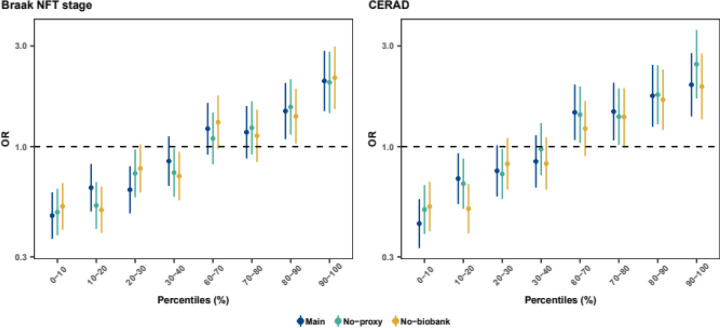
To better characterize the genetic architecture underlying Alzheimer’s disease (AD) and related dementia (ADRD), we performed a meta-analysis of European ancestry genome-wide association studies in 128,681 cases or proxy cases of ADRD and 849,833 (proxy) controls. We identified 91 genetic loci associated with ADRD risk, including 16 which are novel, and 56 which are specifically detected in clinically diagnosed AD cases. We also provide a list of 18 loci (15 novel) requiring further external validation. A polygenic score combining the effect of the ADRD loci except APOE was primarily associated with AD rather than non-AD pathology. Individuals in the 10 th decile of the score had a 2-fold increased risk to present with Braak neurofibrillary tangles stage above 5 and moderate/severe neuritic amyloid plaque pathology at death compared to individuals in the median score group.
Overview
CoChat Summary
TL;DR
This consensus meta-analysis of European-ancestry ADRD GWAS identified 91 genome-wide significant loci, including 16 novel, and showed that a polygenic score excluding APOE primarily tracks AD rather than non-AD neuropathology. Sensitivity analyses highlighted 56 loci detected in clinically diagnosed AD and 18 loci (15 novel) needing external validation.
Key findings
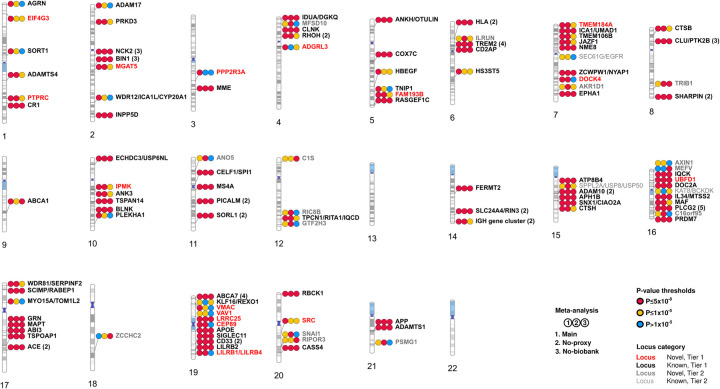
- The meta-analysis identified 91 Tier 1 loci at P ≤ 5×10⁻⁸, including 16 novel in European ancestry samples: EIF4G3, PTPRC, MGAT5, PPP2R3A, ADGRL3, FAM193B, TMEM184A, DOCK4, IPMK, UBFD1, VMAC, VAV1, LRRC25, CEP89, LILRB1/LILRB4 and SRC. It also found 25 independent secondary signals in 16 loci, with the first independent signal detected in CD33, HLA, PICALM and RHOH.
- Among the 91 Tier 1 loci, 75 (82.4%) were genome-wide significant in the no-proxy meta-analysis and 56 (61.5%) in the no-biobank meta-analysis of clinically diagnosed AD cases; 10 novel loci were significant in both main and no-proxy analyses, and UBFD1 and LRRC25 were also significant in the no-biobank analysis. An additional 18 loci (15 novel) were classified as Tier 2 requiring external validation.
- A polygenic score excluding APOE was primarily associated with AD rather than non-AD pathology. In ADC/NACC, compared with the median quintile, the 10th decile had a 2.05-fold (95% CI 1.47–2.85) increased risk for Braak stage above 5 and 1.96-fold (95% CI 1.39–2.78) for moderate/severe neuritic amyloid plaque pathology; the 1st decile had decreased risk of 0.47-fold (95% CI 0.37–0.61) and 0.43-fold (95% CI 0.33–0.56), respectively. Nagelkerke’s pseudo R-squared was 3.98% for Braak stage and 4.37% for CERAD score.
- After excluding APOE, the no-proxy ADRD phenotype was genetically correlated with Lewy body dementia (r=0.64, 95% CI [0.37, 0.92]), amyotrophic lateral sclerosis (r=0.29, 95% CI [0.18, 0.40]), Parkinson’s disease (r=0.16, 95% CI [0.06, 0.27]) and educational attainment (r=−0.12, 95% CI [−0.17, −0.07]).
Methods
- Consensus meta-analysis of European-ancestry GWAS from 52 studies: 72,721 AD cases, 55,960 proxy ADRD cases, 614,267 controls and 235,566 proxy controls, with a rough effective sample size of 230,631; 20,045,120 variants were considered after quality control. Results were combined with fixed-effect inverse-variance weighted meta-analysis in METAL, with sensitivity meta-analyses excluding UKBB-proxy (no-proxy) and excluding large biobanks (no-biobank).
- Loci were defined by LD-based clumping; conditional and joint analyses used GCTA COJO, with exact conditional analyses in a subset of studies. Additional analyses included rare-variant burden analysis in ADES-ADSP, single-cell enrichment with FUMA, pathway analysis with MAGMA, PheWAS, and LDSC genetic correlations.
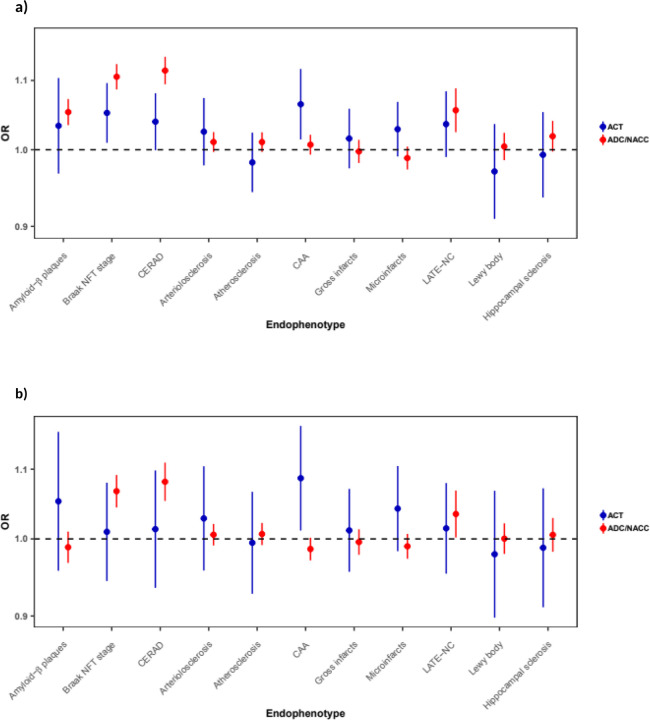
- Three polygenic scores were built from Tier 1 main and secondary signals excluding APOE (115 main, 91 no-proxy, 65 no-biobank variants) and tested for association with 11 neuropathological endophenotypes in ACT (N=677) and ADC/NACC (N=5,808) using logistic regression adjusted for age at death, sex, APOE ε4 and ε2 alleles, 10 PCs and centers.
Limitations
- Stated: genetic correlation with ADRD could not be assessed reliably for most of the 11 neuropathological endophenotypes due to low study sample sizes or heritability; the LATE-NC association remained significant only at the nominal level after adjustment (P=3.78×10⁻²), and a larger sample size is required to assess whether it is due to co-occurrence with AD pathology.
- Stated: some ADRD loci are significantly associated with non-AD neuropathological endophenotypes but not AD ones, which is difficult to interpret given low power of NPE GWASs for variants with small effect on ADRD risk; further well-characterized AD patients and neuropathological data are needed. The authors also note that educational attainment genetic correlation differed between main and no-proxy analyses, consistent with biases in proxy GWAS.
- Evident from the text: all analyses were restricted to European-ancestry samples, so generalizability to other ancestries is not established; the PGS/NPE analyses had limited power, especially in ACT (N=677) and for many NPE GWASs.
Model-written summary. Check it against the paper before relying on it.
Integrity signals
Registry
Cites
Statistics
Figures
Verification
Claims the paper makes
0 Valid · 0 Not valid · 18 Not checked · 74 Own results and interpretations
A result the paper reports from its own data — it cites no other source for it, so there is none to check. The quote shows it is in the paper.
In the paper
“There was no significant interaction (P≤2.27×10⁻³) between the PGS and the number of APOE ε4 and ε2 alleles for Braak stage and CERAD score”
§ Consensus meta-analysis of genome-wide association studies for Alzheimer’s disease and related dementia > Abstract
plain- Asserted: passes — The authors put it forward as true.
- Checkable: passes — It can be checked against evidence.
- Load-bearing: unclear — It is unclear whether the paper’s conclusions depend on it.
- Based: passes — The paper gives a reason why it holds.
- Rests on 2 assumptions not shown here.
A result the paper reports from its own data — it cites no other source for it, so there is none to check. The quote shows it is in the paper.
In the paper
“we also linked some of the new loci (both Tiers) to pathways related to tau, lipids or immunity”
§ Consensus meta-analysis of genome-wide association studies for Alzheimer’s disease and related dementia > Abstract
plainstates an association- Asserted: passes — The authors put it forward as true.
- Checkable: passes — It can be checked against evidence.
- Load-bearing: unclear — It is unclear whether the paper’s conclusions depend on it.
- Based: passes — The paper gives a reason why it holds.
- Rests on 2 assumptions not shown here.
A result the paper reports from its own data — it cites no other source for it, so there is none to check. The quote shows it is in the paper.
In the paper
“After adjustment on the (other) AD NPEs, only the associations with Braak stage and CERAD score remained significant in ADC/NACC”
§ Consensus meta-analysis of genome-wide association studies for Alzheimer’s disease and related dementia > Abstract
plainstates an association- Asserted: passes — The authors put it forward as true.
- Checkable: passes — It can be checked against evidence.
- Load-bearing: passes — The paper’s conclusions depend on it.
- Based: passes — The paper gives a reason why it holds.
- Rests on 2 assumptions not shown here.
A result the paper reports from its own data — it cites no other source for it, so there is none to check. The quote shows it is in the paper.
In the paper
“while four loci were only identified in the no-biobank meta-analysis”
§ Consensus meta-analysis of genome-wide association studies for Alzheimer’s disease and related dementia > Abstract
plain- Asserted: passes — The authors put it forward as true.
- Checkable: passes — It can be checked against evidence.
- Load-bearing: unclear — It is unclear whether the paper’s conclusions depend on it.
- Based: passes — The paper gives a reason why it holds.
In the paper
“In the SRC gene, loss-of-function variants and missense variants with a REVEL score above 50 were jointly associated with AD risk (OR=4.23 (2.04–8.79), P=1.06×10⁻⁴, Supplementary Table 8) in the ADES-ADSP summary statistics10.”
§ Consensus meta-analysis of genome-wide association studies for Alzheimer’s disease and related dementia > Abstract
What the sources say
- Not checked yetcites [10] Holstege H. Exome sequencing identifies rare damaging variants in ATP8B4 and ABCA1 as risk factors for Alzheimer’s disease. Nat. Genet. 54, 1786– 1794 (2022). 36411364 PMC9729101 source
plainstates an association- Asserted: passes — The authors put it forward as true.
- Checkable: passes — It can be checked against evidence.
- Load-bearing: passes — The paper’s conclusions depend on it.
- Based: passes — The paper gives a reason why it holds.
48 more claims
Create a free account to see all 92 claims and to verify the 42 references still open.
- It may state two separate claims as one. 18
- The quote only partly states this claim. 1
- Probably not a substantial claim. 27
Claims other papers make about this one
Each is checked against this paper’s own text: does it say what the citing paper says it does?
In the citing paper
“Finally, a very recent genome-wide consensus meta-analysis study from Bellenguez et al49 that included 128,681 AD cases from Bellenguez et al49 that included 128,681 AD cases from Bellenguez et al[37], the ADGC, DemGene, EADB, EADI, GERAD, GR@ACE/DEGESCO, IGAP, and PGC-AL resulted in the most significant result for rs3865444 to date (P=4.59 × 10⁻¹³ OR=0.95 (0.94–0.96)].”
From Comprehensive adjudication identifies 111 high-confidence loci for Alzheimer's disease and related dementias (2026) · cites this paper as [49]
Citations
Cites
DeLong, E. R., DeLong, D. M., & Clarke-Pearson, D. L. (1988) · Biometrics · doi:10.2307/2531595 · Cited by 22,649
pROC: an open-source package for R and S+ to analyze and compare ROC curves
Robin, X., Turck, N., Hainard, A., Tiberti, N., Lisacek, F., Sanchez, J.-C., & Müller, M. (2011) · BMC Bioinformatics · doi:10.1186/1471-2105-12-77 · Cited by 13,697
Genome-wide association study of 14,000 cases of seven common diseases and 3,000 shared controls
The Wellcome Trust Case Control Consortium, Management Committee, Burton, P. R., Clayton, D. G., Cardon, L. R., Craddock, N., Deloukas, P., Duncanson, A., Kwiatkowski, D. P., McCarthy, M. I., et al. (2007) · Nature · doi:10.1038/nature05911 · Cited by 9,442
GCTA: a tool for genome-wide complex trait analysis
Yang, J., Lee, S. H., Goddard, M. E., & Visscher, P. M. (2011) · The American Journal of Human Genetics · doi:10.1016/j.ajhg.2010.11.011 · Cited by 8,279
The Ensembl Variant Effect Predictor
McLaren, W., Gil, L., Hunt, S. E., Riat, H. S., Ritchie, G. R. S., Thormann, A., Flicek, P., & Cunningham, F. (2016) · Genome Biology · doi:10.1186/s13059-016-0974-4 · Cited by 8,099
A note on a general definition of the coefficient of determination
NAGELKERKE, N. J. D. (1991) · Biometrika · doi:10.1093/biomet/78.3.691 · Cited by 5,927
LD Score regression distinguishes confounding from polygenicity in genome-wide association studies
Schizophrenia Working Group of the Psychiatric Genomics Consortium, Bulik-Sullivan, B. K., Loh, P.-R., Finucane, H. K., Ripke, S., Yang, J., Patterson, N., Daly, M. J., Price, A. L., & Neale, B. M. (2015) · Nature Genetics · doi:10.1038/ng.3211 · Cited by 5,559
METAL: fast and efficient meta-analysis of genomewide association scans
Willer, C. J., Li, Y., & Abecasis, G. R. (2010) · Bioinformatics · doi:10.1093/bioinformatics/btq340 · Cited by 5,205
Meta-Analysis of 74,046 Individuals Identifies 11 New Susceptibility Loci for Alzheimer’s Disease
(EADI), E. A. D. I., Lambert, J.-C., (GERAD), G. A. E. R. I. A. D., Alzheimer's Disease Genetic Consortium (ADGC), (CHARGE), C. F. H. A. A. R. I. G. E., Ibrahim-Verbaas, C. A., Harold, D., Naj, A. C., Sims, R., Bellenguez, C., et al. (2013) · Nature Genetics · doi:10.1038/ng.2802 · Cited by 4,336
An atlas of genetic correlations across human diseases and traits
ReproGen Consortium, Bulik-Sullivan, B., Psychiatric Genomics Consortium, Genetic Consortium for Anorexia Nervosa of the Wellcome Trust Case Control Consortium 3, Finucane, H. K., Anttila, V., Gusev, A., Day, F. R., Loh, P.-R., Duncan, L., et al. (2015) · Nature Genetics · doi:10.1038/ng.3406 · Cited by 4,255
Cited by
P2RX7 drives inflammatory microglia and pathogenic extracellular vesicle secretion in tauopathy
Bodart‐Santos, V., Ravula, A. R., You, Y., Abdullah, M., Ruan, Z., Ellison, J. W., Radhakishun, S., Ray, N. B., Melvin, B. C., Kurti, A., et al. (2026) · Neuron · doi:10.21203/rs.3.rs-6771517/v1 · Cited by 6
Salazar, A., Tesi, N., Knoop, L., van Schoor, N. M., Huisman, M. A., Tijms, B. M., Vijverberg, E. G. B., van der Lee, S. J., Wijesekera, S., Křížová, J., et al. (2025) · medRxiv · doi:10.1101/2025.02.02.25321330 · Cited by 5
Hu, M., Esmaeeli, S., Stolzenburg, L. R., Milkovich, B., Jouni, M., Nyamugenda, E., Hammond, R. K., Reinhardt, P., Bahnassawy, L., Gasparini, L., et al. (2026) · Frontiers in Aging Neuroscience · doi:10.1101/2025.03.31.646439 · Cited by 2
Genetic architecture of Alzheimer’s disease is enriched in peripheral immune and metabolic programsPreprint
Cunha, C., Avelli, M. P., Romero-Lado, M. J., Martínez, R., Belanich, J. R., Jones, T. R., Claussnitzer, M., Loos, R. J. F., & Kilpeläinen, T. O. (2026) · medRxiv · doi:10.64898/2026.02.09.26344392 · Cited by 2
Sherva, R., Bayly, H., Zhang, R., Harrington, K. M., Mez, J., Miller, M. W., Tsuang, D. W., Wolf, E. J., Zeng, Q., Guen, Y. L., et al. (2026) · medRxiv · doi:10.64898/2026.05.01.26352216 · Cited by 2
Metadata
- Authors
- ADGC, Bonn, CHARGE, EADB, Bellenguez, C., EADI, FinnGen, GERAD, GR@ACE/DEGESCO, & PGC-ALZ
- Venue
- medRxiv
- Publisher
- openRxiv
- Published
- 2025-10-23
- Volume
- 58
- Issue
- 6
- Pages
- 1214-1225
- ISSN
- 1061-4036 (ISSN-L)
- PMC
- PMC12633585
- OpenAlex
- W7163386725
- Cited by
- 46
- References
- 61
- Citations by year
- 2026: 45 · 2025: 1
- FWCI
- 21.58
- Type
- journal article
- Language
- en
- Open access
- hybrid
- doi.org
- Licence
- Locations
- Nature Genetics (publishedVersion, cc-by)
- medRxiv (submittedVersion, cc-by-nc-nd)
- DZNE Pub (publishedVersion, cc-by)
- PubMed Central (publishedVersion, cc-by-nc-nd)
- PubMed Central (publishedVersion, cc-by)
- PubMed (publishedVersion)
- Research Publications (Maastricht University) (publishedVersion, cc-by)
- DIGITAL.CSIC (Spanish National Research Council (CSIC)) (publishedVersion, other-oa)
- Oxford University Research Archive (ORA) (University of Oxford) (publishedVersion)
- Research at the University of Copenhagen (University of Copenhagen) (publishedVersion, cc-by)
- EUR Research Repository (Erasmus University Rotterdam) (publishedVersion, cc-by)
- VU Research Portal (publishedVersion, other-oa)
- Repository for Publications and Research Data (ETH Zurich) (publishedVersion, cc-by)
- ORCA Online Research @Cardiff (Cardiff University) (acceptedVersion, cc-by)
- Institutional Repository University of Antwerp (University of Antwerp) (submittedVersion, other-oa)
- BOA (University of Milano-Bicocca) (submittedVersion, cc-by)
- Open access LMU (Ludwid Maxmilian's Universitat Munchen) (submittedVersion)
- PubliCatt (Università Cattolica del Sacro Cuore) (submittedVersion, cc-by)
- Europe PMC (PubMed Central) (submittedVersion, cc-by-nc-nd)
- PubMed (submittedVersion)
- NVA (Nasjonalt vitenarkiv) (submittedVersion, cc-by)
- Uppsala University Publications (Uppsala University) (submittedVersion, other-oa)
- Universitätsbibliographie, Universität Duisburg-Essen (submittedVersion)
- IRIS (submittedVersion)
- Pure Amsterdam UMC (submittedVersion, cc-by)
- ETH Zürich Research Collection (cc-by)
- Zurich Open Repository and Archive (University of Zurich)
- Funders
- U.S. Department of Veterans Affairs
- Alzheimer's Association
- Amgen
- Eli Lilly and Company
- Pfizer
- GlaxoSmithKline
- Sanofi
- Massachusetts General Hospital
- Biogen
- Teva Pharmaceutical Industries
- Alnylam Pharmaceuticals
- Florida Department of Health
- School of Medicine, Boston University
- Icahn School of Medicine at Mount Sinai
- Aarhus Universitet
- Cure Alzheimer's Fund
- University of Washington
- Johns Hopkins University
- University of Pittsburgh
- Universidad de Sevilla
- Universidad de Málaga
- Wellcome Trust
- University of Texas Health Science Center at Houston
- Amarin Corporation
- Prothena
- McGovern Medical School
- Siemens Medical Solutions USA
- Centro de Biología Molecular Severo Ochoa
- Cerveau Technologies
- National Institute for Health and Care Research
- University of Cambridge
- University College London
- University of Oxford
- Institut National de la Santé et de la Recherche Médicale (UMR 1219)
- Eisai
- Novo Nordisk
- Universidad Autónoma de Madrid
- National and Kapodistrian University of Athens
- Deutsches Zentrum für Neurodegenerative Erkrankungen
- Háskóli Íslands
- Universitat de Barcelona
- Aristotle University of Thessaloniki
- Universitat Autònoma de Barcelona
- Siemens Healthineers
- H. Lundbeck A/S
- Julius Clinical
- UK Dementia Research Institute
- Instituto de Investigación Sanitaria del Principado de Asturias
- National Institutes of Health
- Genentech
- Allergan
- University of Texas Health Science Center at San Antonio
- Avid Radiopharmaceuticals
- Medical Research Council
- Research Committee, Aristotle University of Thessaloniki
- National Institute on Aging (P30AG066512, P01AG003991, R01AG058066, P30AG066444, P30AG072946, P01AG026276, P30AG072947, R01AG061111, P30AG072975)
- National Heart, Lung, and Blood Institute (R01HL172803)
- Topics
- Life Sciences › Neuroscience › Cellular and Molecular Neuroscience › Alzheimer's disease research and treatments
- Health Sciences › Medicine › Psychiatry and Mental health › Dementia and Cognitive Impairment Research
- Life Sciences › Biochemistry, Genetics and Molecular Biology › Genetics › Genetic Associations and Epidemiology
- Keywords
- Alzheimer's disease, related dementias, genetic susceptibility loci, polygenic risk score, apolipoprotein E, European ancestry, Alzheimer's disease pathology, genetic architecture
- MeSH terms
- Genetic Risk Score, Alzheimer Disease, Dementia, Humans, Genetic Predisposition to Disease, Multifactorial Inheritance, Polymorphism, Single Nucleotide, Genome-Wide Association Study, Genetic Loci
About these checks
Registry, retraction, Cites and statistics results are computed, not judged, with one exception: a printed reference that no index lists is read once by a model before it counts as a citation error. Claims are extracted by a model and kept only when their quote appears verbatim in the text; each cited source is then checked, with a model’s help, for whether it says what the claim relies on. Those verdicts can be wrong — read the claim’s quote and the cited source before relying on one.
A language model drew the claims from the paper on 2026-11-26, under version 3 of the claim definition (model deepseek-v4.1-flash, prompt extract-v3).
A second model labelled each claim on 2026-11-26 (model jev-1.13-20260917, definition revision gold-guideline-v0.2).
Statistics and arithmetic are recomputed, not judged.
Confidence bands are shown only for fields calibrated on our annotated test set. None is calibrated yet, so no band is shown.
What counts as a claim ›How we measure confidence ›How we check this ›
Are you an author, or do you see a problem with this page? Request a review
Data sources
Bibliographic data: Semantic Scholar, OpenAlex, Crossref.
Contains information from the Semantic Scholar Academic Graph Datasets, made available under the ODC Attribution License (ODC-BY 1.0).
Semantic Scholar’s data is described in: Kinney, R., et al. (2023). The Semantic Scholar Open Data Platform. arXiv:2301.10140.
