

The DOI matches its Crossref record; 24 of the 24 references it cites were found in a registry or an index.
The nucleotide exchange factor, GrpE, modulates substrate affinity by interaction of its N-terminal tails with the DnaK substrate-binding domain
Open accessPreprint — published as 10.1016/j.jbc.2026.111176 · Paper page
Abstract
The 70-kDa heat shock proteins (Hsp70s) assist in protein folding through allosteric communication between their nucleotide-binding domains (NBDs) and substrate-binding domains (SBDs), which are connected by an interdomain linker. Their nucleotide-dependent allosteric cycle is modulated by ligand binding and co-chaperones, including nucleotide exchange factors (NEFs). GrpE, the NEF for the E. coli Hsp70, DnaK, has been proposed to have a dual effect on the chaperone, facilitating the exchange of ADP for ATP in the NBD in a temperature-dependent fashion and promoting substrate release from the SBD. We recently reported NMR-based evidence that GrpE binding to DnaK has a direct structural effect on the SBD. Here, we expanded on these findings and obtained new evidence for a model in which the disordered N-terminal tails of GrpE facilitate peptide dissociation from the nucleotide-free DnaK/GrpE complex by transiently binding to the canonical substrate-binding site in the SBD. This GrpE/SBD interaction, while weak, is favored by the high local concentration of the tails around the SBD after complex formation. Moreover, we identified the DnaK binding motif in GrpE’s N-terminal disordered tails as 17 IIM 19 , which is conserved across many bacterial species. Excitingly, our data further suggest a mechanism for the temperature-dependence of GrpE’s modulation of DnaK’s refolding activity: as the temperature increases, unfolding of GrpE’s coiled-coil weakens its contacts with the SBD, reducing N-terminal tail binding, and thus increasing DnaK affinity to substrates.
Overview
The claims and statistics of this paper haven’t been checked yet.
Run the check — free, no account needed. It reads the open-access text and checks the sources it cites.
Integrity signals
Registry
Cites
Statistics
Figures
Verification
Claims the paper makes
The claims and statistics of this paper haven’t been checked yet.
Run the check — free, no account needed. It reads the open-access text and checks the sources it cites.
Self-check
Percentages, sums and reported differences re-computed from the paper’s own numbers.
The self-check needs the paper’s full text.
Citations
Cites
Basic local alignment search tool
Altschul, S. F., Gish, W., Miller, W., Myers, E. W., & Lipman, D. J. (1990) · Journal of Molecular Biology · doi:10.1006/jmbi.1990.9999 · Cited by 98,669 · cited 1×
“Sequence alignments were created using the Clustal Omega (34) and Blast (35, 36) algorithms.”
Gapped BLAST and PSI-BLAST: a new generation of protein database search programs
Altschul, S. (1997) · Nucleic Acids Research · doi:10.1093/nar/25.17.3389 · Cited by 73,302 · cited 1×
“Sequence alignments were created using the Clustal Omega (34) and Blast (35, 36) algorithms.”
Highly accurate protein structure prediction with AlphaFold
Jumper, J., Evans, R., Pritzel, A., Green, T., Figurnov, M., Ronneberger, O., Tunyasuvunakool, K., Bates, R., Žídek, A., Potapenko, A., et al. (2021) · Nature · doi:10.1038/s41586-021-03819-2 · Cited by 43,764
Varadi, M., Bertoni, D., Magana, P., Paramval, U., Pidruchna, I., Radhakrishnan, M., Tsenkov, M., Nair, S., Mirdita, M., Yeo, J., et al. (2024) · Nucleic Acids Research · doi:10.1093/nar/gkad1011 · Cited by 2,052
The EMBL-EBI Job Dispatcher sequence analysis tools framework in 2024
Madeira, F., Madhusoodanan, N., Lee, J., Eusebi, A., Niewielska, A., Tivey, A. R., López, R., & Butcher, S. (2024) · Nucleic Acids Research · doi:10.1093/nar/gkae241 · Cited by 1,871 · cited 1×
“Sequence alignments were created using the Clustal Omega (34) and Blast (35, 36) algorithms.”
Tugarinov, V., Kanelis, V., & Kay, L. (2006) · Nature Protocols · doi:10.1038/nprot.2006.101 · Cited by 506 · cited 5×
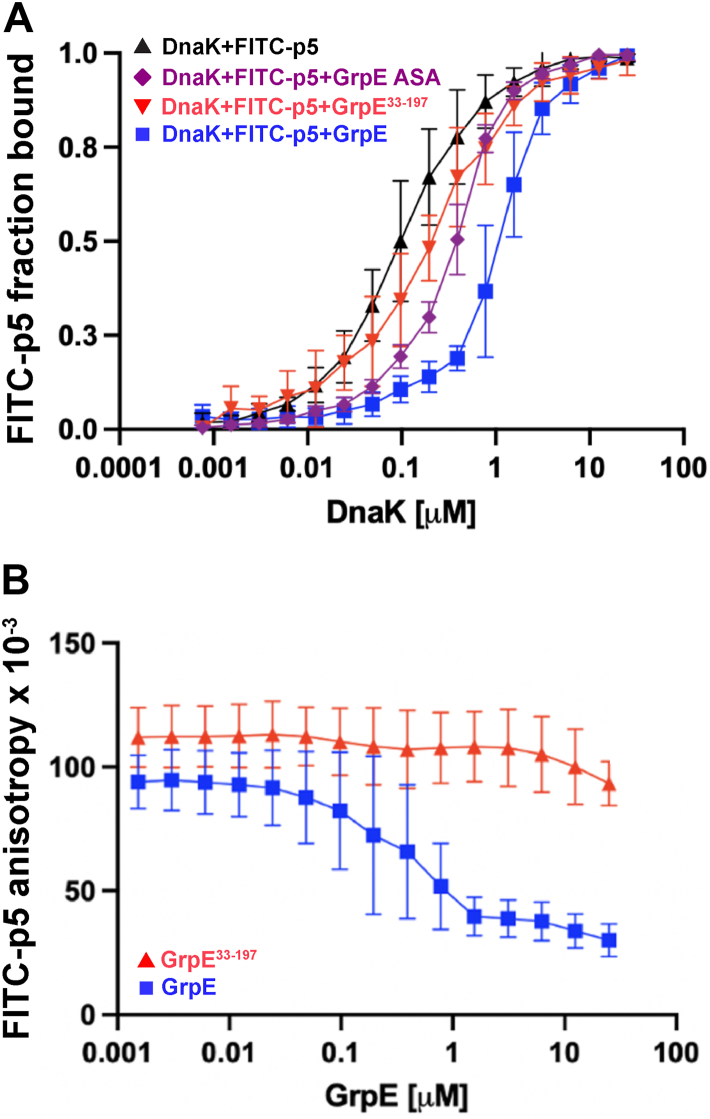
“The apparent affinities of DnaK for fluorescein isothiocyanate (FITC)-labeled peptide p5 (ALLLSAPRR) in the absence or presence of GrpE, GrpE 33-197 , or GrpE ASA was measured at 22 or 38 °C in a Biotek Synergy 2 micro plate reader (Biotek), with excitation at 485 nm and emission at 516 nm. 0 - 25…”
InfluentialHarrison, C., Hayer-Hartl, M., Diliberto, M., Hartl, F., & Kuriyan, J. (1997) · Science · doi:10.1126/science.276.5311.431 · Cited by 499 · cited 11×
“The NBD/GrpE interactions are consistent with the previous x-ray structure of GrpE complexed with the isolated E. coli DnaK NBD (7) and the corresponding predicted structure from our lab (17).”
InfluentialSolution conformation of wild-type E. coli Hsp70 (DnaK) chaperone complexed with ADP and substrate
Bertelsen, E., Chang, L., Gestwicki, J., & Zuiderweg, E. (2009) · Proceedings of the National Academy of Sciences of the United States of America · doi:10.1073/pnas.0903503106 · Cited by 461 · cited 1×
“As seen in the previously reported structures of complexes from homologous organisms, the E. coli DnaK NBD and SBD in the complex with GrpE are not associated with one another, similar to the ADP-bound state of E. coli DnaK (23).”
Zhuravleva, A., Clerico, E. M., & Gierasch, L. (2012) · Cell · doi:10.1016/j.cell.2012.11.002 · Cited by 253 · cited 1×
“Methyl 13 C-HMQC spectra were obtained at 25 or 38 °C on a Bruker Avance III 600 MHz instrument and analyzed as described previously (17, 31).”
Self-citationSchönfeld, H., Schmidt, D., Schröder, H., & Bukau, B. (1995) · Journal of Biological Chemistry · doi:10.1074/jbc.270.5.2183 · Cited by 175 · cited 1×
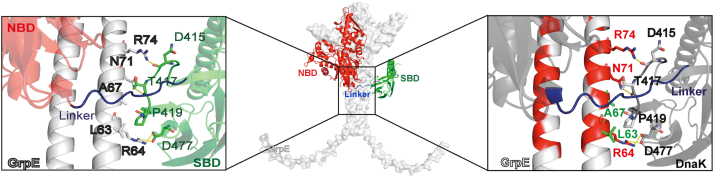
“It is a homodimer with a unique cruciform shape consisting of a globular C-terminal region with two β-bundles and four α-helices, a long coiled-coil, and two N-terminal disordered tails ( Figure 1A ) (7, 11).”
Zhuravleva, A., & Gierasch, L. (2011) · Proceedings of the National Academy of Sciences of the United States of America · doi:10.1073/pnas.1014448108 · Cited by 157 · cited 1×
“To prepare 13 C methyl label ILV nucleotide free DnaK and 13 C methyl label ILV nucleotide free NBD 1-392 , established protocols were followed (30–33).”
Self-citationIntragenic suppressors of Hsp70 mutants: interplay between the ATPase- and peptide-binding domains.
Davis, J. E., Voisine, C., & Craig, E. A. (1999) · Proceedings of the National Academy of Sciences of the United States of America · doi:10.1073/pnas.96.16.9269 · Cited by 76 · cited 1×
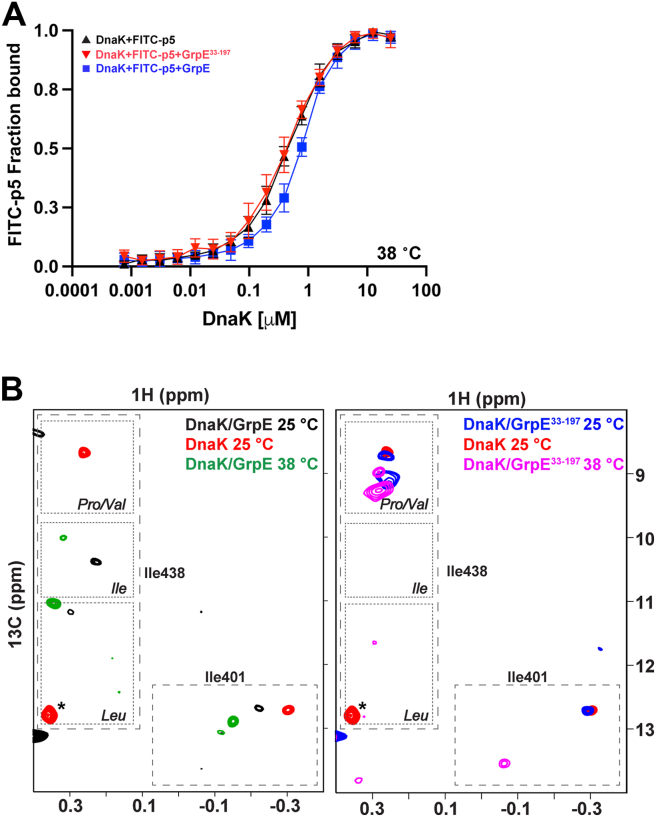
“We found that the apparent affinity (app-K D ) of DnaK for the fluorescein isothiocyanate (FITC)- labeled peptide p5 (ALLLSAPRR, (25)) was reduced in the presence of GrpE ( Table 1, Figure 4A and S5A ).”
Diamant, S., & Goloubinoff, P. (1998) · Biochemistry · doi:10.1021/bi980338u · Cited by 71 · cited 5×
“Finally, our model provides an explanation for the reduced impact of GrpE/DnaK binding on substrate affinity and the loss of DnaK refolding activity at elevated temperatures (14, 15, 20).”
InfluentialGroemping, Y., & Reinstein, J. (2001) · Journal of Molecular Biology · doi:10.1006/jmbi.2001.5116 · Cited by 62 · cited 5×
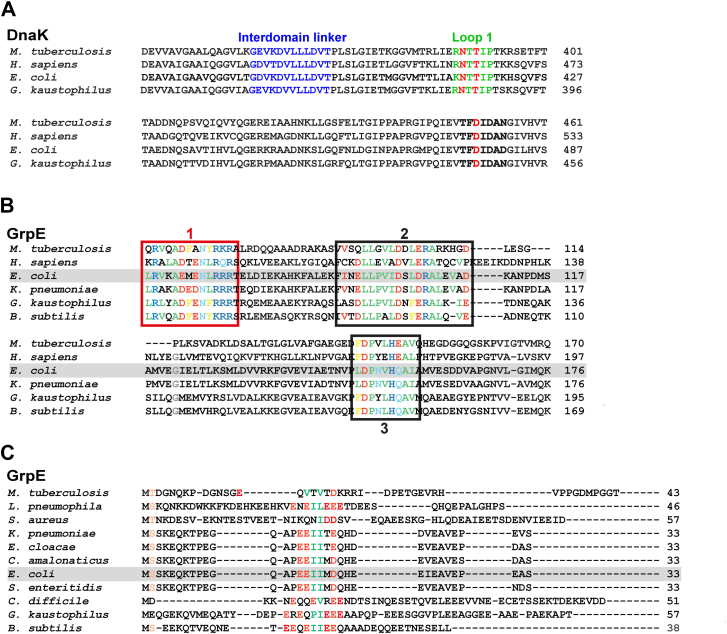
“…at the temperature when GrpE retains its NEF activity and modulates substrate affinity, but when the temperature is raised such that the coiled-coil domain begins to unfold (13, 16), the interaction of the 17 IIM 19 motif in the GrpE N-terminal tails and the substrate-binding pocket is disfavored.”
InfluentialConformational selection in substrate recognition by Hsp70 chaperones.
Marcinowski, M., Rosam, M., Seitz, C., Elferich, J., Behnke, J., Bello, C., Feige, M., Becker, C. F. W., Antes, I., & Buchner, J. (2013) · Journal of Molecular Biology · doi:10.1016/j.jmb.2012.11.030 · Cited by 48 · cited 1×
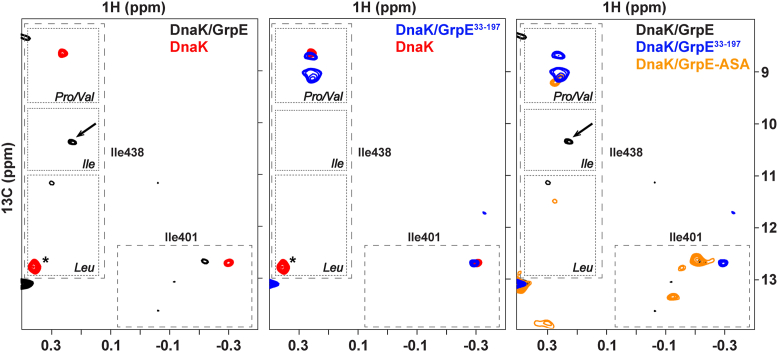
“We focused our NMR analysis of the GrpE complex using δ1-methyl chemical shifts of Ile 401 and 438 of the DnaK SBD, as they have proven to be extremely useful reporters of residue binding to the canonical substrate-binding pocket of the SBD (26, 27).”
Wu, C.-C., Naveen, V., Chien, C., Chang, Y.-W., & Hsiao, C.-D. (2012) · Journal of Biological Chemistry · doi:10.1074/jbc.m112.344358 · Cited by 45 · cited 18×
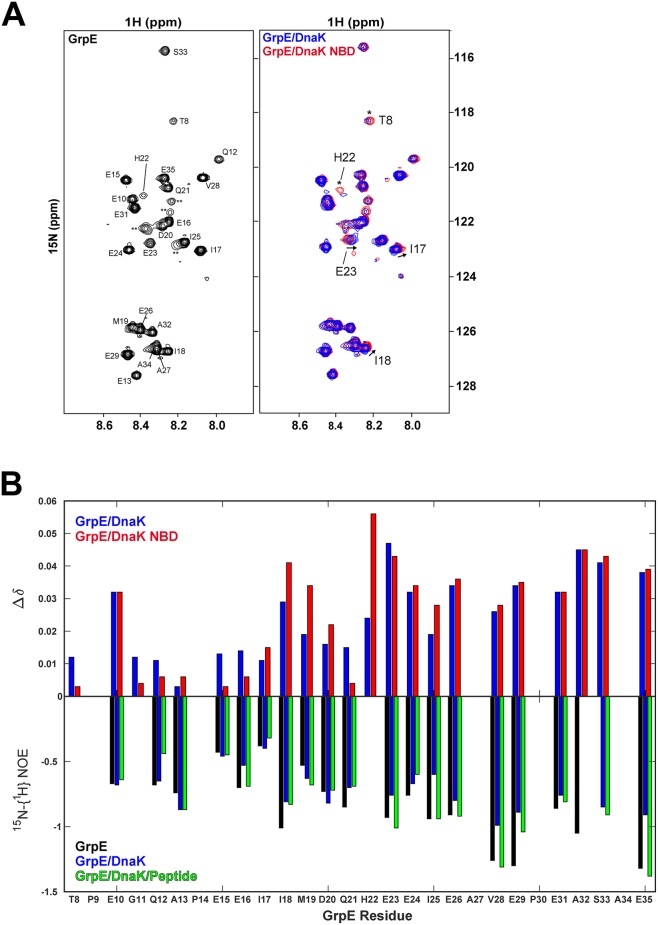
“These shifts are consistent with our model that the GrpE N-terminal tails interact transiently with the DnaK SBD. Importantly, the perturbations observed in I17 and I18 support the direct involvement of the 17 IIM 19 motif in this interaction.”
InfluentialA structure-based interpretation of E.coli GrpE thermodynamic properties.
Gelinas, A., Langsetmo, K., Toth, J., Bethoney, K. A., Stafford, W. F., & Harrison, C. (2002) · Journal of Molecular Biology · doi:10.1016/s0022-2836(02)00915-4 · Cited by 37 · cited 6×
“…at the temperature when GrpE retains its NEF activity and modulates substrate affinity, but when the temperature is raised such that the coiled-coil domain begins to unfold (13, 16), the interaction of the 17 IIM 19 motif in the GrpE N-terminal tails and the substrate-binding pocket is disfavored.”
InfluentialStructure of the M. tuberculosis DnaK−GrpE complex reveals how key DnaK roles are controlled
Xiao, X., Fay, A., Molina, P. S., Kovach, A., Glickman, M. S., & Li, H. (2024) · Nature Communications · doi:10.1038/s41467-024-44933-9 · Cited by 30 · cited 5×
“In addition, the structural ensemble of the M. tubuculosis DnaK/GrpE complex included some examples with greater proximity of the N-terminal tails to the SBD than observed in many other structures (8).”
InfluentialThermodynamic linkage in the GrpE nucleotide exchange factor, a molecular thermosensor.
Gelinas, A., Toth, J., Bethoney, K. A., Langsetmo, K., Stafford, W. F., & Harrison, C. (2003) · Biochemistry · doi:10.1021/bi034416b · Cited by 29 · cited 1×
“The coiled-coil, characterized by a melting transition with a T m of 48 °C, confers upon GrpE the ability to act as a cellular thermosensor (12, 13).”
The Importance of Having Thermosensor Control in the DnaK Chaperone System*
Siegenthaler, R., & Christen, P. (2005) · Journal of Biological Chemistry · doi:10.1074/jbc.m413803200 · Cited by 24 · cited 2×
“As the temperature increases, the coiled-coil domain of GrpE starts to unfold (13, 16), and GrpE loses its ability to assist DnaK in refolding substrates (9, 14, 15, 20).”
Bracher, A., & Verghese, J. (2023) · Sub-cellular biochemistry · doi:10.1007/978-3-031-14740-1_1 · Cited by 21 · cited 2×
“Hsp70 NEFs are categorized into four classes: BAG proteins, HspBP1 and Hsp110 in eukaryotes, and GrpE in prokaryotes, mitochondria, and chloroplasts (3, 10).”
A simple protocol for the production of highly deuterated proteins for biophysical studies
Li, J., & Byrd, R. (2022) · Journal of Biological Chemistry · doi:10.1016/j.jbc.2022.102253 · Cited by 20
Rossi, M.-A., Pozhidaeva, A., Clerico, E. M., Petridis, C., & Gierasch, L. (2023) · Journal of Biological Chemistry · doi:10.1016/j.jbc.2023.105574 · Cited by 8 · cited 10×
“GrpE concentrations throughout the article always refer to the dimer (17).”
InfluentialSelf-citationMorizono, M. A., McGuire, K., Birouty, N. I., & Herzik, M. (2024) · bioRxiv · doi:10.1101/2024.05.10.593630 · Cited by 4 · cited 5×
“Excitingly, the contacts formed between the GrpE coiled-coil with DnaK are the same in the E. coli complex as in those of homologues (8, 18, 19).”
Influential
Research works printed but not linked: 12
- 10.1146/annurev-biochem-060208-092442 · DOI
- 10.1038/s41580-019-0133-3 · DOI · Paper page
- 10.1042/BCJ20170380 · DOI
- 10.1074/jbc.REV118.002810 · DOI · Paper page
- 10.1074/jbc.M114.623371 · DOI
- 10.1016/j.jmb.2007.10.002 · DOI
- 10.1074/jbc.M403558200 · DOI
- 10.1074/jbc.M300924200 · DOI
- 10.1016/j.jmb.2005.08.069 · DOI
- 10.1073/pnas.2016962118 · DOI
- 10.1006/jmbi.1998.2514 · DOI
- 10.1016/j.molcel.2007.02.020 · DOI
Metadata
- Authors
- Maqtedar, A., Rossi, M.-A., Clerico, E. M., Williams, R. V., & Gierasch, L. M.
- Affiliations
- University of Massachusetts Amherst (US)
- Corresponding author
- Gierasch, Lila M.
- Venue
- Journal of Biological Chemistry
- Publisher
- openRxiv
- Published
- 2025-10-21
- Volume
- 302
- Issue
- 3
- Pages
- 111176-111176
- ISSN
- 0021-9258 (ISSN-L)
- PMC
- PMC12915176
- OpenAlex
- W7125431941
- Cited by
- 0
- References
- 23
- FWCI
- 0.00
- Type
- journal article
- Language
- en
- Open access
- gold
- doi.org
- Licence
- Locations
- Journal of Biological Chemistry (publishedVersion, cc-by)
- bioRxiv (Cold Spring Harbor Laboratory) (acceptedVersion, cc-by-nc-nd)
- PubMed (publishedVersion)
- PubMed Central (publishedVersion, cc-by)
- Europe PMC (PubMed Central) (submittedVersion, cc-by-nc-nd)
- Funders
- National Institutes of Health (GM18161, F32-GM156016)
- Topics
- Life Sciences › Biochemistry, Genetics and Molecular Biology › Molecular Biology › Heat shock proteins research
- Life Sciences › Biochemistry, Genetics and Molecular Biology › Molecular Biology › Protein Structure and Dynamics
- Life Sciences › Biochemistry, Genetics and Molecular Biology › Genetics › Bacterial Genetics and Biotechnology
- Keywords
- GrpE, DnaK, HSP70, nucleotide exchange factor, substrate-binding domain, substrate release, allosteric communication, temperature dependence, protein folding, Escherichia coli
About these checks
Registry, retraction, Cites and statistics results are computed, not judged, with one exception: a printed reference that no index lists is read once by a model before it counts as a citation error. Claims are extracted by a model and kept only when their quote appears verbatim in the text; each cited source is then checked, with a model’s help, for whether it says what the claim relies on. Those verdicts can be wrong — read the claim’s quote and the cited source before relying on one.
Statistics and arithmetic are recomputed, not judged.
Confidence bands are shown only for fields calibrated on our annotated test set. None is calibrated yet, so no band is shown.
What counts as a claim ›How we measure confidence ›How we check this ›
Are you an author, or do you see a problem with this page? Request a review
