

The DOI matches its Crossref record; 103 of the 105 references it cites were found in a registry or an index.
Modeling the language of life – Deep Learning Protein Sequences
Open accessPreprint — published as 10.1186/s12859-019-3220-8 · Paper page
Abstract
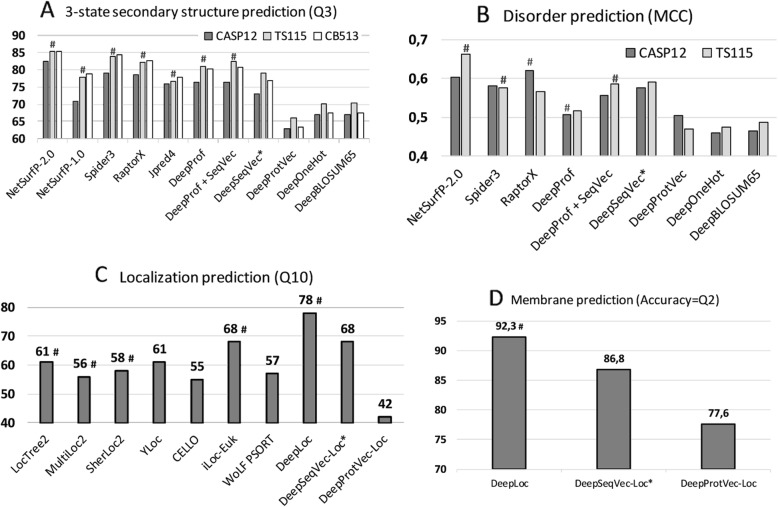
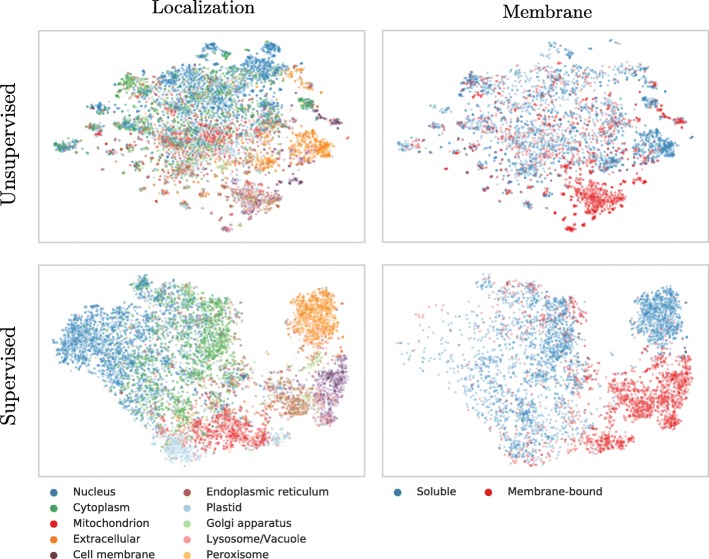
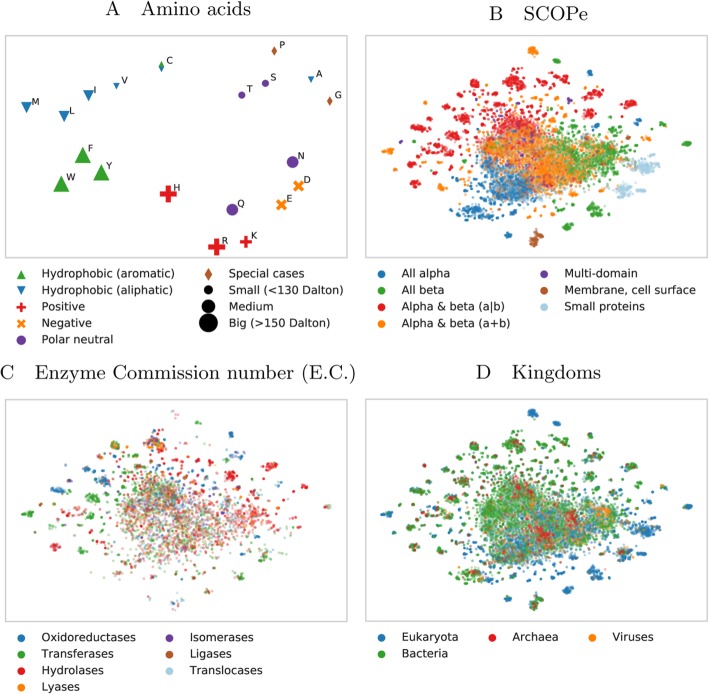
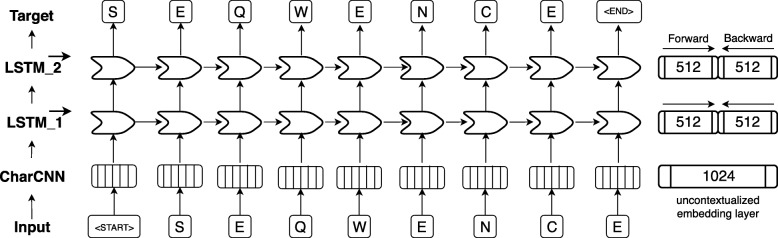
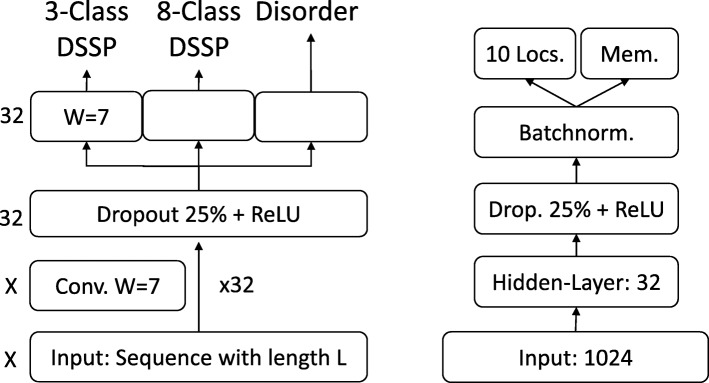
Background: One common task in Computational Biology is the prediction of aspects of protein function and structure from their amino acid sequence. For 26 years, most state-of-the-art approaches toward this end have been marrying machine learning and evolutionary information. The retrieval of related proteins from ever growing sequence databases is becoming so time-consuming that the analysis of entire proteomes becomes challenging. On top, evolutionary information is less powerful for small families, e.g. for proteins from the Dark Proteome . Results: We introduce a novel way to represent protein sequences as continuous vectors ( embeddings ) by using the deep bi-directional model ELMo taken from natural language processing (NLP). The model has effectively captured the biophysical properties of protein sequences from unlabeled big data (UniRef50). After training, this knowledge is transferred to single protein sequences by predicting relevant sequence features. We refer to these new embeddings as SeqVec ( Seq uence-to- Vec tor) and demonstrate their effectiveness by training simple convolutional neural networks on existing data sets for two completely different prediction tasks. At the per-residue level, we significantly improved secondary structure (for NetSurfP-2.0 data set: Q3=79%±1, Q8=68%±1) and disorder predictions (MCC=0.59±0.03) over methods not using evolutionary information. At the per-protein level, we predicted subcellular localization in ten classes (for DeepLoc data set: Q10=68%±1) and distinguished membrane-bound from water-soluble proteins (Q2= 87%±1). All results built upon the embeddings gained from the new tool SeqVec neither explicitly nor implicitly using evolutionary information. Nevertheless, it improved over some methods using such information. Where the lightning-fast HHblits needed on average about two minutes to generate the evolutionary information for a target protein, SeqVec created the vector representation on average in 0.03 seconds. Conclusion: We have shown that transfer learning can be used to capture biochemical or biophysical properties of protein sequences from large unlabeled sequence databases. The effectiveness of the proposed approach was showcased for different prediction tasks using only single protein sequences. SeqVec embeddings enable predictions that outperform even some methods using evolutionary information. Thus, they prove to condense the underlying principles of protein sequences. This might be the first step towards competitive predictions based only on single protein sequences. Availability: SeqVec: https://github.com/mheinzinger/SeqVec Prediction server: https://embed.protein.properties
Overview
The claims and statistics of this paper haven’t been checked yet.
Run the check — free, no account needed. It reads the open-access text and checks the sources it cites.
Integrity signals
Registry
Cites
Statistics
Figures
Verification
Claims the paper makes
The claims and statistics of this paper haven’t been checked yet.
Run the check — free, no account needed. It reads the open-access text and checks the sources it cites.
Self-check
Percentages, sums and reported differences re-computed from the paper’s own numbers.
The self-check needs the paper’s full text.
Citations
Cites
Hochreiter, S., & Schmidhuber, J. (1997) · Neural Computation · doi:10.1162/neco.1997.9.8.1735 · Cited by 102,318
Adam: A Method for Stochastic Optimization
Kingma, D. P., & Ba, J. (2014) · arXiv · doi:10.48550/arxiv.1412.6980 · Cited by 98,946
Gapped BLAST and PSI-BLAST: a new generation of protein database search programs
Altschul, S. (1997) · Nucleic Acids Research · doi:10.1093/nar/25.17.3389 · Cited by 73,302
BERT: Pre-training of Deep Bidirectional Transformers for Language Understanding
Devlin, J., Chang, M.-W., Lee, K., & Toutanova, K. (2018) · arXiv · doi:10.48550/arxiv.1810.04805 · Cited by 73,173
Berman, H. M. (2000) · Nucleic Acids Research · doi:10.1093/nar/28.1.235 · Cited by 40,196
Glove: Global Vectors for Word Representation
Pennington, J., Socher, R., & Manning, C. (2014) · Proceedings of the 2014 Conference on Empirical Methods in Natural Language Processing (EMNLP) · doi:10.3115/v1/d14-1162 · Cited by 34,071
(2014) · Cited by 33,419
(2008) · Journal of Machine Learning Research · Cited by 33,051
Batch Normalization: Accelerating Deep Network Training by Reducing Internal Covariate Shift
Ioffe, S., & Szegedy, C. (2015) · arXiv · doi:10.48550/arxiv.1502.03167 · Cited by 27,818
Efficient Estimation of Word Representations in Vector Space
Mikolov, T., Chen, K., Corrado, G., & Dean, J. (2013) · arXiv · doi:10.48550/arxiv.1301.3781 · Cited by 26,568
Research works printed but not linked: 1
- 10.1007/s10479-011-0841-3. · DOI
Cited by
Sorted by citations
Highly accurate protein structure prediction with AlphaFold
Jumper, J., Evans, R., Pritzel, A., Green, T., Figurnov, M., Ronneberger, O., Tunyasuvunakool, K., Bates, R., Žídek, A., Potapenko, A., et al. (2021) · Nature · doi:10.1038/s41586-021-03819-2 · Cited by 43,764
Evolutionary-scale prediction of atomic level protein structure with a language model
Lin, Z., Akin, H., Rao, R., Hie, B., Zhu, Z., Lu, W., Smetanin, N., Verkuil, R., Kabeli, O., Shmueli, Y., et al. (2022) · doi:10.1101/2022.07.20.500902 · Cited by 5,990
Rives, A., Meier, J., Sercu, T., Goyal, S., Lin, Z., Liu, J., Guo, D., Ott, M., Zitnick, C. L., Ma, J., et al. (2021) · Proceedings of the National Academy of Sciences · doi:10.1073/pnas.2016239118 · Cited by 3,286
ProtTrans: Toward Understanding the Language of Life Through Self-Supervised Learning
Elnaggar, A., Heinzinger, M., Dallago, C., Rehawi, G., Wang, Y., Jones, L., Gibbs, T., Feher, T., Angerer, C., Steinegger, M., et al. (2022) · IEEE Transactions on Pattern Analysis and Machine Intelligence · doi:10.1109/tpami.2021.3095381 · Cited by 2,329
Self-citationProteinBERT: a universal deep-learning model of protein sequence and function
Brandes, N., Ofer, D., Peleg, Y., Rappoport, N., & Linial, M. (2022) · Bioinformatics · doi:10.1093/bioinformatics/btac020 · Cited by 1,009
Metadata
- Authors
- Heinzinger, M., Elnaggar, A., Wang, Y., Dallago, C., Nechaev, D., Matthes, F., & Rost, B.
- Affiliations
- Technical University of Munich (DE)
- Leibniz Supercomputing Centre (DE)
- Corresponding author
- Heinzinger, Michael
- Venue
- BMC Bioinformatics
- Publisher
- openRxiv
- Published
- 2019-04-19
- Volume
- 20
- Issue
- 1
- Pages
- 723-723
- ISSN
- 1471-2105 (ISSN-L)
- PMC
- PMC6918593
- OpenAlex
- W2995514860
- Cited by
- 606
- References
- 105
- Citations by year
- 2026: 53 · 2025: 103 · 2024: 115 · 2023: 117 · 2022: 99 · 2021: 83 · 2020: 29 · 2019: 7
- FWCI
- 18.03
- Type
- journal article
- Language
- en
- Open access
- gold
- doi.org
- Licence
- cc-by
- Locations
- BMC Bioinformatics (publishedVersion, cc-by)
- bioRxiv (Cold Spring Harbor Laboratory) (acceptedVersion, cc-by-nc-nd)
- Europe PMC (PubMed Central) (publishedVersion, cc-by)
- PubMed Central (publishedVersion, cc-by)
- PubMed (publishedVersion)
- DOAJ (DOAJ: Directory of Open Access Journals) (submittedVersion, cc-by-sa)
- mediaTUM – the media and publications repository of the Technical University Munich (Technical University Munich) (submittedVersion, other-oa)
- Columbia Academic Commons (Columbia University)
- Funders
- Alexander von Humboldt-Stiftung
- Nvidia
- Deutsche Forschungsgemeinschaft (DFG-GZ: RO1320/4-1, RO1320/4‐1)
- Bundesministerium für Bildung und Forschung
- Leibniz-Gemeinschaft
- Topics
- Life Sciences › Biochemistry, Genetics and Molecular Biology › Molecular Biology › Machine Learning in Bioinformatics
- Life Sciences › Biochemistry, Genetics and Molecular Biology › Molecular Biology › Protein Structure and Dynamics
- Life Sciences › Biochemistry, Genetics and Molecular Biology › Molecular Biology › Fractal and DNA sequence analysis
- Keywords
- protein sequence embeddings, ELMo, transfer learning, protein function prediction, protein structure prediction, secondary structure prediction, subcellular localization prediction, membrane proteins, dark proteome, metaproteomics, microbiome analysis
- MeSH terms
- Machine Learning, Amino Acid Sequence, Natural Language Processing, Proteins, Neural Networks, Computer, Sequence Analysis, Computational Biology, Databases, Nucleic Acid, Databases, Protein, Proteomics
About these checks
Registry, retraction, Cites and statistics results are computed, not judged, with one exception: a printed reference that no index lists is read once by a model before it counts as a citation error. Claims are extracted by a model and kept only when their quote appears verbatim in the text; each cited source is then checked, with a model’s help, for whether it says what the claim relies on. Those verdicts can be wrong — read the claim’s quote and the cited source before relying on one.
Statistics and arithmetic are recomputed, not judged.
Confidence bands are shown only for fields calibrated on our annotated test set. None is calibrated yet, so no band is shown.
What counts as a claim ›How we measure confidence ›How we check this ›
Are you an author, or do you see a problem with this page? Request a review
