

The DOI matches its Crossref record; 61 of the 61 references it cites were found in a registry or an index.
Large-scale analysis of genome and transcriptome alterations in multiple tumors unveils novel cancer-relevant splicing networks
Open accessPublished version of a preprint
Abstract
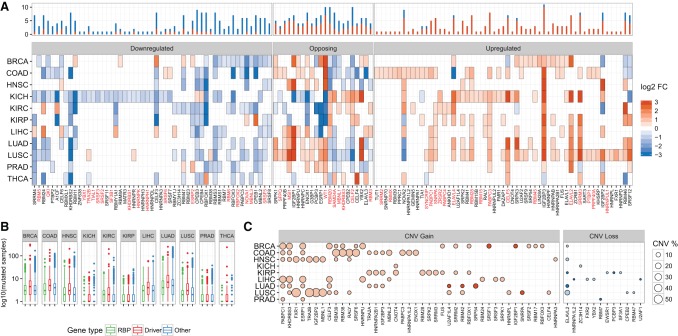
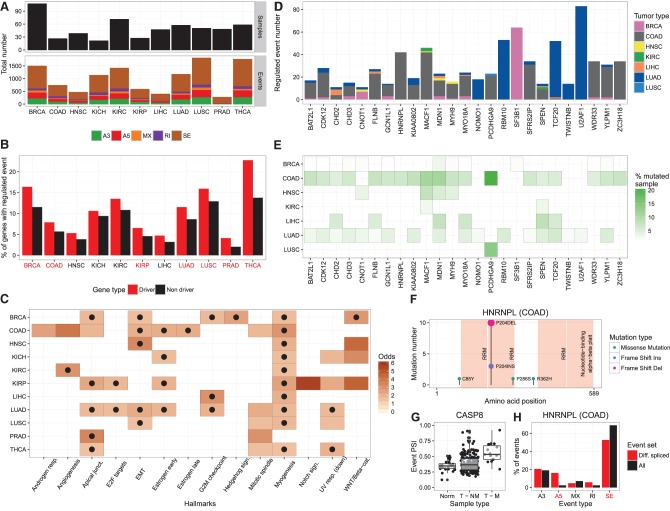
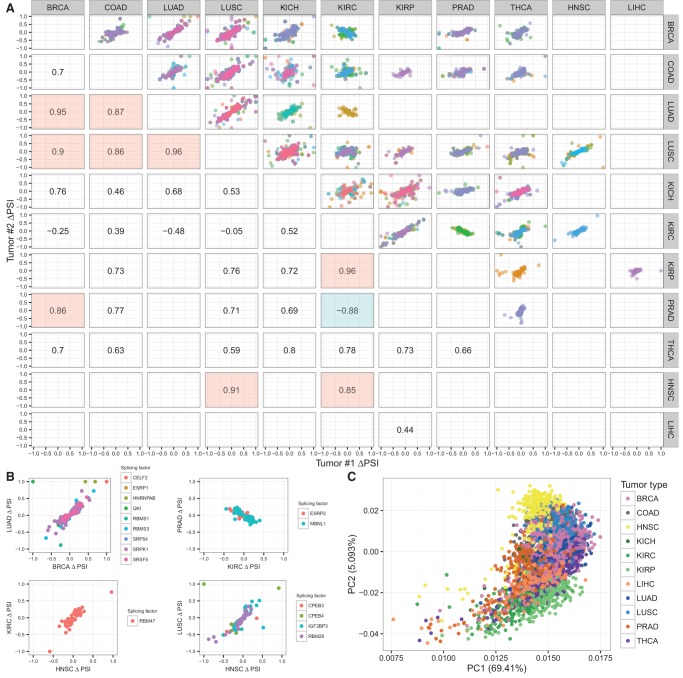
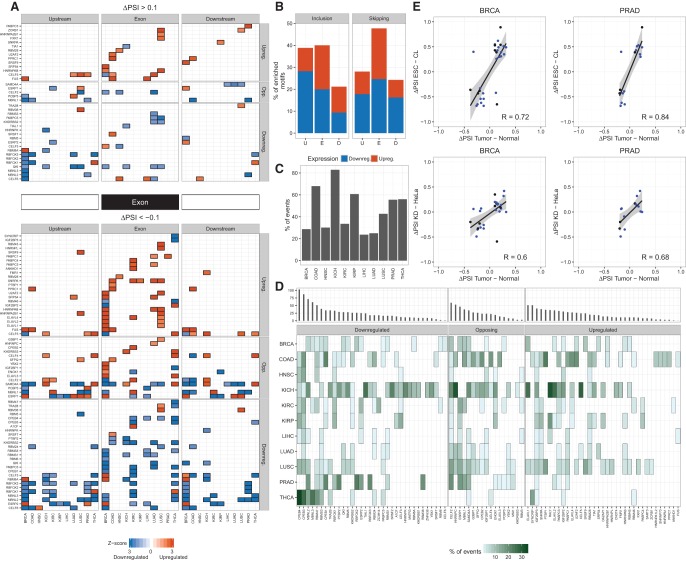
Alternative splicing is regulated by multiple RNA-binding proteins and influences the expression of most eukaryotic genes. However, the role of this process in human disease, and particularly in cancer, is only starting to be unveiled. We systematically analyzed mutation, copy number, and gene expression patterns of 1348 RNA-binding protein (RBP) genes in 11 solid tumor types, together with alternative splicing changes in these tumors and the enrichment of binding motifs in the alternatively spliced sequences. Our comprehensive study reveals widespread alterations in the expression of RBP genes, as well as novel mutations and copy number variations in association with multiple alternative splicing changes in cancer drivers and oncogenic pathways. Remarkably, the altered splicing patterns in several tumor types recapitulate those of undifferentiated cells. These patterns are predicted to be mainly controlled by MBNL1 and involve multiple cancer drivers, including the mitotic gene NUMA1 . We show that NUMA1 alternative splicing induces enhanced cell proliferation and centrosome amplification in nontumorigenic mammary epithelial cells. Our study uncovers novel splicing networks that potentially contribute to cancer development and progression.
Overview
The claims and statistics of this paper haven’t been checked yet.
Run the check — free, no account needed. It reads the open-access text and checks the sources it cites.
Integrity signals
Registry
Cites
Statistics
Figures
Verification
Claims the paper makes
The claims and statistics of this paper haven’t been checked yet.
Run the check — free, no account needed. It reads the open-access text and checks the sources it cites.
Claims other papers make about this one
Each is checked against this paper’s own text: does it say what the citing paper says it does?
In the citing paper
“Notably, 48 DS genes (10%; FDR=8.8×10⁻⁴) encode RNA binding proteins or splicing factors (34), with at least six splicing factors also showing DTE in ASD (MATR3), SCZ (QKI, RBM3, SRRM2, U2AF1) or both (SRSF11).”
From Transcriptome-wide isoform-level dysregulation in ASD, schizophrenia, and bipolar disorder (2018) · cites this paper as [34]
Self-check
Percentages, sums and reported differences re-computed from the paper’s own numbers.
The self-check needs the paper’s full text.
Citations
Cites
PD-1 and PD-L1 Immune Checkpoint Blockade to Treat Breast Cancer
Hartkopf, A. D., Taran, F., Wallwiener, M., Walter, C. B., Krämer, B., Grischke, E., & Brucker, S. Y. (2016) · Breast Care · doi:10.1159/000453569 · Cited by 30,989
The Molecular Signatures Database Hallmark Gene Set Collection
Liberzon, A., Birger, C., Thorvaldsdóttir, H., Ghandi, M., Mesirov, J. P., & Tamayo, P. (2015) · Cell Systems · doi:10.1016/j.cels.2015.12.004 · Cited by 13,807
Nishimura, R., Osako, T., Nishiyama, Y., Tashima, R., Nakano, M., Fujisue, M., Toyozumi, Y., & Arima, N. (2013) · Oncology · doi:10.1159/000353099 · Cited by 13,239
Comprehensive molecular portraits of human breast tumours
The Cancer Genome Atlas Network (2012) · Nature · doi:10.1038/nature11412 · Cited by 12,129
Finding community structure in very large networks
Clauset, A., Newman, M. E. J., & Moore, C. (2004) · Physical Review E · doi:10.1103/physreve.70.066111 · Cited by 7,390
Sparse inverse covariance estimation with the graphical lasso
Friedman, J., Hastie, T., & Tibshirani, R. (2008) · Biostatistics · doi:10.1093/biostatistics/kxm045 · Cited by 6,355
voom: precision weights unlock linear model analysis tools for RNA-seq read counts
Law, C. W., Chen, Y., Shi, W., & Smyth, G. K. (2014) · Genome Biology · doi:10.1186/gb-2014-15-2-r29 · Cited by 6,155
limma: Linear Models for Microarray Data
Smyth, G. K. (2005) · Statistics for Biology and Health · doi:10.1007/0-387-29362-0_23 · Cited by 5,796
Fitting a mixture model by expectation maximization to discover motifs in biopolymers.
Bailey, T. L., & Elkan, C. (1994) · PubMed · Cited by 4,982
Comprehensive genomic characterization of head and neck squamous cell carcinomas
The Cancer Genome Atlas Network (2015) · Nature · doi:10.1038/nature14129 · Cited by 4,147
Cited by
Sorted by citations
Transcriptome-wide isoform-level dysregulation in ASD, schizophrenia, and bipolar disorder
Gandal, M. J., Zhang, P., Hadjimichael, E., Walker, R. L., Chen, C., Liu, S., Won, H., van Bakel, H., Varghese, M., Wang, Y., et al. (2018) · Science · doi:10.1126/science.aat8127 · Cited by 1,247
RNA-Binding Proteins in Cancer: Old Players and New Actors
Pereira, B., Billaud, M., & Almeida, R. (2017) · Trends in cancer · doi:10.1016/j.trecan.2017.05.003 · Cited by 774
Roles and mechanisms of alternative splicing in cancer — implications for care
Bonnal, S., López‐Oreja, I., & Valcárcel, J. (2020) · Nature Reviews Clinical Oncology · doi:10.1038/s41571-020-0350-x · Cited by 760
Self-citationTrincado, J. L., Entizne, J. C., Hysenaj, G., Singh, B., Škalič, M., Elliott, D. J., & Eyras, E. (2018) · Genome biology · doi:10.1186/s13059-018-1417-1 · Cited by 720
Self-citationRNA splicing dysregulation and the hallmarks of cancer
Bradley, R. K., & Anczuków, O. (2023) · Nature Reviews Cancer · doi:10.1038/s41568-022-00541-7 · Cited by 579
Metadata
- Authors
- Sebestyén, E., Singh, B., Miñana, B., Pagès, A., Mateo, F., Pujana, M. A., Valcárcel, J., & Eyras, E.
- Affiliations
- Universitat Pompeu Fabra (ES)
- Institut d'Investigació Biomédica de Bellvitge (ES)
- Institució Catalana de Recerca i Estudis Avançats (ES)
- Venue
- Genome Research
- Publisher
- Cold Spring Harbor Laboratory
- Published
- 2016-04-13
- Volume
- 26
- Issue
- 6
- Pages
- 732-744
- ISSN
- 1088-9051 (ISSN-L)
- 1549-5469
- PMC
- PMC4889968
- OpenAlex
- W2338046461
- Cited by
- 276
- References
- 61
- Citations by year
- 2026: 12 · 2025: 18 · 2024: 25 · 2023: 21 · 2022: 38 · 2021: 45 · 2020: 43 · 2019: 27 · 2018: 22 · 2017: 22 · 2016: 3
- Type
- posted content
- Language
- en
- Open access
- bronze
- doi.org
- Locations
- Genome Research (publishedVersion)
- bioRxiv (Cold Spring Harbor Laboratory) (acceptedVersion, cc-by)
- Europe PMC (PubMed Central) (publishedVersion, cc-by-nc)
- PubMed Central (publishedVersion, cc-by-nc)
- PubMed Central (publishedVersion)
- PubMed (publishedVersion)
- Repositori digital de la UPF (Universitat Pompeu Fabra) (publishedVersion, cc-by-nc)
- HighWire Press Open Archive (submittedVersion)
- RECERCAT (Consorci de Serveis Universitaris de Catalunya) (submittedVersion, cc-by-nc)
- Funders
- Ministerio de Economía y Competitividad
- European Commission
- FEDER (BIO2014-52566-R, PIE13/00022-ONCOPROFILE, PI15/00854, RD12/0036/0008)
- Consolider RNAREG (CSD2009-00080)
- Agència de Gestió d'Ajuts Universitaris i de Recerca (SGR2014-1121)
- Sandra Ibarra Foundation for Cancer (FSI2013)
- Fundación Botín
- Santander Universities Global Division
- MINECO
- AGAUR (SGR2014-364)
- AECC
- Instituto de Salud Carlos III
- Topics
- Life Sciences › Biochemistry, Genetics and Molecular Biology › Molecular Biology › RNA Research and Splicing
- Life Sciences › Biochemistry, Genetics and Molecular Biology › Cancer Research › Cancer-related molecular mechanisms research
- Life Sciences › Biochemistry, Genetics and Molecular Biology › Cancer Research › Cancer Genomics and Diagnostics
- Keywords
- alternative splicing, RNA-binding proteins, cancer, solid tumors, MBNL1, NUMA1, copy number variation, gene expression changes, binding motifs, centrosome amplification, cell proliferation, mammary epithelial cells, undifferentiated cells
- MeSH terms
- RNA Splicing Factors, Binding Sites, Humans, Mutation, Neoplasms, Genome, Human, Gene Expression Regulation, Neoplastic, Alternative Splicing, Amino Acid Motifs, Gene Expression Profiling, Cell Proliferation, Transcriptome
About these checks
Registry, retraction, Cites and statistics results are computed, not judged, with one exception: a printed reference that no index lists is read once by a model before it counts as a citation error. Claims are extracted by a model and kept only when their quote appears verbatim in the text; each cited source is then checked, with a model’s help, for whether it says what the claim relies on. Those verdicts can be wrong — read the claim’s quote and the cited source before relying on one.
Statistics and arithmetic are recomputed, not judged.
Confidence bands are shown only for fields calibrated on our annotated test set. None is calibrated yet, so no band is shown.
What counts as a claim ›How we measure confidence ›How we check this ›
Are you an author, or do you see a problem with this page? Request a review
