

The DOI matches its Crossref record; 21 of the 21 references it cites were found in a registry or an index; none of the 30 sources its claims cite is checked for support yet.
Arbitrarily negative energy for small Kaluza-Klein bubbles
Open accessPublished version of a preprint
Abstract
We show that the energy of a Kaluza-Klein bubble of nothing is unbounded from below even if the size of the circle at infinity and the size of the minimal sphere at the bubble are fixed. We demonstrate this by presenting a family of explicit time-symmetric initial data satisfying these boundary conditions with arbitrarily negative energy. In particular, this is true for very small bubbles, indicating that the standard Kaluza-Klein vacuum is more unstable than previously thought.
Overview
CoChat Summary
TL;DR
The paper constructs explicit time-symmetric Kaluza-Klein initial data for bubbles of nothing whose ADM energy is unbounded from below even when the asymptotic circle size and the minimal \(S^2\) bubble size are fixed. This suggests the standard Kaluza-Klein vacuum is more unstable than previously thought, while the analogous asymptotically AdS initial data does not show arbitrarily negative energy.
Key findings
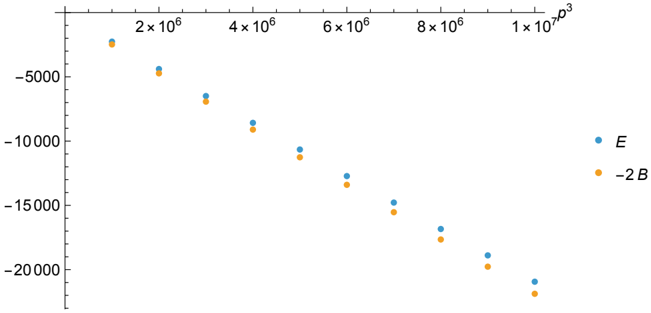
- For a family of Kaluza-Klein bubble initial data with fixed bubble size \(\rho_0\) and fixed asymptotic circle radius \(R\), the ADM energy becomes arbitrarily negative as a parameter \(p\) grows: \(E = -p^3/(2^9 R^2) + O(p^2)\) (Eq. 27).
- The result holds for very small bubbles, indicating that the standard Kaluza-Klein vacuum is more unstable than previously thought.
- The construction satisfies the Brill-Pfister bound \(E > -2B\); the paper reports that both \(E\) and \(B\) are \(O(p^3)\) and checks \(E > -2B\) numerically.
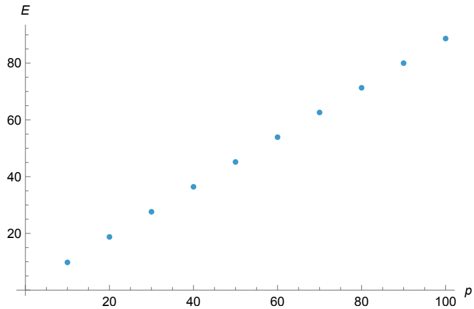
- In the asymptotically AdS analog, the energy does not become arbitrarily negative; for parameters \(R=\ell=G_5=d=1\), \(\rho_0=1/4\), \(C_0=-7/24\), the numerical plot shows the energy remains bounded, consistent with AdS/CFT.
Methods
- The paper studies time-symmetric initial data with \(SO(3)\times U(1)\) symmetry, metric \(ds^2 = f_1(\rho)d\rho^2 + \rho^2 d\Omega^2 + f_2(\rho)d\phi^2\), with \(f_1=(\alpha\beta)^{-1}\), \(f_2=\alpha\), and solves the Hamiltonian constraint \((4)R=0\) for \(\beta\) given \(\alpha\).
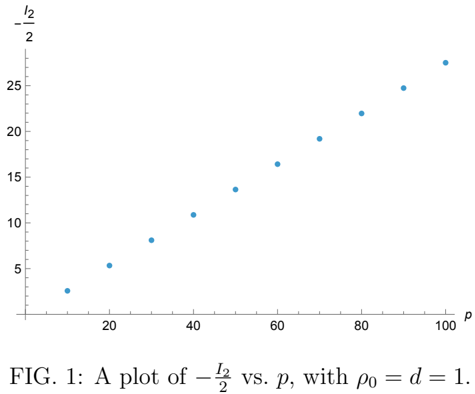
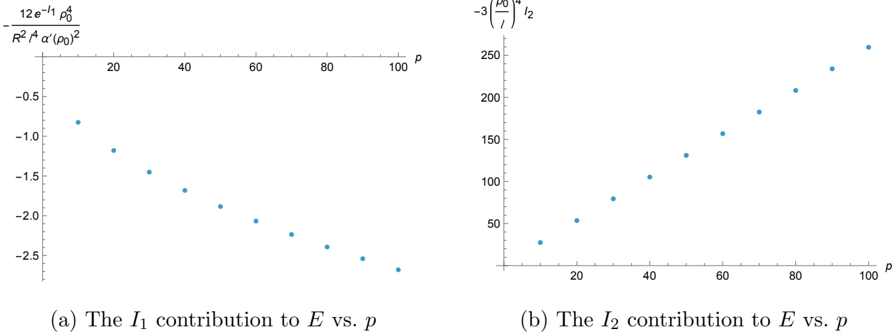
- It derives a general ADM energy expression (Eq. 13) and chooses an explicit \(\alpha(\rho)=\frac{\rho-\rho_0}{\rho-\rho_0+d}\exp(-p/\rho)\) with \(d>0\), \(p\ge 0\), then analyzes the large-\(p\) limit analytically and uses numerical integration for \(I_2\).
- For the AdS case, it uses analogous time-symmetric data with negative cosmological constant, derives the energy expression (Eq. 40), and evaluates the integrals numerically for representative parameters.
Limitations
- The paper states that it does not have the corresponding instantons for the new small zero-energy solutions, that it remains an open question whether any time-symmetric Kaluza-Klein bubble with negative energy always starts out expanding, and that it has no proof that the AdS energy is bounded from below—only trials of other scenarios and functions.
- The paper notes that in the main Kaluza-Klein example the curvature at the bubble grows exponentially in \(|E|^{1/3}\), so strong quantum gravity corrections may impose a lower bound once curvature exceeds the Planck scale; Appendix B gives another family with only polynomial curvature growth.
- Evident from the text: the AdS conclusion relies on numerical integration and specific parameter choices rather than an analytic proof, and the main unbounded-energy family has rapidly growing curvature, limiting its direct classical reliability.
Model-written summary. Check it against the paper before relying on it.
Integrity signals
Registry
Cites
Statistics
Figures
Verification
Claims the paper makes
0 Valid · 1 Not valid · 18 Not checked · 54 Own results and interpretations
A result the paper states — it cites no source for it, so there is none to check. The quote shows it is in the paper.
In the paper
“Since it must approach one by ρ ∼ |α 2 |, and for large p, |α 2 | ∼ p from Eq. ( 16), we see that I 2 is at most O(p) for large p.”
§ Arbitrarily Negative Energy for Small Kaluza-Klein Bubbles > IV. ARBITRARILY NEGATIVE ADM ENERGY
plainstates an association- Asserted: passes — The authors put it forward as true.
- Checkable: passes — It can be checked against evidence.
- Load-bearing: passes — The paper’s conclusions depend on it.
- Based: passes — The paper gives a reason why it holds.
A result the paper states — it cites no source for it, so there is none to check. The quote shows it is in the paper.
In the paper
“Using Eq. ( 1), one can calculate the ADM energy of this metric to be E = m + µ.”
§ Arbitrarily Negative Energy for Small Kaluza-Klein Bubbles > II. SETUP
plainstates a cause- Asserted: passes — The authors put it forward as true.
- Checkable: passes — It can be checked against evidence.
- Load-bearing: passes — The paper’s conclusions depend on it.
- Based: passes — The paper gives a reason why it holds.
A result the paper reports from its own data — it cites no other source for it, so there is none to check. The quote shows it is in the paper.
In the paper
“We show that the ADM energy of a Kaluza-Klein bubble of nothing is unbounded from below even if the size of the circle at infinity and the size of the minimal sphere at the bubble are fixed.”
- Also stated in: § I. INTRODUCTION · plain
“We find that in this case the ADM energy is not bounded from below by constructing an explicit solution to the time-symmetric initial value constraint with parameters that can be varied to achieve an arbitrarily negative energy.”
- Also stated in: § VII. CONCLUSION · plain
“Unlike previous examples, the energy is unbounded from below even when the size of the bubble, i.e., the size of the minimal S 2 (and the size of the S 1 at infinity) are fixed.”
§ Arbitrarily Negative Energy for Small Kaluza-Klein Bubbles > Abstract
plain- Asserted: passes — The authors put it forward as true.
- Checkable: passes — It can be checked against evidence.
- Load-bearing: passes — The paper’s conclusions depend on it.
- Based: passes — The paper gives a reason why it holds.
- Also stated in: § I. INTRODUCTION · plain
A result the paper reports from its own data — it cites no other source for it, so there is none to check. The quote shows it is in the paper.
In the paper
“In particular, this is true for very small bubbles, which indicates that the standard Kaluza-Klein vacuum is more unstable than previously thought.”
§ Arbitrarily Negative Energy for Small Kaluza-Klein Bubbles > Abstract
plain- Asserted: passes — The authors put it forward as true.
- Checkable: passes — It can be checked against evidence.
- Load-bearing: passes — The paper’s conclusions depend on it.
- Based: passes — The paper gives a reason why it holds.
A result the paper states — it cites no source for it, so there is none to check. The quote shows it is in the paper.
In the paper
“We have also shown that if one tries to embed one of these small bubbles into AdS, the energy remains bounded from below, consistent with the AdS/CFT correspondence.”
§ Arbitrarily Negative Energy for Small Kaluza-Klein Bubbles > VII. CONCLUSION
boosted- Asserted: passes — The authors put it forward as true.
- Checkable: passes — It can be checked against evidence.
- Load-bearing: passes — The paper’s conclusions depend on it.
- Based: passes — The paper gives a reason why it holds.
30 more claims
Create a free account to see all 73 claims and every source verdict.
- Probably not a substantial claim. 27
- It may state two separate claims as one. 18
- The quote only partly states this claim. 2
Self-check
Percentages, sums and reported differences re-computed from the paper’s own numbers.
Each contradiction between two passages listed here was confirmed by an independent check.
Rated minor: it would not touch a result — a value no result rests on, a p-value that stays on the same side of the significance level, or a conflict that is clerical, resolved elsewhere in the paper, or outside its own findings.
In the paper
§ Arbitrarily Negative Energy for Small Kaluza-Klein Bubbles > IV. ARBITRARILY NEGATIVE ADM ENERGY
“Since it must approach one by ρ ∼ |α 2 |, and for large p, |α 2 | ∼ p from Eq. ( 16), we see that I 2 is at most O(p) for large p.”
§ Arbitrarily Negative Energy for Small Kaluza-Klein Bubbles > IV. ARBITRARILY NEGATIVE ADM ENERGY
“α ′ (ρ 0 ) = e -p/ρ 0 d , α 1 = -p -d, α 2 = (p + d) 2 + d 2 -2dρ 0 2 ,(16)”
Citations
Cites
Quantentheorie und f�nfdimensionale Relativit�tstheorie
Klein, O. (1926) · The European Physical Journal A · doi:10.1007/bf01397481 · Cited by 2,887
A Stress Tensor for Anti-de Sitter Gravity
Balasubramanian, V., & Kraus, P. (1999) · Communications in Mathematical Physics · doi:10.1007/s002200050764 · Cited by 1,658
A new proof of the positive energy theorem
Witten, E. (1981) · Communications in Mathematical Physics · doi:10.1007/bf01208277 · Cited by 1,163
On the proof of the positive mass conjecture in general relativity
Schoen, R., & Yau, S.-T. (1979) · Communications in Mathematical Physics · doi:10.1007/bf01940959 · Cited by 870
The gravitational Hamiltonian, action, entropy and surface terms
Hawking, S. W., & Horowitz, G. T. (1996) · Classical and Quantum Gravity · doi:10.1088/0264-9381/13/6/017 · Cited by 704
Self-citationInstability of the Kaluza-Klein vacuum
Witten, E. (1982) · Nuclear Physics B · doi:10.1016/0550-3213(82)90007-4 · Cited by 595
Proof of the positive mass theorem. II
Schoen, R., & Yau, S.-T. (1981) · Communications in Mathematical Physics · doi:10.1007/bf01942062 · Cited by 533
On the Unification Problem in Physics
Kaluza, T. (2018) · International Journal of Modern Physics D · doi:10.1142/s0218271818700017 · Cited by 438
AdS-CFT correspondence and a new positive energy conjecture for general relativity
Horowitz, G. T., & Myers, R. C. (1998) · Physical Review D · doi:10.1103/physrevd.59.026005 · Cited by 350
Self-citationPositivity of the Total Mass of a General Space-Time
Schoen, R., & Yau, S.-T. (1979) · Physical Review Letters · doi:10.1103/physrevlett.43.1457 · Cited by 131
Negative energy in string theory
Brill, D., & Horowitz, G. T. (1991) · Physics Letters B · doi:10.1016/0370-2693(91)90618-z · Cited by 123
Self-citationGravity dual of gauge theory onS2×S1×R
Copsey, K., & Horowitz, G. T. (2006) · Journal of High Energy Physics · doi:10.1088/1126-6708/2006/06/021 · Cited by 53
Self-citationGravitational energy in spaces with compactified dimensions
Deser, S., & Soldate, M. (1989) · Nuclear Physics B · doi:10.1016/0550-3213(89)90175-2 · Cited by 46
On energy in 5-dimensional gravity and the mass of the Kaluza-Klein monopole
Bombelli, L., Koul, R. K., Kunstatter, G., Lee, J., & Sorkin, R. D. (1987) · Nuclear Physics B · doi:10.1016/0550-3213(87)90404-4 · Cited by 43
States of negative total energy in Kaluza-Klein theory
Brill, D. R., & Pfister, H. (1989) · Physics Letters B · doi:10.1016/0370-2693(89)91559-1 · Cited by 40
A Positive Mass Theorem for Spaces with Asymptotic SUSY Compactification
Dai, X. (2004) · Communications in Mathematical Physics · doi:10.1007/s00220-003-0986-2 · Cited by 34
Collapse of Kaluza-Klein bubbles
Corley, S., & Ted Jacobson, A. (1994) · Physical review. D. Particles, fields, gravitation, and cosmology/Physical review. D. Particles and fields · doi:10.1103/physrevd.49.r6261 · Cited by 21
Positive mass conjecture for five-dimensional Lorentzian manifolds
Zhang, X. (1999) · Journal of Mathematical Physics · doi:10.1063/1.532906 · Cited by 18
Systolic inequalities and the Horowitz-Myers conjecturePreprint
Brendle, S., & Hung, P. (2024) · arXiv (Cornell University) · doi:10.48550/arxiv.2406.04283 · Cited by 12
A note on positive energy theorem for spaces with asymptotic SUSY compactification
Dai, X. (2005) · Journal of Mathematical Physics · doi:10.1063/1.1862095 · Cited by 8
New energy inequality in AdS spacetimes
Horowitz, G. T., Wang, D., & Ye, X. (2024) · Physical review. D/Physical review. D. · doi:10.1103/physrevd.110.064015 · Cited by 2
Self-citation
Cited by
Properties of generalized Schwarzschild spacetimes with extra dimensions
Mészáros, P. (2026) · The European Physical Journal Plus · doi:10.1140/epjp/s13360-025-07264-2
Metadata
- Authors
- Horowitz, G. T., & Lu, G. (.
- Affiliations
- University of California, Santa Barbara (US)
- Venue
- Physical Review D
- Publisher
- American Physical Society (APS)
- Published
- 2025-10-28
- Volume
- 112
- Issue
- 8
- ISSN
- 2470-0010 (ISSN-L)
- 2470-0029
- OpenAlex
- W4415634244
- Cited by
- 1
- References
- 21
- Citations by year
- 2026: 1
- FWCI
- 0.25
- Type
- journal article
- Language
- en
- Open access
- hybrid
- doi.org
- Licence
- Locations
- Physical review. D/Physical review. D. (publishedVersion, cc-by)
- arXiv (Cornell University) (submittedVersion)
- arXiv (Cornell University)
- Funders
- National Science Foundation (PHY-2408110)
- Topics
- Physical Sciences › Physics and Astronomy › Nuclear and High Energy Physics › Black Holes and Theoretical Physics
- Physical Sciences › Physics and Astronomy › Astronomy and Astrophysics › Cosmology and Gravitation Theories
- Physical Sciences › Physics and Astronomy › Astronomy and Astrophysics › Relativity and Gravitational Theory
- Keywords
- bubble of nothing, negative energy, time-symmetric initial data, compactified extra dimensions, bubble size
About these checks
Registry, retraction, Cites and statistics results are computed, not judged, with one exception: a printed reference that no index lists is read once by a model before it counts as a citation error. Claims are extracted by a model and kept only when their quote appears verbatim in the text; each cited source is then checked, with a model’s help, for whether it says what the claim relies on. Those verdicts can be wrong — read the claim’s quote and the cited source before relying on one.
A language model drew the claims from the paper on 2026-11-13, under version 3 of the claim definition (model deepseek-v4.1-flash, prompt extract-v3).
A second model labelled each claim on 2026-11-13 (model jev-1.13-20260917, definition revision gold-guideline-v0.2).
Statistics and arithmetic are recomputed, not judged.
Confidence bands are shown only for fields calibrated on our annotated test set. None is calibrated yet, so no band is shown.
What counts as a claim ›How we measure confidence ›How we check this ›
Are you an author, or do you see a problem with this page? Request a review
Data sources
Bibliographic data: Semantic Scholar, OpenAlex, Crossref.
Contains information from the Semantic Scholar Academic Graph Datasets, made available under the ODC Attribution License (ODC-BY 1.0).
Semantic Scholar’s data is described in: Kinney, R., et al. (2023). The Semantic Scholar Open Data Platform. arXiv:2301.10140.
