

Activity theory as framework for analysis of workplace learning technologies: the case of generative AI conversational agents
Open accessThe DOI matches its Crossref record; 41 of the 41 references it cites were found in a registry or an index; 8 of the 22 sources its claims cite were checked for support.
Abstract
Purpose: Technology, such as artificial intelligence (AI), is transforming the way we work; however, it is yet to systemically transform learning at the workplace beyond augmentation of formal education’s learning processes. This paper derives functional requirements for technologies that support workplace learning and assesses the suitability and limitations of generative AI conversational agents, as an example of application. Design/methodology/approach: Using activity theory (AT) as theoretical framework, we model workplace learning as an activity, intertwined with work and mediated by technology, and expose contradictions that arise when technology developed for formal education is adopted at work. From these tensions, we derive functional requirements and illustrate their use by comparing them to ChatGPT’s affordances. Findings: A framework is proposed for design and assessment of enabling technologies for workplace learning. In applying it to ChatGPT, as paradigm of conversational agents, we find the aspects that are particularly suitable to enhance workplace learning, and those that need further development. Originality/value: The theoretical approach is novel. Previous research is based on reported use-cases of enabling technologies, such as generative artificial intelligence (GenAI), in the workplace or on the analysis of the learner’s experience when these technologies are embedded in structured training modules. The present study addresses the limitations of current retrospective research, providing a forward-looking approach.
Overview
CoChat Summary
TL;DR
This paper uses activity theory to model workplace learning as an activity system, derive functional requirements for workplace learning technologies, and assess ChatGPT as a generative AI conversational agent. It finds that ChatGPT already meets some requirements for informal workplace learning but falls short on validation, peer learning, assessment, personalisation, and knowledge inventory functions.
Key findings
- The analysis identifies 12 contradictions (C01–C12) between traditional/formal learning and informal workplace learning, and derives 23 functional requirements (R01–R23) for workplace learning technologies (WPLT).
- The scoping review initially found 161 articles, refined to 108 after exclusions, discarded 87 at abstract screening, and retained 13 papers for analysis through the activity theory elements.
- ChatGPT (GPT-4) is found suitable for some WPL requirements: it is conversational and can be intertwined with work (R23), readily available/networked (R03), supports continuous learning (R02), and can retrieve knowledge linked to practical applications (R15, R16).
- However, ChatGPT falls short on requirements including mimetic learning (R01), collaborative learner/teacher role shifting (R17), knowledge maintenance/retirement (R18), rewarding knowledge sharing (R07), peer rating of quality/relevance (R13, R14), personalised peer recommendations (R19), dynamic adaptation to learner background/pace (R04), assessment/certification (R05, R06, R20), and individual/organisational knowledge inventory (R08, R09, R10).
Methods
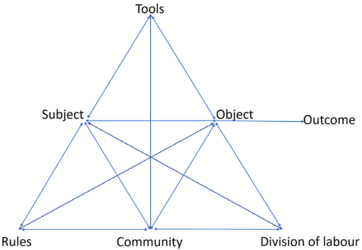
- Conceptual/theoretical study using activity theory (AT), including Engeström’s activity system model and Mwanza’s Eight-Step Model, to model workplace learning as an activity system and expose contradictions with traditional learning.
- Scoping review building on Brandi and Iannone’s (2020) review, covering publications between 2019 and 2024 in Google Scholar, following PRISMA guidelines; search terms appeared in article titles, with exclusions for teaching, school, teacher, and student, yielding 13 included papers.
- The derived functional requirements are illustrated by comparing them to ChatGPT’s affordances, using ChatGPT powered by GPT-4 as the paradigm of conversational agents.
Limitations
- Stated: the theoretical framework allows a comprehensive conceptual approach but can also be seen as a limitation; future research could conduct external expert validation.
- Stated: WPL characteristics were extracted only from papers meeting the scoping review inclusion criteria; no methodological quality assessment was conducted, though peer review was trusted for quality assurance.
- Stated: the scoping review was limited by screening papers with search terms in the title, which may have overlooked relevant papers; evident from the text: the ChatGPT assessment is a single illustrative case, and the authors acknowledge GenAI is still evolving fast and the case is not an assertion of an end state.
Model-written summary. Check it against the paper before relying on it.
Integrity signals
Registry
Cites
Statistics
Figures
Verification
Claims the paper makes
7 Valid · 9 Not valid · 14 Not checked · 34 Own results and interpretations
The cited sources support only part of this claim — read each source’s verdict below.
In the paper
“Tensions also emerge with rules around oncampus delivery or through standardised activities in the learning management system (LMS), as opposed to personalised learning embedded in the professional activities (Decius et al., 2019) (Contradiction C03).”
§ Activity theory as framework for analysis of workplace learning technologies: the case of generative AI conversational agents > 5.2 Rules
What the sources say
- Partly supportedcites Decius et al., 2019 matched to “Informal workplace learning: development and validation of a measure” (2019) sourceExperimental — accuracy not yet measured
The Introduction contrasts generically structured formal programs with informal learning that employees direct during their work, supporting the distinction between standardized and personalized learning. Section 2.2 also contrasts informal learning with classroom or e-learning settings. The paper does not address rules requiring on-campus delivery or LMS activities, or report tensions arising from those rules. (LLM, conf=0.86)
plainstates a cause- Asserted: passes — The authors put it forward as true.
- Checkable: passes — It can be checked against evidence.
- Load-bearing: unclear — It is unclear whether the paper’s conclusions depend on it.
- Based: passes — The paper gives a reason why it holds.
- Partly supported
Every source the paper cites for this claim was checked and supports it.
In the paper
“Furthermore, GenAI can create misleading nonsensical content (hallucinations).”
§ Activity theory as framework for analysis of workplace learning technologies: the case of generative AI conversational agents > 7. Discussion -the case of GenAI conversational agents for workplace learning
What the sources say
- Supportedcites Hagendorff (2024) matched to “Mapping the ethics of generative AI: a comprehensive scoping review” (2024) source
Section 3.4, “Hallucinations” (page not provided), describes LLMs generating false or misleading information, reasoning errors, and flawed outputs. This supports the claim that generative AI can produce misleading, nonsensical content. (LLM, conf=0.92)
plainstates a cause- Asserted: passes — The authors put it forward as true.
- Checkable: passes — It can be checked against evidence.
- Load-bearing: unclear — It is unclear whether the paper’s conclusions depend on it.
- Based: passes — The paper gives a reason why it holds.
- Rests on an assumption not shown here.
- Supported
A conclusion the paper draws from its own results — it cites no other source for it, so there is none to check. The quote shows it is in the paper.
In the paper
“These retrospective studies are looking at the use of GenAI at a point in time in particular settings without providing a comprehensive view of its potential impact.”
§ Activity theory as framework for analysis of workplace learning technologies: the case of generative AI conversational agents > 1. Introduction
plain- Asserted: passes — The authors put it forward as true.
- Checkable: passes — It can be checked against evidence.
- Load-bearing: passes — The paper’s conclusions depend on it.
- Based: passes — The paper gives a reason why it holds.
A conclusion the paper draws from its own results — it cites no other source for it, so there is none to check. The quote shows it is in the paper.
In the paper
“Tensions arise between the traditional assumption of learners as passive recipients of structured learning activities and workers expectations to embed their learning within work activities in a fluid and as needed manner (Contradiction C01).”
§ Activity theory as framework for analysis of workplace learning technologies: the case of generative AI conversational agents > 5.1 Subject
plainstates an association- Asserted: passes — The authors put it forward as true.
- Checkable: passes — It can be checked against evidence.
- Load-bearing: passes — The paper’s conclusions depend on it.
- Based: passes — The paper gives a reason why it holds.
In the paper
“These forms of learning, however, do not support what graduates need once in the workplace, where learning is unstructured, continuous, self-regulated, largely directed by the individual, complex to assess and is generally a response to new challenges at work (Littlejohn and Margaryan, 2014).”
§ Activity theory as framework for analysis of workplace learning technologies: the case of generative AI conversational agents > 2. Workplace learning mediated by technology
What the sources say
- Not checked — no full text of the sourcecites Littlejohn and Margaryan, 2014 matched to “Technology-Enhanced Professional Learning” (2014) source
plain- Asserted: passes — The authors put it forward as true.
- Checkable: passes — It can be checked against evidence.
- Load-bearing: passes — The paper’s conclusions depend on it.
- Based: passes — The paper gives a reason why it holds.
11 more claims
Create a free account to see all 64 claims and every source verdict.
- Probably not a substantial claim. 32
- It may state two separate claims as one. 33
Self-check
Percentages, sums and reported differences re-computed from the paper’s own numbers.
Each contradiction between two passages listed here was confirmed by an independent check.
Rated minor: it would not touch a result — a value no result rests on, a p-value that stays on the same side of the significance level, or a conflict that is clerical, resolved elsewhere in the paper, or outside its own findings.
In the paper
§ Activity theory as framework for analysis of workplace learning technologies: the case of generative AI conversational agents > 7. Discussion -the case of GenAI conversational agents for workplace learning
“Furthermore, peer recommendations at different hierarchical levels and across different organisations (R21, R22) are not currently available and would require further development.”
§ Activity theory as framework for analysis of workplace learning technologies: the case of generative AI conversational agents > 7. Discussion -the case of GenAI conversational agents for workplace learning
“R19.WPLT shall allow recommendations for learning among peers, including co-workers at different hierarchical levels C10.Common forms of assessment”
Citations
Cites
The PRISMA 2020 statement: An updated guideline for reporting systematic reviews
Page, M. J., McKenzie, J. E., Bossuyt, P. M., Boutron, I., Hoffmann, T. C., Mulrow, C. D., Shamseer, L., Tetzlaff, J. M., Akl, E. A., Brennan, S. E., et al. (2021) · BMJ · doi:10.1136/bmj.n71 · Cited by 108,283
Expansive Learning at Work: Toward an activity theoretical reconceptualization
Engeström, Y. (2001) · Journal of Education and Work · doi:10.1080/13639080020028747 · Cited by 5,436
Digital platforms for development: Foundations and research agenda
Bonina, C., Koskinen, K., Eaton, B., & Gawer, A. (2021) · Information Systems Journal · doi:10.1111/isj.12326 · Cited by 512
Ethical framework for Artificial Intelligence and Digital technologies
Ashok, M., Madan, R., Joha, A., & Sivarajah, U. (2022) · International Journal of Information Management · doi:10.1016/j.ijinfomgt.2021.102433 · Cited by 469
Abuhassna, H., Al-Rahmi, W. M., Yahya, N., Zakaria, M. A. Z. M., Kosnin, A. B. M., & Darwish, M. (2020) · International Journal of Educational Technology in Higher Education · doi:10.1186/s41239-020-00216-z · Cited by 411
Shen, C.-W., & Ho, J.-T. (2020) · Computers in Human Behavior · doi:10.1016/j.chb.2019.106177 · Cited by 283
Mwanza-Simwami, D. (2001) · Open Research Online - ORO (The Open University) · Cited by 205
Mapping the ethics of generative AI: a comprehensive scoping review
Hagendorff, T. (2024) · Minds and Machines · doi:10.1007/s11023-024-09694-w · Cited by 141
Informal workplace learning: development and validation of a measure
Decius, J., Schaper, N., & Seifert, A. (2019) · Human Resource Development Quarterly · doi:10.1002/hrdq.21368 · Cited by 127
(2007) · Cited by 124
Artificial intelligence in the workplace -- a double-edged sword
Wilkens, U. (2020) · The International Journal of Information and Learning Technology · doi:10.1108/ijilt-02-2020-0022 · Cited by 117
Exploring augmented reality for worker assistance versus training
Moghaddam, M., Wilson, N. C., Modestino, A., Jona, K., & Marsella, S. (2021) · Advanced Engineering Informatics · doi:10.1016/j.aei.2021.101410 · Cited by 105
Gamification for HRD: Systematic Review and Future Research Directions
Thomas, N. J., Baral, R., & Crocco, O. S. (2022) · Human Resource Development Review · doi:10.1177/15344843221074859 · Cited by 75
Kittel, A. F. D., Kunz, R. A. C., & Seufert, T. (2021) · Frontiers in Psychology · doi:10.3389/fpsyg.2021.643748 · Cited by 52
Technology-Enhanced Professional Learning
Littlejohn, A., & Margaryan, A. (2014) · Springer International Handbooks of Education · doi:10.1007/978-94-017-8902-8_43 · Cited by 52
Khandakar, M. S. A., & Pangil, F. B. (2019) · Journal of Workplace Learning · doi:10.1108/jwl-04-2019-0049 · Cited by 49
Ley, T. (2020) · British Journal of Educational Technology · doi:10.1111/bjet.12835 · Cited by 48
Digital environments as sites for informal workplace learning in knowledge work
Karhapää, A., Rikala, J., Pöysä‐Tarhonen, J., & Hämäläinen, R. (2024) · Journal of Workplace Learning · doi:10.1108/jwl-11-2023-0184 · Cited by 47
Lizier, A. L., & Reich, A. (2020) · Studies in Continuing Education · doi:10.1080/0158037x.2020.1814714 · Cited by 41
Facilitating informal learning at work
Moore, A. L., & Klein, J. D. (2020) · TechTrends · doi:10.1007/s11528-019-00458-3 · Cited by 38
Framework of Artificial Intelligence Learning Platform for Education
Thongprasit, J., & Wannapiroon, P. (2022) · International Education Studies · doi:10.5539/ies.v15n1p76 · Cited by 37
Lee, A. Y.-P., Chang, P.-C., & Chang, H.-Y. (2022) · Employee Relations: The International Journal · doi:10.1108/er-06-2021-0251 · Cited by 35
Technology-Enhanced Professional Learning
Berendt, B., Vuorikari, R., Littlejohn, A. H., & Margaryan, A. (2013) · Routledge eBooks · doi:10.4324/9780203745052 · Cited by 34
Approaches to learning in the context of work – workplace learning and human resources
Brandi, U., & Iannone, R. L. (2021) · Journal of Workplace Learning · doi:10.1108/jwl-01-2020-0015 · Cited by 27
Taheri, M., Motealleh, S., & Younesi, J. (2021) · Journal of Workplace Learning · doi:10.1108/jwl-05-2021-0062 · Cited by 27
Interoperability Scenarios to Measure Informal Learning Carried Out in PLEs
Conde, M. Á., García‐Peñalvo, F. J., & Alier, M. (2011) · International Conference on Intelligent Networking and Collaborative Systems (INCoS) · doi:10.1109/incos.2011.104 · Cited by 26
A case study for measuring Informal Learning in PLEs
García‐Peñalvo, F. J., Conde, M. Á., Alier, M., & Colomo‐Palacios, R. (2014) · International Journal of Emerging Technologies in Learning (iJET) · doi:10.3991/ijet.v9i7.3734 · Cited by 24
Graßmann, C., & Decius, J. (2023) · Gruppe Interaktion Organisation Zeitschrift für Angewandte Organisationspsychologie (GIO) · doi:10.1007/s11612-023-00702-8 · Cited by 22
Informal learning behaviors, interaction and workplace autonomy and readiness to learn
Barbosa, F. L., & Borges‐Andrade, J. E. (2021) · Journal of Workplace Learning · doi:10.1108/jwl-04-2021-0047 · Cited by 22
Sergio Santoro, N. A. (2022) · Journal of Workplace Learning · doi:10.1108/jwl-11-2021-0143 · Cited by 21
Australian Standard Classification of Education
Queensland (2006) · Cited by 18
Kittel, A. F. D., & Seufert, T. (2023) · PLOS ONE · doi:10.1371/journal.pone.0286065 · Cited by 17
Calleja, A. R., Dennerlein, S., Kowald, D., Theiler, D., Lex, E., & Ley, T. (2019) · Journal of Learning Analytics · doi:10.18608/jla.2019.62.9 · Cited by 14
Informal and Self-Directed Learning in the Age of Massive Open Online Courses (MOOCs)
Lin, L., & Cranton, P. A. (2015) · Advances in higher education and professional development book series · doi:10.4018/978-1-4666-8265-8.ch007 · Cited by 8
Bucher, A., Schenk, B., Dolata, M., & Schwabe, G. (2024) · arXiv · doi:10.48550/arxiv.2405.15561 · Cited by 4
Micro-credentials for recognition of workplace learning
Marroquin, E. M., & Male, S. A. (2025) · Journal of Teaching and Learning for Graduate Employability · doi:10.21153/jtlge2021vol12no1art1513 · Cited by 3
Self-citationWork-related informal learning in knowledge-intensive industry
Gáthy-Stéber, A. (2022) · The Hungarian Educational Research Journal · doi:10.1556/063.2021.00091 · Cited by 2
Pradhan, M. S., Rattanawiboonsom, V., & Panya, F. (2023) · Environment and Social Psychology · doi:10.54517/esp.v9i3.2078 · Cited by 2
Conclusion: Technology-enhanced Professional Learning: Challenges and Future Directions
Margaryan, A., & Littlejohn, A. H. (2013) · Enlighten: Publications (University of Glasgow) · doi:10.4324/9780203745052-26 · Cited by 1
OpenAI, Achiam, J., Adler, S., Agarwal, S., Ahmad, L., Akkaya, I., Aleman, F. L., Almeida, D., Altenschmidt, J., Altman, S., et al. (2023) · arXiv · doi:10.48550/arxiv.2303.08774
Transformative Digital Technology for Effective Workplace Learning
O’Donnell, R. (2021) · doi:10.1201/9781003149132
Cited by
Pardo, J. S. D. (2025) · Development in Learning Organizations An International Journal · doi:10.1108/dlo-06-2025-0228 · Cited by 11
Sodobni izzivi v odnosih med predavatelji in poslušalci
Civić, A., & Marič, M. (2026) · doi:10.18690/um.fov.6.2026.5
PERAN AGENTIC AI DALAM TRANSFORMASI PENDIDIKAN VOKASIONAL: SEBUAH SCOPING REVIEW
Inderanata, R. N., & Purwaningsih, T. (2026) · Jurnal Pendidikan Teknik Mesin · doi:10.36706/jptm.v13i1.425
Metadata
- Authors
- Martinez Marroquin, E., & Senadji, B.
- Affiliations
- Faculty of Science and Technology, University of Canberra , ,
- James Cook University (AU)
- Venue
- The International Journal of Information and Learning Technology
- Publisher
- Emerald
- Published
- 2025-06-09
- Volume
- 42
- Issue
- 4
- Pages
- 353-365
- ISSN
- 2056-4880 (ISSN-L)
- 2056-4899
- OpenAlex
- W4411148494
- Semantic Scholar
- 1568eac220c66b470d40c178e3c485cecb836b36
- Cited by
- 4
- References
- 37
- Citations by year
- 2026: 3 · 2025: 1
- FWCI
- 24.35
- Type
- journal article
- Language
- en
- Open access
- hybrid
- doi.org
- Licence
- cc-by
- Locations
- International Journal of Information and Learning Technology (publishedVersion, cc-by)
- ResearchOnline - JCU (James Cook University) (submittedVersion)
- Topics
- Social Sciences › Education › Innovative Education and Learning Practices
- Social Sciences › Education › Artificial Intelligence in Education
- Social Sciences › Business, Management and Accounting › Organizational Behavior and Human Resource Management › Organizational Learning and Leadership
- Keywords
- activity theory, workplace learning, generative AI, chatbots, ChatGPT, functional requirements, educational technology, technology design, contradiction, artificial intelligence in the workplace
About these checks
Registry, retraction, Cites and statistics results are computed, not judged, with one exception: a printed reference that no index lists is read once by a model before it counts as a citation error. Claims are extracted by a model and kept only when their quote appears verbatim in the text; each cited source is then checked, with a model’s help, for whether it says what the claim relies on. Those verdicts can be wrong — read the claim’s quote and the cited source before relying on one.
The claim verdicts this report counts are experimental: their accuracy is not yet measured.
A language model drew the claims from the paper on 2026-09-29, under version 3 of the claim definition (model deepseek-v4.1-flash, prompt extract-v3).
A second model labelled each claim on 2026-09-29 (model jev-1.13-20260917, definition revision gold-guideline-v0.2).
Cited sources are checked with a language model’s help (gpt-6-sol).
Statistics and arithmetic are recomputed, not judged.
Confidence bands are shown only for fields calibrated on our annotated test set. None is calibrated yet, so no band is shown.
What counts as a claim ›How we measure confidence ›How we check this ›
Are you an author, or do you see a problem with this page? Request a review
Data sources
Bibliographic data: Semantic Scholar, OpenAlex, Crossref.
Contains information from the Semantic Scholar Academic Graph Datasets, made available under the ODC Attribution License (ODC-BY 1.0).
Semantic Scholar’s data is described in: Kinney, R., et al. (2023). The Semantic Scholar Open Data Platform. arXiv:2301.10140.
