

How to explain AI systems to end users: a systematic literature review and research agenda
Open accessThe DOI matches its Crossref record; 66 of the 66 references it cites were found in a registry or an index.
Abstract
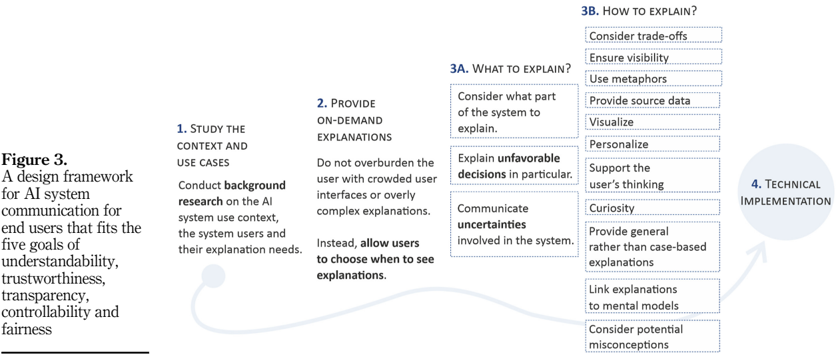
Purpose: Inscrutable machine learning (ML) models are part of increasingly many information systems. Understanding how these models behave, and what their output is based on, is a challenge for developers let alone non-technical end users. Design/methodology/approach: The authors investigate how AI systems and their decisions ought to be explained for end users through a systematic literature review. Findings: The authors’ synthesis of the literature suggests that AI system communication for end users has five high-level goals: (1) understandability, (2) trustworthiness, (3) transparency, (4) controllability and (5) fairness. The authors identified several design recommendations, such as offering personalized and on-demand explanations and focusing on the explainability of key functionalities instead of aiming to explain the whole system. There exists multiple trade-offs in AI system explanations, and there is no single best solution that fits all cases. Research limitations/implications: Based on the synthesis, the authors provide a design framework for explaining AI systems to end users. The study contributes to the work on AI governance by suggesting guidelines on how to make AI systems more understandable, fair, trustworthy, controllable and transparent. Originality/value: This literature review brings together the literature on AI system communication and explainable AI (XAI) for end users. Building on previous academic literature on the topic, it provides synthesized insights, design recommendations and future research agenda.
Overview
The claims and statistics of this paper haven’t been checked yet.
Free: it reads the open-access text and checks the first 5 claims that cite a source we can check. Create a free account to check every claim.
Integrity signals
Registry
Cites
Statistics
Figures






Verification
Claims the paper makes
The claims and statistics of this paper haven’t been checked yet.
Free: it reads the open-access text and checks the first 5 claims that cite a source we can check. Create a free account to check every claim.
Claims other papers make about this one
Each is checked against this paper’s own text: does it say what the citing paper says it does?
The cited source says what the claim attributes to it.
In the citing paper
“Previous reviews of XAI have also reported that explainability is sensitive to contextual factors and future research should investigate different groups of end users [15,16].”
From Explainable AI in hospital clinical decision support systems: A scoping review of healthcare professionals’ perspectives (2026) · cites this paper as [15]
Self-check
Percentages, sums and reported differences re-computed from the paper’s own numbers.
The self-check needs the paper’s full text.
Citations
Cites
Preferred reporting items for systematic reviews and meta-analyses: The PRISMA statement
Moher, D., Liberati, A., Tetzlaff, J., Altman, D. G., & the PRISMA Group* (2009) · Annals of Internal Medicine · doi:10.7326/0003-4819-151-4-200908180-00135 · Cited by 37,554
"Why Should I Trust You?": Explaining the Predictions of Any Classifier
Ribeiro, M. T., Singh, S., & Guestrin, C. (2016) · Proceedings of the 22nd ACM SIGKDD International Conference on Knowledge Discovery and Data Mining · doi:10.1145/2939672.2939778 · Cited by 17,555
Arrieta, A. B., Díaz-Rodríguez, N., Del Ser, J., Bennetot, A., Tabik, S., Barbado, A., García, S., Gil-López, S., Molina, D., Benjamins, R., et al. (2019) · arXiv · doi:10.48550/arxiv.1910.10045 · Cited by 11,321
Barredo Arrieta, A., Díaz-Rodríguez, N., Del Ser, J., Bennetot, A., Tabik, S., Barbado, A., Garcia, S., Gil-Lopez, S., Molina, D., Benjamins, R., et al. (2020) · Information Fusion · doi:10.1016/j.inffus.2019.12.012 · Cited by 10,423
Peeking Inside the Black-Box: A Survey on Explainable Artificial Intelligence (XAI)
Adadi, A., & Berrada, M. (2018) · IEEE Access · doi:10.1109/access.2018.2870052 · Cited by 6,294
The global landscape of AI ethics guidelines
Jobin, A., Ienca, M., & Vayena, E. (2019) · Nature Machine Intelligence · doi:10.1038/s42256-019-0088-2 · Cited by 6,220
Wohlin, C. (2014) · Proceedings of the 18th International Conference on Evaluation and Assessment in Software Engineering · doi:10.1145/2601248.2601268 · Cited by 4,234
How the machine “thinks”: Understanding opacity in machine learning algorithms
Burrell, J. (2016) · Big Data & Society · doi:10.1177/2053951715622512 · Cited by 3,196
Model Cards for Model Reporting
Mitchell, M., Wu, S., Zaldivar, A., Barnes, P., Vasserman, L., Hutchinson, B., Spitzer, E., Raji, I. D., & Gebru, T. (2019) · Proceedings of the Conference on Fairness, Accountability, and Transparency · doi:10.1145/3287560.3287596 · Cited by 2,681
Explainable artificial intelligence: A survey
Dosilovic, F. K., Brcic, M., & Hlupic, N. (2018) · 2018 41st International Convention on Information and Communication Technology, Electronics and Microelectronics (MIPRO) · doi:10.23919/mipro.2018.8400040 · Cited by 1,147
Research works printed but not linked: 2
- Sepp€ al€ a, A., Birkstedt, T. and M€ antym€ aki, M. (2021), "From ethical principles to governed AI", in Proceedings of the 42nd International Conference on Information Systems (ICIS2021).
- Strauss, A. and Corbin, J. (1998), Basics of Qualitative Research Techniques, Sage Publications, Thousand Oaks, CA.
Cited by
Items 101–195 of 195
Zink, A., Boone, C., Maddox, K. E. J., Chernew, M. E., & Neprash, H. T. (2024) · The American Journal of Managed Care · doi:10.37765/ajmc.2024.89556 · Cited by 5
Responsible Artificial Intelligence Systems Critical considerations for business model design
Zimmer, M. P., Minkkinen, M., & Mäntymäki, M. (2022) · Multilingual Matters (Channel View Publications) · Cited by 21
Self-citationSystematic Review of XAI Tools for AI-HCI Research
Alaqsam, A., & Sas, C. (2024) · Electronic workshops in computing · doi:10.14236/ewic/bcshci2024.6 · Cited by 3
“Another key outcome is the limited user interfaces for XAI tools and their interactivity, despite the argue need for such interfaces (Chromik & Butz, 2021; Chromik & Schuessler, 2020; Laato et al., 2021; Nazar et al., 2021; Weber et al., 2023).”
InfluentialEthical Legal Practice and the Integration of AI into Legal Profession: Striking the Balance
Ehirim, U. G. (2025) · Open Journal for Legal Studies · doi:10.32591/coas.ojls.0801.02013e · Cited by 3
Zeng, B., Habib, M. D., Albishri, N. A., Arrigo, E., Nespoli, P., & Li, L. (2025) · Journal of Knowledge Management · doi:10.1108/jkm-03-2025-0299 · Cited by 3
Correa, T., Luco, F., Hernández-Estrada, Y., Oyarzún-Merino, I., & López, C. (2026) · Int. J. Hum. Comput. Stud. · doi:10.1016/j.ijhcs.2026.103769 · Cited by 2
Efficient and Interpretable Image Processing Approach for Crack Segmentation
Zaheer, Q., Shah, S. F. H., Shah, S. M. A. H., Ai, C., Wang, J., & Qiu, S. (2026) · Journal of Infrastructure Systems · doi:10.1061/jitse4.iseng-2759 · Cited by 4
Explainable AI: Bridging Transparency and Trust in AI
Oyenuga, M. O., & OLADELE, T. O. (2026) · Advances in computational intelligence and robotics book series · doi:10.4018/406019 · Cited by 3
Cosentino, C., Gündüz-Cüre, M., Marozzo, F., & Birim, Ş. Ö. (2026) · Machine Learning · doi:10.1007/s10994-026-07037-7 · Cited by 3
“Incorporating XAI into topic model - ing could enhance transparency and interpretability in applications such as sentiment analy - sis or opinion mining (Laato et al., 2022).”
Physicians in ACOs Report Greater Documentation Burden
Apathy, N. C., Patel, V., Rolle, T. L., & Holmgren, A. J. (2024) · The American Journal of Managed Care · doi:10.37765/ajmc.2024.89552 · Cited by 4
A personalized value-based justification in food swaps to stimulate healthy online food choices
Jansen, L. Z. H., van Kleef, E., & Loo, E. J. V. (2025) · Electronic Commerce Research · doi:10.1007/s10660-025-09961-7 · Cited by 6
“Tailored justifications alongside food suggestions might bolster the relevance and acceptance of swap suggestions [41], as personalized explanations increase feelings of relevancy and fit to consumers [24–26].”
Li, W., Yu, J., Zhou, Y., Shi, J., You, W., & Zhou, Z. (2025) · CHI Conference on Human Factors in Computing Systems · doi:10.1145/3706598.3713090 · Cited by 5
Communicating Ethical Considerations in Generative AI Systems
Comes, L., Silveira, J. C. S., Martins, H. C., Lana, C. A., & Villela, M. L. B. (2025) · Simpósio Brasileiro de Fatores Humanos em Sistemas Computacionais (IHC) · doi:10.5753/ihc.2025.10939 · Cited by 3
“There are several studies that address explainability in the feld of ethical AI [Vainio-Pekka et al. 2023, Laato et al. 2022 Several other initiatives have also been taken to address the challenge of ethical AI design in general.”
Deep Sensitivity Analysis for Objective-Oriented Combinatorial Optimization
Gireesan, G., Pillai, N., Rothrock, M. J., Nanduri, B., Chen, Z., & Ramkumar, M. (2023) · International Conference on Computational Science and Computational Intelligence (CSCI) · doi:10.1109/csci62032.2023.00093 · Cited by 3
“Explainable AI techniques [18] provide model transparency through simplification, feature relevance, local explanations, and visualizations.”
BackgroundTrustworthy AI for Educational MetaversesPreprint
Abdullakutty, F. C., Qayyum, A., Lampropoulos, G., & Qadir, J. (2024) · doi:10.36227/techrxiv.170775108.81506629/v1 · Cited by 5
Bonner, T. J., Ayyanar, P., Milam, A. J., & Blocker, R. C. (2024) · The American Journal of Managed Care · doi:10.37765/ajmc.2024.89547 · Cited by 3
Cousineau, C., Herger, N., & Dara, R. A. (2025) · AI and Ethics · doi:10.1007/s43681-025-00725-5 · Cited by 2
“…prioritize technical details for debugging and performance improvement, most research literature has catered to them, prompting our focus on creating a sample transparency card to help AI end users gain a general understanding and assess the trustworthiness of the system [11, 15, 21, 23, 25].”
TELL-ME: Toward Personalized Explanations of Large Language Models
Jeck, J., Leiser, F., Hüsges, A., & Sunyaev, A. (2025) · CHI Conference Extended Abstracts on Human Factors in Computing Systems (CHI EA) · doi:10.1145/3706599.3719982 · Cited by 8
Riding the Paradox: How AI Consultants Manage the Tradeoff Between Explainability and Performance
Benyakhlaf, M., Lamkadem, A., & Okoli, C. (2025) · Information Systems Management · doi:10.1080/10580530.2025.2506369 · Cited by 2
“In this article, we do not attempt a general review of the literature on XAI; several such reviews have already been conducted (e.g., Barredo Arrieta et al., 2020; Duan et al., 2019; Laato et al., 2022).”
Aljuneidi, S., Heuten, W., Wolters, M. K., & Boll, S. (2025) · Lecture notes in computer science · doi:10.1007/978-3-032-05002-1_5 · Cited by 2
Hamzah, N., Husin, H. S., Azman, A., & Chuprat, S. B. (2025) · International Conference on Metaverse and Current Trends in Computing (ICMCTC) · doi:10.1109/icmctc62214.2025.11196377 · Cited by 3
“The adoption of information systems, particularly explainable artificial intelligence (XAI) applications, has witnessed a rapid surge in the past decade [15-17].”
Dutta, P., Josan, P. K., Wong, R. K. W., Dunbar, B. J., Diaz‐Artiles, A., & Selva, D. (2025) · Journal of Cognitive Engineering and Decision Making · doi:10.1177/15553434251392301 · Cited by 2
“Previous research in the area of XAI suggests that to alleviate the effects of uncertainty on user ’ s trust, AI systems must be designed such that they can explain their decisions to the users (Haque et al., 2023; Laato et al., 2021; Tiainen, 2021).”
Bakidou, A., Hagiwara, M. A., Lee, E., Caragounis, E.-C., Sjöqvist, B. A., Seth, M., Jönsson, A., & Candefjord, S. (2025) · Digital Health · doi:10.1177/20552076251403207 · Cited by 9
“24 Instead of being used as general solutions, suggestions in the literature should therefore be evaluated on a case-by-case basis.”
Systematic Literature Review Methodology and Systems
Selvakumar, P., Uprikar, V. N., Chavan, S., Deshmukh, P. B., Kalshett, P., & Gorde, S. G. (2026) · IGI Global eBooks · doi:10.4018/979-8-3373-6410-0.ch002 · Cited by 4
Zhou, Q., Wu, C., Long, H., & Zhang, X. (2026) · Administrative Sciences · doi:10.3390/admsci16030144 · Cited by 3
“XAI refers to AI systems capable of generating understandable reasoning or providing decision-relevant information tailored to specific end users (Arrieta et al., 2020), thereby enabling individuals to comprehend the logic underlying AI-driven decisions (Laato et al., 2022).”
Nizam, T., Zafar, S., Biswas, S. S., & Hussain, I. (2024) · Lecture notes in networks and systems · doi:10.1007/978-981-97-1260-1_13 · Cited by 2
Ansari, S., & Alam, M. Z. (2025) · ACM International Workshop on Multimedia AI against Disinformation (MAD) · doi:10.1145/3733567.3735568 · Cited by 5
The Influence of Artificial Intelligence on User Experience Design: Systematic Literature Review
Utama, N. P., Tobing, P. E. L., & Kurniawan, Y. (2025) · IEEE Symposium on Industrial Electronics & Applications (ISIEA) · doi:10.1109/isiea65768.2025.11138410 · Cited by 2
“It leaves the users unsure of how their data is handled, undermining trust in AI-integrated UX systems [24].”
InfluentialAuto Sales Forecasting Model Based on Target Customer Satisfaction Theory
He, S. (2022) · Advances in computer science research · doi:10.2991/978-94-6463-108-1_78 · Cited by 2
Exploring Commonalities in Explanation Frameworks: A Multi-Domain Survey AnalysisPreprint
Barbu, E., Domnich, M., Vicente, R., Sakkas, N., & Morim, A. (2024) · arXiv (Cornell University) · doi:10.48550/arxiv.2405.11958 · Cited by 2
“In their literature review, the authors in Laato et al. [2022] define five primary goals for AI system interactions with end users: understandability, trustworthiness, transparency, controllability, and fairness.”
BackgroundInterventional Analytics in Skilled Nursing Facilities Associated With Reduced Readmissions
Kaknes, D., Barbour, T. B., Ji, W., Stein, S. M., Naylor, M. D., & Hanlon, A. L. (2024) · The American Journal of Managed Care · doi:10.37765/ajmc.2024.89557 · Cited by 2
When, Who, and Why: Exploring Occupants’ Demand of Explanations from Autonomous Vehicles
Kou, Y., Zhou, Q., Wang, S., Yu, N. X., Lu, Z., & Wang, J. (2025) · International Journal of Human-Computer Interaction · doi:10.1080/10447318.2025.2544229 · Cited by 2
“Although AI models have advanced in terms of predictive power, their complexity often makes them opaque (Laato et al., 2022).”
Khaireddin, M. A., & Alrababah, O. A. (2026) · Dirasat Human and Social Sciences · doi:10.35516/hum.2026.8656 · Cited by 1
Lan, H., Luo, Y. (., Lowe, B., Gong, Y., & Tang, X. (2026) · Internet Research · doi:10.1108/intr-11-2024-1831 · Cited by 2
Chen, H., Bai, J., Tian, F., & Lim, B. Y. (2026) · CHI Conference on Human Factors in Computing Systems · doi:10.1145/3772318.3791375 · Cited by 2
Exploring SHAP: A Deep Dive into Feature Attribution for Explainable AI
Preet, S., Chhabra, G., & Mishra, A. (2025) · International Conference on Internet of Things: Smart Innovation and Usages (IoT-SIU) · doi:10.1109/iot-siu65919.2025.11402705 · Cited by 1
“Calculation of the aggregate effect based on feature combination and providing relevant interpretable prediction is one of the hallmarks of SHAP [6].”
van Beem, E. H. (2026) · International Review of Law Computers & Technology · doi:10.1080/13600869.2026.2668320 · Cited by 1
Lu, Z., Guo, J., Yuan, T., Zhang, Y., Yang, J., 杜郁萱, Chen, M., Xie, M., Xian, L., Cao, H., et al. (2026) · Behavioral Sciences · doi:10.3390/bs16060932 · Cited by 1
“When systems provide clear rationales or understandable explanations, users are more likely to comprehend their underlying logic, which in turn enhances trust and reliance (Laato et al., 2022).”
Archival Paradata and Artificial Intelligence in Archaeology
Huvila, I. (2026) · Open Archaeology · doi:10.1515/opar-2025-0091 · Cited by 1
“An even more critical problem is that the outputs of many of the most capable AI algorithms, including deep learning and neural networks, resist clear-cut explanations (Laato et al. 2022) and the explanations can be misleading to their users (Ehsan and Riedl 2024).”
Ikwue, U., Coker, J. O., Uzougbo, N. S., & Oguejiofor, B. B. (2023) · SOCIO ECONOMY AND POLICY STUDIES · doi:10.26480/seps.02.2023.98.108 · Cited by 1
Cognitive Bias and Fairness Challenges in AI Consciousness
Ashwini, P., & Padhy, P. C. (2024) · Advances in computational intelligence and robotics book series · doi:10.4018/979-8-3693-2015-0.ch005 · Cited by 2
Towards Interpreting Multi-Objective Feature Associations
Pillai, N., Gireesan, G., Rothrock, M. J., Nanduri, B., Chen, Z., & Ramkumar, M. (2024) · IEEE International Systems Conference (SysCon) · doi:10.1109/syscon61195.2024.10553467 · Cited by 1
“Generally, explainable AI algorithms [11] can be divided into four categories: 1) explanation by simplification, 2) explanation by feature relevance, 3) local explanation, and 4) explanation by visuality.”
BackgroundLeadership in Healthcare: Navigating Skill Changes in the Era of Emerging Technologies
Sahiwal, U. P. K., & Chaturvedi, V. (2024) · Advances in healthcare information systems and administration book series · doi:10.4018/979-8-3693-5523-7.ch010 · Cited by 3
ANALISIS EFEKTIVITAS “SISUMAKER” SEBAGAI MEDIA SURAT MENYURAT ELEKTRONIK
Andriyati, R., Kuswantoro, A., & Ramadhan, W. S. (2024) · EFISIENSI - KAJIAN ILMU ADMINISTRASI · doi:10.21831/efisiensi.v21i2.76336 · Cited by 5
“Hal ini dikarenakan pengguna merasa sistem lebih intuitif dan bermanfaat ketika informasi yang disajikan memenuhi tujuan mereka (Laato et al. 2022).”
The Impact of AI on the Media Industry.
Khan, M. H. (2023) · Uppsala University Publications (Uppsala University) · Cited by 15
Alon, L. (2026) · SSRN Electronic Journal · doi:10.2139/ssrn.6172315
van Biljon, J. A., van der Poel, E., Motlhape, M., & Mafune, H. (2023) · doi:10.59200/icarti.2023.007
Human-Centered AI at Work: Common Ground in Theories and Methods
Kluge, A., Peifer, C., Wilkens, U., Nitsch, V., Berretta, S., & Ontrup, G. (2024) · Frontiers research topics · doi:10.3389/978-2-8325-4840-0
Ronckers, M., Conijn, R., & Snijders, C. C. P. (2024) · doi:10.17504/protocols.io.n92ld89e8v5b/v1
Shared Decision-Making for Lung Cancer Screening: More Straw for the Camel’s Back
Green, J. (2024) · The American Journal of Managed Care · doi:10.37765/ajmc.2024.89548
Bridging Explainability and Interpretability in AI-driven SCM Projects to Enhance Decision-Making
Oualidi, T. E., & Assar, S. (2024) · ITM Web of Conferences · doi:10.1051/itmconf/20246901002
“This approach can align the development of AI-based systems with the practical requirements of end-users, ensuring that the explainability of AI becomes a practical tool that improves decision-making along the SCM value chain [25].”
Ethical Considerations and Challenges of Leveraging IoT and Machine Learning in Smart Urban Planning
Mohtashim, M. (2025) · IGI Global eBooks · doi:10.4018/979-8-3693-9030-6.ch007 · Cited by 1
AI Auditing: Towards a Practicable Model
van Wingerden, A. B., & Weigand, H. (2025) · Lecture notes in business information processing · doi:10.1007/978-3-031-92471-2_14
Lu, M. (2025) · Applied and Computational Engineering · doi:10.54254/2755-2721/2025.ld25048
FURDUESCU, E. N. (2025) · BUSINESS EXCELLENCE AND MANAGEMENT · doi:10.24818/beman/2025.s.i.5-08 · Cited by 1
Human guided learning of transparent regression models
Pensel, L., & Krämer, S. (2026) · Knowledge-Based Systems · doi:10.1016/j.knosys.2026.116527
The Influences of AI Locus of Causality and Trust in AI on the Adoption of AI Advice
Lee, K., Cho, W., & Woo, H. (2025) · Journal of Organizational Computing and Electronic Commerce · doi:10.1080/10919392.2025.2574195
Bridging Explainability and Interpretability in AI-driven SCM Projects to Enhance Decision-Making
Oualidi, T. E., & Assar, S. (2024) · Springer Link (Chiba Institute of Technology) · doi:10.1051/itmconf/20246901002/pdf
Trust in artificial intelligence for its adoption and use in organisational decision-making
(2024) · UpSpace Institutional Repository (University of Pretoria)
Mykhayliv, V. (2024) · Portuguese National Funding Agency for Science, Research and Technology (RCAAP Project by FCT) · Cited by 1
Sîrbu, A.-M., Schelhorn, T. C., & Gnewuch, U. (2025) · AIS Electronic Library (AISeL) · Cited by 3
Automaatio ja algoritminen päätöksenteko yritysten rekrytointiprosesseissa
Peltola, A. (2025) · UTUPub (University of Turku)
AI Auditing : Incorporating eXplainable AI in an auditing framework
Van Wingerden, B. (2024) · UTUPub (University of Turku)
Shahzad, S. S. D. M. D. H. A. (2025) · Journal of Business and Management Research · doi:10.5281/zenodo.17452699
Modeling the Dynamic Agency in Human-AI Collaboration
Liou, S., Chiu, C.-Y., Sibo, I. P. H., Chen, Y.-C., Wang, I., Lin, S.-B., Ai, S.-T., & Chang, C.-Y. (2025) · International Association of Societies of Design Research Congress (IASDR) · doi:10.21606/iasdr.2025.469
Promoting Critical Thinking With Domain-Specific Generative AI ProvocationsPreprint
von Davier, T. Ş., Lee, H.-P., Forlizzi, J., & Das, S. (2026) · arXiv (Cornell University) · doi:10.48550/arxiv.2603.19975
“Prior explainable AI (XAI) work suggests that making system capabilities, limitations, and intent legible to users can help mitigate such resistance [8].”
AI Governance in the Digital Age: Recognizing Challenges and Determining Future Directions
Satish Kumar, K. (2026) · Journal of Propulsion Technology · doi:10.52783/tjjpt.v47.i01.10556
Muchowe, R. M., & Chingwaro, L. (2026) · Advances in computational intelligence and robotics book series · doi:10.4018/406026
Daruwala, Z. (2026) · Advances in computational intelligence and robotics book series · doi:10.4018/979-8-2600-1348-9.ch007
Inteligencia artificial en el proceso de catastro en una municipalidad distrital, Lima 2024
Beramendi, J. R. E. (2025) · LA Referencia (Red Federada de Repositorios Institucionales de Publicaciones Científicas)
Intelligent Agents from Symbolic to Neurosymbolic Systems: The Quest for Integration
Agiollo, A., Calegari, R., Ciatto, G., Magnini, M., Omicini, A., & Sabbatini, F. (2026) · Lecture notes in computer science · doi:10.1007/978-3-032-22940-3_12
The Agents Journey: Twenty-Five Years of Multi-agent Systems
Mascardi, V., & Omicini, A. (2026) · Lecture notes in computer science · doi:10.1007/978-3-032-22940-3 · Cited by 11
Collaborative Paradigms of Generative AI and Human Intelligence for Equitable Learning Futures
Rafael, S. L., & Sekti, B. A. (2026) · Advances in computational intelligence and robotics book series · doi:10.4018/979-8-3373-6063-8.ch002
Explainable AI for Clinical Decision Support: A Study on Interpretable Models for Disease Diagnosis
Goyal, R. (2026) · International Journal on Science and Technology · doi:10.71097/ijsat.v17.i2.10674
“For instance, Laato et al. (2022) emphasize the need for systematic strategies to explain AI to end-users, highlighting a critical gap in user trust and comprehension of machine-generated recommendations.”
Triangga, B., Noermijati, N., Rohman, F., & Sumiati, S. (2026) · Artificial Intelligence in Education · doi:10.1108/aiie-07-2025-0177
Explainable AI for HCI: a systematic review of a decade of studies on XAI tools
Alaqsam, A., & Sas, C. (2026) · Interacting with Computers · doi:10.1093/iwc/iwag022
Impact of Artificial Intelligence on the Accuracy of Digital Evidence Analysis
Khare, A., & Sharma, K. (2026) · Advances in computational intelligence and robotics book series · doi:10.4018/979-8-2600-2278-8.ch004
Preaching Meaning, Practicing the Motions: A Critical Analysis of XAI Research
van der Linden, I., & Ghebreab, S. (2026) · ACM Conference on Fairness, Accountability, and Transparency (FAccT) · doi:10.1145/3805689.3812356
Finantsnõu allika, selgituse ja rahatarkuse roll kasutaja usalduse ning kasutuskavatsuse kujunemisel
Enok, J. E., & Konov, V. (2026) · DSpace repository (University of Tartu)
Extending the Synergy of Explainability and Interpretability in AI-Driven SCM
Oualidi, T. E., & Assar, S. (2025) · Journal of the Association for Information Systems
Parental Warmth-Neglect, Perceived Phubbing and Emotional Behavioral Problems of Gen Z
Hanif, L., Riaz, A., Nasir, K., & Baig, H. (2026) · International Journal of Emerging Multidisciplinaries Social Science · doi:10.54938/ijemdss.2026.05.2.655
Le, T. H., Nguyen, N. A. N., Le, D., & Quach, S. (2026) · International Journal of Hospitality Management · doi:10.1016/j.ijhm.2026.104847 · Cited by 1
Erin, O. A. (2026) · CSR, sustainability, ethics & governance · doi:10.1007/978-3-032-20091-4_10
Ethics Before Algorithms: A Framework for AI-Driven Corporate Transparency
Bình, N. T. T. (2026) · AI · doi:10.3390/ai7090326
Beyond Transparency: Reframing Ethical Explainability in Human–AI Teams
Shirazi, H. P., Al-Asfour, A. A., Ahmadie, S. E., & Yılmaz, S. (2026) · Systems · doi:10.3390/systems14091088
Empowered yet unethical? Understanding GenAI misuse intention in generative AI chatbot use
Hung, S., & Jian, J.-H. (2026) · Asia Pacific Journal of Marketing and Logistics · doi:10.1108/apjml-04-2026-0774
Willie, M. (2026) · Milestone Journal of Strategic Management · doi:10.19166/ms.v6i2.11693
“Work on explainable AI shows that explanation for end users pursues understandability, trustworthiness, transparency, controllability and fairness, and that no single form satisfies all of them (Laato et al., 2022), a custodian who cannot interrogate an output cannot answer for it.”
Valiao, A. (2026) · Journal of interdisciplinary perspectives · doi:10.69569/jip.2026.317
Bashir*, A., Rizvi*, S. A. A., Khan, A. Z., & Ali, W. (2025) · Journal of Business and Management Research · doi:10.64105/jbmr.04.04.579 · Cited by 1
Krot, K., & Rudawska, I. (2026) · Human Technology · doi:10.14254/1795-6889.2026.22-2.11
Putri, D. G. P., Zahra, M. A. A., & Hardiyanti, M. (2026) · Artificial Intelligence Systems and Its Applications · doi:10.65917/aisa.v2i1.72
Toward an Explainable Generative AI: Investigating User Needs Through a User-Centered Study
Alsufiani, K. (2026) · Lecture notes in networks and systems · doi:10.1007/978-3-032-36012-0_21
AI diminish design quality? Exploring consumers’ reactions to AI-designed products
Li, S., & Wu, R. (2026) · Current Psychology · doi:10.1007/s12144-026-10274-7
Mendez, L., Sato, H., & Kowalczyk, A. (2025) · Journal of Trustworthy and Explainable Intelligent Systems · doi:10.68159/b045363804
Santos, J. R. D., Jamison, E. A. C., Calanno, G. I., Uy, H. G., Sortijas, A. C., & Conwi, L. J. C. (2026) · Journal of interdisciplinary perspectives · doi:10.69569/jip.2026.495
Metadata
- Authors
- Laato, S., Tiainen, M., Najmul Islam, A. K. M., & Mäntymäki, M.
- Affiliations
- University of Turku (FI)
- Corresponding author
- Laato, Samuli
- Venue
- Internet Research
- Publisher
- Emerald
- Published
- 2022-05-02
- Volume
- 32
- Issue
- 7
- Pages
- 1-31
- ISSN
- 1066-2243 (ISSN-L)
- OpenAlex
- W4229079390
- Cited by
- 155
- References
- 65
- Citations by year
- 2026: 35 · 2025: 36 · 2024: 52 · 2023: 27 · 2022: 5
- FWCI
- 2.11
- Type
- journal article
- Language
- en
- Open access
- hybrid
- doi.org
- Licence
- cc-by
- www.emerald.com/insight/site-policies (tdm)
- Locations
- Internet Research (publishedVersion, cc-by)
- Tampere University Institutional Repository (Tampere University) (submittedVersion, cc-by)
- Topics
- Physical Sciences › Computer Science › Artificial Intelligence › Explainable Artificial Intelligence (XAI)
- Physical Sciences › Computer Science › Artificial Intelligence › Ethics and Social Impacts of AI
- Physical Sciences › Computer Science › Human-Computer Interaction › Usability and User Interface Design
- Keywords
- explainable AI, end users, explainability, model transparency, trustworthiness, fairness, controllability, comprehensibility, personalized explanations, AI governance
About these checks
Registry, retraction, Cites and statistics results are computed, not judged, with one exception: a printed reference that no index lists is read once by a model before it counts as a citation error. Claims are extracted by a model and kept only when their quote appears verbatim in the text; each cited source is then checked, with a model’s help, for whether it says what the claim relies on. Those verdicts can be wrong — read the claim’s quote and the cited source before relying on one.
Statistics and arithmetic are recomputed, not judged.
Confidence bands are shown only for fields calibrated on our annotated test set. None is calibrated yet, so no band is shown.
What counts as a claim ›How we measure confidence ›How we check this ›
Are you an author, or do you see a problem with this page? Request a review
Data sources
Bibliographic data: Semantic Scholar, OpenAlex, Crossref.
Contains information from the Semantic Scholar Academic Graph Datasets, made available under the ODC Attribution License (ODC-BY 1.0).
Semantic Scholar’s data is described in: Kinney, R., et al. (2023). The Semantic Scholar Open Data Platform. arXiv:2301.10140.
