

How to explain AI systems to end users: a systematic literature review and research agenda
Open accessThe DOI matches its Crossref record; 66 of the 66 references it cites were found in a registry or an index.
Abstract
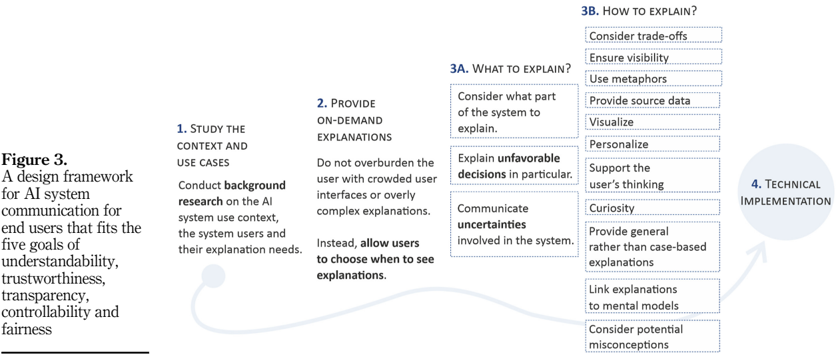
Purpose: Inscrutable machine learning (ML) models are part of increasingly many information systems. Understanding how these models behave, and what their output is based on, is a challenge for developers let alone non-technical end users. Design/methodology/approach: The authors investigate how AI systems and their decisions ought to be explained for end users through a systematic literature review. Findings: The authors’ synthesis of the literature suggests that AI system communication for end users has five high-level goals: (1) understandability, (2) trustworthiness, (3) transparency, (4) controllability and (5) fairness. The authors identified several design recommendations, such as offering personalized and on-demand explanations and focusing on the explainability of key functionalities instead of aiming to explain the whole system. There exists multiple trade-offs in AI system explanations, and there is no single best solution that fits all cases. Research limitations/implications: Based on the synthesis, the authors provide a design framework for explaining AI systems to end users. The study contributes to the work on AI governance by suggesting guidelines on how to make AI systems more understandable, fair, trustworthy, controllable and transparent. Originality/value: This literature review brings together the literature on AI system communication and explainable AI (XAI) for end users. Building on previous academic literature on the topic, it provides synthesized insights, design recommendations and future research agenda.
Overview
The claims and statistics of this paper haven’t been checked yet.
Free: it reads the open-access text and checks the first 5 claims that cite a source we can check. Create a free account to check every claim.
Integrity signals
Registry
Cites
Statistics
Figures






Verification
Claims the paper makes
The claims and statistics of this paper haven’t been checked yet.
Free: it reads the open-access text and checks the first 5 claims that cite a source we can check. Create a free account to check every claim.
Claims other papers make about this one
Each is checked against this paper’s own text: does it say what the citing paper says it does?
The cited source says what the claim attributes to it.
In the citing paper
“Previous reviews of XAI have also reported that explainability is sensitive to contextual factors and future research should investigate different groups of end users [15,16].”
From Explainable AI in hospital clinical decision support systems: A scoping review of healthcare professionals’ perspectives (2026) · cites this paper as [15]
Self-check
Percentages, sums and reported differences re-computed from the paper’s own numbers.
The self-check needs the paper’s full text.
Citations
Cites
Preferred reporting items for systematic reviews and meta-analyses: The PRISMA statement
Moher, D., Liberati, A., Tetzlaff, J., Altman, D. G., & the PRISMA Group* (2009) · Annals of Internal Medicine · doi:10.7326/0003-4819-151-4-200908180-00135 · Cited by 37,554
"Why Should I Trust You?": Explaining the Predictions of Any Classifier
Ribeiro, M. T., Singh, S., & Guestrin, C. (2016) · Proceedings of the 22nd ACM SIGKDD International Conference on Knowledge Discovery and Data Mining · doi:10.1145/2939672.2939778 · Cited by 17,555
Arrieta, A. B., Díaz-Rodríguez, N., Del Ser, J., Bennetot, A., Tabik, S., Barbado, A., García, S., Gil-López, S., Molina, D., Benjamins, R., et al. (2019) · arXiv · doi:10.48550/arxiv.1910.10045 · Cited by 11,321
Barredo Arrieta, A., Díaz-Rodríguez, N., Del Ser, J., Bennetot, A., Tabik, S., Barbado, A., Garcia, S., Gil-Lopez, S., Molina, D., Benjamins, R., et al. (2020) · Information Fusion · doi:10.1016/j.inffus.2019.12.012 · Cited by 10,423
Peeking Inside the Black-Box: A Survey on Explainable Artificial Intelligence (XAI)
Adadi, A., & Berrada, M. (2018) · IEEE Access · doi:10.1109/access.2018.2870052 · Cited by 6,294
The global landscape of AI ethics guidelines
Jobin, A., Ienca, M., & Vayena, E. (2019) · Nature Machine Intelligence · doi:10.1038/s42256-019-0088-2 · Cited by 6,220
Wohlin, C. (2014) · Proceedings of the 18th International Conference on Evaluation and Assessment in Software Engineering · doi:10.1145/2601248.2601268 · Cited by 4,234
How the machine “thinks”: Understanding opacity in machine learning algorithms
Burrell, J. (2016) · Big Data & Society · doi:10.1177/2053951715622512 · Cited by 3,196
Model Cards for Model Reporting
Mitchell, M., Wu, S., Zaldivar, A., Barnes, P., Vasserman, L., Hutchinson, B., Spitzer, E., Raji, I. D., & Gebru, T. (2019) · Proceedings of the Conference on Fairness, Accountability, and Transparency · doi:10.1145/3287560.3287596 · Cited by 2,681
Explainable artificial intelligence: A survey
Dosilovic, F. K., Brcic, M., & Hlupic, N. (2018) · 2018 41st International Convention on Information and Communication Technology, Electronics and Microelectronics (MIPRO) · doi:10.23919/mipro.2018.8400040 · Cited by 1,147
A systematic review of systematic review process research in software engineering
Kitchenham, B., & Brereton, P. (2013) · Information and Software Technology · doi:10.1016/j.infsof.2013.07.010 · Cited by 1,094
Parsa, A. B., Movahedi, A., Taghipour, H., Derrible, S., & Mohammadian, A. (. (2020) · Accident Analysis & Prevention · doi:10.1016/j.aap.2019.105405 · Cited by 1,057
Designing Theory-Driven User-Centric Explainable AI
Wang, D., Yang, Q., Abdul, A., & Lim, B. Y. (2019) · Proceedings of the 2019 CHI Conference on Human Factors in Computing Systems · doi:10.1145/3290605.3300831 · Cited by 906
Transparency and the black box problem: why we do not trust AI
von Eschenbach, W. J. (2021) · Philosophy & Technology · doi:10.1007/s13347-021-00477-0 · Cited by 786
Collins, C., Dennehy, D., Conboy, K., & Mikalef, P. (2021) · International Journal of Information Management · doi:10.1016/j.ijinfomgt.2021.102383 · Cited by 783
Shneiderman, B. (2020) · ACM Transactions on Interactive Intelligent Systems · doi:10.1145/3419764 · Cited by 768
'It's Reducing a Human Being to a Percentage': Perceptions of Justice in Algorithmic Decisions
Binns, R., Van Kleek, M., Veale, M., Lyngs, U., Zhao, J., & Shadbolt, N. (2018) · Proceedings of the 2018 CHI Conference on Human Factors in Computing Systems · doi:10.1145/3173574.3173951 · Cited by 691
Antoniadi, A. M., Du, Y., Guendouz, Y., Wei, L., Mazo, C., Becker, B. A., & Mooney, C. (2021) · Applied Sciences · doi:10.3390/app11115088 · Cited by 629
Cai, C. J., Winter, S., Steiner, D., Wilcox, L., & Terry, M. (2019) · Proceedings of the ACM on Human-Computer Interaction · doi:10.1145/3359206 · Cited by 594
Why and why not explanations improve the intelligibility of context-aware intelligent systems
Lim, B. Y., Dey, A. K., & Avrahami, D. (2009) · Proceedings of the SIGCHI Conference on Human Factors in Computing Systems · doi:10.1145/1518701.1519023 · Cited by 552
Understanding the Effect of Accuracy on Trust in Machine Learning Models
Yin, M., Wortman Vaughan, J., & Wallach, H. (2019) · Proceedings of the 2019 CHI Conference on Human Factors in Computing Systems · doi:10.1145/3290605.3300509 · Cited by 527
A review on deep learning for recommender systems: challenges and remedies
Batmaz, Z., Yurekli, A., Bilge, A., & Kaleli, C. (2019) · Artificial Intelligence Review · doi:10.1007/s10462-018-9654-y · Cited by 504
The effects of transparency on trust in and acceptance of a content-based art recommender
Cramer, H., Evers, V., Ramlal, S., van Someren, M., Rutledge, L., Stash, N., Aroyo, L., & Wielinga, B. (2008) · User Modeling and User-Adapted Interaction · doi:10.1007/s11257-008-9051-3 · Cited by 448
The Role of Explanations on Trust and Reliance in Clinical Decision Support Systems
Bussone, A., Stumpf, S., & O'Sullivan, D. (2015) · 2015 International Conference on Healthcare Informatics · doi:10.1109/ichi.2015.26 · Cited by 441
Rana, N. P., Chatterjee, S., Dwivedi, Y. K., & Akter, S. (2022) · European Journal of Information Systems · doi:10.1080/0960085x.2021.1955628 · Cited by 404
Evaluating XAI: A comparison of rule-based and example-based explanations
van der Waa, J., Nieuwburg, E., Cremers, A., & Neerincx, M. (2021) · Artificial Intelligence · doi:10.1016/j.artint.2020.103404 · Cited by 393
Explainable artificial intelligence: Objectives, stakeholders, and future research opportunities
Meske, C., Bunde, E., Schneider, J., & Gersch, M. (2022) · Information Systems Management · doi:10.1080/10580530.2020.1849465 · Cited by 365
Tarafdar, M., Maier, C., Laumer, S., & Weitzel, T. (2020) · Information Systems Journal · doi:10.1111/isj.12253 · Cited by 327
Oh, C., Song, J., Choi, J., Kim, S., Lee, S., & Suh, B. (2018) · Proceedings of the 2018 CHI Conference on Human Factors in Computing Systems · doi:10.1145/3173574.3174223 · Cited by 301
Gamified crowdsourcing: Conceptualization, literature review, and future agenda
Morschheuser, B., Hamari, J., Koivisto, J., & Maedche, A. (2017) · International Journal of Human-Computer Studies · doi:10.1016/j.ijhcs.2017.04.005 · Cited by 297
Explaining Decision-Making Algorithms through UI: Strategies to Help Non-Expert Stakeholders
Cheng, H.-F., Wang, R., Zhang, Z., O'Connell, F., Gray, T., Harper, F. M., & Zhu, H. (2019) · Proceedings of the 2019 CHI Conference on Human Factors in Computing Systems · doi:10.1145/3290605.3300789 · Cited by 292
Explaining models: an empirical study of how explanations impact fairness judgment
Dodge, J., Liao, Q. V., Zhang, Y., Bellamy, R. K. E., & Dugan, C. (2019) · Proceedings of the 24th International Conference on Intelligent User Interfaces · doi:10.1145/3301275.3302310 · Cited by 286
Defining organizational AI governance
Mäntymäki, M., Minkkinen, M., Birkstedt, T., & Viljanen, M. (2022) · AI and Ethics · doi:10.1007/s43681-022-00143-x · Cited by 285
Self-citationExplainable AI for Designers: A Human-Centered Perspective on Mixed-Initiative Co-Creation
Zhu, J., Liapis, A., Risi, S., Bidarra, R., & Youngblood, G. M. (2018) · 2018 IEEE Conference on Computational Intelligence and Games (CIG) · doi:10.1109/cig.2018.8490433 · Cited by 255
Bringing Transparency Design into Practice
Eiband, M., Schneider, H., Bilandzic, M., Fazekas-Con, J., Haug, M., & Hussmann, H. (2018) · 23rd International Conference on Intelligent User Interfaces · doi:10.1145/3172944.3172961 · Cited by 250
Assessing demand for intelligibility in context-aware applications
Lim, B. Y., & Dey, A. K. (2009) · Proceedings of the 11th international conference on Ubiquitous computing · doi:10.1145/1620545.1620576 · Cited by 246
Explainable Agents and Robots: Results from a Systematic Literature Review
Anjomshoae, S., Najjar, A., Calvaresi, D., & Främling, K. (2019) · International Joint Conference on Autonomous Agents and Multiagent Systems · doi:10.65109/kczb5817 · Cited by 227
Explainability as a non-functional requirement: challenges and recommendations
Chazette, L., & Schneider, K. (2020) · Requirements Engineering · doi:10.1007/s00766-020-00333-1 · Cited by 220
Automated rationale generation: a technique for explainable AI and its effects on human perceptions
Ehsan, U., Tambwekar, P., Chan, L., Harrison, B., & Riedl, M. O. (2019) · Proceedings of the 24th International Conference on Intelligent User Interfaces · doi:10.1145/3301275.3302316 · Cited by 210
Using AI to Enhance Business Operations
Tarafdar, M., Beath, C. M., & Ross, J. W. (2020) · The MIT Press eBooks · doi:10.7551/mitpress/12588.003.0015 · Cited by 174
Asatiani, A., University of Gothenburg, S., Malo, P., Aalto University School of Business, F., Nagbøl, P. R., IT University of Copenhagen, D., Penttinen, E., Aalto University School of Business, F., Rinta-Kahila, T., The University of Queensland, A., et al. (2021) · Journal of the Association for Information Systems · doi:10.17705/1jais.00664 · Cited by 173
Communicating Algorithmic Process in Online Behavioral Advertising
Eslami, M., Krishna Kumaran, S. R., Sandvig, C., & Karahalios, K. (2018) · Proceedings of the 2018 CHI Conference on Human Factors in Computing Systems · doi:10.1145/3173574.3174006 · Cited by 171
Applying DevOps Practices of Continuous Automation for Machine Learning
Karamitsos, I., Thabit, S., & Apostolopoulos, C. (2020) · Information · doi:10.3390/info11070363 · Cited by 140
Weitz, K., Schiller, D., Schlagowski, R., Huber, T., & André, E. (2019) · Proceedings of the 19th ACM International Conference on Intelligent Virtual Agents · doi:10.1145/3308532.3329441 · Cited by 136
“Let me explain!”: exploring the potential of virtual agents in explainable AI interaction design
Weitz, K., Schiller, D., Schlagowski, R., Huber, T., & André, E. (2021) · Journal on Multimodal User Interfaces · doi:10.1007/s12193-020-00332-0 · Cited by 119
Scenario-Based Requirements Elicitation for User-Centric Explainable AI: A Case in Fraud Detection
Cirqueira, D., Nedbal, D., Helfert, M., & Bezbradica, M. (2020) · Lecture notes in computer science · doi:10.1007/978-3-030-57321-8_18 · Cited by 113
What about investors? ESG analyses as tools for ethics-based AI auditing
Minkkinen, M., Niukkanen, A., & Mäntymäki, M. (2024) · AI & SOCIETY · doi:10.1007/s00146-022-01415-0 · Cited by 109
Self-citationChallenges of Explaining the Behavior of Black-Box AI Systems
University of Gothenburg (Sweden), Asatiani, A., Malo, P., Aalto University School of Business (Finland), Nagbøl, P. R., IT University of Copenhagen (Denmark), Penttinen, E., Aalto University School of Business (Finland), Rinta-Kahila, T., The University of Queensland (Australia), et al. (2020) · MIS Quarterly Executive · doi:10.17705/2msqe.00037 · Cited by 106
Do You Get It? User-Evaluated Explainable BDI Agents
Broekens, J., Harbers, M., Hindriks, K. V., den Bosch, K. V., Jonker, C. M., & Meyer, J. C. (2010) · Lecture notes in computer science · doi:10.1007/978-3-642-16178-0_5 · Cited by 96
Hornung, O., & Smolnik, S. (2022) · Electronic Markets · doi:10.1007/s12525-021-00493-0 · Cited by 96
Minkkinen, M., Zimmer, M. P., & Mäntymäki, M. (2022) · Information Systems Frontiers · doi:10.1007/s10796-022-10269-2 · Cited by 93
Self-citationZarifis, A., Kawalek, P., & Azadegan, A. (2021) · Journal of Internet Commerce · doi:10.1080/15332861.2020.1832817 · Cited by 89
A systematic review on AI/ML approaches against COVID-19 outbreak
Dogan, O., Tiwari, S., Jabbar, M. A., & Guggari, S. (2021) · Complex & Intelligent Systems · doi:10.1007/s40747-021-00424-8 · Cited by 87
Exploring Mental Models for Transparent and Controllable Recommender Systems: A Qualitative Study
Ngo, T., Kunkel, J., & Ziegler, J. (2020) · Proceedings of the 28th ACM Conference on User Modeling, Adaptation and Personalization · doi:10.1145/3340631.3394841 · Cited by 81
Interpretable confidence measures for decision support systems
Waa, J. V. D., Schoonderwoerd, T., Diggelen, J. V., & Neerincx, M. (2020) · International Journal of Human-Computer Studies · doi:10.1016/j.ijhcs.2020.102493 · Cited by 77
What Do People Really Want When They Say They Want "Explainable AI?" We Asked 60 Stakeholders.
Brennen, A. (2020) · Extended Abstracts of the 2020 CHI Conference on Human Factors in Computing Systems · doi:10.1145/3334480.3383047 · Cited by 76
Putnam, V., & Conati, C. (2019) · IUI Workshops · Cited by 74
Trends and Trajectories in the Software Industry: implications for the future of work
Laato, S., Mäntymäki, M., Islam, A. K. M. N., Hyrynsalmi, S., & Birkstedt, T. (2022) · Information Systems Frontiers · doi:10.1007/s10796-022-10267-4 · Cited by 68
Self-citationOutlining the Design Space of Explainable Intelligent Systems for Medical DiagnosisPreprint
Xie, Y., Gao, G., & Chen, X. (2019) · arXiv (Cornell University) · doi:10.48550/arxiv.1902.06019 · Cited by 64
Evans, R., Bošnjak, M., Buesing, L., Ellis, K., Pfau, D., Kohli, P., & Sergot, M. J. (2021) · Artificial Intelligence · doi:10.1016/j.artint.2021.103521 · Cited by 61
ProtoSteer: Steering Deep Sequence Model with Prototypes
Ming, Y., Xu, P., Cheng, F., Qu, H., & Ren, L. (2020) · IEEE Transactions on Visualization and Computer Graphics · doi:10.1109/tvcg.2019.2934267 · Cited by 59
Liang, T.-P., Robert, L., Sarker, S., Cheung, C. M. K., Matt, C., Trenz, M., & Turel, O. (2021) · Internet Research · doi:10.1108/intr-11-2020-0668 · Cited by 53
Improving transparency of deep neural inference process
Kuwajima, H., Tanaka, M., & Okutomi, M. (2019) · Progress in Artificial Intelligence · doi:10.1007/s13748-019-00179-x · Cited by 27
Weitz, K., Schlagowski, R., & André, E. (2021) · Lecture notes in computer science · doi:10.1007/978-3-030-87626-5_19 · Cited by 18
Color for Characters - Effects of Visual Explanations of AI on Trust and Observability
Schrills, T., & Franke, T. (2020) · Lecture Notes in Computer Science · doi:10.1007/978-3-030-50334-5_8 · Cited by 17
Digital Transformation of Software Development: Implications for the Future of Work
Laato, S., Mäntymäki, M., Birkstedt, T., Islam, A. K. M. N., & Hyrynsalmi, S. (2021) · Lecture notes in computer science · doi:10.1007/978-3-030-85447-8_50 · Cited by 12
Self-citation
Research works printed but not linked: 2
- Sepp€ al€ a, A., Birkstedt, T. and M€ antym€ aki, M. (2021), "From ethical principles to governed AI", in Proceedings of the 42nd International Conference on Information Systems (ICIS2021).
- Strauss, A. and Corbin, J. (1998), Basics of Qualitative Research Techniques, Sage Publications, Thousand Oaks, CA.
Cited by
AI governance: themes, knowledge gaps and future agendas
Birkstedt, T., Minkkinen, M., Tandon, A., & Mäntymäki, M. (2023) · Internet Research · doi:10.1108/intr-01-2022-0042 · Cited by 309
Self-citationHaque, A. B., Islam, A. K. M. N., & Mikalef, P. (2023) · Technological Forecasting and Social Change · doi:10.1016/j.techfore.2022.122120 · Cited by 240
“An AI ecosystem contains different stakeholders, such as designers, domain experts, developers, data scientists, UX engineers, and regulatory bodies (Meske et al., 2022; Laato et al., 2022).”
BackgroundResultInfluentialAI and the quest for diversity and inclusion: a systematic literature review
Shams, R. A., Zowghi, D., & Bano, M. (2025) · AI and Ethics · doi:10.1007/s43681-023-00362-w · Cited by 192
“As the body of AI literature continues to expand, a growing number of traditional and systematic reviews reflects an increased focus on issues related to bias [17, 18], fairness [11, 19], transparency [20], and explainability [21].”
Personalized Tourism Recommendations and the E-Tourism User Experience
Yang, X., Zhang, L., & Feng, Z. (2024) · Journal of Travel Research · doi:10.1177/00472875231187332 · Cited by 160
“…concerns (Hornung & Smolnik, 2022; Su et al., 2022), algorithm aversion (Yeomans et al., 2019), inaccuracy of recommendations (J. Kim et al., 2021), discomfort and perceived risk (Ulker-Demirel & Ciftci, 2020), and a sense of unfairness (Kaur et al., 2023; Laato et al., 2022; J. Wang et al., 2022).”
BackgroundLaine, J., Minkkinen, M., & Mäntymäki, M. (2024) · Information & Management · doi:10.1016/j.im.2024.103969 · Cited by 227
“Second, we contribute to the literature on AI system stakeholders (e.g., [75,87]) by presenting a framework that clarifies the knowledge contributions of AI auditing literature to stakeholders and, thereby, illuminating how AI auditing can benefit the multi-stakeholder ecosystem involved in AI…”
InfluentialSelf-citation
Metadata
- Authors
- Laato, S., Tiainen, M., Najmul Islam, A. K. M., & Mäntymäki, M.
- Affiliations
- University of Turku (FI)
- Corresponding author
- Laato, Samuli
- Venue
- Internet Research
- Publisher
- Emerald
- Published
- 2022-05-02
- Volume
- 32
- Issue
- 7
- Pages
- 1-31
- ISSN
- 1066-2243 (ISSN-L)
- OpenAlex
- W4229079390
- Cited by
- 155
- References
- 65
- Citations by year
- 2026: 35 · 2025: 36 · 2024: 52 · 2023: 27 · 2022: 5
- FWCI
- 2.11
- Type
- journal article
- Language
- en
- Open access
- hybrid
- doi.org
- Licence
- cc-by
- www.emerald.com/insight/site-policies (tdm)
- Locations
- Internet Research (publishedVersion, cc-by)
- Tampere University Institutional Repository (Tampere University) (submittedVersion, cc-by)
- Topics
- Physical Sciences › Computer Science › Artificial Intelligence › Explainable Artificial Intelligence (XAI)
- Physical Sciences › Computer Science › Artificial Intelligence › Ethics and Social Impacts of AI
- Physical Sciences › Computer Science › Human-Computer Interaction › Usability and User Interface Design
- Keywords
- explainable AI, end users, explainability, model transparency, trustworthiness, fairness, controllability, comprehensibility, personalized explanations, AI governance
About these checks
Registry, retraction, Cites and statistics results are computed, not judged, with one exception: a printed reference that no index lists is read once by a model before it counts as a citation error. Claims are extracted by a model and kept only when their quote appears verbatim in the text; each cited source is then checked, with a model’s help, for whether it says what the claim relies on. Those verdicts can be wrong — read the claim’s quote and the cited source before relying on one.
Statistics and arithmetic are recomputed, not judged.
Confidence bands are shown only for fields calibrated on our annotated test set. None is calibrated yet, so no band is shown.
What counts as a claim ›How we measure confidence ›How we check this ›
Are you an author, or do you see a problem with this page? Request a review
Data sources
Bibliographic data: Semantic Scholar, OpenAlex, Crossref.
Contains information from the Semantic Scholar Academic Graph Datasets, made available under the ODC Attribution License (ODC-BY 1.0).
Semantic Scholar’s data is described in: Kinney, R., et al. (2023). The Semantic Scholar Open Data Platform. arXiv:2301.10140.
