

Exposure to green space and prevention of anxiety and depression among young people in urban settings: a global scoping review
Open accessThe DOI matches its Crossref record; 29 of the 29 references it cites were found in a registry or an index.
Abstract
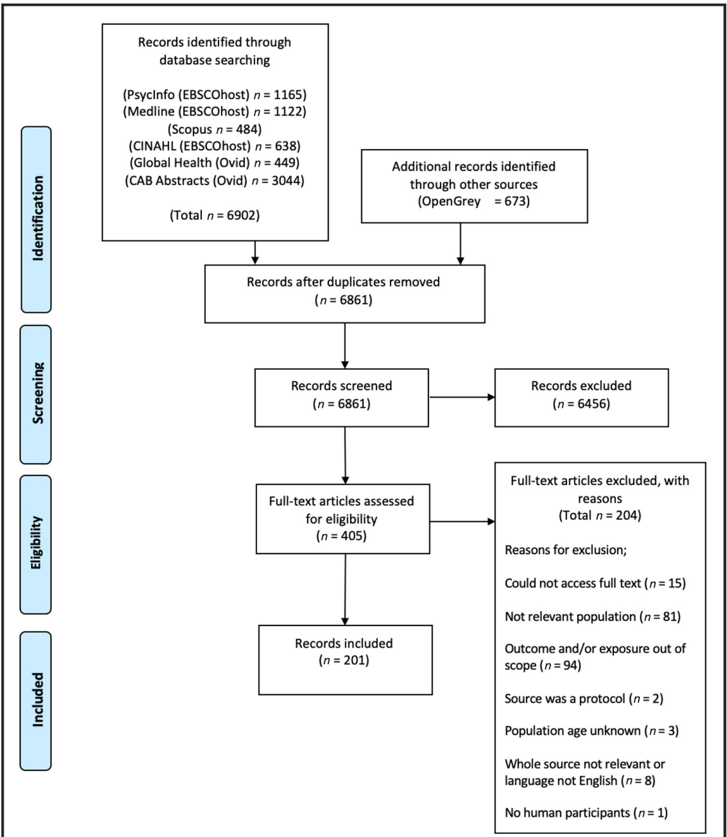
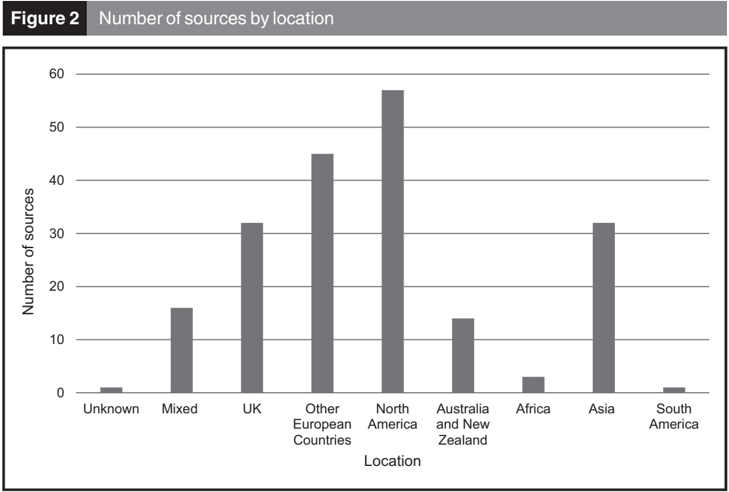
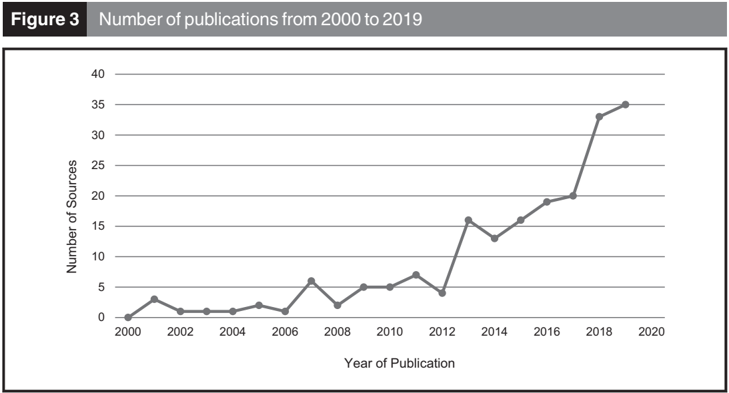
Purpose: There is a mental health crisis, particularly among young people. Despite many young people living in urban settings, reviews about the association between exposure to green or natural environments and mental health tend to focus on either children or adults. The aim of this review is to examine the scope of the global literature for this age group, to inform a systematic review on the role of exposure to green space in preventing anxiety and depression amongst young people aged 14–24 years. Design/methodology/approach: Seven databases were searched for quantitative and qualitative sources published from January 2000 to June 2020. This identified 201 sources and their characteristics are described here. Gaps in the literature are also highlighted. Findings: The number of relevant studies published per year has increased over time. Most studies are set in North America (28%) or Europe (39%). The most common study designs were observational (34%) or experimental (28%). A wide range of exposures and interventions are described. Research limitations/implications: This review included literature from predominantly high-income countries and has shown the under-representation of low-middle income countries and lack of ethnic diversity in study populations. It has also highlighted the lack of clinical measures of anxiety and depression as outcomes. Originality/value: This inter-disciplinary review has contributed to the field by describing the geographic distribution of the literature and the broad range of exposures to green spaces being reported. Unlike previous scoping reviews, this review focused specifically on young people and on measures of anxiety and depression and their pre-cursers.
Overview
The claims and statistics of this paper haven’t been checked yet.
Free: it reads the open-access text and checks the first 5 claims that cite a source we can check. Create a free account to check every claim.
Integrity signals
Registry
Cites
Statistics
Figures
Verification
Claims the paper makes
The claims and statistics of this paper haven’t been checked yet.
Free: it reads the open-access text and checks the first 5 claims that cite a source we can check. Create a free account to check every claim.
Claims other papers make about this one
Each is checked against this paper’s own text: does it say what the citing paper says it does?
The source backs part of the claim, not all of it — or backs it for a different population, condition or comparison.
In the citing paper
“This reflects the finding of our earlier scoping review (Reece et al., 2021), in which only 2% of sources related to blue spaces.”
From Exploring the role of exposure to green and blue spaces in preventing anxiety and depression among young people aged 14–24 years living in urban settings: A systematic review and conceptual framework (2022) · cites this paper as Reece et al., 2021
Experimental — accuracy not yet measuredThe cited source says what the claim attributes to it.
In the citing paper
“It found that the literature included both observational (34%) and experimental designs (28%).”
From Exploring the role of exposure to green and blue spaces in preventing anxiety and depression among young people aged 14–24 years living in urban settings: A systematic review and conceptual framework (2022) · cites this paper as Reece et al., 2021
The cited source says what the claim attributes to it.
In the citing paper
“Importantly, few studies had clinical levels of anxiety or depression as the outcome.Instead, broader terms for mental health which can be related to, or precursors of, anxiety and depression were more common in the literature.”
From Exploring the role of exposure to green and blue spaces in preventing anxiety and depression among young people aged 14–24 years living in urban settings: A systematic review and conceptual framework (2022) · cites this paper as Reece et al., 2021
Self-check
Percentages, sums and reported differences re-computed from the paper’s own numbers.
The self-check needs the paper’s full text.
Citations
Cites
PRISMA Extension for Scoping Reviews (PRISMA-ScR): Checklist and Explanation
Tricco, A. C., Lillie, E., Zarin, W., O'Brien, K. K., Colquhoun, H., Levac, D., Moher, D., Peters, M. D. J., Horsley, T., Weeks, L., et al. (2018) · Annals of Internal Medicine · doi:10.7326/m18-0850 · Cited by 43,565 · cited 1×
“This scoping review followed the guidance and items presented in the “Preferred Reporting Items for Systematic Reviews and Meta-Analyses Extension for Scoping Reviews (PRISMA-ScR)” checklist (Tricco et al., 2018).”
MethodPreferred reporting items for systematic reviews and meta-analyses: The PRISMA statement
Moher, D., Liberati, A., Tetzlaff, J., Altman, D. G., & the PRISMA Group* (2009) · Annals of Internal Medicine · doi:10.7326/0003-4819-151-4-200908180-00135 · Cited by 37,554
Scoping studies: towards a methodological framework
Arksey, H., & O'Malley, L. (2005) · International Journal of Social Research Methodology · doi:10.1080/1364557032000119616 · Cited by 36,742 · cited 1×
“As the literature is multidisciplinary, complex and heterogenous, a scoping review is needed to describe the existing evidence base and to provide the first step towards conducting a systematic review (Mays et al., 2001; Arksey and O’Malley, 2005).”
BackgroundMunn, Z., Peters, M. D. J., Stern, C., Tufanaru, C., McArthur, A., & Aromataris, E. (2018) · BMC Medical Research Methodology · doi:10.1186/s12874-018-0611-x · Cited by 11,385
The psychological impact of the COVID-19 epidemic on college students in China
Cao, W., Fang, Z., Hou, G., Han, M., Xu, X., Dong, J., & Zheng, J. (2020) · Psychiatry Research · doi:10.1016/j.psychres.2020.112934 · Cited by 5,843 · cited 1×
“This has influenced the level of experienced anxiety in university students (Cao et al., 2020).”
BackgroundAge of onset of mental disorders: a review of recent literature
Kessler, R. C., Amminger, G. P., Aguilar-Gaxiola, S., Alonso, J., Lee, S., & ??st??n, T. B. (2007) · Current Opinion in Psychiatry · doi:10.1097/yco.0b013e32816ebc8c · Cited by 3,457 · cited 1×
“It is particularly important to improve the mental health of young people, as many adults with mental health problems develop these during adolescence (Kessler et al., 2007; Patel et al, 2007).”
BackgroundMental health of young people: A global public-health challenge
Patel, V., Flisher, A. J., Hetrick, S., & McGorry, P. (2007) · The Lancet · doi:10.1016/s0140-6736(07)60368-7 · Cited by 3,126 · cited 1×
“It is particularly important to improve the mental health of young people, as many adults with mental health problems develop these during adolescence (Kessler et al., 2007; Patel et al, 2007).”
BackgroundThompson Coon, J., Boddy, K., Stein, K., Whear, R., Barton, J., & Depledge, M. H. (2011) · Environmental Science & Technology · doi:10.1021/es102947t · Cited by 1,391 · cited 5×
“…interventions can have positive associations with mental well-being and emotional measures related to stress relief (Corazon et al., 2019; Houlden et al., 2018), as well as some positive benefits to mental well-being when exercising outdoors compared to indoors (Thompson Coon et al., 2011).”
BackgroundInfluentialFeitosa, M. F., Kraja, A. T., Chasman, D. I., Sung, Y. J., Winkler, T. W., Ntalla, I., Guo, X., Franceschini, N., Cheng, C.-Y., Sim, X., et al. (2018) · PLOS ONE · doi:10.1371/journal.pone.0198166 · Cited by 1,165
An analysis of mood in neurotics.
McNair, D. M., & Lorr, M. (1964) · The Journal of Abnormal and Social Psychology · doi:10.1037/h0040902 · Cited by 556 · cited 1×
“Instead, for example, many studies measured anxiety using the Profile of Mood States scale (McNair and Lorr, 1964).”
Method
Research works printed but not linked: 3
- Mays, N., Roberts, E. and Popay, J. (2001), "Synthesizing research evidence", in Fulop, N., Allen, P., Clarke, A., and Black, N. (Eds), Studying the Organisation and Delivery of Health Services: Research Methods, Routledge, London, pp. 188-219.
- Sundquist, K., Frank, G. and Sundquist, J. (2018), "Urbanisation and incidence of psychosis and depression", British Journal of Psychiatry, Vol. 184 No. 4, pp. 293-298.
- Tiller, J. (2013), "Depression and anxiety", Medical Journal of Australia, Vol. 199 No. 6, pp. 28-31.
Cited by
Green space exposure on depression and anxiety outcomes: A meta-analysis
Liu, Z., Chen, X., Cui, H., Ma, Y., Gao, N., Li, X., Meng, X., Lin, H., Abudou, H., Guo, L., et al. (2023) · Environmental Research · doi:10.1016/j.envres.2023.116303 · Cited by 155
Bray, I., Reece, R., Sinnett, D., Martin, F., & Hayward, R. (2022) · Environmental Research · doi:10.1016/j.envres.2022.114081 · Cited by 124
“We also include ‘blue space ’ (such as lakes), although this field of research is more recent (Reece et al., 2021).”
BackgroundSelf-citationGonzales‐Inca, C., Pentti, J., Stenholm, S., Suominen, S., Vahtera, J., & Käyhkö, N. (2022) · Health & Place · doi:10.1016/j.healthplace.2022.102760 · Cited by 71
Associations Between Urban Green Space Quality and Mental Wellbeing: Systematic Review
Xu, Z., Marini, S., Mauro, M., Latessa, P. M., Grigoletto, A., & Toselli, S. (2025) · Land · doi:10.3390/land14020381 · Cited by 72
Effect of nature on the mental health and well-being of children and adolescents: meta-review
Lomax, T., Butler, J. A., Cipriani, A., & Singh, I. (2024) · The British Journal of Psychiatry · doi:10.1192/bjp.2024.109 · Cited by 58
Nigg, C., Petersen, E., & Macintyre, T. E. (2023) · Journal of Environmental Psychology · doi:10.1016/j.jenvp.2023.102009 · Cited by 40
Long-term exposure to greenspace and anxiety from preschool and primary school children
de la Osa, N., Navarro, J. B., Penelo, E., Valentí, A., Ezpeleta, L., & Dadvand, P. (2023) · Journal of Environmental Psychology · doi:10.1016/j.jenvp.2023.102207 · Cited by 37
Critical life course interventions for children and adolescents to promote mental health
Laurenzi, C. A., Mamutse, S., Marlow, M., Mawoyo, T. L., Katzen, L. S., Carvajal-Vélez, L., Lai, J., Luitel, N. P., Servili, C., Sinha, M., et al. (2022) · Cambridge Prisms Global Mental Health · doi:10.1017/gmh.2022.58 · Cited by 42
“This type of component may include access to green spaces and recreational areas (Reece et al., 2021), or increased neighbourhood cohesion (Donnelly et al., 2016).”
BackgroundUrban Green Spaces and Healthy Living: A Landscape Architecture Perspective
Russo, A. (2024) · Urban Science · doi:10.3390/urbansci8040213 · Cited by 33
Coastal cultural ecosystem services and adolescents’ subjective well-being
Cabana, D., Pinna, S., Farina, S., Grech, D., Barbieri, N., & Guala, I. (2024) · Ambio · doi:10.1007/s13280-024-02043-2 · Cited by 20
“This approach addresses the underrepresentation of adolescents’ voices in CES and coastal well-being research, a critical gap identified by Reece et al. (2021), which is crucial for developing targeted interventions and policies (Wright and McLeod 2014).”
How properties of urban greenspaces shape well-being across age groups: A qualitative study
Reece, R., Elliott, L. R., Bray, I., & Bornioli, A. (2024) · Wellbeing Space and Society · doi:10.1016/j.wss.2024.100206 · Cited by 27
Self-citationWiśniewska-Paluszak, J., Paluszak, G., Fiore, M., Coticchio, A., Galati, A., & Lira, J. (2023) · Land Use Policy · doi:10.1016/j.landusepol.2023.106562 · Cited by 29
Why cities matter for adolescent mental health and wellbeing
Hannon, E., Anselimus, S. M., Bardikoff, N., Bulc, B., Germann, S., Gonsalves, P. P., Meléndez‐Torres, G. J., Ospina‐Pinillos, L., Sinha, M., & Wanjiru, M. (2023) · The Lancet · doi:10.1016/s0140-6736(23)02238-9 · Cited by 23
Zhang, Z., Jiang, M., & Zhao, J. (2024) · Forests · doi:10.3390/f15091611 · Cited by 25
Multiscale rooftop greening and its socioeconomic implications in Hong Kong
Ling, J., Yip, K. H. A., Wei, S., Sit, K. Y., Sun, L., Meng, Q., Cong, N., Lin, J., & Zhang, H. (2024) · Building and Environment · doi:10.1016/j.buildenv.2024.111643 · Cited by 19
A Nature-Based Intervention and Mental Health of Schoolchildren: A Cluster Randomized Clinical Trial
Loose, T., Fuoco, J., Malboeuf‐Hurtubise, C., Ayotte‐Beaudet, J., Gauvin, L. I., Chadi, N., Ouellet‐Morin, I., Mâsse, B. R., Côté, S. M., & Geoffroy, M. (2024) · JAMA Network Open · doi:10.1001/jamanetworkopen.2024.44824 · Cited by 20
Pastore, M. C., Parenti, C. I. M., & Patetta, C. (2025) · Land · doi:10.3390/land14010097 · Cited by 18
Xu, H., Duan, J., Ren, M., Zhao, G., & Liu, Z. (2025) · Landscape Ecology · doi:10.1007/s10980-025-02115-y · Cited by 15
“…exposure to green spaces and increase their social engagement, thereby helping to alleviate their anxiety and depression in modern urban lives (Reece et al. 2021 redesign underutilized park into multi-functional spaces to enhance their contributions to social recreation, artistic expression,…”
Invisible and overlooked: young people’s perceptions of managing green spaces for mental wellbeing
Whitten, M. (2025) · Cities & Health · doi:10.1080/23748834.2025.2458394 · Cited by 9
“2020, Reece et al .”
Marchionatti, L. E., Caye, A., & Kieling, C. (2021) · Current Opinion in Psychiatry · doi:10.1097/yco.0000000000000769 · Cited by 9
Haile, S. R., Peralta, G. P., Raineri, A., Rueegg, S., Ulytė, A., Puhan, M. A., Radtke, T., & Kriemler, S. (2024) · European Journal of Pediatrics · doi:10.1007/s00431-024-05459-w · Cited by 7
“School-based interventions [54] could include self-help strategies [53, 55], nature and green space [56–58], or strategies to improve lifestyle [16, 59].”
Nigg, C., Petersen, E., & Macintyre, T. E. (2021) · PsyArXiv (OSF Preprints) · doi:10.31234/osf.io/a9unf · Cited by 9
COVID-19 and cities: a systematic review of early urban studies
Roosta, M., Gholami, A., & Shahvaran, F. (2023) · Cities & Health · doi:10.1080/23748834.2023.2215413 · Cited by 6
“Access to parks, riversides, and green spaces is also essential during the COVID-19 pandemic, and the importance of such spaces is significant for improving mental health (Bereitschaft and Scheller 2020, Reece et al .”
BackgroundLinking Ethical Standards for Healthcare Professionals with Indian Cultural Values
Mathew, J., & Wesarat, P.-O. (2021) · Asia Pacific Journal of Health Management · doi:10.24083/apjhm.v16i3.965 · Cited by 5
“” [12] The relevant studies from the Scopus and Google Scholar have been revealed.”
BackgroundYe, Z., & Gu, X. (2025) · Applied Geography · doi:10.1016/j.apgeog.2025.103811 · Cited by 6
Presepsi Remaja Terhadap Gangguan Kecemasan Pada Fase Remaja Akhir Menuju Dewasa Awal
Sulistyo, A., Ristanti, R., Suharyono, E., Djamil, F. D., & Sudanang, E. A. (2023) · Harmoni Nusa Bangsa · doi:10.47256/jhnb.v1i1.276 · Cited by 4
“Penelitian yang muncul sebelumnya, lebih banyak berbicara tentang kesenjangan sosial (Shawky et al., 2021), adaptasi komunikasi (Hassan et al., 2020; Wiese & Van Der Westhuizen, 2023) dan depresi (Huansuriya et al., 2022; Reece et al., 2021).”
Global warming is a mental health issue: An editorial
Ghainder, K., Rusnac, S. D., Schettini, C., Lemière, C., & Bui, É. (2022) · International Journal of Mental Health · doi:10.1080/00207411.2022.2105522 · Cited by 4
“…warming is a mental health issue: An editorial Emerging research has highlighted the positive effects of urban green spaces (i.e., open-space areas reserved for parks, plant life, and other kinds of natural environment) on mental and physical health (e.g., Reece et al., 2021; Sillman et al., 2022).”
BackgroundThe Role of Urban Green Spaces on Life Satisfaction and Migration Willingness in Tirana, Albania
Kruja, S., Braçe, O., Kokthi, E., & Garrido‐Cumbrera, M. (2024) · Human Ecology · doi:10.1007/s10745-024-00511-7 · Cited by 3
“…2021; Pope et al., 2018; Wang et al., 2019), (2) self-reported physician-diagnosed depression or anxiety (Banay et al., 2019; Hystad et al., 2019; Reece et al., 2021), (3) self-rated fair to poor general health (Furukawa et al., 2003), (4) well-being (WHO-5), and (5) life satisfaction (An et…”
Greenspace use and anxiety in young adults: The role of interoception
Shen, H., Flouri, E., Cheng, Y., Li, Y., & Wei, G. (2024) · Environmental Research · doi:10.1016/j.envres.2024.120232 · Cited by 2
Sari, D. P., Utomo, P. K., Putri, N. A., & Yoma, D. (2023) · Advances in biological sciences research/Advances in Biological Sciences Research · doi:10.2991/978-94-6463-180-7_50 · Cited by 2
Lyu, B., Peng, T., Zhang, J., & Chen, Q. (2024) · Land · doi:10.3390/land13091472 · Cited by 2
Kalfouni, B. B. (2025) · Open House International · doi:10.1108/ohi-12-2024-0394 · Cited by 4
Making the case for citizenship-oriented mental healthcare for youth in Canada
Jordan, G., Mutschler, C., Kidd, S. A., Rowe, M., & Iyer, S. N. (2023) · Journal of Public Mental Health · doi:10.1108/jpmh-06-2022-0055 · Cited by 2
Built environment determinants of mental health in Mashhad metropolis, Iran
Hosseini, S. H., Zarei, M., & Ghodrati, H. (2026) · Cities & Health · doi:10.1080/23748834.2025.2589638 · Cited by 1
“2020, Reece et al .”
Youssef, R., Dassuki, N., Natour, D. E., Achcar, J. A., MAADARANI, R., Krayker, G., Azakir, B., Masri, J. E., & Salameh, P. (2026) · PLoS ONE · doi:10.1371/journal.pone.0344534 · Cited by 1
Bubalo, M., van den Broek, K. L., Helbich, M., & Labib, S. M. (2026) · Journal of Environmental Psychology · doi:10.1016/j.jenvp.2026.103254 · Cited by 1
Stanhope, J., Foley, K. M., Butler, M., Boddy, J., Clanchy, K., George, E., Roberts, R., Rothmore, P., Salter, A. B., Serocki, P., et al. (2024) · SocArXiv (OSF Preprints) · doi:10.31235/osf.io/nv95r · Cited by 1
Rock Climbing on the Niagara Escarpment: Emerging Entanglements of Care at the Crag
Schaefer, B. (2021) · The Atrium (University of Guelph) · doi:10.13140/rg.2.2.29923.68647
Laurenzi, C. A. (2022) · Cambridge Prisms Global Mental Health · doi:10.1017/gmh.2022.58.pr7
Laurenzi, C. A. (2022) · Cambridge Prisms Global Mental Health · doi:10.1017/gmh.2022.58.pr1
Laurenzi, C. A., Mamutse, S., Marlow, M., et al. (2022) · Cambridge Prisms Global Mental Health · doi:10.1017/gmh.2022.58.pr2
Laurenzi, C. A., Mamutse, S., Marlow, M., et al. (2022) · Cambridge Prisms Global Mental Health · doi:10.1017/gmh.2022.58.pr11
Laurenzi, C. A., Mamutse, S., Marlow, M., et al. (2022) · Cambridge Prisms Global Mental Health · doi:10.1017/gmh.2022.58.pr4
Laurenzi, C. A., Mamutse, S., Marlow, M., et al. (2022) · Cambridge Prisms Global Mental Health · doi:10.1017/gmh.2022.58.pr10
Laurenzi, C. A., Mamutse, S., Marlow, M., et al. (2022) · Cambridge Prisms Global Mental Health · doi:10.1017/gmh.2022.58.pr8
Laurenzi, C. A., Mamutse, S., Marlow, M., et al. (2022) · Cambridge Prisms Global Mental Health · doi:10.1017/gmh.2022.58.pr9
Laurenzi, C. A., Mamutse, S., Marlow, M., et al. (2022) · Cambridge Prisms Global Mental Health · doi:10.1017/gmh.2022.58.pr6
Laurenzi, C. A., Mamutse, S., Marlow, M., et al. (2022) · Cambridge Prisms Global Mental Health · doi:10.1017/gmh.2022.58.pr3
Laurenzi, C. A., Mamutse, S., Marlow, M., et al. (2022) · Cambridge Prisms Global Mental Health · doi:10.1017/gmh.2022.58.pr5
Αστικοί χώροι πράσινου και επιπτώσεις στην ψυχική υγεία στην Τανζανία
Βαρδάκα, Μ.-Λ. (2022) · Institutional Repository Hellanicus · doi:10.26215/heal.uoa.8023
Nigg, C. (2023) · Repository KITopen (Karlsruhe Institute of Technology) · doi:10.5445/ir/1000164657
Wang, Q. (2026) · Applied Spatial Analysis and Policy · doi:10.1007/s12061-026-09914-z
“Beyond its function as a form of exercise, it reflects broader shifts toward low car - bon lifestyles, preventive health practices, and the pursuit of subjective well-being in contemporary cities (Reece et al., 2021).”
CITY, PSYCHIC SUFFERING AND REGIMES OF VISIBILITY: HUMANISTIC PERSPECTIVES ON POLICIES OF CARE
da Cunha, V. N., Barreto, T. G. G., Marques, M. V., Maciel, A. C., de Souza, G. B., Campos, F. M. C., Amador, A. E., & Guimarães, M. H. D. (2026) · Artefactum · doi:10.23900/artefactum.v25i9.4237
VALUE CO-CREATION IN HEALTHCARE: A BIBLIOMETRIC ANALYSIS
Zhu, M., & Muhamad, N. S. (2026) · Aposta · doi:10.23900/ra.v24i119.2063
Metadata
- Authors
- Reece, R., Bray, I., Sinnett, D., Hayward, R., & Martin, F.
- Affiliations
- University of the West of England (GB)
- Coventry University (GB)
- Corresponding author
- Reece, Rebecca
- Venue
- Journal of Public Mental Health
- Publisher
- Emerald
- Published
- 2021-05-28
- Volume
- 20
- Issue
- 2
- Pages
- 94-104
- ISSN
- 1746-5729 (ISSN-L)
- OpenAlex
- W3158547856
- Cited by
- 50
- References
- 29
- Citations by year
- 2026: 4 · 2025: 6 · 2024: 12 · 2023: 9 · 2022: 15 · 2021: 4
- FWCI
- 3.98
- Type
- journal article
- Language
- en
- Open access
- hybrid
- doi.org
- Licence
- cc-by
- www.emerald.com/insight/site-policies (tdm)
- Locations
- Journal of Public Mental Health (publishedVersion, cc-by)
- ORCA Online Research @Cardiff (Cardiff University) (acceptedVersion)
- Pure (Coventry University) (submittedVersion, other-oa)
- UWE Research Repository (UWE Bristol) (submittedVersion, cc-by)
- Topics
- Social Sciences › Urban Studies › Urban Green Space and Health
- Health Sciences › Medicine › Psychiatry and Mental health › Mental Health Treatment and Access
- Social Sciences › Psychology › Applied Psychology › Digital Mental Health Interventions
- Keywords
- green space exposure, natural environment, anxiety, depression, youth, adolescents, urban mental health, mental health prevention, regional distribution of research, low- and middle-income countries
About these checks
Registry, retraction, Cites and statistics results are computed, not judged, with one exception: a printed reference that no index lists is read once by a model before it counts as a citation error. Claims are extracted by a model and kept only when their quote appears verbatim in the text; each cited source is then checked, with a model’s help, for whether it says what the claim relies on. Those verdicts can be wrong — read the claim’s quote and the cited source before relying on one.
Statistics and arithmetic are recomputed, not judged.
Confidence bands are shown only for fields calibrated on our annotated test set. None is calibrated yet, so no band is shown.
What counts as a claim ›How we measure confidence ›How we check this ›
Are you an author, or do you see a problem with this page? Request a review
Data sources
Bibliographic data: Semantic Scholar, OpenAlex, Crossref.
Contains information from the Semantic Scholar Academic Graph Datasets, made available under the ODC Attribution License (ODC-BY 1.0).
Semantic Scholar’s data is described in: Kinney, R., et al. (2023). The Semantic Scholar Open Data Platform. arXiv:2301.10140.
