

The DOI matches its Crossref record; 34 of the 34 references it cites were found in a registry or an index; none of the 18 sources its claims cite is checked for support yet.
Evaluation of Frequency and Temperature Dependence of Power Losses Difference in Parallel IGBTs
Open accessAbstract
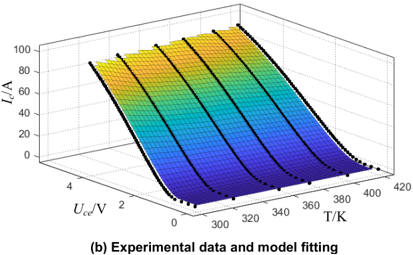
With the development of high power converters, safe operation of IGBT modules with parallel chips is of increasing importance. IGBT can work normally in safe range in the initial operation even if current imbalance is happening. However, if the uneven current state lasts too long, it is difficult to keep a uniform junction temperature, which can further lead to uneven distribution of the power losses. In severe cases, the device and converter may be damaged due to overheating. This paper studies the stability of such an interactive process with mathematical modelling backed by experiment. Because of the opposite sensitivities of switching and conduction losses to temperature under high current injection, the concept of `inflection point frequency characteristic' is introduced to evaluate the trend of junction temperature mismatches between the parallel IGBT chips. The inflection point frequency at different current and temperature levels is tested to verify the model prediction, and the applicability of this approach in multi-chip parallel module is discussed. By establishing the relationship between the switching frequency and the thermal stability limit of parallel IGBTs, it can provide a feasible reference for improving the reliability of multi-chip parallel power devices.
Overview
CoChat Summary
TL;DR
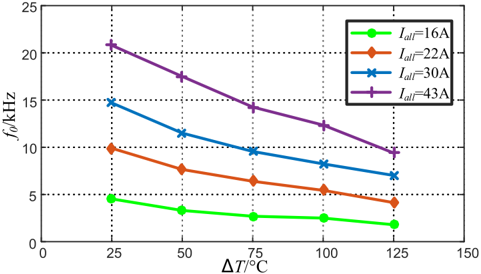
This paper models how temperature affects switching and conduction losses in parallel IGBTs and introduces an “inflection point frequency” at which the total loss difference between chips is zero. Experiments with two parallel Infineon IHW20N120R2 IGBTs verify that this frequency falls as junction-temperature difference rises and as parallel current falls.
Key findings
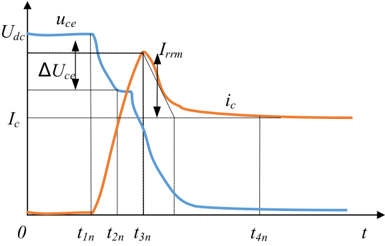
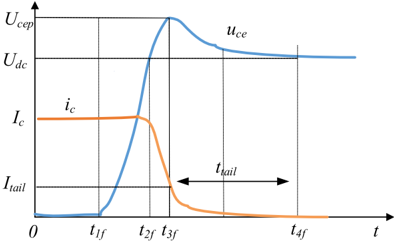
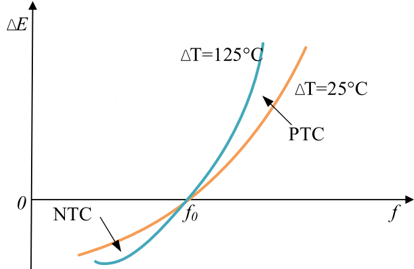
- Switching loss increases with temperature while conduction loss decreases under high current injection, giving opposite temperature sensitivities; at the inflection point frequency \(f_0\), the total loss difference is zero and the junction temperature difference remains unchanged.
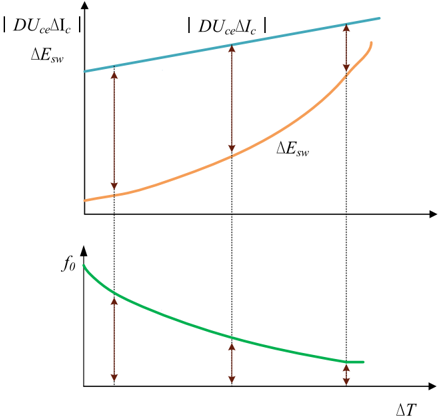
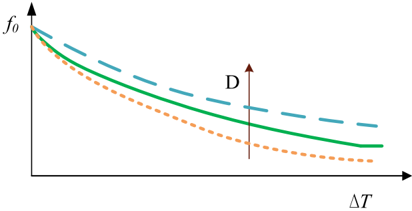
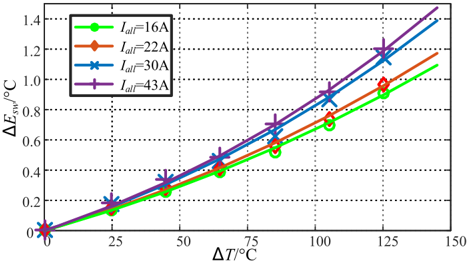
- For two parallel IHW20N120R2 devices at duty cycle 0.99, the inflection point frequency decreased from 20.8 kHz to 9.4 kHz as junction temperature difference increased from 25°C to 125°C; at 25°C difference, it decreased from 20.8 kHz to 3.3 kHz as parallel current decreased from 43 A to 16 A.
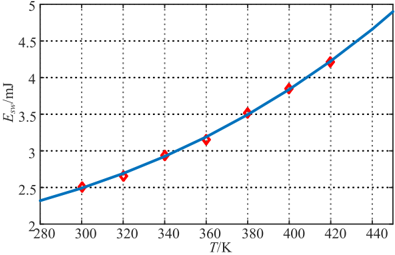
- The switching-loss temperature coefficient fitted for Infineon trench-gate IHW20N120R2 was \(\phi = 2.263\).
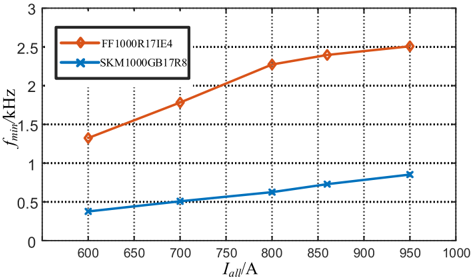
- For 1700 V/1000 A multi-chip modules at 25°C junction temperature difference and duty cycle 0.99, the minimum inflection point frequency was several kHz for the Infineon module and only a few hundred Hz for the SEMIKRON module.
Methods
- Mathematical derivation of turn-on/turn-off switching loss and conduction loss versus temperature; defines \(f_0 = |D U_{ce} \Delta I_c| / \Delta E_{sw}\) and a minimum inflection point frequency for multi-chip modules.
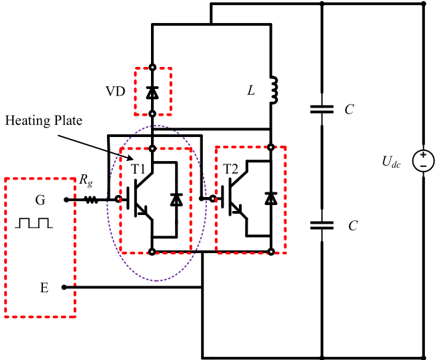
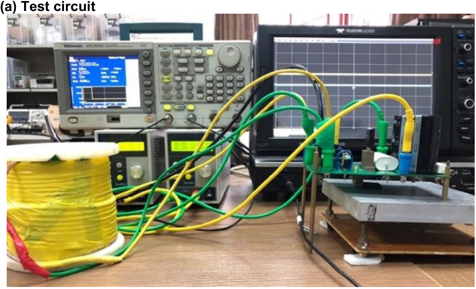
- Double-pulse test with two parallel Infineon IHW20N120R2 IGBTs; T1 was heated by an electric heating plate, T2 was kept at 25°C room temperature, DC voltage was 400 V, and verification focused on high current injection.
- Experimental extraction of inflection point frequency at different current and temperature differences; multi-chip applicability was assessed using datasheet data for FF1000R17IE4 and SKM1000GB17R8 modules.
Limitations
- Stated: only switching and conduction losses are considered; off-state blocking loss is ignored. Experimental verification is discussed for high current injection because the inflection point only occurs there.
- Stated/evident: multi-chip parallel module applicability is discussed using datasheet data, not experimentally tested; the experiments use two discrete parallel IGBTs, not a multi-chip module.
- Evident: T2 is fixed at 25°C while T1 is heated, so thermal coupling and dynamic self-heating between chips are not directly tested; the paper has no dedicated limitations section.
Model-written summary. Check it against the paper before relying on it.
Integrity signals
Registry
Cites
Statistics
Figures




Verification
Claims the paper makes
31 Own interpretation · 18 Own result · 8 Sources not found · 2 Own method
A result the paper reports from its own data — it cites no other source for it, so there is none to check. The quote shows it is in the paper.
In the paper
“with the junction temperature difference of 25 • C and the duty cycle of 0.99, the inflection point frequency decreases from 20.8kHz to 3.3kHz as the parallel current decreases from 43A to 16A”
§ Evaluation of Frequency and Temperature Dependence of Power Losses Difference in Parallel IGBTs > D. EXPERIMENTAL RESULTS OF INFLECTION POINT FREQUENCY CHARACTERISTICS
plainstates a cause- Asserted: passes — The authors put it forward as true.
- Checkable: passes — It can be checked against evidence.
- Load-bearing: passes — The paper’s conclusions depend on it.
- Based: passes — The paper gives a reason why it holds.
A result the paper reports from its own data — it cites no other source for it, so there is none to check. The quote shows it is in the paper.
In the paper
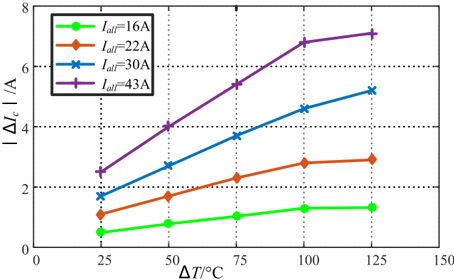
“Different from the switching process, the difference of IGBT conduction current is related to the total parallel current, so the total parallel current level affects the inflection point frequency.”
§ Evaluation of Frequency and Temperature Dependence of Power Losses Difference in Parallel IGBTs > C. EXPERIMENTAL RESULTS OF CONDUCTION CURRENT DIFFERENCE
plainstates an association- Asserted: passes — The authors put it forward as true.
- Checkable: passes — It can be checked against evidence.
- Load-bearing: passes — The paper’s conclusions depend on it.
- Based: passes — The paper gives a reason why it holds.
A result the paper reports from its own data — it cites no other source for it, so there is none to check. The quote shows it is in the paper.
In the paper
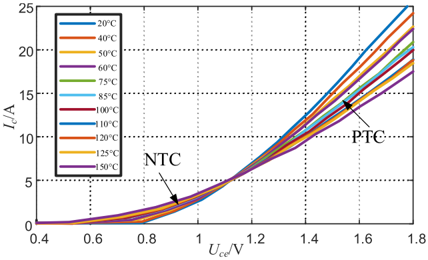
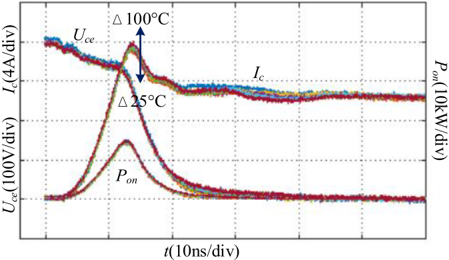
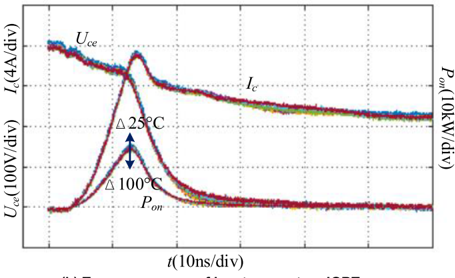
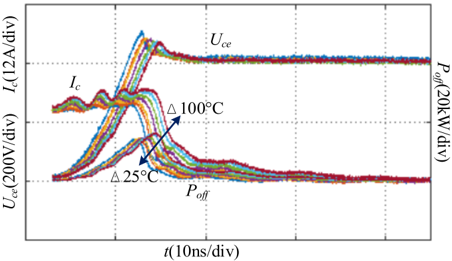
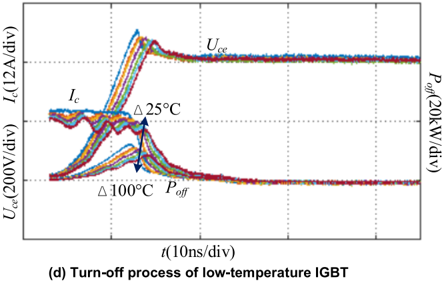
“Although parallel IGBTs voltage clamp, the collector current gap increases with the increase of temperature difference, which is consistent with the device datasheet.”
§ Evaluation of Frequency and Temperature Dependence of Power Losses Difference in Parallel IGBTs > C. EXPERIMENTAL RESULTS OF CONDUCTION CURRENT DIFFERENCE
plainstates a cause- Asserted: passes — The authors put it forward as true.
- Checkable: passes — It can be checked against evidence.
- Load-bearing: passes — The paper’s conclusions depend on it.
- Based: passes — The paper gives a reason why it holds.
A result the paper reports from its own data — it cites no other source for it, so there is none to check. The quote shows it is in the paper.
In the paper
“1) There is inflection point frequency in parallel IGBTs working in the positive temperature characteristic region, and the loss difference working in different junction temperature is zero at this frequency.”
§ Evaluation of Frequency and Temperature Dependence of Power Losses Difference in Parallel IGBTs > VI. CONCLUSION
plain- Asserted: passes — The authors put it forward as true.
- Checkable: passes — It can be checked against evidence.
- Load-bearing: passes — The paper’s conclusions depend on it.
- Based: passes — The paper gives a reason why it holds.
30 more claims
Create a free account to see all 59 claims and every source verdict.
- It may state two separate claims as one. 19
- Probably not a substantial claim. 6
Self-check
Percentages, sums and reported differences re-computed from the paper’s own numbers.
Each contradiction between two passages listed here was confirmed by an independent check.
Rated minor: it would not touch a result — a value no result rests on, a p-value that stays on the same side of the significance level, or a conflict that is clerical, resolved elsewhere in the paper, or outside its own findings.
In the paper
§ Evaluation of Frequency and Temperature Dependence of Power Losses Difference in Parallel IGBTs > B. TEMPERATURE DIFFERENCE-FREQUENCY CHARACTERISTICS OF PARALLEL IGBTs
“Under the current in positive temperature characteristic region, the relationship between T and f 0 is shown in Figure 8.”
§ Evaluation of Frequency and Temperature Dependence of Power Losses Difference in Parallel IGBTs > VI. CONCLUSION
“Figure: 8 FIGURE 8 . FIGURE 8. Double test circuit and test bench.”
Citations
Cites
Lutz, J., Schlangenotto, H., Scheuermann, U., & Doncker, R. D. (2011) · Springer eBooks · doi:10.1007/978-3-642-11125-9 · Cited by 709
Detailed and Averaged Models for a 401-Level MMC–HVDC System
Peralta, J., Saad, H., Dennetière, S., Mahseredjian, J., & Nguefeu, S. (2012) · IEEE Transactions on Power Delivery · doi:10.1109/tpwrd.2012.2188911 · Cited by 624
Influences of Device and Circuit Mismatches on Paralleling Silicon Carbide MOSFETs
Li, H., Munk-Nielsen, S., Wang, X., Maheshwari, R., Beczkowski, S., Uhrenfeldt, C., & Franke, W.-T. (2016) · IEEE Transactions on Power Electronics · doi:10.1109/tpel.2015.2408054 · Cited by 306
Luo, H., Chen, Y., Sun, P., Li, W., & He, X. (2015) · IEEE Transactions on Power Electronics · doi:10.1109/tpel.2015.2481465 · Cited by 240
Investigation Into IGBT dV/dt During Turn-Off and Its Temperature Dependence
Bryant, A. T., Yang, S., Mawby, P., Xiang, D., Ran, L., Tavner, P. J., & Palmer, P. (2011) · IEEE Transactions on Power Electronics · doi:10.1109/tpel.2011.2125803 · Cited by 236
Self-citationRajapakse, A. D., Gole, A. M., & Wilson, P. (2005) · IEEE Transactions on Power Delivery · doi:10.1109/tpwrd.2004.839726 · Cited by 187
Singh, A. K., Anurag, A., & Anand, S. (2016) · IEEE Transactions on Power Electronics · doi:10.1109/tpel.2016.2621757 · Cited by 149
Xu, Z., Xu, F., & Wang, F. (2014) · IEEE Transactions on Industrial Electronics · doi:10.1109/tie.2014.2374575 · Cited by 142
Power loss and junction temperature analysis of power semiconductor devices
Xu, D. D., Lu, H., Huang, L., Azuma, S., Kimata, M., & Uchida, R. (2002) · IEEE Transactions on Industry Applications · doi:10.1109/tia.2002.802995 · Cited by 133
Use of opposition method in the test of high-power electronic converters
Forest, F., Huselstein, J.-J., Faucher, S., Elghazouani, M., Ladoux, P., Meynard, T. A., Richardeau, F., & Turpin, C. (2006) · IEEE Transactions on Industrial Electronics · doi:10.1109/tie.2006.870711 · Cited by 131
Research works printed but not linked: 3
- sun, 2015, Junction temperature extraction of high power IGBT module based on turn-off delay time, Proc CSEE, 35, 3366
- li, 2016, Review and prospect of junction temperature extraction principle of high power semiconductor devices, Proc CSEE, 36, 3546
- zhao, 2019, Control technologies for power electronic hybrid systems in high-voltage high-power applications: A review, High Voltage Eng, 45, 2017
Cited by
Adaptive Gate Delay-Time Control of Si/SiC Hybrid Switch for Efficiency Improvement in Inverters
Peng, Z., Wang, J., Liu, Z., Li, Z., Wang, D., Dai, Y., Zeng, G., & Shen, Z. J. (2020) · IEEE Transactions on Power Electronics · doi:10.1109/tpel.2020.3015803 · Cited by 39
Efficiency Increase through Model Predictive Thermal Control of Electric Vehicle Powertrains
Wahl, A., Wellmann, C., Krautwig, B., Manns, P., Chen, B., Schernus, C., & Andert, J. (2022) · Energies · doi:10.3390/en15041476 · Cited by 31
Huang, X., Mu, F., Liu, Y., Wu, Y., & Sun, H. (2021) · IEEE Access · doi:10.1109/access.2021.3089495 · Cited by 23
Wellmann, C., Khaleel, A. R., Brinkmann, T., Wahl, A., Monissen, C., Eisenbarth, M., & Andert, J. (2025) · eTransportation · doi:10.1016/j.etran.2024.100392 · Cited by 14
Yang, J., Che, Y., Ran, L., Hu, B., & Du, M. (2024) · IEEE Transactions on Power Electronics · doi:10.1109/tpel.2024.3412918 · Cited by 10
Self-citationMeasurement method of the IGBT chip temperature fluctuation based on electrothermal model derivation
Li, L., He, Y., & Du, B. (2022) · Microelectronics Journal · doi:10.1016/j.mejo.2022.105613 · Cited by 10
Junction temperature estimation approach based on TSEPs in multichip IGBT modules
Yang, J., Che, Y., Ran, L., Hu, B., & Du, M. (2022) · Journal of Power Electronics · doi:10.1007/s43236-022-00465-3 · Cited by 8
Self-citationJohnsson, A., Schmidt, G., Hauf, M., & Pichler, P. (2021) · physica status solidi (a) · doi:10.1002/pssa.202100462 · Cited by 8
Cao, Q., Che, Y., Yang, J., Mi, M., & Men, Y. (2021) · Journal of Power Electronics · doi:10.1007/s43236-021-00232-w · Cited by 6
Self-citationIGBT Overcurrent Capabilities in Resonant Circuits
Al‐Hadithi, B. M., & Jiménez, M. A. (2024) · Sensors · doi:10.3390/s24237631 · Cited by 5
Parametric compensation based dynamic current balancing strategy for parallel IGBTs
Peng, L., Huang, H., & Wang, H. (2025) · Journal of Power Electronics · doi:10.1007/s43236-024-00981-4 · Cited by 4
Ogura, K., Chandhaket, S., Kolhe, M. L., Sakphrom, S., & Mekhilef, S. (2022) · Applied Sciences · doi:10.3390/app12031122 · Cited by 3
Im, S.-H., Park, G., Kim, J.-H., & Gu, B.-G. (2022) · Journal of Electrical Engineering and Technology · doi:10.1007/s42835-022-01113-3 · Cited by 3
Zou, S., Yang, Y., Yang, W., Huang, T., Du, X., Wang, Y., & Li, Y. (2026) · Microelectronics Reliability · doi:10.1016/j.microrel.2026.116041 · Cited by 2
Li, C., Liu, B., Zhu, Q., Yu, Q., Cao, J., Du, Y., Jain, P., & Song, G. (2024) · IEEE International Conference on Power Science and Technology (ICPST) · doi:10.1109/icpst61417.2024.10601737 · Cited by 2
Temperature Control Concept for Parallel IGBT Operation
Brandis, A., Pelin, D., Matić, T., & Topić, D. (2021) · Electronics · doi:10.3390/electronics10040429 · Cited by 2
Reliability Considerations for Large Spacecraft Propulsion System
Homaeinezhad, M., Beik, O., & Karni, A. (2024) · IEEE Aerospace Conference (AERO) · doi:10.1109/aero58975.2024.10521020 · Cited by 2
The collector current model of the IGBT based on the gate charge
Li, G., Zeng, P., Zhang, X., Li, Q., Chen, Y., Jianghui, Z., Zhang, F., Yang, B., Cui, X., Ye, J., et al. (2024) · Microelectronics Reliability · doi:10.1016/j.microrel.2024.115432 · Cited by 1
Liu, Y., Zhu, Q., Liu, B., Du, Y., Cao, J., Jain, P., Song, G., Li, C., Dou, Z., & Yu, Q. (2024) · International Power Electronics and Motion Control Conference (EPE-PEMC) · doi:10.1109/ipemc-ecceasia60879.2024.10567778 · Cited by 1
Integrated methodology to calculate nonsinusoidal AC systems of high frequency
Gusenkov, A. V., Dyachkov, A. A., Lebedev, V., Sokolov, A. M., & Shadrikov, T. (2021) · Vestnik IGEU · doi:10.17588/2072-2672.2021.2.040-054
Temperature duty cycle characteristics of parallel IGBTs
Peng, L., Huang, H., & Wang, H. (2024) · Journal of Power Electronics · doi:10.1007/s43236-023-00736-7
The Analysis of Switching Losses of IGBT with RPWM ControlPreprint
Yi, C., Ma, J., Wu, G., Chen, C., He, Z., Wu, Q., Liu, H., & Li, Y. (2024) · Research Square · doi:10.21203/rs.3.rs-4711332/v1
Shao, L., Wei, W., & Xu, G. (2025) · Research Square · doi:10.21203/rs.3.rs-7072623/v1
Metadata
- Authors
- Yang, J., Che, Y., Ran, L., & Jiang, H.
- Affiliations
- Tianjin University (CN)
- Chongqing University (CN)
- Venue
- IEEE Access
- Published
- 2020
- Volume
- 8
- Pages
- 104074-104084
- ISSN
- 2169-3536 (ISSN-L)
- OpenAlex
- W3026744421
- Semantic Scholar
- 00527cdfd55ad0477cdb70ddd161618d1f6c68b7
- Cited by
- 23
- References
- 34
- Citations by year
- 2026: 1 · 2025: 3 · 2024: 8 · 2022: 5 · 2021: 5 · 2020: 1
- FWCI
- 0.95
- Type
- journal article
- Language
- en
- Open access
- gold
- doi.org
- Locations
- IEEE Access (publishedVersion, cc-by)
- DOAJ (DOAJ: Directory of Open Access Journals) (submittedVersion, cc-by-sa)
- Funders
- National Basic Research Program of China (2018YFB0905803)
- Topics
- Physical Sciences › Engineering › Electrical and Electronic Engineering › Silicon Carbide Semiconductor Technologies
- Physical Sciences › Engineering › Electrical and Electronic Engineering › Multilevel Inverters and Converters
- Physical Sciences › Engineering › Electrical and Electronic Engineering › Induction Heating and Inverter Technology
- Keywords
- current imbalance, power loss distribution, switching losses, conduction losses, thermal stability limit, temperature dependence, power device reliability, high-power converters
About these checks
Registry, retraction, Cites and statistics results are computed, not judged, with one exception: a printed reference that no index lists is read once by a model before it counts as a citation error. Claims are extracted by a model and kept only when their quote appears verbatim in the text; each cited source is then checked, with a model’s help, for whether it says what the claim relies on. Those verdicts can be wrong — read the claim’s quote and the cited source before relying on one.
A language model drew the claims from the paper on 2026-11-12, under version 3 of the claim definition (model deepseek-v4.1-flash, prompt extract-v3).
A second model labelled each claim on 2026-11-12 (model jev-1.13-20260917, definition revision gold-guideline-v0.2).
Statistics and arithmetic are recomputed, not judged.
Confidence bands are shown only for fields calibrated on our annotated test set. None is calibrated yet, so no band is shown.
What counts as a claim ›How we measure confidence ›How we check this ›
Are you an author, or do you see a problem with this page? Request a review
Data sources
Bibliographic data: Semantic Scholar, OpenAlex, Crossref.
Contains information from the Semantic Scholar Academic Graph Datasets, made available under the ODC Attribution License (ODC-BY 1.0).
Semantic Scholar’s data is described in: Kinney, R., et al. (2023). The Semantic Scholar Open Data Platform. arXiv:2301.10140.
