

TermBall: Tracking and Predicting Evolution Types of Research Topics by Using Knowledge Structures in Scholarly Big Data
Open accessThe DOI matches its Crossref record; 75 of the 76 references it cites were found in a registry or an index; none of the 17 sources its claims cite is checked for support yet.
Abstract
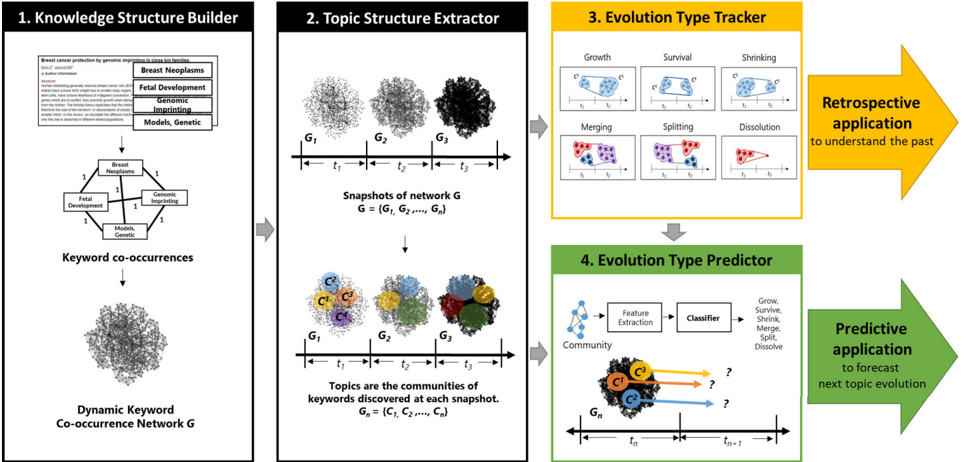
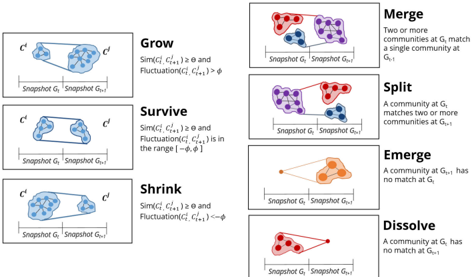
The exponential growth in the number of publications and the prevalence of interdisciplinary research in recent years call for new approaches for analyzing how topics in science are evolving at large. This paper proposes TermBall, a framework that tracks and predicts fine-grained topic evolution in terms of the evolution types: emergence, growth, shrinkage, survival, merging, splitting, and dissolution. TermBall builds the knowledge structure, which is a weighted dynamic network of co-occurring keywords in the literature, and then discovers key topic structures that consist of keywords and their relationships by performing community detection methods. Based on the topic structures, TermBall provides two applications: (1) Retrospective application to identify topic evolution in the past and (2) Predictive application to forecast upcoming topic evolution type based on the structural and temporal features of the topic structures. For the evaluation, we built the knowledge structure by applying TermBall to 19 million articles in PubMed that were published from 1980 to 2014. We conducted qualitative analysis on the derived topic evolution types and quantitative analysis on the prediction results. As a result, our qualitative analysis reveals that TermBall is able to find various topic evolution types from the knowledge structure and also can predict how topics will evolve after five years with an accuracy of 83%.
Overview
CoChat Summary
TL;DR
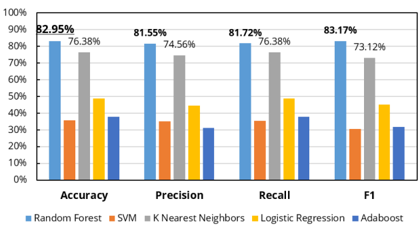
TermBall builds a dynamic keyword co-occurrence network from PubMed MeSH terms and uses community detection to track and predict fine-grained research topic evolution types (emergence, growth, shrinkage, survival, merging, splitting, dissolution). Applied to 18.54 million PubMed papers from 1980–2014, its random forest model predicted which of six evolution events a topic would undergo within five years with 82.95% accuracy.
Key findings
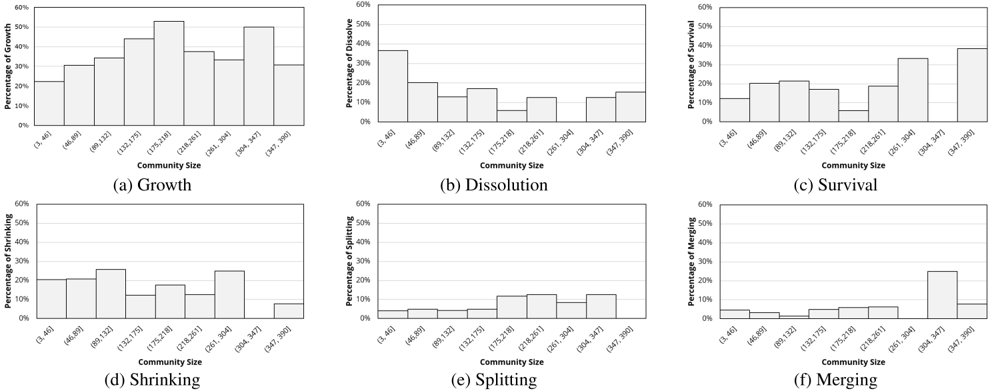
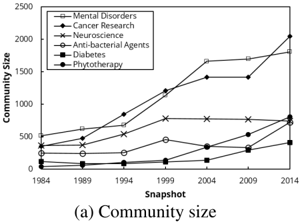
- TermBall identified 41 major topics (≥100 MeSH terms at some point); 80% of these exhibited continual growth. It found growth (Cancer Research, Mental Disorders, Phytotherapy), shrinkage (Occupational Diseases from 118 nodes in 1980–1984 to 73 MeSH terms in 2010–2014), splitting (Brain-related Diseases into Brain Neoplasms and Hydrocephalus in 2010–2014), and merging (Coronary Heart Disease with Arterial Diseases since 2004).
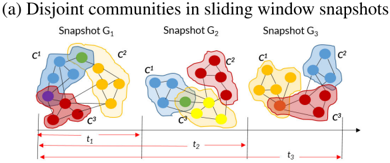
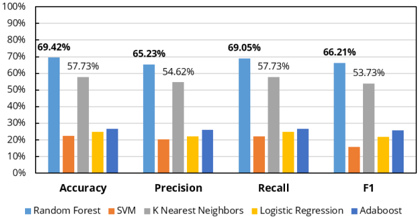
- Prediction: random forest consistently outperformed SVM, KNN, logistic regression, and AdaBoost; overall accuracy was 82.95% for predicting which of six possible events (growth, survival, shrinking, merging, splitting, dissolution) a topic will experience within five years. Disjoint communities in sliding windows (323 Infomap communities) gave the best performance versus overlapping aggregate-window communities (1,271 OSLOM communities).
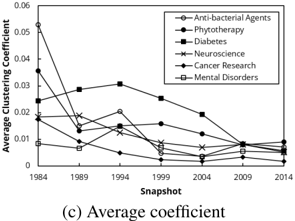
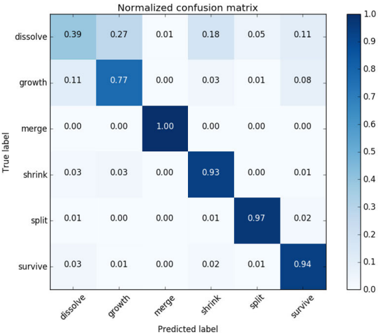
- Most prediction mistakes were concentrated on growth and dissolution events; merge and split events were predicted with considerably high accuracy. Among 42 handcrafted features, distribution of node clustering coefficients, cohesion, and density change ranked highest; most informative features were structural.
- Applied to the most recent snapshot, the model predicted continued growth for Mental Disorders, Anti-Bacterial Agents, and Diabetes by 2019; splitting for Artificial Nanoparticles, Neuroscience, and Environmental Monitoring; and dissolution for Cancer Research and Phytotherapy, though dissolution may mean division into smaller specialized communities.
Methods
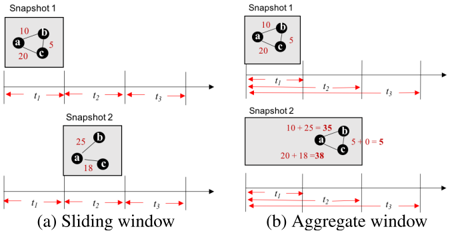
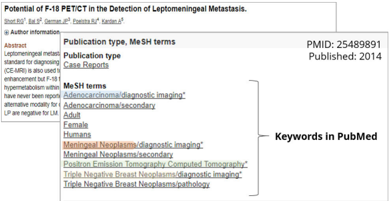
- Data: 18.54 million PubMed papers published 1980–2014 (described as 19 million in the abstract/introduction), using MeSH primary subject terms. Built an undirected weighted dynamic keyword co-occurrence network with five-year snapshots; edges only between MeSH terms co-occurring more than five times within the snapshot interval; used sliding and aggregate window schemes.
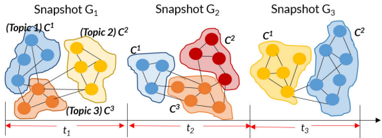
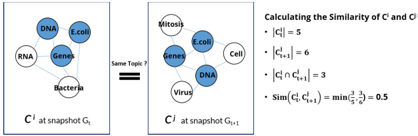
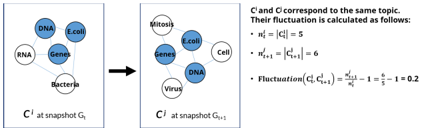
- Topic extraction: Infomap for disjoint community detection on sliding-window snapshots; OSLOM for overlapping community detection on aggregate-window snapshots. Matched communities across consecutive snapshots using similarity threshold θ = 0.25; fluctuation threshold φ = 0.10 classified persistent topics as growth, survival, or shrinkage; merging, splitting, dissolution, and emergence were defined by matching patterns.
- Prediction: six-label supervised classification (excluding emergence) using 42 structural and temporal features; SMOTE for class imbalance; trained SVM, KNN, logistic regression, AdaBoost, and random forest; cross-validated evaluation; random forest was best.
Limitations
- Stated: the framework relies on a controlled vocabulary such as MeSH; without such an ontology, natural language processing to extract entities is needed. It cannot capture a new emerging topic if all related terms are not included in MeSH, though the authors argue effects are not serious because MeSH terms are manually selected and often used as ground truth, and smaller windows can mitigate this.
- Stated: the model can predict topic merging but cannot determine which two communities will specifically converge; predicted dissolution may mean division into smaller specialized communities rather than complete disappearance.
- Evident from the text: evaluation is limited to one biomedical corpus (PubMed/MeSH), with no validation in other scholarly domains despite the claim of applicability. Also, class imbalance and limited examples for some event types are noted, and hyperparameters θ = 0.25 and φ = 0.10 were chosen partly to obtain samples for each evolution type rather than through independent tuning.
Model-written summary. Check it against the paper before relying on it.
Integrity signals
Registry
Cites
Statistics
Figures


Verification
Claims the paper makes
0 Valid · 2 Not valid · 9 Not checked · 94 Own results and interpretations
A result the paper states — it cites no source for it, so there is none to check. The quote shows it is in the paper.
In the paper
“We were also able to assess which of the handcrafted structural and temporal features were informative in the prediction task.”
§ TermBall: Tracking and Predicting Evolution Types of Research Topics by Using Knowledge Structures in Scholarly Big Data > V. DISCUSSION
plainstates an association- Asserted: passes — The authors put it forward as true.
- Checkable: passes — It can be checked against evidence.
- Load-bearing: unclear — It is unclear whether the paper’s conclusions depend on it.
- Based: passes — The paper gives a reason why it holds.
A result the paper reports from its own data — it cites no other source for it, so there is none to check. The quote shows it is in the paper.
In the paper
“The other instances of splitting that we detected include the forking of the Chromosomes topic into the more specific foci of Biological and Molecular Evolution and Chromosome Aberrations, Translocation, and Deletions in 1995-1999.”
§ TermBall: Tracking and Predicting Evolution Types of Research Topics by Using Knowledge Structures in Scholarly Big Data > 2) MERGING AND SPLITTING
plainstates a cause- Asserted: passes — The authors put it forward as true.
- Checkable: passes — It can be checked against evidence.
- Load-bearing: unclear — It is unclear whether the paper’s conclusions depend on it.
- Based: passes — The paper gives a reason why it holds.
A result the paper reports from its own data — it cites no other source for it, so there is none to check. The quote shows it is in the paper.
In the paper
“We were able to identify 41 major topics that persisted throughout the duration of our analysis .”
§ TermBall: Tracking and Predicting Evolution Types of Research Topics by Using Knowledge Structures in Scholarly Big Data > 1) GROWTH, SURVIVAL, AND SHRINKING
plain- Asserted: passes — The authors put it forward as true.
- Checkable: passes — It can be checked against evidence.
- Load-bearing: unclear — It is unclear whether the paper’s conclusions depend on it.
- Based: passes — The paper gives a reason why it holds.
A result the paper states — it cites no source for it, so there is none to check. The quote shows it is in the paper.
In the paper
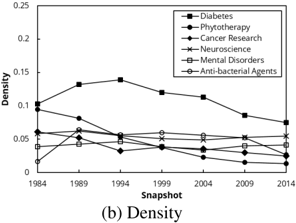
“On the other hand, the Neuroscience and Mental Disorders communities appear to maintain a relatively stable density.”
§ TermBall: Tracking and Predicting Evolution Types of Research Topics by Using Knowledge Structures in Scholarly Big Data > 1) GROWTH, SURVIVAL, AND SHRINKING
hedged- Asserted: passes — The authors put it forward as true.
- Checkable: passes — It can be checked against evidence.
- Load-bearing: unclear — It is unclear whether the paper’s conclusions depend on it.
- Based: passes — The paper gives a reason why it holds.
A result the paper reports from its own data — it cites no other source for it, so there is none to check. The quote shows it is in the paper.
In the paper
“Our experiments on biomedical literature demonstrated that the emergence of topics, as evidenced by the formation of new keyword communities, can be explained by notable events such as global outbreaks of diseases and the application of new computational techniques to biomedical challenges.”
§ TermBall: Tracking and Predicting Evolution Types of Research Topics by Using Knowledge Structures in Scholarly Big Data > V. DISCUSSION
boostedstates a cause- Asserted: passes — The authors put it forward as true.
- Checkable: passes — It can be checked against evidence.
- Load-bearing: passes — The paper’s conclusions depend on it.
- Based: passes — The paper gives a reason why it holds.
52 more claims
Create a free account to see all 105 claims and every source verdict.
- Probably not a substantial claim. 34
- It may state two separate claims as one. 19
Citations
Cites
SMOTE synthetic minority over-sampling technique
Chawla, N. V., Bowyer, K. W., Hall, L. O., & Kegelmeyer, W. P. (2002) · Journal of Artificial Intelligence Research · doi:10.1613/jair.953 · Cited by 32,865
(2003) · Journal of Machine Learning Research · doi:10.5555/944919.944937 · Cited by 32,337
Fast unfolding of communities in large networks
Blondel, V. D., Guillaume, J.-L., Lambiotte, R., & Lefebvre, E. (2008) · Journal of Statistical Mechanics: Theory and Experiment · doi:10.1088/1742-5468/2008/10/p10008 · Cited by 21,424
Community structure in social and biological networks
Girvan, M., & Newman, M. E. J. (2002) · Proceedings of the National Academy of Sciences · doi:10.1073/pnas.122653799 · Cited by 15,502
Finding and evaluating community structure in networks
Newman, M. E. J., & Girvan, M. (2004) · Physical Review E · doi:10.1103/physreve.69.026113 · Cited by 13,931
Blei, D. M., Ng, A. Y., & Jordan, M. I. (2002) · Advances in Neural Information Processing Systems 14 · doi:10.7551/mitpress/1120.003.0082 · Cited by 12,223
A tutorial on spectral clustering
von Luxburg, U. (2007) · Statistics and Computing · doi:10.1007/s11222-007-9033-z · Cited by 10,349
Finding community structure in very large networks
Clauset, A., Newman, M. E. J., & Moore, C. (2004) · Physical Review E · doi:10.1103/physreve.70.066111 · Cited by 7,390
Griffiths, T. L., & Steyvers, M. (2004) · Proceedings of the National Academy of Sciences · doi:10.1073/pnas.0307752101 · Cited by 6,049
Blei, D. M. (2012) · Communications of the ACM · doi:10.1145/2133806.2133826 · Cited by 5,516
Research works printed but not linked: 4
- World Health Organization. (2003). sARS: Chronology of a Serial Killer. Accessed: Nov. 19, 2017. [Online]. Available: http://www. who.int/csr/don/2003_07_04/en/
- World Health Organization. (2009). What is the Pandemic (h1n1) 2009 Virus? Accessed: Nov. 19, 2017. [Online]. Available: http://www.who. int/csr/disease/swineflu/frequently_asked_questions/about_disease/en/ CHRISTINE BALILI received the B.S. degree (magna cum laude) in computer science from the University of the Philippines Diliman, in 2015 and the M.S. degree in knowledge service engineer- ing from KAIST, South Korea, in 2018. She had worked as a Management Associate with Globe Telecom. She also co-founded Roadmob and served as a volunteer for some developer communities in Manila. As an undergraduate at the UP Diliman Computer Science, she served as the Chairperson of UP ACM, from 2014 to 2015 and a Google Student Ambassador, from 2013 to 2014. Her research interests include product development, service design, and machine learning.
- UICHIN LEE (Member, IEEE) received the B.S. degree in computer engineering from Chonbuk National University, in 2001, the M.S. degree in computer science from the Korea Advanced Insti- tute of Science and Technology (KAIST), in 2003, and the Ph.D. degree in computer science from UCLA, in 2008. He continued his studies at UCLA as a Postdoctoral Research Scientist from 2008 to 2009 and then worked for Alcatel-Lucent Bell Laboratories as a member of technical staff till 2010. He is an Associate Professor with the Department of Knowledge Service Engineering, KAIST. His research interests include social computing systems and mobile/pervasive computing.
- AVIV SEGEV (Member, IEEE) received the Ph.D. degree in technology and information systems from Tel-Aviv University, in 2004. He is an Asso- ciate Professor with the Department of Com- puter Science, School of Computing, University of South Alabama. His research interests include the DNA of knowledge, an underlying structure common to all knowledge, through analysis of knowledge models in natural sciences, knowledge processing in natural and artificial neural net- works, and knowledge mapping between different knowledge domains.
Cited by
Identifying interdisciplinary topics and their evolution based on BERTopic
Wang, Z., Chen, J., Chen, J., & Chen, H. (2023) · Scientometrics · doi:10.1007/s11192-023-04776-5 · Cited by 216
Quantifying the rise and fall of scientific fields
Singh, C. K., Barme, E., Ward, R., Tupikina, L., & Santolini, M. (2022) · PLoS ONE · doi:10.1371/journal.pone.0270131 · Cited by 44
Xu, M., Du, J., Xue, Z., Guan, Z., Kou, F., & Shi, L. (2022) · International Journal of Intelligent Systems · doi:10.1002/int.22846 · Cited by 42
Huang, L., Chen, X., Zhang, Y., Wang, C., Cao, X., & Liu, J. (2022) · Scientometrics · doi:10.1007/s11192-022-04273-1 · Cited by 26
An improved practical approach to forecasting exceptional growth in research
Boyack, K. W., & Klavans, R. (2022) · Quantitative Science Studies · doi:10.1162/qss_a_00202 · Cited by 14
Creating an ignorance-base: Exploring known unknowns in the scientific literature
Boguslav, M. R., Salem, N. M., White, E. K., Sullivan, K. J., Bada, M. A., Hernandez, T. L., Leach, S. M., & Hunter, L. (2023) · Journal of Biomedical Informatics · doi:10.1016/j.jbi.2023.104405 · Cited by 12
Nentidis, A., Krithara, A., Tsoumakas, G., & Παλιούρας, Γ. (2021) · International Journal on Digital Libraries · doi:10.1007/s00799-021-00304-z · Cited by 10
ATEM: A Topic Evolution Model for the Detection of Emerging Topics in Scientific Archives
Rahimi, H., Naacke, H., Constantin, C., & Amann, B. (2024) · Studies in Computational Intelligence · doi:10.1007/978-3-031-53472-0_28 · Cited by 9
Wang, Q., Zou, B., Jin, J., & Wang, Y. (2024) · Scientometrics · doi:10.1007/s11192-024-05059-3 · Cited by 9
Identification and Prediction of Emerging Topics through Their Relationships to Existing Topics
Jung, S., Datta, R., & Segev, A. (2020) · IEEE International Conference on Big Data (BigData) · doi:10.1109/bigdata50022.2020.9378277 · Cited by 9
Self-citationDAC: Descendant-aware clustering algorithm for network-based topic emergence prediction
Jung, S., & Segev, A. (2022) · Journal of Informetrics · doi:10.1016/j.joi.2022.101320 · Cited by 6
Self-citationWhy IEEE Xplore Matters for Research Trend Analysis in the Energy Sector
Chigarev, B. (2021) · Energy Systems Research · doi:10.38028/esr.2021.03.0005 · Cited by 4
Yin, D. (2024) · IEEE Access · doi:10.1109/access.2024.3434546 · Cited by 2
Topic Discovery in Scientific Literature
Huang, Y., Liu, Q., Liu, J., & Hu, Y. (2023) · Communications in computer and information science · doi:10.1007/978-981-99-2356-4_38 · Cited by 2
Angelia, L., Muthie, I., Oktavani, L., Handayani, S. G., & Syafnita, T. (2026) · Journal of Advanced Sciences and Mathematics Education · doi:10.58524/jasme.v6i2.1353 · Cited by 1
Ghufron, Gernowo, R., & Surarso, B. (2025) · International Conference on Artificial Intelligence Technology (ICoAIT) · doi:10.1109/icoait67446.2025.11309080
Modeling topic evolution for scientific archives with deep learning
Rahimi, H. (2024) · theses.fr (ABES) · doi:10.70675/c0cbc96fz0a96z4661z865bzd0caaf3dedd5
Leveraging Topic Features in Prediction of Social Network Community Evolutions
Abid, R. N., & Naderi, H. (2025) · IEEE Access · doi:10.1109/access.2025.3578551
Metadata
- Authors
- Balili, C., Lee, U., Segev, A., Kim, J., & Ko, M.
- Affiliations
- Korea Advanced Institute of Science and Technology (KR)
- University of South Alabama (US)
- Hanyang University (KR)
- Venue
- IEEE Access
- Published
- 2020
- Volume
- 8
- Pages
- 108514-108529
- ISSN
- 2169-3536 (ISSN-L)
- OpenAlex
- W3035084145
- Cited by
- 18
- References
- 76
- Citations by year
- 2026: 1 · 2025: 2 · 2024: 4 · 2023: 3 · 2022: 5 · 2021: 2 · 2020: 1
- FWCI
- 4.04
- Type
- journal article
- Language
- en
- Open access
- gold
- doi.org
- Locations
- IEEE Access (publishedVersion, cc-by)
- DOAJ (DOAJ: Directory of Open Access Journals) (submittedVersion)
- Funders
- Ministry of Education of the Republic of Korea and the National Research Foundation of Korea (NRF-2019S1A5A2A03052192)
- Technology Advancement Research Program funded by Ministry of Land, Infrastructure and Transport of Korean Government (19CTAP-C152247-01)
- KAIST-KU Joint Research Center, KAIST, South Korea
- Topics
- Social Sciences › Library and Information Sciences › scientometrics and bibliometrics research
- Physical Sciences › Physics and Astronomy › Statistical and Nonlinear Physics › Complex Network Analysis Techniques
- Health Sciences › Medicine › Public Health, Environmental and Occupational Health › Diverse Approaches in Healthcare and Education Studies
- Keywords
- topic evolution, topic emergence, topic prediction, co-occurrence networks, keyword co-occurrence, community detection, knowledge structure, dynamic networks, interdisciplinary research, PubMed literature
About these checks
Registry, retraction, Cites and statistics results are computed, not judged, with one exception: a printed reference that no index lists is read once by a model before it counts as a citation error. Claims are extracted by a model and kept only when their quote appears verbatim in the text; each cited source is then checked, with a model’s help, for whether it says what the claim relies on. Those verdicts can be wrong — read the claim’s quote and the cited source before relying on one.
A language model drew the claims from the paper on 2026-11-23, under version 3 of the claim definition (model deepseek-v4.1-flash, prompt extract-v3).
A second model labelled each claim on 2026-11-23 (model jev-1.13-20260917, definition revision gold-guideline-v0.2).
Statistics and arithmetic are recomputed, not judged.
Confidence bands are shown only for fields calibrated on our annotated test set. None is calibrated yet, so no band is shown.
What counts as a claim ›How we measure confidence ›How we check this ›
Are you an author, or do you see a problem with this page? Request a review
Data sources
Bibliographic data: Semantic Scholar, OpenAlex, Crossref.
Contains information from the Semantic Scholar Academic Graph Datasets, made available under the ODC Attribution License (ODC-BY 1.0).
Semantic Scholar’s data is described in: Kinney, R., et al. (2023). The Semantic Scholar Open Data Platform. arXiv:2301.10140.
