

Modern Artificial Intelligence Model Development for Undergraduate Student Performance Prediction: An Investigation on Engineering Mathematics Courses
Open accessThe DOI matches its Crossref record; 66 of the 67 references it cites were found in a registry or an index.
Abstract
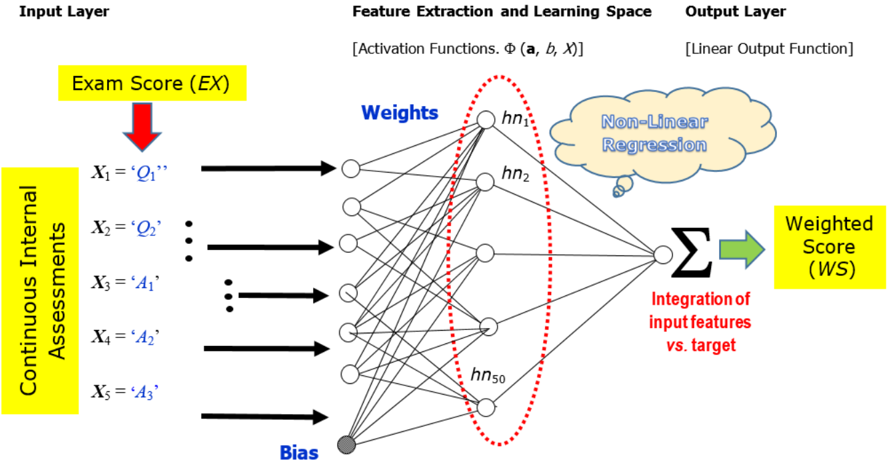
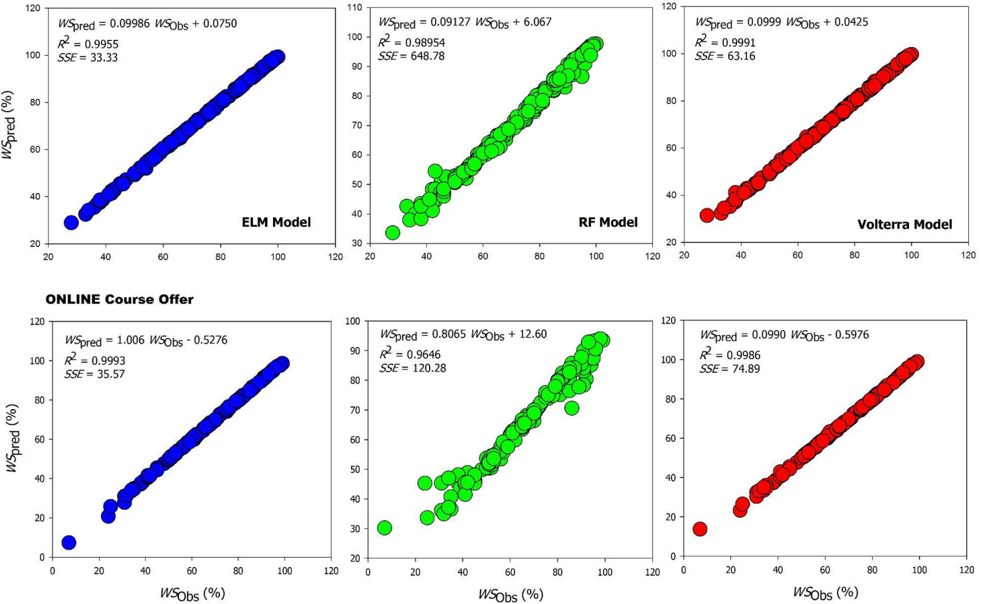
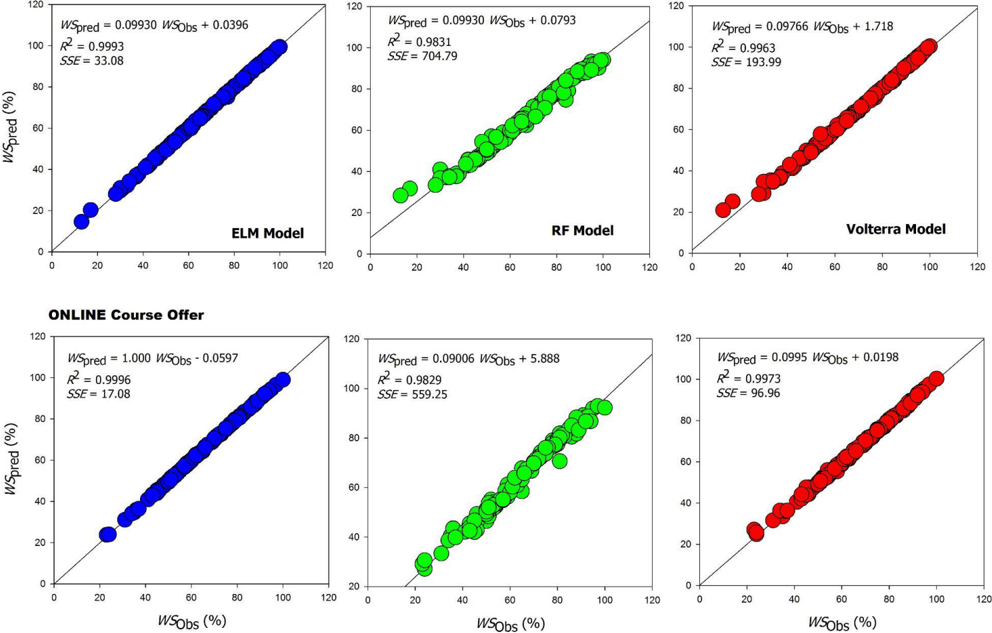
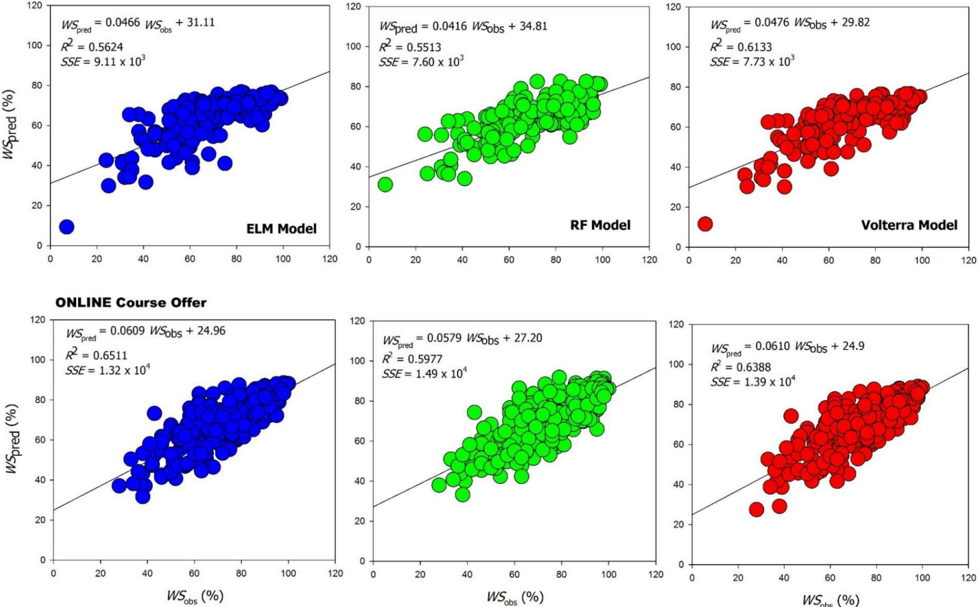
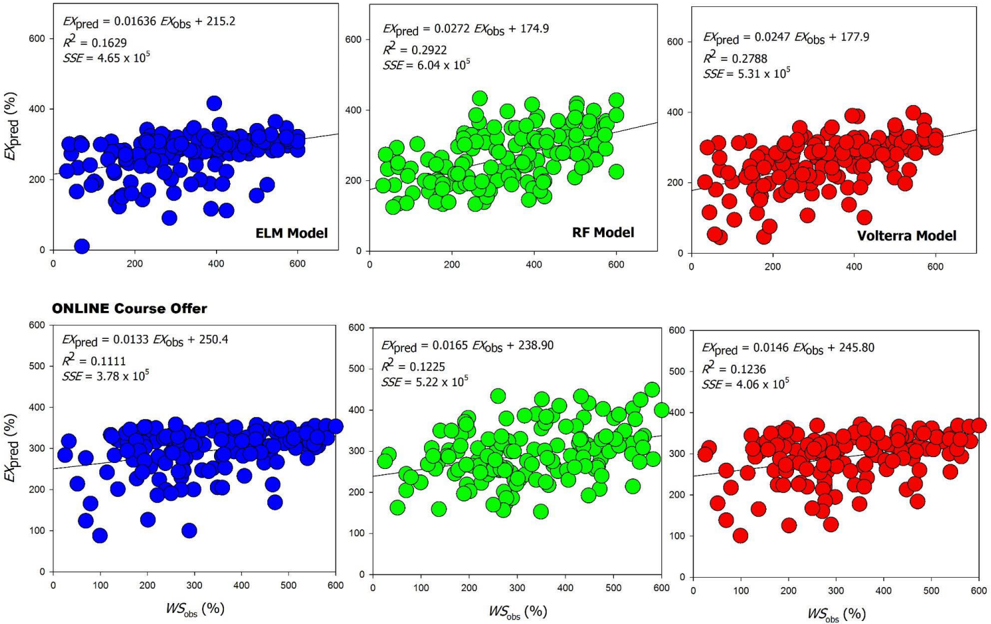
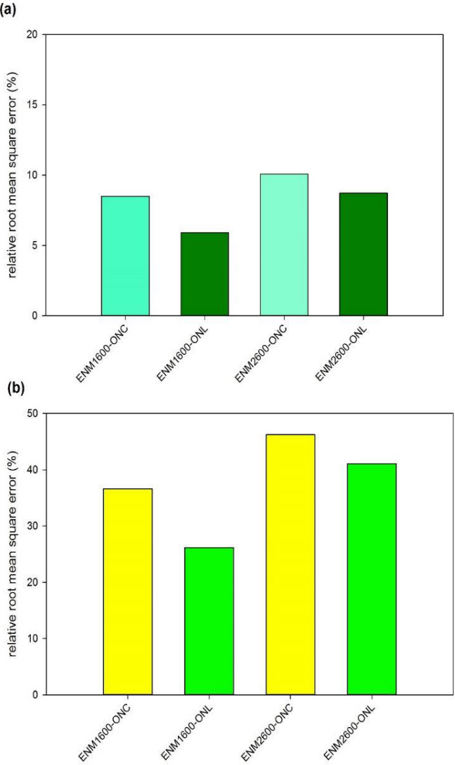
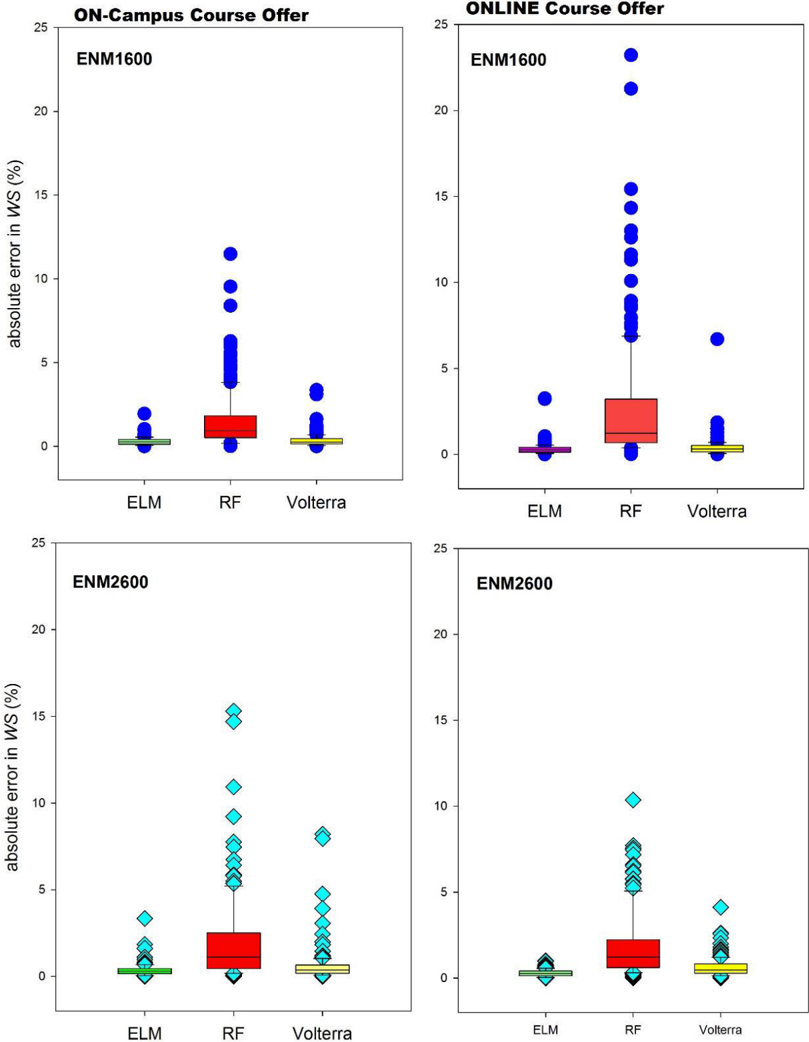
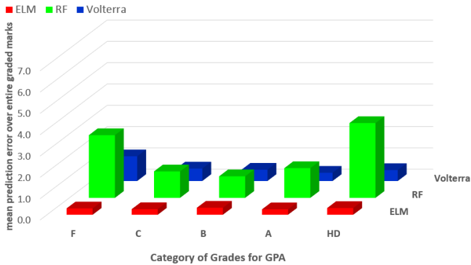
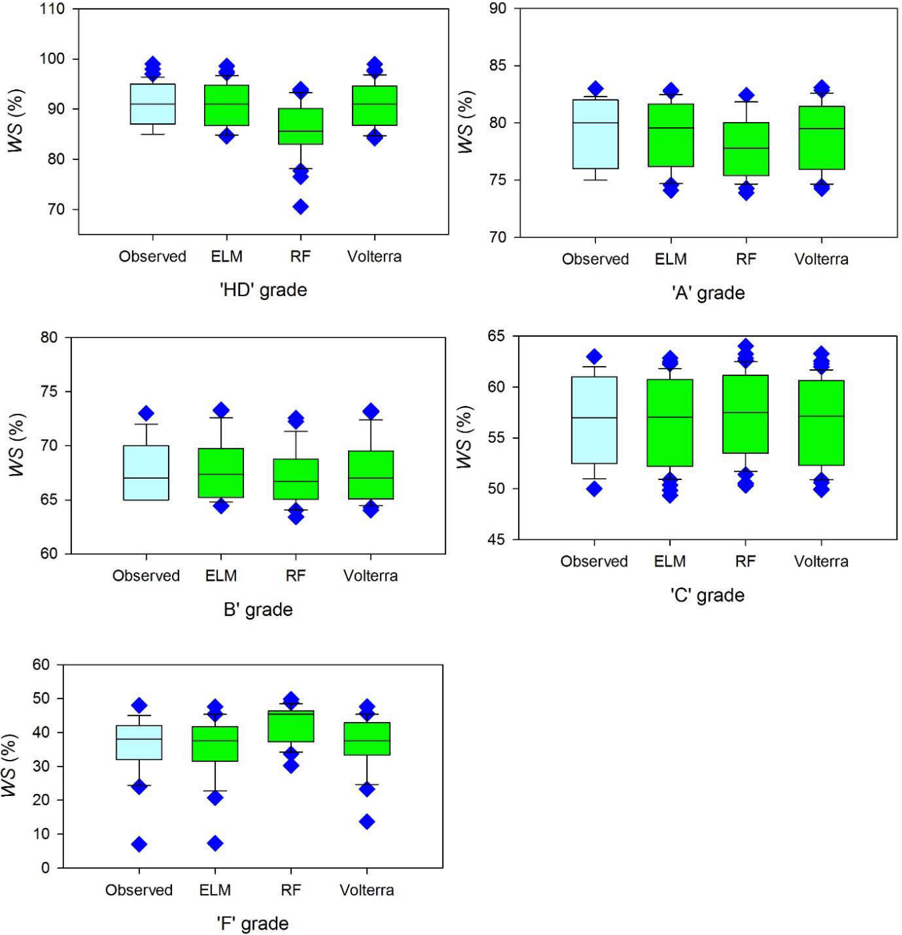
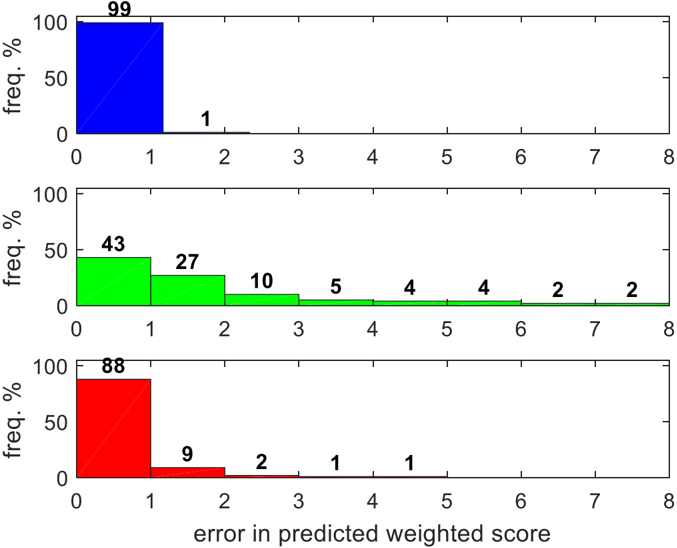
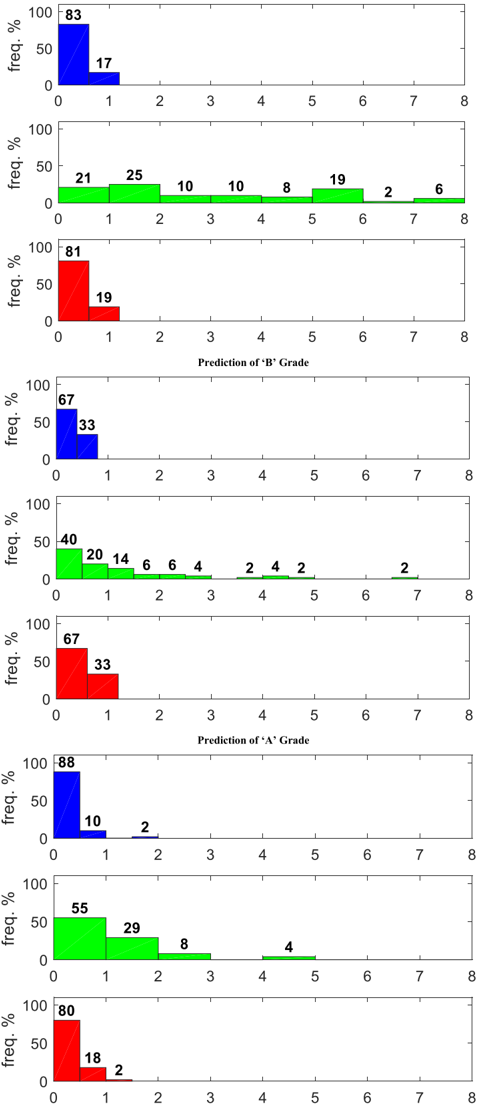
A computationally efficient artificial intelligence (AI) model called Extreme Learning Machines (ELM) is adopted to analyze patterns embedded in continuous assessment to model the weighted score (WS) and the examination (EX) score in engineering mathematics courses at an Australian regional university. The student performance data taken over a six-year period in multiple courses ranging from the mid- to the advanced level and a diverse course offering mode (i.e., on-campus, ONC, and online, ONL) are modelled by ELM and further benchmarked against competing models: random forest (RF) and Volterra. With the assessments and examination marks as key predictors of WS (leading to a grade in the mid-level course), ELM (with respect to RF and Volterra) outperformed its counterpart models both for the ONC and the ONL offer. This generated relative prediction error in the testing phase, of only 0.74%, compared to about 3.12% and 1.06%, respectively, while for the ONL offer, the prediction errors were only 0.51% compared to about 3.05% and 0.70%. In modelling the student performance in advanced engineering mathematics course, ELM registered slightly larger errors: 0.77% (vs. 22.23% and 1.87%) for ONC and 0.54% (vs. 4.08% and 1.31%) for the ONL offer. This study advocates a pioneer implementation of a robust AI methodology to uncover relationships among student learning variables, developing teaching and learning intervention and course health checks to address issues related to graduate outcomes, and student learning attributes in the higher education sector.
Overview
The claims and statistics of this paper haven’t been checked yet.
Free: it reads the open-access text and checks the first 5 claims that cite a source we can check. Create a free account to check every claim.
Integrity signals
Registry
Cites
Statistics
Figures








Verification
Claims the paper makes
The claims and statistics of this paper haven’t been checked yet.
Free: it reads the open-access text and checks the first 5 claims that cite a source we can check. Create a free account to check every claim.
Self-check
Percentages, sums and reported differences re-computed from the paper’s own numbers.
The self-check needs the paper’s full text.
Citations
Cites
Breiman, L. (2001) · Machine Learning · doi:10.1023/a:1010933404324 · Cited by 133,538
Extreme learning machine: Theory and applications
Huang, G.-B., Zhu, Q.-Y., & Siew, C.-K. (2006) · Neurocomputing · doi:10.1016/j.neucom.2005.12.126 · Cited by 13,285
Chai, T., & Draxler, R. R. (2014) · Geoscientific Model Development · doi:10.5194/gmd-7-1247-2014 · Cited by 8,761 · cited 1×
“the relative prediction error (%), given mathematically as follows [54], [55], (15)–(22), as shown at the bottom of the page, whereWSObs andWSPred were the observed and the predicted ith value of WS; WSObs and WSPred were the observed and forecasted mean WS in testing phase; and N was the number of datum points in the…”
BackgroundThe role of artificial intelligence in achieving the Sustainable Development Goals
Vinuesa, R., Azizpour, H., Leite, I., Balaam, M., Dignum, V., Domisch, S., Felländer, A., Langhans, S. D., Tegmark, M., & Fuso Nerini, F. (2020) · Nature Communications · doi:10.1038/s41467-019-14108-y · Cited by 3,294
Universal Approximation using Incremental Constructive Feedforward Networks with Random Hidden Nodes
Huang, G.-B., Chen, L., & Siew, C.-K. (2006) · IEEE Transactions on Neural Networks · doi:10.1109/tnn.2006.875977 · Cited by 2,614
A Fast and Accurate Online Sequential Learning Algorithm for Feedforward Networks
Liang, N.-Y., Huang, G.-B., Saratchandran, P., & Sundararajan, N. (2006) · IEEE Transactions on Neural Networks · doi:10.1109/tnn.2006.880583 · Cited by 1,965
Penetrating the Fog: Analytics in Learning and Education.
Siemens, G., & Long, P. (2011) · Adelaide Research & Scholarship (AR&S) (University of Adelaide) · Cited by 1,752
Trends in extreme learning machines: A review
Huang, G., Huang, G.-B., Song, S., & You, K. (2015) · Neural Networks · doi:10.1016/j.neunet.2014.10.001 · Cited by 1,732
Machine Learning Benchmarks and Random Forest Regression
Segal, M. R. (2004) · eScholarship (California Digital Library) · Cited by 1,250
On big data, artificial intelligence and smart cities
Allam, Z., & Dhunny, Z. A. (2019) · Cities · doi:10.1016/j.cities.2019.01.032 · Cited by 1,178
Research works printed but not linked: 5
- calvo-flores, 2006, Predicting students’ marks from Moodle logs using neural network models, Current Develop Technol Edu, 1, 586
- bhatt, 2011, Fuzzy logic based student performance evaluation model for practical components of engineering institutions subjects, International Journal of Technology and Engineering Education, 8, 1
- 2019, Study Book (ENM2600 Engineering Mathematics
- 2019, Study Book (ENM1600 Engineering Mathematics)
- 2017, The Higher Education Reform Package
Cited by
Artificial Intelligence for Student Assessment: A Systematic Review
González-Calatayud, V., Prendes-Espinosa, P., & Roig-Vila, R. (2021) · Applied Sciences · doi:10.3390/app11125467 · Cited by 503
“[48] determine that AI could be incorporated as a subcategory of intelligent algorithms implemented in stand-alone models, or within a hybrid integrated computer systems model.”
BackgroundThe application of AI technologies in STEM education: a systematic review from 2011 to 2021
Xu, W., & Ouyang, F. (2022) · International Journal of STEM Education · doi:10.1186/s40594-022-00377-5 · Cited by 495
“First, in the sub-category of learning performance prediction, AI algorithms and modeling techniques were employed in STEM education to help instructors adjust the instructional processes by predicting students’ learning performance (Deo et al., 2020; Hellings & Haelermans, 2020).”
BackgroundMethodArtificial intelligence in educational leadership: a comprehensive taxonomy and future directions
Sposato, M. (2025) · International Journal of Educational Technology in Higher Education · doi:10.1186/s41239-025-00517-1 · Cited by 260
Owoc, M. L., Sawicka, A., & Weichbroth, P. (2021) · IFIP Advances in Information and Communication Technology · doi:10.1007/978-3-030-85001-2_4 · Cited by 222
Artificial Intelligence and Machine Learning Approaches in Digital Education: A Systematic Revision
Munir, H., Vogel, B., & Jacobsson, A. (2022) · Information · doi:10.3390/info13040203 · Cited by 165
Nja, C., Idiege, K. J., Uwe, U. E., Meremikwu, A. N., Ekon, E. E., Erim, C. M., Ukah, J. U., Eyo, E. O., Anari, M. I., & Cornelius-Ukpepi, B. U. (2023) · Smart Learning Environments · doi:10.1186/s40561-023-00261-x · Cited by 140
Marengo, A., Pagano, A., Pange, J., & Soomro, K. A. (2024) · Interactive Technology and Smart Education · doi:10.1108/itse-11-2023-0218 · Cited by 125
Cai, L., Msafiri, M. M., & Kangwa, D. (2025) · Education and Information Technologies · doi:10.1007/s10639-024-13112-0 · Cited by 104
Şekeroğlu, B., Abiyev, R. H., İlhan, A., Arslan, M., & Idoko, J. B. (2021) · Applied Sciences · doi:10.3390/app112210907 · Cited by 110
Hybrid Convolutional Neural Network-Multilayer Perceptron Model for Solar Radiation Prediction
Ghimire, S., Nguyen‐Huy, T., Prasad, R., Deo, R. C., Casillas-Pérez, D., Salcedo‐Sanz, S., & Bhandari, B. (2022) · Cognitive Computation · doi:10.1007/s12559-022-10070-y · Cited by 87
Self-citationSystematic Review: AI's Impact on Higher Education - Learning, Teaching, and Career Opportunities
Slimi, Z., & Villarejo-Carballido, B. (2023) · TEM Journal · doi:10.18421/tem123-44 · Cited by 79
Fernández‐García, A. J., Rodríguez-Echeverría, R., Preciado, J. C., Conejero, J. M., & Sánchez-Figueroa, F. (2020) · IEEE Access · doi:10.1109/access.2020.3031572 · Cited by 77
The Use of Artificial Intelligence in Higher Education – Systematic Review
Al-Dhaen, F. (2022) · Springer eBooks · doi:10.1007/978-3-031-13351-0_13 · Cited by 71
Systematic Review: Trends in Intelligent Tutoring Systems in Mathematics Teaching and Learning
Rojas, F. N., Lancheros-Cuesta, D. J., Valderrama, M. T. P. J., Carrillo, G. I. M., & Gómez, S. (2023) · International Journal of Education in Mathematics Science and Technology · doi:10.46328/ijemst.3189 · Cited by 67
Elbaz, A. M., Salem, I. E., Darwish, A., Alkathiri, N. A., Mathew, V., & Al-Kaaf, H. A. (2024) · Computers and Education Artificial Intelligence · doi:10.1016/j.caeai.2024.100324 · Cited by 47
Rahman, N. F. A., Wang, S. L., Ng, T. F., & Ghoneim, A. S. (2024) · Journal of Advanced Research in Applied Sciences and Engineering Technology · doi:10.37934/araset.54.1.198221 · Cited by 39
Sutrisno, S., Azis, A., Setyawan, M. B., Dewi, D. A., Hidayah, Y., Hakiki, M. A., Hamid, M. A., & Fadli, R. (2025) · Cogent Education · doi:10.1080/2331186x.2025.2582948 · Cited by 39
Quo Vadis, University? A Roadmap for AI and Ethics in Higher Education
Sirvent, F. C., Roger‐Monzó, V., & Rodrigues, R. G. (2024) · The Electronic Journal of e-Learning · doi:10.34190/ejel.22.6.3267 · Cited by 42
Application of AI in engineering education: A bibliometric study
Liu, Y., Jing, Y., Li, J., Dai, J., Hu, Z., & Wang, C. (2025) · Review of Education · doi:10.1002/rev3.70044 · Cited by 37
Qiu, Y., Pan, J., & Ishak, N. A. (2022) · Computational Intelligence and Neuroscience · doi:10.1155/2022/1362996 · Cited by 35
RetractedAL‐Musaylh, M. S., Al‐Daffaie, K., Downs, N. J., Ghimire, S., Ali, M., Yaseen, Z. M., Igoe, D. P., Deo, R. C., Parisi, A. V., & Jebar, M. A. A. (2025) · Modeling Earth Systems and Environment · doi:10.1007/s40808-024-02282-y · Cited by 35
Self-citationGhimire, S., Abdulla, S., Joseph, L. P., Prasad, S., Murphy, A. F., Devi, A., Barua, P. D., Deo, R. C., Acharya, U. R., & Yaseen, Z. M. (2024) · Computers and Education Artificial Intelligence · doi:10.1016/j.caeai.2024.100331 · Cited by 39
Self-citationBudiman, R. D. A. (2025) · International Journal of Information and Education Technology · doi:10.18178/ijiet.2025.15.7.2342 · Cited by 28
Nguyen‐Huy, T., Deo, R. C., Khan, S., Devi, A., Adeyinka, A. A., Apan, A., & Yaseen, Z. M. (2022) · IEEE Access · doi:10.1109/access.2022.3168322 · Cited by 21
Self-citationArtificial intelligence in education: A text mining-based review of the past 56 years
Ekin, C. Ç., Cantekin, Ö. F., Polat, E., & Hopcan, S. (2025) · Education and Information Technologies · doi:10.1007/s10639-024-13225-6 · Cited by 24
A comprehensive review of applications of AI technologies in higher engineering education
Liu, C. (2025) · Discover Education · doi:10.1007/s44217-025-00954-0 · Cited by 19
Artificial intelligence innovations challenges and emerging trends in engineering education
Rahman, A., Khandakar, A., Ayari, M. A., Naji, K. K., Al-Ali, A. K., Sellami, A., & Alhazbi, S. (2026) · Discover Education · doi:10.1007/s44217-026-01137-1 · Cited by 19
Megawati, S. (2025) · The Journal of Educators Online · doi:10.9743/jeo.2025.22.4.11 · Cited by 16
Teaching the Future: The Vision of AI/ChatGPT in Education
Bahrami, M. R., Bahrami, B., Behboodi, F., & Pourrafie, S. (2023) · Smart innovation, systems and technologies · doi:10.1007/978-981-99-3068-5_37 · Cited by 18
Ahmed, A. A. M., Deo, R. C., Ghimire, S., Downs, N. J., Devi, A., Barua, P. D., & Yaseen, Z. M. (2022) · Sustainability · doi:10.3390/su141711070 · Cited by 13
Self-citationA systematically derived AI-based framework for student-centered learning in higher education
Albasry, H., Carmona-Cejudo, E., Rauf, A., & Chen, D. (2025) · Social Sciences & Humanities Open · doi:10.1016/j.ssaho.2025.102085 · Cited by 15
A Comparison of Classification Models in Predicting Graduate Admission Decision
Iman, A., & Tian, X. (2021) · Journal of Higher Education Theory and Practice · doi:10.33423/jhetp.v21i7.4498 · Cited by 12
Rimal, Y., & Sharma, N. (2025) · Frontiers in Education · doi:10.3389/feduc.2025.1571133 · Cited by 11
Reinventing The Future Online Education Using Emerging Technologies
Reine, R., Juwono, F. H., & Wong, W. K. (2021) · Green Intelligent Systems and Applications · doi:10.53623/gisa.v1i1.42 · Cited by 11
A 2-tier fuzzy control system for grade adjustment based on students’ social interactions
Krouska, A., Troussas, C., Voulodimos, A. S., & Sgouropoulou, C. (2022) · Expert Systems with Applications · doi:10.1016/j.eswa.2022.117503 · Cited by 11
Karabacak, S., & BİLGİN, E. A. (2025) · International e-Journal of Educational Studies · doi:10.31458/iejes.1562535 · Cited by 10
Meylani, R. (2025) · International journal of Technology in Education Science · doi:10.46328/ijoftes.258 · Cited by 17
A Fuzzy-Logic-Based Student Learning Assessment System for Outcome-Based Education
Aziz, A., Golap, M. A.-U., & Hashem, M. M. A. (2025) · IEEE Transactions on Education · doi:10.1109/te.2025.3574202 · Cited by 8
Durai, M., Dravidapriyaa, R. B., Prakash, S. P., Wanjale, K. H., Kamarunisha, M., & Karthiga, M. (2025) · International Journal of Computational and Experimental Science and Engineering · doi:10.22399/ijcesen.999 · Cited by 7
Toapanta, S. M. T., Díaz, E. Z. G., Zambrano, M., V, & Chávez, E. E. O. (2022) · Frontiers in artificial intelligence and applications · doi:10.3233/faia220563 · Cited by 7
Mitigating Imbalanced Classification Problems in Academic Performance with Resampling Methods
Rahim, A. A. A., & Buniyamin, N. (2023) · Journal of Electrical & Electronic Systems Research · doi:10.24191/jeesr.v23i1.006 · Cited by 6
Shoukath, T. K., & Chakkaravarthy, M. (2025) · Data & Metadata · doi:10.56294/dm2025730 · Cited by 5
AI‐Based Prediction of Program Learning Outcomes for an Engineering Undergraduate Degree
Zaman, F. H., Imtiaz, J., Iqbal, M., & Mir, A. W. (2025) · Computer Applications in Engineering Education · doi:10.1002/cae.70092 · Cited by 5
Integration of Artificial Intelligence in E-learning: Distance Education Students' Responses
Marisa, M., Putri, D. A. P., Mujiono, M., & Jameel, A. H. (2024) · Jurnal Edutech Undiksha · doi:10.23887/jeu.v12i1.62023 · Cited by 5
Sahu, P. K., Kumar, A., Williams-Persad, A. F.-A., Mohapatra, D., & Ming, W. S. C. (2026) · Panminerva Medica · doi:10.23736/s0031-0808.25.05384-4 · Cited by 5
Retracted: Gamification and XAI Tutoring Structure using Mamdani Fuzzy Inference Systems
Narayanan, K. S., & Kumaravel, A. (2023) · International Conference on Smart Structures and Systems (ICSSS) · doi:10.1109/icsss58085.2023.10407066 · Cited by 4
RetractedBeyond the hype: evidence-based approaches to responsible AI integration in workplace learning
Sposato, M. (2025) · Education + Training · doi:10.1108/et-01-2025-0034 · Cited by 3
Akendita, P. A., Boateng, F. O., Arthur, Y. D., & Banson, G. M. (2025) · Artificial Intelligence in Education · doi:10.1108/aiie-09-2024-0004 · Cited by 5
Predição de Desempenho de Estudantes: Uma Revisão Sistemática de Literatura
da Silva, B. J., Pimentel, E. P., & Botelho, W. T. (2022) · Anais do ... Simpósio Brasileiro de Informática na Educação/Anais do Simpósio Brasileiro de Informática na Educação · doi:10.5753/sbie.2022.225093 · Cited by 3
Aplicação da Inteligência Artificial no Ensino Superior: Áreas e Características
Cavalcanti, W. M., Tavares, E. M., & Júnior, J. L. C. P. (2021) · Revista ADM.MADE/Adm.MADE · doi:10.5935/2237-51392020v25n1p040061 · Cited by 7
Zhu, J., Lei, L., Wu, P., Cheng, B., Yang, X., Fu, J. W., Wu, Z., & He, F. (2022) · Frontiers in Psychology · doi:10.3389/fpsyg.2022.1002468 · Cited by 3
Advancing STEM cognition with current AI landscape and systems
Anass, B. (2024) · Conference on Information Communications Technology and Society (ICTAS) · doi:10.1109/ictas59620.2024.10507138 · Cited by 3
The Teaching and Learning of Tertiary Mathematics
Oates, G., Coupland, M., Dunn, P. K., Evans, T., Galligan, L., & Hernandez‐Martinez, P. (2024) · Springer eBooks · doi:10.1007/978-981-97-1964-8_9 · Cited by 3
Self-citationBibliometrics Analysis of AI Integration in Mathematics Teaching
Tupulu, N., Hermiati, K., Uripno, G., Suprihatiningsih, S., & Rangkuti, R. K. (2024) · Mosharafa Jurnal Pendidikan Matematika · doi:10.31980/mosharafa.v13i2.1699 · Cited by 3
Özkurt, C. (2024) · Engineering Science Letter · doi:10.56741/esl.v3i03.556 · Cited by 3
Wang, N. (2022) · Wireless Communications and Mobile Computing · doi:10.1155/2022/1945562 · Cited by 2
RetractedEvaluation System of Modern Education Development from the Perspective of Algorithmic Recommendation
Yu, X. (2022) · International Conference on Digital Technology in Education (ICDTE) · doi:10.1145/3568739.3568757 · Cited by 2
Advancing Decision Review System (DRS) in Cricket: Harnessing Ai for Enhanced Decision Making
Satheeskumar, R. (2023) · International Journal of Education and Management Engineering · doi:10.5815/ijeme.2023.06.03 · Cited by 2
Zaki, N. A. M., Hashib, S. A., Yusof, N. M., & Ibrahim, U. K. (2024) · Advances in computer science research · doi:10.2991/978-94-6463-589-8_21 · Cited by 2
The Genie in a Bottle: potential and major risks of the use of Artificial Intelligence in Education
Chiappe, A., Álvarez, R. A. N., Álvarez, T. A. N., & Parra, S. L. N. (2025) · Journal of Posthumanism · doi:10.63332/joph.v5i7.2950 · Cited by 4
Inteligência Artificial na abordagem europeia à Educação: Perspectivas, percepções e desconfiança
Nizzolino, S. (2024) · FORMAZIONE & INSEGNAMENTO. Rivista internazionale di Scienze dell'educazione e della formazione · doi:10.7346/-fei-xxii-02-24_08 · Cited by 2
Hong, J. S. (2021) · Arabian Journal for Science and Engineering · doi:10.1007/s13369-021-05883-2 · Cited by 2
RetractedUsing Artificial Intelligence in Academia to Help Students Choose Their Engineering Program
Jawad, S. K., Uhlig, R., Dey, P. P., Amin, M., & Sinha, B. R. (2024) · ASEE Annual Conference & Exposition · doi:10.18260/1-2--44567 · Cited by 1
Assessment of effective factors on student performance based on machine learning methods
Yıldırım, H. (2024) · Journal of Intelligent Systems Theory and Applications · doi:10.38016/jista.1383998 · Cited by 1
Maddu, R. B. R., & Murugappan, S. (2025) · Journal of Ambient Intelligence and Humanized Computing · doi:10.1007/s12652-025-04997-x · Cited by 1
Alvarado, A., & Portillo, J. R. (2025) · World Engineering Education Forum - Global Engineering Deans Council (WEEF-GEDC) · doi:10.1109/weef-gedc66748.2025.11256341 · Cited by 1
On the Use of AI in Signal Processing Programming Applications at the Master of Science Level
Druga, C. G., Sîrbu, G., & Aiordăchioaie, D. (2025) · doi:10.1109/iseee67817.2025.11304834 · Cited by 1
Ahmed, W., Zaneldin, E. K., Alrabaee, S., Maraqa, M. A., Alzahmi, S., & Bande, L. (2026) · Lecture notes on data engineering and communications technologies · doi:10.1007/978-981-95-4423-3_26 · Cited by 1
Khawaja, S. (2026) · International Journal of Service Science Management Engineering and Technology · doi:10.4018/ijssmet.420182 · Cited by 1
Intelligent Learning Analytics through E-learning
Manasa, P., Khandelwal, P., Shah, Y., Jain, V., & Kataruka, K. (2024) · International Conference on Emerging Technologies in Computer Science for Interdisciplinary Applications (ICETCS) · doi:10.1109/icetcs61022.2024.10543572 · Cited by 1
Annoscia, S., Ladiana, S., & Colella, D. (2024) · FORMAZIONE & INSEGNAMENTO. Rivista internazionale di Scienze dell'educazione e della formazione · doi:10.7346/-feis-xxii-01-24_09 · Cited by 1
Subirats, L., Reina, B. N., Cuenca, M. E., & Sacha, G. M. (2025) · Research Square · doi:10.21203/rs.3.rs-7801827/v1 · Cited by 1
Zomaya, A. Y. (2016) · Elsevier eBooks · doi:10.1016/b978-0-12-804535-0.09995-0
Sports Performance Prediction Model Based on Stochastic Simulation Algorithm
Zhou, Y., & Cheryl (2022) · Lecture notes on data engineering and communications technologies · doi:10.1007/978-3-031-05484-6_54
Teaching Reform of Visual Communication Design Specialty from the Perspective of Embedded Mode
Gou, S., & Mei, L. (2022) · International Conference on Education, Network and Information Technology (ICENIT) · doi:10.1109/icenit57306.2022.00062
Bao, H. (2022) · Atlantis highlights in social sciences, education and humanities/Atlantis Highlights in Social Sciences, Education and Humanities · doi:10.2991/978-94-6463-044-2_11
Tiwari, H. P. (2023) · Journal of English Language Teaching and Linguistics · doi:10.21462/jeltl.v8i1.1030
Coupled Finite Element Method-Boundary Element Method on Microstrip Transmission Line
Montañez, J. J. F., & Ocampo, A. L. P. D. (2023) · IEEE Region 10 Symposium (TENSYMP) · doi:10.1109/tensymp55890.2023.10223657
How Effective Is Blended Learning for Short Courses In Language and Art for International Students?
Arnailis, A., Nurmalena, N., Awerman, A., Murniati, M., Firdaus, F., & Hasnah, H. (2023) · Aksara · doi:10.29255/aksara.v35i1.1244.151--161
Suresh, B., & Renugadevi, R. (2024) · AIP conference proceedings · doi:10.1063/5.0186053
AMPNet: Academic Multi-Task Prediction Network for Students' Grade and Graduation
Xie, C., Bai, T., Liu, X., Dong, J., Chang, X., & Li, Y. (2024) · International Conference on Information and Education Technology (ICIET) · doi:10.1109/iciet60671.2024.10542740
AI and Assessment Design in Engineering Disciplines
Sabet, P. G. P., Shen, Z., & Shishehgarkhaneh, M. B. (2024) · Education Research and Perspectives · doi:10.70953/erpv51.2412002 · Cited by 1
Dhanya, D., Palekar, K. P., Harish.G, Chandrasekaran, S., Hariharan, T., & Athinarayanan, S. (2024) · International Conference on Electronic Systems and Intelligent Computing (ICESIC) · doi:10.1109/icesic61777.2024.10846335
AI-Driven CSR in East Asia: Navigating Leadership and Ethical Challenges
Portillo, J. P. V. (2025) · Advances in computational intelligence and robotics book series · doi:10.4018/979-8-3693-9894-4.ch008
人工智能技术赋能教学研究热点与趋势——基于CiteSpace的可视化分析
谢雪梅, & 王明慧 (2025) · 教育学刊 · doi:10.62836/jer.v3n4.0316
Personalized Learning Analytics Using AI
Sri, S. S., Harshini, G., Kowsalya, R., Ratthna, M. S. G. J., & Kalaiselvi, S. (2025) · International Research Journal on Advanced Engineering Hub (IRJAEH) · doi:10.47392/irjaeh.2025.0275
Rodrigues, H. S., Moraes, L. O., García, A. C. B., Alvares, R. V., dos Santos, R. P., & Delgado, C. A. D. M. (2025) · Anais do Workshop sobre Educação em Computação (WEI) · doi:10.5753/wei.2025.7173 · Cited by 1
Revisión bibliométrica sobre la adopción de inteligencia artificial en la educación superior
Jiménez, M. U., López-Mallama, Ó. M., & Espinosa, A. A. (2025) · Revista Guillermo de Ockham · doi:10.21500/22563202.7780
Economic Mathematics Question Bank Development System Based on Artificial Intelligence Algorithm
Zhu, Y., & Bao, C. (2025) · International Conference on Artificial Intelligence and Computer Information Technology (AICIT) · doi:10.1109/aicit65974.2025.11282705
Nja, C. O., Idiege, K. J., Uwe, U. E., Meremikwu, A. N., Ekon, E. E., Erim, C. M., Ukah, J. U., Eyo, E. O., Anari, M. I., & Cornelius-Ukpepi, B. U. (2024) · Figshare · doi:10.6084/m9.figshare.26617609
Okafor, M. U., Shaoan, M. R., Arif, M., Namanyane, T., & Feng, M. (2025) · Kwartalnik Pedagogiczny · doi:10.31338/2657-6007.kp.2025-2.4
Student Academic Performance Evaluation and Prediction Using Optimized Artificial Neural Network
Michael, H. L., Prasad, R., Owolabi, O., & Sharma, B. K. (2026) · Studies in autonomic, data-driven and industrial computing · doi:10.1007/978-981-96-9083-1_19
The Adoption of AI at the University of Mauritius. Performance, Tutor Support and Interaction
Narrainen, G. S. (2026) · Communications in computer and information science · doi:10.1007/978-3-032-17557-1_5
Ngan, V. P. T., Huynh-Cam, T.-T., Chen, L., Dwyer, L. G., & Lu, T.-C. (2025) · International Workshop on Artificial Intelligence and Education (WAIE) · doi:10.1109/waie67422.2025.11381285
Sunarto, M. J. D., Wardhanie, A. P., Lemantara, J., & Kisworo, A. Y. (2026) · Studies in Learning and Teaching · doi:10.46627/silet.v7i1.787
DESIGN AND IMPLEMENTATION OF AN AI-BASED SYSTEM FOR PREDICTING STUDENT ACADEMIC PERFORMANCE
Nisha, & Yadav, R. (2025) · International Journal of Research -GRANTHAALAYAH · doi:10.29121/granthaalayah.v13.i12.2025.6962
Heredia, L. J. C., & Molina, L. (2026) · NOVASINERGIA REVISTA DIGITAL DE CIENCIA INGENIERÍA Y TECNOLOGÍA · doi:10.37135/ns.01.18.09
Identifying students at-risk with explainable artificial intelligence: A case study for Australia
Jui, S. J. J., Ahmed, A. A. M., Deo, R. C., Murphy, A., Prasad, S. S., Ghimire, S., Abdulla, S., Devi, A., Yaseen, Z. M., Barua, P. D., et al. (2026) · Technology in Society · doi:10.1016/j.techsoc.2026.103551
Self-citation
Metadata
- Authors
- Deo, R. C., Yaseen, Z. M., Al-Ansari, N., Nguyen-Huy, T., Langlands, T. A. M., & Galligan, L.
- Affiliations
- University of Southern Queensland (AU)
- Luleå University of Technology (SE)
- ORCID
- Venue
- IEEE Access
- Published
- 2020
- Volume
- 8
- Pages
- 136697-136724
- ISSN
- 2169-3536 (ISSN-L)
- OpenAlex
- W3044093562
- Cited by
- 89
- References
- 67
- Citations by year
- 2026: 8 · 2025: 27 · 2024: 16 · 2023: 12 · 2022: 16 · 2021: 8 · 2020: 1
- FWCI
- 8.45
- Type
- journal article
- Language
- en
- Open access
- gold
- doi.org
- Locations
- IEEE Access (publishedVersion, cc-by)
- Epubl LTU (submittedVersion, other-oa)
- DOAJ (DOAJ: Directory of Open Access Journals) (submittedVersion, cc-by-sa)
- Funders
- University of Southern Queensland, through the School of Sciences Quartile 1 Challenge Internal Grant, for this research study under Grant 2018
- Office for the Advancement of Learning and Teaching: Technology Demonstrator Project (H18REA236)
- Topics
- Physical Sciences › Computer Science › Computer Science Applications › Online Learning and Analytics
- Physical Sciences › Computer Science › Artificial Intelligence › Machine Learning and ELM
- Social Sciences › Education › Educational Technology and Pedagogy
- Keywords
- student performance prediction, extreme learning machine, continuous assessment, test scores, online learning, on-campus learning, random forest, Volterra model, higher education
About these checks
Registry, retraction, Cites and statistics results are computed, not judged, with one exception: a printed reference that no index lists is read once by a model before it counts as a citation error. Claims are extracted by a model and kept only when their quote appears verbatim in the text; each cited source is then checked, with a model’s help, for whether it says what the claim relies on. Those verdicts can be wrong — read the claim’s quote and the cited source before relying on one.
Statistics and arithmetic are recomputed, not judged.
Confidence bands are shown only for fields calibrated on our annotated test set. None is calibrated yet, so no band is shown.
What counts as a claim ›How we measure confidence ›How we check this ›
Are you an author, or do you see a problem with this page? Request a review
Data sources
Bibliographic data: Semantic Scholar, OpenAlex, Crossref.
Contains information from the Semantic Scholar Academic Graph Datasets, made available under the ODC Attribution License (ODC-BY 1.0).
Semantic Scholar’s data is described in: Kinney, R., et al. (2023). The Semantic Scholar Open Data Platform. arXiv:2301.10140.
